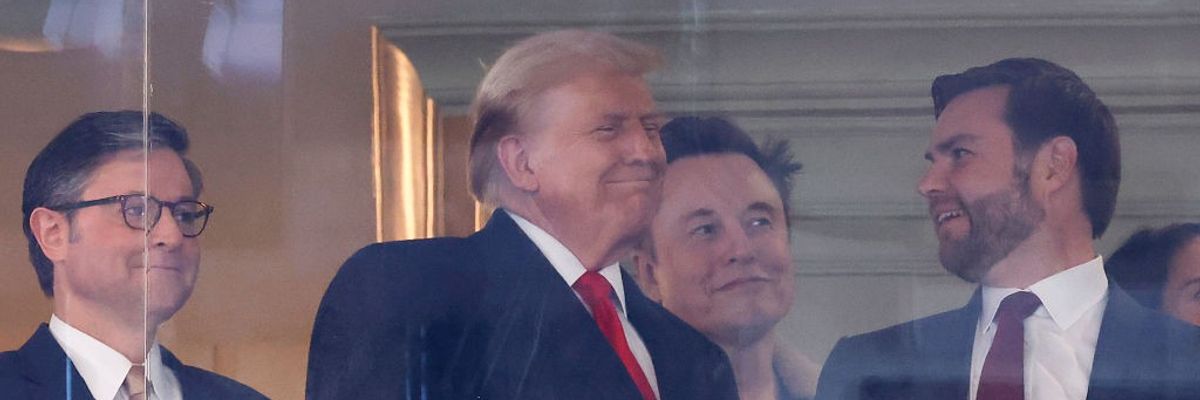
House Speaker Mike Johnson (R-La.), President-elect Donald Trump, Tesla CEO Elon Musk, and Vice President-elect JD Vance attend the Army-Navy football game at Northwest Stadium on December 14, 2024 in Landover, Maryland. (Photo: Kevin Dietsch/Getty Images)
“The record-shattering abuses of the 2025 Trump-Vance Presidential Inaugural Committee, Inc. should signal the immediate need for legislation to prevent this influence peddling,” said one ethics expert.
With Inauguration Day less than a week away, a watchdog group on Tuesday published research shining light on the unprecedented level of financial support President-elect Donald Trump’s inaugural fund has received from corporations and executives seeking to court favor with the incoming administration.
The new research from Public Citizen includes a tracker that lists known corporate donations or pledged contributions to Trump’s inaugural committee, which is tax-exempt and not subject to contribution limits.
Amazon, Apple, Chevron, Citigroup, Bank of America, Goldman Sachs, Google, Meta, OpenAI CEO Sam Altman, the pharmaceutical lobby, Pfizer, Microsoft, and Coinbase are among those that have pumped money into Trump’s inaugural fund, which has raked in a record-shattering $150 million since Election Day—and could bring in over $200 million by January 20.
“These million-dollar donors come from a small class of very wealthy industries in Big Tech, cryptocurrency, government contractors, and others with lucrative contracts or business pending before the federal government,” Public Citizen found. “Some of the biggest donors had long been critics of Trump, especially following the January 6 Insurrection by Trump supporters, and who are now fearful of retributions by a vengeful president.”
Some of the companies that have donated to the inaugural fund are also facing federal investigations, amplifying suspicions that the contributions were made with the goal of receiving favorable treatment from the next administration.
“The record-breaking cesspool of special interest financing for the Trump-Vance Inaugural Committee raises serious concerns about the ability of corporations and wealthy special interests to purchase influence over public policy or lucrative government contracts,” Craig Holman, a government ethics expert at Public Citizen, said in a statement Tuesday.“The record-shattering abuses of the 2025 Trump-Vance Presidential Inaugural Committee, Inc. should signal the immediate need for legislation to prevent this influence peddling.”
“The possibility for corruption exists any time an officeholder accepts large donations from those who have business pending before the official.”
Trump’s inaugural fund has easily surpassed the then-record-setting $107 million he raised for his inauguration in 2017, The New York Times reported earlier this month. On Monday, the Times reported that “Harold G. Hamm, the billionaire oil and gas executive who helped bankroll Donald J. Trump’s campaign and stands to profit from his energy policies, is hosting an exclusive fossil fuel industry celebration on Inauguration Day.”
“Among the invited guests to Mr. Hamm’s celebration is Doug Burgum, Mr. Trump’s pick to run the Interior Department,” according to the newspaper.
The president-elect has openly boasted that prominent figures in corporate America—from Amazon founder Jeff Bezos to Meta CEO Mark Zuckerberg—have lined up to show support for his second administration, which is set to be packed with billionaires and others with close business ties. Trump is reportedly keeping close track of major companies that have yet to donate to his inaugural fund.
Public Citizen noted Tuesday that “while the self-serving motivations of inaugural donors has a long and troubling precedent, the scope of donations and, in many cases, the fear of retribution driving the donations to the Trump-Vance Inaugural Committee represents a worrying shift.”
“Buying access to the president and the president’s inner circle is the name of the game,” the group says in its new research brief. “For corporations and wealthy special interests attempting to influence public policy or secure lucrative government contracts, writing big checks to Trump’s inaugural committee—or any presidential inaugural committee—provides a bonanza of access to leading government officials and influence over public policy. This is a level of influence peddling only available to those who can afford to pay the price and is denied to those who are not wealthy.”
To “ensure that undue influence-peddling through Inaugural donations is mitigated,” Public Citizen called on lawmakers to pass legislation banning corporate and lobbyist donations to inaugural funds, implementing contribution limits, and strengthening disclosure requirements, among other reforms.
“The possibility for corruption exists any time an officeholder accepts large donations from those who have business pending before the official,” Public Citizen said. “Congress should end the double standard for presidential inauguration fundraising. The celebration of an election victory should be viewed as part and parcel of the process of selecting our president.”
A smartphone displays a post from U.S. President-elect Donald Trump’s Truth account announcing the $TRUMP meme coin on January 19, 2025. (Photo: Jonathan Raa/NurPhoto via Getty Images)
“We now have a president-elect who, the weekend before inauguration, is launching new businesses along with promises to deregulate… those sectors in a way to just blatantly profit off his own presidency.”
U.S. President-elect Donald Trump faced a flood of criticism throughout the weekend for launching a cryptocurrency token as the world prepared for his Monday inauguration and policies expected to benefit the industry that helped Republicans take control of the White House and Congress.
“It is literally cashing in on the presidency—creating a financial instrument so people can transfer money to the president’s family in connection with his office,” Campaign Legal Center executive director Adav Noti told The New York Times. “It is beyond unprecedented.”
Jordan Libowitz, vice president for communications at Citizens for Responsibility and Ethics in Washington, also contrasted Trump’s move with behaviors of past presidents, telling Politico, “It is absolutely wild.”
“After decades of seeing presidents-elect spend the time leading up to inauguration separating themselves from their finances to show that they don’t have any conflicts of interest, we now have a president-elect who, the weekend before inauguration, is launching new businesses along with promises to deregulate… those sectors in a way to just blatantly profit off his own presidency,” said Libowitz.
The president-elected announced the $TRUMP meme coin, hosted on the Solana blockchain, via his Truth social media platform and X—owned by Elon Musk, his ally and the richest person on the planet—on Friday, declaring that “it’s time to celebrate everything we stand for: WINNING!”
He linked to a website that explains “there are 200 million $TRUMP available on day one and will grow to a total of 1 billion $TRUMP over three years.” It also states that “Trump Memes are intended to function as an expression of support for, and engagement with, the ideals and beliefs embodied by the symbol ‘$TRUMP’ and the associated artwork, and are not intended to be, or to be the subject of, an investment opportunity, investment contract, or security of any type.”
Forbes reported that “the remaining 80% of tokens that have yet to be publicly released are owned by the Trump Organization affiliate CIC Digital LLC and Fight Fight Fight LLC, a company formed in Delaware on January 7, according to state filings, and both companies will receive an undisclosed amount of revenue derived from trading activity.”
The president-elect’s son Eric Trump, who helps run Trump Organization, told the Times that “this is just the beginning.”
“I am extremely proud of what we continue to accomplish in crypto,” he said in a statement. “$TRUMP is currently the hottest digital meme on Earth.”
In an article simply headlined, “Donald Trump, crypto billionaire,” Axios noted that by Sunday morning, “Trump’s crypto holdings were worth as much as $58 billion on paper, enough—with his other assets—to make him one of the world’s 25 richest people.”
Responding to Axios‘ report, Wa’el Alzayat, who served as a Middle East policy expert at the U.S. Department of State for a decade, said that “when I was in government I couldn’t accept a lunch over $20. Now anyone can give our next president millions.”
Predicting that “this is going to end VERY badly for everyone except Donald Trump and his cronies,” journalist Jeff St. John said that “it is a scandal and an outrage.”
The meme coin announcement came as “the elite of the crypto world” gathered in Washington, D.C. for the first-ever Crypto Ball.
The president-elect did not attend the event, but House Speaker Mike Johnson (R-La.) and the nominees for commerce and treasury secretary, Howard Lutnick and Scott Bessent, were there. Reporting on the gala, Reuters pointed out that the Trump “courted crypto campaign cash with promises to be a ‘crypto president,’ and is expected next week to issue executive orders aimed at reducing crypto regulatory roadblocks and promoting widespread adoption of digital assets.”
Trump is no stranger to ethics scandals. As Mother Jones detailed:
The meme coin is just the latest in a bizarre line of grifty, super-weird takes on “merch.” Last February, Trump showed off gold “Never Surrender High-Tops” for $399 at Sneaker Con, which had Fox News applauding his appeal to Black voters. In March, he began endorsing the $59.99 “God Bless the USA Bible,” which includes the Constitution, the Bill of Rights, and handwritten lyrics to the chorus of Lee Greenwood’s “God Bless the USA.” (Trump’s inaugural committee has confirmed that he will not be using one of these Bibles to swear the presidential oath of office on Monday.) In August, Trump released a new round of his “baseball card” NFTs.
S.V. Dáte, a senior White House correspondent at HuffPost, highlighted Sunday that during the Republican’s first term, “Trump’s D.C. hotel was a convenient way for foreign and domestic lobbyists to put cash directly into his pocket.”
“This crypto thing is next level. Anyone on the planet can put money directly into his pocket. Huge,” Dáte added. “The efficiency here is a thing of beauty. With a hotel, you have all the costs of owning the property as well as paying cleaning staff, front desk staff, and so on. This selling of fake money is almost pure profit.”
The Trump Organization sold the D.C. hotel in 2022, but The Wall Street Journal reported earlier this month that his “real estate company is in talks to reclaim” the property.
CBS Evening News (1/13/25) cited Colorado’s 2021 Marshall Fire as another example of how climate disruption is making wildfires more destructive.
The devastation of the ongoing Los Angeles fires is an alarm going off, but also the result of society having hit the snooze button long ago (Democracy Now!, 1/9/25; CBS, 1/13/25). Game-changing fires destroyed Paradise, California (NPR, 11/8/23), in 2023, and Lahaina, Hawaii, in 2024—clear warnings, if any were still needed, that the climate catastrophe had arrived.
“The evidence connecting the climate crisis and extreme wildfires is clear,” the Nature Conservancy (7/9/24) said. “Increased global temperatures and reduced moisture lead to drier conditions and extended fire seasons.”
The scientific journal Fire Ecology (7/24/23) reported that “climate change is expected to continue to exacerbate impacts to forested ecosystems by increasing the frequency, size and severity of wildfires across the western United States.”
Now we are watching one of America’s largest cities burn. It’s a severe reminder that the kind of disruption we experienced in the beginning of the Covid pandemic in 2020 is the new normal under climate change.
The right-wing media, however, have found a culprit—it’s not climate change, but Democratic Party–led wokeness. The coverage demonstrates once again that the W-word can be used to blame literally anything in the Murdoch fantasyland.
‘Preoccupation With DEI’
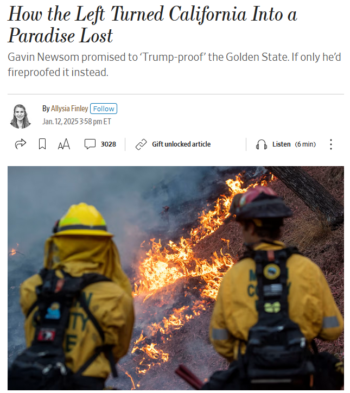
Alyssia Finley (Wall Street Journal, 1/12/25): “A cynic might wonder if environmentalists interfered with fire prevention in hope of evicting humans.” Another cynic might wonder if the Journal publishes smears without evidence as part of its business model.
“Megyn Kelly sounded off on Los Angeles Fire Department Chief Kristin Crowley and Mayor Karen Bass,” the New York Post (1/8/25) reported. Former Fox News host Kelly said “that the officials’ preoccupation with diversity, equity and inclusion [DEI] programs distracted them from the city’s fire-combating duties.”
Wall Street Journal editorial board member Allysia Finley (1/12/25) echoed the charge: “Bloated union contracts and DEI may not have directly hampered the fire response, but they illustrate the government’s wrongheaded priorities.” In other words, the paper didn’t have evidence to blame the fires on firefighter salaries or department diversity, but decided to insinuate as much anyway.
Other conservative journalists were more direct, like CNN pundit Scott Jennings, who went on CNN NewsNight (1/8/25) to assert:
As a matter of public policy in California, the main interest in the fire department lately has been in DEI programming and budget cuts, and now we have this massive fire, and people are upset.
As the Daily Beast (1/9/25) noted, “His response was part of a Republican kneejerk reaction that included President-elect Donald Trump blaming ‘liberals’ and state Gov. Gavin Newsom.”
The Washington Post (1/10/25) reported that Trump-supporting X owner Elon Musk
has been inundating his 212 million followers with posts casting blame for the blazes on Democrats and diversity policies, amplifying narratives that have taken hold among far-right activists and Republican leaders.
Liel Leibovitz, editor-at-large at the conservative Jewish magazine Tablet, blamed the LA devastation on the “woke religion” (New York Post, 1/9/25).
“There are many things we’ve learned that the Los Angeles Fire Department needs—and more women firefighters isn’t one of them,” moaned National Review editor-in-chief Rich Lowry (New York Post, 1/15/25). “Los Angeles for years has been in the grips of a bizarre obsession with recruiting more women firefighters.”
Blaming gay singers
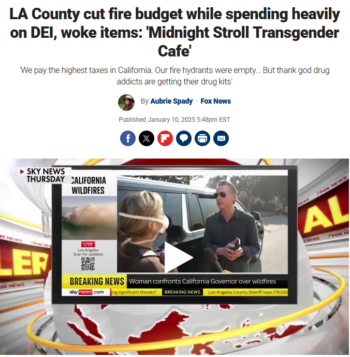
Mentioned by Fox News (1/10/25): $13,000 allocated to Lesbian, Gay, Bisexual and Transgender Heritage Month programs. Not mentioned by Fox News: a $126 million boost to the LAPD budget.
Fox & Friends (1/9/25, 1/9/25) blamed the city’s Democratic leaders and the fire chief for the destruction. Fox NewsDigital (1/10/25) said:
While Los Angeles officials were stripping millions in funding from their fire department ahead of one of the most destructive wildfires in state history, hundreds of thousands of dollars were allocated to fund programs such as a “Gay Men’s Chorus” and housing for the transgender homeless.
You may notice the shift from “millions” to “hundreds of thousands”—the latter, obviously, can’t explain what happened to the former. What can far better explain it is that the city focused much more on funding cops than firefighters (Intercept, 1/8/25). The mayor’s budget plan offered “an increase of more than $138 million for the Los Angeles Police Department; and a decrease of about $23 million for the LA Fire Department” (KTTV, 4/22/24). KABC (1/9/25) reported more recent numbers, saying the “fire department’s budget was cut by $17.6 million,” while the “city’s police department budget increased by $126 million,” according to the city’s controller.
And in 2023, the LA City Council approved salary increases for cops over objections that these pay boosts “would pull money away from mental health clinicians, homeless outreach workers and many other city needs” (LA Times, 8/23/23). The cop-pay deal was reportedly worth $1 billion (KNBC, 8/23/23).
LAFD cuts under Mayor Bass were, in fact, big news (KTTV, 1/15/25). Fox overlooked the comparison with the police, one regularly made by city beat reporters who cover public safety and city budgets, and went straight to blaming gay singers.
Crusade against ‘woke’
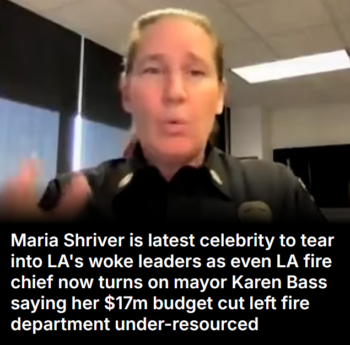
Contrary to the Daily Mail‘s headline (1/14/25), former California first lady Maria Shriver Maria Shriver did not “tear into LA’s woke leaders”; rather, she complained about LA’s insufficient funding of public needs.
Or take the Daily Mail (1/14/25), a right-wing British tabloid with a huge US footprint, whose headline said former California first lady “Maria Shriver Is Latest Celebrity to Tear Into LA’s Woke Leaders.” But the story went on to say that Shriver had decried the cuts to the LAFD, citing no evidence that she was fighting some culture war against women firefighters.
Shriver, the ex-wife of actor and former California Gov. Arnold Schwarzenegger, was pointing the finger at austerity and calling for more public spending. In other words, Shriver was siding with LAFD Chief Kristin Crowley, who had complained that city budget cuts had failed her department (CNN, 1/12/25). The Mail’s insistence on calling this a crusade against “woke” is just another example of how tediously the conservative media apply this word to almost anything.
While these accusations highlight diversification in the LA firefighting force, the right never offers real evidence that these hiring practices lead to any kind of hindering of fire response, as University of Southern California education professor Shaun Harper (Time, 1/13/25) noted. If anything, the right admits that miserly budgeting, usually considered a virtue in the conservative philosophy, is the problem.
Equal opportunity disasters
These talking points among right-wing politicians and their sycophants in the media serve several purposes. They bury the idea that climate change, driven by fossil fuels and out-of-control growth, has anything to do with the rise in extreme weather. They pin the blame on Democrats: LA is a blue city in a blue state. And they continue the racist and sexist drumbeat that all of society’s ills can be pinned on the advancement of women and minorities.
There is, of course, an opportunity to look at political mismanagement, including the cutbacks in the fire department. But natural disasters—intensified by climate change and exacerbated by poor political leadership—have ravaged unwoke, Republican-dominated states, as well, meaning Democrats don’t have a monopoly on blame.
Hurricane Ian practically destroyed Sanibel Island in Florida, a state that has been living with Trumpism for some time under Gov. Ron DeSantis. Hurricane Helene also ravaged that state, as well as western North Carolina, a state that went to Trump in the last three elections. Hurricane Harvey drowned Texas’ largest city, Houston, and the rest of Texas has suffered power outages and shortages, due to both extreme cold and summer spikes in energy demand.
Climate change, and the catastrophes it brings to the earth, does not discriminate against localities based on their populations’ political leanings. But conservative media do.
Metastasizing mythology
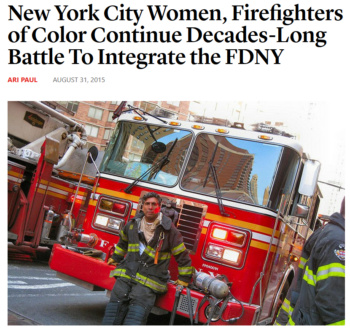
Ari Paul (In These Times, 8/31/15): “The more progress made in racial and gender diversity, the more white male firefighters will denounce the changes and say that increased diversity is only the result of lowering standards.”
Meanwhile, real firefighters know what the real problem is. The Western Fire Chiefs Association (3/5/24) said:
Global warming pertains to the increased rise in Earth’s average surface temperature, largely caused by human activity, such as burning fossil fuels and deforestation. These practices emit greenhouse gases like carbon dioxide (CO2), methane (CH4) and nitrous oxide (N2O) into the atmosphere. These gases trap heat, resulting in a gradual increase in global temperatures over time. Recent data on fire and trends suggests that global extreme fire incidents could rise by up to 14% by the year 2030, 30% by 2050, and 50% by the end of the century. The impact of global warming is seen particularly in the western United States, where record-setting wildfires have occurred in recent years. Fourteen of the 20 largest wildfires on record have been in California over the past 15 years.
Conservative media can ignore all this, because the notion that cultural liberalism has tainted firefighting isn’t new. I covered efforts to diversify the New York City Fire Department as a reporter for the city’s labor-focused weekly Chief-Leader, and I saw firsthand that the resistance to the efforts were based on the idea that minority men weren’t smart enough and women (white and otherwise) weren’t strong enough (PBS, 3/28/06; New York Times, 3/18/14; In These Times, 8/31/15).
What I found interesting in that case was that other major fire departments had achieved higher levels of integration, and no one was accusing those departments of falling behind in their duties. At the same time, while the FDNY resisted diversification, the New York Police Department, almost worshipped by right-wing media, embraced it (New York Post, 9/8/14, 6/10/16).
This racist and sexist mythology has metastasized in the Republican Party and its propaganda apparatus for years. With Trump coming back into power, these media outlets will feel more empowered to regurgitate this line of thinking, both during this disaster in LA and in the disasters ahead of us.
FAIR’s work is sustained by our generous contributors, who allow us to remain independent. Donate today to be a part of this important mission.
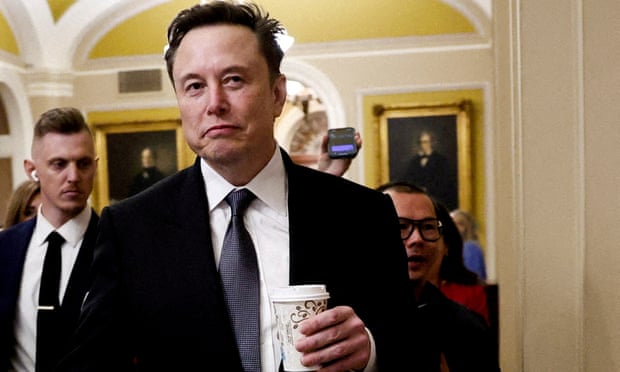
The EU has come under growing pressure to take action after a series of forays by Musk into European politics. Photograph: Benoît Tessier/Reuters
Musk’s company has been accused of manipulating systems to give far-right posts and politicians greater visibility
The European Commission has asked X to hand over internal documents about its algorithms, as it steps up its investigation into whether Elon Musk’s social media platform has breached EU rules on content moderation.
The EU’s executive branch told the company it wanted to see internal documentation about its “recommender system”, which makes content suggestions to users, and any recent changes made to it, by 15 February.
X has been under investigation since December 2023 under the EU’s content law – known as the Digital Services Act (DSA) – over how it tackles the spread of illegal content and information manipulation. The company has been accused of manipulating the platform’s systems to give far-right posts and politicians greater visibility over other political groups.
The EU has come under growing pressure in recent weeks to take action after a series of interventions by Musk into European politics. Musk, who will be a part of Donald Trump’s administration in the US, has angered many on the continent with attacks on its leaders as well as expressions of support for Germany’s far-right Alternative für Deutschland (AfD) party.
Across the 2000s, a series of child sex exploitation cases affected British towns, including Telford, Rochdale, Oxford and Rotherham, scarring the lives of hundreds of children. In 2011, Times journalist Andrew Norfolk reported that networks – so-called “grooming gangs” – of largely British Asian men of Pakistani heritage had trafficked and raped hundreds of mainly girls and young women.
These are facts that are widely known in the UK and have been the subject of multiple investigations. The 2014 Jay report found that authorities had been slow to act, sometimes for fear of being accused of racism.
Police had in some cases blamed victims, criminalising children as prostitutes. Alexis Jay, who also led the 2022 independent inquiry into child sexual abuse, has noted the “appalling and lifelong effects” of abuse on victims.
Elon Musk – the billionaire owner of social media platform X and incoming lead on US government efficiency – has, it seems, just found out about this devastating national scandal.
In a series of posts on X, Musk politicised these crimes to denounce Prime Minister Keir Starmer as “evil”, and to call for a new general election in the UK. He also reposted the anti-Islam activist Tommy Robinson, calling for his release from prison where he is serving 18 months for contempt of court.
Musk portrayed Robinson as campaigning to expose the “truth” about grooming, as though the story had not been subject to widespread investigation, media coverage and public debate.
Of course, women’s rights within our criminal justice and political systems desperately need to be improved. But, Musk is no cheerleader for women and there is no evidence that he is “genuinely incensed” by child sexual exploitation.
Musk has not shown an interest in women’s rights or sexual abuse before. If he had, he might not have accepted a job in the administration of Donald Trump, a man found liable for sexual abuse.
Musk’s newfound interest evidently isn’t in all sex offences – apparently just those perpetrated by “Muslim men” against white women. He has not shown any obvious interest in cases where Muslim women were also abused, nor does he have much if anything to say about abuse perpetrated by white men.
He appears to support women’s protections when they are politically useful to him in fanning division – a common far-right tactic.
Musk has supported far-right actors, reinstating Tommy Robinson to X in November 2023, just in time for him to organise a mass rally at the Cenotaph in London, stoking division and, as I noted at the time, threatening democracy. He has also recently written in support of Germany’s anti-Islam party the Alternative für Deutschland (AfD), and hosted its leader Alice Weidel in live discussion on X.
By publicising the UK’s “grooming gangs” scandal, Musk has aligned himself with a gendered narrative: it is men’s duty to protect women – even when it means breaking rules or using force. This gender binary – strong men must be ready to use force to protect weak women, especially from hostile alien men – is the core narrative of patriarchal, nationalist, ultra nationalist and also Nazi groups.
It is highly racialised – only vulnerable white women matter – and it relates to class, in that it regards white, liberal women as betraying working-class girls. Musk has singled out Labour safeguarding minister Jess Phillips as a “rape genocide apologist” and “wicked witch”, thereby putting her at risk.
Exploiting women victims, protecting patriarchy
The recent attack on Phillips reveals Musk’s call to protect women for what it really is: a means to protect powerful men. Feminist women are understood as fair targets, because they challenge a gender order in which men have natural dominance.
Patriarchy protects (some) men by positioning men’s role as leaders and fighters, protectors and providers, for nation and family, wives and children. This is protection without care, which is gendered as feminine, and weak. It is protection as a means of control.
Musk is not in a position of moral authority regarding either protection or care. Before his takeover, social media platform Twitter appeared to care for workers, prioritising health and wellbeing.
The ethos of X is the opposite: Musk has gutted staff numbers, and transformed workplace practices aimed at safeguarding both employees and users. He now promises to do the same across the US government as head of efficiency in the Trump administration.
Social media has always been a space in which women are at risk of both personal and structural misogyny; these harms are amplified through Musk’s approach to X. Musk has sought to amplify the voices of influencers who decry women’s rights.
Musk has reposted Andrew Tate, who police in the UK have linked to an epidemic of misogyny and violence against women, and who has faced charges of rape and sex trafficking. He has allowed white supremacist Nick Fuentes to use X to promote the phrase “your body, my choice”. There is no real protection here, no care – only white men’s control of women.
Race to the bottom
Where Musk leads, others follow. Meta chief Mark Zuckerberg has recently ceded fact-checking to the “community”, and noted the need for a more “masculine” and “aggressive” corporate culture. Zuckerberg also ended the company’s diversity equity and inclusion policy, which minorities rely upon for some degree of workplace protection.
In an age of strong-man politics, where young men are choosing role models from a marketplace of competing masculinities, hypermasculinity wins. Young men aged 18-29 voted overwhelmingly for Trump in the US elections, supported by men’s rights activists in the online “manosphere”. Musk knows this.
Musk has money and social media power, but he is a “tech bro” – a “nerd”. Exploiting the horror of British child sexual exploitation scandals has enabled him to attempt to assert himself as a protector of women – a hero of the forgotten.
He has amplified a far-right political position, and the voices of far-right actors he believes embody this, like Robinson. But Musk has no moral authority to speak on the protection of women, or on care more generally.
Those British politicians cynically lauding Musk’s apparently protective stance on women to attack the government – and the UK’s parliamentary democracy – should recognise this is nothing but hypocrisy. And, from that perspective, Musk has no authority to dictate the political agenda on girls’ and women’s rights in Britain, or anywhere else.