‘These partnerships embarrass the LGBTQ+ community at a time when much of the cultural world is rejecting ties to these toxic industries’
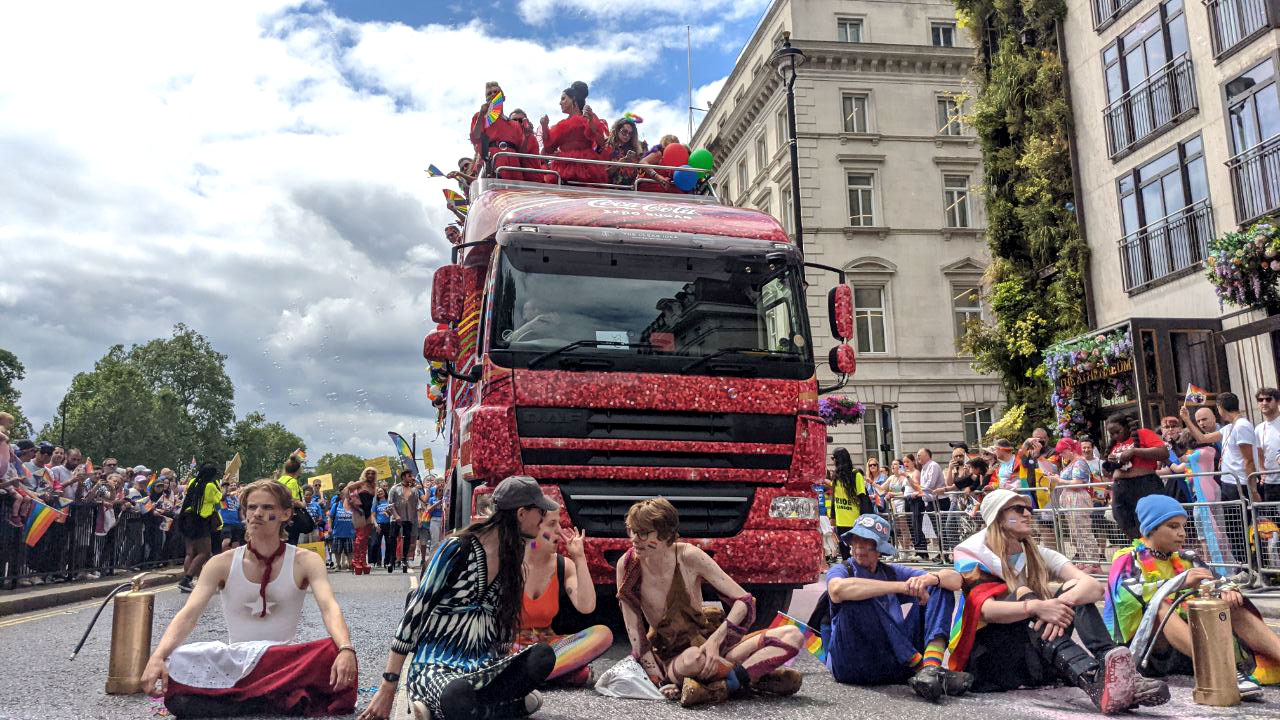
‘Pinkwashing’: Just Stop Oil activists from the LGBTQ community sprayed pink paint and blocked the Pride In London Parade by sitting in front of a Coca-Cola truck taking part in the parade, in protest against Pride working with industries linked to the climate crisis and in protest against Coca-Cola, seen as the world’s biggest plastic polluter, Saturday, July 1, 2023. Image by Just Stop Oil.
Just Stop Oil protesters temporarily blocked London’s Pride Parade Saturday afternoon to protest the event accepting sponsorship money from “high-polluting industries.”
Pride faced accusations of “pinkwashing” over its decision to make United Airlines the headline sponsor of this year’s event.
Seven protesters were arrested at 1:30 pm after blocking the road in front of a Coca-Cola truck. Coca-Cola is seen as the world’s biggest plastic polluter.
LGBTQ+ members of Just Stop Oil called on organizers to condemn new oil, gas, and coal licenses and stop allowing the inclusion of floats from these corporations in the parade.
James Skeet, a Just Stop Oil spokesperson, said in a statement:
“Pride was born from protest. It speaks to how far we’ve come as a community, that high-polluting industries and the banks that fund them, now see Pride as a useful vehicle for sanitizing their reputations, waving rainbow flags in one hand whilst accelerating social collapse with the other. It is queer people, and particularly queer people of color in the global south, who are suffering first in this accelerating social breakdown. What would those who instigated the gay liberation movement during the Stonewall riots in 1969, make of the corporatized spectacle Pride has now become?”
“These partnerships embarrass the LGBTQ+ community, at a time when much of the cultural world is rejecting ties to these toxic industries. We call on Pride to remember the spirit in which it was founded and to respect the memory of all those who fought and died to secure the rights we now possess whilst taking the necessary steps to protect our community long into the future.”
London Mayor Sadiq Khan speaking before the parade said:
“I agree with protesting in a way that is lawful, safe, and peaceful. I think that Extinction Rebellion and Just Stop Oil are really important pressure groups trying to put power on those who have power and influence.”
“I fully support the right to protest. It’s really important to recognize the joy of democracy is protest.”
“I am somebody who feels quite passionately that we have to tackle the climate emergency. And I feel quite passionately about encouraging people to join the movement to tackle the climate emergency. In my view, protest should be peaceful, lawful, and safe.”
Peter Tatchell, the legendary LGBTQ+ rights campaigner, and prominent member of the Gay Liberation Front and the civil resistance group OutRage! Said:
“I helped organize the first Pride in the UK in 1972 and have attended every Pride London march since then. Pride was always meant to be both a celebration and a protest. From the outset, we stood in solidarity with other struggles for freedom and social justice, against corporate pinkwashing and all forms of exploitation. We saw queer liberation as just one aspect of a wider liberation movement.”
“Climate destruction is destroying communities, jobs, homes and lives across the world, especially in poorer countries. Fossil fuels are endangering the survival of humanity – including LGBTQ+ people. Our community must not collude with environment, species and climate destroying companies.”
[4 twitter threads that twitter is refusing to embed, see Original article ]
The prime minister praised Policy Exchange, which received $30,000 from oil and gas giant ExxonMobil in 2017, for shaping laws that target green activists.
Image of InBedWithBigOil by Not Here To Be Liked + Hex Prints from Just Stop Oil’s You May Find Yourself… art auction.
Rishi Sunak has confirmed that a fossil fuel-funded think tank helped to draft his government’s laws targeting climate protests.
Speaking at Policy Exchange’s summer party on Wednesday (28 June), the prime minister boasted that the think tank’s work “helped us draft” the government’s crackdown on protests, according to Politico.
OpenDemocracy reported last year that Policy Exchange’s US wing, American Friends of Policy Exchange, which provides funds to the UK branch, received $30,000 (roughly £23,700) from oil and gas giant ExxonMobil in 2017.
Two years later, Policy Exchange published a report entitled “Extremism Rebellion”, in reference to the environmental protest group, calling for the police and the government to clamp down on eco protests.
An Extinction Rebellion spokesperson told DeSmog that this story “exemplifies the stranglehold that private interests have on our democracy.”
Ministers have been clear that new police powers are designed to stop climate protests. The former Home Secretary Priti Patel cited tactics used by Extinction Rebellion and Insulate Britain when arguing for what became the Police, Crime, Sentencing and Courts Act 2022.
Sunak’s statement yesterday appears to confirm Extremism Rebellion’s allegation that sections of the 2022 law were ‘directly inspired’ by Policy Exchange’s report.
The “Extremism Rebellion” report said that legislation relating to public protest needed to be “urgently reformed” in order to “strengthen the ability of the police to place restrictions on planned protest and deal more effectively with mass lawbreaking tactics”.
This was implemented in the Police, Crime, Sentencing and Courts Act, which came into effect in April 2022 and awarded the police new powers to decide what constitutes a ‘disruptive’ protest and to more harshly punish those involved.
In the year to April 2023, more than 2,000 people were arrested and 138 spent time in prison for their involvement in campaigns by Just Stop Oil, the climate protest group.
Those encarcerated included two protesters who were each sentenced to more than two and a half years in prison – the longest sentences for peaceful climate protest in British history, according to the group – for causing a ‘public nuisance’ by scaling the Dartford Crossing.
This crackdown on protests has been continued by current Home Secretary Suella Braverman, a vocal critic of the UK’s net zero targets, who singled out Just Stop Oil when advocating further powers in the Public Order Act 2023, which received Royal Assent in May.
The legislation, which has been labelled as “draconian” by its opponents, allows the police to pre-emptively intervene to shut down protests and creates new offences for what it describes as “guerrilla tactics”, all of which have been used in recent climate protests.
The law criminalises protesters for attaching themselves (or coming equipped) to lock on to other protesters or buildings, threatening a maximum penalty of six months’ imprisonment, an unlimited fine or both.
For organising protests that block key infrastructure including “airports, railways, printing presses, and oil and gas infrastructure” protesters are threatened with up to 12 months in prison, while tunnelling is set at three years.
The law follows a November report by Policy Exchange that said it was “imperative” for protesters who repeatedly obstruct the highways to be “swiftly arrested, convicted and punished”. It further urged that “magistrates and judges should be imposing severe sentences on repeat offenders who aim deliberately to harm the public by breaching the criminal law”.
Sunak, who worked at Policy Exchange before his 2015 election to parliament, also used the summer party to make a jibe about the Labour Party’s links to Just Stop Oil, one of whose funders, Dale Vince, has donated £1.4 million to the party since 2014.
Sunak’s comments echoed the claim made often by senior Conservatives, that Labour’s opposition to new North Sea oil and gas projects is linked to Dale’s donation. Grant Shapps, Secretary of State for Energy Security and Net Zero, has repeatedly attacked Labour over the connection, writing in the Daily Mail that Labour has become “the political wing of Just Stop Oil”.
In fact, the International Energy Agency has said that new oil and gas projects are not compatible with keeping warming below 1.5C – an international climate goal that has been adopted by the UK government.
Meanwhile, DeSmog revealed in March that the Conservative Party received £3.5 million from fossil fuel interests, high-polluters and climate science deniers last year alone.
Policy Exchange and Climate Change
Policy Exchange was co-founded in 2002 by Michael Gove, who has been a mainstay in the cabinet since 2010. The think tank continues to retain significant influence in Westminster: Policy Exchange alumni make up a greater number of special advisers in Rishi Sunak’s government than any other think tank.
At the 2022 Conservative Party conference, Jacob Rees-Mogg, at the time serving as Business, Energy and Industrial Strategy Secretary, said: “I believe that where Policy Exchange leads, governments have often followed.”
Lord Frost, is currently a senior fellow at the think tank. He was also recently appointed as a director of the Global Warming Policy Foundation (GWPF) – the UK’s principal climate science denial group. This week, Frost – who also attended the Policy Exchange summer party – gave a speech criticising Sunak’s government for offering voters “more net zero”.
Since 2016, Policy Exchange has hosted events at the Conservative Party conference sponsored by energy companies and trade groups including: wood-burning bioenergy firm Drax, gas and electricity supplier E.on, British Gas parent company Centrica, the gas and electricity industry body Energy Networks Association, gas generation company Cadent Gas, trade association Hydrogen UK, and the Sizewell C nuclear plant.
According to VICE News, while the think tank does not advertise the cost of sponsored meetings at party conferences, other similar organisations charge over £12,000 to host an event, which lasts about 30 minutes.
Meanwhile, the chair of the Policy Exchange board is Alexander Downer, who served as Australia’s Foreign Minister from 1996 to 2007. Downer has expressed climate science scepticism in the past, claiming that we are “going through an era” of global warming, and saying that Australian climate leadership would be expensive “virtue signalling”.
Downer was appointed as the High Commissioner to the UK in 2014 by Tony Abbott, who also recently joined the board of the GWPF.
Policy Exchange and 10 Downing Street have been approached for comment.
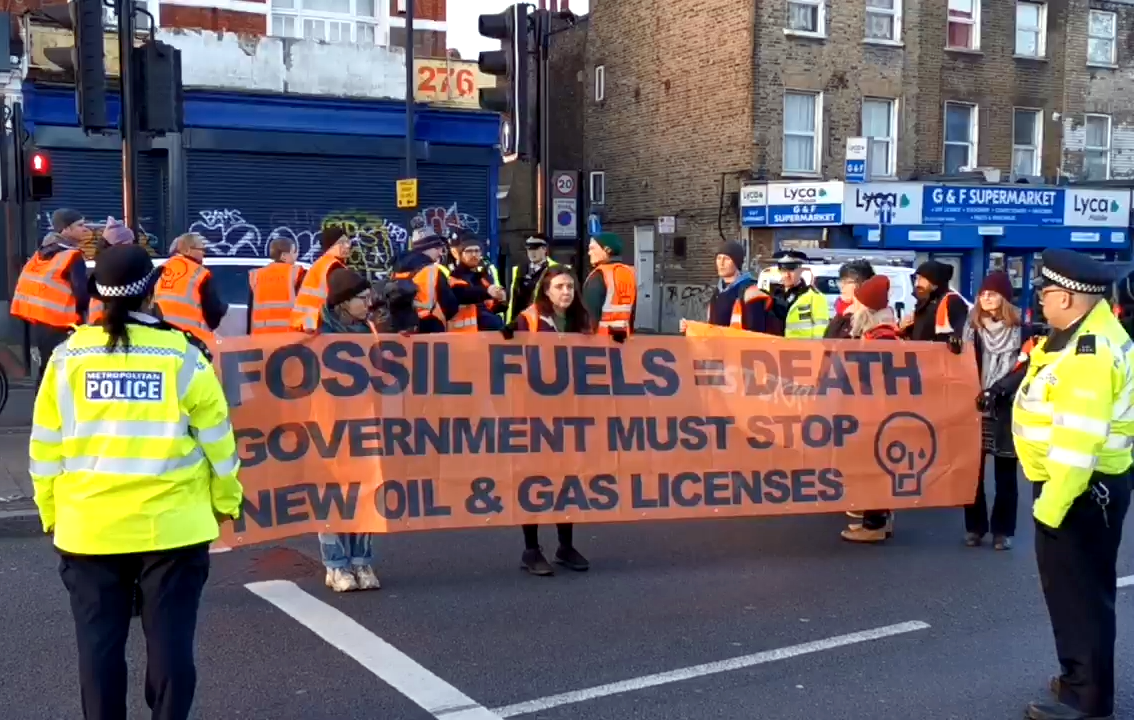
Just Stop Oil protesting in London 6 December 2022.
I am webmaster of https://onaquietday.org. Here I am speculating on the likely outcomes of the current climate crisis. Please regard this post as draft and subject to change, revision or elaboration.
Writing in June 2023, the current situation is that the climate crisis is generally accepted as real, there are very few climate sceptics and instead there are mostly right-wing politicians but also others that campaign to stifle or delay meaningful climate action, the fossil fuel industry who are largely responsible for the climate crisis continuing to destroy the planet and profiteer in the process, scientists and others pleading for climate action. Extreme weather events are experienced worldwide which are expected to continue increasing, the 1.5 degree C goal of the Paris Agreement is likely to be passed within a few years.
There is currently some hostility to climate activists like Extinction Rebellion and Just Stop Oil. I attribute this to the influence of the right-wing corporate press – GB News, Rupert Murdoch and Viscount Rothermere amoung others. As the climate is further damaged – and there’s only one way it’s going – the influence of these cnuts is likely to diminish as people recognise the shite they spew as exactly that.
People will come to realise that politicians and the tiny ruling elite that they serve have failed them as they experience more and harsher climate impacts actually over the next few years. Who will they turn to then? It’s obvious, isn’t it? We’re either going to end up co-operating to address the climate crisis or with authoritarianism protecting a tiny elite denying it.
Notes: While global temperatures often pass the 1.5°C specified by the Paris Agreement, that 1.5°C increase specified in the Paris Agreement is an average increase over a longer term. It is likely that it will passed within a few years as I stated in the text above. The problem is that the fossil fuel industry is profiteering hugely with a disregard for the climate and governments are facilitating it.
Huge biodiversity loss accompanies climate destruction.
I find it difficult to understand the incessant drive for profit. Multiplying your wealth is meaningless if you’re already hugely rich. It’s a real shame that these people don’t understand that there is far greater wealth than monetary wealth.
Just Stop Oil protesting in London 6 December 2022.
I am webmaster of https://onaquietday.org. Here I am speculating on the likely outcomes of the current climate crisis. Please regard this post as draft and subject to change, revision or elaboration.
Writing in June 2023, the current situation is that the climate crisis is generally accepted as real, there are very few climate sceptics and instead there are mostly right-wing politicians but also others that campaign to stifle or delay meaningful climate action, the fossil fuel industry who are largely responsible for the climate crisis continuing to destroy the planet and profiteer in the process, scientists and others pleading for climate action. Extreme weather events are experienced worldwide which are expected to continue increasing, the 1.5 degree C goal of the Paris Agreement is likely to be passed within a few years.
There is currently some hostility to climate activists like Extinction Rebellion and Just Stop Oil. I attribute this to the influence of the right-wing corporate press – GB News, Rupert Murdoch and Viscount Rothermere amoung others. As the climate is further damaged – and there’s only one way it’s going – the influence of these cnuts is likely to diminish as people recognise the shite they spew as exactly that.
People will come to realise that politicians and the tiny ruling elite that they serve have failed them as they experience more and harsher climate impacts actually over the next few years. Who will they turn to then? It’s obvious, isn’t it? We’re either going to end up co-operating to address the climate crisis or with authoritarianism protecting a tiny elite denying it.
Just Stop Oil protesting in London 6 December 2022.
I am dizzy deep (not my real name and I seem to have many names ;), webmaster of https://onaquietday.org. Here I am speculating on the likely outcomes of the current climate crisis. Please regard this post as draft and subject to change.
Writing in June 2023, the current situation is that the climate crisis is generally accepted as real, there are very few climate sceptics and instead there are mostly right-wing politicians but also others that campaign to stifle or delay meaningful climate action, the fossil fuel industry who are largely responsible for the climate crisis continuing to destroy the planet and profiteer in the process, scientists and others pleading for climate action. Extreme weather events are experienced worldwide which are expected to continue increasing, the 1.5 degree C goal of the Paris Agreement is likely to be passed within a few years.
There is currently some hostility to climate activists like Extinction Rebellion and Just Stop Oil. I attribute this to the influence of the right-wing corporate press – GB News, Rupert Murdoch and Viscount Rothermere amoung others. As the climate is further damaged – and there’s only one way it’s going – the influence of these cnuts is likely to diminish as people recognise the shite they spew as exactly that.
People will come to realise that politicians and the ruling elite that they serve have failed them as they experience more and harsher climate impacts actually over the next few years. Who will they turn to then? It’s obvious, isn’t it? We’re either going to end up co-operating to address the climate crisis or authoritarianism denying it. Authoritarianism is unlikely since it affects so many people and there is not a scapegoat other than the rich. I regard this as inevitable, the only issue is that the longer it takes, the more damage is done to our World.