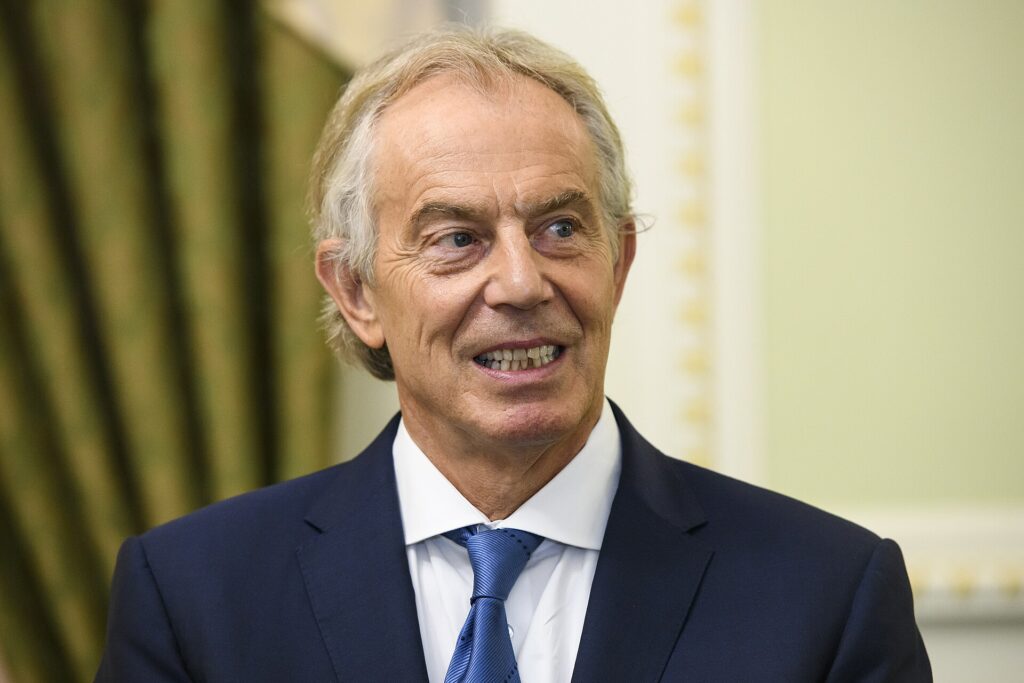
UK barrister Cherie Blair. Credit: The Swift Hour / YouTube
The oil major has provided a significant chunk of the foundation’s income.
A charity set up by Cherie Blair has received more than £3.6 million from U.S. fossil fuel giant ExxonMobil, DeSmog can reveal.
The eponymous Cherie Blair Foundation for Women was founded in 2008 – providing training and resources, including mobile apps, for “women entrepreneurs” in low-income countries to start small businesses, according to its website.
The group has received at least $4.8 million (around £3.6 million) from ExxonMobil’s charitable arm, the ExxonMobil Foundation, since 2015.
The majority of this ($2.8 million, around £2.1 million) was received between 2020 and the ExxonMobil Foundation’s most recent filing in 2024.
The oil and gas giant provided roughly a-fifth of the Cherie Blair Foundation’s total income from 2020 to 2024, according to an analysis of the latter’s accounts.
Blair is a barrister and the wife of former UK Prime Minister Tony Blair, who last month called for the UK to abandon its climate targets and ramp-up North Sea fossil fuel exploration. There is no suggestion that Exxon funded the Cherie Blair Foundation to influence Tony Blair’s work, nor that his views have been swayed by the money provided.
The ExxonMobil Foundation is the primary philanthropic arm of ExxonMobil, the largest U.S.-based oil and gas company.
Internal company reports have revealed that Exxon knew in the 1980s that unrestrained carbon emissions have the potential to cause “great irreversible harm to our planet,” and that it predicted the exact amount of global warming the world is now experiencing. However, instead of warning the public, Exxon internally decided to publicly “emphasize the uncertainty” of climate science.
The Cherie Blair Foundation said that it is “focused on supporting women entrepreneurs in low- and middle-income countries.”
It added: “We receive funding from a range of donors to deliver programmes aligned with our mission. One of these donors is the ExxonMobil Foundation, with whom we have worked since 2015. This support has enabled us to expand access to business skills training for women entrepreneurs in Nigeria and Guyana.”
Africa is disproportionately vulnerable to climate change, with eight of the 10 countries most at risk globally located in central, west, and southern Africa.
The ExxonMobil Foundation’s available tax returns show that it gave the Cherie Blair Foundation $1 million in 2015 and 2016, $600,000 in 2024, 2023, and 2022, and $500,000 in 2021 and 2020.
Exxon’s tax returns for 2017 to 2019 do not list any donation recipients, although the Cherie Blair Foundation’s annual accounts for those years still list Exxon as a donor.
The ExxonMobil Foundation is also listed on the Cherie Blair Foundation’s “donors and partners” list for 2011 to 2014, but details of any money provided are not available in the charity’s reports or the ExxonMobil Foundation’s tax returns.
Cherie Blair is still involved in the foundation, having given an interview to The Standard about its work in March.
The foundation added: “We are not connected to the Tony Blair Institute for Global Change or to Tony Blair’s personal or professional activities, and we operate independently in our governance, strategy and operations. Information relating to funding received is publicly available in our annual report and accounts.”
ExxonMobil was approached for comment.
Tony Blair and Net Zero
In a major intervention in May, Tony Blair called on the Labour government to “use what is left of our North Sea oil and gas resources” and sideline the UK’s net zero emissions targets.
He also said new oil and gas was essential to power the data centres needed for the mass deployment of artificial intelligence (AI), which Blair has championed.
The U.S.-Israeli war with Iran has caused an energy crisis and a spike in the price of oil. Labour has argued the UK needs to deploy clean energy at a faster pace, while the Conservatives and Reform have been calling for the UK’s ban on new North Sea exploration licences to be lifted.
The Cherie Blair Foundation’s ExxonMobil donations are the latest example of fossil fuel interests backing Blair family initiatives.
TBI has been paid to advise the governments of several authoritarian petrostates, including Saudi Arabia, the United Arab Emirates, and Azerbaijan, all of which are heavily reliant on oil and gas exports.
The institute has also championed the deployment of artificial intelligence by the government and in the economy, and has supported the use of gas to power AI data centres.
TBI received $130 million (around £96.5 million) between 2021 and 2023 from billionaire tech entrepreneur Larry Ellison, founder of data software company Oracle and an ally of U.S. President Donald Trump. In total, Ellison has donated or pledged at least £257 million to TBI.
“Neither Tony nor Cherie Blair can be taken seriously when it comes to climate change, energy policy or human rights when their organisations have taken so much money from oil companies and oil dictators,” a spokesperson for the Green Party said.
In a 5,000-word essay published on the TBI website in May, Blair listed “the net-zero acceleration and phasing out of the British oil and gas industry” among Labour’s 2024 manifesto commitments which he considers a mistake.
He wrote that Labour should “remove those parts of the net-zero agenda which prioritise clean energy over cheaper energy”.
Blair, who was prime minister from 1997 to 2007, concluded: “We must prioritise cheaper energy and electrification over net zero and use what is left of our North Sea oil and gas resources. This is essential for our competitiveness and for taking advantage of AI.”
Renewable energy from wind and solar power are consistently the cheapest form of energy. High energy bills are caused by the price of oil and gas, while new North Sea exploration will do little to cut energy bills.
Data centres are currently using six percent of electricity in the UK and U.S., according to a report earlier this month by the International Data Center Authority, an industry body. The average data centre uses enough energy to power roughly 5,000 UK homes, and between 11 million and 19 million litres of water per day, the same as a town of between 30,000 and 50,000 people.
Up to 100 data centres in the UK are reportedly looking to use gas power to meet this demand, threatening emissions reduction targets. The Labour government has yet to state whether it will prevent gas-powered data centres from being built in the UK.
Last month, the government admitted that it had under-estimated the potential carbon emissions of data centres by a factor of more than 100.
Last year, Keir Starmer’s administration – which has close ties to Blair and TBI – signed a ‘Tech Prosperity Deal’ with the U.S. government through which big tech companies pledged to heavily invest in AI development in the UK. While Trump paused the deal in December, it’s unclear to what extent these investments are also on pause.
As reported by the New York Times, the court has agreed to hear arguments related to a petition filed by ExxonMobil and Canadian energy firm Suncor related to a 2018 lawsuit by the city of Boulder, Colorado that seeks financial damages from the companies for their role in causing global climate change.
The Times report noted that dozens of similar lawsuits have been filed by states and municipalities over the last decade, and they generally seek money from energy firms to help mitigate or repair damage done by extreme weather exacerbated by the climate crisis.
According to the Associated Press, attorneys for the energy companies are petitioning to have the case moved from state courts to federal courts that have in the past dismissed similar complaints.
“The use of state law to address global climate change represents a serious threat to one of our nation’s most critical sectors,” the attorneys claimed.
The Supreme Court’s decision to hear the case comes months after the Colorado Supreme Court ruled that Boulder’s lawsuit could initiate the discovery process and move toward a trial.
In an interview with the Colorado Sun, Boulder County Commissioner Ashley Stolzmann said that the city wasn’t backing down from its efforts make the fossil fuel industry pay for the damage it’s done.
“The oil companies have tried every avenue to delay our climate accountability case or move it to an out-of-state court system,” said Stolzmann. “As everyone continues to face rising costs that put budgets under pressure, we must hold oil companies accountable for the significant harm they’ve caused our communities.”
Richard Wiles, president of the Center for Climate Integrity, said that the merits of the Boulder lawsuit are clear, regardless of the Supreme Court’s intervention.
“Big Oil’s climate lies are the most consequential and harmful corporate deception campaign in history,” Wiles said, “and the communities paying the price for that deception deserve to put these companies on trial. Exxon’s desperation to escape accountability does not change the evidence of their wrongdoing or the law that lower courts agree is on Boulder’s side.”
Alyssa Johl, vice president of legal and general counsel at the Center for Climate Integrity, said the Supreme Court should simply affirm lower court rulings stating that “communities like Boulder have the right to seek accountability in their state courts when corporations have knowingly caused local harms.”
Donald Fuhrump says that Amerikkka doesn’t bother with crimes or charges anymore, not being 100% Amerikkkan and opposing his real estate intentions is enough.Orcas discuss Donald Trump and the killer apes’ concept of democracy. Front Orca warns that Trump is crashing his country’s economy and that everything he does he does for the fantastically wealthy.Elon Musk urges you to be a Fascist like him, says that you can ignore facts and reality then.
With Brazil about to host COP30, DeSmog has obtained copies of checks Exxon mailed to the right-wing Atlas Network in the 1990s to turn Latin America against climate treaties.
(Credit: Sari Williams)
A version of this article appeared in The Guardian.
In early September, the Danish climate crisis denier Bjørn Lomborg travelled to São Paulo to deliver a stark warning. On the sidelines of a conference called the Forum Caminhos da Liberdade, happening just as Brazil was gearing up to host annual global climate talks (known as “COP30”) in November, Lomborg claimed that if implemented poorly, government efforts to address climate change could “destroy economic growth.”
Lomborg had some behind-the-scenes assistance to help his message land, because one of the top 2025 sponsors of the conference (whose speakers in previous years have included Silicon Valley billionaire and Donald Trump ally Peter Thiel), was Atlas Network, a United States-based worldwide coalition of more than 500 free-market think tanks and allied partners. This wasn’t the first time that a foreign conservative activist aimed to stir up doubts in Latin America about climate action on the eve of global climate talks.
Starting in earnest around 1997, during the early years of United Nations-led efforts to forge a global climate pact, Atlas Network and its partners created and executed a playbook to sabotage support for international treaties across the Global South, according to hundreds of Atlas Network documents obtained by DeSmog.
It’s now public knowledge that throughout the 1990s and 2000s, Exxon helped fund and lead a constellation of U.S.-based organizations that sought to discredit climate science, assure the public that it was safe to burn fossil fuels, and block America’s participation in the international climate treaty — a campaign that is now the subject of dozens of lawsuits across the U.S. accusing the company of deceiving the public.
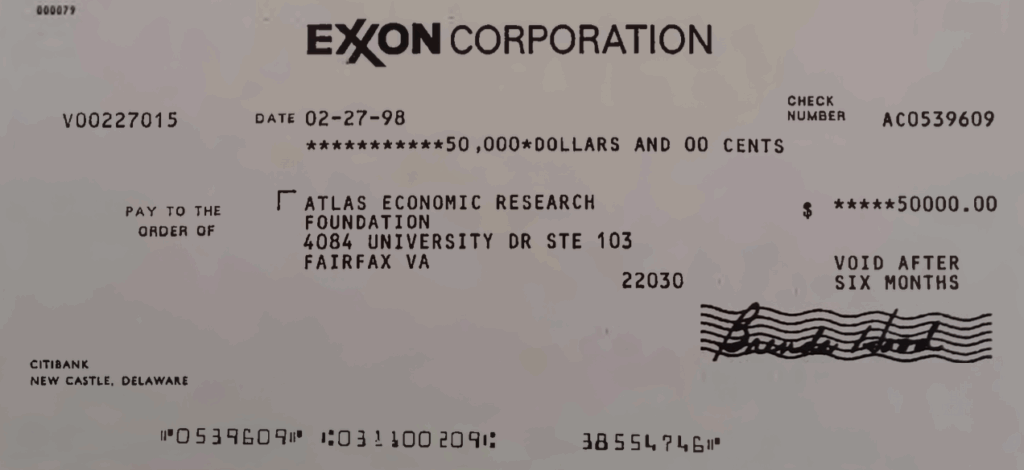
DeSmog’s newly obtained documents, which included copies of checks mailed to Atlas Network for amounts ranging from $15,000 to $50,000 at a time, show that Exxon, with the help of Atlas Network partners, was also quietly financing climate denial in developing countries.
These strategy memos, funding proposals, personal letters and progress reports reveal in specific detail how Exxon and Atlas Network (which was formerly known as Atlas Economic Research Foundation) sought to amplify diplomatic tensions ahead of climate treaty summits, which are focused on bringing countries with vastly differing economic and social needs to consensus on reducing carbon emissions.
In stoking confusion and doubt about climate change among developing nations during critical early moments of climate diplomacy, Exxon and Atlas Network exacerbated geopolitical fault-lines and raised economic fears that persist to this day, according to Kert Davies, director of special investigations at the non-profit Center for Climate Integrity, who is a long-time expert on Exxon’s climate denial campaigns.
“That’s a pretty ugly history,” Davies said. “Exxon seemed to think that if you could make developing nations, and all nations, skeptical that climate change was a crisis then you’d never have a global climate treaty.”
A $50,000 contribution that Exxon mailed to Atlas Network in early 1998. (Credit: DeSmog)
The checks Exxon wrote to Atlas financed activities ranging from Spanish translations of English-language books denying the reality of climate change, to flights to Latin American cities for U.S. climate deniers. They funded public events that enabled those deniers to reach local media and network with policymakers, as well as Atlas Network partner reports warning of dire economic consequences from climate policy.
The goal was to make countries across the region “less inclined” to support treaties on cutting carbon emissions, even though these agreements would be essential to stopping global temperature rise from spiraling out of control.
Three decades later, the consequences of insufficient global climate action are impossible to ignore. Scientists announced in mid-October that worldwide carbon emissions are so high that the planet has passed the tipping point where a mass die-off of the planet’s coral reefs is likely irreversible, and that unless there are drastic global cuts to emissions and deforestation within the next 10 to 20 years, a collapse of the Amazon rainforest could be locked in.
‘Never an Important Donor’
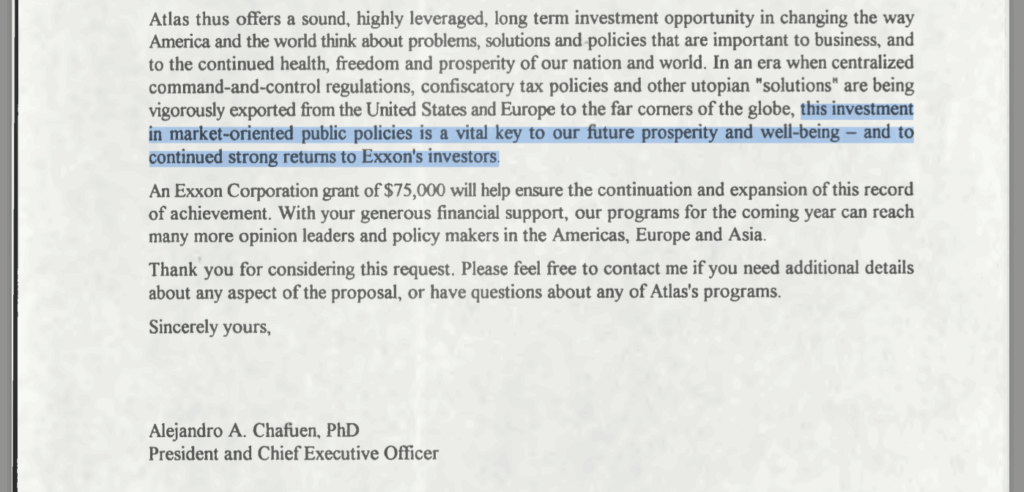
Exxon’s climate obstruction in the Global South had the potential to increase profits, according to a 1997 strategy plan “dealing specifically with the problems of international treaties” that Atlas sent by mail to the company’s headquarters in Irving, Texas. “This investment in market-oriented public policies is a vital key to our future prosperity and well-being — and to continued strong returns to Exxon’s investors,” Atlas Network explained.
Asked about this document and others viewed by DeSmog, Atlas Network spokesperson Adam Weinberg replied that “these questions deal with memos and materials drafted by former employees from more than a quarter century ago, addressed to a corporation that was never an important donor to our organization, and which indeed has not been a donor at all for close to two decades.”
But considering that over 50 percent of the world’s greenhouse gas emissions since 1751 have been released since the early 1990s, Exxon and Atlas Network efforts to stall carbon cuts are extremely relevant to where the world finds itself today.
“What happened 30 years ago matters very much,” said Carlos Milani, a professor of international relations at Rio de Janeiro State University’s Institute for Social and Political Studies. “The atmosphere has a huge historical memory when it comes to greenhouse gas emissions.”
Exxon did not respond to a request for comment.
In a 1997 strategy plan sent to Exxon, Atlas Network requested $75,000, saying that “this investment in market-oriented public policies is a vital key to our future prosperity and well-being — and to continued strong returns to Exxon’s investors.” (Credit: DeSmog)
‘Influence Government Policies’
During his September trip to Brazil, in addition to attending the Forum Caminhos da Liberdade, Lomborg gave a lecture at a private research university in Belo Horizonte known as IBMEC, which he later said in his newsletter was “broadcast to hundreds of students unable to fit into the auditorium.”
Lomborg had been described in Brazilian promotional materials as one of the world’s leading experts on environmental issues and other global challenges, even though many actual climate scientists regard his statements on climate change as misrepresentative of the mainstream consensus that global temperature rise is an urgent and escalating crisis.
Lomborg did not reply to detailed questions about his activities in Brazil. The university event was hosted by IBMEC professor Adriano Gianturco, who is a board member of the Instituto Liberal, a Rio de Janeiro-based think tank and Atlas Network partner with a history of spreading climate disinformation throughout Latin America.
In videos posted to social media during the summer, Instituto Liberal repeated in Portuguese the long-standing climate denier trope that COP30 is an expensive get-together for the United Nations’ globe-trotting technocratic elites that will leave nothing but debt for ordinary Brazilians.
Instituto Liberal did not respond to a request for information. “We did not convene any of the meetings or activities with Bjørn Lomborg,” Weinberg of Atlas Network said in email. “We do not take institutional positions on topics like COP30.”
Instituto Liberal has been fine-tuning its critique of the international climate treaty process since at least 1997, when it was contacted by Atlas Network about “an important new donor” looking to foster think tanks in the Global South.
The proposal explained that the donor was particularly interested in “international treaties and agreements that force Latin and other developing countries to adopt stringent labor, environmental or other laws that may not reflect the developing nation’s own needs, priorities or viewpoints on these issues.”
That donor was Exxon, which — as detailed in a 1997 letter from Exxon executive William Hale to Atlas Network — was “interested in nurturing free-market think tanks outside the United States,” particularly in Asia, the former Soviet Union, Europe, and Latin America. Exxon was prepared to give Atlas “up to $50,000” — adjusted for inflation, roughly $100,000 in today’s money — to grow “international groups which have the ability to influence government policies.”
In a 1998 letter to Exxon’s Hale, then-Atlas Network president Alejandro Chafuen spelled out how its partner organizations could amplify the company’s influence in the Global South. They would provide “entrees to government officials”; “access to local and national TV and radio programs”; “a distant early warning system on emerging issues”; “an improved ability to respond to legislative and regulatory initiatives”; and, “a greatly expanded ability to carry corporate messages…beyond Washington and the United States.”
Latin American academics who study Atlas Network see in such activities a coordinated effort to create favorable political conditions for big business and foreign investors. “It is a movement,” Ana Lúcia Faria and Vera Chaia wrote in a 2023 paper, “to legitimize and pave the the way for the unbridled escalation of capital.” The research was published in the London Journal of Research Humanities and Social Sciences.
Atlas Network in its 1998 funding proposal to Exxon stressed “that even relatively small investments in developing nations can produce substantial results.” The proposal explained that Exxon funding would “enable new and established think tanks to undertake or expand studies of vital importance to business in general and the petroleum industry in particular.”
Exxon’s financial support of Atlas Network came at a crucial early moment in global climate diplomacy.
World leaders had met in Japan in 1997 to negotiate the Kyoto Protocol, the first-ever legally binding international treaty designed to reduce global greenhouse gas emissions.
Over two weeks of negotiations, tensions surfaced about which countries should bear the costs of addressing the mounting climate crisis. The wealthiest nations had created most of the climate-heating pollution over two centuries of coal- and oil-fired industrialization, but emissions from developing nations were rising in the present as they industrialized their economies and pulled their citizens out of poverty.
Countries were planning to convene in Buenos Aires in November 1998 to find a solution that could help unite the Global North and South more decisively in the worldwide climate fight. It would be just the fourth annual “conference of the parties” to the United Nations climate treaty process, thus known as “COP4.”
To Atlas Network, this meeting would be “a rare opportunity” to create opposition to the Kyoto Protocol for those “who doubt the claims behind the global warming theory, and worry about the devastating results that any treaty could have on the United States, the world economy and the energy industry.” With Exxon’s support, Atlas Network believed it could help persuade the developing world of “the adverse effects of global climate change treaties.”
In September 1998, just two months before global delegates were due to meet, Atlas Network requested supplementary financing from Exxon to fund a series of global warming seminars. The money would pay for Atlas Network to fly Patrick Michaels, a U.S. climate denier, to Buenos Aires to speak at the events. Michaels was connected to several think tanks and groups that had previously received money from Exxon,
Earlier that year, Michaels had erroneously stated in a short film that “the entire global climate change hysteria is driven by computer models; it is not driven by reality.”
Atlas Network pitched to Exxon that the additional funding would also help several think tanks in the network facilitate meetings between Michaels, as well as other seminar speakers, and “ministers, politicians, editorial boards [and] business leaders in Argentina.”
This wouldn’t be difficult to organize, as Atlas Network had explained to Exxon in an earlier funding proposal, because “the many free market think tanks in Argentina, Brazil and other Latin countries enjoy excellent relationships with the news media and high level government officials.” Those think tanks, in turn, were also connected to “bankers, owners of investment funds, and party advisors,” according to Brazil-based researcher Hernán Ramírez.
Further, the extra money from Exxon would pay for analysts at Instituto Liberal and other Atlas Network think tanks in the region to produce a report about the “trade, economic and political implications of Kyoto Protocol on Latin American and other developing nations,” which could then be turned into commentaries that were “placed with key U.S. and Latin papers.”
In this pre-digital era, Atlas Network conceived the seminars as global distribution hubs for talking points, data, and narratives attacking the legitimacy of climate treaties. It explained to Exxon in a 1998 memo that one of its institutes in Latin America had produced a Spanish translation of a booklet by the U.S. climate denier Fred Singer, titled “The Scientific Case Against the Global Climate Treaty,” which it planned to distribute at the Argentina workshops.
Singer’s booklet claimed “there is no significant scientific support for a global ‘threat’ of climate warming,” and that “developing countries will suffer” from any global treaty “since their well-being and economic stability depend on international trade and general world prosperity.”
Atlas expected participants at the workshops to produce new papers, which it would then distribute “all over South America, including Mexico, and send them over to China and India, as well.”
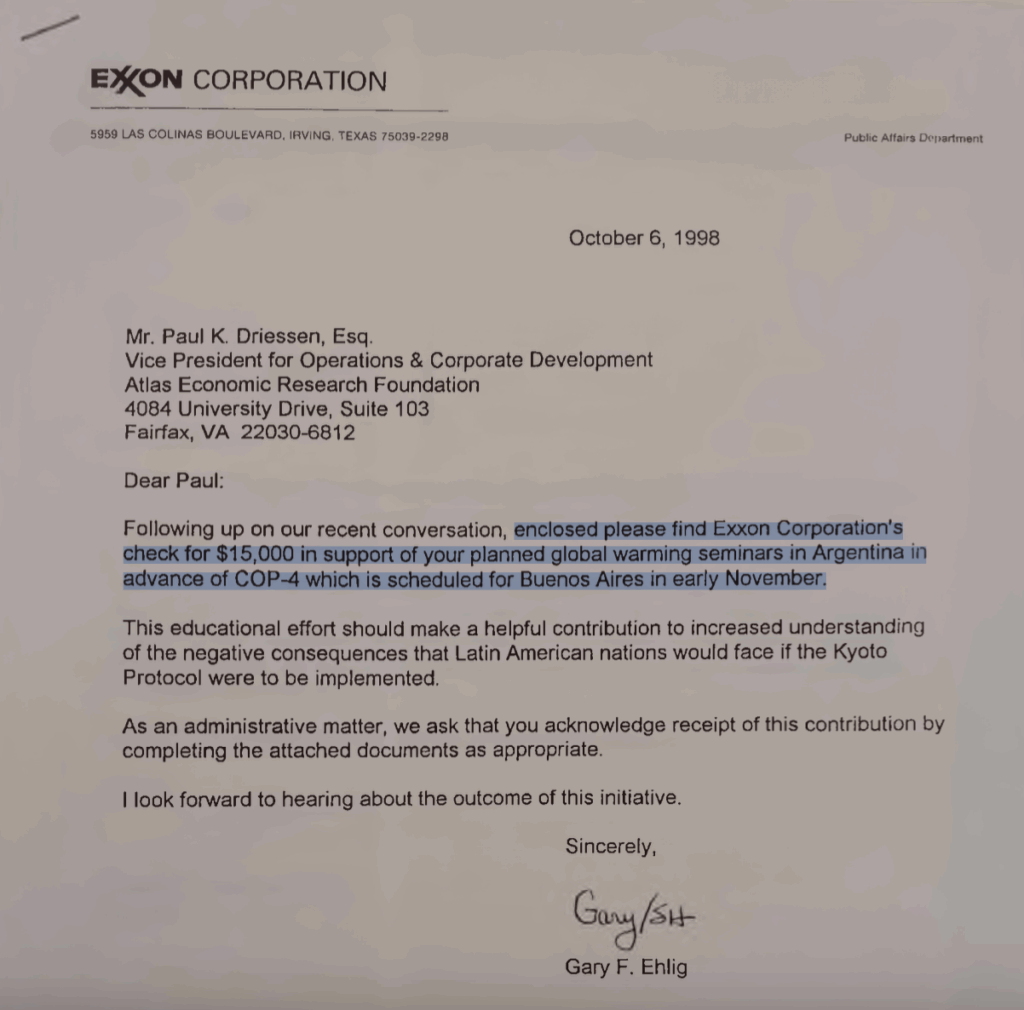
Exxon signed off on the plan and on October 6, 1998, mailed an additional $15,000 to Atlas “in support of your planned global warming seminars in Argentina in advance of COP-4.” The letter, authored by Exxon executive Gary Ehlig, predicted the seminars could lead to “increased understanding of the negative consequences that Latin American nations would face if the Kyoto Protocol were ever implemented.”
He added, “I look forward to hearing about the outcome.”
Exxon sent Atlas Network $15,000 in October 1998 to fund “global warming seminars in Argentina in advance of COP-4 …[T]his educational effort should make a helpful contribution to increased understanding of the negative consequences that Latin American nations would face if the Kyoto Protocol were to be implemented.”
‘Wouldn’t Have Been Obvious’
Exxon explained in its correspondence that it was eager to support Atlas Network groups abroad because the company already felt like it had the political and communications infrastructure in place to protect its interests at home. “We are comfortable with the support we provide to US-based organizations and on US-related issues,” the company told Atlas Network in a 1997 letter.
By this time Exxon already had a track record of creating and spreading climate disinformation, even though its internal scientists, from the 1970s onward, had made highly accurate predictions about future warming caused by fossil fuels.
Exxon was a founding member of the Global Climate Coalition (GCC), a lobby and communications group representing fossil fuel producers, automakers, and other large industrial companies. Throughout the 1990s, the GCC ran media campaigns attempting to convince the public and policymakers that human-caused climate change wasn’t real.
The Global Climate Coalition itself had doubts about the deniers it was promoting, with one internal document during this period describing the “contrarian theories” of global warming as “not convincing.”
Nevertheless, on the eve of the 1997 climate negotiations in Kyoto, the Global Climate Coalition successfully lobbied the U.S. Senate to pass the Byrd-Hagel Resolution, which banned signing on to an international climate treaty that gave any concessions to developing countries, such as more lenient timelines for lowering their emissions — in effect, leveraging a central geopolitical fault-line of the COP process to prevent the U.S. from taking leadership.
Exxon then joined with fossil fuel companies and climate denial organizations such as the George C. Marshall Institute to create a communications plan targeting media, policymakers, and teachers, disseminating a now-infamous memo in April 1998 stating that “victory will be achieved when average citizens understand uncertainties in climate science.”
Efforts like this reflected a deliberate financial calculation on the part of oil and gas producers, argued Milani, the Rio de Janeiro State University academic. “They are aware of the fact that we need to transition away from oil and gas, and the later we do this the better for them, because they’ll still make lots of money from it,” he said.
Six months after the “victory will be achieved” memo, six Latin American Atlas Network partners “sponsored a series of seminars, briefings and media interviews in five Argentine cities, to present information of global climate change science and economics prior to the COP4 summit in Buenos Aires,” according to an Atlas Network update to Exxon on the organization’s activities.
These events “drew several hundred people” to hear “several well-known specialists from USA” discuss the “global warming scare.” All in all, Atlas reported, “media coverage included 8 television and radio appearances, over 12 articles in newspapers and magazines, and 19 interviews.”
Atlas Network noted in an update to Exxon on its 1998 programs that a partner in Beijing, the Institute of World Economics and Politics, had translated Singer’s book into Chinese. Atlas Network was also sending materials about climate change to think tanks in India.
“Few of these accomplishments would have been possible without Exxon Corporation’s generous financial assistance,” Atlas Network told its benefactor.
Exxon itself was barely visible at the COP4 climate talks, recalled Kert Davies, a climate disinformation expert, who attended the 1998 Buenos Aires negotiations with the non-profit Ozone Action. Davies recalled walking the venue’s hallways to try and get a sense of who had come to push for the strongest climate deal, and who was there to obstruct it.
Exxon’s only representative inside the event was Brian Flannery, Davies said, and his affiliation to Exxon wasn’t included on the official list of COP4 delegates. That the oil company was financing efforts to obstruct the talks “wouldn’t have been obvious to anyone,” Davies said. “I think it was intentionally not obvious.”
Strategizing With Exxon
In mid-February 2000, Atlas Network’s Jo Kwong met with Exxon executives William Hale and Lynn Russo. The meeting was a strategy session on “advanc[ing] understanding of the international picture to see what is needed and how the company can ‘sensibly’ help,” according to an internal Atlas Network update submitted by Kwong.
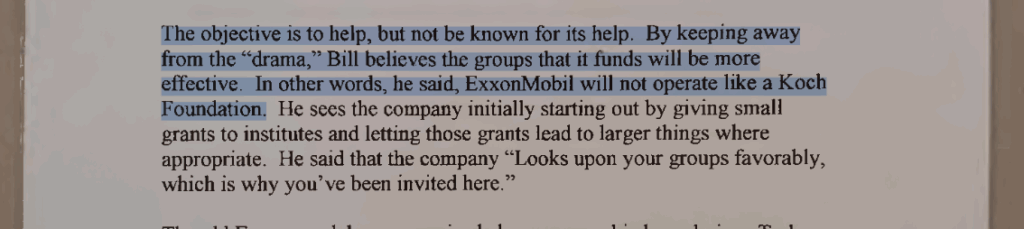
Hale stressed during the meeting that Exxon had to have anonymity in its financing of Atlas groups and programs. “The approach has been behind-the-scenes, intentionally not seeking public kudos for its efforts,” he said. Hale also explained that this was a strategic choice. Exxon’s goal was “to help, but not be known for its help,” according to the update. “By keeping away from the ‘drama,’ Bill believes the groups that it funds will be more effective.”
At a 2000 meeting with Atlas Network, Exxon stressed that it wanted anonymity in its financing of Atlas groups and programs. “The objective is to help, but not be known for its help,” read an internal Atlas Network update on the meeting. “By keeping away from the ‘drama,’ Bill [Exxon executive William Hale] believes the groups that it funds will be more effective. In other words, he said, ExxonMobil will not operate like a Koch Foundation.”
In a follow-up letter to Hale after the meeting, Kwong said she “felt very honored” that the Exxon executive made time in his busy schedule for “so many hours” of strategizing with Atlas, and expressed her admiration for Exxon’s “commitment to furthering our joint interests.”
Kwong wished Hale, who was transitioning out of his role as an Exxon liaison with Atlas, “good luck in your new position at the company.”
In his new role working on “Communications and other public relations,” Hale would be helping to create “advertorials in the New York Times,” according to the Atlas update.
The following month, Exxon ran a now-infamous full-page advertorial in The Times headlined “Unsettled Science.” In the advert, Exxon took the position that “it is impossible for scientists to attribute the recent small surface temperature increase [in the atmosphere] to human causes” — even though years of high-quality internal climate research had found otherwise.
Five months after the meeting with the Exxon executives, Kwong went on a media and speaking tour in Argentina. The tour’s “major objective was to introduce the concept of free market environmentalism,” Kwong explained in a 2000 trip report for Atlas Network.
During talks hosted by network partners Fundacion Global and Fundacion Libertad, Kwong delivered this message to business leaders, government officials, policymakers, and environmental groups. She also gave “several press interviews with newspapers and television.”
Kwong summarized her main takeaways from the trip, saying that the reporters she encountered in Latin America invariably wanted to hear her views on whether to prioritize environmental protection or economic growth. “They were very surprised to hear my response: that countries must be rich before they can invest in the environment — that environmental amenities are a luxury good,” Kwong wrote.
This free-market environmentalism was, Kwong said, “quite the contrary to everything else they have heard.”
More than 25 years later, with global temperatures rising to historic levels and another key climate summit on the horizon, Bjørn Lomborg would echo essentially the same message.
‘Achieve Quick Results’
During September’s Climate Week in New York City, Lomborg authored an op-ed for the New York Post in which he described the global climate fight as an intractable stalemate, framing it as “rich-world elites obsessed with climate change versus developing nations battling poverty, hunger and disease.”
Climate experts say Lomborg’s divisive attacks on climate policy are propaganda designed to dampen enthusiasm among the public and policymakers for effective action to slow the climate crisis. The Danish economist has referred to these charges as a “smear.”
In Brazil, the same messages are being amplified by Leandro Narloch, an author and influencer with more than 100,000 followers on Instagram.
In an August episode of the Brazilian podcast Tubacast titled “COP30 — What’s Going To Happen Is Terrible,” Narloch launched into a familiar populist jab at climate conference delegates, criticizing the emissions released from their flights to the talks. “I also love parties, I love free flights, I love hotels, I love feeling like I’m part of the enlightened, but damn it’s kind of hypocritical,” he said, according to an English translation of his remarks.
Narloch and Lomborg’s paths crossed while Lomborg was in Brazil, at an intimate dinner with other free-market advocates such as Wagner Lenhardt, executive director of the Atlas Network partner Instituto Millenium, and Antonia Tallarida, president of Instituto de Formação de Líderes de SP, another Atlas partner. Narloch told his followers afterwards that it had been “an honor” to dine with Lomborg, the “author of False Alarm and so many other books on the exaggerations of climate debates,” posting a photo of the smiling group squeezed into a restaurant booth.
In a September 14, 2025 Instagram post, Brazilian author Leandro Narloch wrote that it had been “an honor” to dine with Bjorn Lomborg, the “author of False Alarm and so many other books on the exaggerations of climate debates.” (Credit: DeSmog)
Narloch himself recently published a book called “The Politically Incorrect Guide to the Environment,” and is using promotional appearances as an opportunity to attack the upcoming climate talks in Belém, Brazil.
Carlos Alexandre Da Costa, an economist who served in the Ministry of Economy under the far-right former president Jair Bolsonaro, also attended the dinner, and shared the same photo on Instagram.
As nice as it was to enjoy the “pleasant companies” of fellow activists in the free-market movement, he posted, the meeting was also an opportunity to strategize. “We came out with several concrete actions to promote these ideas and achieve quick results,” he wrote.
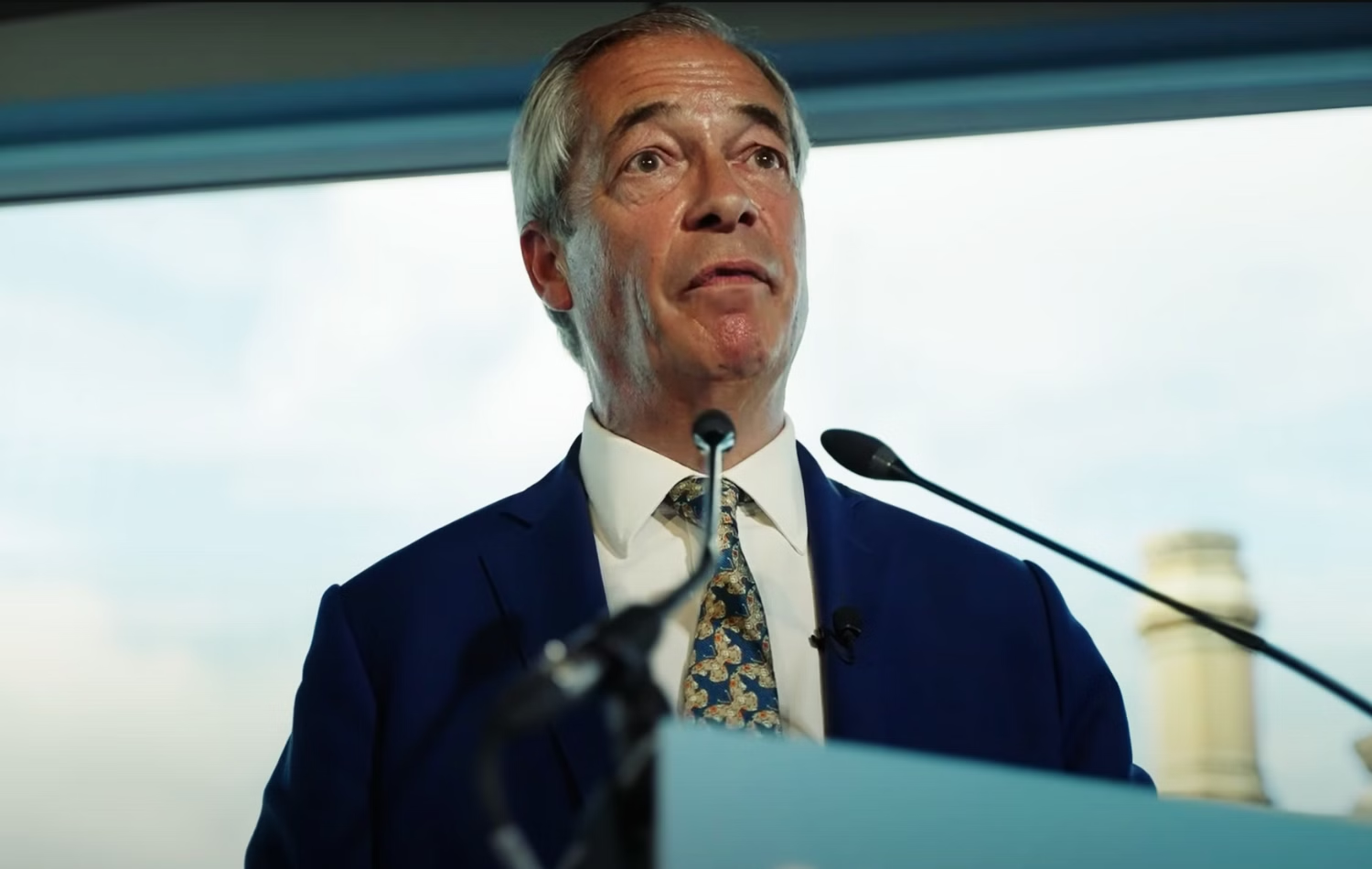
Reform UK leader Nigel Farage speaking in Aberdeen. Credit: Reform UK / YouTube
Nigel Farage’s party was told by Offshore Energies UK to rethink its plan to thwart clean energy.
LIVERPOOL – The UK’s largest oil and gas trade body has criticised Reform UK’s plans to “turn off the tap” on renewable energy.
Nigel Farage’s party has tried to present itself as the oil and gas industry’s closest ally, vowing to “drill, baby, drill” in the North Sea and scrap the windfall tax on excess profits, while meeting with oil executives, and courting donations from the sector.
However, on a panel at the Labour Party’s annual conference in Liverpool on Monday (29 September), a spokesperson for Offshore Energies UK (OEUK) criticised Reform’s plans to end state support for clean energy.
Natalie Coupar, communications and marketing director at OEUK – members of which include fossil fuel giants BP, Shell, ExxonMobil, TotalEnergies, and Equinor – said the group is “apolitical” but gives “hard truths to all parties”.
She said: “One of the things we’ve been saying to Reform very much is, you know, if you’re going to turn on the taps for oil and gas, there’s almost really no point if you’re just going to turn off the taps to renewables.
“That doesn’t help. We need to keep both those streams open.”
According to the Confederation of British Industry (CBI), the UK’s net zero economy grew by 10 percent in 2024, employing almost a million people in full-time jobs.
Coupar also said it was essential to “hold the consensus on tackling climate change and growing our energy future”.
A panel at 2025 Labour Party conference sponsored by Offshore Energies UK (OEUK). Credit: DeSmog
Reform’s Oil Campaign
Reform has vowed to stop all government subsidies for renewable energy, and has pledged to block solar and onshore wind farms in the local authorities it controls.
In May, the party’s deputy leader Richard Ticesaid: “Whether it’s planning blockages, whether it’s judicial reviews, whether it’s lawsuits, whether it’s health and safety notices, we will use every available legal measure to an extreme way in order to frustrate these people.”
Tice – who has said “there’s no evidence that man-made CO2 is going to change the climate” – met with senior oil executives in May and promised to approve new drilling licences “on day one” of a Reform government.
Last month, he pledged to overturn the UK’s ban on fracking for shale gas, which he calls “treasure beneath our feet”, and told the industry to “get ready”.
In April, Reform party treasurer and a billionaire property developer Nick Candy said he was trying to secure donations from oil and gas executives, claiming to have raised £100,000 from one, though this has yet to appear on Reform’s donations register.
As DeSmog has reported, 92 percent of Reform’s funding between the 2019 and 2024 general elections came from climate science deniers or those with highly polluting interests – a total of £2.3 million.
Since his election as an MP last year, Farage has spoken at a string of events in the U.S. organised by radical groups backing U.S. President Donald Trump’s pro-fossil fuel agenda. Last December, Farage launched the UK-EU branch of the Heartland Institute, a U.S. climate denial think tank.
Speaking at the Alliance for Responsible Citizenship conference in London in February, Farage claimed it was “absolutely nuts” for CO2 to be considered to a pollutant. However, he added: “I’m not a scientist. I can’t tell you whether CO2 is leading to warming or not, but there are so many other massive factors.”
Climate scientists at the UN’s Intergovernmental Panel on Climate Change (IPCC), the world’s leading climate science body, have stressed that “it is a statement of fact, we cannot be any more certain; it is unequivocal and indisputable that humans are warming the planet”.
Nigel Farage urges you to ignore facts and reality and be a climate science denier like him and his Deputy Richard Tice. He says that Reform UK has received £Millions and £Millions from the fossil fuel industry to promote climate denial and destroy the planet.Elon Musk urges you to be a Fascist like him, says that you can ignore facts and reality then.Nigel Farage reminds you that he’s the man that brought you Brexit and asks what could possibly go wrong.
Carbon capture faces significant skepticism from environmentalists who note that the industry’s past is littered with failed projects, missed targets, and an overall net increase in emissions. Credit: Matt Hrkac (CC BY-NC-ND 2.0)NDLA,
CCS can “no longer be considered an unlimited” climate solution, researchers caution after concluding most storage options are in risky regions
As the Trump administration seeks to wipe away environmental rules covering the oil, gas, and coal industries, fossil fuel producers and sellers are reassuring buyers that carbon capture and storage (CCS) could slash climate-altering emissions from a growing range of fossil-fuel projects — like blue hydrogen, LNG export terminals, and data centers.
“That’s right: data centers,” fossil fuel giant ExxonMobil wrote in December, adding that the need for more data centers for AI could represent a fifth of the world’s demand for carbon capture by 2050.
Now, a study published in the journal Nature calls attention to another issue that could loom in the future if CCS were to really take off — a lack of easy-to-develop locations where captured carbon can be buried underground.
The vast majority of places where you can find the kinds of sedimentary rocks that allow carbon dioxide to be stored underground sit in higher risk zones or in areas like the Arctic that are potentially off-limits for practical or political reasons, the study found.
That has big implications for the energy transition, since once carbon dioxide is put into storage, it’s supposed to stay there for as long as possible. Any storage sites we use today can’t be expected to be available for future generations — not just the children and grandchildren of people alive today but “more than ten generations into the future,” the study notes.
“This study should be a gamechanger for carbon storage,” coauthor Joeri Rogelj, director of research at the Grantham Institute at Imperial College London, said in a statement when the study was announced. “It can no longer be considered an unlimited solution to bring our climate back to a safe level. Instead, geological storage space needs to be thought of as a scarce resource that should be managed responsibly to allow a safe climate future for humanity.”
In fact, there may be only enough practical storage to potentially reverse between 0.4 and 0.7 degrees Celsius of warming — a tiny fraction of the five or six degrees experts previously estimated, the researchers said.
The carbon storage that is available “should be used to halt and reverse global warming,” Rogelj added, “and not be wasted on offsetting on-going and avoidable CO2 pollution from fossil electricity production or outdated combustion engines.”
On Track to ‘Overshoot’
International plans to limit climate change tend to assume that we can “overshoot” on climate pollution, pushing the Earth’s climate into dangerous territory past 1.5 or 2 degrees Celsius of warming. That’s because, the argument goes, carbon capture and storage could come to the rescue if we go too far, letting us draw carbon dioxide levels back down.
The new study calls that assumption into question, highlighting uncertainty about how effective carbon removal will be at curbing climate change, in addition to concerns over difficulties in accessing underground carbon storage.
“With current trends suggesting warming up to 3°C this century, using all of the safe geological storage wouldn’t even get us back to 2°C,” said lead author Matthew Gidden, research professor at the Center for Global Sustainability at the University of Maryland.
Industry estimates, like those from the Oil and Gas Climate Initiative (OGCI), suggest the world has plenty of storage potential to keep 14,000 gigatons of carbon dioxide buried below ground and out of the atmosphere.
That would be “more than enough to meet projected needs for CCUS [carbon capture, use and sequestration] over the coming century,” the OGCI wrote in a 2023 report it called a “playbook for regulators, industrial emitters and hub developers.”
The new study, however, takes a closer look at where that storage is located — and in particular whether it’s in regions at higher risk of earthquakes or groundwater contamination like locations deep in the ocean, or in the Arctic and Antarctic circles. The study concludes that nearly 90 percent of that storage capacity is in less-than-desirable locations.
The researchers estimate there’s just 1,460 gigatons worth of “prudent” storage available worldwide — a tenth of the industry estimates.
Some earlier estimates stretch even higher, suggesting there’s around 40,000 gigatons of CO2 storage capacity worldwide.
“These estimates are also important as they remove all the technical constraints from assessment and assume that cost and engineering challenges will pose no issue in the future,” coauthor Siddharth Joshi, a research scholar at the Integrated Assessment and Climate Change Research Group, told DeSmog, adding that “the shock value of technical potentials is enough to sometimes drive an industry forward.”
At the same time, focusing only on larger capacity estimates can create a “false sense of abundance,” Gidden noted, if policy-makers think the world has more room for overshoot than carbon storage can really offer.
The Nature study raises big questions about how the world’s carbon storage should be used long term.
“As [the study authors] point out, if we act to reduce emissions now, we probably have enough storage, but that ceases to be true really, really soon,” Rob Anex, professor at the University of Wisconsin-Madison who researches carbon capture technology, told Canada’s CBC News. “Global emission rates are so high that the window of time in which geologic storage is practical is shutting really, really fast.”
Trump Backs Carbon Capture Subsidies
Despite the federal government’s retreat from climate action, including Trump’s January executive order withdrawing the U.S. from the Paris Agreement, the Trump administration has moved to protect and expand some federal subsidies for CCS.
Lucrative tax credits for using captured carbon for enhanced oil recovery were expanded this summer as part of Trump’s “One Big Beautiful Bill Act.”
Given this political climate, experts didn’t expect to see a major direct impact from the study for blue hydrogen projects and other proposals aiming to use carbon storage.
“The pragmatist in me says it’s unlikely,” Anika Juhn, energy data analyst for the Institute for Energy Economics and Financial Analysis (IEEFA), told DeSmog. “I don’t see government taking those kinds of steps.”
The Nature study follows a precautionary approach to carbon storage, she noted. “The precautionary principle says if we don’t really know about it, then maybe we shouldn’t be rushing headlong into just applying this technology everywhere as fast as possible,” she said. “I think that’s really where the strength of it is, saying if you are interested in doing it safely, here are some key aspects that you should really focus on.”
“Because their estimate is so prudent, it really doesn’t reflect at all current industry practice,” Juhn noted.
So far, there’s not a lot of carbon storage operating worldwide, with the Nature study pointing out existing projects currently store just 49 megatons per year, with 416 megatons worth “either planned or in construction.” Meanwhile, annual global emissions from fossil fuels topped 37,400 megatons last year, according to the World Meteorological Organization, another record high.
But that small CCS industry has already caused significant safety incidents — including well blowouts and a major 2020 CO2 pipeline leak that hospitalized dozens of people.
Concerns over the potential for groundwater contamination — one of the factors highlighted in the Nature study — have already begun curbing real-world carbon storage availability at the state and local level.
Take, for example, Illinois, home to the nation’s first dedicated carbon storage project, the Archer-Daniels-Midland (ADM) carbon storage site in Decatur, Illinois.
Carbon injections were halted at ADM’s site a year ago, after the company discovered leaks below ground. “Given the extreme depth and the multiple layers of shale and other confining rock up to the surface, at no time was there an impact to the surface or groundwater sources, nor any threat to public health,” ADM said at the end of August, announcing the restart of operations at its Decatur site.
But the incident appears to have hit a nerve in the state, where nearly a million people rely on the Mahomet Aquifer in Champaign, Illinois, as their sole source of drinking water.
This summer, Illinois passed a law banning carbon storage below that aquifer, making roughly 15 percent of the state’s counties off limits for carbon storage. ADM’s leak had reached within about six miles of the Mahomet Aquifer, Taxpayers for Common Sense notes.
The Nature study notes that most of the carbon storage in operation today doesn’t actually offer any net climate benefit — because it’s used for enhanced oil recovery, which, the researchers wrote, “overall results in net-positive CO2 emissions.”
“After decades of bold projections, only around 10 million tons of CO₂ are captured and permanently stored each year (excluding enhanced oil recovery), representing less than 0.03% of annual global fossil fuel emissions,” Kevin Anderson, professor of Energy and Climate Change at the University of Manchester, said in a statement responding to the study. “Rather than serving as a credible mitigation technology, CCS has largely functioned as a rhetorical device to delay robust fossil fuel regulation.”
Donald Trump urges you to be a Climate Science denier like him. He says that he makes millions and millions for destroying the planet, Burn, Baby, Burn and Flood, Baby, Flood.Nigel Farage urges you to ignore facts and reality and be a climate science denier like him. He says that Reform UK has received millions and millions from the fossil fuel industry to promote climate denial and destroy the planet.