Palestinians sit at a large table surrounded by the rubble of destroyed homes and buildings as they gather for iftar, the fast-breaking meal, on the first day of Ramadan in Rafah, southern Gaza Strip, March 1, 2025
THE ceasefire deal between Israel and Hamas was hanging by a thread today after Israel blockaded all goods and supplies reaching Palestinians in the Gaza Strip.
Israeli representatives also warned of “additional consequences” if Hamas doesn’t accept a new proposal to extend the fragile ceasefire.
Hamas has accused Israel of trying to derail the existing ceasefire agreement and said its decision to cut off aid was “cheap extortion, a war crime and a blatant attack” on the truce, which began in January after more than a year of negotiations.
Both sides stopped short of saying the ceasefire had ended.
The first phase of the ceasefire, which included a surge in humanitarian assistance, expired on Saturday. The two sides have yet to negotiate the second phase, in which Hamas was to release dozens of remaining hostages in return for an Israeli withdrawal and a lasting ceasefire.
An Israeli official, speaking on condition of anonymity, said the decision to suspend aid was made in co-ordination with the United States.
Genocide denier and Current UK Prime Minister Keir Starmer is quoted that he supports Zionism without qualification. He also confirms that UK air force support has been essential in Israel’s mass-murdering genocide. Includes URLs https://www.declassifieduk.org/keir-starmers-100-spy-flights-over-gaza-in-support-of-israel/ and https://youtu.be/O74hZCKKdpAUK Foreign Minister David Lammy confirms that UK government and military are active participants in Israel’s genocides and that the F-35 parts that they suspended from supplying to Israel are instead simply diverted via the United States. He says see https://youtu.be/QILgUHrdWRE
An Israeli soldier carries a U.S.-supplied 155mm artillery shell near a self-propelled howitzer deployed at a position near the border with Lebanon in the upper Galilee region of northern Israel on October 18, 2023. (Photo: Jalaa Marey/ AFP via Getty Images)
Like the Biden administration, Trump is claiming an “emergency” in order to bypass Congress.
As Palestinians released from Israeli imprisonment recount torture and other abuse suffered at the hands of their former captors, the Trump administration on Friday approved a new $3 billion weapons package for Israel.
The new package, reported by Zeteo‘s Prem Thakker, includes nearly $2.716 billion worth of bombs and weapons guidance kits, as well as $295 million in bulldozers. The Trump administration said that “an emergency exists that requires the immediate sale,” allowing it to bypass Congress, as the Biden administration did on multiple occasions. However, the weapons won’t be delivered until 2026 or 2027.
The Trump-Vance State Department just approved $3.01 billion in arms & equipment sales to Israel$2.04 billion in bombs$675.7 million in bombs & weapon guidance kits$295 million in bulldozersAdministration said "an emergency exists that requires the immediate sale," waiving congressional review
From October 2023 to October 2024, Israel received a record $17.9 billion worth of U.S. arms as it waged a war of annihilation against the Gaza Strip that left more than 170,000 Palestinians dead, maimed, or missing and millions more displaced, starved, or sickened. Israel is facing genocide allegations in an International Court of Justice case brought by South Africa. The International Criminal Court has also issued arrest warrants for Israeli Prime Minister Benjamin Netanyahu and former Israeli Defense Minister Yoav Gallant.
Reporting on the new package came after U.S. Sen. Bernie Sanders (I-Vt.) on Monday announced an effort to block four other arms sales totaling $8.56 billion in offensive American weaponry to Israel.
Meanwhile, some of the approximately 1,000 Palestinians released by Israel as part of a prisoner swap described grim stories of abuse by Israeli forces. The former detainees, who were arrested but never charged with any crimes, “have returned visibly malnourished and scarred by the physical and psychological torture they say they faced in Israeli prisons,” according to The Washington Post. Some returned to what were once their homes to find them destroyed and their relatives killed or wounded by Israeli forces.
Eyas al-Bursh, a doctor volunteering at al-Shifa Hospital in Gaza City when he was captured by Israeli troops, was held in Sde Teiman and the Ofer military prison in the illegally occupied West Bank for 11 months.
“The places where we were held were harsh, sleep was impossible, and we remained handcuffed and blindfolded,” al-Bursh told the Post.
“We endured psychological and physical torture without a single day of respite—whether through beatings, abuse, punches, or even verbal insults and humiliation,” he added.
The Israel Defense Forces told the Post that it “acts in accordance with Israeli and international law in order to protect the rights of the detainees held in the detention and questioning facilities.”
However, farmer Ashraf al-Radhi, who was held for 14 months—including at the notorious Sde Teiman prison in Israel’s Negev Desert—told the Post that “we witnessed all kinds of humiliation.”
According to the newspaper:
Radhi said he “wished for death” during his detention, which included long periods when he was blindfolded, handcuffed, andcrammed into a filthy cell with dozens of other prisoners. The 34-year-old said he had no access to a lawyer; no idea why he was there; or what, in his absence, had become of his family.
Rahdi also said that Mohammed al-Akka, a 44-year-old detainee held with him, died last December. Al-Akka is one of dozens of Palestinian prisoners who have died in Israeli custody, some from suspected torture and, in at least one case, rape with an electric baton. A number of Israeli reservists are being investigated for the alleged gang-rape of a Sde Teiman prisoner.
Neo-Fascist Climate Science Denier Donald Trump says Burn, Baby, Burn.Elon Musk urges you to be a Fascist like him, says that you can ignore facts and reality then.
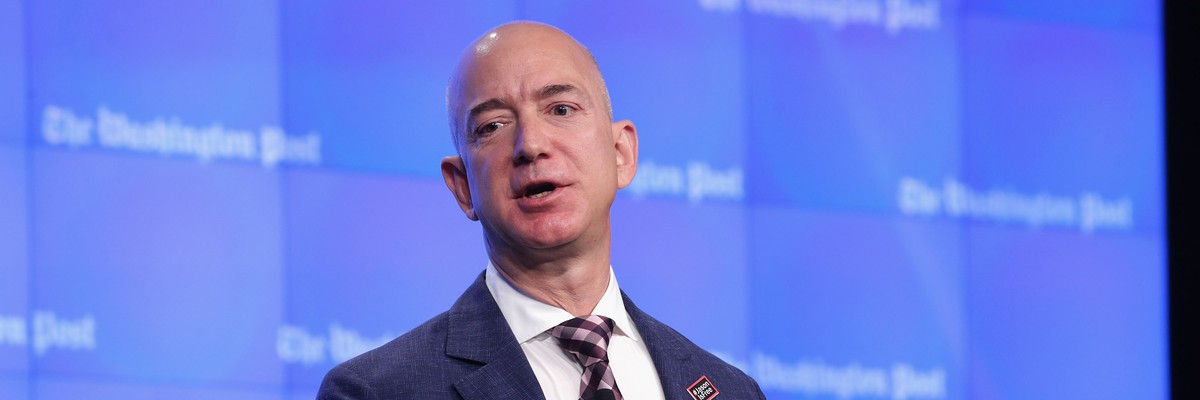
Amazon founder and Washington Post owner Jeff Bezos delivers remarks during the opening ceremony of the media company’s new location January 28, 2016 in Washington, D.C. (Photo: Chip Somodevilla/Getty Images)
The Washington Post’s shift toward free-market advocacy is not simply an editorial decision; it is a strategic move to reinforce the dominant ideological framework that benefits the billionaire class.
The recent directive by Jeff Bezos that The Washington Post editorial section should promote “personal liberties and free markets” is a stark reminder of how freedom under capitalism often boils down to the freedom of economic elites to dictate the parameters of public discourse. While Bezos has suggested that social media provides alternative perspectives, thus absolving his newspaper of the responsibility to represent diverse viewpoints, his decision is part of a broader trend of billionaire media ownership shaping acceptable discourse.
This phenomenon is visible across digital platforms as well. Elon Musk’s control over X (formerly Twitter) has demonstrated how ownership can shape public debate—both through direct interventions, such as the alleged suppression of progressive perspectives, and through more subtle changes to platform algorithms. Similarly, Mark Zuckerberg’s Meta has faced repeated allegations of privileging certain political narratives while suppressing others, including ending its “fact checking” policy that could challenge far-right viewpoints.
Perhaps the most glaring contradiction in Bezos’ advocacy for free markets is the extent to which he, and other billionaires like him, have benefited from state intervention as part of an intentional strategy of “corporate welfare.”
In each case, the rhetoric of “free speech” is selectively applied. While these platforms and newspapers claim to support open debate, their policies ultimately reflect the ideological preferences of their owners. This demonstrates a fundamental truth: In capitalist societies, freedom of expression is often contingent on the interests of those who control the means of communication. The Washington Post’s shift toward free-market advocacy is not simply an editorial decision; it is a strategic move to reinforce the dominant ideological framework that benefits the billionaire class.
The Myth of Meritocracy and the Far-Right’s War on DEI
Bezos’ framing of free markets as inherently linked to personal liberties exposes a deeper ideological assumption—namely, that economic success is the result of individual talent and merit rather than systemic privilege. This assumption is not unique to Bezos but is foundational to the way many economic elites understand their own wealth and influence.
The logic behind Bezos’ editorial direction is similar to the arguments used by the contemporary far-right to attack Diversity, Equity, and Inclusion (DEI) initiatives. The opposition to DEI is rooted in a desire to preserve the myth that success is determined purely by hard work and ability, rather than by racial, gender, or class privilege. By rejecting policies that acknowledge structural inequalities, The far-right seeks to uphold a narrative that justifies existing economic and social hierarchies.
This worldview is deeply intertwined with the ideology of neoliberalism, which insists that markets are neutral mechanisms that reward the most capable individuals. However, history shows that markets are anything but neutral. The barriers faced by marginalized groups are not simply the result of individual shortcomings; they are the product of centuries of systemic exclusion. The far-right’s attack on DEI serves to obscure these realities, just as Bezos’ insistence on free markets seeks to erase the role of privilege and power in determining economic outcomes.
By positioning The Washington Post as a champion of free markets, Bezos is promoting the idea that capitalism functions as a pure meritocracy. This serves not only to legitimize his own position but also to delegitimize calls for policies that challenge structural inequality, whether in the form of DEI programs, labor protections, or wealth redistribution measures.
The Illusion of the Free Market and Its Political Implications
Perhaps the most glaring contradiction in Bezos’ advocacy for free markets is the extent to which he, and other billionaires like him, have benefited from state intervention as part of an intentional strategy of “corporate welfare.” The notion of a truly free market, where economic actors compete on equal footing without government interference, is a fantasy. In reality, corporations like Amazon have thrived not because of unregulated competition, but because of significant government support.
From tax incentives to government contracts, Amazon has received billions in subsidies that have allowed it to dominate the retail and logistics industries. Moreover, the U.S. government plays a critical role in enforcing corporate-friendly trade policies, suppressing labor movements, and protecting the interests of multinational corporations abroad. These interventions are rarely acknowledged in discussions of free markets, yet they are crucial to understanding the power dynamics of contemporary capitalism.
If freedom under capitalism ultimately means the freedom of the wealthy to dictate the terms of discourse, then the very concept of free speech is in jeopardy.
Politically, Bezos’ editorial directive at The Washington Post serves to strengthen a broader ideological alignment between neoliberal economics and far-right nationalism. By framing free-market capitalism as an essential component of personal liberty, Bezos is laying the groundwork for a political agenda that fuses economic libertarianism with nationalist conservatism. This is significant because it provides an ideological foundation for challenging emerging economic policies that deviate from neoliberal orthodoxy—such as the rise of protectionism in response to globalization.
This alignment between free-market ideology and far-right nationalism is not new. Historically, neoliberalism has often coexisted with reactionary politics, as seen in the economic policies of figures like former U.S. President Ronald Reagan and former U.K. Prime Minister Margaret Thatcher. Today, this synthesis is being revived as right-wing populists seek to defend corporate interests while simultaneously appealing to nationalist sentiments. Bezos’ intervention in The Washington Post should be understood within this broader context: It is not just about shaping editorial policy but about consolidating an ideological framework that benefits economic elites while limiting the scope of acceptable political debate.
The Dangers of Billionaire-Controlled Media
Bezos’ decision to impose a free-market ideology on The Washington Post is not an isolated event; it is part of a larger trend in which media ownership is used to shape public discourse in ways that serve elite interests. This phenomenon extends beyond traditional journalism to social media platforms, where billionaires like Musk and Zuckerberg wield immense power over the flow of information.
At its core, this issue is about more than just media bias—it is about the fundamental tension between democracy and concentrated economic power. A truly free and open society requires a diversity of perspectives, yet the dominance of billionaire-controlled media threatens to constrain the range of acceptable debate. If freedom under capitalism ultimately means the freedom of the wealthy to dictate the terms of discourse, then the very concept of free speech is in jeopardy.
The consolidation of media power in the hands of a few ultra-wealthy individuals raises urgent questions about the future of democratic debate. If we are to challenge the ideological hegemony of economic elites, we must first recognize the mechanisms through which they shape public discourse. Bezos’ editorial mandate is not just about The Washington Post—it is a reflection of the broader struggle over who gets to define the boundaries of political and economic debate in the 21st century.