The UK government has today (Thursday) confirmed it will not challenge the judicial review brought against the Rosebank oil and gas development.
Campaign groups Uplift and Greenpeace launched legal action against the approval of the West of Shetland development late last year.
They claimed the decision made by the former UK government was “unlawful” as it failed to consider the impact of burning the fossil fuels extracted from the development during its lifetime.
Although the new Labour administration said it would not be contesting the legal case, it does not mean the licenses have been withdrawn.
However, it leaves questions for the future of the controversial development.
dizzy: The oil companies involved in the Rosebank (and Jackdaw) fields can contest the judicial review. However, this is still a huge step in defeating Rosebank. Well done, all those involved in stopping Rosebank.
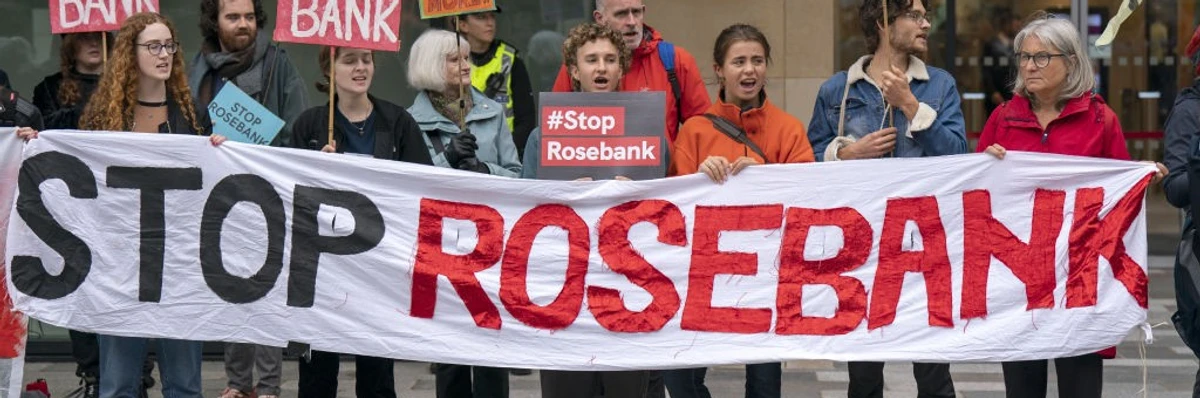
Campaigners take part in a Stop Rosebank emergency protest outside the U.K. Government building in Edinburgh, after the controversial Equinor Rosebank North Sea oil field was given the go-ahead Wednesday, September 27, 2023. (Photo: Jane Barlow/PA Images via Getty Images)
Campaigners fear increase by £149 in energy price cap by Ofgem will put more pressure on household
…
Households in Great Britain will begin the run-up to winter with a 10% increase in their energy bills after the industry regulator increased its cap on gas and electricity prices from October.
Under the new price cap, the average annual dual-fuel energy bill will rise to £1,717 a year, up £149 from its current level of £1,568, which has been in place since July.
The price cap is set every quarter by Ofgem, the energy regulator for Great Britain, and imposes a maximum on how much suppliers can charge their 28 million household customers per unit of gas and electricity.
It is expressed in terms of how much the average home would pay at this rate for their typical annual energy use, which means a cold autumn and winter could push bills even higher if households need to keep the heating on for longer.
Households in Great Britain will begin the run-up to winter with a 10% increase in their energy bills after the industry regulator increased its cap on gas and electricity prices from October.
Under the new price cap, the average annual dual-fuel energy bill will rise to £1,717 a year, up £149 from its current level of £1,568, which has been in place since July.
The price cap is set every quarter by Ofgem, the energy regulator for Great Britain, and imposes a maximum on how much suppliers can charge their 28 million household customers per unit of gas and electricity.
It is expressed in terms of how much the average home would pay at this rate for their typical annual energy use, which means a cold autumn and winter could push bills even higher if households need to keep the heating on for longer.
THE bad news is that the typical yearly household energy bill in Britain will rise by about £150 from this autumn.
…
Energy Secretary Ed Miliband, who should know better, put a superficial gloss on the situation by arguing: “The rise in the price cap is a direct result of the failed energy policy we inherited, which has left our country at the mercy of international gas markets controlled by dictators.”
The first part of that statement is spot on in as far as Labour has made a few steps to reverse the Tory barriers to a more sustainable energy policy — although not as many as Miliband would like. And Russian President Vladimir Putin is an unsavoury character but actually he wanted to keep on selling his cheap gas to the Germans and us.
Western oil and energy monopolies have long been in partnership with dictatorial regimes in the Middle East who lack even Putin’s pretensions to democratic accountability.
Labour could tighten up the regulatory regime to control consumer prices, could tax energy profits more, could use the sovereign powers that leaving the EU confers by asserting domestic controls over wholesale energy prices.
But the quickest and best way to put the energy industry at the service of the people is to take it into public ownership, use the profits to retrofit our housing stock to save energy, invest in renewables and keep consumption and prices down.
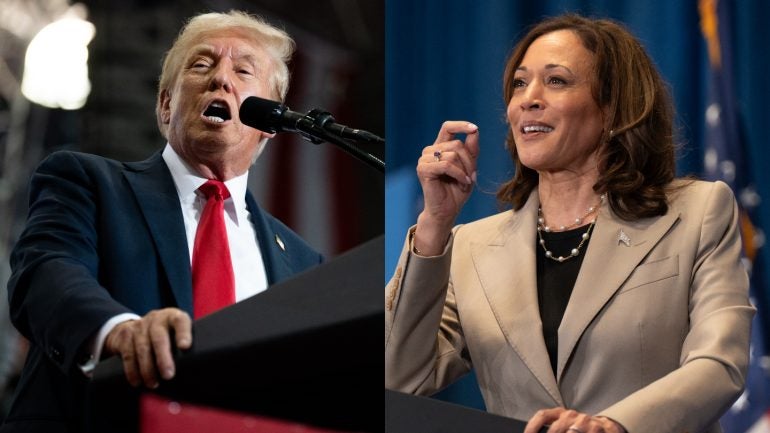
Trump and Harris’s environmental policies chart starkly different climate futures for the US and the world. Credit (from left): Stephen Maturen/Getty Images and Allison Joyce/AFP via Getty Images
The presidential candidates for the world’s largest fossil fuel producer have starkly different climate policies.
All eyes are on the US elections in November this year, with the decision of the 160+ million voters in the country to play a major role in determining the world’s trajectory towards a net-zero future.
According to the United Nations Environment Programme (UNEP), even with current pledges for emissions reduction, the planet is hurtling towards a rise of up to 2.9°C above pre-industrial levels by the end of the century. This would be catastrophic, and, one report indicates that the crisis could cost $178trn in global economic loss by 2070.
Projected 2030 emissions must fall by an additional 28-42% to limit warming to 2°C, per UNEP estimates. This means that global decisions on decarbonisation in this decade will have ramifications for this century of humanity.
…
Trump dismisses ‘green new scam’
Under a Trump administration, net-zero goals are expected to be in severe jeopardy.
During his former presidency, Trump not only reversed more than 100 Obama-era environmental protections but also pulled the US out of the landmark 2016 Paris Agreement, through which countries are working together to keep global emissions below the threshold of a 2°C rise.
During his campaign for re-election, Trump has dismissed rising environmental regulations as a “green new scam” and made no secret of his intentions to support the fossil fuel industry yet again.
Speaking to a Fox News journalist at a town hall event in Iowa, he shared plans to expand oil drilling on “day one” and also promised to “drill, baby, drill” in his presidential nomination speech on 18 July.
Moreover, at an April dinner at Trump’s Mar-a-Lago resort, he was reported to have asked oil industry executives to donate $1bn to aid his presidential campaign, citing benefits for them on avoided taxation and regulation as he plans to reverse environmental rules.
The projections are dire. According to analysis by Carbon Brief, a climate policy and science website, Trump’s likely policies would add four billion tonnes of greenhouse gas emissions to the atmosphere, which would cause global climate damages worth more than $900bn, as per the latest US government evaluations.
…
Harris hailed a ‘climate champion’
Harris, on the other hand, has a long history of enforcing climate action and is widely expected to carry on the legacy of the IRA.
She was an early co-sponsor for the Green New Deal, a comprehensive proposal for systemic decarbonisation in the US, including creating a 100% renewable energy grid and millions of green jobs.
Most notably, ahead of her brief presidential election campaign back in 2019, Harris unveiled a $10trn plan to reduce US greenhouse gas emissions to zero by 2045, including policies such as working to eliminate fossil fuel subsidies.
She also pledged to tax polluting industries and said she would establish an independent Office of Climate and Environmental Justice Accountability that would represent and support frontline communities, and monitor government compliance.
“Success in the presidential election in November would likely lead to Harris continuing to build on this existing climate legislation and defend against Republican criticism,” says Gregory.
Even now, decades after we first began trying to avert the worst of global warming, more than 80% of the world’s total energy comes from fossil fuels.
You might think this would make fossil fuel production extremely profitable. But it’s not always the case. Much of the most accessible oil has already been extracted and burned. Many countries want to shore up domestic sources of fossil fuels to boost energy security. Energy price fluctuations and competition from new energy sources such as solar, wind and fossil gas have made it harder for some fossil fuel companies to make money, especially in coal.
You might have wondered – why would some of the largest companies on Earth need subsidies? Here’s why.
Australia’s surging liquefied natural gas industry has been boosted by government funding. KDS Photographics/Shutterstock
Private companies, public money
Globally, private companies dominate fossil fuel production, though fossil fuel-rich nations often have state-owned companies, such as Saudi Arabia’s Aramco and Russia’s Rosneft.
Why would governments give fossil fuel companies money? Many reasons. But the most important is that wealthy countries have historically needed huge volumes of fossil fuels for manufacturing, transport and power. Many countries have some sources of fossil fuels inside their borders, but only a few are self-sufficient. This has enabled fossil fuel giants such as Saudi Arabia to become wealthy beyond belief.
Many governments have used subsidies to boost their energy security and encourage local producers to seek out new sources of coal, gas and oil. These subsidies can make all the difference in making fossil fuel companies competitive internationally. For instance, Canada spent billions on subsidies to boost its oil sands and fracking projects.
Subsidies were essential in the United States’ fracking revolution. Novel approaches to extracting fossil gas and oil – boosted by major tax incentives – turned the US from a major importer of oil and gas into a net exporter by 2019.
You can see why the US did this. At a stroke, it went from being dependent on energy provided by foreign nations to being independent.
Once subsidies are in place, they become very hard to remove. Indonesia’s lavish fuel subsidies now account for 2% of the nation’s GDP. When the national government tried to walk these back, there were riots.
And there’s another reason, too. Fossil fuels are still playing an important role in boosting the economy in most nations. Subsidising them has long been seen as a way to maintain economic growth and stability.
Globally, these subsidies are estimated at a staggering $10.5 trillion each year.
This figure has grown sharply in recent years, after Russia’s invasion of Ukraine. As European nations tried to wean themselves off Russia’s gas, energy prices surged worldwide. In response, some countries introduced new subsidies to support businesses and consumers.
The top-line figure of $10.5 trillion includes two types of subsidy – explicit (meaning real dollars change hands) and implicit (for example, governments building roads and railways to encourage crude oil transport).
Explicit subsidies
Explicit fossil fuel subsidies are direct financial incentives from governments to fossil fuel producers and consumers. These incentives come in different forms, such as tax breaks, direct payments, grants and price controls. All of them aim to reduce the financial burden associated with fossil fuel production and use.
In Australia, explicit subsidies include fuel tax credits and exploration tax reductions. Fossil fuel companies can get subsidies to offset the losses they make during the years it takes to find and begin extracting new fossil fuels.
In the US, oil and gas companies benefit from the oil depletion allowance, which permits them to deduct a percentage of their gross income from oil and gas sales as an expense. They can also claim tax deductions for intangible drilling costs, such as the wages of workers and material needed to find new sources of oil and gas.
China, too, uses direct subsidies, discounted land-use fees, and preferential loans as explicit subsidies to boost coal production and consumption. The national government also supports fossil fuel consumption through direct payments to consumers.
China has used subsidies to encourage exploitation of its large coal resources. zhaoliang70/Shutterstock
Implicit subsidies
Implicit subsidies are often described as “imaginary”. That doesn’t mean they don’t exist, just that they’re not a direct transfer to directly paid to fossil fuel producers.
For instance, the cost of burning fossil fuels is borne by the global community and the natural world, in the form of climate change, damage to human health and other harms. Most fossil fuel companies don’t have to pay a cent for the pollution their products cause – so in effect, they are being granted an indirect subsidy.
Implicit incentives also include government investment in facilities such as transport networks, pipelines, oil refineries and port infrastructure, which will accelerate fossil fuel production and delivery. Think of the Middle Arm development in Darwin, funded by both the federal and territory government.
Why are these subsidies still being paid?
As the world grapples with a worsening climate crisis, fossil fuel subsidies are under great scrutiny.
It’s politically difficult to withdraw subsidies once given. This is why governments around the world have instead begun to give subsidies and tax incentives to green energy developers, including the enormous $500 billion Inflation Reduction Act in the US, the European Union’s Green Deal, and China’s massive subsidies of green technologies such as electric vehicles and solar panels.
The goal here is to make renewable energy and electrified transport steadily more affordable and competitive – just as fossil fuel subsidies did for oil, gas and coal.