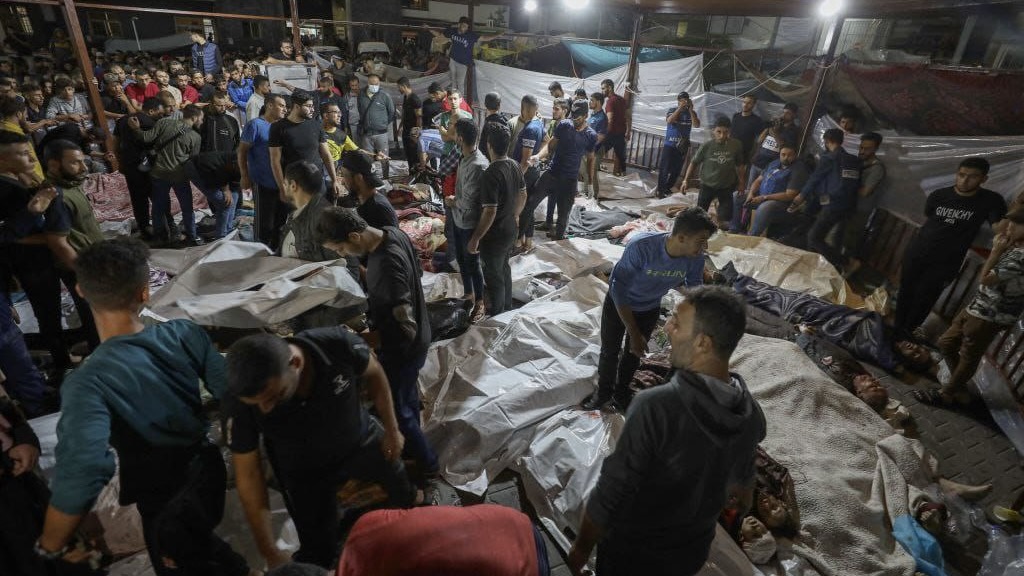
Israel bombs Al Ahli Arab Hospital, killing hundreds, October 2023.
Hospitals in northern Gaza continue to endure Israeli attacks as Palestinians’ health deteriorates amid rising hunger and infectious disease
Kamal Adwan Hospital in northern Gaza remains under direct attack by Israeli forces. After a prolonged siege on the facility, Israeli strikes have damaged critical infrastructure, including water tanks, and injured patients and staff. “Following intense fighting, a siege, and a raid, Kamal Adwan has been reduced from a hospital helping hundreds of patients with dozens of health workers to a shell of itself,” stated WHO Director-General Tedros Adhanom Ghebreyesus.
The latest attacks have destroyed key medical equipment for treating children and newborns, including incubators. Video footage from the hospital shows agitated efforts by staff to move children as Israeli forces target the upper floors of the building. Since children’s and neonatal care in Gaza has suffered severe blows since October 2023, the impact of these latest attacks on Kamal Adwan will deepen the overall healthcare crisis, exacerbated by the fact that most children are exposed to hunger and infectious diseases.
The situation at Al-Awda Hospital is similarly dire. The facility has received no fuel since early October and key services, including ambulance transport, were forced to cease as a result of the attacks. Although limited UN missions have reached the hospital to conduct medical evacuations, they were not allowed to deliver critical supplies, pushing the facility to the brink of collapse. Health workers have voiced fears that ongoing attacks on hospitals in northern Gaza may be intended to completely annihilate healthcare in the region, including by exterminating medical staff who refuse to leave.
Despite targeted attacks and health workers’ concerns about safety, Kamal Adwan and Al-Awda continue to represent the only available point of care for northern Gaza residents. With the hospitals overwhelmed, many patients are dying within days due to scarce medical capacity, Al Jazeera’s Hani Mahmoud reported on November 5.
Other healthcare facilities in the north are also under attack by Israeli forces. Shortly after the polio vaccination campaign in northern Gaza resumed in early November, a primary health center designated as an immunization site was hit, injuring patients and staff. This attack was carried out despite the center being located in an area where a humanitarian pause was agreed to allow vaccination to proceed, according to the WHO.
Because of these ongoing attacks and restrictions imposed by Israeli authorities, the polio vaccination campaign in northern Gaza only reached around 94,000 children out of the planned 119,000. In other parts of the Gaza Strip, WHO and partners were able to achieve or even surpass their 90% coverage goal, but the vaccination rate in northern Gaza dropped below 80%. WHO officials noted that while many children received their vaccines, the continuous obstructions by Israeli forces undermined the overall campaign. The area designated for immunization was restricted compared to previous phases, and the attack on the primary health center highlighted that even these limited zones were not spared from attacks. Rik Peeperkorn, WHO representative for Palestine, described the immunization drive as without doubt “a compromised campaign.”
Women’s health in Gaza also continues to be severely impacted by Israeli obstructions. The UN estimates that 155,000 pregnant and breastfeeding women have been affected by attacks on healthcare facilities, with experts warning of rising rates of complicated, high-risk pregnancies and women forced to give birth without any medical support.
Palestinian prisoners have been denied access to healthcare as well. Prisoners’ associations recently reported on health conditions among political prisoners in Negev detention camp, revealing that “all detainees are infected with scabies and don’t receive any medical treatment, and [are] deprived of hygiene and bathing supplies,” leading to worsening health conditions.
As if this was not enough, new concerns about healthcare access have emerged after the Israeli parliament banned UNRWA’s work. “No one in the UN can replace UNRWA,” agreed Tedros and Peeperkorn. They explained that while WHO organizes medical missions into Gaza, UNRWA’s mandate is essential for ongoing healthcare delivery. Besides coordinating with other agencies, UNRWA directly provides health services, meaning that, once the ban comes into effect, it will leave even more people across Palestine without lifesaving care.
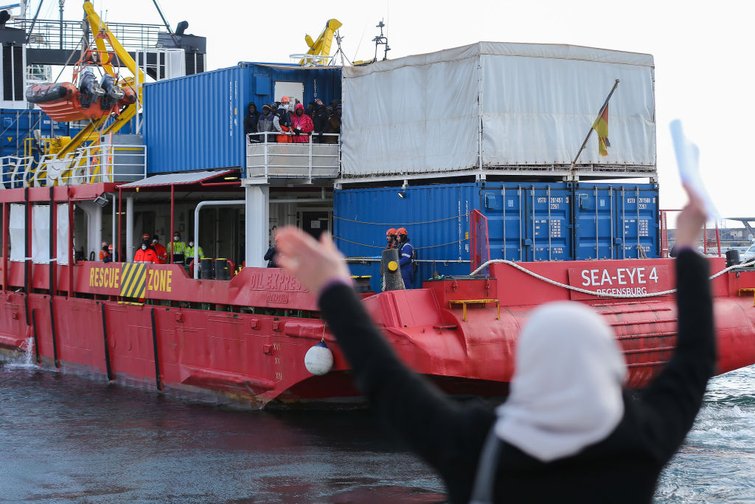
A woman greets the people on board the Sea-Eye 4 rescue ship as it arrives in Naples, Italy in June 2023 | Marco Cantile/LightRocket/Getty Images. All rights reserved
We were fined and our boat blocked after we rescued 114 people. It’s a political campaign to make movement illegal
Hope arrived on the radio, late in the afternoon with August sunshine blasting the deck.
After tortuous negotiations with authorities from four countries, Italy had finally granted us a port of safety. We were allowed to disembark the people we had rescued, in accordance with international law.
We had 114 passengers on board our ship, the Sea Eye 4, where I was volunteering as part of the crew. Overall, we had rescued three boats in distress. Some of the rescued had drifted without food, fuel, or water for days. One man had been unconscious for over 24 hours and would have been unlikely to survive much longer without aid.
But the rescue operation was not where the troubles ended. On reaching port in Salerno, we found our ship detained for 20 days and its operator, the NGO Sea Eye, fined €3,000.
We were one of three ships detained during that week in August 2023. This represented a total loss of 60 operating days during high summer, in a year where at least 2,000 people had already died while trying to cross the Mediterranean.
We were detained under the 2023 Piantedosi Decree, an Italian law which mandates immediate return to port after just one rescue. The law forces crews to make impossible choices. Should you ignore incoming distress calls and risk lives in the present, or risk detention and the ability to save lives in the future?
The decree is not an isolated piece of legislation – in Italy or the EU. It is just one of dozens of policies and laws that have been created to limit the movement of people across borders, and to limit other people’s capacity to help them. For over a decade, European states have withdrawn, denied, or evaded their responsibility to carry out rescues or provide safe ports.
Criminalisation: a refined tactic
It didn’t start off this way. In 2013, horrific twin shipwrecks near Lampedusa led to a serious response from the Italian government – a year-long rescue operation called Mare Nostrum, which saved thousands of lives.
But as the claims grew that Europe was experiencing a ‘migration crisis’, and with wider European support significantly lacking, the mood in Italy changed. Mare Nostrum was cancelled, and in 2017 a ‘code of conduct’ was introduced that restricted the actions of civil rescue ships.
This “Minniti Code” was brought in by centrists seeking to blunt a right-wing surge by proving they were sufficiently tough on irregular migration. It had little effect. Instead, the code handed tools to the far-right (such as the mainstreaming of an anti-migrant narrative and demonisation of rescue operations) that they would build on in later years to make additional gains.
At the end of last decade, rescue crews were being surveilled, wiretapped, and threatened with jail in a vicious offensive led by the Italian right. The sweeping crackdowns were an undeniable effort to criminalise humanitarian action and the movement of people across borders.
This campaign was eventually seen by policymakers as counterproductive. It had caused a huge public backlash, and taking NGOs and individuals to court with little evidence proved costly and time consuming. Undeterred, however, the Italian state switched to bureaucratic harassment.
Using a combination of fines, blockades, the assignment of distant ports of safety and weaponised inspections, they continued to significantly limit the ability of rescue crews to save lives at sea. They just kept a lower profile this time, lessening the potential for public outcry.
Block the rescuers, enable the militias
While Italy harassed rescue workers, it was also busy – together with the EU – handing over responsibility for rescue to violent criminals. The so-called Libyan Coast Guard (LCG) has received boats, equipment, funding, and support to establish a wider search and rescue area. It is routinely given the coordinates of boats in distress by Frontex, the EU border agency.
The LCG attacks, abuses, and violates the rights of people in distress at sea. It also returns them to detention camps in Libya where extortion, torture and exploitation are rife.
When the Libyan coast guard first spotted the rescue boat, they threatened to shoot at the rescuers
On their first mission back at sea after Sea Eye 4’s detainment, the crew arrived at a scene where the LCG was dangerously manoeuvring around a boat in distress, causing people to fall into the water. And when the LCG first spotted the rescue boat, they threatened to shoot at the rescuers.
Sea Eye 4 ultimately did respond to the people in distress, but was unable to prevent four people drowning. When they returned, Italy once again detained the ship and fined its crew for failing to “cooperate” with Libyan forces.
Over a year later, I returned to the central Mediterranean aboard the Humanity 1, a rescue ship run by the organisation SOS Humanity. The day before we sailed, Tunisia’s president Kais Saied was re-elected. He has joined Libya as a staunch ally in Europe’s fight against people migrating. Tunisia, Libya and Morocco have carried out countless “desert dumps”, in which thousands of mostly Black migrants are transported to and abandoned en masse in the Sahara.
Tunisia’s coast guard, which also has a grim record of rights abuses, is becoming more active too. Our most recent mission took place near the recently expanded Tunisian zone of rescue responsibility in the Mediterranean. The expansion of the zone has left rescue crews in that area at even further risk of detainment if they don’t return rescued people to Tunisia.
Whilst we were at sea, Giorgia Meloni launched a new attempt to forcibly transfer people disembarked in Italy to camps in Albania to await deportation. This proved a costly failure when the first twelve detainees immediately returned to Italy after a court judgment. But it provides just one more indication of a very worrying direction of travel for Italy and the EU.
All these efforts to hinder civilian rescue are, of course, partially about limiting the number of people arriving by sea to Europe. But that’s not the whole picture.
All together, the civil fleet only carries out a small proportion of overall rescues in the Med. Its ships brought in just 8% of those arriving in Italy in 2023. The Italian coast guard is still rescuing the rest of those delivered to the country’s shores – even though their area of operations has now shrunk to an area relatively close to the shoreline.
So why go to such great effort to stymie and discredit civil sea rescue? Something else is going on here.
Making movement illegal
Europe speaks loudly about its commitment to human rights and humanitarian values. For years, rescue organisations have pointed to the shallowness of these commitments in the face of thousands dying off European shores.
Europe and its member states have responded by delegitimising rescue workers’ motives and their voices, impugning them as not genuine humanitarians. They accuse the civil fleet of unprofessionalism, of being too political, and of cooperating with ‘smugglers’. When they’re feeling generous, they say rescuers are well-intentioned but their presence at sea encourages people to risk dangerous crossings.
None of this has ever been proven. Every single smuggling case brought against rescue crews has collapsed. And comprehensive studies have debunked the link between the presence of rescue assets and people’s decisions to cross the Mediterranean.
As the EU rewrites its anti-smuggling policy, there is a real risk that the criminalisation of people migrating, and people who assist them, will deepen
But it does not matter anymore. Humanitarian actors in the Mediterranean have already become associated with criminality, and that idea is now embedded in European political discourse. Justified by the claim of ‘countering smuggling’, the EU is seeking to undermine every aspect of irregular movement by criminalising more and more parts of it outright and framing the rest as criminal in essence.
It’s not just rescue workers. From 2015 to 2018 alone, Italy arrested 1,300 people they accused of driving small boats. An Iranian women’s rights activist fleeing persecution and four Libyan refugee footballers who survived a shipwreck were among those caught up in this campaign. Greece has engaged in similar tactics, with thousands of trials taking place and ‘boat drivers’ handed sentences of over 100 years in prison.
Many of the trials are deeply legally unsound, and some have lasted as little as 30 minutes. But their effect on the framing of humanitarian action has a much longer shelf life. Europe and Italy are seeking to tar everyone associated with irregular migration as criminals in the court of public opinion – those on the move and those extending a hand.
‘Counter-smuggling’ doesn’t work
The EU is currently rewriting its anti-smuggling policy, and there is a real risk that the criminalisation of people migrating, and people who act in solidarity with them, will deepen. As with the war on drugs and prohibition-type policies in general, the strategy won’t stop people from doing either of these things. But it will likely get more people killed.
Neither smuggling groups nor rescue actors create the demand for their services. Poverty, violence, and the absence of safe routes do. As borders are enforced more harshly, people attempting to move are forced to rely on more dangerous routes, and sometimes more dangerous actors. More people end up in distress, and more people need to be rescued.
It’s a loop, but not one created by smuggling profits. It exists because governments refuse to see reason.
Another way to understand this is to see ‘countering smuggling’ not so much as a policy approach, but as a political convergence. It’s where the demands of the right for evermore violent border control and the demands of liberals for lip-service to humanitarian principles meet.
This convergence reframes border enforcement as ‘protecting’ migrants from the brutality of gangs. It conjures up a simple enemy, obscuring the agency of people migrating and the reality of their journeys. And it treats movement as a crime, one which necessitates a multinational police and military response.
In turn, this helps the lucrative border and surveillance industry to hijack policy, selling ever more expensive ‘solutions’ to monitoring and controlling movement. Those resources should be going into helping people, not harming them. The first imperative should not be to “smash gangs” but to save lives.
We need the restoration of coordinated search and rescue by the competent authorities. We need safe routes. And we need funding and support both for people arriving and the wider communities they settle in.
At the moment, such vision and compassion seem a long way from the reality of European politics. But the emergency at Europe’s shores is not going anywhere. Not until we reach an approach founded on hope and courage rather than fear and division.
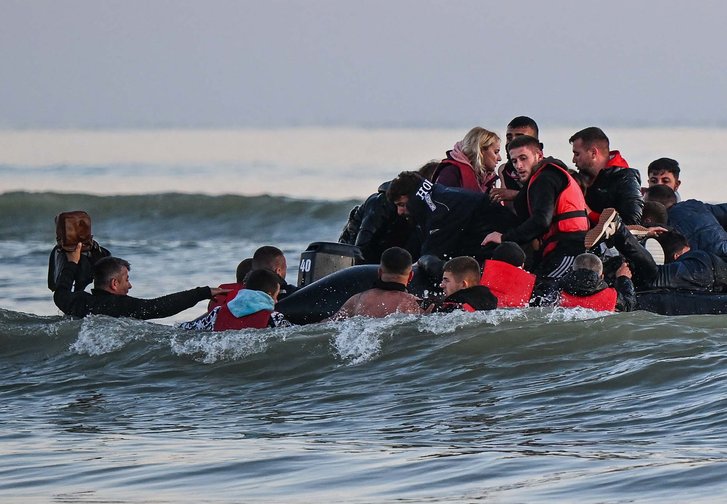
People board an inflatable dinghy in an attempt to cross the Channel from France to the UK in July 2022 | Denis Charlet/AFP/Getty Images. All rights reserved
New series: UK and EU governments are targeting people crossing borders in the name of ‘counter-smuggling’
On 1 June 2019, Samyar Bani boarded a small dinghy with five other people. Looking out at the expanse of the English Channel, he said he felt afraid, but knew he had to continue. Just a few miles more and he would be in the UK. At that point, he never expected to still be journeying, still seeking safety, two years after fleeing persecution in his hometown of Shiraz, Iran.
Bani and his companions had purchased the dinghy together to avoid smugglers’ fees. He hoped the boat would keep them safe as they crossed the water, because he didn’t know how to swim. It was a dangerous last step, he knew that. But, given the limits of the UK’s resettlement routes and the tightness of its visa regimes, he saw this as his best chance for reaching sanctuary.
Bani hoped he’d be welcomed on the other side of the Channel, and that his request for asylum would be accepted. He had no idea that placing his hand on the tiller of the boat would land him in prison, cause him to plead his case before a jury at trial, and tie him up in an appeal process for two and a half years.
He never expected to lose contact with his wife and daughter, or for them to spend three years mourning the death of their husband and father. He never expected to have his picture put online, or to be branded as a ‘dangerous people smuggler’.
All of this happened to Bani because he helped to buy a boat, and helped to steer it to safety.
A new normal has crept in. Over the last few decades, crossing borders without permission – sometimes called ‘irregular migration’ – has become a criminal offence in many countries. Among those prosecuted are people in search of asylum, fleeing war and persecution.
These migrants and refugees, as well as solidarity actors like rescue workers, are also increasingly at risk of being labelled as ‘smugglers’ for the purposes of prosecution.
Governments are widening the nets of who they consider criminal as they respond to calls from the far-right to crack down on immigration. In doing so, states justify measures which racially profile, control and contain people on the move. These measures have been shown to make no tangible difference to immigration numbers, and instead cause immense harm to the very people they purport to protect.
In this new series, 12 authors do a deep dive into the criminalisation of migration and solidarity in the UK and Europe. Some of the contributors to this series have been accused of espionage, people smuggling, and facilitating ‘illegal entry/ arrival’. Some were crossing borders, and others were acting in solidarity with those crossing borders. Contributors also include policy experts and journalists working to expose those injustices.
Over the next two weeks, we’ll examine the hidden corners of global anti-migration structures set up in the name of ‘anti-smuggling’. We’ll be looking at: the detention of rescue workers in Italy; the imprisonment ofchildrenunder ‘smuggling’ charges in the UK; the repeal of EU-enforced smuggling laws in Niger; how the EU is putting pressure on migrants’ rights groups in North Africa; the lucrative policing contracts in the ‘digital fight’ against smuggling; and the far-reaching influence of anti-mafia and counter-terror policies on counter-smuggling.
Widening the definition of ‘smuggling’
People fleeing wars, occupations or persecution often have no choice but to travel without documents or visas. Many must leave quickly and under dangerous circumstances, and in any case most countries of destination don’t make any practical legal routes available to them.
In recognition of these circumstances, refugees are protected from “penalties on account of their illegal entry or presence” by the 1951 Refugee Convention, which the UK and all EU countries are party to. But their protected status has, in recent years, been eroded by anti-immigration and counter-smuggling policies. What used to be considered ‘irregular’ movement for asylum has increasingly been redefined as ‘illegal’.
Many countries, for example, now target the people steering the boats carrying people on the move – people like Samyar Bani – regardless of whether they were involved further in ‘smuggling’ activities or not. Organisations and researchers have documented this practice in Greece, Italy, Spain, Indonesia, and, most recently, in the UK.
Soon after people started arriving in the UK in ‘small boats’ in greater numbers in late 2018, the Conservative government began to arrest, charge, and convict those identified as steering the dinghies. These arrests were accompanied by media briefings labelling the people arrested as ‘smugglers’ responsible for crossings.
Yet even those tasked with identifying the ‘smugglers’ questioned the logic. Border Force officers told inspectors, “there were no organised crime group members onboard the boats, although one of the migrants might have agreed with the facilitators to act as a ‘chaperone’ for a reduced fee.”
A series of successful appeals in 2021 overturned these early convictions. Lawyers argued that people intending to arrive at ports and claim asylum are not guilty of the offence of ‘illegal entry’, since they are simply arriving irregularly, and then entering as an ‘asylum seeker’.
The legislation effectively made all irregular arrival, even for the purposes of claiming asylum, a criminal offence in the UK
In response, the UK government used the 2022 Nationality and Borders Act to expand the criminal offences that can be applied against people crossing borders irregularly. This legislation introduced a new offence of ‘illegal arrival’ and increased the maximum sentence to four years imprisonment. For the crime of ‘facilitation’ – in other words, assisting arrival or ‘smuggling’ – the maximum sentence was increased to life in prison.
This legislation effectively made all irregular arrival, even for the purposes of claiming asylum, a criminal offence in the UK.
Across Europe, states are also working on expanding the definition of ‘smuggling’ to increase the number of prosecutions. Member states can currently charge people for offences relating to crossing borders, or for defending the rights of those crossing borders through the EU’s 2002 Facilitation Directive.
Just like in the UK, the directive has allowed states to prosecute people for steering boats even if no other evidence of ‘smuggling’ activities is presented. In 2021, a Greek court sentenced M. Hanad Abdi to 142 years in prison for “transporting” 33 people to the country. The decision was made despite Abdi having been forced “at gunpoint” to helm the boat, and despite him saving 31 of his co-passengers’ lives on the way.
His lawyers appealed the sentence, and it was reduced to eight years in 2023. Responding to the decision, Abdi’s lawyer, Alexandros Georgoulis wrote: “The law is completely obsolete. We now know that smugglers no longer approach the Greek coast to avoid arrest, and let the migrants guide the boats on their own.”
The new EU directive is likely to “dramatically increase” the criminalisation of migration and solidarity in Europe, according to migrants’ rights organisation PICUM. It will introduce longer prison sentences, broaden provisions for criminalising NGO workers, and continue to allow smuggling charges to be brought against people simply for crossing borders with their children.
Hundreds already serving sentences
As the UK and EU expand the legislation which allows them to criminalise those crossing borders or those standing in solidarity with them, hundreds are already caught in the web of the system.
According to PICUM, 117 people were subject to criminal proceedings for their solidarity work with people crossing borders in Europe, and 76 people were charged for crossing borders in 2023. Most of them faced charges of migrant smuggling or facilitation of entry, transit or stay, allowed under the 2002 EU directive. These numbers are most likely an undercount, since charges across the entire bloc are hard to track.
Those branded as ‘smugglers’ are made convenient scapegoats for the real, unaddressed failures of UK and EU governments
The vast majority of these people were crossing borders to seek sanctuary and a better life. Some were victims of trafficking and torture. And at least 22 of those charged in the UK are age disputed, meaning that they were charged as an adult despite stating their age as under 18.
In courts across Europe and the UK, those arrested often explain how they drove the boats under duress, or because they could not otherwise afford the passage. Individuals – some of them teenagers like Ibrahima Bah or the El Hiblu 3 – explain how they were only seeking a place of safety.
Yet they have been declared ‘smugglers’ and labelled as solely responsible for any harms that occurred at sea. This placement of blame entirely obscures the structural responsibility of states who close alternative routes to safety while continuing to invest in border security infrastructure.
And Europe isn’t only criminalising people on its own shores. Years of policies to offshore its border control, for example to countries on the other side of the Mediterranean, have resulted in people being targeted for migrating or for solidarity work before they even reach European soil.
EU countries have handed billions to Turkey, Libya, Tunisia, Egypt, Mauritania and Morocco in deals to control and curb migration. Many of those deals hand funds to authoritarian regimes – and, in Libya’s case, facilitate human rights abuses on and off its shores.
Erosion of rights for everyone
Criminalisation policies cause immense harm to people. NGO workers are targeted for supporting people on the move and are forced to uproot their work and their lives. People migrating are forced to take even more dangerous routes to evade arrests, through deserts and in unseaworthy boats – and if they do make it to safety, they face spending years or decades in prison.
All the while, those branded as ‘smugglers’ are made convenient scapegoats for the real, unaddressed failures of UK and EU governments: soaring poverty and homelessness, declining public services, a rising cost of living and crises in the healthcare systems.
Experts have long called for safe routes to be made available to people seeking sanctuary. But governments seem intent to plough on with harmful criminalisation policies instead, all the while increasing the risks people are forced to take at borders.
Since being released from prison, Samyar Bani has been granted leave to remain in the UK. The scars of his experiences are far from healed: he still suffers flashbacks from his time in prison, is still struggling to get a job due to his criminal record, and has had his application to bring his wife and daughter to the UK rejected.
But he’s not giving up on building a life in safety. He’s working on his English so he can go back to work, and he’s appealing the decision on his family reunification application. “Humans need life,” said Bani at the end of our interview together. “My country wasn’t safe for me, so I came to the UK.”
He paused. “Police understand who a smuggler is, and they don’t sit in the boat. They just do this so they can close the border to refugees.”
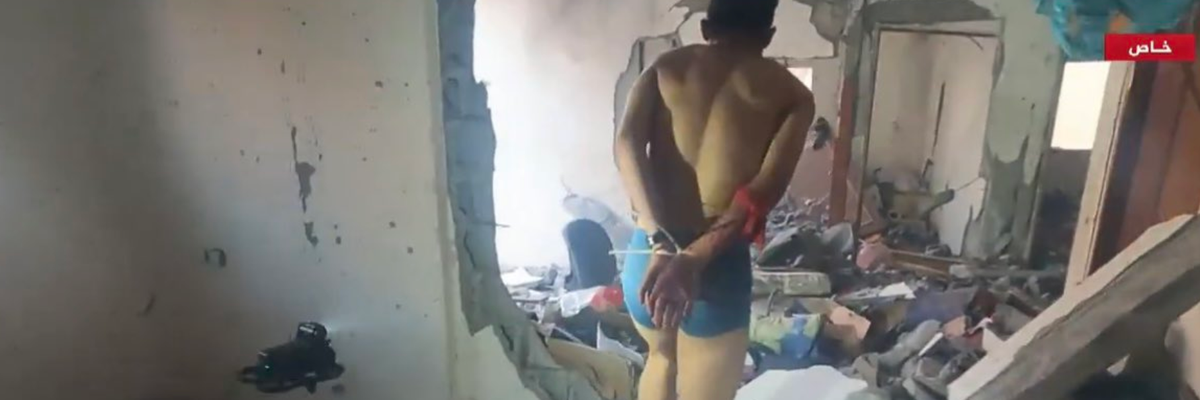
Footage shows a Palestinian man being used by the Israel Defense Forces as a human shield. (Photo: Al Jazeera)
“The earliest testimony we have on it is from a soldier who was aware of it just a few weeks after the ground invasion began,” one human rights expert said. “The latest testimony we have on this is from the summer.”
The Israel Defense Forces routinely use detained Palestinians as human shields in Gaza, according to testimony from four Palestinians and one IDF soldier shared withThe Washington Post.
Their stories, published on Sunday, build on other accounts from Haaretz, Al Jazeera, the international press, and Defense for Children International to reveal a pattern of Israeli soldiers forcing Palestinians—including children—to enter buildings or tunnels ahead of them to check for militants or explosives, in clear violation of international law.
“This wasn’t something that happened just here and there but rather on a large scale throughout a number of different units, at different times, throughout the war and in different places,” Joel Carmel, advocacy director of Breaking the Silence, told The Washington Post.
“My hospital was turning into rubble, and they were asking me to demolish it with my own hands.”
The incidents recounted to the Post occurred between January and August. One man, 20-year-old Mohammed Saad, said he was detained by the IDF in June and interrogated for several days. Then, a new pattern began. Every day, he and two other Palestinian men were blindfolded and taken to a different location. They were made to wear IDF uniforms, given cameras, and told to enter buildings ahead of the Israeli soldiers to film and check for explosives. On the second day, an explosion went off after Saad had made his forced investigation.
“They tied my hands and threw me on the sand,” he recalled. “They took turns beating me. I still don’t know where the explosion came from.”
Another time, the captain of the unit he was detained by showed him an image of his family home destroyed by bombing.
“If you do not cooperate with us, we will kill all your family members like this,” the captain said.
On the 15th day of Saab’s ordeal, he was given civilian clothes and told to walk. As he did so, he felt a pain and realized he had been shot in the back.
The other three Palestinians interviewed by the Post were detained during the IDF’s raid on al-Shifa hospital in Gaza City in March. One was a surgeon at the hospital, while the other two were taken from their homes nearby. They were made to enter the hospital building ahead of IDF troops, remove any barriers, and take pictures of each room they entered.
“I was telling them that my hands are precious for my work; I am the only vascular surgeon here,” the surgeon, Omar al-Jadba recalled to the Post. “My hospital was turning into rubble, and they were asking me to demolish it with my own hands.”
The IDF soldier, who spoke anonymously, said that two Palestinian detainees were placed with his unit to make sure that buildings were safe to enter. One of them was only a teenager. His commander said the two men were terrorists, but then later said they could be released after the mission was over.
“At this point we understood that if we could release them, then they were not terrorists,” the soldier, a reservist, told the Post. “The officer just lied to us.”
“Every one of their accusations is a confession.”
Another group of soldiers questioned the use of human shields, telling a higher-level commander that it was against international law.
“He told us that international law is not important and the only thing that simple soldiers need to think about is the ethical code of the IDF,” the soldier told the Post.
However, the IDF said in a statement that its orders prohibit the use of human shields.
Breaking the Silence, a group that records testimonies from Israeli soldiers in the occupied Palestinian territories, said the reservist’s account was in line with others they had received.
“The earliest testimony we have on it is from a soldier who was aware of it just a few weeks after the ground invasion began,” Carmel said. “The latest testimony we have on this is from the summer.”
The Post reporting came the same day as a major Associated Press investigation into Israeli raids on three hospitals in northern Gaza at the end of 2023. Israel has often justified its hospital raids with the claim that Hamas operates from the inside, turning all the patients and doctors into human shields. However, the AP concluded that “Israel has presented little or even no evidence of a significant Hamas presence at the three” hospitals it considered: the al-Awda, Indonesian, and Kamal Adwan hospitals.
“What do [former U.S. President Donald] Trump and [Israeli Prime Minister Benjamin] Netanyahu have in common?” asked journalist Mehdi Hasan in response to the Post‘s reporting. “Many things but especially… projection. Every one of their accusations is a confession.”
Other commenters responded to the clear violations of international law and questioned why the U.S. continues to provide weapons and funding to the IDF while it engages in war crimes.
The Austin for Palestine coalition shared a quote from the article, noting that what it described was “paid for by our tax dollars.”
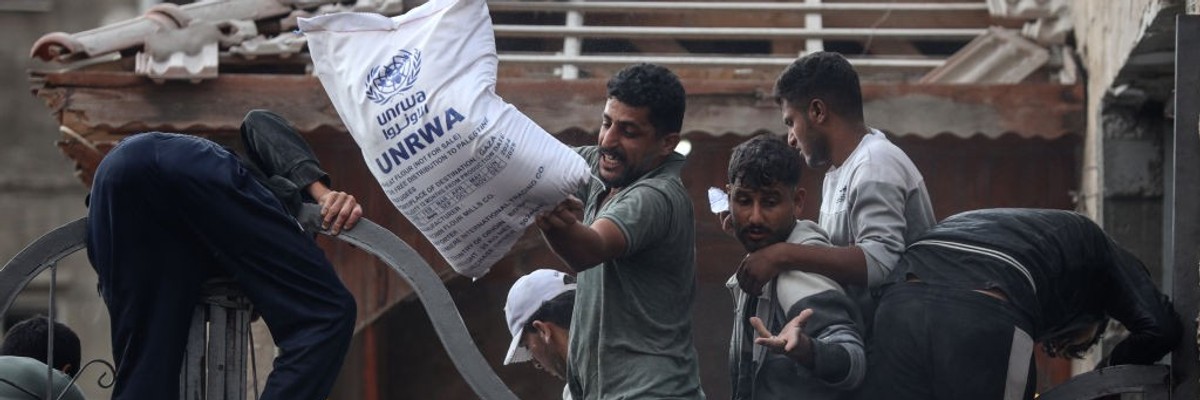
Palestinians scramble to receive sacks of flour at a United Nations Relief and Works Agency aid distribution center in Deir al-Balah, Gaza on November 3, 2024. (Photo: Majdi Fathi/NurPhoto via Getty Images)
“Restricting humanitarian access and at the same time dismantling UNRWA will add an additional layer of suffering to already unspeakable suffering,” said the U.N. agency’s commissioner-general.
Israel’s Foreign Affairs Ministry on Sunday formally notified the United Nations that it has terminated a decades-old legal agreement governing the country’s relations with the U.N. agency for Palestinian refugees, a move that aid workers and advocacy groups say will spell further disaster for Gaza’s besieged and famine-stricken population as winter approaches.
The director-general of the Israeli Foreign Affairs Ministry announced the decision to scrap the 1967 agreement in a letter to the president of the U.N. General Assembly, a message sent roughly a week after Israeli lawmakers approved legislation banning the U.N. Relief and Works Agency for Palestine Refugees in the Near East (UNRWA) from operating or providing services “in the sovereign territory of the state of Israel.”
The new letter states that the legislation “will enter into effect following a three-month period.”
The Washington Post reported Monday that Juliette Touma, UNRWA’s communications director, said that “the agency expected to continue its work coordinating the distribution of aid in Gaza and the West Bank at the operational level.”
But aid groups have warned that Israel’s UNRWA ban could inflict fatal damage to humanitarian operations in Gaza and the West Bank, given Israeli control over access to the illegally occupied territories. The legislation Israeli lawmakers passed last week bars the government from issuing work permits to foreign UNRWA staff and prevents the military from coordinating with the aid agency.
“The human cost of this ban is immeasurable,” Mara Kronenfeld, executive director of UNRWA USA, said in a statement last week. “This Israeli Knesset vote banning UNRWA is not merely an attack on the U.N. agency; it’s an attack on the fundamental rights and dignity due to all human beings. The consequences of this ban could result in the loss of tens of thousands, if not more, precious Palestinian lives. Where is the humanity?”
“You can hear children crying, people screaming, people running for their lives, and it has been nonstop for 24 hours. There’s nowhere to go. People are trapped.”
The U.S., Israel’s main ally and arms supplier, urged the Israeli government last week not to implement the newly passed legislation, even though the U.S. has yet to restore its own funding to UNRWA. The Biden administration suspended U.S. funding for UNRWA in January after Israel accused a small number of agency employees of taking part in the October 7, 2023 Hamas-led attack on Israel.
The U.N. fired nine UNRWA workers after an investigation determined that they “may have been involved” in the attack. UNRWA has roughly 13,000 staffers in the Gaza Strip, and the agency is the most important aid group operating in the enclave.
Dylan Williams, vice president for government affairs at the Center for International Policy, argued that by terminating its agreement with UNRWA, “Israel is also further breaking U.S. law prohibiting the restriction of aid delivery.”
“It’s a definitive rejection of an explicit demand in the Biden administration’s October 13 letter and by law must result in halting U.S. arms and military aid to Israel,” Williams added.
The Israeli Foreign Affairs Ministry’s announcement came as Israel’s military continued its bombing campaign and ground attacks across Gaza. Reuters reported that at least a dozen Palestinians were killed by Israeli airstrikes on Monday, including seven people in an attack on houses in northern Gaza.
“It is absolutely terrifying,” Louise Wateridge, an UNRWA spokesperson, told Al Jazeera on Saturday, referring to conditions on the ground in Gaza. “You can hear children crying, people screaming, people running for their lives, and it has been nonstop for 24 hours. There’s nowhere to go. People are trapped.”
Philippe Lazzarini, UNRWA’s commissioner-general, said Monday that Israeli authorities allowed an average of just 30 aid trucks to enter Gaza per day last month.
Prior to October 7, 2023, around 500 aid trucks were entering the enclave daily.
“This cannot meet the needs of over 2 million people, many of whom are starving, sick, and in desperate conditions,” Lazzarini said Monday. “Restricting humanitarian access and at the same time dismantling UNRWA will add an additional layer of suffering to already unspeakable suffering.”
“Only political will,” he added, “can put an end to a politically made situation.”