‘All states have an obligation to prevent atrocity crimes and promote adherence to norms that protect civilians. The international community is long overdue to live up to these commitments.’
Sixteen leading international human rights and humanitarian organisations have made a joint call to all UN Member States to stop fuelling the crisis in Gaza, to avert further loss of civilian life and humanitarian catastrophe.
The aid coalition includes Oxfam, Amnesty International, and Save the Children. It is demanding an immediate halt on the transfer of weapons, parts and ammunition to Israel and Palestinian armed groups while there is a risk they are used to ‘commit or facilitate serious violations of international humanitarian or human rights law.’
The United Nations’ Palestinian Refugee Agency has warned that around 1.7 million people have been displaced within Gaza. The Gaza Health Ministry says the Palestinian death toll from the conflict is over 25,700, most of which are women and children. Islamic Relief (IR) said the figures show that 4 percent of the population of Gaza was now dead or injured.
Over 95 percent of Israel’s supply of weapons comes from the US. The UK, Italy and Germany also produce parts which are sold to Israel. The UK is home to Israeli weapon manufacturers, including Elbit Systems, which makes surveillance and armed drones. Both the UK and US administrations have been accused of playing a part in facilitating the destruction of Gaza.
While the Court did not grant South Africa’s request for an immediate suspension of Israel’s military operations, it has ordered Israel take “all measures” to prevent acts of genocide in Gaza, including by its military
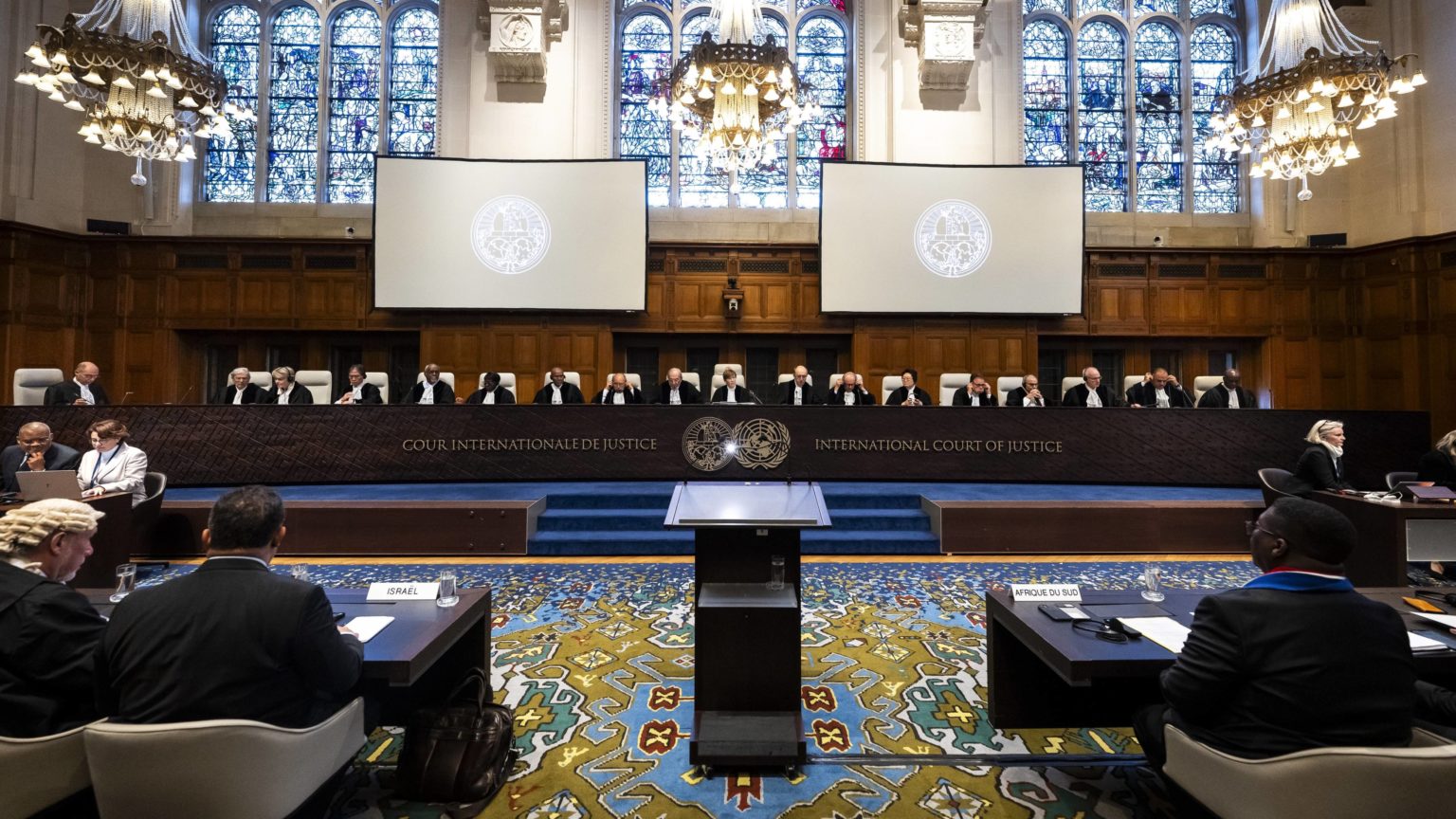
The International Court of Justice (ICJ) has ruled in favor of South Africa’s request for provisional measures in its case against Israel over the ongoing war on Gaza. The request is part of an application filed by Pretoria, accusing Israel of violating its obligations under the Convention on the Prevention and Punishment of the Crime of Genocide.
In a ruling issued on January 26, the Court determined that it had jurisdiction over the matter, and as such, rejected Israel’s request for the case to be dismissed.
While reading Friday’s ruling, Judge Joan Donoghue reiterated that at the stage for the request for provisional measures, the court is not required to ascertain whether any violations of Israel’s obligations under the Genocide Convention have occurred, but whether the acts complained of “appear to be capable” of falling under its provisions.
“In the court’s view, at least some of the acts and omissions alleged by South Africa have been committed by Israel in Gaza appear to be capable of falling within the provisions of the Convention”, the ICJ’s order states.
The Court also recognized that the Palestinians in Gaza formed a substantial part of the Palestinian people as a protected group under Article II of the Convention, which defines genocide as “acts committed with intent to destroy, in whole or in part, a national, ethnical, racial or religious group.”
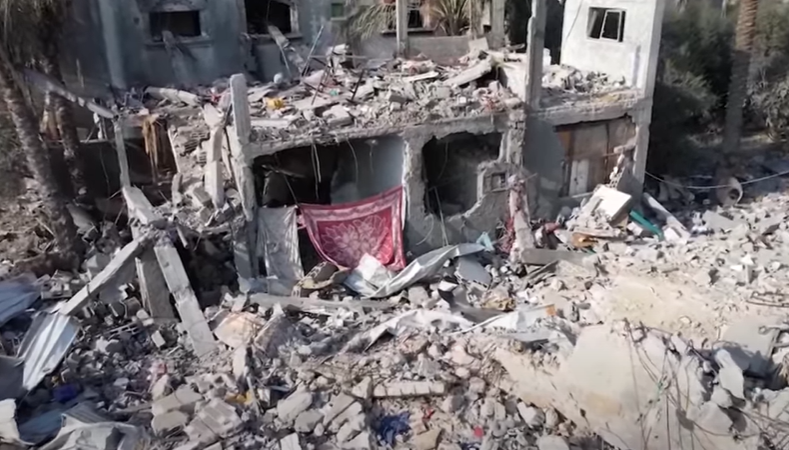
“The Court notes that the military operation being conducted by Israel following the attack of 7 October 2023 has resulted in a large number of deaths and injuries, as well as massive destruction of homes, forcible displacement of the vast majority of the population and extensive damage to civilian infrastructure.”
Donaghue went on to cite statements by the UN humanitarian chief, Martin Griffiths, who had stated on January 5 that Gaza had “become a place of death and despair”, and that its people were witnessing “daily threats to their very existence.” She also quoted statements from the WHO, as well as the head of the UN Relief and Works Agency for Palestine Refugees in the Near East (UNRWA) , Philippe Lazzarini, who stated on January 13 that the “clock is ticking fast towards famine.”
The Court recognized the right of the Palestinian people to be protected from acts of genocide.
Importantly, the ICJ took note of the statements made by senior Israeli officials — statements meticulously documented in Pretoria’s application as evidence of an intent to commit genocide.
Donaghue read aloud Israeli defense minister Yoav Gallant’s declaration of the “complete siege of Gaza,” his reference to Palestinians as “human animals,” and his call to “eliminate everything.” Also mentioned were Israeli President Isaac Herzog’s remarks that there is “an entire nation out there that is responsible” and “we will fight until we break their backbone.”
Noting that Israel’s military operations in Gaza strip were ongoing, quoting Israeli Prime Minister Benjamin Netanyahu that the war would take “many more long months” — at a time when Palestinians did not have access to food, water, electricity, medicines or heating, as well as indications that maternal and newborn death rates are expected to increase— the Court stated that the “catastrophic humanitarian situation in the Gaza strip is at serious risk of deteriorating further before the court renders its final judgment.”
The Court further stated that the steps Israel had taken to address the conditions in Gaza, and the remarks by its Attorney General that a call for intentional harm to civilians may amount to a criminal offense of incitement, were insufficient.
Pending a final decision in the case, “the Court considers that there is an urgency…there is a real and imminent risk that irreparable prejudice will be caused to the rights found by the Court to be plausible…The court concludes…that the conditions required …for provisional measures are met.”
The first provisional measure sought by South Africa was an immediate suspension of Israel’s military operations in and against Gaza. On January 25, Hamas had also stated that it would abide by a ceasefire if it was ordered by the ICJ, as long as Israel did the same.
The ICJ in its order made no mention of this request, and as observers have highlighted, did not discuss military action, a ceasefire, or the question of self-defense— in its advisory opinion in 2004, the ICJ had determined that Israel could not claim this right in relation to a territory it was occupying.
However, it has indicated a series of provisional measures, each approved with an overwhelming majority among the 17-judge-panel, which are binding in effect and place “international legal obligations” to the State Party to whom they are addressed — in this case, Israel.
First, by 15 votes to 2, Israel must “take all measures within its powers to prevent the commission of all acts within the scope of the Convention.” These acts include a) killing members of the group, b) causing serious bodily or mental harm” and c) deliberately inflicting on the group conditions of life calculated to bring about its physical destruction in whole or in part and d) imposing measures intended to prevent births within the group.
Second, with 15 votes in favor, Israel shall ensure with immediate effect that its military does not commit any acts described in point 1. By 16 to 1 votes, Israel shall take all measures within its power to prevent and punish the direct and public incitement to commit genocide in relation to Palestinians in Gaza.
Fourth, with 16 votes, Israel has been ordered to “take immediate and effective measures to ensure the provision of urgently needed basic services and humanitarian assistance to address the adverse conditions of life” in Gaza. By 15 to two votes, Israel must also take “effective measures to prevent the destruction and ensure the preservation of evidence” related to allegations under the Genocide Convention. In its application, South Africa had also requested that Israel “shall not act to deny or otherwise restrict access by fact-finding missions, international mandates and other bodies to Gaza to assist in ensuring the preservation and retention of said evidence.”
Finally, Israel has to submit a report to the ICJ on “all measures taken to give effect to this order” within one month as from the date of the order (January 26). This was approved with 15 votes in favor.
Under the statute of the ICJ, it will now notify the UN Security Council of the provisional measures ordered. Given that the Court lacks an enforcement mechanism, questions remain on how these measures will be operationalized.
Prime Minister Netanyahu responded to Friday’s ruling by calling the charge of genocide as “false” and “outrageous,” adding that “Israel would continue to defend itself against Hamas.”
Senior Hamas official, Sami Abu Zahri, told Reuters that the ruling was an “important development that contributes to isolating the occupation and exposing its crimes in Gaza. We call for compelling the occupation to implement the court’s decision.”
The Palestinian foreign ministry stated that the ruling “breaks Israel’s entrenched culture of criminality and impunity, which has characterized its decades-long occupation, dispossession, persecution and apartheid in Palestine…Governments must ensure that they are not complicit in this genocide…This is now a binding legal obligation.”
The Court’s ruling will raise significant questions of the obligations of other State Parties to the Genocide Convention.
As South Africa noted in its statement on Friday, “Third States are now on notice of the existence of a serious risk of genocide against the Palestinian people in Gaza. They must, therefore, also act independently and immediately to prevent genocide by Israel and to ensure that they are not themselves in violation of the Genocide Convention including by aiding or assisting in the commission of genocide.”
“This necessarily imposes an obligation on all States to cease funding and facilitating Israel’s military actions, which are plausibly genocidal.”
It further warned that “the veto power wielded by individual states [in the Security Council] cannot be permitted to thwart international justice, not least in light of the ever-worsening situation in Gaza brought about by Israel’s acts and omissions in violation of the Genocide Convention.”
The Tories and Labour competing over hardline immigration policies only helps to mainstream far-right ideas
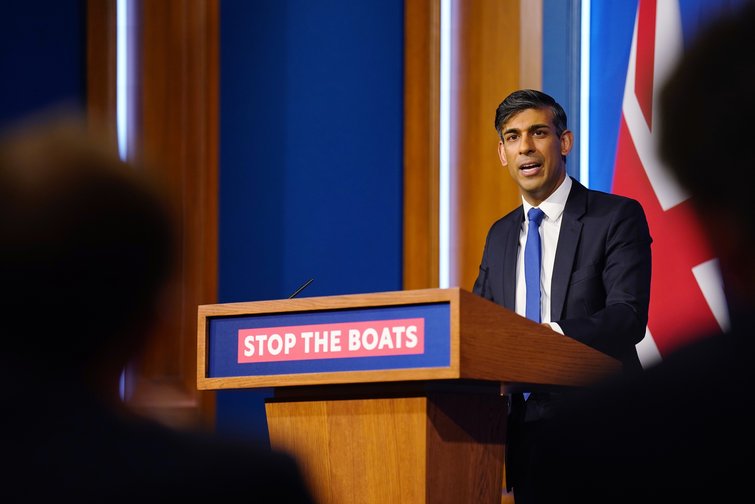
Rishi Sunak conducts a press conference in December 2023 | James Manning (WPA Pool)/Getty Images
Standing at a lectern with the familiar slogan, “STOP THE BOATS”, Rishi Sunak evoked the “will of the people” as the so-called Rwanda Bill made its fractious passage through the Commons last week.
The prime minister’s summoning of “the people” to push through an inhumane and unpopular policy smacks of the misuse of populism that we have come to associate with this government. The insistence that stopping people seeking asylum is “an urgent national issue” deliberately ignores that the priority issues for the British public remain the cost of living and the NHS.
We have seen both main political parties eagerly trading punches for the prize of who can appear most punitive on blocking people seeking asylum. Not only does this stale consensus manufacture a sense of crisis that is a distortion of public opinion, but it also pretends it has nothing to do with racism. And yet whether it’s warning about a “hurricane” or “invasion” of migrants and the failures of multiculturalism, or condemning Britain’s “immigration dependency”, the messaging relies on innuendo and euphemism that stoke racial tensions.
The Runnymede Trust, where I am the interim co-CEO, has today published a report warning of the dangers of this rotten politics that helps mainstream far-right, racist political ideas. Political debate on immigration, based on racialised ideas of who is welcome and who belongs, has become the norm. Whether directly or indirectly, historic and contemporary migration policies are predicated on the exclusion of people of colour. As exemplified by the Windrush scandal, this cheap politics has a high cost – and it is people of colour, regardless of their citizenship status, who bear the ugly consequences.
These toxic anti-migrant policies are coupled with a sustained assault on our democratic infrastructure. In 2022, the government passed the Elections Act, which made it a requirement that voters present ID at polling stations. There was strong opposition about the impact on people of colour. The first UK elections to use them – the May 2023 local elections – confirmed these fears. The Electoral Commission reported about 14,000 people were turned away, and that people of colour and disabled people were most likely to be impacted. The commission predicts 800,000 people could be blocked from voting at the next general election – an incredible price to pay when there were just six cases of voter fraud in 2019.
It’s not just legislation, but also through rhetoric that politicians have persistently attacked the right to protest. Indeed, former home secretary Suella Braverman labelled pro-Palestine marches “hate marches” and compared them with wicked vexation to Black Lives Matter protests – both causes which have high levels of support among communities of colour.
And dare I even mention the ‘culture war’ and the injuries it has inflicted on the strength of civil society? In recent years we have seen the vilification of organisations across the arts, heritage, charity sector and our higher education spaces. The targets have often been those that have dared to embark on progressive racial justice work, who have been demonised with the absurd inversion of the term ‘woke’.
The fact it is the likes of Braverman and her replacement James Cleverly – ministers of colour – who have designed and executed these policies, shows diversity at the top does not protect against racist impact, nor does it mean people in those positions won’t have divergent or indeed opposing political interests to those with whom they may share some points of affinity.
The politics of representation may prioritise superficial visibility, but we mustn’t forget people in positions of power have always designed and inflicted policies that have harmed those they are deemed to share some interest with.
As we prepare for the 2024 general election, we must act to stop the rot of our democracy. Pandering to far-right politics by creating a crisis around small boats and invoking the “will of the people” to implement punitive and racist policies while ignoring the needs of the very people they invoke is unacceptable. On every count, it is people of colour that lose.
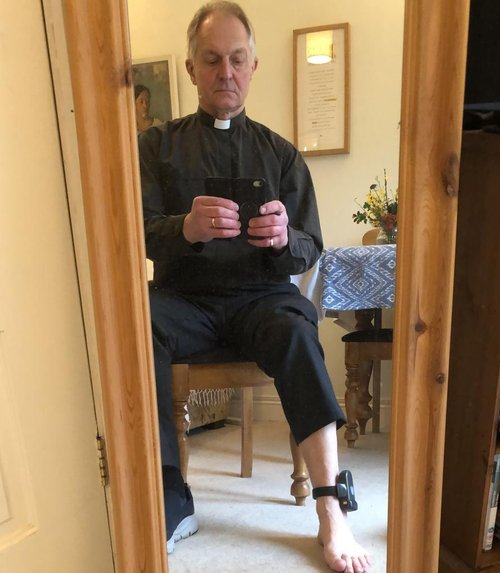
Just Stop Oil member Tim Hewes has to lead church services with an ankle tag on – despite not yet having faced trial
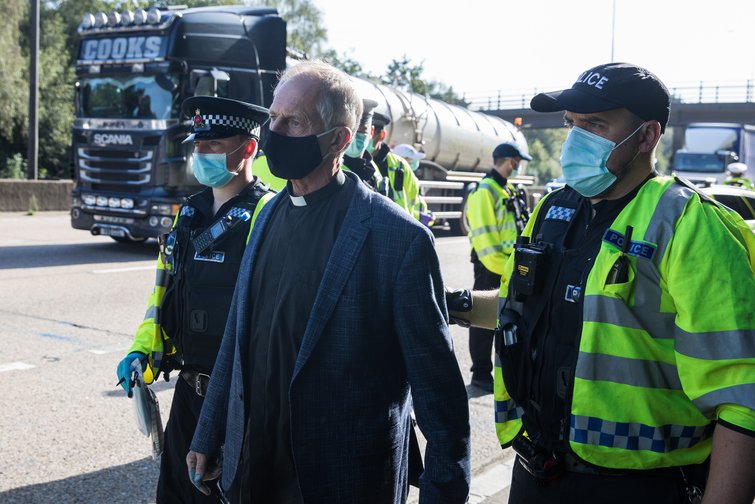
The 73-year-old priest has long taken part in direct action with other campaign groups including Insulate Britain, Extinction Rebellion and Christian Climate Action calling for climate justice | Mark Kerrison/In Pictures via Getty Images
A 73-year-old priest accused of helping plan a climate protest on the M25 has been forced to lead church services while wearing a GPS ankle tag for two years.
Tim Hewes, from Oxfordshire, is among at least ten members of Just Stop Oil who were given the tags despite not having been convicted of a crime. Hewes, who previously sewed his lips shut outside a newspaper office, is also barred from going on the M25 or taking part in any actions to oppose the climate crisis.
On one occasion, Hewes said he was thrown into the back of a police van and locked up overnight after being accused of breaking his bail conditions because his ankle monitor failed to charge. He says the tag was faulty and he was released once the court realised.
“Now if there’s a knock at the door, I think, well, it’s either the tag team or the police,” he told openDemocracy.
“The difficulty with the GPS is that, although I don’t have a curfew, I’ve still got to sleep at home.
“I asked my solicitor: ‘What if I want to go and see the dawn, or something like that?’ and she said: ‘Well, between 12 and five is probably about your limit.’ So, that would rule out midnight mass… Why should I not be able to do that? You know where I am.
“We’re supposed to be able to protest… The perpetrators of real, serious harm in this country are actually in government. What are we supposed to do?”
Hewes, who was speaking to openDemocracy in December and was in fact able to attend midnight mass without a hitch on Christmas Day, had been arrested in November 2022 and charged with conspiracy to cause a public nuisance. He has worn the tag since January 2023 after being held on remand at Wandsworth Prison for six weeks, and has to keep it on until his trial begins in February 2025. Tags must be worn at all times for as long as the court decides.
While he denies the charge, Hewes’s tag prohibits him from going on the M25 and taking part in or organising climate protests. Following previous action with other climate campaign groups such as Extinction Rebellion, Insulate Britain and Christian Climate Action, he says he has faced increasingly harsh treatment from the police and justice system.
Hewes was arrested on a Sunday afternoon. He said he had just put his collar on as he prepared to take part in a church service when he looked out of the window and saw his garden “swarming with police”.
“They shouted up: ‘If you don’t come down and open the door, we’re going to break it down now.’ And they got what they call a ‘big red key’, which is a euphemism for the battering ram. It was scary.”
He added: “Sunday afternoon was just never the same for me.”
Hewes said he was initially embarrassed to lead services with his tag on, and believes climate activists are being heavily criminalised in order to silence and discredit them.
“Suella Braverman talked about Just Stop Oil in the same breath as terrorists,” he told openDemocracy. “That’s outrageous. We’re peaceful protesters. The climate crisis is an existential threat.”
Braverman, the former home secretary who was forced out after inciting a far-right mob to storm the Cenotaph in November, referred to the activist group as “extremists” in 2022 and said they were “out of control” following a series of protests on the M25.
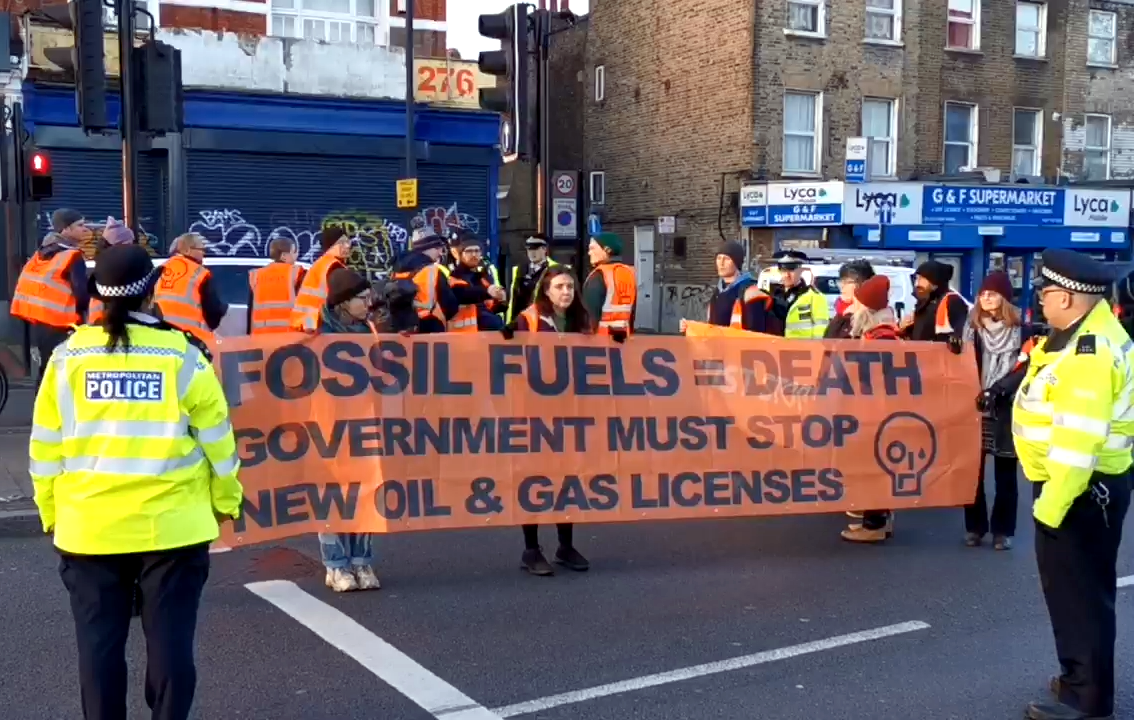
Marcin Wawrzyn, 42 – who was arrested after 20 minutes of ‘slow marching’ with Just Stop Oil in November – told openDemocracy that being given a tag felt “unfair” and “disproportionate”.
“It felt like a punishment and for what?” he said. “I was marching in the road – where else would you protest? The judges of ECHR say roads are the most appropriate places for protests and anything under 90 minutes cannot be seen as disruptive.”
Mentally, it was harsh – I felt like a dog on a leash
Wawrzyn was charged under section 7 of the Public Order Act 2023, which bans any act that “interferes with the use or operation of any key national infrastructure”. He has pleaded not guilty, and his case is expected to begin in 2025.
Under the conditions of his tag, Wawrzyn was prohibited from crossing the River Thames from his home in Wandsworth, south-west London, and from going into north London for a month. Though his tag has now been removed, he described feeling isolated.
“Despite my work being in north London, I was excluded from my office for a month, which is something a court shouldn’t do. But that’s what happened to me. Mentally, it was harsh – I felt like a dog on a leash.
“I felt detached and like I was prevented from having human contact with people I really care about.”
Hewes agreed. “I’m a marked and tracked man,” he said. “It’s really frustrating. As activists, one of the things that helps our mental health is the fact that you are trying to do something, however feeble it might appear to other people.”
Last month, Just Stop Oil wrote to the Met Police after the force claimed that policing the group’s protests cost almost £20m. Just Stop Oil said that “arresting non-violent grandmothers, teenagers, vicars, medics, engineers” was a “waste” of resources.
But Wawrzyn added that campaigners have not been deterred by the crackdown. “The fact that the state reacts in such a way only emboldens us and gives us the assurance that they’re actually noticing what we’re doing and they are actively fighting us,” he said. “If anything, we’re galvanised and we’re drawing more and more people in.”
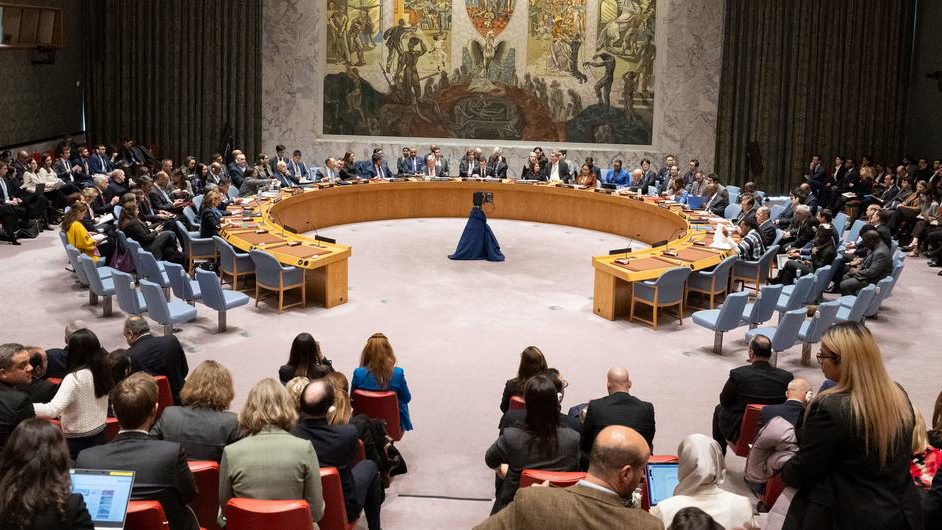
The UN Security Council meets on the situation in the Middle East, including Palestine (Photo via United Nations)
Participants in the UN Security Council highlighted need for a ceasefire in Gaza and a long term solution to the Palestinian question as necessary for peace
On January 23, speaking during the two day extended meeting of the UN Security Council on Palestine, UN Secretary General Antonio Guterres underlined that “Israel’s clear and repeated rejection” of a two-state solution is unacceptable. He also warned that this refusal and “denial of the right to statehood to the Palestinian people would indefinitely prolong a conflict that has become a major threat to global peace and security.”
Most of the countries which participated in the two day proceedings demanded an immediate humanitarian ceasefire and a two-state solution, claiming it necessary for regional and global peace.
Invoking ever deteriorating humanitarian conditions in Gaza, Guterres termed it “collective punishment” executed by Israeli forces, asserting that “nothing can justify it.”
More than 25,700 Palestinians have been killed, over 63,000 have been wounded, and nearly 90% of Gaza’s population has been displaced due to relentless bombings and ground offensives carried out by Israeli armed forces since October 7.
Israel has maintained that its war in Gaza is in response to Palestinian resistance forces, mainly Hamas, attacking inside its borders on October 7, in which nearly 1,200 people were killed and nearly 250 Israelis were taken as hostages.
Speaking in the meeting, Gilad Erdan, the Israeli ambassador to the UN, claimed that until persons involved in the October 7 attacks are handed over and hostages are released, war in Gaza will not end.
Most of the members of the UN Security Council repeated the call for an immediate ceasefire and called for better delivery of humanitarian aid to Gaza.
The Chinese ambassador to the UN, Zhang Jun, also noted that the Israeli leadership’s repeated rejection of a two-state solution is unacceptable, and demanded that it must be rejuvenated by granting Palestinians full membership to the UN.
Israeli Prime Minister Benjamin Netanyahu had, earlier this month, rejected the calls for a Palestinian state, calling it untenable and a threat to Israeli security.
The need for a two-state solution was raised by the Palestinian Foreign Minister Riyad Maliki, who denounced the war in Gaza as Israel’s “premeditated effort to inflict maximum pain on the Palestinian population.”
“No home, hospital, school, mosque, church or UNRWA shelter is safe from Israeli bombardments, 2,000 pound bombs dropped with no care whatsoever for civilian lives,” he noted.
South Africa, which has taken Israel to the International Court of Justice for its genocide of Palestinians, maintained that there cannot be selective implementation of international law and Israel must face consequences for its repeated violations of the same.
US positions provide a carte blanche to Israeli crimes
Speaking during the meeting, the US representative Uzra Zeya claimed the centrality of a two-state solution. She claimed that the US has been making efforts to prevent greater civilian casualties in the Israeli war in Gaza. However, US policies in Gaza were heavily criticized by both the permanent members of the UNSC and others as detrimental to peace.
Chinese ambassador Jun condemned the repeated use of veto by the US in earlier UNSC meetings on ceasefire resolutions, identifying them as impeding all efforts to peace.
The US had vetoed resolutions proposing a ceasefire in the UNSC in previous months and tried to excuse Israeli bombings in Gaza as the Zionist state’s right to self defense.
Jun hoped that all members of the international community must prioritize ceasefire in Gaza, and ways to stop the spread of the war in the region.
Russian Foreign Minister Sergei Lavrov asserted that the UNSC must take steps to prevent further destabilization in the region, which has been caused by US policies which vetoes ceasefire resolutions and provides carte blanche to Israeli acts of “collective punishment of Palestinians.”
Lavrov emphasized that until a ceasefire is implemented the talks about future solutions to the conflict are useless.
Iranian Foreign Minister Hussein Amir Abdollahian warned the US against violating Yemeni sovereignty by carrying out repeated air strikes against it. He alleged that it is a trap laid down by Israel with the objective of expanding the war in Gaza to the regional level.
Abdollahian proposed that a referendum among all Palestinians must be held to find a permanent solution to the Palestinian question.
Lebanese Foreign Minister Abdallah Bou Habib emphasized that all stakeholders, including the US, should see that Israel wants to expand the war across the region, and underlined that his country does not want war.
He emphasized that “what happened on October 7 did not happen in a vacuum” and if no attempts are made to secure a lasting solution “it will happen again,” as there is no peace in the region until there is justice for Palestinians.
Speaking in the meeting on Tuesday, the Saudi delegate Waleed El-Khereiji said that because of the “Israeli war machine,” tensions in the region, including in the Red Sea and Yemen, are increasing. He demanded that the Security Council make sure that Israel stops its violations of international law.
On Sunday, in an interview with CNN, Saudi Foreign Minister Faisal bin Farhad al-Saud denied any possibility of normalization of relations with Israel, as proposed by the US, until there is a road map for a two-state solution and an independent Palestinian state. “What we are seeing is Israelis crushing Gaza, the civilian population of Gaza. This is completely unnecessary, completely unacceptable, and has to stop.”