Amnesty Details ‘Shocking’ Allegations of India Targeting Reporters With Pegasus Spyware

Spread the love

Original article by JULIA CONLEY republished from Common Dreams under Creative Commons (CC BY-NC-ND 3.0). 

A woman uses an iPhone in front of the building of the NSO Group, developer of the spyware Pegasus, on August 28, 2016, in Herzliya, Israel. (Photo: Jack Guez/AFP via Getty Images)

“Increasingly, journalists in India face the threat of unlawful surveillance simply for doing their jobs,” said one advocate.

Amnesty International on Thursday demanded transparency from the Indian government regarding its contracts with surveillance companies, including the Israeli firm NSO Group, after the rights organization joined The Washington Post in publishing what it called “shocking new details” about the use of spyware to target journalists in India.

Amnesty’s Security Lab revealed that a round of “state-sponsored attacker” notifications that were sent to Apple customers in October by the tech company went to more than 20 Indian journalists including Siddharth Varadarajan, founding editor of The Wire, and Anand Mangnale, South Asia editor at the Organized Crime and Corruption Report Project (OCCRP).

The Security Lab ran a forensic analysis of the two reporters’ devices and found evidence that the NSO Group’s highly invasive Pegasus spyware, which is capable of eavesdropping on phone calls and harvesting data, had been installed on phones owned by Varadarajan and Mangnale.

In Mangnale’s case, the journalist appeared to have received a “zero-click exploit” via iMessage on August 23, allowing the individual or group who sent it to covertly install Pegasus spyware on his phone without requiring Mangnale to take any action, such as clicking a link.

At the time of the attempted attack, said Amnesty, Mangnale was working on a story about alleged stock manipulation by a major Indian multinational firm with ties to Indian Prime Minister Narendra Modi. The journalist told Agence France Presse that his phone was targeted “within hours” of his sending interview questions to the company.

The timing of the attack—and the fact that NSO Group has said it only licenses Pegasus to governments and security agencies—was “a hell of a coincidence,” Mangnale said.

“Targeting journalists solely for doing their work amounts to an unlawful attack on their privacy and violates their right to freedom of expression,” said Donncha Ó Cearbhaill, head of Amnesty’s Security Lab. “All states, including India, have an obligation to protect human rights by protecting people from unlawful surveillance.”

The Indian government was previously accused of targeting journalists, opposition politicians, and activists with Pegasus in 2021, when leaked documents showed the spyware had attacked more than 1,000 phone numbers.

India has fallen 21 spots to 161 out of 180 countries in Reporters Without Borders’ World Press Freedom Index since Modi took office in 2014. In addition to the alleged use of spyware by the government, journalists have been arrested and detained while covering anti-government protests, and reporters have been targeted by coordinated social media campaigns inciting hatred and violence.

Varadarajan was the subject of an earlier report by Amnesty, which documented how he had previously been targeted by Pegasus spyware in 2018.

This past October the same email address used in the Pegasus attack on Mangnale was identified on Varadarajan’s phone, confirming he was targeted again.

Varadarajan toldThe Washington Post that at the time of the most recent covert spyware installation, he had been leading public opposition to the detention of a news publisher in New Delhi.

“Our latest findings show that increasingly, journalists in India face the threat of unlawful surveillance simply for doing their jobs, alongside other tools of repression including imprisonment under draconian laws, smear campaigns, harassment, and intimidation,” said Ó Cearbhaill.

The group called for the Indian Supreme Court to immediately release the findings of a technical committee report on Pegasus, which was completed in 2022 but has still not been made public.

“Despite repeated revelations,” said Ó Cearbhaill, “there has been a shameful lack of accountability about the use of Pegasus spyware in India which only intensifies the sense of impunity over these human rights violations.”

Original article by JULIA CONLEY republished from Common Dreams under Creative Commons (CC BY-NC-ND 3.0). 

Continue ReadingAmnesty Details ‘Shocking’ Allegations of India Targeting Reporters With Pegasus Spyware

Breaking from U.S., Canada votes for ceasefire—but continues Israeli arms shipments

Spread the love

Original article by DAVE MCKEE republished from People’s World under http://creativecommons.org/licenses/by-nc-nd/3.0/us/.

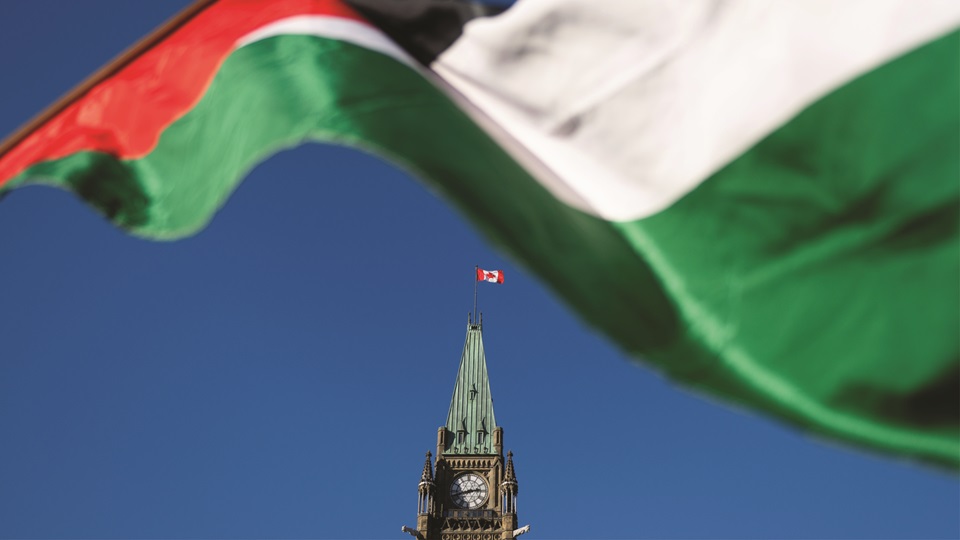
A Palestinian flag flies near the Peace Tower during a rally on Parliament Hill in Ottawa on Nov. 4, 2023. | Spencer Colby / The Canadian Press via AP

TORONTO—Peace and solidarity activists across Canada were pleased to see the government support the United Nations vote on Dec. 12 calling for a ceasefire in Gaza. They should be pleased—it was their efforts which helped make it happen.

Without the continuing mass mobilizations against Israel’s war in communities large and small, the Liberal government of Prime Minister Justin Trudeau would surely not have felt compelled to shift from its two-month-long refusal to support a ceasefire.

At the same time, the same activists are rightfully disgusted that the government took so long to take even a modest stand against a bloody siege that many rightfully recognize as a genocide.

In the time it took for Ottawa to decide that a ceasefire was worth supporting, over 18,000 Palestinian people have been killed and nearly 50,000 wounded. The majority of the people killed and wounded are women and children. Eighty-five percent of the people in Gaza have been displaced by the siege, according to the U.N.—this would be like having over 32 million of Canada’s 38 million people displaced.

The government’s public statements on the ceasefire vote have been contradictory, leaving many people concerned that the Liberals will quickly weasel their way out of any commitment to action. When Trudeau has used the word “ceasefire” (which is not very often), he has stressed that it must be “sustainable” but has avoided saying it must be permanent.

His government took great pains to amend the previous U.N. resolution for a ceasefire, on Oct. 27, to make it explicitly condemn Hamas. When the amendment failed, Canada abstained from voting on the resolution. Trudeau’s current qualified call for a “sustainable ceasefire” suggests that the government is still guided by the same thinking.

The Canadian government needs to issue a clear, public call for an immediate and permanent ceasefire, beginning with and focused on Israel’s vicious offensive against the people of Gaza. Imposing conditions through an assumed moral equivalency between Israel’s violence and that of Hamas will only stall a ceasefire before it can even begin.

Ottawa also needs to back up a real call for a ceasefire by ending its military support for the genocidal siege itself. Canada can and should immediately halt shipments of arms to Israel. Where the government has so far failed to do this, protesters have tried by blockading arms manufacturers like L3Harris and Lockheed Martin.

Certainly, it is positive that Canada has finally been pushed to support a ceasefire. But this only makes the work of the peace and solidarity movements more urgent and more important. Over the past nine weeks, millions of people in this country have protested and petitioned the government, and that wave of mobilization needs to continue—and grow—if Ottawa is to be pushed from words to real action.

People’s Voice

Original article by DAVE MCKEE republished from People’s World under http://creativecommons.org/licenses/by-nc-nd/3.0/us/.

Continue ReadingBreaking from U.S., Canada votes for ceasefire—but continues Israeli arms shipments

Beyond a ceasefire: The Palestinian Youth Movement’s demands for liberation

Spread the love

Original article republished from peoples dispatch under a Creative Commons Attribution-ShareAlike 4.0 (CC BY-SA) license.

Peoples Dispatch speaks to Munir Marwan, a longtime Palestine solidarity organizer and PYM member about PYM’s latest demands, which include an end to occupation, the release of all Palestinian political prisoners, and ending Western complicity in Zionism

The entire Palestine solidarity movement in North America has united behind the demand of a ceasefire in Gaza. For the first time in years, organizations of the working class such as labor unions have been united against the status quo of Western foreign policy and taken an unprecedented stance against Israeli violence.

At the same time, important sectors in the movement have been trying to push the demands even further. The Palestinian Youth Movement, a major international formation of Palestinian youth with significant presence across North America, has been working to push the movement beyond dreaming of an end to current aggression, and into demanding full liberation from Israeli occupation.

To talk about PYM’s latest demands, which include an end to occupation, the release of all Palestinian political prisoners, and ending Western complicity in Zionism, Peoples Dispatch speaks to Munir Marwan, a longtime Palestine solidarity organizer and PYM member.

Original article republished from peoples dispatch under a Creative Commons Attribution-ShareAlike 4.0 (CC BY-SA) license.

Continue ReadingBeyond a ceasefire: The Palestinian Youth Movement’s demands for liberation

Pressure rises for Biden to drop military aid to Israel

Spread the love

Original article republished from Peoples Dispatch under a Creative Commons Attribution-ShareAlike 4.0 (CC BY-SA) license.

After over two months of genocide, support for the US’s usual policy of unconditional aid to the Zionist state is dwindling

Image from demonstration outside of Secretary of Defense Lloyd Austin’s house on Christmas morning, protesting US policy in Israel

Since October 7, Biden has added to Israel’s massive US-made military arsenal and sent more weapons to Israel as it carries out its genocide in the Gaza Strip, even bypassing Congressional review to do so. After nearly three months of war, however, support for the US’s usual policy of unconditional aid to the Zionist state is dwindling.

Some of the most bloody attacks against Palestinian civilians have been made possible with US-made bombs, such as the attack that leveled an apartment block in the Jabalya refugee camp, killing over 100 people.

Many of the atrocities perpetrated by Israel with US-made weaponry and funded by US money have been broadcast internationally across communications channels for even the people of the US to see. As a result, mass protests have erupted in the streets for months, often disrupting major commercial centers and events throughout the busy holiday season

A recent poll shows that popular support for US aid to Israel has dropped since November. According to a poll from Quinnipiac University released on December 20, less than half (45%) of registered voters support sending “military aid to Israel for their efforts in the war.” This is a significant drop from the results of Quinnipiac’s previous poll from a month ago, in which 54% of voters expressed their support for military aid to Israel. A comparison of the two polls reveals that support for aid to Israel has dropped among voters in both the Republican and Democratic parties. In the November poll, 71% of Republicans and 45% Democratic voters said they were in favor of further military aid to Israel. Those numbers dropped in December, with 65% of Republicans and only 36% of Democrats supporting more US aid to Israel.

The dwindling support for US support to the Zionist state follows the trends of other polls in the growing popularity of the Palestinian cause, such as an early December Date for Progress poll which found that 61% of voters support calls for a permanent ceasefire—including nearly half, 49%, of Republicans. 

Pressure for the Biden administration to shift its policies on Israel has also been coming from within Congress itself—not even necessarily from the most progressive elements of the legislature. Six members of security-oriented committees of the House of Representatives, including the Intelligence, Armed Services or Foreign Affairs committees, none of whom are known progressives, penned a letter to Biden on December 18, calling on the President to “use all of our nation’s leverage to shift the Israeli military’s strategy.” 

“The mounting civilian death toll and humanitarian crisis are unacceptable and not in line with American interests,” the letter reads. The representatives also reference the history of “America’s war on terror” as a warning for the future, stating, “We know from personal and often painful experience that you can’t destroy a terror ideology with military force alone. And it can, in fact, make it worse.”

Several prominent humanitarian organizations, including Human Rights Watch, Médecins Sans Frontières/Doctors Without Borders USA, Oxfam America, and Amnesty International, have also penned a letter to Defense Secretary Lloyd Austin, urging him to halt military aid to Israel. The organizations urge the Pentagon to “withhold U.S. assistance, in accordance with U.S. law and policy, that would facilitate violations of international humanitarian law.” 

Biden himself has not responded to any of the outside pressures against his Israel policy, and has only dug his heels in. As his administration told CNN earlier this month, the US has no plans to place conditions on Israel aid as it carries out genocide in Gaza.

Original article republished from Peoples Dispatch under a Creative Commons Attribution-ShareAlike 4.0 (CC BY-SA) license.

Continue ReadingPressure rises for Biden to drop military aid to Israel

South Africa launches case at UN court accusing Israel of genocide

Spread the love
Jabalya Refugee Camp Gaza 31 October 2023 Photo: Quds News Network

https://www.theguardian.com/world/2023/dec/29/south-africa-accuses-israel-of-committing-genocide-in-gaza

South Africa has launched a case against Israel at the UN’s international court of justice (ICJ) accusing the state of committing genocide in its military campaign in Gaza.

Israel responded to the allegations “with disgust”, calling South Africa’s case a “blood libel” and urging the ICJ to reject it.

Any case at the ICJ is likely to take years to resolve, but South Africa has called for the court to convene in the next few days to issue “provisional measures” calling for a ceasefire. In March 2022, the ICJ ordered Russia to halt its offensive in Ukraine, an order which was supposed to be legally binding, but Moscow ignored it anyway. Any such ruling however is likely to significantly sway international public opinion.

“The acts and omissions by Israel complained of by South Africa are genocidal in character because they are intended to bring about the destruction of a substantial part of the Palestinian national, racial and ethnical group,” the South African application to open proceedings said.

“Provisional measures are necessary in this case to protect against further, severe and irreparable harm to the rights of the Palestinian people under the Genocide Convention, which continue to be violated with impunity.”

Article IX of the Genocide Convention allows any state party to the convention to bring a case against another to the ICJ, even if it doesn’t have any direct link to the conflict in question. Last year, the court ruled that the Gambia could bring a genocide claim against Myanmar. The court also ruled in a case between Croatia and Serbia that depriving a people of food, shelter, medical care and other means of subsistence constitutes genocidal acts.

https://www.theguardian.com/world/2023/dec/29/south-africa-accuses-israel-of-committing-genocide-in-gaza

Continue ReadingSouth Africa launches case at UN court accusing Israel of genocide