Israel cabinet delays approval of Gaza ceasefire deal, as strikes on enclave kill 77

Spread the love

https://www.middleeastmonitor.com/20250116-israel-cabinet-delays-approval-of-gaza-ceasefire-deal-as-strikes-on-enclave-kill-77

Israeli Prime Minister Benjamin Netanyahu (L) holds a meeting with the Security Cabinet after Iran’s missile attacks on Israel in West Jerusalem on October 01, 2024. [Avi Ohayon (GPO) / Handout – Anadolu Agency]

Israel said it had delayed holding a cabinet meeting on Thursday to ratify a ceasefire with Hamas, blaming the group for the hold-up, as Palestinian authorities said Israeli air strikes overnight had killed 77 people in Gaza, Reuters reports.

Hamas senior official, Izzat el-Reshiq, said the group remained committed to the ceasefire deal, agreed a day earlier, that was scheduled to take effect from Sunday to bring an end to 15-months of bloodshed.

President Joe Biden’s envoy, Brett McGurk, and President-elect Donald J. Trump’s envoy, Steve Witkoff were in Doha with Egyptian and Qatari mediators working to resolve the last remaining dispute, a US official, who spoke on condition of anonymity, said.

The dispute involves the identities of several prisoners Hamas is demanding be released and it is expected to be resolved soon, the US official said.

Israeli government spokesperson, David Mencer, told reporters Israeli negotiators were in Doha to reach a solution.

The complex ceasefire accord emerged on Wednesday after mediation by Qatar, Egypt and the US to stop the war that has devastated the coastal territory and inflamed the Middle East.

WATCH: Israel Intensifies attacks on Gaza as ceasefire is agreed

The deal outlines a six-week initial ceasefire with the gradual withdrawal of Israeli forces from the Gaza Strip, where tens of thousands have been killed. Hostages taken by Hamas, which controls the enclave, would be freed in exchange for Palestinian prisoners detained in Israel.

The deal also paves the way for a surge in humanitarian aid for Gaza, where the majority of the population has been displaced and is facing acute food shortages, food security experts warned late last year.

Rows of aid trucks were lined up in the Egyptian border town of El-Arish waiting to cross into Gaza, once the border is reopened.

Israel’s acceptance of the deal will not be official until it is approved by the country’s security cabinet and government, and a vote had been slated for Thursday.

However, Israeli Prime Minister, Benjamin Netanyahu, has delayed the meeting, accusing Hamas of making last-minute demands and going back on agreements.

“The Israeli cabinet will not convene until the mediators notify Israel that Hamas has accepted all elements of the agreement,” a statement from Netanyahu’s office said.

Hardliners in Netanyahu’s government were still hoping to stop the deal, though a majority of ministers were expected to back it.

Finance Minister Bezalel Smotrich’s Religious Zionism Party said in a statement that its condition for remaining in the government would be a return to fighting at the end of the first phase of the deal, in order to destroy Hamas and bring all the hostages back. Far-right police minister, Itamar Ben-Gvir, has also threatened to quit the government if the ceasefire is approved.

In Jerusalem, some Israelis marched through the streets carrying mock coffins in protest at the ceasefire, blocking roads and scuffling with police.

Despite the hold-up to the cabinet meeting, political commentators on Israel’s public broadcaster, Kan, said the latest delay would likely be resolved and that the ceasefire was a done deal.

Calls for faster implementation 

For some Palestinians, the deal could not come soon enough.

READ: Israel’s Smotrich demands resuming Gaza war, displacing Palestinians

“We lose homes every hour. We demand for this joy not to go away, the joy that was drawn on our faces – don’t waste it by delaying the implementation of the truce until Sunday,” Gazan man, Mahmoud Abu Wardeh, said.

The accord requires 600 truckloads of humanitarian aid to be allowed into Gaza every day of the ceasefire, with 50 carrying fuel. The first phase of the agreement will also see Israel releasing more than 1,000 Palestinian prisoners.

While people celebrated the pact in Gaza and Israel, Israel’s military conducted more attacks, the civil emergency service and residents said.

Gaza’s Health Ministry said at least 81 people had been killed over the past 24 hours and about 188 injured. The Palestinian Civil Emergency Service said at least 77 of those were killed since the ceasefire announcement.

The Israeli military is looking into the reports, a military spokesperson said.

Israel secured major gains over Iran and its proxies, mainly Hezbollah, as the Gaza conflict spread. In Gaza, however, Hamas may have been crippled, but without an alternative administration in place, it has been left standing.

If successful, the ceasefire will halt fighting that has razed much of heavily urbanised Gaza, killed over 46,000 people, and displaced most of the tiny enclave’s pre-war population of 2.3 million, according to Gaza authorities.

That, in turn, could defuse tensions across the wider Middle East.

With 98 foreign and Israeli hostages remaining in Gaza, phase one of the deal entails the release of 33 of them, including all women, children and men over 50.

Global reaction to the ceasefire was enthusiastic.

Israel launched its campaign in Gaza after Hamas-led gunmen burst into Israeli border-area communities on 7 October, 2023, killing 1,200 soldiers and civilians and abducting over 250 hostages, according to Israeli tallies.

However, since then, it has been revealed by Haaretz that helicopters and tanks of the Israeli army had, in fact, killed many of the 1,139 soldiers and civilians claimed by Israel to have been killed by the Palestinian Resistance.

READ: Dismantling UNRWA will be ‘catastrophic’ for Gaza and Palestinians: Expert

This work by Middle East Monitor is licensed under a Creative Commons Attribution-NonCommercial-ShareAlike 4.0 International License

Continue ReadingIsrael cabinet delays approval of Gaza ceasefire deal, as strikes on enclave kill 77

‘How Does It Feel to Have Your Legacy Be Genocide?’ Asks Journalist Thrown Out of Blinken’s Briefing

Spread the love

Original article by Eloise Goldsmith republished from Common Dreams under Creative Commons (CC BY-NC-ND 3.0).

Journalist Sam Husseini is carried out of a State Department news conference after confronting Secretary of State Antony Blinken about the U.S. policy towards Gaza on January 16, 2025. (Photo credit: Ryan Grim/X.com)

“Physically dragging out a reporter from the State Department briefing room while preaching press freedom to the rest of the world is the perfect example of the Biden administration’s love affair with double standards and duplicity,” said one foreign policy observer.

Two journalists were removed from Secretary of State Antony Blinken’s final news conference on Thursday after interrupting Blinken’s remarks to heckle him about the United States’ policy toward Gaza, a day after a cease-fire deal between Hamas and Israel was announced. One of the reporters, independent journalist Sam Husseini, was physically carried out of the briefing room by security.

Less than two minutes into Blinken’s remarks, as he was thanking the reporters in the attendance for “asking tough questions,” Max Blumenthal, the editor in chief of The Grayzone—an independent news—addressed Blinken, saying loudly in reference to the cease-fire deal:“300 reporters in Gaza were on the receiving end of your bombs. Why did you keep the bombs flowing when we had a deal in May?” On Wednesday, President Biden announced the breakthrough, saying that “this is the ceasefire agreement I introduced last spring.”

https://twitter.com/MaxBlumenthal/status/1879926469633487204?ref_src=twsrc%5Etfw%7Ctwcamp%5Etweetembed%7Ctwterm%5E1879926469633487204%7Ctwgr%5Eac1ca52eb44e2334af54c3d882d720229c45dbbb%7Ctwcon%5Es1_c10&ref_url=https%3A%2F%2Fwww.commondreams.org%2Fhusseini-blumenthal-removed-state-department

Sorry, this content could not be embedded.

X

“Why did you sacrifice the rules-based order on the mantle of your commitment to Zionism,” Blumenthal continued, before being led to the door. “How does it feel to have your legacy be genocide?” he yelled.

Blumenthal also called out State Department Spokesman Matt Miller, who is briefly visible in a video filmed by the journalist, who charged that Miller “smirked through a genocide.”

Not long after, Husseini also interrupted Blinken.

“I am asking questions after being told by Matt Miller that he will not answer my questions,” said Husseini, who also referenced the findings of Amnesty International, which concluded in December that Israel has committed genocide against Palestinians in Gaza. “You pontificate about a free press… Criminal! Why aren’t you in the Hague.” The Hague is where the International Criminal Court is located.

https://twitter.com/ryangrim/status/1879928681499591145?ref_src=twsrc%5Etfw%7Ctwcamp%5Etweetembed%7Ctwterm%5E1879928681499591145%7Ctwgr%5Eac1ca52eb44e2334af54c3d882d720229c45dbbb%7Ctwcon%5Es1_c10&ref_url=https%3A%2F%2Fwww.commondreams.org%2Fhusseini-blumenthal-removed-state-department

Blinken can be heard saying “respect the process” in response to Husseini’s outburst.

Trita Parsi, the executive vice president of the non-interventionist “action tank” the Quincy Institute for Responsible Statecraft, remarked that “physically dragging out a reporter from the State Department briefing room while preaching press freedom to the rest of the world is the perfect example of the Biden administration’s love affair with double standards and duplicity…”

Original article by Eloise Goldsmith republished from Common Dreams under Creative Commons (CC BY-NC-ND 3.0).

Genocide Joe Biden
Genocide Joe Biden
Continue Reading‘How Does It Feel to Have Your Legacy Be Genocide?’ Asks Journalist Thrown Out of Blinken’s Briefing

Cease-Fire Deal Reportedly Reached After 15 Months of Israeli Atrocities in Gaza

Spread the love

Original article by Jake Johnson republished from Common Dreams under Creative Commons (CC BY-NC-ND 3.0).

People watch a television along a street in Khan Younis in the southern Gaza Strip on January 15, 2025. (Photo: Bashar Taleb/AFP via Getty Images)

“The cease-fire alone will not end the ongoing genocide that Israel is perpetrating against the Palestinian people in Gaza,” said one Palestinian human rights organization.

This is a developing news story… Please check back for possible updates…

The U.S. and Qatar said Wednesday that negotiators have reached a cease-fire and hostage-release agreement between Israel and Hamas after more than 15 months of incessant Israeli bombing that killed tens of thousands of people, displaced millions, and left Gaza in ruins.

At a press conference, Qatar’s prime minister said the agreement is set to take effect on Sunday. U.S. President Joe Biden said that “it is long past time for the fighting to end and the work of building peace and security to begin.”

Shortly before the formal announcement from the U.S. and Qatar, the office of Israeli Prime Minister Benjamin Netanyahu said in a statement that the deal has yet to be cemented.

“Due to the strong insistence of Prime Minister Benjamin Netanyahu, Hamas folded on its last-minute demand to change the deployment of IDF forces in the Philadelphi Corridor,” the prime minister’s office said, referring to the Israel Defense Forces. “However, several items in the framework have yet to be finalized; we hope that the details will be finalized tonight.”

The reported deal, brokered by Egyptian and Qatari mediators, would entail “a six-week initial cease-fire phase and includes the gradual withdrawal of Israeli forces from Gaza and release of hostages held by Hamas in exchange for Palestinian detainees held by Israel,” according to Reuters, which cited an unnamed official briefed on the negotiations.

Al Jazeera, also citing anonymous sources, provided an outline of the reported deal:

  • The Israeli military will withdraw to within 700 meters (2,297 feet) inside Gaza.
  • Israel will release about 2,000 Palestinian prisoners, including 250 serving life sentences.
  • Palestinian groups will release 33 Israeli captives.
  • Israel will allow injured people in Gaza to travel to receive medical treatment.
  • Israel will open the Rafah crossing with Egypt seven days after the start of the first stage.
  • Israeli forces will begin to pull back from Gaza’s border with Egypt, known as the Philadelphi Corridor, to withdraw from it completely in later stages.

Following news of potentially decisive progress toward a cease-fire, The Associated Press reported that “large crowds of cheering people” took to the streets in southern Gaza to celebrate. Meanwhile, the outlet noted, hundreds of demonstrators rallied outside of the Israeli military’s headquarters in Tel Aviv “calling for a deal to be completed.”

Reporting from central Gaza, Al Jazeera‘s Hani Mahmoud said that “we’re seeing people in tears” after news of a possible agreement spread in the besieged enclave.

“We’re seeing mothers here, who live in tents near the hospital… hugging and kissing their children, thanking God that they have survived,” said Mahmoud.

U.S. President-elect Donald Trump, who voiced support for Israel’s catastrophic assault on Gaza during his 2024 campaign, took to his social media platform Wednesday to declare, in all-caps: “WE HAVE A DEAL FOR THE HOSTAGES IN THE MIDDLE EAST. THEY WILL BE RELEASED SHORTLY. THANK YOU!”

Steve Witkoff, the incoming Trump administration’s Middle East envoy, joined members of Biden’s team in working to finalize the cease-fire agreement, which came as the official death toll from Israel’s assault climbed above 46,000—a figure that experts say is likely a significant undercount. The majority of the people killed in Israeli attacks have been women, children, or elderly.

Drop Site‘s Jeremy Scahill reported Tuesday that “the terms of the deal being negotiated are largely consistent with what was on the table last May when outgoing President Joe Biden first announced it.”

“Biden allowed Netanyahu to steamroll him for months—rewarding Israel with billions of dollars in arms transfers and political support after rejecting that cease-fire deal,” Scahill wrote. “Since that time, tens of thousands of Palestinian civilians have been killed and maimed and an unknown number of Israeli captives killed, either by their captors or Israeli strikes. All the while, the administration and its backers repeatedly assured voters in the U.S. that Biden and Vice President Kamala Harris were working tirelessly to achieve a cease-fire deal.”

“What is required is for Israel to end all ongoing genocidal acts, open Gaza, and for the international community to ensure accountability for those responsible.”

The Al-Mezan Center for Human Rights, a Palestinian organization, said the apparent cease-fire agreement marks “a crucial step toward reducing the killing of Palestinians through deadly force.”

“However, the cease-fire alone will not end the ongoing genocide that Israel is perpetrating against the Palestinian people in Gaza,” the group added. “What is required is for Israel to end all ongoing genocidal acts, open Gaza, and for the international community to ensure accountability for those responsible.”

Inger Ashing, CEO of the international humanitarian group Save the Children, said the cease-fire “must be permanent” and accompanied by urgent efforts to “end the siege and vastly increase the entry of aid.”

“For 15 months, about 1 million children in Gaza have been caught in a living nightmare with loss, trauma, and risks to their lives at every turn,” said Ashing. “If implemented, this pause will bring them vital reprieve from the bombs and bullets that have stalked them for more than a year. But it is not enough and the race is on to save children facing hunger and disease as the shadow of famine looms.”

Sen. Bernie Sanders (I-Vt.), who has vocally criticized Israel’s response to the Hamas-led October 7, 2023 attack and U.S. military aid to the Israeli government, said Wednesday that a cease-fire is “long-overdue” and “both sides must honor the deal and implement it as quickly as possible.”

“The senseless killing must stop. The hostages must be released,” said Sanders. “The United Nations and other aid organizations must finally be allowed unfettered access to all areas of the Gaza Strip in order to provide the massive amounts of humanitarian aid that is desperately needed. Hundreds of thousands of innocent people are struggling to survive, lacking food, water, and medical care in the middle of winter. Innocent lives hang in the balance.”

“This is just the first step to restoring peace,” the senator added. “The international community must insist that the cease-fire be sustained and formalized. A plan for rebuilding Gaza and establishing peaceful Palestinian governance of the area must be laid out. And there must be accountability for the many war crimes committed by both sides in this terrible conflict.”

Original article by Jake Johnson republished from Common Dreams under Creative Commons (CC BY-NC-ND 3.0).

Continue ReadingCease-Fire Deal Reportedly Reached After 15 Months of Israeli Atrocities in Gaza

Israeli Assault on Gaza, West Bank Continues in ‘Final Stage’ of Cease-Fire Talks

Spread the love

Original article by Jessica Corbett republished from Common Dreams under Creative Commons (CC BY-NC-ND 3.0).

A father cries while carrying the body of his child wrapped in a blood-stained shroud west of Deir al-Balah, central Gaza Strip, on January 14, 2025. (Photo: Youssef Alzanoun/Middle East Images via AFP via Getty Images)

“As a cease-fire in Gaza is near, Israel is expanding its assault on the West Bank,” said one expert. “It was always a war on Palestinian existence.”

As negotiators in Qatar navigated the “final stage” of a cease-fire agreement to end the U.S.-backed Israeli assault on the Gaza Strip, Israel’s forces on Tuesday continued to kill Palestinians in the besieged coastal enclave and the illegally occupied West Bank.

Since the Hamas-led October 7, 2023 attack, the Israel Defense Forces (IDF) have killed at least 46,645 Palestinians in Gaza and wounded 110,012, with over 10,000 others missing, health officials said Tuesday. The true death toll could be much higher. A peer-reviewed analysis published last week in The Lancetfound that the official tally through last June was likely a 41% undercount.

The Palestinian National Authority’s news agency WAFA reported Tuesday that IDF shelling killed at least two civilians at the Nuseirat refugee camp and a correspondent in Gaza City “said that Israeli warplanes fired missiles at a house in the Sheikh Radwan neighborhood, north of Gaza City, and another house in the Manara neighborhood, south of Khan Younis City, killing several civilians and injuring others.”

According to multiple media outlets, Israeli forces also killed at least 13 people in an attack on a home in Deir al-Balah.

https://twitter.com/DropSiteNews/status/1879282625933930531?ref_src=twsrc%5Etfw%7Ctwcamp%5Etweetembed%7Ctwterm%5E1879282625933930531%7Ctwgr%5Efb190fd0cbacccf9c3169520bf576a90ec6772ee%7Ctwcon%5Es1_c10&ref_url=https%3A%2F%2Fwww.commondreams.org%2Fnews%2Fgaza-ceasefire-talks

Sorry, this content could not be embedded.
X

Israel faces a genocide case at the International Court of Justice over its assault on Gaza and in November the International Criminal Court issued arrest warrants for Israeli Prime Minister Benjamin Netanyahu and his former defense minister, Yoav Gallant, as well as Hamas leader Mohammed Diab Ibrahim Al-Masri.

In addition to waging war on Gaza over the past 15 months, Israel has stepped up its military activity in the West Bank—where a Tuesday strike on the Jenin refugee camp killed at least six Palestinians and wounded several others. The Times of Israel reported that “the IDF said it carried out the strike in a joint operation with the Shin Bet, without immediately providing further information.”

The Israeli newspaper also noted that “on Tuesday evening, as on many previous Tuesday nights, thousands gather for a unity rally of prayer and song held in Tel Aviv’s Hostages Square,” while hundreds of right-wing demonstrators blocked “an intersection in central Jerusalem, in protest of the ongoing hostage negotiations between Israel and Hamas.”

According to a draft obtained by The Associated Press, the first part of the three-stage deal would involve a halt to the fighting, both sides releasing captives, displaced Palestinians in Gaza returning home, and more humanitarian aid entering the strip.

Phase two would feature a declaration of “sustainable calm” and Hamas freeing more hostages in exchange for additional Palestinian prisoners and the full withdrawal of Israeli troops from Gaza, AP reported. The third part would include an exchange of bodies, a reconstruction plan for the strip—where civilian infrastructure is in ruins—and the reopening of border crossings.

https://twitter.com/AssalRad/status/1879253470630604879?ref_src=twsrc%5Etfw%7Ctwcamp%5Etweetembed%7Ctwterm%5E1879253470630604879%7Ctwgr%5Efb190fd0cbacccf9c3169520bf576a90ec6772ee%7Ctwcon%5Es1_c10&ref_url=https%3A%2F%2Fwww.commondreams.org%2Fnews%2Fgaza-ceasefire-talks

“The terms of the deal being negotiated are largely consistent with what was on the table last May when outgoing President Joe Biden first announced it. Biden allowed Netanyahu to steamroll him for months—rewarding Israel with billions of dollars in arms transfers and political support after rejecting that cease-fire deal,” Jeremy Scahill detailed at Drop Site News.

The latest cease-fire talks come as U.S. President-elect Donald Trump prepares for his inauguration next Monday. The Republican has been pushing for a resolution to Israel’s assault on Gaza—or at least an appearance of one—before he returns to office.

“The fact that Trump emerged as the decisive player in pushing a potential cease-fire forward is evidence that Biden never used the full powers available to a sitting U.S. president to seal the deal in the summer,” wrote Scahill. “While Trump has publicly repeated his threat that he will ‘unleash hell’ on Hamas if the Israeli hostages are not freed, his pressure has not been solely focused on Hamas; Trump and his aides have made clear to Netanyahu that the president-elect expects Israel to comply with his demands, too.”

Netanyahu on Tuesday told hostages’ families that “he is willing to agree to a prolonged cease-fire Gaza in exchange for their return,” according toHaaretz. Later Tuesday, The Times of Israel reported that the prime minister was meeting with “Israel’s hostage negotiation team and with members of Israel’s security establishment,” and expected negotiations to go through the night.

Even if a deal is reached regarding Gaza, some experts fear the bloodshed will continue there and in the West Bank

“There will possibly be an end to the Gaza war, but there will be now another war in the West Bank,” Sami Al-Arian, a Palestinian analyst and director of the Center for Islam and Global Affairs at Istanbul Zaim University, told Scahill. “It may not be on the same scale, but it would be as vicious from the settlers, from the Netanyahu government.”

Gazan writer and analyst Muhammad Shehada wrote for the U.S.-based Center for International Policy last week that a senior Arab official told him the U.S. president-elect asked the Qataris and Egyptians to finalize a deal before he takes office but the Israeli prime minister “is not budging while at the same time issuing false positive statements of a breakthrough and progress to buy time and pretend to seek a deal until Trump is in office, where Netanyahu can trade the Gaza war for something big in the West Bank.”

Sharing on social media a video of the Tuesday strike on Jenin, Middle East expert Assal Rad said that “as a cease-fire in Gaza is near, Israel is expanding its assault on the West Bank. The Gaza genocide is only the most recent atrocity Israel—with the help of the U.S.—has carried out against Palestinians. The same story for 77+ years. It was always a war on Palestinian existence.”

Original article by Jessica Corbett republished from Common Dreams under Creative Commons (CC BY-NC-ND 3.0).

Continue ReadingIsraeli Assault on Gaza, West Bank Continues in ‘Final Stage’ of Cease-Fire Talks

‘Far Too Little, Far Too Late,’ Say Critics as Biden Finally Removes Cuba From Terror List

Spread the love

Original article by Brett Wilkins republished from Common Dreams under Creative Commons (CC BY-NC-ND 3.0). 

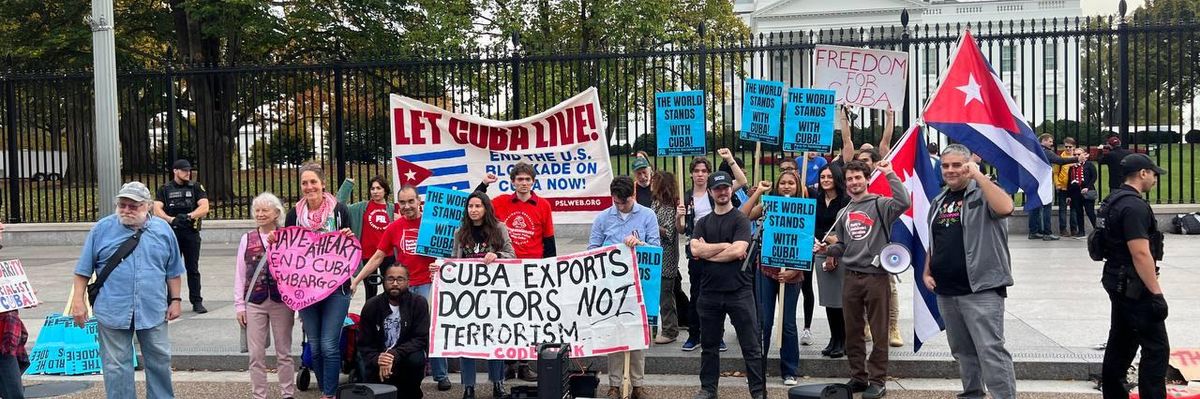
CodePink led a November 2, 2022 rally against the U.S. economic blockade of Cuba outside the White House in Washington, D.C. (Photo: CodePink)

“Seriously? You wait until six days before leaving office to do what you promised to do during your 2020 campaign?” said one observer.

In a move likely to be reversed by the incoming Trump administration, President Joe Biden on Tuesday notified Congress of his intent to remove Cuba from the U.S. State Sponsors of Terrorism list, a designation that critics have long condemned as politically motivated and meritless.

Noting that “the government of Cuba has not provided any support for international terrorism” and has “provided assurances” that it will not do so in the future, the White House said in a memo that the Biden administration is moving to rescind the first Trump administration’s January 2021 addition of Cuba to the State Sponsors of Terrorism (SSOT) list and take other measures to ease some sanctions on the long-suffering island of 11 million inhabitants.

Cuba’s SSOT designation was based mostly on the socialist nation’s harboring of leftist Colombian rebels and several U.S. fugitives from justice for alleged crimes committed decades ago, even though no other country has been placed on the SSOT list for such a reason and despite right-wing Cuban exile terrorists enjoying citizenship—and even heroic status—in the United States.

“Despite its limited nature, it is a decision in the right direction and in line with the sustained and firm demand of the government and people of Cuba, and with the broad, emphatic, and repeated call of many governments, especially Latin America and the Caribbean, of Cubans living abroad, political, religious and social organizations, and numerous political figures from the United States and other countries,” the Cuban Ministry of Foreign Affairs said in a statement.

“It is important to note that the economic blockade and much of the dozen coercive measures that have been put into effect since 2017 remain in force to strengthen it, with full extraterritorial effect and in violation of international law and human rights of all Cubans,” the ministry added.

https://twitter.com/cidelson/status/1879273086085939288?ref_src=twsrc%5Etfw%7Ctwcamp%5Etweetembed%7Ctwterm%5E1879273086085939288%7Ctwgr%5Ea895ab5425ec3540961455b263e9b98fa9fd162d%7Ctwcon%5Es1_c10&ref_url=https%3A%2F%2Fwww.commondreams.org%2Fnews%2Fcuba-ssot

Sorry, this content could not be embedded.

X

For 32 straight years, the United Nations General Assembly has overwhelmingly voted for resolutions condemning the U.S. blockade of Cuba. And for 32 years, the United States, usually along with a small handful of countries, has opposed the measures. Last year’s vote was 187-2, with Israel joining the U.S. in voting against the resolution.

Cuba followed Biden’s move by announcing it would “gradually” release 553 political prisoners following negotiations with the Catholic Church, The New York Timesreported.

Many progressives welcomed Biden’s shift. Congresswoman Nydia Velázquez (D-N.Y.) said in a statement that Cuba’s SSOT designation “has only worsened life for the Cuban people without advancing U.S. interests” and “has made it harder for Cubans to access humanitarian aid, banking services, and the ability to travel abroad.”

“It has also deepened food and medicine shortages and worsened the island’s energy crisis, especially after Hurricane Rafael,” she added. “These hardships have driven an unprecedented wave of migration, leading to the largest exodus in Cuba’s history.”

Rep. Ilhan Omar (D-Minn.) called Biden’s move “a long overdue action that will help normalize relations with our neighbor.”

“This is a step toward ending decades of failed policy that has only hurt Cuban families and strained diplomatic ties,” Omar added. “Removing this designation will help the people of Cuba and create new opportunities for trade and cooperation between our nations. I look forward to continuing the work to build bridges between our countries and supporting policies that benefit both the American and Cuban people.”

https://twitter.com/dsa_intl_comm/status/1879288137966641462?ref_src=twsrc%5Etfw%7Ctwcamp%5Etweetembed%7Ctwterm%5E1879288137966641462%7Ctwgr%5E5bb7e50bbcb151d4ef02ea69a12198cf5b1fc9ef%7Ctwcon%5Es1_c10&ref_url=https%3A%2F%2Fwww.commondreams.org%2Fnews%2Fcuba-ssot

Sorry, this content could not be embedded.

X

David Adler, the co-general coordinator at Progressive International, called the delisting “far too little, far too late.”

“POTUS removing Cuba’s SSOT designation in the final days of his presidency only means one thing: He knew—from day one—that the designation was simply an excuse to punish the Cuban people,” Adler added. “But he maintained it anyway. Sickening.”

The peace group CodePink released a statement welcoming Biden’s shift, but adding that “it is unacceptable that it took this administration four years to address these injustices.”

“President Biden made the inhumane decision every single day to not alleviate the suffering of millions of Cubans by keeping this designation in place,” the group added. “As we mark this overdue progress, we can only hope that the Trump administration does not reverse these crucial steps towards justice and diplomacy.”

Trump’s nominee for secretary of state, Sen. Marco Rubio (R-Fla.) is the son of Cuban immigrants and a fierce critic of Cuba’s socialist government. In 2021, Rubio introduced legislation aimed at blocking Cuba’s removal from the SSOT list. Trump has also tapped Mauricio Claver-Carone—a staunch supporter of sanctioning Cuba—as his special envoy for Latin America.

Alex Main, director of international policy at the Center for Economic and Policy Research, said Tuesday that “while this decision, which comes years after 80 members of Congress urged Biden to reverse Trump’s ‘total pressure’ approach should have been made long ago, it is better late than never.”

“Sixty years of failed policy should be more than enough, and hopefully the new administration will have the wisdom and the courage to pursue a new course, one that’s in the best interest of both the U.S. and the Cuban people,” Main added.

Cuba was first placed on the SSOT list by the Reagan administration in 1982 amid an ongoing, decadeslong campaign of U.S.-backed exile terrorismattempted subversionfailed assassination attemptseconomic warfare, and covert operations large and small in a futile effort to overthrow the revolutionary government of longtime leader Fidel Castro. Cuba says U.S.-backed terrorism has killed or wounded more than 5,000 Cubans and cost its economy billions of dollars.

In stark contrast, Cuba has not committed any terrorism against the United States.

Former President Barack Obama removed Cuba from the SSOT in 2015 during a promising but ultimately short-lived rapprochement between the two countries that abruptly ended when Trump took office for the first time in 2017.

“Cuba will continue to confront and denounce this policy of economic war, the interference programs, and the disinformation and discredit operations financed each year with tens of millions of dollars from the United States federal budget,” the Cuban Foreign Ministry said Tuesday. “It will also remain ready to develop a relationship of respect with that country, based on dialogue and noninterference in the internal affairs of both, despite differences.”

David Adler, the co-general coordinator at Progressive International, called the delisting “far too little, far too late.”

“POTUS removing Cuba’s SSOT designation in the final days of his presidency only means one thing: He knew—from day one—that the designation was simply an excuse to punish the Cuban people,” Adler added. “But he maintained it anyway. Sickening.”

The peace group CodePink released a statement welcoming Biden’s shift, but adding that “it is unacceptable that it took this administration four years to address these injustices.”

“President Biden made the inhumane decision every single day to not alleviate the suffering of millions of Cubans by keeping this designation in place,” the group added. “As we mark this overdue progress, we can only hope that the Trump administration does not reverse these crucial steps towards justice and diplomacy.”

Trump’s nominee for secretary of state, Sen. Marco Rubio (R-Fla.) is the son of Cuban immigrants and a fierce critic of Cuba’s socialist government. In 2021, Rubio introduced legislation aimed at blocking Cuba’s removal from the SSOT list. Trump has also tapped Mauricio Claver-Carone—a staunch supporter of sanctioning Cuba—as his special envoy for Latin America.

Alex Main, director of international policy at the Center for Economic and Policy Research, said Tuesday that “while this decision, which comes years after 80 members of Congress urged Biden to reverse Trump’s ‘total pressure’ approach should have been made long ago, it is better late than never.”

“Sixty years of failed policy should be more than enough, and hopefully the new administration will have the wisdom and the courage to pursue a new course, one that’s in the best interest of both the U.S. and the Cuban people,” Main added.

Cuba was first placed on the SSOT list by the Reagan administration in 1982 amid an ongoing, decadeslong campaign of U.S.-backed exile terrorismattempted subversionfailed assassination attemptseconomic warfare, and covert operations large and small in a futile effort to overthrow the revolutionary government of longtime leader Fidel Castro. Cuba says U.S.-backed terrorism has killed or wounded more than 5,000 Cubans and cost its economy billions of dollars.

In stark contrast, Cuba has not committed any terrorism against the United States.

Former President Barack Obama removed Cuba from the SSOT in 2015 during a promising but ultimately short-lived rapprochement between the two countries that abruptly ended when Trump took office for the first time in 2017.

“Cuba will continue to confront and denounce this policy of economic war, the interference programs, and the disinformation and discredit operations financed each year with tens of millions of dollars from the United States federal budget,” the Cuban Foreign Ministry said Tuesday. “It will also remain ready to develop a relationship of respect with that country, based on dialogue and noninterference in the internal affairs of both, despite differences.”

Original article by Brett Wilkins republished from Common Dreams under Creative Commons (CC BY-NC-ND 3.0). 

Continue Reading‘Far Too Little, Far Too Late,’ Say Critics as Biden Finally Removes Cuba From Terror List