“The reported decisions by Israel’s security cabinet to make it easier for settlers to buy land in the West Bank and to expand enforcement powers over Palestinians are a profound assault on Palestinian rights, further entrenching occupation and legitimising illegal settlement expansion.
“These measures are built on the foundation of decades of dispossession, subjugation, and military control of Palestinians, and stand against the stark backdrop of the catastrophic genocide committed in Gaza, where swathes of the population remain deprived of vital aid, medical care, and adequate nutrition, and Palestinians in Gaza continue to be killed by Israeli forces despite a ceasefire being in place. These are not the actions of a state seeking peace; they are the latest extension of a long-upheld system that denies Palestinians the right to determine their own future.
“When the Green Party welcomed the UK’s recognition of the state of Palestine last year as a necessary and long-overdue step, we also warned that recognition alone was not enough – it must be accompanied by meaningful action to uphold Palestinian rights. The UK must take those actions now – ban imports from illegal Israeli settlements in Palestine, halt all arms sales to and military cooperation with the Israeli Government, drive independent investigations into war crimes and support justice mechanisms for victims, and impose sanctions on those Israeli Government officials who are responsible, including Benjamin Netanyahu and other senior figures, given the flagrant disregard for international law displayed through the expansion of illegal settlements.”
Genocide denier and Current UK Prime Minister Keir Starmer is quoted that he supports Zionism without qualification. He also confirms that UK air force support has been essential in Israel’s mass-murdering genocide. Includes URLs https://www.declassifieduk.org/keir-starmers-100-spy-flights-over-gaza-in-support-of-israel/ and https://youtu.be/O74hZCKKdpAKeir Starmer objects to criticism of the IDF. He asks how could anyone object to them starving people to death, forced marches like the Nazis did, bombing Gaza’s hospitals and universities, mass-murdering journalists, healthworkers and starving people queuing for food, killing and raping prisoners and murdering children. He calls for people to stop obstructing his genocide for Israel.Orcas discuss Genocide-supporting and complicit Zionists. Donald Trump, Keith Starmer, David Lammy, Rachel Reeves, Angela Rayner and Wes Streeting are acknowledged as evil genocide-complicit and supporting cnuts.
Keir Starmer’s reputation will “forever…be associated with the decision to appoint the best friend of the world’s most notorious paedophile” as British ambassador to Washington, the author of a book on the prime minister has said.
Investigative journalist Paul Holden told Declassified that after the resignation of the prime minister’s chief of staff Morgan McSweeney: “Keir Starmer is on borrowed time. He’s done. There’s no coming back from this.
“I mean he was pretty much toast before this because he was so deeply unpopular and there were already moves to remove him.
“The problem is we now have this political vacuum because the success of the McSweeney-Mandelson-Starmer political project has been to totally take utter control of the commanding heights of the Labour party. It’s bureaucracy but also the cabinet.”
Holden, who wrote a book about Starmer’s top aide called The Fraud, said “The eight most senior people in cabinet all have links to McSweeney going back years and decades. This entire political project is implicated and tainted by this scandal.
…
Keir Starmer says that the Labour Party under his leadership is intensely relaxed about assaulting those least able to defend themselves – the very poorest and most vulnerable.Keir Starmer objects to criticism of the IDF. He asks how could anyone object to them starving people to death, forced marches like the Nazis did, bombing Gaza’s hospitals and universities, mass-murdering journalists, healthworkers and starving people queuing for food, killing and raping prisoners and murdering children. He calls for people to stop obstructing his genocide for Israel.Orcas discuss Genocide-supporting and complicit Zionists. Donald Trump, Keith Starmer, David Lammy, Rachel Reeves, Angela Rayner and Wes Streeting are acknowledged as evil genocide-complicit and supporting cnuts.
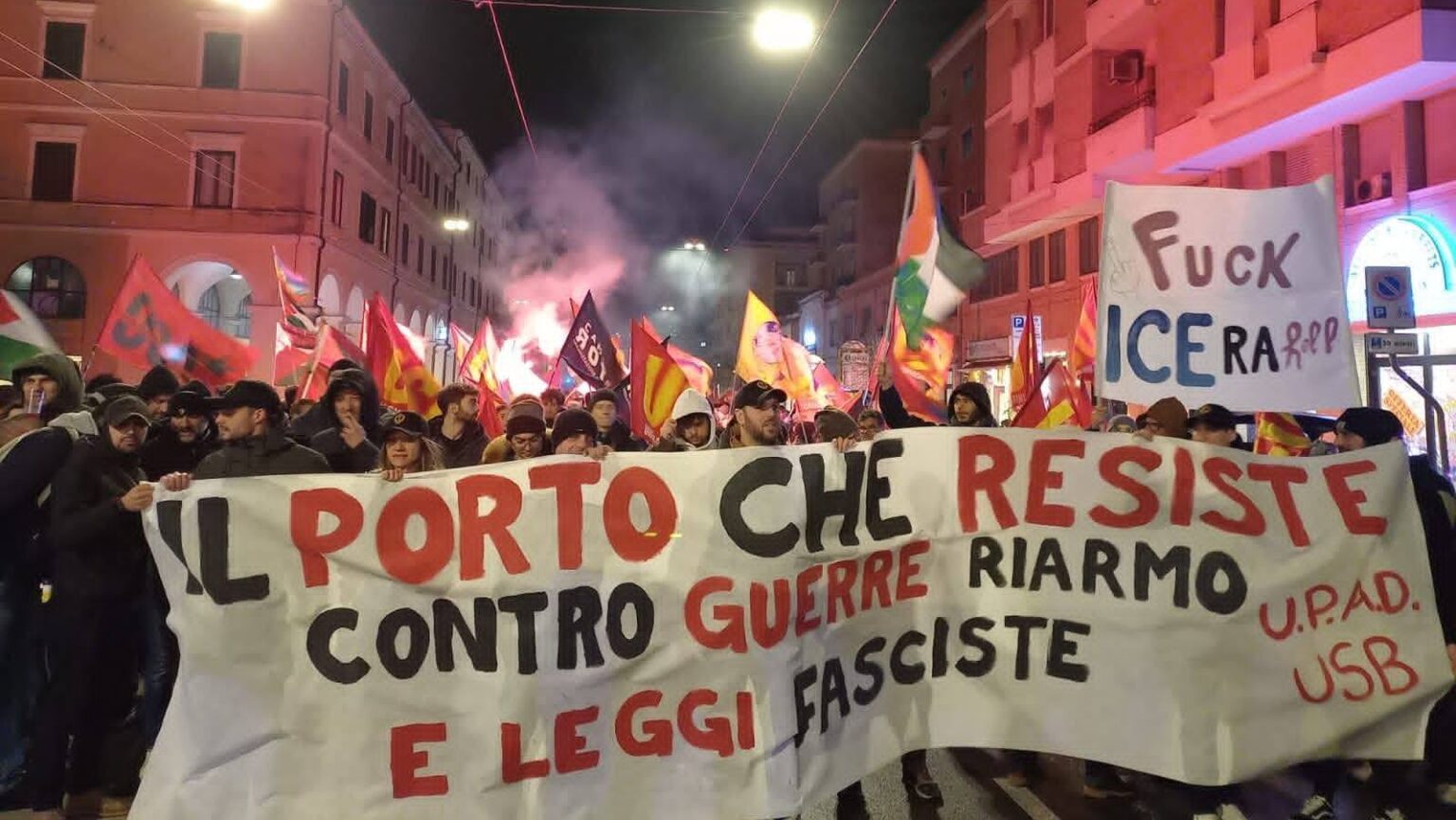
Strike banner in Ancona, reading: “The port that resists wars, rearmament, and fascist laws.” Source: Potere al Popolo Terni/Facebook
On February 6, dockworkers in more than 20 Mediterranean ports went on strike against war, militarization, and port privatization.
Dockworkers in more than 20 ports across the Mediterranean marked a historic moment today as they launched an international day of strike and protest against war and rearmament. Dockers also protested the privatization and militarization of port infrastructure.
Unionists involved in preparing the action described it as the result of a long and complex process, built on dockworkers’ solidarity with Palestine and their struggles for dignified working conditions at home.
The impact of the strike was felt even before it fully unfolded on February 6, as reports emerged of ships – vessels that regularly transport military cargo to Israel – disrupting their itineraries due to the actions.
“Ports are places of sweat, not blood”
Demonstrations began in the morning in the Greek ports of Piraeus and Elefsina, in Türkiye’s Mersin, and in Bilbao and Pasaia in the Basque Country. The trade union Liman-İş Sendikası rallied hundreds of its members to send a message against genocide and in solidarity with Palestine, echoing similar dispatches by their comrades from LAB in the Basque Country.
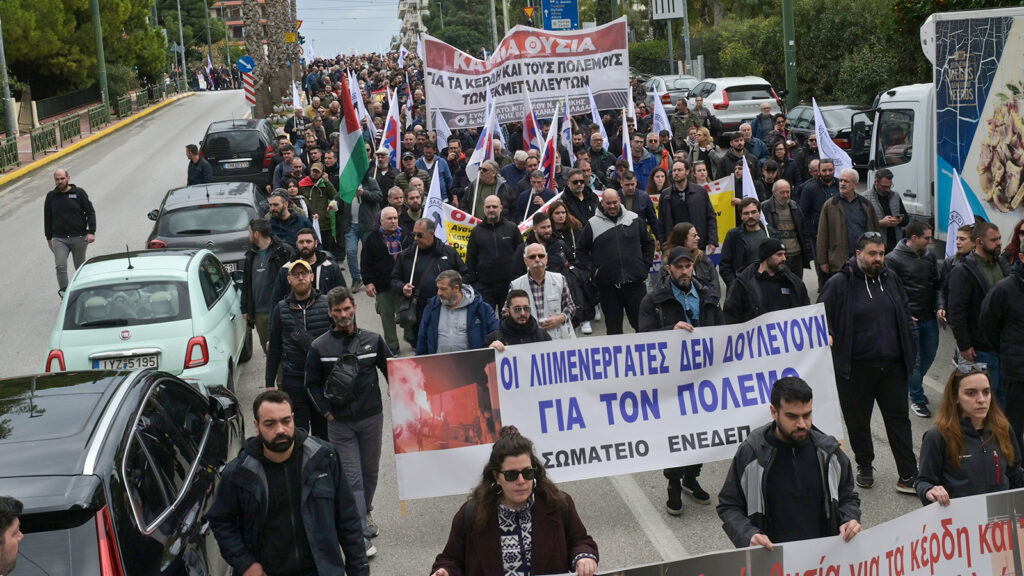
In Greece, dockworkers highlighted the contradiction between massive European investments in rearmament and the imposition of austerity on public services and infrastructure, which is leading to increasingly unsafe working conditions. “We won’t accept work without rights,” said Damianos Voudigaris of the Greek union ENEDEP later in the day. “Development should mean going home alive. Ports are places of work, not war. They are places of sweat, not blood.”
Demonstration during the strike in Piraeus Port. Source: PAME International
Some of the largest mobilizations of the day took place in Italy. Strikes were organized in Ancona, Bari, Cagliari, Civitavecchia, Crotone, Genoa, Livorno, Palermo, Ravenna, Salerno, and Trieste, involving not only dockworkers and port employees but also students and members of the public. The map of the strikes once again underscored the momentum built by Italy’s labor movement over the past year, including three general strikes for Palestine – mobilizations that have drawn inspiration from some of the dockers collectives’ anti-war activism.
The trade union Unione Sindacale di Base (USB) reported from all striking ports, with union representatives addressing assemblies prominently displaying Palestinian and Cuban flags. Workers stressed that Europe’s labor movement must find an internationalist orientation in order to block the anti-worker agenda of the European Union and right-wing governments. Governments including that of Prime Minister Giorgia Meloni, which, as USB activists noted during live broadcasts, was rattled by the determination shown by workers after years of stagnation. According to trade unionists, this panic has translated into a new wave of repression, including measures targeting union members involved in Palestine solidarity actions. USB, however, insisted that resistance to Meloni’s policies would only intensify in the coming weeks.
“Today it’s the ports, tomorrow it will be the entire logistics sector”
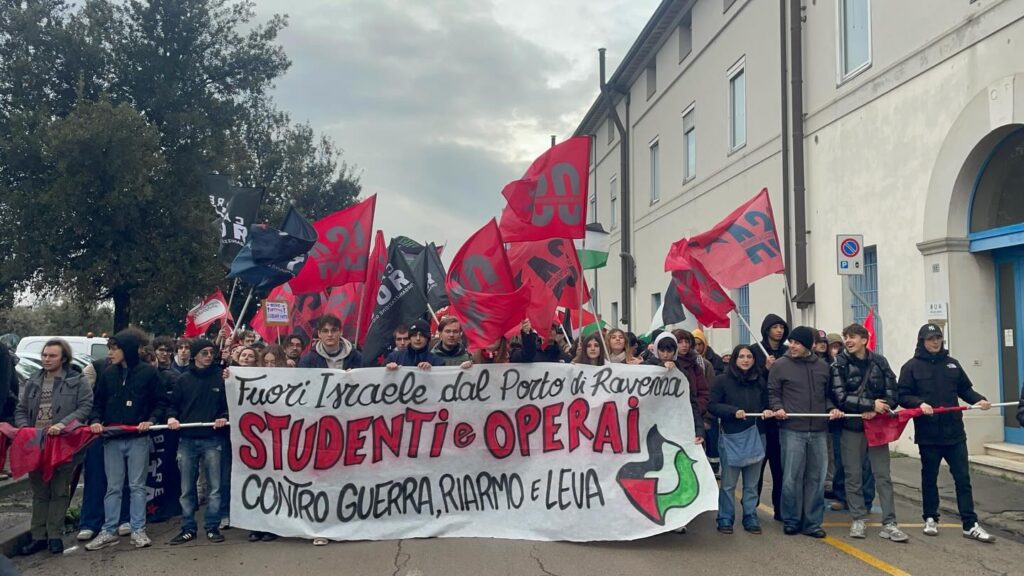
While uniting around shared demands – to prevent the militarization of ports, reject rearmament, and stop a war economy from stifling all other priorities – striking workers also raised local concerns. Dockworkers in Trieste warned against port privatization. Elsewhere, including in Bari and Ravenna, workers and students described how port infrastructure was being used, sometimes covertly, to transport military and dual-use materials to Israel. “Everyone here has had enough of that,” one activist in Ravenna said.
Demonstrations held in Civitavecchia, Livorno, and Ancona on Friday evening were notable, with strikers in Ancona describing the day as “monumental.” In Genoa, as has become customary, turnout was massive. Members of the collective CALP – who had previously vowed that “not one nail” would leave the port if Israel attacked the Global Sumud Flotilla en route to Gaza – led the protest. Speaking to media and fellow activists, they stressed that the success of the international strike once again proved that dockworkers keep their promises.
“We promised to block everything – and we blocked everything. We promised a general strike – and we had a general strike. We promised an international strike – and here we are,” they said.
Students in solidarity with dockworkers in Ravenna. Source: Cambiare Rotta Bologna
The international dockworkers’ strike, however, is not the end of the road, workers emphasized. “Today it’s the ports, tomorrow it will be the entire logistics sector, and then it will be all workers,” strikers in Ravenna concluded.
Actions were also reported in the ports of Fos-sur-Mer near Marseille, the German hubs of Bremen and Hamburg, and in Corsica. Dockworkers from Morocco’s Democratic Labor Organization (ODT), who had been involved in preparing the strike throughout the process, were forced to postpone their industrial action due to extreme weather conditions that led to port closures.
Genocide denier and Current UK Prime Minister Keir Starmer is quoted that he supports Zionism without qualification. He also confirms that UK air force support has been essential in Israel’s mass-murdering genocide. Includes URLs https://www.declassifieduk.org/keir-starmers-100-spy-flights-over-gaza-in-support-of-israel/ and https://youtu.be/O74hZCKKdpAKeir Starmer objects to criticism of the IDF. He asks how could anyone object to them starving people to death, forced marches like the Nazis did, bombing Gaza’s hospitals and universities, mass-murdering journalists, healthworkers and starving people queuing for food, killing and raping prisoners and murdering children. He calls for people to stop obstructing his genocide for Israel.Orcas discuss Genocide-supporting and complicit Zionists. Donald Trump, Keith Starmer, David Lammy, Rachel Reeves, Angela Rayner and Wes Streeting are acknowledged as evil genocide-complicit and supporting cnuts.
Original article by Simon Lock republished from TBIJ under a Creative Commons Attribution-NonCommercial-NoDerivs 3.0 Unported License.
Redacted email deciphered by TBIJ shows former politician suggesting holiday home for convicted sex offender
Peter Mandelson emailed Jeffrey Epstein after his release from house arrest to recommend a holiday home where the financier could host his “guests”.
Mandelson said he had found a villa in Italy that Epstein could use, offering “privacy with accompanying rooms for your ‘guests’” – with quote marks around the word guests.
It is not clear who this was in reference to. Epstein’s connections among the global elite included bankers, royals and Middle Eastern sheikhs.
The email was published this week by the US government as part of the Epstein Files cache. Its sender has been redacted but we were able to identify it as coming from Mandelson.
A spokesperson for Mandelson said: “Lord Mandelson regrets, and will regret until to his dying day, that he believed Epstein’s lies about his criminality. Lord Mandelson did not discover the truth about Epstein until after his death in 2019. He is profoundly sorry that powerless and vulnerable women and girls were not given the protection they deserved.”
The email chain is from August 2010, a month after Epstein had been released from house arrest following his conviction for child sex offences.
In the message in question, Mandelson tells Epstein that he is due to arrive back in London from “Myk”, shorthand for the Greek island of Mykonos, at the end of August. He goes on to say: “Found you a great place to stay on the Amalfi coast near to Positano. Zeferelli home converted into beautiful suites and privacy with accompanying rooms for your ‘guests’.”
While the identity of the sender is blacked out in the published file, other emails from the same period confirm that Mandelson travelled at that time to Mykonos, which he also referred to as “Myk” in separate emails. The email in question was sent from a Blackberry, Mandelson’s favoured method of communication at the time.
The redaction in the files leaves some parts of the email address visible, and we were able to match it with an address used by Mandelson (see video below).
The conversation with Epstein took place during a period of frequent contact between the pair following Mandelson’s exit from frontline politics after Labour’s election defeat.
The men discussed job opportunities for Mandelson, including with mining giant Glencore, investment banks Lazard and Deutsche Bank, and his own advisory firm, Global Counsel.
The house Mandelson refers to in the email appears to be Villa Treville, an exclusive 16-suite luxury hotel located on a clifftop overlooking the Gulf of Salerno.
There is no evidence that Epstein ever visited the villa.
Villa Treville as it appears today
Lead image: Peter Mandelson and Jeffrey Epstein pictured together. Credit: Department of Justice / ZUMA Press Wire / Shutterstock
Reporter: Simon Lock Enablers editor: Eleanor Rose Deputy editor: Katie Mark Editor: Franz Wild Production editor: Alex Hess
TBIJ has a number of funders, a full list of which can be found here. None of our funders have any influence over editorial decisions or output.
Original article by Simon Lock republished from TBIJ under a Creative Commons Attribution-NonCommercial-NoDerivs 3.0 Unported License.
Keir Starmer(R) and his boss Peter Mandelson(L).
Two Labour Party total s***s, David Lammy and Peter Mandelson.
CONFIDENTIAL – STRICTLY NOT FOR PUBLICATION: Ipso has asked us to circulate the following advisory:
Ipso has today been contacted by a representative acting on behalf of Peter Mandelson.
Mr Mandelson’s representatives state that he does not wish to speak to the media at this time. He requests that the press do not take photos or film, approach, or contact him via phone, email, or in-person. His representatives ask that any requests for his comment are directed to [REDACTED]
We are happy to make editors aware of his request. We note the terms of Clause 2 (Privacy) and 3 (Harassment) of the Editors’ Code, and in particular that Clause 3 states that journalists must not persist in questioning, telephoning, pursuing or photographing individuals once asked to desist, unless justified in the public interest.
Please do not hesitate to contact me to discuss any Code issues on [REDACTED] or out of hours on [REDACTED].
[IPSO official]
13.15pm Don’t know why this was not displaying properly.




 Villa Treville as it appears today

