This work by Middle East Monitor is licensed under a Creative Commons Attribution-NonCommercial-ShareAlike 4.0 International License.
Relatives and loved ones of Palestinians, who lost their lives in an Israeli attack ON Sabra neighborhood, mourn for their deceased ones at Al-Ahli Baptist hospital during their funeral procedures on October 03, 2025 in Gaza City, Gaza. [Hamza Z. H. Qraiqea – Anadolu Agency]
At least 67,139 Palestinians have been killed in Israel’s genocidal war on the Gaza Strip since October 2023, the Health Ministry said on Sunday, Anadolu reports.
A ministry statement said that 65 bodies were brought to hospitals in the last 24 hours, while 153 people were injured, taking the number of injuries to 169,583 in the Israeli onslaught.
“Many victims are still trapped under the rubble and on the roads as rescuers are unable to reach them,” it added.
It also noted that two Palestinians were killed and 30 others injured by Israeli army fire while trying to get humanitarian aid in the last 24 hours, bringing the total number of Palestinians killed while seeking aid to 2,605, with over 19,124 others wounded since May 27.
The Israeli army resumed its attacks on the Gaza Strip on March 18 and has since killed 13,549 people and injured 57,542 others, shattering a ceasefire and prisoner exchange agreement that took hold in January.
Last November, the International Criminal Court issued arrest warrants for Israeli Prime Minister Benjamin Netanyahu and his former Defense Minister Yoav Gallant for war crimes and crimes against humanity in Gaza.
Israel also faces a genocide case at the International Court of Justice for its war on the enclave.
This work by Middle East Monitor is licensed under a Creative Commons Attribution-NonCommercial-ShareAlike 4.0 International License.
Keir Starmer objects to criticism of the IDF. He asks how could anyone object to them starving people to death, forced marches like the Nazis did, bombing Gaza’s hospitals and universities, mass-murdering journalists, healthworkers and starving people queuing for food, killing and raping prisoners and murdering children. He calls for people to stop obstructing his genocide for Israel.Genocide denier and Current UK Prime Minister Keir Starmer is quoted that he supports Zionism without qualification. He also confirms that UK air force support has been essential in Israel’s mass-murdering genocide. Includes URLs https://www.declassifieduk.org/keir-starmers-100-spy-flights-over-gaza-in-support-of-israel/ and https://youtu.be/O74hZCKKdpAOrcas discuss Genocide-supporting and complicit Zionists. Donald Trump, Keith Starmer, David Lammy, Rachel Reeves, Angela Rayner and Wes Streeting are acknowledged as evil genocide-complicit and supporting cnuts.
This work by Middle East Monitor is licensed under a Creative Commons Attribution-NonCommercial-ShareAlike 4.0 International License.
Aid workers are seen distributing aid parcels to Palestinians amid ongoing Israeli attacks during World Humanitarian Day in Khan Yunis, Gaza on August 18, 2024. [Hani Alshaer – Anadolu Agency]
A “perfect humanitarian storm” – that is how the International Federation of Red Cross and Red Crescent Societies (IFRC) describes Gaza, where aid workers endure the same hunger and fear as those they try to help, Anadolu reports.
The warning comes as Israel’s war nears its third year, following what aid agencies describe as the deadliest year on record for humanitarian workers – and 2025 is already following the same trajectory.
“Last year was the deadliest year on record for colleagues killed from different organizations – we’re talking about hundreds,” IFRC spokesperson Tommaso Della Longa told Anadolu. “The vast majority, sadly, are from Gaza, the West Bank and Sudan. And 2025 is already following the same trend.”
At least 265 aid workers had been killed worldwide as of Aug. 14, 2025, approaching the previous year’s toll of 383, according to the Aid Worker Security Database.
Latest figures from the UN show Israeli forces have killed at least 562 humanitarian workers in Gaza over the past two years, including 376 UN staff members and 54 staff and volunteers of the Palestine Red Crescent Society.
As violence against humanitarian workers reaches record levels, the IFRC warns that Gaza is at the heart of a trend threatening to make attacks on aid workers a new feature of war. “The risk here is to normalize something that should never be normalized,” said Della Longa, lamenting that people who devote their lives to saving others are instead “attacked, killed, wounded, detained.”
– Living with hunger and famine
Inside Gaza, where the UN officially declared famine in late August, the hardship is staggering. Aid workers describe colleagues telling children to go to bed early so they do not feel the hunger or holding on to a single piece of bread until the end of the day to give to their children.
“One colleague told me what it means to live with famine and hunger: you dream of food you cannot have, and when you finally get even a piece of bread, you must keep it for your child,” said Della Longa. “Then, after giving it to them, you have to say sorry and ask them to wait for more because you will not be able to provide. As a father myself, I found this absolutely shocking.”
Doctors and nurses in Gaza have been working frantically, often without rest and basic needs, enduring unimaginable personal loss and suffering while trying to save others falling prey to endless Israeli attacks.
“There was never anyone to replace them … even for a couple of days. They were killed, they were not protected, and now even they don’t know how to have meals during the day,” he said. “Weakening doctors and nurses means weakening entire communities.”
Carla Drysdale, a World Health Organization spokesperson, echoed the concern and drew attention to the attacks that not only destroyed the functionality of hospitals and ambulances, but also injured and killed thousands of health workers.
Both organizations say that without protection and access, humanitarian action in Gaza will remain paralyzed.
– ‘Impunity once risks impunity everywhere’
Over the past two years, Israel has killed more than 67,000 Palestinians in Gaza, most of them women and children, and wounded nearly 170,000, according to figures from Palestinian authorities confirmed by the UN and other international organizations.
A UN independent international commission of inquiry concluded last month that Israel is committing genocide in the enclave, where its siege and blockade on all essentials has also triggered a famine that has killed more than 450 Palestinians, including over 150 children.
Earlier in August, UN experts warned that Israel’s targeted destruction of Gaza’s health system amounts to “medicide.”
In a statement, UN special rapporteurs Tlaleng Mofokeng and Francesca Albanese said Israel was “deliberately attacking and starving healthcare workers, paramedics and hospitals to wipe out medical care in the besieged enclave.”
“In addition to bearing witness to an ongoing genocide we are also bearing witness to a ‘medicide,’ a sinister component of the intentional creation of conditions calculated to destroy Palestinians in Gaza which constitutes an act of genocide,” the experts said.
Della Longa warned that the erosion of respect for aid workers is no longer confined to war zones.
“If you think about 10 years ago, talking about the protection of humanitarians in this way would have been not understandable, because you don’t attack humanitarians. This trend is so widely spread that it is really deeply concerning and shocking.”
He called for enforcement of respect for existing laws and stressed the need for mechanisms to end impunity.
“If there is impunity once, it means there would be impunity everywhere. This is a precedent that we cannot accept,” he said.
“The issue is the political will. Humanitarians must do the humanitarian work and call on governments to take their own responsibility,” he said.
He concluded with one plea: “Don’t shoot the Red Cross. Don’t shoot humanitarians. Don’t shoot the people who are saving lives and alleviating suffering.”
This work by Middle East Monitor is licensed under a Creative Commons Attribution-NonCommercial-ShareAlike 4.0 International License.
Keir Starmer objects to criticism of the IDF. He asks how could anyone object to them starving people to death, forced marches like the Nazis did, bombing Gaza’s hospitals and universities, mass-murdering journalists, healthworkers and starving people queuing for food, killing and raping prisoners and murdering children. He calls for people to stop obstructing his genocide for Israel.Genocide denier and Current UK Prime Minister Keir Starmer is quoted that he supports Zionism without qualification. He also confirms that UK air force support has been essential in Israel’s mass-murdering genocide. Includes URLs https://www.declassifieduk.org/keir-starmers-100-spy-flights-over-gaza-in-support-of-israel/ and https://youtu.be/O74hZCKKdpAOrcas discuss Genocide-supporting and complicit Zionists. Donald Trump, Keith Starmer, David Lammy, Rachel Reeves, Angela Rayner and Wes Streeting are acknowledged as evil genocide-complicit and supporting cnuts.
Protesters taking part in a demonstration organised by Defend our Juries, in support of Palestine Action in Trafalgar Square, London, October 4, 2025
Campaigners condemned government’s plan to give police new powers to crack down on protests
CAMPAIGNERS have condemned the government’s mounting authoritarianism after it was announced yesterday that police will be granted new powers to crack down on protests.
The measures follow a mass demonstration in support of proscribed campaign group Palestine Action in which nearly 500 people were arrested in central London on Saturday for peacefully holding signs.
The government plans to amend sections 12 and 14 of the Public Order Act 1986 so that police can consider the “cumulative impact” of protests.
Under the changes, police could instruct organisers to hold protests elsewhere if a site has seen repeated demonstrations.
…
Ms Mahmood said that “large repeated protests can leave sections of our country, particularly religious communities, feeling unsafe” and that this was evident in the Jewish community.
On Friday she called for pro-Palestine protesters to “step back” from demonstrations following an attack on a Manchester synagogue in which two people were killed the day before.
Yesterday Stop the War accused the government of weaponising the attack to ramp up its crackdown on the Palestine movement.
The group’s convener, Lindsey German, said: “We condemn the attack on the Manchester synagogue, just as we condemn recent attacks on mosques and hotels accommodating asylum-seekers.
“We wholeheartedly reject the implication that our peaceful marches are in any way responsible for the attack.
“Stop the War has never conflated Israel’s illegal actions with the British Jewish community and will continue to vociferously oppose any attempt to do so.”
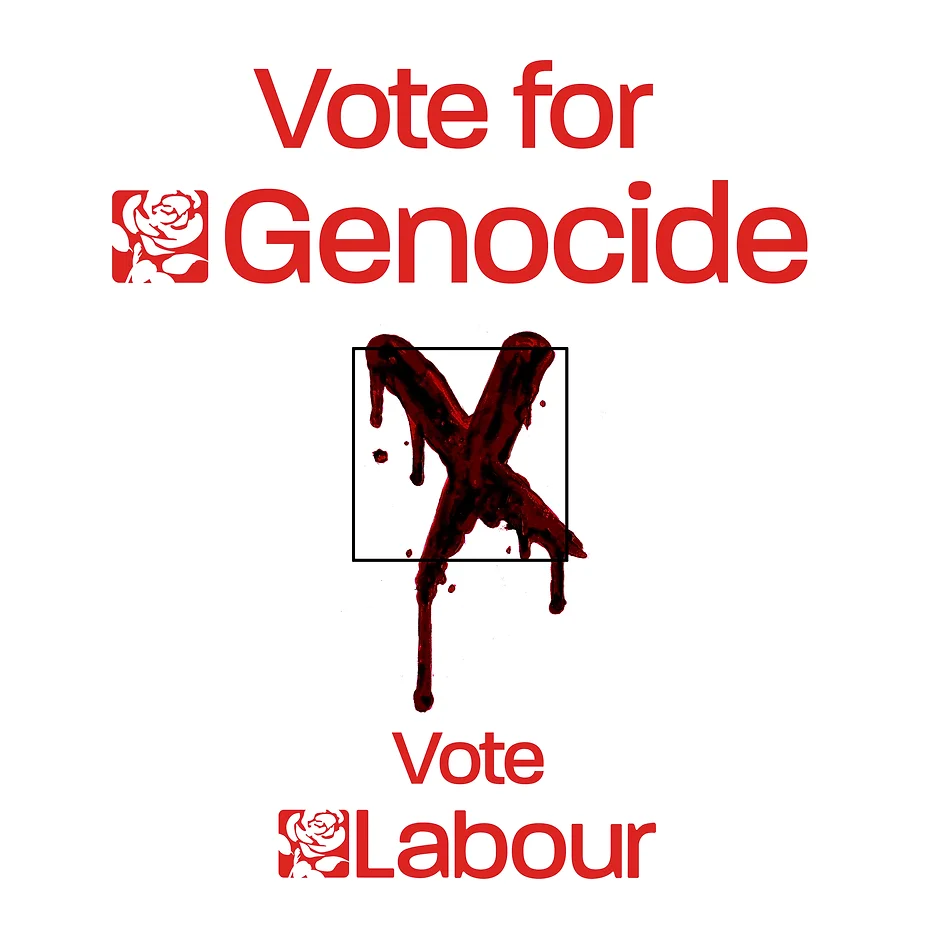
Keir Starmer objects to criticism of the IDF. He asks how could anyone object to them starving people to death, forced marches like the Nazis did, bombing Gaza’s hospitals and universities, mass-murdering journalists, healthworkers and starving people queuing for food, killing and raping prisoners and murdering children. He calls for people to stop obstructing his genocide for Israel.Vote Labour for Genocide.Palestine Action joke that appeared in the UK satirical magazine ‘Private Eye’.
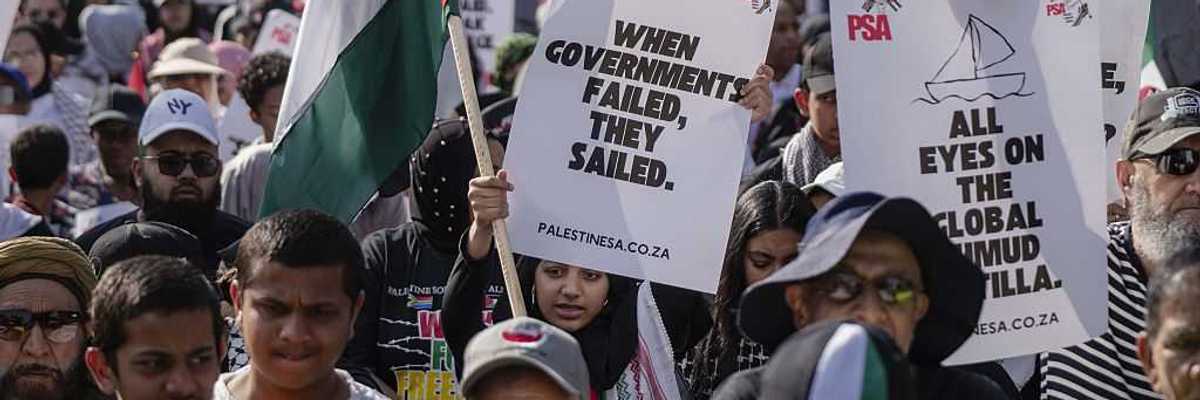
Thousands gather for a march ahead of the second anniversary of the war in Gaza, on October 5, 2025, in Johannesburg, South Africa. (Photo by Ihsaan Haffejee/Anadolu via Getty Images)
US Rep. Ro Khanna demanded that Israel release American flotilla member David Adler, whose family has not heard from him since October 1.
US Congressman Ro Khanna on Sunday demanded the Israeli government’s release of David Adler, a US citizen who was one of the organizers intercepted by Israeli forces last week after they came close to breaking the country’s blockade on Gaza with the Global Sumud Flotilla.
As Marco Sermoneta, Israel’s consul general to the Pacific Northwest in the US, dismissed reports that humanitarians who were aboard the flotilla’s 50 boats are being deprived of food and water and mistreated in an Israeli detention center, Khanna (D-Calif.) called on the diplomat to confirm that Adler, a California resident, is a safe.
“I am most concerned about David Adler, a Californian and Jewish American, who is in the Ketziot prison,” said Khanna. “I spoke to his sister last night and their family is deeply anxious. Can you assure us he will be released and sent home safely?”
Khanna said Saturday that Adler’s family has not had contact with him since October 1, the day before a majority of the flotilla’s boats were stopped from reaching Gaza to deliver humanitarian aid.
The congressman said he plans to lead a delegation letter to Secretary of State Marco Rubio and Israeli Ambassador to the US Michael Leiter on Monday and expressed hope that “every colleague, particularly every California member, will sign.”
“Our government must stand up for an American citizen’s fair treatment and release,” said Khanna.
The Israeli Foreign Ministry said Saturday that 137 of the rights advocates who were aboard the flotilla had been deported to Turkey; they were from the United Kingdom, Italy, and the United States.
More than 400 humanitarians, lawmakers, and lawyers were aboard the vessels, including Swedish climate activist Greta Thunberg, who told Swedish officials Saturday that she has been “subjected to harsh treatment in Israeli custody” in recent days.
The Guardian obtained correspondence from Sweden’s Foreign Ministry that described Israeli authorities taking photos of the climate campaigner “holding flags,” the identity of which was not reported.
“The embassy has been able to meet with Greta,” reads an email sent by the Foreign Ministry to people close to Thunberg and viewed by The Guardian. “She informed of dehydration. She has received insufficient amounts of both water and food. She also stated that she had developed rashes which she suspects were caused by bedbugs. She spoke of harsh treatment and said she had been sitting for long periods on hard surfaces.”
Turkish activist Ersin Çelik, who also participated in the Sumud flotilla, told Anadolu that Israeli authorities “dragged little Greta by her hair before our eyes, beat her, and forced her to kiss the Israeli flag. They did everything imaginable to her, as a warning to others.”
Another humanitarian told reporters that the Sumud flotilla campaigners had been “woken up at 3 in the morning with dogs and snipers walking into our rooms” and prevented from having medicine.
JUST IN: A Turkish activist from the Sumud Flotilla speaks out:
Israelis prevented us from having medicine, they only gave us water after 32 hours. We barely had any food.
We were woken up at 3 in the morning with dogs and snipers walking into our rooms, they woke us up every… pic.twitter.com/fDF8jI2gVh
“If Netanyahu’s government is treating Greta Thunberg this way, imagine how they are treating women and children in Gaza,” said Khanna on Sunday.
Talks on a peace plan between Israel and Hamas, proposed last week by US President Donald Trump, are scheduled to begin Monday in Egypt. Hamas has said it is willing to release the remaining hostages the group has been holding captive in Gaza since October 7, 2023 in exchange for the release of nearly 2,000 Palestinians detained by Israel.
On Saturday, hundreds of thousands of people across Europe marched in solidarity with the flotilla members and with Gaza, where more than 67,000 Palestinians have been killed by Israel—with the backing of the US and a number of European governments—since October 2023.
Organizers in Rome said 1 million people turned out for the demonstration that was planned after Israel’s interception of the flotilla; police said 250,000 people marched. Spanish campaigners said hundreds of thousands of people rallied in every major city in the country, while smaller protests were reported in cities including Paris, Lisbon, Athens, and London.
Families attended a rally in Barcelona—whose former mayor, Ada Colau, was among the participants in the flotilla—and held signs with messages including, “Stop the Genocide,” and “Hands off the flotilla.”
Hundreds of thousands turn out at pro-Palestine marches across Europe, demanding immediate ceasefire in Gaza and the release of flotilla activists trying to get aid to enclave.
On Sunday, protests in support of the flotilla and Gaza continued in countries including South Africa and Amsterdam.
Aaron Bastani of Novara Mediasaid it was likely not “a coincidence that David Adler remains in prison, has not been in contact with his family, and has reputedly suffered significant ill treatment.”
“The biggest problem for [Prime Minister Benjamin] Netanyahu and the Israeli right, long term,” said Bastani, “is anti-Zionist Jewish Americans.”
Keir Starmer objects to criticism of the IDF. He asks how could anyone object to them starving people to death, forced marches like the Nazis did, bombing Gaza’s hospitals and universities, mass-murdering journalists, healthworkers and starving people queuing for food, killing and raping prisoners and murdering children. He calls for people to stop obstructing his genocide for Israel.Genocide denier and Current UK Prime Minister Keir Starmer is quoted that he supports Zionism without qualification. He also confirms that UK air force support has been essential in Israel’s mass-murdering genocide. Includes URLs https://www.declassifieduk.org/keir-starmers-100-spy-flights-over-gaza-in-support-of-israel/ and https://youtu.be/O74hZCKKdpAOrcas discuss Genocide-supporting and complicit Zionists. Donald Trump, Keith Starmer, David Lammy, Rachel Reeves, Angela Rayner and Wes Streeting are acknowledged as evil genocide-complicit and supporting cnuts.
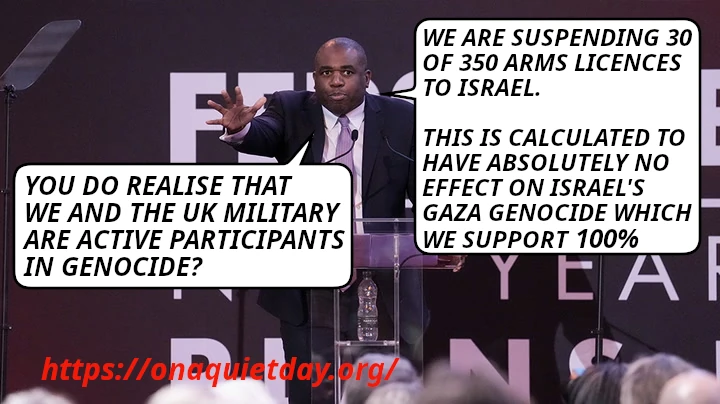
Keir Starmer objects to criticism of the IDF. He asks how could anyone object to them starving people to death, forced marches like the Nazis did, bombing Gaza’s hospitals and universities, mass-murdering journalists, healthworkers and starving people queuing for food, killing and raping prisoners and murdering children. He calls for people to stop obstructing his genocide for Israel.Genocide denying UK Foreign Secretary David Lammy says that UK is suspending 30 of 350 arms licences to Israel. He also confirms the UK government’s support for Israel’s Gaza genocide and the UK government and military’s active participation in genocide.Orcas discuss Genocide-supporting and complicit Zionists. Donald Trump, Keith Starmer, David Lammy, Rachel Reeves, Angela Rayner and Wes Streeting are acknowledged as evil genocide-complicit and supporting cnuts.


 Protesters taking part in a demonstration organised by Defend our Juries, in support of Palestine Action in Trafalgar Square, London, October 4, 2025