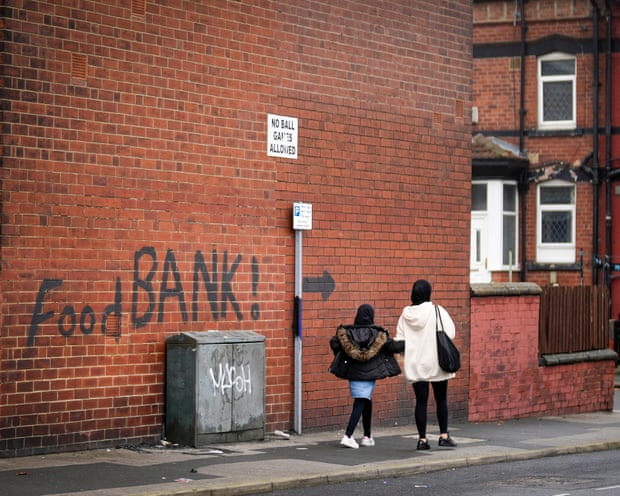
One economist said there was ‘a total disconnect between macroeconomic indicators and the reality of income gains for most people’. Photograph: Christopher Furlong/Getty Images
This ‘ghost GDP’ shows how headline economic growth is increasingly disconnected from reality for most, says report
The wealth of Britain’s 157 billionaires is now equivalent to more than a fifth of the country’s entire GDP, according to analysis by the Equality Trust – a fivefold increase since 1990.
The charity describes the trend, based on data in this year’s Sunday Times rich list, as Britain’s “ghost GDP”: headline economic growth increasingly disconnected from everyday life.
“Every year politicians point to GDP growth as proof the economy is working. Ghost GDP shows us what that ambition has done to the rest of us because for most of us, it doesn’t feel like the economy is working at all,” said Priya Sahni-Nicholas, the co-executive director of the Equality Trust.
“Ghost GDP and the hollowed out economy it creates, tells you what the rest of us have lost as a direct result.”
…
When the Sunday Times first published its rich list in 1989, 15 billionaires held a total of £27bn – about 4p in every pound of GDP at the time. Today, the Equality Trust calculates that 157 billionaires hold just under £670bn – more than 22p in every pound.
“Workers have endured the longest pay squeeze in living memory,” said Sahni-Nicholas. “But the richest 50 families now hold more wealth than the poorest 34 million of us combined.”
Article by Emiliano Mellino republished from TBIJ under a Creative Commons Attribution-NonCommercial-NoDerivs 3.0 Unported License.
George Madgwick has multiple tribunal rulings against him for unpaid wages
When Nigel Farage declared that young people should be paid less, George Madgwick leapt to his defence.
Madgwick, a restaurateur and Reform’s most senior councillor in Portsmouth, told the radio station LBC young people were being paid too much and were priced out of jobs. He admitted that reducing the minimum wage for those under 21 would be unpopular, but said politicians “need to start being honest with the general population”.
But what he didn’t disclose was that employment tribunals have found that some of his own companies failed to pay employees wages and holiday pay.
In total, two of his businesses have been ordered to pay £4,386 to former employees for breaching employment law. Madgwick told the Bureau of Investigative Journalism (TBIJ) he is contesting the tribunals’ rulings, which he says were made without the companies having opportunity to defend the claims. So far his businesses have not paid the sums awarded to his former staff.
Only the most shameless employer would tell young people they’re paid too much while failing to pay their own staff’s wages
According to one of the judgments, an employee of Madgwick’s Signature by the Wicks restaurant, was unable to claim maternity pay because it had failed to provide her with a contract or pay statements.
The tribunal ordered the business to pay £1,800 to make up for the unpaid maternity pay, as well as £400 in unpaid wages and £1,120 in unpaid holiday pay.
Another of Madgwick’s businesses, Parnells Food Outlets Ltd, had two separate judgments against it, one for unauthorised deduction of wages and another for unpaid holiday pay.
Bryan Simpson, the national lead for the Unite union’s hospitality sector, said Madgwick’s companies represent everything that is wrong with unscrupulous hospitality employers.
“Only the most shameless employer would tell young people they’re paid too much while failing to pay their own staff’s wages, holiday pay, and even denying a new mum her legal right to a contract, costing them hundreds in maternity pay,” he said.
“You can’t preach about hard work when you won’t even pay your workers — this is exploitation dressed up as opinion from Reform’s leader on Portsmouth council.”
Even though the most recent judgment was handed down more than two years ago, Madgwick told TBIJ he only became aware of the tribunal cases recently.
He said the tribunal had served notice of the claims to his companies’ addresses after he had vacated the premises, leaving him unable to defend himself as he didn’t get any letters or notices about the cases.
Madgwick says the hearings took place without him or his businesses having any awareness or legal representation. He said he has now applied for the judgments to be reconsidered, but he didn’t want to provide any evidence or copies of those applications while the legal proceedings were ongoing.
Both businesses are still listed as active on Companies House but have not filed accounts for several years. The law requires directors to keep the addresses of their businesses up to date. This is in part so that documents sent to them are received by a company official.
Madgwick said that both companies had been dormant since 2022 and were in the process of being formally wound up “with all necessary filings and notifications”. He suggested that the employment tribunal cases were delaying the winding up process.
TBIJ has not seen the applications Madgwick has submitted to overturn the judgments. However, several lawyers told TBIJ that if the tribunal were to find that the documents were validly served at the registered company address, it was unlikely that the tribunal would be sympathetic to his attempts to have the matters reviewed.
Madgwick is listed as a shareholder of 15 other businesses – all are dissolved and most never filed accounts. He told TBIJ that “almost all of them were non-trading dormant companies that were set up as holding names, mostly over 10 years ago”.
Earlier this month Madgwick used his experience of the hospitality sector to argue in favour of Farage’s suggestion to lower the minimum wage for young people. He told LBC: “It’s not outrageous. I own restaurants, that is my job. I own businesses in hospitality. I’m telling you now – I’ve employed a lot of young people. A lot of really good young people too. But there are certain qualities, especially in hospitality, that you can’t learn without age. Interactions with customers, for example.”
He has subsequently claimed on facebook that Reform is “the party of workers”.
Cal Corkery, a councillor who sits on Portsmouth council’s employment committee, said Reform may claim to be on the side of working people, but their proposal to “cut the minimum wage for young workers shows whose side they’re really on.”
“Led nationally by an ex-banker and locally here in Portsmouth by a businessman whose companies have repeatedly broken employment law, Reform are exposing themselves as just another party of the privileged elite,” he said.
Madgwick was a member of the Portsmouth Independents Party (PIP) until he defected to Reform earlier this year. All but two of Reform’s eight councillors in Portsmouth were previously members of PIP.
Header image: George Madgwick and the site of his former restaurant, Signature by the Wicks. Design by Oliver Kemp
Reporters: Emiliano Mellino Bureau Local editor: Gareth Davies Deputy Editor: Chrissie Giles Editor: Franz Wild Production editor: Frankie Goodway Fact checker: Ero Partsakoulaki
TBIJ has a number of funders, a full list of which can be found here. None of our funders have any influence over editorial decisions or output.
Article by Emiliano Mellino republished from TBIJ under a Creative Commons Attribution-NonCommercial-NoDerivs 3.0 Unported License.
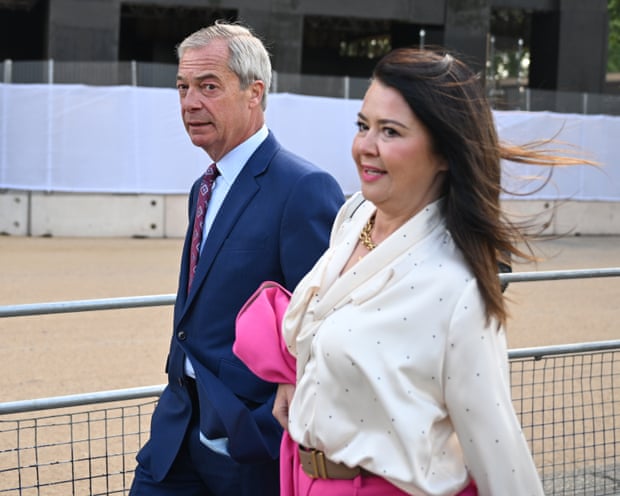
View image in fullscreen Farage with his partner, Laure Ferrari, in Westminster on Wednesday. He received the £5m gift shortly before announcing he would stand in the 2024 election. Photograph: WPA/Getty Images
Watchdog to examine whether Reform UK leader should have declared sum he received before entering parliament
Nigel Farage is facing a formal investigation by the parliamentary standards watchdog over a £5m gift from the crypto billionaire Christopher Harborne.
The Reform UK leader received the money weeks before announcing he would stand as a candidate in the 2024 general election.
Farage has said the gift, first revealed by the Guardian, was intended to cover his personal security costs and therefore did not need to be declared. However, other parties argue that the money from the Thailand-based businessman falls within rules requiring MPs to declare any potentially relevant gifts or donations received in the 12 months before entering parliament.
Daniel Greenbergh, the parliamentary commissioner for standards, is understood to have begun an investigation under rule 5 of the code of conduct obliging MPs to “fulfil conscientiously” requirements relating to their registration of interests.
It states that new MPs must register all their current financial interests, and any registrable benefits (other than earnings) received in the 12 months before their election. This must be done within one month of their election, and they must register any change in those registrable interests within 28 days.
If the investigation finds Farage committed a particularly serious breach of parliamentary declaration rules, he could be suspended from the Commons. A suspension of 10 days or more could trigger a recall petition, potentially forcing him to fight again for his Clacton seat.
Climate science denier Nigel Farage explains that it’s simple to blame asylum-seekers or Muslims for everything.Keir Starmer refuses to be outcnuted by Nigel Farage’s chasing the racist bigot vote.Elon Musk urges you to be a Fascist like him, says that you can ignore facts and reality then.
The Green Party has accused Farage of being “focused on personal gain and public division”.
Reform UK leader Nigel Farage has banked more than £2 million in earnings and gifts since becoming an MP, DeSmog can reveal.
Farage has come under fire in recent days for failing to declare a £5 million gift from major Reform donor Christopher Harborne prior to the 2024 general election, potentially in violation of parliamentary rules.
Despite this tax-free handout, Farage has used his time in Parliament to earn millions from second jobs, speaking events, and trips abroad.
DeSmog’s analysis shows that Farage has registered more than £2 million in financial interests since July 2024, when he was elected as the MP for Clacton.
His principal employer has been the right-wing broadcaster GB News, which has now paid Farage £700,000 since July 2024. The Reform leader – who presents a show on GB News – registered another £40,662 from the outlet last week.
This income has been received on top of Farage’s £94,000-a-year public salary.
He also listed a new gift from South African businessman Avi Lasarow, who gave the Reform leader three tickets to a boxing match on 4 April worth £1,749.
“Nigel Farage is a multi-millionaire who is out for himself and working for the interests of his super-rich friends,” a Green Party spokesperson said. “His whole career has been focused on personal gain and public division. He is failing his constituents and has no positive plan to help ordinary people with the cost of living crisis, housing or improving public services.”
Since becoming an MP, Farage has accepted £272,000 in gifts, including several private jet flights to the United States, and F1 tickets provided by the Abu Dhabi government.
“That Farage has amassed £2 million from personal earnings and gifts while a sitting member of Parliament should concern anyone who thinks an MP’s job is to represent their constituents,” said Kamila Kingstone, a senior campaign lead at Spotlight on Corruption.
“It’s a systemic issue and highlights a wider failure of the rules that are supposed to ensure integrity in public life. It risks blurring the lines between public service and private interests, creating the perception – and in some cases a reality – that some politicians are in it for themselves.”
DeSmog revealed in April that over 70 percent of Farage’s patrons are based abroad – including Harborne, the Thailand-based crypto investor who has gifted flights and accommodation to Farage worth £85,453 since July 2024.
Harborne, who owns a jet fuel supplier, has donated £22 million to Reform on top of the £5 million that he gifted to Farage before the 2024 general election.
His contributions to the party are now in jeopardy after Labour introduced new rules that cap political donations from overseas residents to £100,000 a year. In response, Harborne has committed to finding a loophole through which he can donate even larger sums to Reform.
“Where there’s a will, there’s a way,” he told The Telegraph – adding: “I don’t believe the government has a right to stop me, and they won’t.”
Reform UK is the UK’s leading anti-climate party, with several of its senior figures – including Farage – having denied basic climate science. The Reform leader has claimed it’s “absolutely nuts” for CO2 to be considered a pollutant, while his deputy Richard Tice has called it “plant food”.
“The government urgently needs to impose tougher limits on MPs’ second jobs,” Kingstone added, “so that the public can be confident that their representatives are working in the public interest rather than to line their own pockets.”
Reform and Farage were approached for comment.
A version of this article was published by The Guardian.
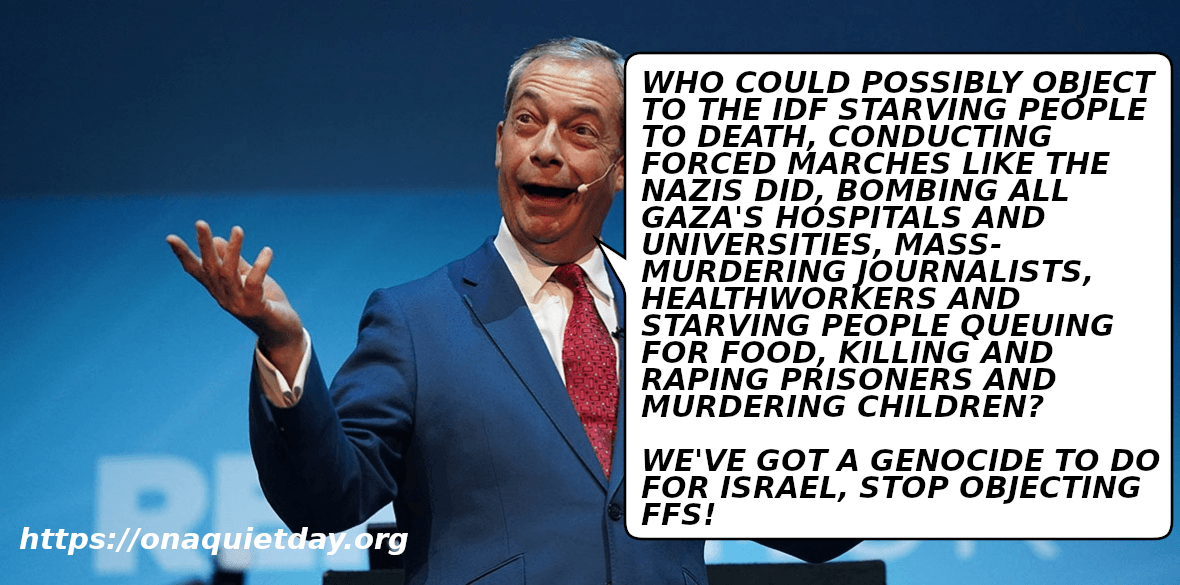
Climate science denier Nigel Farage explains that it’s simple to blame asylum-seekers or Muslims for everything.Nigel Farage explains the politics of Reform UK: Racism, Fake anti-establishmentism, Deregulation, Corporatism, Climate Change Denial, Mysogyny and Transphobia.Nigel Farage objects to criticism of the IDF. He asks how could anyone object to them starving people to death, forced marches like the Nazis did, bombing Gaza’s hospitals and universities, mass-murdering journalists, healthworkers and starving people queuing for food, killing and raping prisoners and murdering children. He calls for people to stop obstructing his genocide for Israel.Nigel Farage urges you to ignore facts and reality and be a climate science denier like him and his Deputy Richard Tice. He says that Reform UK has received £Millions and £Millions from the fossil fuel industry to promote climate denial and destroy the planet.Nigel Farage reminds you that he’s the man that brought you Brexit and asks what could possibly go wrong.
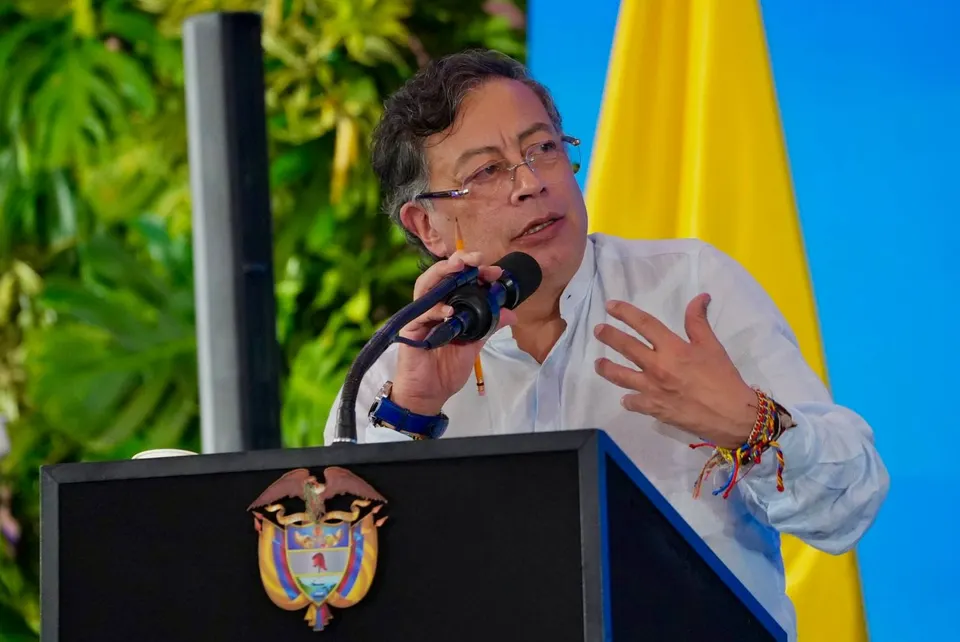
Colombian President Gustavo Petro speaks at the First Conference on the Transition Beyond Fossil Fuels | Colombian Ministry of the Environment
Nearly 60 countries launch coalition to accelerate the energy transition against the backdrop of the blockade of the Strait of Hormuz
SANTA MARTA, COLOMBIA — As the US and Israeli war against Iran puts oil at the centre of global concerns, a new intergovernmental coalition is seeking to accelerate the energy transition outside the UN’s climate change convention (COP) system, which has been trying – and failing – to phase out fossil fuels for three decades.
The coalition’s 57 members, who account for almost half of global GDP, met last week in the Colombian coastal city of Santa Marta for the First Conference on the Just Transition Away from Fossil Fuels, co-hosted by the governments of Colombia and the Netherlands.
Colombian President Gustavo Petro said the initiative was established after COP30 ended in November with no concrete resolution on phasing out the use of fossil fuels, which account for 75% of global greenhouse emissions. Since then, it has only been made more urgent by the oil crisis created by the Iran war.
“The ongoing disruptions due to the hostilities in the Strait of Hormuz have underlined that reducing fossil fuel dependencies is critical. It is essential to keep our planet livable, to safeguard energy security, and to build economic resilience to volatile fossil fuel markets,” states the conference’s final communiqué.
Rather than duplicating COPs’ efforts to establish new greenhouse gas reduction targets, the coalition agreed “to advance and accelerate the implementation of agreed goals” by applying pressure and strengthening international alliances within the multilateral negotiations adopted by consensus, the text says.
The conference was significant for its discussions on what “the consequences of decarbonisation” mean for oil exporters, said Susana Muhamad, Colombia’s ambassador for the initiative to create aFossil Fuel Non-Proliferation Treaty. It was the first time such conversations have been had at “a diplomatic forum on climate issues”.
“The fact that a country like Nigeria [which depends on crude oil exports] is here at a high level is very important, because they are not necessarily saying we are going to stick with oil until the end, whatever the cost,” she told openDemocracy. “They are recognising the vulnerability of being economically dependent on those exports.”
This need for economic freedom from oil was recognised by President Petro. “Can capitalism adapt to an energy system that is not fossil-based?” he asked an auditorium of delegates from participant countries, including Brazil, Mexico, Nigeria, the United Kingdom, France and the European Union as a bloc, as well as small island states in the Caribbean and the South Pacific.
Noticeably absent were representatives of the United States and China – the world’s two biggest carbon emitters – as well as Russia and India, all of whom were deliberately not invited to avoid the kind of deadlocks and obstructionism that led to the blocking of efforts to create a roadmap to phase out fossil fuels at COP30.
“When you make a plan, you first call your closest friends, and then you send the invitation to the rest,” Juan Carlos Monterrey Gómez, Panama’s Ministry of the Environment’s special representative for climate change, told openDemocracy.
Monterrey Gómez said the initial focus was instead on strengthening a group of countries committed to phasing out fossil fuels. “With this first group, we can have an honest conversation, without administrative roadblocks. This conversation has never taken place before, and that is historic.”
Other attendees had mixed feelings about the invite list.
While Claudio Angelo, an international policy coordinator at the Climate Observatory, a network of Brazilian environmental organisations, agreed that inviting Donald Trump’s climate-denying US administration would have been “unnecessary”, he told openDemocracy: “China should be here, as it supplies renewable energy technology to the whole world.”
‘Oil is nobody’s friend’
As well as the official delegates, the conference was attended by representatives of social movements, academia, multilateral institutions, parliaments, trade unions, Indigenous and Afro-descendant peoples, women and diverse communities, the private sector, farmers, NGOs, children and young people.
In the days leading up to the event, Santa Marta hosted scientific and civil society debates, where activists and Indigenous peoples urged governments to accelerate the energy transition.
Their calls came as a new report by 350.org, a global grassroots movement to accelerate the transition away from fossil fuels, found that consumerspay three times for fossil fuels: through public subsidies, on their bills, and through the natural disasters that are a direct consequence of the climate crisis.
“Oil is nobody’s friend,” said Angelo, noting that the international community has viewed the energy transition more favourably as solar and wind technologies have become more accessible over the past decade. Installed capacity of renewable energy was 50% higher last year than in 2023 and almost all new energy demand is being met by renewable sources, according to thefinal communiqué of the meeting.
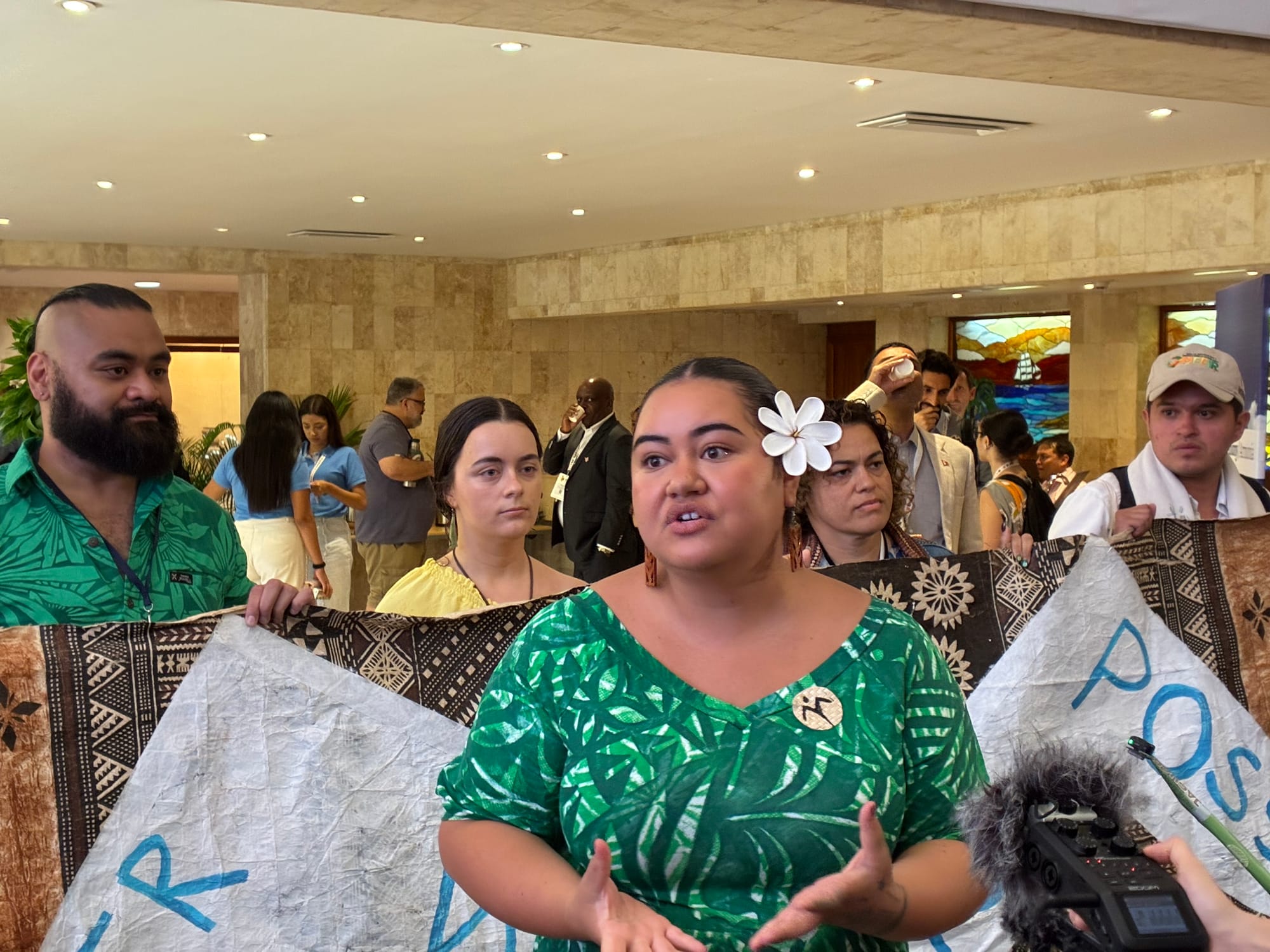
Samoan activist Brianna Fruean at a demonstration held at the conference venue | Julián Reingold/openDemocracy
For Colombian environment minister Irene Vélez Torres and Stientje van Veldhoven, the Dutch minister for climate and green growth, the event marked the beginning of a new era of global environmental democracy.
“This new method of dialogue between civil society, parliamentarians and governments represents a new multilateral collective force that is not bound by consensus and is led by women,” Torres said at the conference’s close. Veldhoven agreed, saying the meeting was the first step towards a proactive coalition of governments that do not negotiate, as happens at the UN, but rather collaborate with one another.
At the conference, civil society and governments agreed on steps to address the inequalities in the energy transition, which is taking place primarily in the Global North, rather than in countries where it is most needed but that lack the financing for green energy. These included drafting national road maps for the phase-out of fossil fuels, in addition to the global road map that will be discussed at COP31 this year.
“This is a contribution towards resolving common and interdependent problems through dialogue, discussion and cooperation, rather than through military means,” said Muhamad, who was Colombia’s Environment Minister until early 2025.
Harjeet Singh, the founder and director of the India-based Satat Sampada Climate Foundation that advocates for global climate justice, said the war in Iran has opened people’s eyes to the vulnerability inherent in dependence on fossil fuels.
“In a recent statement, India’s road and transport minister said that the era of diesel and petrol vehicles is over. It’s all about clean fuels, biofuels and electric vehicles,” Singh told openDemocracy.
But this realisation is meaningless without “international cooperation in green finance”, he said, noting that India self-funds 80% of its climate initiatives despite being a part of the Global South – and needs trillions more dollars for its transition away from fossil fuels.
Democracy, climate denialism and the future
Carlos Nobre, a researcher at the University of São Paulo and a member of the scientific panel for aGlobal Energy Transition, highlighted the risk that citizens might elect leaders who deny climate change. This is a particularly pressing worry in Amazonian countries such as Brazil, Colombia and Peru, where far-right parties that deny the climate crisis or are committed to expanding fossil fuels stand a chance of winning presidential elections taking place this year.
“It is not just that the far right seeks to maintain dependence on fossil fuels, but that they also intend to push ahead with deforestation and the removal of protections for indigenous peoples. We must not head towards ecocide, that is, ecological suicide,” said Nobre in an interview with openDemocracy.
Colombia remains the world’s deadliest country for environmental activists – an issue that must be addressed at the election on 31 May and can serve as a gateway to discussing wider environmental policies, says Liberal Party congressman Juan Carlos Losada, a member of Colombia’s Parliamentarians for a Fossil-Fuel-Free Future network.
Losada believes the candidate of the ruling left-wing Historic Pact coalition, Iván Cepeda, “will clearly prioritise the defence of human rights at a local level, and other issues will fall under that umbrella”. Polls currently suggest Cepeda will lead the election’s first round, although most analysts believe he is unlikely to reach the 50% threshold needed to win outright.
The other presidential candidates say “that if they come to power, they’ll go all out to extract every last bit of what exists,” Losada said, referring to the right’s proposals to intensify coal mining and introduce fracking.
“The debate on energy security has changed, and fossil fuels are seen as part of the insecurity issue,” said Brazilian Ana Toni, the executive director of COP30, noting: “It’ll be interesting to see how different actors act from now on.”
Speaking to openDemocracy at a press conference, Toni acknowledged the contradictions facing even climate-conscious governments, such as Brazil’s. “I don’t know if this conference is going to change the mind of Petrobras and its exploration plans,” she said, referring to Brazil’s state-owned oil company, whichlast year obtained permission for new exploration 500 kilometres from the mouth of the Amazon, days before world leaders met to debate the climate crisis at COP30.
“But it is changing the mind of many people in many countries,” she argued, noting that a move away from fossil fuels is becoming more popular as wars, supply shocks and extreme weather events expose the risk of oil and gas dependence. “When we talk about the transition, we do it not just because of climate change but also because of energy and economic security, and peace.”
These risks will be on full display at next year’s conference, where delegates will visit one of the countries most threatened by rising sea levels: Tuvalu, a South Pacific island nation that is co-hosting the second conference with Ireland.
“We, the small Pacific Islands, have no choice but to be ambitious,” said Brianna Fruean, a climate activist from Samoa, at a rally during the Colombian conference. “The next summit in Tuvalu will put faces to our countries and bring world leaders to the frontline of the climate crisis.”