The victory of the Greens in the Gorton and Denton parliamentary byelection is a landmark for the party. But our new research reveals the Greens have received limited airtime over the last year despite almost doubling their support in the polls and in party membership.
While Reform UK has seen a spike in media coverage since it took a commanding lead in the polls, our research shows the Greens have not received more airtime in recognition of their growing popularity.
Broadcasters have to abide by due impartiality rules, but they have the editorial freedom to balance the airtime of political parties. They consider factors such as a party’s vote share at the last UK general election or a party’s electoral performance at the most recent devolved, regional and local election. Other factors to consider include the latest trends in opinion polls tracking voting intention, and whether what a party is saying the news organisation considers significant or, as the BBC says, whether they are “making the political weather” by setting the agenda.
After winning the byelection, this raises the question: should the Greens now be given more airtime?
Limited coverage of Greens
Our Impartiality project team has been tracking coverage of UK opposition parties on BBC News at Ten and ITV News at Ten, the UK’s most-watched nightly TV news bulletins.
In 2025, we found the Greens were the sixth most covered opposition party, being referenced in just 32 items, behind the Conservatives (375), Reform UK (213), the Liberal Democrats (116), the Scottish National Party or SNP (46) and ahead of Plaid Cymru (10).
Number of items led by an opposition party on BBC News at Ten and ITV News at Ten. Cardiff University, CC BY-NC-ND
We also tracked how often a party was the leading focus of a broadcaster’s report. The Greens led four items – three on BBC and one on ITV. These stories related to the Greens’ May local election campaign, Zack Polanski winning the party leadership in September and the party conference in October. But neither BBC News at Ten and ITV News at Ten covered the announcement or build-up to the leadership contest.
In contrast, Reform UK led 69 items, Conservatives led 45 items, the Liberal Democrats led 14 items and the SNP led 13 items.
The Greens also appeared on only four episodes of BBC Question Time during 2025. That was about a third as often as the Liberal Democrats and Reform UK. Despite the leadership change, the subsequent surge in membership and the sustained rise in poll ratings (from 11% in August 2025 to 17% in December 2025), broadcast coverage of Greens did not increase at the end of 2025.
This shows a potential inequality in the treatment of the rising left and right parties. The BBC cited improvements in opinion polling as one of the factors behind the increased coverage of Reform UK, but the Green party’s popularity has not received anywhere near the same recognition.
In May 2025, news coverage of Reform UK increased substantially following its victories in local and mayoral elections, which broadcasters considered a sign that the party was now a major player in UK electoral politics. Our research even showed in September 2025 Reform UK was referenced on TV news more than the Conservatives, the party that is supposed to be the UK’s parliamentary official opposition.
Greens and Reform UK TV news coverage compared to opinion polls. Cardiff University, CC BY-NC-ND
The question now is whether broadcasters will take the Green party’s victory in Gorton and Denton as a similar sign of its electoral significance and increase media coverage of the party.
While broadcasters have not broken any of the UK’s rules on due impartiality, our new research raises questions about how they have been interpreting impartiality in a new multi-party system.
Traditionally they have relied on allocating airtime according to parties with the largest number of MPs and total vote at the last general election. They have also factored in performances at the latest local, regional or devolved elections. But they now appear to making more subjective judgements about allocating airtime according to the opinion polls or the newsworthiness of parties.
Given the Greens’ growing popularity, their distinctive set of policies, charismatic leader and byelection victory, they might now look set to receive more media attention and scrutiny over the coming months.
Nigel Farage urges you to ignore facts and reality and be a climate science denier like him and his Deputy Richard Tice. He says that Reform UK has received £Millions and £Millions from the fossil fuel industry to promote climate denial and destroy the planet.Nigel Farage explains the politics of Reform UK: Racism, Fake anti-establishmentism, Deregulation, Corporatism, Climate Change Denial, Mysogyny and Transphobia.Nigel Farage reminds you that he’s the man that brought you Brexit and asks what could possibly go wrong.
Hannah Spencer has won a huge victory for the Green party over Reform UK and the Labour party in Gorton and Denton. The left united in their support behind Spencer and the Green party to defeat the evil promoted by Farage and Starmer’s parties. Both nasty right-wing parties were properly rejected.
Congratulation to Hannah and the Green Party, champions of the left, defeaters of evil.
Genocide denier and Current UK Prime Minister Keir Starmer is quoted that he supports Zionism without qualification. He also confirms that UK air force support has been essential in Israel’s mass-murdering genocide. Includes URLs https://www.declassifieduk.org/keir-starmers-100-spy-flights-over-gaza-in-support-of-israel/ and https://youtu.be/O74hZCKKdpAKeir Starmer objects to criticism of the IDF. He asks how could anyone object to them starving people to death, forced marches like the Nazis did, bombing Gaza’s hospitals and universities, mass-murdering journalists, healthworkers and starving people queuing for food, killing and raping prisoners and murdering children. He calls for people to stop obstructing his genocide for Israel.Orcas discuss Genocide-supporting and complicit Zionists. Donald Trump, Keith Starmer, David Lammy, Rachel Reeves, Angela Rayner and Wes Streeting are acknowledged as evil genocide-complicit and supporting cnuts.
Top polling party’s moves to ‘undeclare’ the climate emergency and scrap net zero targets could be a sign of things to come
Reform UK’s disregard of the climate crisis is already taking effect across the country. Since gaining control of 10 councils last May, the party has scrapped vital environmental goals. It has courted support from fossil fuel investors with a promise to “drill, baby, drill”. And its councillors have hijacked public debates with outright climate denialism.
Seven of the councils now controlled by Reform have abandoned important green measures. This includes ditching ambitious net zero targets and withdrawing the declaration of a climate emergency – which could threaten green investment and undermine action taken locally to deal with the crisis.
With Reform leading the polls and more local elections to come this year, what we’ve seen so far could be the tip of the iceberg.
For Lord Adair Turner, co-chair of the Energy Transitions Commission, the return of climate denial to public debate is “undoubtedly bad news” and presents a major setback for tackling the crisis. “We’ve got to work out how to convince people that there is a real, massive climate problem and that we do have the solutions now, which are available at relatively low cost,” he said.
We’ve been looking at how Reform has treated climate issues at a local level to gauge what might happen if it wins more councils this year – and if it comes to power in 2029.
The ‘global warming hoax’
One of Reform UK’s key campaigning pledges is the scrapping of net zero in order to cut energy bills. West Northamptonshire’s council leader Mark Arnull said: “Every resident who voted Reform UK voted for that and they must be heard.”
Of the 10 new Reform-controlled councils, seven promptly abandoned their climate promises. Of the remaining three, Lincolnshire did not have any significant climate pledges to scrap but Reform leaders there say they have “declared war” on green energy projects; Derbyshire confirmed its commitment to cutting emissions but ditched the objective to “work to address the causes, and adapt to the impacts, of climate change”; and Doncaster – which has a Reform majority but a Labour mayor and cabinet – has maintained its climate pledges.
The Reform councils’ position contrasts sharply with those controlled by other parties. Climate Emergency UK – a campaign organisation for council climate action – says it is not aware of any other local authorities that have scrapped their climate pledges. Across the UK, more than 300 councils have declared a “climate emergency” and many of those are backed up with ambitious net zero targets.
Polling suggests almost three quarters of people in the UK believe climate change is caused by human activity; a study of more than 88,000 climate-related studies found that 99.9% of peer-reviewed scientific papers agree.
Yet in public debates, some Reform councillors have put forward the opposite view. In Nottinghamshire, councillor Bert Bingham said: “I’ve been involved in sustainability projects for 25 years and I’ve never seen such nonsense as the anthropogenic global warming hoax.”
In Kent, Councillor Chris Hespe said: “It is often stated that anthropogenic climate change is ‘settled science’ and that the whole scientific community believes it. However, this is far from the case.”
Outright climate denial has permeated local debate. After Rachael Hatchett, a Green councillor in Derbyshire, spoke up in a debate about solar farms last year, she was heckled by another councillor shouting: “There is no climate change!”
Reform’s claim that scrapping net zero will cut energy bills is also misleading, according to energy experts. Dhara Vyas, chief executive of industry body Energy UK, told Carbon Brief it is “crystal clear what has driven electricity bills up in the UK … it’s the wholesale costs, driven by the price of gas”.
Liberal Democrat councillor Alex Ricketts said Reform’s climate denial would have real-world impacts for Kent’s constituents. Parts of the county are recognised to be at risk of flooding and local authorities have received funding from the Environment Agency to shore up sea walls and maintain other defences.
Ricketts said this money was allocated based on the science and policymaking that Reform criticises: “There are very real effects on the people of Kent by trying to debunk these things.”
In Durham, Reform proposed retracting the climate emergency and instead declaring a “care emergency” with a focus on special educational needs. Independent councillor Chris Lines said: “Politically, the rhetoric from Reform was that if you voted against it, you were labelled as someone who didn’t care about young people. Conflating the two issues was frankly appalling.”
Lines is concerned about the impact of these declarations on the economy, pointing to research showing that the low-carbon industry was worth £1.7bn to County Durham in 2021/22. “If I was a business in that growing sector looking to invest in an area, would I really want to come here, given the direction this council is going?”
Not all the debates on net zero have involved outright climate denial. In West Northamptonshire, councillors questioned how feasible climate policies were and raised concerns about their cost – an approach that academics have labelled “climate delay”, which can hinder action on climate change.
Alan Graves, the Reform UK leader in Derbyshire, said: “We do not deny that the climate is changing… The council continues to support practical, affordable measures that cut waste, improve efficiency, and reduce costs for residents.”
Responding to whether climate denial had spread in local councils, he said he could only speak for Derbyshire but that they weren’t focusing on “culture-war labels”.
Graves added: “We do not remove policies for ideological reasons. Where we have amended plans, it is because they were vague, unfunded, sometimes unfounded or undeliverable. Our responsibility is to be honest with the public about what can realistically be achieved within local government budgets.” Reform UK and the other councils mentioned did not respond to requests for comment.
A familiar playbook
Reform UK has proudly borrowed slogans from Donald Trump’s campaigns in the US. At a recent council meeting in Durham, Reform councillor Kyle Genner painted a vivid picture of the county’s “dilapidated and deprived estates … the joblessness … the lack of dignity and hope”. He urged his fellow councillors to support the reindustrialisation of the county – including the extraction of coal, oil and gas – to “make Durham great again”.
“I’m clearly not Donald Trump,” he said. “But I do like the idea of ‘drill, baby, drill’. I do like the idea of ‘jobs, baby, jobs’.”
Reform are in the climate denial camp and the Conservatives have moved into – not climate denial, but saying they want to get away from net zero
Lord Turner
The Reform leader of the council, Andrew Husband, said this local debate held a national significance. “It’s telling the North Sea oil and gas producers, ‘Don’t give up just yet’. We’re preparing County Durham for a Reform government in 2029 so we can hit the ground running. Simple as that.”
Back in Kent, former Reform councillor Fothergill said it was “ridiculous” the county was not exploiting its abundance of gas, coal and mineral resources.
In further echoes of the Trump administration, Reform councils across the country are erasing the words climate and environment from cabinet roles, committee names and planning documents.
Where Trump set up the Department of Government Efficiency spearheaded by Elon Musk, Kent county council introduced its own Department of Local Government Efficiency, or DOLGE.
Andrew Husband speaks during the Reform UK County Durham Conference last FebruaryIan Forsyth / Getty Images
Kent’s first head of DOLGE, Matthew Fraser Moat, highlighted what he said were “several, maybe tens of millions of pounds” wasted on the county’s declaration of a climate emergency. In September last year, he said this spending should be stopped, “given that there is no discernible benefit to the world’s climate from all of [Kent county council’s] efforts over the last seven years”.
Weeks later, Kent’s council leader said Reform had saved the county £32m over four years by “undeclaring the climate emergency”, and a further £7.5m by scrapping the county council’s transition to electric vehicles.
Fraser Moat, however, told the Financial Times this month that the Reform council “had not actually made any cuts”. The DOLGE team reportedly expected to find vast amounts of waste but didn’t. Fraser Moat has since stepped down from the council’s cabinet, saying his comments were the result of a “lapse of judgement” and that his words had been twisted.
Blocking the bulldozers
Across the country, Reform-controlled councils have opposed solar projects. In Durham, the party has abandoned a plan to install solar panels on council buildings, which aimed to save the council money on energy bills.
In Lincolnshire, Reform councillor Sean Matthews told the BBC about a new solar farm development: “I’m going to do whatever I can to stop it, and that does include laying in front of those bulldozers.”
While it may not always stray into the outright climate denial Hatchett faced in Derbyshire, Ricketts said Reform’s opposition to solar is largely political. “They know that resonates with one part of their base that don’t want solar farms built on fields, but also with the other part that are anti-climate change measures.”
Time and again, the environmental issues raised in local councils came back to party politics. Independent councillor Ian McCord welcomed West Northamptonshire’s move to scrap net zero targets. “Those that are crying into their tofu and quinoa forget that they lost the May election,” he said.
This has shifted the debate on net zero across the political spectrum. Lord Turner said: “Reform, obviously, are in the climate denial camp but the Conservatives have moved into, not climate denial, but saying they want to get away from net zero.
“It’s a bit ironic that, in the face of catastrophic weather events around the world, we are losing [the cross-party] consensus. I’m under no illusion that we’re facing a more tricky situation than we were five or 10 years ago.”
This story was updated on Wednesday 25 February 2026 to reflect the fact that Nottinghamshire county council has not rescinded its climate emergency declaration.
Reporters: Josephine Moulds and Grace Murray Environment editor: Rob Soutar Deputy editor: Chrissie Giles Editor: Franz Wild Fact checker: Ero Partsakoulaki Production editor: Alex Hess
TBIJ has a number of funders, a full list of which can be found here. None of our funders have any influence over editorial decisions or output.
Nigel Farage urges you to ignore facts and reality and be a climate science denier like him and his Deputy Richard Tice. He says that Reform UK has received £Millions and £Millions from the fossil fuel industry to promote climate denial and destroy the planet.Nigel Farage explains the politics of Reform UK: Racism, Fake anti-establishmentism, Deregulation, Corporatism, Climate Change Denial, Mysogyny and Transphobia.Neo-Fascist Climate Science Denier Donald Trump says Burn, Baby, Burn.
Rising temperatures across France since the mid-1970s are putting Tour de France competitors at “high risk”, according to new research.
The study, published in Scientific Reports, uses 50 years of climate data to calculate the potential heat stress that athletes have been exposed to across a dozen different locations during the world-famous cycling race.
The researchers find that both the severity and frequency of high-heat-stress events have increased across France over recent decades.
But, despite record-setting heatwaves in France, the heat-stress threshold for safe competition has rarely been breached in any particular city on the day the Tour passed through.
However, the researchers add it is “only a question of time” until this occurs as average temperatures in France continue to rise.
The lead author of the study tells Carbon Brief that, while the race organisers have been fortunate to avoid major heat stress on race days so far, it will be “harder and harder to be lucky” as extreme heat becomes more common.
‘Iconic’
The Tour de France is one of the world’s most storied cycling races and the oldest of Europe’s three major multi-week cycling competitions, or Grand Tours.
Riders cover around 3,500 kilometres (km) of distance and gain up to nearly 55km of altitude over 21 stages, with only two or three rest days throughout the gruelling race.
Heat has become a growing problem for the competition in recent years.
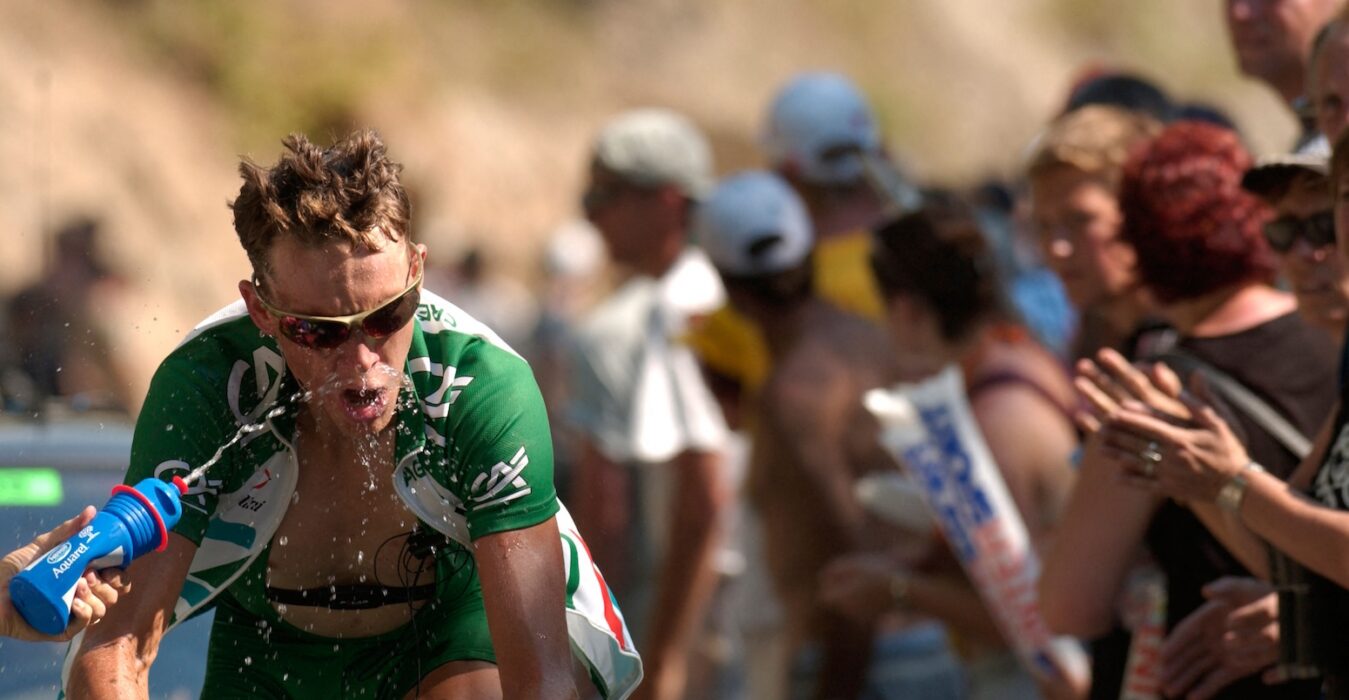
In 2022, Alexis Vuillermoz, a French competitor, collapsed at the finish line of the Tour’s ninth stage, leaving in an ambulance and subsequently pulling out of the race entirely.
Two years later, British cyclist Sir Mark Cavendish vomited on his bike during the first stage of the race after struggling with the 36C heat.
The Tour also makes a good case study because it is almost entirely held during the month of July and, while the route itself changes, there are many cities and stages that are repeated from year to year, Cvijanovic adds.
‘Have to be lucky’
The study focuses on the 50-year span between 1974 and 2023.
The researchers select six locations across the country that have commonly hosted the Tour, from the mountain pass of Col du Tourmalet, in the French Pyrenees, to the city of Paris – where the race finishes, along the Champs-Élysées.
These sites represent a broad range of climatic zones: Alpe d’ Huez, Bourdeaux, Col du Tourmalet, Nîmes, Paris and Toulouse.
For each location, they use meteorological reanalysis data from ERA5 and radiant temperature data from ERA5-HEAT to calculate the “wet-bulb globe temperature” (WBGT) for multiple times of day across the month of July each year.
WBGT is a heat-stress index that takes into account temperature, humidity, wind speed and direct sunlight.
Although there is “no exact scientific consensus” on the best heat-stress index to use, WBGT is “one of the rare indicators that has been originally developed based on the actual human response to heat”, Cvijanovic explains.
It is also the one that the International Cycling Union (UCI) – the world governing body for sport cycling – uses to assess risk. A WBGT of 28C or higher is classified as “high risk” by the group.
Murfree, who was not involved in the new study, adds that the researchers are “doing the right things by conducting their science in alignment with the business practices that are already happening”.
The researchers find that across the 50-year time period, WBGT has been increasing across the entire country – albeit, at different rates. In the north-west of the country, WBGT has increased at an average rate of 0.1C per decade, while in the southern and eastern parts of the country, it has increased by more than 0.5C per decade.
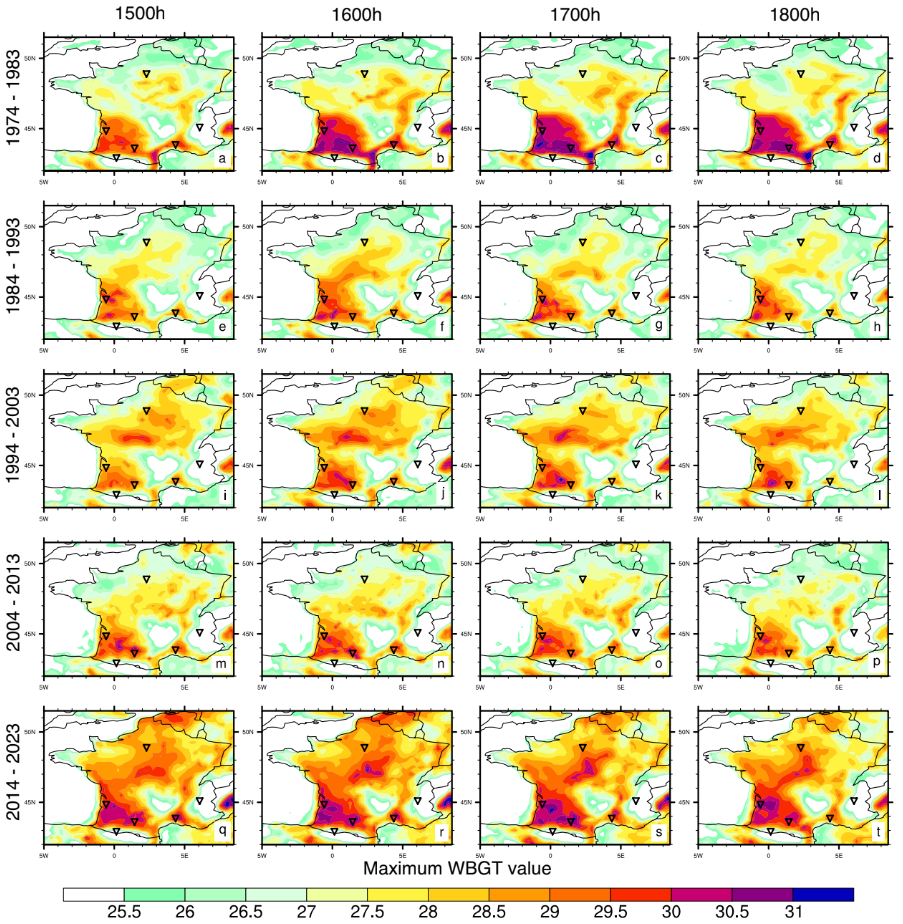
The maps below show the maximum July WBGT for each decade of the analysis (rows) and for hourly increments of the late afternoon (columns). Lower temperatures are shown in lighter greens and yellows, while higher temperatures are shown in darker reds and purples.
Six Tour de France locations analysed in the study are shown as triangles on the maps (clockwise from top): Paris, Alpe d’ Huez, Nîmes, Toulouse, Col du Tourmalet and Bordeaux.
The maps show that the maximum WBGT temperature in the afternoon has surpassed 28C over almost the entire country in the last decade. The notable exceptions to this are the mountainous regions of the Alps and the Pyrenees.
Maximum WBGT across France for the month of July from 1974-2023. Rows show the values for each decade and columns show the hourly values for 3:00pm, 4:00pm, 5:00pm and 6:00pm. Lower temperatures are shown in lighter greens and yellows, while higher temperatures are shown in darker reds and purples. Triangles indicate the six Tour de France locations analysed in the study. Source: Cvijanovic et al. (2026)
The researchers also find that most of the country has crossed the 28C WBGT threshold – which they describe as “dangerous heat levels” – on at least one July day over the past decade. However, by looking at the WBGT on the day the Tour passed through any of these six locations, they find that the threshold has rarely been breached during the race itself.
For example, the research notes that, since 1974, Paris has seen a WBGT of 28C five times at 3pm in July – but that these events have “so far” not coincided with the cycling race.
The study states that it is “fortunate” that the Tour has so far avoided the worst of the heat-stress.
Cvijanovic says the organisers and competitors have been “lucky” to date. She adds:
“It has worked really well for them so far. But as the frequency of these [extreme heat] events is increasing, it will be harder and harder to be lucky.”
Dr Madeleine Orr, an assistant professor of sport ecology at the University of Toronto who was not involved in the study, tells Carbon Brief that the paper was “really well done”, noting that its “methods are good [and its] approach was sound”. She adds:
“[The Tour has] had athletes complain about [the heat]. They’ve had athletes collapse – and still those aren’t the worst conditions. I think that that says a lot about what we consider safe. They’ve still been lucky to not see what unsafe looks like, despite [the heat] having already had impacts.”
Heat safety protocols
In 2024, the UCI set out its first-ever high temperature protocol – a set of guidelines for race organisers to assess athletes’ risk of heat stress.
The assessment places the potential risk into one of five categories based on the WBGT, ranging from very low to high risk.
The protocol then sets out suggested actions to take in the event of extreme heat, ranging from having athletes complete their warm-ups using ice vests and cold towels to increasing the number of support vehicles providing water and ice.
If the WBGT climbs above the 28C mark, the protocol suggests that organisers modify the start time of the stage, adapt the course to remove particularly hazardous sections – or even cancel the race entirely.
However, Orr notes that many other parts of the race, such as spectator comfort and equipment functioning, may have lower temperatures thresholds that are not accounted for in the protocol, but should also be considered.
Murfree points out that the study’s findings – and the heat protocol itself – are “really focused on adaptation, rather than mitigation”. While this is “to be expected”, she tells Carbon Brief:
“Moving to earlier start times or adjusting the route specifically to avoid these locations that score higher in heat stress doesn’t stop the heat stress. These aren’t climate preventative measures. That, I think, would be a much more difficult conversation to have in the research because of the Tour de France’s intimate relationship with fossil-fuel companies.”
Neo-Fascist Climate Science Denier Donald Trump says Burn, Baby, Burn.Nigel Farage urges you to ignore facts and reality and be a climate science denier like him and his Deputy Richard Tice. He says that Reform UK has received £Millions and £Millions from the fossil fuel industry to promote climate denial and destroy the planet.Donald Trump urges you to be a Climate Science denier like him. He says that he makes millions and millions for destroying the planet, Burn, Baby, Burn and Flood, Baby, Flood.
Reform UK’s Gorton and Denton byelection candidate, Matt Goodwin, attends a campaign event in Manchester with Nigel Farage, 5 February 2026. Photograph: Adam Vaughan/EPA
This byelection should have been a stroll for Keir Starmer’s party. Instead, all hope of defeating Matt Goodwin now seems to lie with the Greens
Every barb Labour has directed at the Greens can now be returned with interest. “It’s a wasted vote.” “Do you want to see Reform in power?” New polling ahead of the crucial Gorton and Denton byelection this week, while by no means decisive, puts the Greens first on 22%, followed by Reform UK (20%), then Labour (18%), with 31% undecided. But still Keir Starmer falsely claims that “only Labour can beat Reform”. Does he want to see Reform in power?
…
A survey of 6,000 people by the group Persuasion UK found that by far the most effective message of five options was focused on corporate interests and went as follows: “Nigel Farage says he’s on people’s side – but when you take a closer look it’s pretty clear who he’s really fighting for, isn’t it? It’s the rich, the powerful, his mates in big business.” It explained that Reform UK has taken vast donations from fossil fuel investors and climate science deniers. This, Persuasion UK said, is why Farage wants to cut public services, workers’ rights and taxes for the richest. “He’s not smashing the system. He and his rich friends basically are the system.”
None of the other attack lines came anywhere near this for efficacy. So why doesn’t Labour use it? Because that might alienate the people Starmer seems keenest to appease: Labour’s own corporate backers and the billionaire proprietors of the rightwing press. The leadership’s key objective is not stopping Farage, but frightening people into voting Labour. Quite frankly, it has nothing else left.
One by one, it has destroyed the hopes that people vested in it, alienating potential voters on everything from Gaza to benefits to its self-destructive apeing of Reform’s rhetoric on immigration; from its vicious factional warfare against leftwingers in the party to its tearing up of environmental protections and attacks on wildlife, which, in a country of nature lovers, is utter, self-defeating madness. Disgust and disillusionment among former supporters is everywhere palpable.
Nigel Farage urges you to ignore facts and reality and be a climate science denier like him and his Deputy Richard Tice. He says that Reform UK has received £Millions and £Millions from the fossil fuel industry to promote climate denial and destroy the planet.Keir Starmer refuses to be outcnuted by Nigel Farage’s chasing the racist bigot vote.Nigel Farage explains the politics of Reform UK: Racism, Fake anti-establishmentism, Deregulation, Corporatism, Climate Change Denial, Mysogyny and Transphobia.