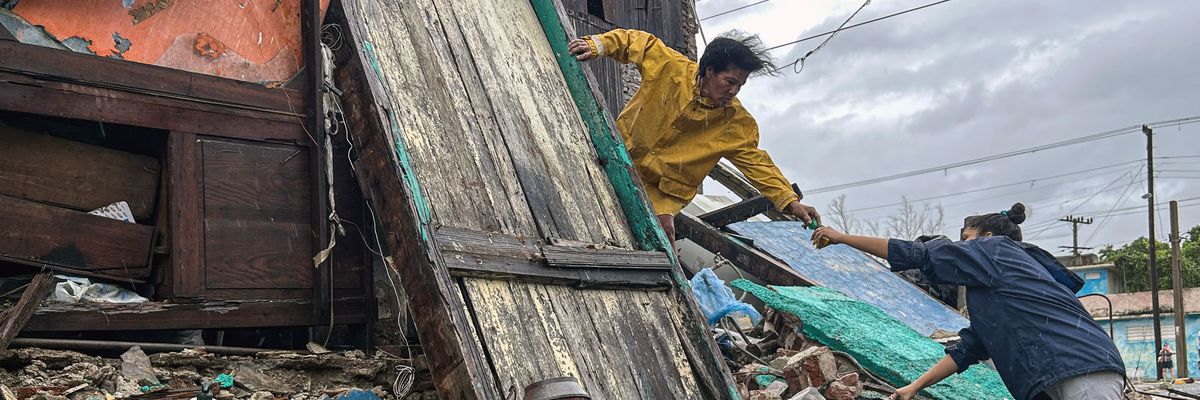
A family salvages belongings from their home after it collapsed during Hurricane Melissa’s passage through Santiago de Cuba, Cuba on October 29, 2025. (Photo by Yamil Lage/AFP via Getty Images)
“The very richest individuals in the world are funding and profiting from climate destruction, leaving the global majority to bear the fatal consequences of their unchecked power.”
A report released Tuesday showed that the wealthiest people on the planet are disproportionately fueling the climate emergency that is intensifying weather catastrophes like Hurricane Melissa, which slammed Cuba on Wednesday after leaving a trail of devastation in Jamaica.
The Oxfam International report, titled Climate Plunder: How a Powerful Few Are Locking the World Into Disaster, features updated figures showing that the consumption-based carbon emissions of the richest 0.1% of the global population grew by 92 tonnes between 1990 and 2023, while the emissions of the poorest half of humanity grew by just 0.1 tonnes.
“A person from the world’s richest 0.1% emits over 800kg of CO2 every day. Even the strongest person on earth could not lift this much,” the report notes. “In contrast, someone from the poorest 50% of the world emits an average of just 2kg of CO2 per day, which even a small child could lift.”
“A person in the top 0.1% emits more in a day than a person in the poorest 50% emits all year,” the report adds.
The destruction caused by Hurricane Melissa—the most powerful storm on Earth this year and the strongest to ever hit Jamaica—underscored the extent to which vulnerable nations are bearing the brunt of a crisis they did little to cause as wealthy countries and individuals continue to spew planet-warming emissions with abandon.
Jamaica, where the true extent of the damage from Melissa is only just beginning to emerge, is responsible for an estimated 0.02% of global greenhouse gas emissions, according to the latest available data.
“The climate crisis is an inequality crisis,” said Oxfam executive director Amitabh Behar. “The very richest individuals in the world are funding and profiting from climate destruction, leaving the global majority to bear the fatal consequences of their unchecked power.”
“We must break the chokehold of the super-rich over climate policy by taxing their extreme wealth.”
Oxfam’s report was published less than two weeks before the start of COP30 in Belém, Brazil, where world leaders will gather once again to weigh climate solutions after years of failing to reach an agreement to curb fossil fuel production and use.
In its new report, Oxfam implores governments to target the emissions of the ultra-wealthy, including through “climate-specific taxes” such as “frequent flyer levies and taxes on luxury travel.”
“It is a travesty that power and wealth have been allowed to accumulate in the hands of a few, who are only using it to further entrench their influence and lock us all into a path to planetary destruction,” said Behar. “We must break the chokehold of the super-rich over climate policy by taxing their extreme wealth, banning their lobbying, and instead put those most affected by the climate crisis in the front seat of climate decision-making.”
Donald Trump urges you to be a Climate Science denier like him. He says that he makes millions and millions for destroying the planet, Burn, Baby, Burn and Flood, Baby, Flood.Nigel Farage urges you to ignore facts and reality and be a climate science denier like him and his Deputy Richard Tice. He says that Reform UK has received £Millions and £Millions from the fossil fuel industry to promote climate denial and destroy the planet.Elon Musk urges you to be a Fascist like him, says that you can ignore facts and reality then.
An activist from the environmental movement Extinction Rebellion holds up a sign reading “Oil Kills” as police officers remove him from the premises of DNB Bank during a protest in Oslo, Norway on August 21, 2025. (Photo by Javad Parsa/NTB/AFP via Getty Images)
“Requiring governments to assess the global climate consequences of oil and gas combustion before approving new fossil projects is common sense, and long overdue,” said one campaigner.
Although the European Court of Human Rights on Tuesday sided with the Norwegian government over six young adults and a pair of climate groups, the plaintiffs still welcomed the tribunal’s ruling as “a major step forward,” in the words of Frode Pleym, head of GreenpeaceNorway.
The case stems from the Norwegian Ministry of Petroleum and Energy granting 10 exploration licenses to 13 companies for fossil fuel production in the Arctic Barents Sea in 2016. The plaintiffs argued that doing so violated Article 8 of the European Convention on Human Rights, or the right to respect for private and family life.
The court unanimously held that “there had been no violation” of Article 8, but it also affirmed that the government must conduct a full environmental impact assessment, including greenhouse gas emissions from combustion, for any new petroleum production.
“It’s a relief to see the court recognize what science has told us for years—that new oil and gas fields threaten our most basic human rights,” Pleym said in a statement. “Requiring governments to assess the global climate consequences of oil and gas combustion before approving new fossil projects is common sense, and long overdue.”
Young Friends of the Earth Norway, which sued alongside Greenpeace and the six individuals, also praised the ruling as progress.
“This decision is a quantum leap for climate accountability,” said the group’s leader, Sigrid Hoddevik Losnegård. “The government can no longer continue its oil and gas policy as if climate change doesn’t exist. This judgment will have ripple effects far beyond Norway.”
I can think of at least seven ways fossil fuel producers could wiggle out of this, but still: holy shit this is huge.
The plaintiffs noted in a joint statement that the ruling “builds on” recent decisions from the International Court of Justice and the UK Supreme Court. The ICJ said in a landmark advisory opinion in July that countries have a legal obligation to take cooperative action to address the fossil fuel-driven climate emergency. At the time, Danilo Garrido, legal counsel at Greenpeace International, hailed the development as “the start of a new era of climate accountability at a global level.”
That decision came roughly a year after the UK’s top court ruled that Surrey authorities’ approval of the Horse Hill drilling project “was unlawful” because they didn’t consider “emissions that will occur when the oil produced is burnt as fuel,” as required by law. Friends of the Earth UK called the ruling “a heavy blow for the fossil fuel industry” that could impact other projects.
The European court’s Tuesday decision came less than two weeks away from the start of the 30th United Nations Climate Change Conference in Belém, Brazil. In preparation for COP30, the UN on Tuesday released a report warning that governments’ climate plans would reduce fossil fuel emissions by just 10% by 2035 compared to 2019 levels, far short of what is needed to meet the Paris Agreement goal of limiting temperature rise this century to 1.5°C above preindustrial levels.
As Oil Change Internationalpointed out in a June report, Norway and three other wealthy nations—Australia, Canada, and the United States—account for the majority of planned oil and gas expansion over the next decade. This month, the group commissioned a poll that found a majority of Norwegians believe their country should either stop exploring for new oil and gas or slow down the pace.
“The data show that Norwegians increasingly want political leadership that aligns the country’s oil policy with its climate goals,” Oil Change’s North Sea campaign manager, Silje Lundberg, said Monday. “People are calling time on endless oil expansion—it’s the government that’s stuck in the past. The public clearly wants a plan to phase down oil and gas and deliver real climate leadership, not more empty talk from ministers protecting the industry.”
Orcas comment on killer apes destroying the planet by continuing to burn fossil fuels.Donald Trump urges you to be a Climate Science denier like him. He says that he makes millions and millions for destroying the planet, Burn, Baby, Burn and Flood, Baby, Flood.Nigel Farage urges you to ignore facts and reality and be a climate science denier like him and his Deputy Richard Tice. He says that Reform UK has received £Millions and £Millions from the fossil fuel industry to promote climate denial and destroy the planet.
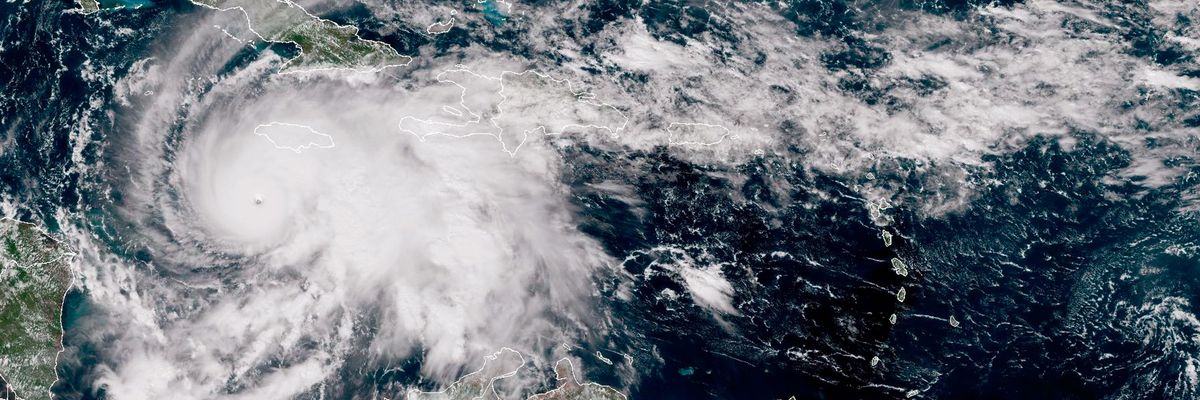
A satellite image provided by the National Oceanic and Atmospheric Administration shows Hurricane Melissa churning northwest through the Caribbean on October 27, 2025. (Photo by NOAA via Getty Images)
“Unimaginable violence is hiding in the very small and compact eyewall of Melissa,” said one hurricane specialist.
Hurricane Melissa barreled toward Jamaica on Tuesday as a monstrous Category 5 storm as the island country braced for devastating landfall, humanitarian operations urgently mobilized, and experts voiced horror at the latest climate-fueled weather disaster.
Anne-Claire Fontan, the World Meteorological Organization’s tropical cyclone specialist, told reporters that “a catastrophic situation is expected in Jamaica” and described the hurricane as “the storm of the century” for the island. Melissa is expected to make landfall imminently, bringing extreme flooding, landslides, and other life-threatening impacts.
Tens of thousands of Jamaicans lost power as the slow-moving storm approached the island, bringing torrential rain and maximum sustained winds of 185 mph, with gusts over 220 mph. Storms like Melissa are the reason scientists are pushing to formally add a Category 6 for hurricanes.
“Unimaginable violence is hiding in the very small and compact eyewall of Melissa,” said Greg Postel, hurricane specialist at The Weather Channel. “Nearly continuous lightning will accompany the tornadic wind speeds.”
Melissa tonight has had one of the most powerful satellite presentations you will ever see for an Atlantic Hurricane. Perfect symmetry in all quadrants and satellite estimation techniques being maxed out, with Dvorak analysis yielding 871.1 mbar (recon found the real pressure to… pic.twitter.com/nKKFbv4g7j
The International Federation of the Red Cross said up to 1.5 million people in Jamaica—roughly half the island’s population—are expected to be directly affected by Hurricane Melissa, one of the most powerful hurricanes ever recorded in the Atlantic Basin and the strongest storm on Earth this year.
“We are okay at the moment but bracing ourselves for the worst,” Jamaican climate activist Tracey Edwards said Tuesday. “I’ve grown weary of these threats, and I do not want to face the next hurricane.”
The International Organization for Migration warned that “the risk of flooding, landslides, and widespread damage is extremely high,” meaning that “many people are likely to be displaced from their homes and in urgent need of shelter and relief.”
Melissa’s landfall will come on the same day that United Nations Secretary-General António Guterres said the international community has failed to prevent planetary warming from surpassing the key 1.5°C threshold “in the next few years.”
Meteorologist Eric Holthaus wrote on social media that “this is the news I’ve dreaded all my life.”
“Humanity has failed to avoid dangerous climate change,” he wrote. “We have now entered the overshoot era. Our new goal is to prevent as many irreversible tipping points from taking hold as we can.”
Hurricane Melissa will make landfall in Jamaica in a few hours as one of the two strongest hurricanes ever to make landfall anywhere in the Atlantic Basin — on par with the 1935 Labor Day hurricane in south Florida.Just horrific. The stuff of nightmares.
Climate experts said Hurricane Melissa bears unmistakable fingerprints of the planetary crisis, which is driven primarily by the burning of fossil fuels.
The warming climate is “clearly making this horrific disaster for Jamaica, Cuba, and the Bahamas even worse,” Jennifer Francis, a senior scientist at the Woodwell Climate Research Center, told the New York Times.
Akshay Deoras, a meteorologist at the University of Reading in the United Kingdom, told the Associated Press that the Atlantic “is extremely warm right now.”
“And it’s not just the surface,” said Deoras. “The deeper layers of the ocean are also unusually warm, providing a vast reservoir of energy for the storm.”
Amira Odeh, Caribbean campaigner at 350.org, warned in a statement Tuesday that “what is happening in Jamaica is what climate injustice looks like.”
“Every home without electricity, every flooded hospital, every family cut off by the storm is a consequence of political inaction,” said Odeh. “We cannot continue losing Caribbean lives because of the fossil fuel industry’s greed.”
“As world leaders head to COP30, they must understand that every delay, every new fossil fuel project, means more lives lost,” Odeh added. “Jamaica is the latest warning, and Belém must be where we finally see a steer to change courses. The Caribbean is sounding the alarm once again. This time, the world must listen.”
Orcas comment on killer apes destroying the planet by continuing to burn fossil fuels.Donald Trump urges you to be a Climate Science denier like him. He says that he makes millions and millions for destroying the planet, Burn, Baby, Burn and Flood, Baby, Flood.Nigel Farage urges you to ignore facts and reality and be a climate science denier like him and his Deputy Richard Tice. He says that Reform UK has received £Millions and £Millions from the fossil fuel industry to promote climate denial and destroy the planet.
Zack Polanski, Zarah Sultana and Jeremy Corbyn offer hope for the British left | Ben Montgomery/Stringer / Leon Neal/Staff / Kristian Buus/Contributor / Getty Images / Composition by James Battershill
In choosing big business over ordinary people, the PM has sacrificed the heart of the Labour Party. So what next?
Labour’s political position is increasingly the reverse of the ‘for the many, not the few’ policy pursued under former leader Jeremy Corbyn. The party has embraced corporate capture and the main features of neoliberalism, albeit with incredibly poor timing, as the neoliberal economic model drives runaway wealth that increases dissent across much of the world.
It is no coincidence that, at the same time, when it should be coasting along on a huge parliamentary majority won less than 18 months ago, Labour has been plunged into political disarray and seen its lead disappear in the polls.
By cosying up to big business and failing to offer anything to substantially improve the lives of ordinary people up and down the country, Keir Starmer’s New-New Labour has seen a collapse in its general support and, more significantly, its membership.
The Labour Party has lost 300,000 of the 550,000 members it had in the Corbyn era. While it has been able to recoup the financial support offered by these ordinary members from a few big donors, it has in the process lost the heart of the party.
Many issues demonstrate this, but a few stand out. The government’s repeated refusal (now rumoured to be U-turned on at next month’s Budget) to lift the two-child benefit cap. Its flagship welfare bill (already U-turned on), which would have cut Universal Credit and Personal Independence Payments for millions of vulnerable people. The decision, announced in February of this year, to cut the foreign aid programme to increase military spending.
And then came perhaps the biggest problem of all for Starmer’s Labour: Gaza, where the UK government’s continuing support for Israel as it engages in genocide still beggars belief for many. There have been 32 mass demonstrations in London in the past two years, the most recent being one of the largest protests ever held in the UK. That level of political activity will continue, given Israeli prime minister Binyamin Netanyahu seems determined to avoid a peaceful outcome, and Starmer is unlikely to stand up to him or, by extension, the US.
Widespread dismay and depression on the backbenches may ebb and flow, but at this point, it feels like even a change of leadership may not be enough for a real change in fortune.
The government’s current predicament is the main reason why Westminster politics is so uncertain. Looking at the UK-wide parties, the far-right Reform UK is leading polls with vote shares that vary but are typically over 30%, having soaked up plenty of support as a substantial protest vote. If that persists through to the next general election in 2029, it will likely put Nigel Farage into Downing Street.
Labour’s support, meanwhile, is hovering at around 20%, the Tories more like 15% and the Liberal Democrats rather less.
And until three months ago, the Greens were still weak in polling terms – despite having made some progress since last year’s election – and millions on the left were still disenfranchised, having been disillusioned with Starmer’s Labour leadership.
Two things have changed; the first being Zack Polanski winning the Green Party leadership at the start of September. He has brought a more radical and left-wing perspective to the party, which has led to a jump in the polls and an 80% increase in new members. The Greens announced this week that its membership now stands at 126,000 – more than either the Conservatives or the Lib Dems.
The second change is in the fortunes of the new Your Party group, fronted by Corbyn and former Labour MP Zarah Sultana. While the party’s initial request for expressions of interest received a massive 800,000 responses – at which point it appeared likely to provide a serious challenge to Starmer’s Labour – it ran into internal disagreements six weeks ago that knocked it right back and led to a period of utter dismay and anger among supporters.
Those feelings have eased somewhat over the past two weeks, as Your Party has published draft versions of its constitution, standing orders and an organisational strategy, all of which are to be discussed and developed before being decided at a large national conference in Liverpool at the end of November. The documents, including a draft political statement, are open to all and will no doubt be subject to intense debate and plenty of disagreement, but they do appear to be a genuine attempt at accountability that is a very long way from the opacity of the Labour Party.
A typical meeting of supporters, of which there are hundreds around the country, still sees some of the anger of a few weeks ago, but now also more determination to see things through. If the new party can recapture the mood of three months ago – and particularly if it and the Greens are willing to work with one another – then there may be some hope for the disenfranchised left.
One of the most interesting aspects of these rapid political changes is the potential for the three figureheads of these two parties to have a substantial impact.
Zarah Sultana, with an often combative style, appeals particularly to younger and frustrated audiences, while Zack Polanski’s normal and measured approach is persistently disarming for Reform’s far-right politicians. Then there is Jeremy Corbyn, who is already a national figure known for a long-term commitment to a progressive agenda and a remarkable personal following.
These are very early days in a time of rapid political change. Reform is still on the up, but compared with just three months ago, there is now a lot more reason for hope on the left.
Keir Starmer explains that he feels no shame or guilt benefitting personally from gifts from the rich and powerful while insisting on policies of severe austerity causing suffering and death.Keir Starmer says that the Labour Party under his leadership all feel a small part of Scunthorpe.Keir Starmer objects to criticism of the IDF. He asks how could anyone object to them starving people to death, forced marches like the Nazis did, bombing Gaza’s hospitals and universities, mass-murdering journalists, healthworkers and starving people queuing for food, killing and raping prisoners and murdering children. He calls for people to stop obstructing his genocide for Israel.