Suella Braverman’s decision to defect to Reform UK is not just another blow to Kemi Badenoch’s attempt to stabilise the Conservatives after their 2024 defeat. It also changes what Reform is being judged on.
Earlier this month, Badenoch sacked Robert Jenrick from the shadow cabinet for plotting to defect to Reform. Hours later, he did just that. Braverman’s move takes Reform’s number of MPs to eight. Party leader Nigel Farage has said Reform had been in talks with her for a year.
At this point, though, Reform is at risk of absorbing so many former Tories that it starts to look like the establishment it denounces. This recruitment spree rewrites the insurgent brand.
Reform’s leadership will understandably celebrate Braverman’s arrival as a serious coup. She is a former home secretary and a national media figure. Her departure is an unmistakable signal that the Conservative right is fragmenting. The Times reports she told supporters it felt like she had “come home”, but there is a basic strategic tension here.
Reform has thrived by arguing that British politics is run by a closed circle of insiders who fail repeatedly and then reshuffle into new jobs. A rapid intake of ex-ministers risks making Reform look less like a clean break and more like a migration route for political careers.
That attack line is already being deployed. After former chancellor Nadhim Zahawi’s switch earlier this month, the Liberal Democrats described Reform as “a retirement home for disgraced former Conservative ministers”. The same basic charge has followed Braverman’s move: critics argue that people who helped shape the recent Conservative record are now trying to rebrand themselves inside Reform rather than account for that record.
For Reform, then, the immediate gain in publicity comes with a reputational cost: the party becomes easier to frame as a collection of defectors rather than a coherent alternative.
The May deadline: Reform knows the danger
If Reform were confident that any defection is good news, it would have no need for a cut-off date. But Farage has set the local elections date of May 7 as the latest date he will take Conservative switchers. After that, he believes his party would start to look like “a rescue charity for every panicky Tory MP”.
That is revealing. It implies Reform is trying to capture the benefits of defections (experience, profile, the aura of inevitability) while limiting the downside (brand dilution, factional chaos, accusations of being “Tories in new colours”). A deadline is, in effect, an admission that there is such a thing as too many ex-Tories… or at least too many arriving too quickly.
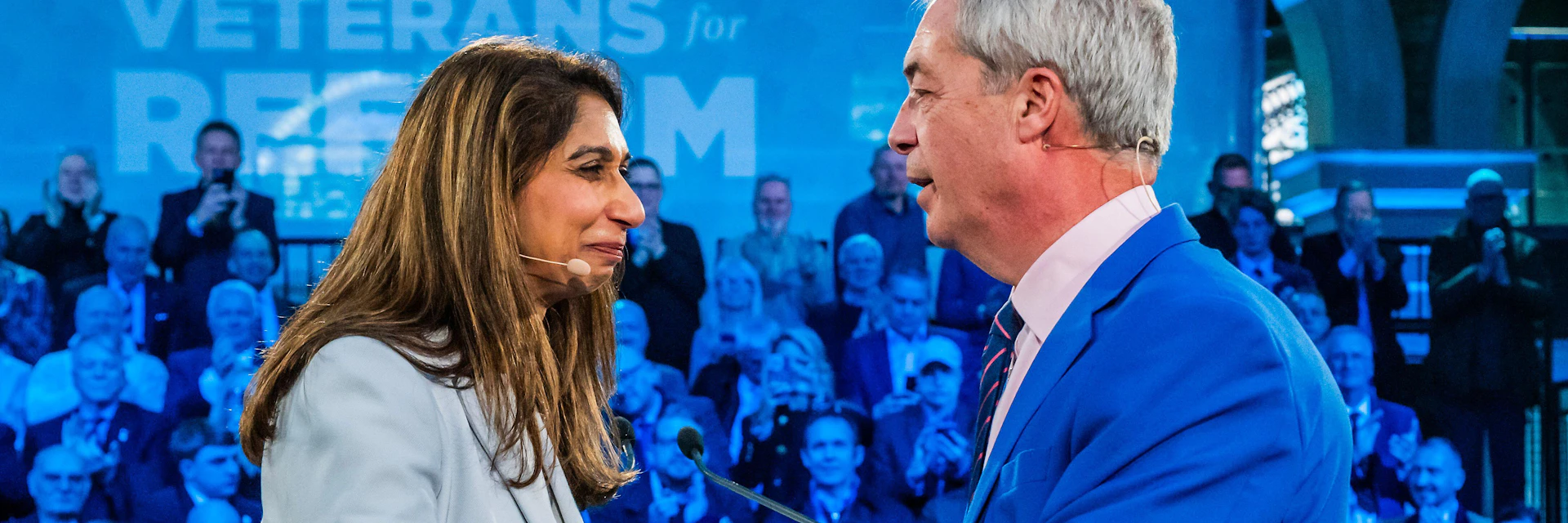
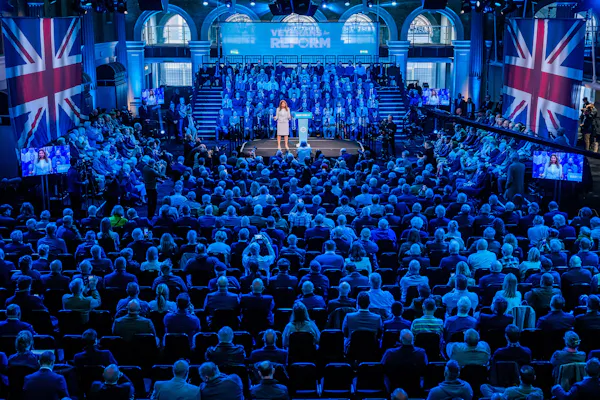
Braverman’s defection was announced at a Veterans for Reform event. Alamy/Guy Bell
The deeper issue is organisational. Recruiting MPs is not the same as building a party machine. Defectors bring personal followings, constituency operations, donor networks and ideological baggage. They can add reach but they can also add volatility, especially if Reform’s appeal relies on projecting discipline and clarity.
And internal tensions are not theoretical. Braverman and Jenrick are not merely Conservatives who happen to have drifted rightwards. They were also senior figures in a government that Reform has attacked as incompetent and deceitful.
That is why a July 2025 post on X by Zia Yusuf (widely circulated as Braverman joined) lands so sharply. In the post, the head of policy at Reform UK referred to the Conservative government’s handling of an Afghan data leak and secret resettlement, asking “who was in government?”, and then named Braverman as home secretary and Jenrick as immigration minister.
The point isn’t whether Yusuf’s earlier argument was fair or unfair. It’s that it feeds an “own goal” narrative. Reform’s senior figures have recently depicted these people as emblematic of the failures of the Conservative state, and now the party is inviting them into the tent.
That forces Reform into a delicate position. If it embraces defectors uncritically, it weakens its anti-establishment brand. If it keeps attacking them, it destabilises its own recruitment strategy.
Braverman’s seat: opportunity and risk
Braverman’s own constituency, Fareham and Waterlooville, illustrates why Reform wants converts of her stature and why the strategy can backfire.
On official local results for the 2024 general election, Braverman won with 35% of the vote; Reform placed fourth on 18%, behind Labour (23%) and the Liberal Democrats (19%).
That is the kind of compressed result Reform dreams about: a sizeable right-populist base already present, plus a Conservative vote that if transferred could turn a marginal into a secure Reform seat. From this perspective, defections are not just PR. They are an attempt to solve Reform’s hardest electoral problem: converting diffuse national support into winnable constituency coalitions.
But the same numbers show the danger. If Braverman fails to bring a large share of Conservative voters with her, the most likely short-term effect is to make the seat more competitive for her opponents through vote fragmentation and tactical voting. Defections can therefore produce a paradox: they make Reform look bigger nationally while making individual contests messier locally.
And at the national level, the risk is huge. Reform’s central claim – that it is the “alternative” to a failed political class – is now colliding with the reality of who it is recruiting from that class.
If Reform wants to remain a pure insurgency, it must keep its distance from establishment figures and prioritise new candidates. If it wants to look like a credible government-in-waiting, it will keep collecting experienced politicians, but it must then accept the costs – intensified scrutiny, more ammunition for opponents, and the constant suspicion that it is simply rebranding Conservatism rather than replacing it.
Want more politics coverage from academic experts? Every week, we bring you informed analysis of developments in government and fact check the claims being made.
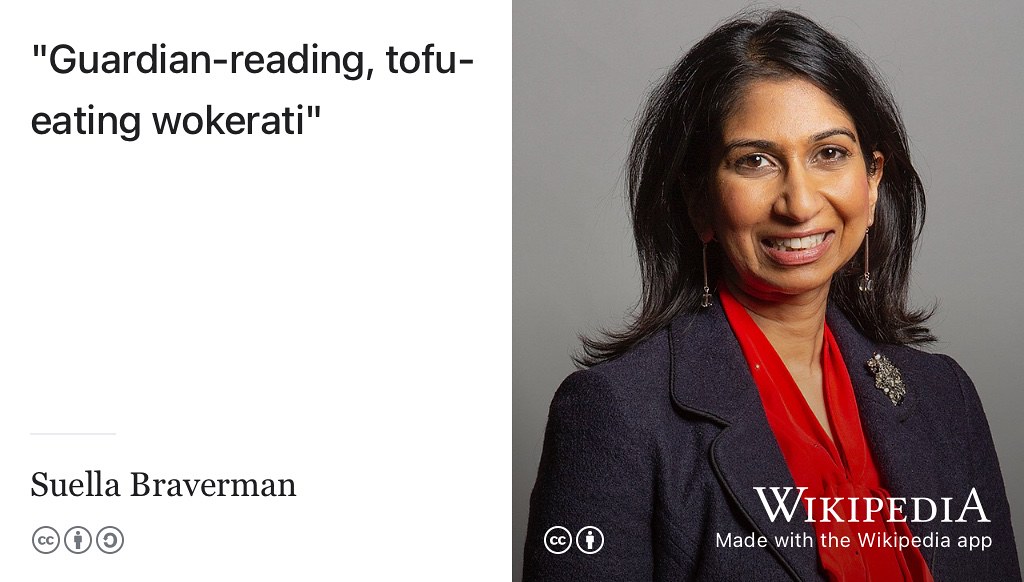
Keir Starmer confirms that his government is cnutier than Suella Braverman on killing the right to protest.Image quoting Suella ‘Sue-Ellen’ Braverman reads ‘Guardian-reading, tofu-eating wokerati’.
Reform’s leader, Nigel Farage, and deputy leader, Richard Tice, during the party’s annual conference in Birmingham on 6 September 2025 | Darren Staples/Bloomberg via Getty Images
How Nigel Farage’s ‘anti-establishment’ party began a love affair with lobbyists and industry leaders
Richard Tice must be sick of finger sandwiches. In the last few months, Reform UK’s deputy leader has ramped up his meetings with Big Business, openDemocracy can reveal, spending one or two mornings each week getting together with industry leaders at roundtable breakfast events facilitated by lobbying firms.
This campaign has several aims, not least to get businesses developing Reform’s future manifesto. The party believes it has the votes needed to win at the 2029 election – or, it says, even sooner – but it doesn’t yet have the policies or the people needed to govern. That’s where Tice comes in; he’s asked businesses to detail their policy ideas in written submissions of no more than three pages, openDemocracy understands.
Big Finance looks particularly set to benefit from this engagement. Like Labour and the Conservatives before it, Reform has promised a bonfire of regulations aimed at further unleashing the economic might of the financial sector.
Speaking at one roundtable event hosted by lobbying firm Pagefield last year, Tice said Reform was having “lots of these [meetings] to get the message out and also to learn from your clients [about] the issues that affect their sector”.
He then listed the main issues businesses have raised with the party – and vowed to address them. “Too much regulation, tax is going up, uncertainty; they’re finding that really depressing,” he said. “So that’s what we’re keen to focus on. Smart regulation, safe regulation, we all want that; what we don’t want is daft regulation that adds to costs, adds to inflation, and restricts growth and investment.”
It is not unusual for industry leaders to forge ties with a party tipped to enter government. For Reform, these partnerships offer not only policy ideas and potential funding, but also help to legitimise the party as an heir to the Tory agenda. Its meetings and agreements with business leaders tell other companies – and, indeed, voters – that Reform is not the toxic political force they’ve read about, but a normal political party that they can engage with or support without fearing reputational blowback.
For business leaders, on the other hand, the potential rewards are numerous. In the years before the 2024 election, a significant number of companies sent members of their staff to work for Labour on policy development and business engagement; today, some of these firms are enjoying an uptick in government contracts, while others have managed to water down regulations or influence Keir Starmer’s policy platform. Now, lobbying firms are actively looking to recreate these successes with Reform – and, openDemocracy can reveal, to go one step further by bagging their clients’ roles in a Farage government.
“The opportunities for business if Reform gets in are a lot greater than we’ve seen previously,” said one lobbyist openDemocracy spoke with. “[Reform is] saying they’re going to have up to 50% of their cabinet [come from industry]. Businesses are thinking at this point, ‘Could I be in their cabinet?’ and, ‘How can I position myself to be as influential as possible now, but also when they get in?’”
Another lobbyist added that, even if Reform doesn’t win the next election, business increasingly sees it as one of the most important parties to influence because of how it dominates the agenda.
“They are setting the policy agenda in so many ways,” they said, “because the government is so keen to outflank them on issues, and [is] obviously very worried about them. It means that what they say is likely to have an impact on government thinking and government policy.”
‘Industry has woken up’
To voters up and down the country, Reform has sought to cast itself as an insurgent, anti-establishment party. At the same time, it has been quietly building relationships with financial giants in the City of London and some of the UK’s most influential lobbying agencies, whose clients include blue-chip multinational corporations.
These include FGS Global, owned by private equity giant KKR and chaired by Roland Rudd, one of the UK’s wealthiest lobbyists, who led the People’s Vote campaign that unsuccessfully called for a second referendum on a final version of a Brexit deal. FGS Global’s clients last year included tech giant Oracle, outsourcing firm Serco and the owner of South West Water, Pennon.
Richard Tice was also hosted by Teneo Advisory, another global lobbying and PR giant that’s majority owned by a private equity firm – in this case, Jersey-based CVC Capital Partners. Teneo represents some of the biggest companies in the world, and its clients in the UK last year included HSBC, metals and oil trader Trafigura and autonomous vehicles firm Wayve.
The purpose of these kinds of meetings is to bring together a group of a lobbying agency’s clients and introduce them to leading political figures, with information flowing in both directions. The companies want to make their views clear while gaining an insight into how the party sees issues relevant to their business.
But, as openDemocracy noted when reporting on the major corporate lobbying blitz that targeted Labour ahead of the 2024 general election, these meetings are often shrouded in secrecy. Only firms that lobby the government are required to publish a list of their clients; companies trying to influence opposition parties have no such obligation. Similarly, despite campaigners’ best efforts, neither businesses nor political parties have to publish details of their meetings, only the government.
This significant legislative gap means the public has no right to know which individuals and companies are lobbying Reform – or how.
From conversations with sources and public posts on LinkedIn, openDemocracy is aware of more than a dozen specific meetings that Tice was involved in with lobbying agencies between September and the end of the year, though we understand that many more took place, with some firms declining to publicise the efforts due to the reputational concerns that still linger around the party.
While Tice is the face of the party’s business engagement campaign, internally, it’s being led by Matthew Mackinnon, Reform’s head of external relations. Mackinnon is well-experienced in British politics; he is a former adviser to the Welsh Conservative Party and has stood as a council candidate for both the Tories and the Liberal Democrats, though his ties to Faragist politics date back to his time as a regional director for Vote Leave in Wales.
Another lobbyist who spoke to openDemocracy on condition of anonymity said there is more opportunity for businesses to “offer their expertise” to Reform – ie, help write the party’s policies – because it is a new, challenger party without the established infrastructure of its rivals Labour and the Tories.
They predicted that the engagement between the party and business will ramp up as an election nears.
“Farage is predicting a general election by 2027,” they said. “By that point, they are going to have a pretty clear idea of what their manifesto is going to be. So the window for influencing that manifesto is the next 18 months. The industry has woken up to this opportunity.”
A porous membrane
As was the case with Labour ahead of the last election, the corporate affairs industry has sought to take advantage of the porous membrane between frontline politics and lobbying by hiring individuals with firsthand experience of working for or with Reform.
This is challenging, though. While Reform’s lack of infrastructure presents an opportunity for lobbyists to help shape policy, the relative lack of people with direct experience of working for the party or Farage’s previous projects compared with the major parties means there has been a scramble to find suitable hires.
Farage’s former right-hand man, Gawain Towler, was hired by Bradshaw Advisory in March last year and has become a regular fixture on the business roundtable circuit. Towler, a former head of press at UKIP and director of communications at Reform, was then elected to Reform’s board in August 2025.
Meanwhile, former parliamentary assistants for Farage and Reform MP Lee Anderson (who defected from the Tories in 2024, having previously been a Labour councillor) have been snapped up by Flint Global and Hanbury Strategy, respectively.
Flint is an executive advisory firm staffed largely by senior ex-civil servants that helps clients (“international businesses and investors”) to “identify risks and opportunities” in politics, and “develop strong arguments that will have an impact on decision-makers”. The company recently also brought in veteran commentator and campaigner Tim Montgomerie; his profile on their website states that last year he “ended a 33-year membership of the Conservative Party and defected to Reform UK”.
Former Tory minister Jonathan Gullis spent months on the employment scrapheap after losing his seat at the last election, even appearing on the radio to bemoan the plight of recently unseated MPs finding it difficult to get back into work – though he did set up an advisory firm, Aegean Consultants, which offered to help businesses develop ties to Reform. Now, Gullis’s unemployability problem seems to have been solved; within a week or so of announcing he had officially joined Reform, he was hired by 5654 & Partners, a Westminster lobbying firm that has counted private health giant HCA Healthcare, Coca-Cola, Drax Group, and arms manufacturer Raytheon UK among its clients. “A former Conservative MP and minister for school standards who recently became one of Reform UK’s most high-profile appointments,” 5654 boasted on LinkedIn.
In the years before the last general election, a significant number of companies sent members of their staff to work for Labour, working on policy development and business engagement, with some of these firms now enjoying an uptick in government contracts with Labour in power. Now, the lobbying industry is actively looking for opportunities to do the same for Reform.
“There will obviously be public affairs agencies and people from industry who are saying: ‘We are experts. We can help you craft your policy agenda in this area, you should listen to us,’” the lobbyist explained. “And that is an opportunity, obviously. That’s another thing we’re looking to do.”
‘Too much regulation’
In November last year, Nigel Farage strode down the stairs of a plush City venue decked out with Reform UK banners. He was, to a delighted reaction from those in the room, about to dismantle much of the fiscal policy offering he’d previously laid out to the British electorate.
Months earlier, Farage had donned high-vis and turned up on site at British Steel in Scunthorpe to advocate for emergency nationalisation – though it would later be revealed that, not long after this stunt, his party accepted a £100,000 donation from Greybull Capital, a private equity firm that had a hand in British Steel’s long demise. Reform had also talked up plans for the water industry to be returned to some form of public ownership, and wrote to Andrew Bailey, the governor of the Bank of England, accusing him of prioritising corporate profits over the interests of working people.
At the Banking Hall, Farage struck a very different tone. Over half an hour, he played many of the hits; bashing net-zero and praising cryptocurrencies. Again, this came months after his party received £9m, the largest single political donation from a living person in British history, from Christopher Harborne, who has significant interests in both aviation and crypto, though some weeks before the donation would be made public. Farage has since said he has offered the businessman “absolutely nothing in return at all”.
The Reform leader also took the opportunity to row back on one of the party’s key policies in winning over working-class voters: a pledge to increase the threshold at which workers begin paying income tax from £12,570 to £20,000. This, Farage clarified, was an “aspiration”. “We want to cut taxes, of course we do,” he said, “but we understand substantial tax cuts, given the dire state of debt and our finances, are not realistic at this current moment in time.”
It was a homecoming, both ideologically and literally, for the small-state Thatcherite who began his working life as a City trader. And it went over well with an audience, according to one attendee, made up largely of corporate lobbyists and financiers. For some, who had spent the past few months developing relations with Reform, it felt like a victory.
Two days later, Farage’s deputy gave a more focused speech to a similar City audience, this time at the UK headquarters of Bloomberg. Tice’s message was similar; pare back the state and deregulate, with a focus on letting loose the economic might of the City of London.
He announced that the party would set up four policy working groups in collaboration with the newly founded pro-Reform think tank, Centre for a Better Britain. openDemocracy understands that these groups have met twice already and involve executives from the City of London.
One is focused on financial deregulation, including reassessing the roles of the Financial Conduct Authority and the Prudential Regulation Authority, key City watchdogs that Keir Starmer’s Labour government has already leaned on to prioritise growth over consumer rights. Taxation is another focus area, with Tice having spoken of the need to simplify the UK tax system and strip back compliance measures aimed at tackling money-laundering. The other working groups are looking at facilitating access to private finance for small and medium-sized companies, and reforming the UK’s pensions system
With these groups and plans in place, the stage is now set for an all-out lobbying charm offensive – all of which will take place completely hidden from the view of the British electorate.
openDemocracy reached out to Reform and Tice for comment but did not hear back.
Nigel Farage urges you to ignore facts and reality and be a climate science denier like him and his Deputy Richard Tice. He says that Reform UK has received £Millions and £Millions from the fossil fuel industry to promote climate denial and destroy the planet.Nigel Farage reminds you that he’s the man that brought you Brexit and asks what could possibly go wrong.Nigel Farage explains the politics of Reform UK: Racism, Fake anti-establishmentism, Deregulation, Corporatism, Climate Change Denial, Mysogyny and Transphobia.
Nigel Farage has taken frequent trips to support Trump, or organisations that support him(Image: AFP via Getty Images)
Most recently, Farage attended an event at Trump’s Mar A Lago resort celebrating US Military Veterans just months before Trump’s vile slur dismissing the sacrifice of British troops who served in Afghanistan
Nigel Farage has racked up more than £151,000 in donor-funded flights to support Donald Trump since entering Parliament.
Most recently, Farage attended an event at Trump’s Mar A Lago resort celebrating US Military Veterans just months before Trump’s vile slur dismissing the sacrifice of British troops who served in Afghanistan.
It has emerged that Farage was acting as an advisor to Hossein Ghandehari, an Iranian-born businessman, during his trip to the World Economic Forum in Davos, Switzerland this week.
The Reform UK leader, who presents himself as a champion of “ordinary people”, spent much of his first year as an MP criss-crossing the Atlantic – often with wealthy backers picking up the tab.
In November, Nigeria-born Lebanese billionaire Bassim Haidar paid £54,921 for flights for Farage and two aides to attend a veterans’ event at Donald Trump’s Mar-a-Lago resort, according to figures compiled by the investigations site DeSmog.
Donald Trump urges you to be a Climate Science denier like him. He says that he makes millions and millions for destroying the planet, Burn, Baby, Burn and Flood, Baby, Flood.Nigel Farage urges you to ignore facts and reality and be a climate science denier like him. He says that Reform UK has received millions and millions from the fossil fuel industry to promote climate denial and destroy the planet.Elon Musk urges you to be a Fascist like him, says that you can ignore facts and reality then.
Prime Minister Keir Starmer delivers his keynote speech during the Labour Party Conference at the ACC Liverpool, September 30, 2025
NEW Unison general secretary Andrea Egan has done a service to the entire labour movement. Barely a week in office, she has spelt out exactly what is wrong with the Starmer government, and what needs to change.
We make no apology for quoting her words, written for Tribune, extensively. First the crisis: “The first far-right government in our history is a very real prospect. Nigel Farage in power would be the biggest triumph for the enemies of the working class since his idol Margaret Thatcher took office…
“It would be a global victory for a billionaire-backed ethnonationalist project represented by the administration of Donald Trump…for every worker, active trade unionist or anyone who wants to live in an open and democratic society, the political stakes of the coming months and years are potentially existential. We are staring down the barrel of a historically devastating offensive against our class.”
Then, the blame: “From witnessing the recent behaviour of Labour’s ruling faction, you wouldn’t know it. Spearheaded from Downing Street, this narrow Westminster grouping often gives the impression it would rather hand the country over to Farage and put the labour movement’s survival on the line than consider any change in policy direction or lose the slightest control over the party machine.”
Egan slams the “stitch-up” which blocked Manchester Mayor Andy Burnham from standing in the Gorton and Denton by-election, with the reasons offered “an insult to the intelligence.”
Then the warning: “Trade unions will not tolerate this self-destructive approach any longer. The costs are simply too high, and it is our members — our whole movement — who will pay the price.
“Labour’s rotten internal culture is a significant cause of its failure to deliver for workers while in government, which in turn drives its historic unpopularity and lays the ground for the far right.



 Prime Minister Keir Starmer delivers his keynote speech during the Labour Party Conference at the ACC Liverpool, September 30, 2025