Austerity and alignment to Washington: Two years of President Javier Milei

Spread the love

Original article by Pablo Meriguet republished from peoples dispatch under Creative Commons Attribution-ShareAlike 4.0 (CC BY-SA) license.
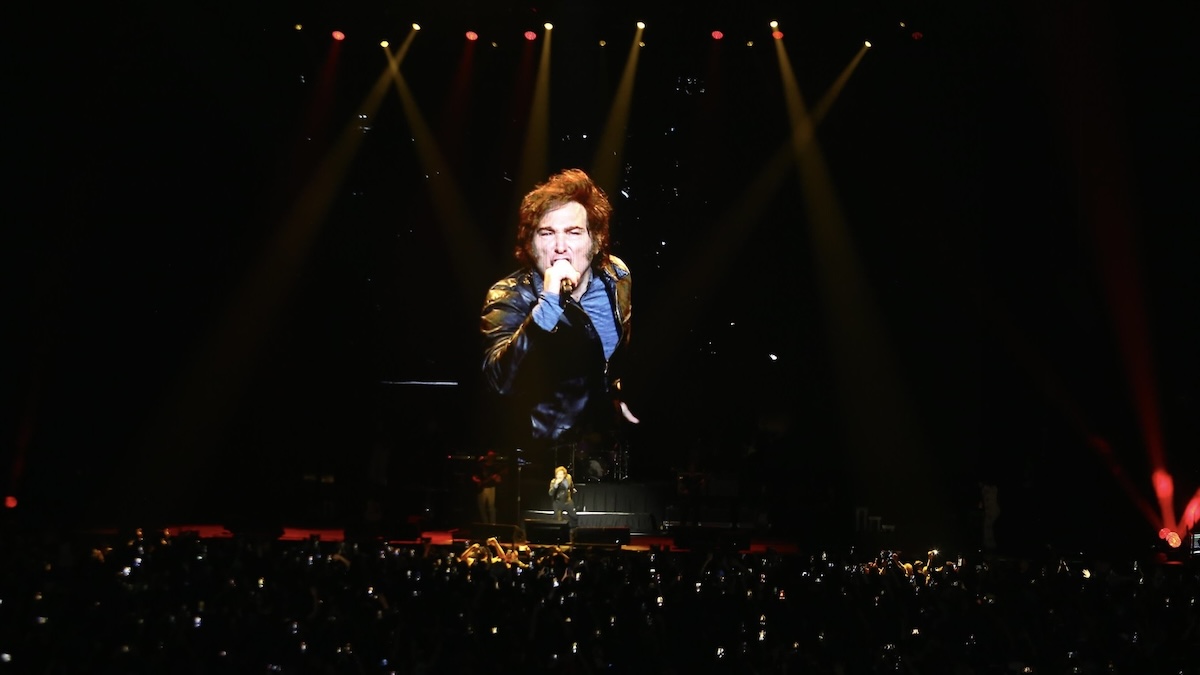
Argentina President Javier Milei. Photo: Javier Milei / X

In this article, we review some of the general trends and attitudes of Milei’s government two years into his term.

Thousands of Argentines endured high temperatures as they took to the streets on December 18 to protest the labor reform of Javier Milei’s far-right government. The call to action by the General Confederation of Labor (CGT) was supported by several trade unions, which claimed that the measure seeks to destroy workers’ rights to benefit big business: “This reform will only deepen poverty, social exclusion, and job insecurity. We will not give up our fight for decent work,” the CGT said in a statement.

The government has justified the measure by citing an alleged need to modernize labor relations: “The text also incorporates specific incentives for the formalization of employment, new rules for the platform economy, more efficient employer contribution schemes, and mechanisms that reduce litigation, providing the system with greater predictability and long-term stability.”

However, organized workers claim that this is a labor flexibility project that aligns with President Milei’s neoliberal agenda. Cristian Jerónimo, leader of the CTE, said: “[The labor reform] does nothing to benefit the world of work; it is written in favor of Argentina’s large corporations and does not favor small and medium-sized enterprises.”

But for the protesters, this reform comes as no surprise. Long before becoming president, Milei announced that it was imperative to reform the entire structure of the Argentine state in order to put it on the “path to freedom,” which means neoliberalizing the economy, reducing state participation in the economy to a minimum, strengthening the apparatus of repression, and aligning the South American country geopolitically with Washington’s interests. In short, to return to the path of the Washington Consensus.

After the day of mass mobilization, the government announced that the debate on the reform would be postponed until February, an initial sign that Milei is feeling the pressure of the popular demonstrations. Yet, after two years in office, Milei has done everything possible to push forward his neoliberal agenda even amid many rounds of mass demonstrations. A series of laws, executive decrees, and international diplomatic engagements have been the clearest signs of the path taken by the right-wing libertarian leader who governs a country that, despite his promises, is once again returning to the path of economic crisis and political instability.

Economy: fiscal adjustment and social tension

In line with neoliberal orthodoxy, Milei has implemented a series of fiscal adjustments to eliminate the deficit, even though this has been at the expense of the material stability of the most disadvantaged sectors, who have taken to the streets to protest against cuts in health, education, and other areas that the Argentine state now refuses to cover in full or adjust in line with the current economic reality. Students, teachers, researchers, and university workers have also taken to the streets consistently, demanding improvements in higher education funding, funding for science and health research, and defending free and public education.

Repression of mass protests, ordered by Security Minister Patricia Bullrich, has been severe. Hundreds have been arrested and injured, including Pablo Grillo, a journalist who was nearly killed when a tear gas canister struck him in the head.

Nevertheless, Milei did not slow down. The elimination of subsidies, wage freezes, and widespread privatization of public companies generated the long-awaited fiscal surplus in more than a decade. Year-on-year inflation, which stood at around 211% at the end of 2023, was reduced to 3% at some point in 2025.

Despite this, several analysts have stated that the 2.3% increase in inflation in October 2025 reflects the shortcomings of a neoliberal model in sustaining a long-term surplus.

Furthermore, it is important to remember that this year, Donald Trump’s administration bailed out Argentina with a record payment of more than USD 20 billion, in addition to the IMF’s generous granting of USD 20 billion to Argentina.

In other words, the surplus that the executive branch promotes as its great economic success has been achieved thanks to enormous support from its international allies, who demand neoliberal macroeconomic change not only in Argentina but throughout the region. This, of course, comes at a price that Argentines will have to pay for decades to come. Argentina has the largest IMF debt in the world. Its debt of more than USD 64 billion is “the price of freedom.”

Politics: reduction of the state and open confrontation

Following his economic model, Milei’s government has pushed radical downsizing. More than 10 ministries and 200 government departments were eliminated in one fell swoop. This meant the dismissal of almost 50,000 people who suddenly found themselves thrown into unemployment and precarity.

These decisions were made abruptly and aggressively, political attitudes that the president has adopted as part of his communication strategy. Bypassing parliamentary approval whenever possible, Milei always sought to govern unilaterally whenever possible.

But Milei has also achieved significant legislative victories. At the beginning of his administration, he had the support of only 39 deputies and six senators; however, he managed to pass several laws, such as the Bases Law (which allowed for the radical privatization of the Argentine state) and tax reforms.

He achieved this thanks to the support of the PRO, a right-wing party led by former president Mauricio Macri, and certain dissident Peronists. The formation of the so-called “May Pact,” a major agreement between Argentina’s right-wing parties and governors, allowed him to negotiate and agree on several reforms desired by right-wing libertarianism.

This pact prevented an increase in pensions for the elderly, who have regularly protested to demand more money to buy medicine and food, which are now major obstacles in their lives. Despite this, the Pact has not budged and continues with its neoliberal drift.

Political and judicial scandals

Milei’s administration has also been marked by several scandals. Very early on, he began a dispute with Victoria Villarruel, his vice president, whom he accused of playing into the hands of his political enemies.

He was also involved in the “$LIBRA” scandal, in which he is accused of being part of an international fraud scheme related to the sale of cryptocurrencies. A parliamentary commission concluded that Milei did use his position as president to promote the scam, which caused millions in losses to investors around the world.

But the event that probably had the greatest impact on Milei’s popularity involved his sister. Karina Milei, who serves as Secretary to the President, is accused of participating in a bribery ring that operated through the National Disability Agency (ANDIS). Many saw the emergence of this scandal as the reason for his resounding defeat in the Buenos Aires Province elections on October 26.

Despite this, Milei managed to recover and his party, La Libertad Avanza (LLA), won the next legislative elections and increased its number of seats in the legislature. His strategy was the usual one: accusing Peronism of destroying Argentina and presenting himself as the only one capable of saving the country. However, this messianic communication strategy has begun to be questioned precisely because of the corruption and fraud scandals that have plagued his government.

Alignment with Washington

Milei has made a significant shift in the country’s foreign policy. Argentina’s vote against the UN resolution condemning the US economic and trade blockade of Cuba reflects an important change. Historically, Argentina has maintained a diplomatic position against any act of imperialism due to its claim over the Malvinas Islands, which, despite being off its coast, are governed by the United Kingdom. The dispute has escalated to military levels despite repeated claims by the Argentine authorities.
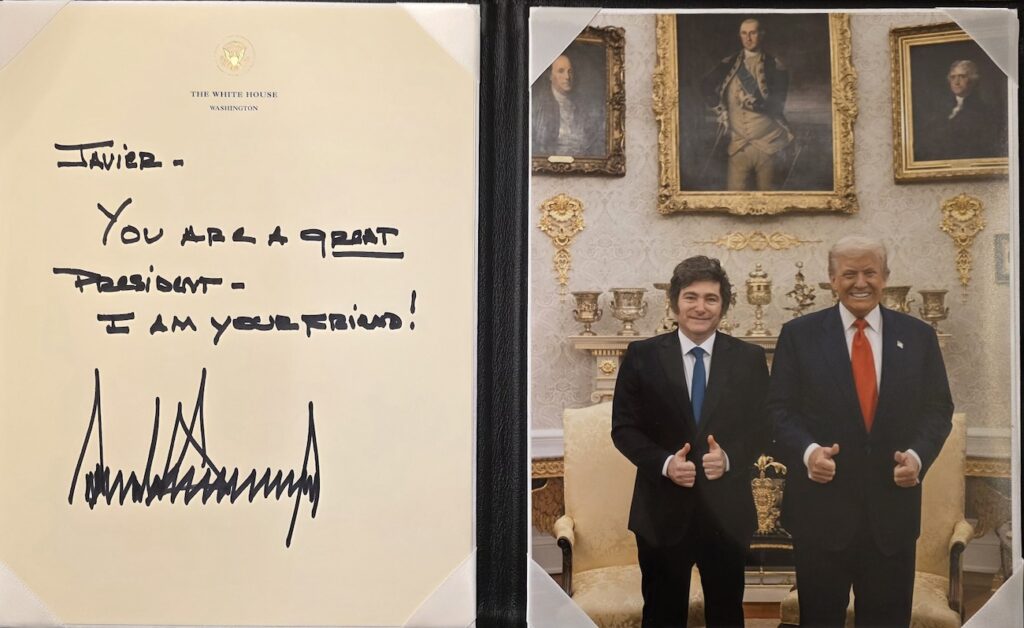
Photo Javier Milei Donald Trump
Donald Trump-signed photo of him and Javier Milei. Photo: Javier Milei / X

But the change is much more than nominal. Argentina has become the Trump administration’s greatest ally in South America. Milei has praised Trump’s personality, and Trump has publicly supported him, like when, in the last legislative elections, he suggested an end to cooperation between Buenos Aires and Washington if Milei lost. In response, the Argentine president has repeatedly declared his loyalty to Trump’s geopolitical project and has supported all of his initiatives both within and outside the region.

In this way, Milei has become a sort of archetype for the leaders of the new Latin American right. With radical fiscal adjustment at the expense of the most impoverished sectors, open confrontation with their opponents, and an international policy fully aligned with Washington (which has initiated a new chapter of the Monroe Doctrine), far-right governments are beginning to gain ground in the region: Kast in Chile, Paz in Bolivia, etc., are examples of an ideological and geopolitical shift in the region that is impossible to understand without the figure of Javier Milei.

Original article by Pablo Meriguet republished from peoples dispatch under Creative Commons Attribution-ShareAlike 4.0 (CC BY-SA) license.
Continue ReadingAusterity and alignment to Washington: Two years of President Javier Milei

Trump Ramps Up Aggression Against Venezuela With Seizure of Ship Not Under US Sanctions

Spread the love

Original article by Brett Wilkins republished from Common Dreams under Creative Commons (CC BY-NC-ND 3.0). 

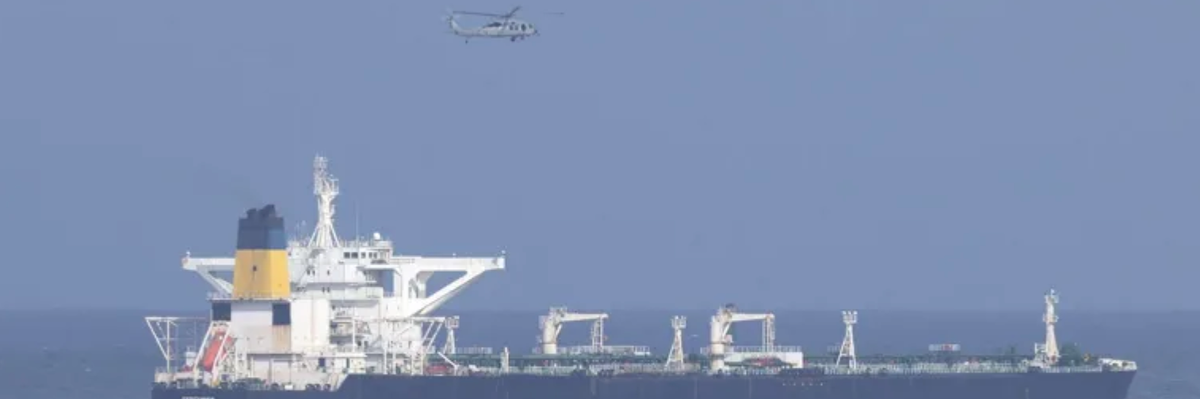
A US military helicopter flies over the oil tanker Centuries in the southern Caribbean Sea on December 20, 2025. 
(Photo by US Department of Homeland Security)

The Venezuelan government condemned the seizure as “a serious act of international piracy;” meanwhile, a US official said the Coast Guard was pursuing a third tanker in the Caribbean.

The Trump administration’s “total and complete blockade” of “all sanctioned oil tankers” off the Venezuelan coast was already denounced by critics as “an act of war”—and the United States further escalated its aggression on Saturday by seizing a tanker that is not on a list vessels under US sanctions.

US Coast Guard troops led Saturday’s seizure of the Centuries, a Panamanian-flagged, Chinese-owned oil tanker in the Caribbean Sea, after it left Venezuela.

RECOMMENDED…

Trump Escalates in Venezuela With 'Illegal' US Seizure of Oil Tanker

Trump Escalates in Venezuela With ‘Illegal’ US Seizure of Oil Tanker

Venezuelan President Nicolás Maduro

Venezuela Condemns US ‘Piracy’ as Trump White House Signals It Will Seize More Oil Vessels

“The United States will continue to pursue the illicit movement of sanctioned oil that is used to fund narco-terrorism in the region,” US Homeland Security Secretary Kristi Noem said on X. “We will find you, and we will stop you.”

On Sunday, an unnamed US official told Reuters that the Coast Guard “is in active pursuit” of a third tanker near Venezuela, “a sanctioned dark fleet vessel” that “is flying a false flag and under a judicial seizure order.”

The Venezuelan government condemned Saturday’s seizure as “a serious act of international piracy.”

Venezuela “denounces and rejects the theft and hijacking of a new private vessel transporting oil, as well as the forced disappearance of its crew, committed by military personnel of the United States of America in international waters,” Venezuelan Vice President Delcy Rodríguez said in a statement.

“These acts will not go unpunished,” she vowed, adding that Venezuela will pursue “all corresponding actions, including filing a complaint before the United Nations Security Council, other multilateral organizations, and the governments of the world.”

Earlier this week, President Donald Trump declared a blockade of all oil tankers under US sanctions that are traveling to or from Venezuela.

Saturday’s action followed the US seizure of the Panamanian-flagged Skipper—which is under sanctions—off the Venezuelan coast on December 10.

The Centuries seizure also comes amid the Trump administration’s bombing of at least 28 boats allegedly transporting drugs in the Caribbean Sea and Pacific Ocean, attacks that have killed more than 100 people and have been condemned as acts of extrajudicial murder.

In addition to the blockade and boat strikes, Trump has deployed an armada of warships and thousands of troops to the southern Caribbean, authorized covert CIA action against the socialist government of Venezuelan President Nicolás Maduro, and has threatened to invade the South American nation. This latest wave of aggression continues more than a century of US meddling in Venezuela’s affairs and sovereignty.

Numerous world leaders have denounced the US aggression toward Venezuela. On Saturday, leftist Brazilian President Luiz Inácio Lula de Silva said during a summit of the South American Mercosur bloc in Foz do Iguaçu, Brazil that an “armed intervention in Venezuela would be a humanitarian catastrophe.”

In the United States, multiple efforts by members of Congress—mostly Democrats, but also a handful of anti-war Republicans—to pass a war powers resolution blocking the Trump administration from bombing boats or attacking Venezuela have failed.

Echoing assertions by Venezuelan officials and others, one of those Republicans, Rep. Thomas Massie of Kentucky, said earlier this week that Trump’s aggressive escalation “is all about oil and regime change.”

Some critics have called Trump’s actions a renewal of the “gunboat diplomacy” practiced by the US in the 19th and 20th centuries. The US has conducted scores of military interventions in Latin America, including dozens of regime change operations.

Original article by Brett Wilkins republished from Common Dreams under Creative Commons (CC BY-NC-ND 3.0). 

Donald Fuhrump says that Amerikkka doesn't bother with crimes or charges anymore, not being 100% Amerikkkan and opposing his real estate intentions is enough.
Donald Fuhrump says that Amerikkka doesn’t bother with crimes or charges anymore, not being 100% Amerikkkan and opposing his real estate intentions is enough.
Orcas discuss how Trump was re-elected and him being an obviously insane, xenophobic Fascist.

Continue ReadingTrump Ramps Up Aggression Against Venezuela With Seizure of Ship Not Under US Sanctions

New poll shows Reform lead ‘cut to three points’ – as Green surge continues

Spread the love

https://www.thelondoneconomic.com/politics/latest-polls-reform-green-party-nigel-farage-zack-polanski-401645/

Should Reform start looking over their shoulders? Their lead at the top of the polls is dwindling, as the Green Party continues to gain.

To say Nigel Farage and Reform are in the cross-hairs right now could prove to be the understatement of the year. After soaring high in the voting intention polls throughout 2025, one survey has shown that their lead over the chasing pack has dropped significantly in recent weeks.

ALSO READ: A Tory–Reform election pact would be doomed to fail

What’s behind the Reform slump?

The political upstarts have endured arguably their roughest time since their official rebrand to ‘Reform UK’, following a slew of scandals and negative headlines. After taking charge of their first local councils back in May, tax rises have been proposed – and a flurry of councillors lost their positions.

This unsteady ship has been further rocked by allegations levelled against Nigel Farage himself. His connections to Nathan Gill, the former leader of Reform in Wales who was convicted of taking Russian bribes, provided ample fodder for his political opponents on the offensive.

Weeks after this fiasco, former classmates of Brexit’s biggest cheerleader accused him of using racist and antisemitic language during his school days. He has so far refused to issue an apology – but the toxicity surrounding these claims has done Mr. Farage no good in the polls…

Article continues at https://www.thelondoneconomic.com/politics/latest-polls-reform-green-party-nigel-farage-zack-polanski-401645/

Orcas discuss how Trump was re-elected and him being an obviously insane, xenophobic Fascist.
Nigel Farage explains the politics of Reform UK: Racism, Fake anti-establishmentism, Deregulation, Corporatism, Climate Change Denial, Mysogyny and Transphobia.
Nigel Farage urges you to ignore facts and reality and be a climate science denier like him and his Deputy Richard Tice. He says that Reform UK has received £Millions and £Millions from the fossil fuel industry to promote climate denial and destroy the planet.
Continue ReadingNew poll shows Reform lead ‘cut to three points’ – as Green surge continues

Pirates of the Caribbean: sovereignty, law and Donald Trump

Spread the love

https://www.morningstaronline.co.uk/article/pirates-caribbean-sovereignty-law-and-donald-trump

 US President Donald Trump says Venezuela must return ownership rights of its oil to US companies

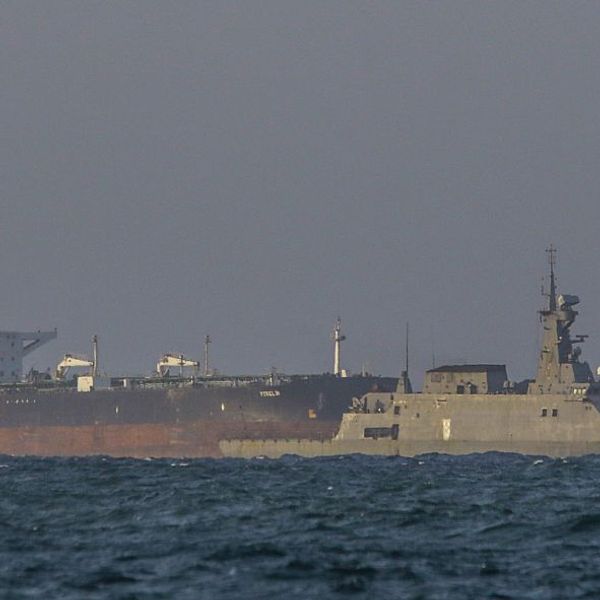
WASHINGTON’S seizure of a second ship carrying Venezuelan oil continues its brazen piracy on the high seas.

It’s a further escalation in US aggression against Venezuela designed to bring about regime change.

Donald Trump’s crimes are dramatic, his motives expressed unusually openly. His secretary for war — and the revival of this title instead of defence secretary speaks for itself  — boasts about prioritising “maximum lethality, not tepid legality.” The administration is hardly making the effort to pretend its actions are legal.

That doesn’t mean it isn’t lying. It lies constantly, and the official rationale for its Venezuela blockade is a lie — there is no evidence the boats it bombs were smuggling drugs, nor that the Venezuelan oil industry has any connection to the drug trade, nor even of the existence of the so-called Cartel de los Soles that it alleges Venezuelan President Nicolas Maduro heads.

But just as when, during his first term, Trump embarrassed his Nato allies by admitting Western militaries were in Syria “only for the oil,” the president’s online rants show the same is true for Venezuela.

Article continues at https://www.morningstaronline.co.uk/article/pirates-caribbean-sovereignty-law-and-donald-trump

Donald Fuhrump says that Amerikkka doesn't bother with crimes or charges anymore, not being 100% Amerikkkan and opposing his real estate intentions is enough.
Donald Fuhrump says that Amerikkka doesn’t bother with crimes or charges anymore, not being 100% Amerikkkan and opposing his real estate intentions is
enough.
Orcas discuss how Trump was re-elected and him being an obviously insane, xenophobic Fascist.
Continue ReadingPirates of the Caribbean: sovereignty, law and Donald Trump