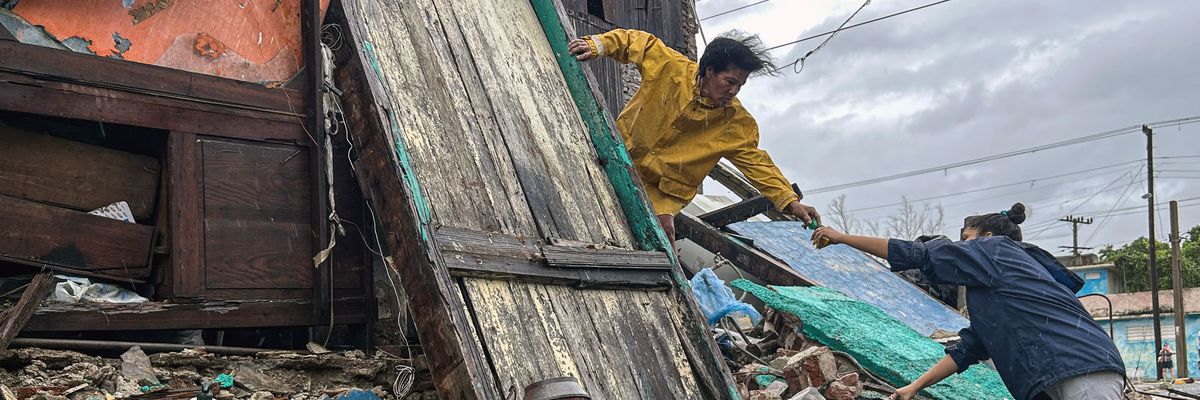
A family salvages belongings from their home after it collapsed during Hurricane Melissa’s passage through Santiago de Cuba, Cuba on October 29, 2025. (Photo by Yamil Lage/AFP via Getty Images)
“The very richest individuals in the world are funding and profiting from climate destruction, leaving the global majority to bear the fatal consequences of their unchecked power.”
A report released Tuesday showed that the wealthiest people on the planet are disproportionately fueling the climate emergency that is intensifying weather catastrophes like Hurricane Melissa, which slammed Cuba on Wednesday after leaving a trail of devastation in Jamaica.
The Oxfam International report, titled Climate Plunder: How a Powerful Few Are Locking the World Into Disaster, features updated figures showing that the consumption-based carbon emissions of the richest 0.1% of the global population grew by 92 tonnes between 1990 and 2023, while the emissions of the poorest half of humanity grew by just 0.1 tonnes.
“A person from the world’s richest 0.1% emits over 800kg of CO2 every day. Even the strongest person on earth could not lift this much,” the report notes. “In contrast, someone from the poorest 50% of the world emits an average of just 2kg of CO2 per day, which even a small child could lift.”
“A person in the top 0.1% emits more in a day than a person in the poorest 50% emits all year,” the report adds.
The destruction caused by Hurricane Melissa—the most powerful storm on Earth this year and the strongest to ever hit Jamaica—underscored the extent to which vulnerable nations are bearing the brunt of a crisis they did little to cause as wealthy countries and individuals continue to spew planet-warming emissions with abandon.
Jamaica, where the true extent of the damage from Melissa is only just beginning to emerge, is responsible for an estimated 0.02% of global greenhouse gas emissions, according to the latest available data.
“The climate crisis is an inequality crisis,” said Oxfam executive director Amitabh Behar. “The very richest individuals in the world are funding and profiting from climate destruction, leaving the global majority to bear the fatal consequences of their unchecked power.”
“We must break the chokehold of the super-rich over climate policy by taxing their extreme wealth.”
Oxfam’s report was published less than two weeks before the start of COP30 in Belém, Brazil, where world leaders will gather once again to weigh climate solutions after years of failing to reach an agreement to curb fossil fuel production and use.
In its new report, Oxfam implores governments to target the emissions of the ultra-wealthy, including through “climate-specific taxes” such as “frequent flyer levies and taxes on luxury travel.”
“It is a travesty that power and wealth have been allowed to accumulate in the hands of a few, who are only using it to further entrench their influence and lock us all into a path to planetary destruction,” said Behar. “We must break the chokehold of the super-rich over climate policy by taxing their extreme wealth, banning their lobbying, and instead put those most affected by the climate crisis in the front seat of climate decision-making.”
Donald Trump urges you to be a Climate Science denier like him. He says that he makes millions and millions for destroying the planet, Burn, Baby, Burn and Flood, Baby, Flood.Nigel Farage urges you to ignore facts and reality and be a climate science denier like him and his Deputy Richard Tice. He says that Reform UK has received £Millions and £Millions from the fossil fuel industry to promote climate denial and destroy the planet.Elon Musk urges you to be a Fascist like him, says that you can ignore facts and reality then.
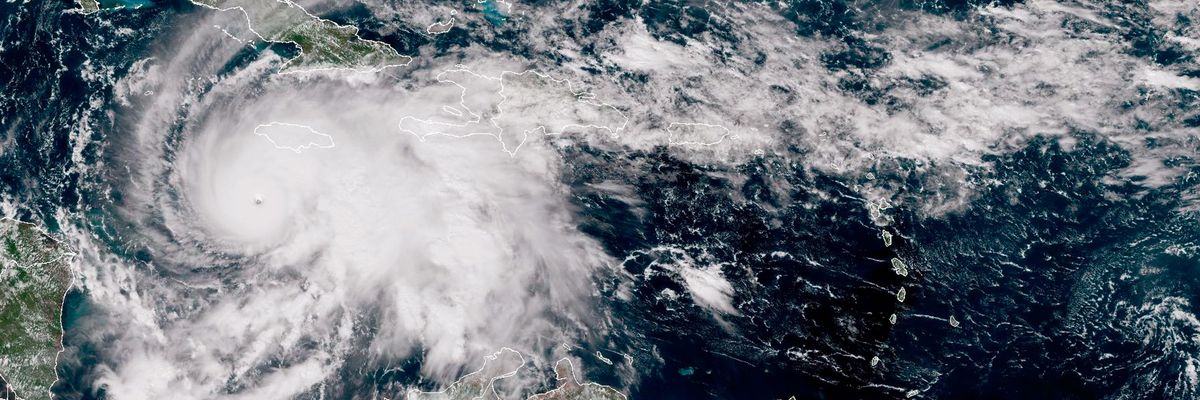
A satellite image provided by the National Oceanic and Atmospheric Administration shows Hurricane Melissa churning northwest through the Caribbean on October 27, 2025. (Photo by NOAA via Getty Images)
“Unimaginable violence is hiding in the very small and compact eyewall of Melissa,” said one hurricane specialist.
Hurricane Melissa barreled toward Jamaica on Tuesday as a monstrous Category 5 storm as the island country braced for devastating landfall, humanitarian operations urgently mobilized, and experts voiced horror at the latest climate-fueled weather disaster.
Anne-Claire Fontan, the World Meteorological Organization’s tropical cyclone specialist, told reporters that “a catastrophic situation is expected in Jamaica” and described the hurricane as “the storm of the century” for the island. Melissa is expected to make landfall imminently, bringing extreme flooding, landslides, and other life-threatening impacts.
Tens of thousands of Jamaicans lost power as the slow-moving storm approached the island, bringing torrential rain and maximum sustained winds of 185 mph, with gusts over 220 mph. Storms like Melissa are the reason scientists are pushing to formally add a Category 6 for hurricanes.
“Unimaginable violence is hiding in the very small and compact eyewall of Melissa,” said Greg Postel, hurricane specialist at The Weather Channel. “Nearly continuous lightning will accompany the tornadic wind speeds.”
Melissa tonight has had one of the most powerful satellite presentations you will ever see for an Atlantic Hurricane. Perfect symmetry in all quadrants and satellite estimation techniques being maxed out, with Dvorak analysis yielding 871.1 mbar (recon found the real pressure to… pic.twitter.com/nKKFbv4g7j
The International Federation of the Red Cross said up to 1.5 million people in Jamaica—roughly half the island’s population—are expected to be directly affected by Hurricane Melissa, one of the most powerful hurricanes ever recorded in the Atlantic Basin and the strongest storm on Earth this year.
“We are okay at the moment but bracing ourselves for the worst,” Jamaican climate activist Tracey Edwards said Tuesday. “I’ve grown weary of these threats, and I do not want to face the next hurricane.”
The International Organization for Migration warned that “the risk of flooding, landslides, and widespread damage is extremely high,” meaning that “many people are likely to be displaced from their homes and in urgent need of shelter and relief.”
Melissa’s landfall will come on the same day that United Nations Secretary-General António Guterres said the international community has failed to prevent planetary warming from surpassing the key 1.5°C threshold “in the next few years.”
Meteorologist Eric Holthaus wrote on social media that “this is the news I’ve dreaded all my life.”
“Humanity has failed to avoid dangerous climate change,” he wrote. “We have now entered the overshoot era. Our new goal is to prevent as many irreversible tipping points from taking hold as we can.”
Hurricane Melissa will make landfall in Jamaica in a few hours as one of the two strongest hurricanes ever to make landfall anywhere in the Atlantic Basin — on par with the 1935 Labor Day hurricane in south Florida.Just horrific. The stuff of nightmares.
Climate experts said Hurricane Melissa bears unmistakable fingerprints of the planetary crisis, which is driven primarily by the burning of fossil fuels.
The warming climate is “clearly making this horrific disaster for Jamaica, Cuba, and the Bahamas even worse,” Jennifer Francis, a senior scientist at the Woodwell Climate Research Center, told the New York Times.
Akshay Deoras, a meteorologist at the University of Reading in the United Kingdom, told the Associated Press that the Atlantic “is extremely warm right now.”
“And it’s not just the surface,” said Deoras. “The deeper layers of the ocean are also unusually warm, providing a vast reservoir of energy for the storm.”
Amira Odeh, Caribbean campaigner at 350.org, warned in a statement Tuesday that “what is happening in Jamaica is what climate injustice looks like.”
“Every home without electricity, every flooded hospital, every family cut off by the storm is a consequence of political inaction,” said Odeh. “We cannot continue losing Caribbean lives because of the fossil fuel industry’s greed.”
“As world leaders head to COP30, they must understand that every delay, every new fossil fuel project, means more lives lost,” Odeh added. “Jamaica is the latest warning, and Belém must be where we finally see a steer to change courses. The Caribbean is sounding the alarm once again. This time, the world must listen.”
Orcas comment on killer apes destroying the planet by continuing to burn fossil fuels.Donald Trump urges you to be a Climate Science denier like him. He says that he makes millions and millions for destroying the planet, Burn, Baby, Burn and Flood, Baby, Flood.Nigel Farage urges you to ignore facts and reality and be a climate science denier like him and his Deputy Richard Tice. He says that Reform UK has received £Millions and £Millions from the fossil fuel industry to promote climate denial and destroy the planet.
Revealed: Only a third of national climate pledges support ‘transition away from fossil fuels’
Only around a third of the latest country climate pledges submitted to the UN express support for the “transition away from fossil fuels”, according to Carbon Brief analysis.
Several countries even have used their 2035 climate plans to commit to increasing the production or use of fossil fuels, predominately gas, the analysis finds.
The first global stocktake of progress to tackle climate change, agreed at the COP28 climate summit in Dubai in 2023, calls on all countries to contribute to “transitioning away from fossil fuels”.
Countries were meant to explain how they are implementing the outcomes of the global stocktake, including their contribution to transitioning away from fossil fuels, in their latest climate plans.
However, just 23 of the 63 plans submitted to the UN so far express support for “transitioning away from fossil fuels”, or the “phase out” or “phase down” of their use.
In addition, six countries, including Russia, Nigeria and Morocco, use their climate plans to commit to boosting gas production.
Some two-thirds of countries have not yet announced or submitted their pledges, missing not only the UN deadline of 10 February, but also an extension to September.
How to address the lack of sufficient action from countries with their latest plans is billed to be one of the major issues up for debate at the COP30 climate summit in Brazil next month.
Taking stock
In 2015, countries forged the Paris Agreement, the landmark deal to keep temperature rise “well-below” 2C, with “aspirations” to limit global warming to 1.5C of warming by the end of this century.
At the time, countries’ initial pledges were not enough to put the world on track to meet the temperature targets, so they built a “ratchet mechanism” into the Paris Agreement, requiring them to keep increasing their ambition in the following years.
As part of this, countries agreed to submit new, more ambitious plans every five years detailing what they are doing to take action on climate change and adapt to its impacts. These are called “nationally determined contributions” (NDCs).
The Paris Agreement also stated that, following on from these plans, “global stocktakes” should be conducted to assess collective progress in meeting the temperature goal.
The first global stocktake concluded at the COP28 climate summit in Dubai in 2023, with countries agreeing to a new document setting out how they will respond to a lack of sufficient action to meet the Paris goals.
The two-week talks saw fierce debate about how fossil fuels – the main driver of human-caused climate change – should be referred to in this text.
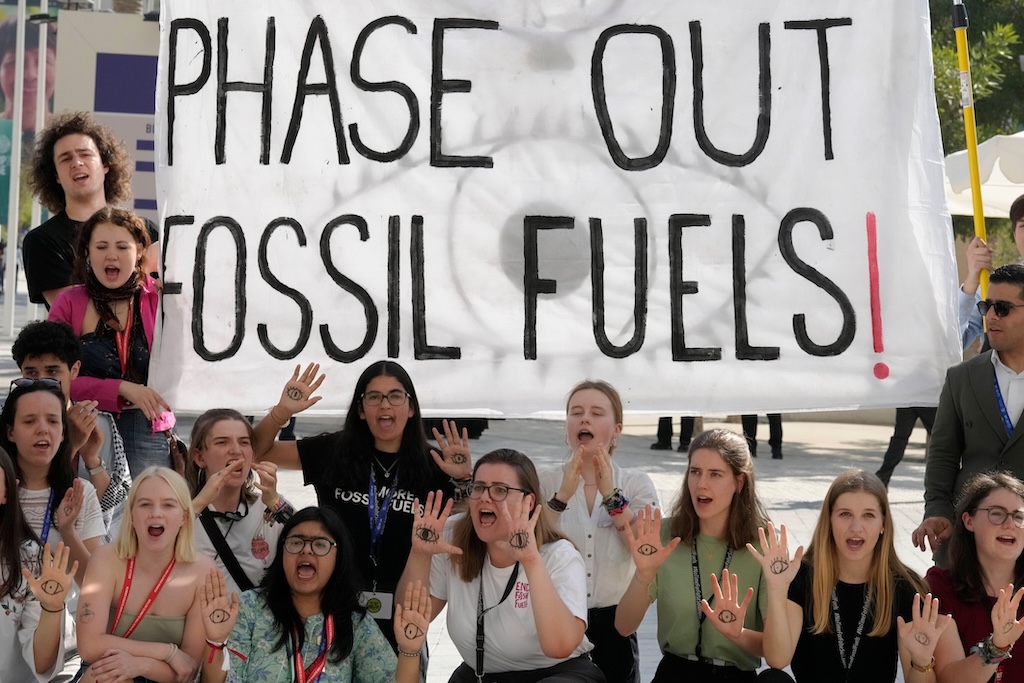
Activists demonstrating at the 2023 COP28 climate summit in Dubai Credit: Associated Press.
In the end, the stocktake “calls on” all countries to “contribute to” a list of global goals, including “transitioning away from fossil fuels…accelerating action in this critical decade” towards net-zero by 2050.
It was the first time that countries formally acknowledged the need to transition away from fossil fuels in almost 30 years of international climate negotiations.
However, many countries were disappointed that the text did not contain a firmer commitment to phase out all fossil fuels, or even just those with “unabated” emissions.
After Dubai, countries were expected to come up with new NDCs for 2035 that explained how they responded to the priorities set out in the stocktake.
The deadline for submitting the “3.0” NDCs was 10 February 2025, which 95% of countries missed.
On 24 September, the UN convened a climate summit in New York at the sidelines of the UN general assembly in the hope of encouraging more countries to come forward with new NDCs.
China stole the show at the event, announcing a pledge – although not yet formally submitted to the UN – to cut greenhouse gas emissions to 7-10% below peak levels by 2035. Several other countries announced new plans, including Russia, Turkey and Bangladesh.
Following the summit, around one-third of countries have announced or submitted their 2035 NDCs.
Fossil-fuel focus
For the analysis, Carbon Brief reviewed each of the NDCs submitted to the UN to determine whether they express support for “transitioning away” from fossil fuels or for phasing them out or “down”.
Countries were considered to have expressed support if they explicitly mentioned the terms “transition” or “phase out/down” in relation to “fossil fuels” when speaking about their own actions to address climate change.
Some countries spoke in general terms about “reducing” or “replacing” fossil fuels, but did not explicitly reference the need to transition away from or phase them down or out. Others spoke about transitioning to a clean or renewable-based economy, but did not explicitly mention fossil fuels.
For the purposes of this analysis, all of these countries were considered to have not expressed support for the need to transition away from fossil fuels.
In addition, some countries mentioned in their NDCs that the global stocktake calls for a transition away from fossil fuels, but did not say that transitioning away from fossil fuels would be part of their own actions to address climate change.
These countries were also considered to have not expressed support for the need to transition away from fossil fuels.
Overall, the results show that only one-third of countries express support for the need to transition away from fossil fuels in their NDCs.
Countries used varying language when speaking about the need to transition away from fossil fuels.
Some directly acknowledged that transitioning away from fossil fuels was a key conclusion of the global stocktake and committed to doing this within their own borders.
This includes the UK, Brazil, Canada, Australia, Singapore, Lebanon and Niue. For example, the UK’s NDC states:
“At home and in line with the outcomes of the GST [global stocktake], the UK is committed to transitioning away from fossil fuels to achieve net-zero by 2050.”
Other countries chose to commit to “phasing out” fossil fuels instead of “transitioning away”.
This includes Iceland and Vanuatu. Similarly, Colombia’s NDC says:
“NDC 3.0 reaffirms that the phasing out of fossil fuels is not only a climate imperative, but also an opportunity to strengthen energy sovereignty [and] democratise the benefits of the transition.”
(Colombia and Vanuatu were two of the countries that were disappointed not to see a commitment to phase out fossil fuels included within the global stocktake text.)
Barbados, an island nation known for its strong commitment to climate action, committed in its NDC to “achieve a fossil fuel-free economy” by 2040. In addition, Chile pledged to contribute to the “elimination of fossil fuels”.
In the analysis, these pledges were considered to be support for transitioning away from fossil fuels, despite not using the terms “transition” or “phase out”.
The table below shows the language used by each of the 21 countries that expressed support for transitioning away from fossil fuels, according to the analysis.
Country
Expression of support for ‘transitioning away from fossil fuels’ in NDC
United Kingdom
“At home and in line with the outcomes of the GST, the UK is committed to transitioning away from fossil fuels to achieve net-zero by 2050.”
Brazil
“Brazil will respond to the call to contribute to global efforts under paragraph 28 of decision 1/CMA.5, through the policies and national efforts below, including those under the National Climate Plan. In addition, Brazil would welcome the launching of international work for the definition of schedules for transitioning away from fossil fuels in energy systems, in a just, orderly and equitable manner, with developed countries taking the lead, on the basis of the best available science, reflecting equity and the principle of common but differentiated responsibilities and respective capabilities in the light of different national circumstances and in the context of sustainable development and efforts to eradicate poverty, as per paragraph 6 of decision 1/ CMA.5.”
Canada
“Canada also remains committed to implementing the mitigation outcomes of the Global Stocktake (GST), agreed at COP28…This includes…transitioning away from fossil fuels in energy systems.”
Lebanon
“Guided by the UAE Consensus reached at COP28, which calls on all Parties to transition away from fossil fuels and strengthen support for adaptation, this NDC reflects Lebanon’s commitment to scaling ambition while addressing national vulnerabilities.”
Iceland
“Iceland’s NDC takes note of the outcome of the global stocktake, according to Decision 1/CMA.5. Specifically, Iceland’s NDC seeks to represent the need for deep, rapid and sustained reductions in greenhouse gas emissions in line with 1.5°C pathways by contributing to the phase-out of fossil fuels across sectors and the strategic, fair and ambitious implementation of carbon capture, utilisation and storage, according to para. 28.”
Barbados
“In 2020, the Government of Barbados set the aspirational goal to achieve a fossil fuel-free economy and to reduce GHG emissions across all sectors to as close to zero as possible by 2030. In light of the significant challenges faced by the country, the aspirational goal is currently expected to be reached around 2040.”
Chile
“In 2023, within the framework of the 28th Conference of the Parties to the UNFCCC (COP) in Dubai, the report on the First Global Stocktake, designed within the framework of the Paris Agreement to assess the global response to the climate crisis, was presented…Among its main conclusions, the agreement to move towards the elimination of fossil fuels in energy systems…stands out. All these conclusions are addressed in this NDC, demonstrating Chile’s commitment to climate ambition.”
Vanuatu
“Moving beyond our current net-zero status, this NDC recommits Vanuatu to rapidly phasing out fossil fuels, deeply decarbonising and transitioning completely to a circular economy.”
Pakistan
“Natural gas and furnace oil are set to decline, with net reductions of 2,147 MW and 430 MW respectively, as per IGCEP 2025-2035, signaling a gradual phase down of fossil fuels in Pakistan’s capacity mix.”
Colombia
“NDC 3.0 reaffirms that the phasing out of fossil fuels is not only a climate imperative, but also an opportunity to strengthen energy sovereignty, democratize the benefits of the transition, and consolidate Colombia as a Power of Life.”
Niue
Niue understands the need to transition from fossil fuel-based electricity generation to renewable energy to reduce the GHG emissions footprint and ensure energy security.”
Singapore
“Singapore is contributing to the first global stocktake’s call to triple global renewable energy capacity and double the global average annual rate of energy efficiency improvements by 2030. We are also supporting efforts to transition away from fossil fuels in energy systems and phase out inefficient fossil fuel subsidies.”
Australia
“The global stocktake recognised the global direction of travel in its consensus call to transition away from fossil fuels in energy systems and to phase-down unabated coal-fired power. In Australia, our transition is underway.”
United Arab Emirates
“The GST Outcome at COP28, together with the broader UAE Consensus and the work under the Troika, has provided a strong impetus for the UAE NDC 3.0. The outcome of the first GST notably emphasizes the need to transition away from fossil fuels in energy systems in a just, orderly and equitable manner, urging parties to adopt ambitious, economy-wide emission reduction targets.”
Japan
“The items listed in decision 1/CMA.5 have been incorporated to the greatest extent possible into the Plan for Global Warming Countermeasures, which is a comprehensive implementation plan for achieving Japan’s NDC.”
Bolivia
“The persistent dependence on fossil fuels, both for electricity generation and transportation, not only contributes to national greenhouse gas emissions, but also exposes the country to volatility in international oil and gas prices, highlighting the urgency of a fair, sovereign, and resilient energy transition toward renewable sources.”
Nicaragua
“The transition to an energy matrix less dependent on fossil fuels is a fundamental priority of the government.”
Marshall Islands
“This NDC also demonstrates our drive, our achievements, and the challenges we face. In particular, we detail our domestic actions to contribute to the collective commitments made following the global stocktake, including the tripling of renewable energy, doubling of energy efficiency and removal of fossil fuel subsidies, all in pursuit of accelerating the transition away from fossil fuels this decade.”
Cambodia
“This transition will be implemented in two key phases: 70% renewable energy by 2030, followed by a further increase to 72% by 2035, ensuring a gradual yet decisive shift away from fossil fuel dependency in the power sector.”
Bangladesh
“Transitioning away from fossil fuels in energy systems, in a just, orderly and equitable manner [is] central to Bangladesh’s contribution to the global response to climate change. The NDC 3.0 commitments are designed not only to reduce Greenhouse Gas (GHG) emissions but also to accelerate the just energy transition, promote zero- and low-emission technologies, and enhance climate resilience.”
Tuvalu
“We are steadfast in our transition to 100% renewable energy.”
Sri Lanka
“With abundant solar, wind, and hydropower resources, Sri Lanka has a clear opportunity and expressed ambitious commitments to move towards total electricity generation based on renewable sources, to transition away from fossil fuels toward cleaner, decentralised energy systems.”
Nepal
Nepal’s NDC is “informed” by Decision 1/CMA.5 Outcome of the first GST, “such as 1.5C decarbonisation pathway…just transition away from fossil fuels in energy systems.”
Separately, the thinktank E3G has examined how countries speak about their policies for reducing fossil fuels in their NDCs.
It found that more than two-thirds of countries include “explicit references to displacing fossil fuels in their electricity mix”.
However, E3G also noted that “specific language on winding down the production of coal, oil, and fossil gas is lacking in almost all NDCs”.
‘Transitional fuel’
Carbon Brief also examined each of the submitted NDCs to see how countries speak about new fossil-fuel production and use within their borders.
Six of the 64 nations – around 10% – used their NDCs to pledge to increase fossil-fuel production or use, predominately gas, claiming this could contribute to their efforts to lower emissions.
In its NDC, the world’s fourth biggest emitter, Russia, says it “emphasises the importance of implementing a just transition to low-emission development models using all available solutions”, including “gas as a transition fuel and technologies for reducing emissions in coal-fired power generation”.
During negotiations on the stocktake text in 2023, Russia had pushed successfully to include a controversial paragraph that says “transitional fuels can play a role in facilitating the energy transition while ensuring energy security”, Climate Home News reported.
The publication noted that, after this text was agreed, Antigua and Barbuda negotiator Diann Black-Layne called it a “dangerous loophole”, adding that gas is also a fossil fuel that “we need to transition away from”.
Several African nations, including Nigeria, Morocco, Mauritius and Zimbabwe, also pledged to boost the production or use of gas as part of their “climate” actions.
Nigeria, Africa’s second biggest emitter, says that the country “relies heavily on the oil and gas industry” and that the sector will be “called upon to further grow while adopting sustainability measures”. It continues:
“Natural gas use will be boosted, serving as a key transition fuel in Nigeria’s move towards increased adoption of renewable energy for meeting its net-zero emissions target.”
The world’s energy watchdog, the International Energy Agency, recently reemphasised that there would be no need for any new fossil-fuel production, if the world cuts emissions in line with limiting global warming to 1.5C.
It comes after the world’s top court this year concluded that new fossil-fuel production, consumption, the granting of exploration licences or the provision of subsidies “may constitute an internationally wrongful act”, leaving the states involved vulnerable to legal action.
COP30 calls
After nearly all nations missed the deadline for submitting NDCs in February, UN climate chief Simon Stiell asked laggard countries to do so by the end of September.
This will allow their plans to be included in a new report synthesising the level of progress contained within the latest NDCs, which is due to be published on 24 October. (Less than a third of nations met Stiell’s request.)
The report will come just before COP30, which will take place from 10-21 November in the rainforest Brazilian city of Belém.
Whether and how to respond to the insufficient progress contained within these NDCs, including whether to call for increased ambition in line with the outcomes of the first global stocktake, are among the key issues up for debate at the summit.
The Brazilian presidency is pushing for a formal COP decision on any “disappoint[ment]” over NDCs falling short, collectively, of what is needed to avoid dangerous global warming.
However, other countries would need to agree to this proposal at the summit.
Orcas comment on killer apes destroying the planet by continuing to burn fossil fuels.Orcas discuss Donald Trump and the killer apes’ concept of democracy. Front Orca warns that Trump is crashing his country’s economy and that everything he does he does for the fantastically wealthy.
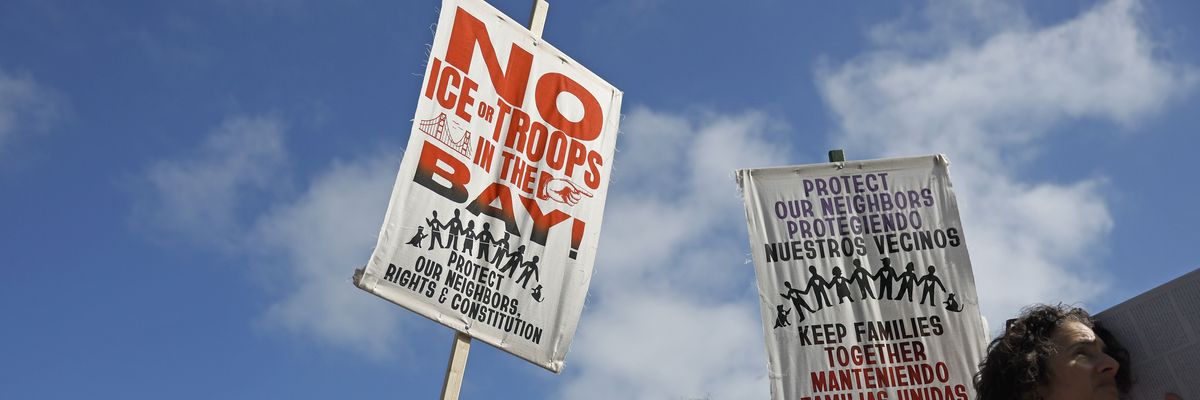
Protesters hold signs during an anti-ICE protest outside of San Francisco City Hall on October 23, 2025 in San Francisco, California. (Photo by Justin Sullivan/Getty Images)
“Maybe other cities should try to convince a wealthy tech CEO or two to keep the president from siccing his agents on them,” quipped one writer.
After threatening for days to deploy troops to San Francisco, President Donald Trump announced Thursday that he would pull back for the moment, apparently after some of his billionaire “friends” in the city called him and asked him not to.
“The Federal Government was preparing to ‘surge’ San Francisco, California, on Saturday,” Trump wrote on Truth Social. “But friends of mine who live in the area called last night to ask me not to go forward with the surge in that the Mayor, Daniel Lurie, was making substantial progress.”
Trump said he “spoke to Mayor Lurie last night and he asked, very nicely, that I give him a chance to see if he can turn it around. I told [Lurie], I think he is making a mistake, because we can do it much faster, and remove the criminals that the Law does not permit him to remove. I told him, ’It’s an easier process if we do it, faster, stronger, and safer but, let’s see how you do?‘”
In a separate post, Lurie affirmed that he had spoken with Trump. He said he told the president that “San Francisco is on the rise,” and that a military occupation would “hinder our recovery.”
Although Trump is walking back his troop threat, for now, US Customs and Border Protection agents still arrived in the Bay Area on Thursday as part of the Trump administration’s crackdown on immigrants.
The Associated Pressreported that “police used at least one flash-bang grenade to clear a handful of demonstrators from the entrance” of Coast Guard Island in Alameda, where the CBP agents will be based.
In addition to threatening San Francisco in recent days, Trump has sent National Guard troops to Los Angeles, California; Washington, DC; Portland, Oregon; and Chicago, Illinois—where a judge has halted the deployment.
Like virtually all of the cities where Trump has either surged or threatened to surge federalized troops, San Francisco has no crime wave to “turn around.” In fact, crime has been falling precipitously in the city. Homicides dropped by 35% during 2024 and hit a 60-year low this year, contradicting Trump’s assertions that the city is a “mess” and that people there lived in constant fear of being “mugged, murdered, robbed, raped, assaulted, or shot.”
Lurie said he agreed to help Trump go to war on this imaginary crime wave, and said he would welcome “would welcome continued partnerships with the FBI, DEA, ATF, and US attorney.”
Trump said he was persuaded to hold off on the surge of troops after he was called by two Silicon Valley billionaires, Marc Benioff and Jensen Huang, whom he called “great people.”
Benioff, the CEO of Salesforce, was a longtime Democrat who quickly morphed into an outspoken Trump supporter after his victory in 2024. He was also an initial champion of Trump’s proposal to send troops to San Francisco, but later backed off and even apologized after facing criticism from local officials and former political allies.
Huang, the CEO of the computer tech company Nvidia, meanwhile, cut an unprecedented deal with Trump in August that allowed the company to sell computer chips in China if it handed 15% of the revenue from those sales to the federal government, which was described as a “shakedown” by one financial columnist.
Trump said that these two and some unspecified “others” called him, “saying that the future of San Francisco is great” and that “they want to give [Lurie’s efforts] a ’shot.‘”
“Therefore,” Trump said, “we will not surge San Francisco on Saturday.”
Hafiz Rashid, a writer for the New Republic, quipped that “maybe other cities should try to convince a wealthy tech CEO or two to keep the president from siccing his agents on them.”
Orcas discuss how Trump was re-elected and him being an obviously insane, xenophobic Fascist.Donald Trump urges you to be a Climate Science denier like him. He says that he makes millions and millions for destroying the planet, Burn, Baby, Burn and Flood, Baby, Flood.Orcas discuss Donald Trump and the killer apes’ concept of democracy. Front Orca warns that Trump is crashing his country’s economy and that everything he does he does for the fantastically wealthy.
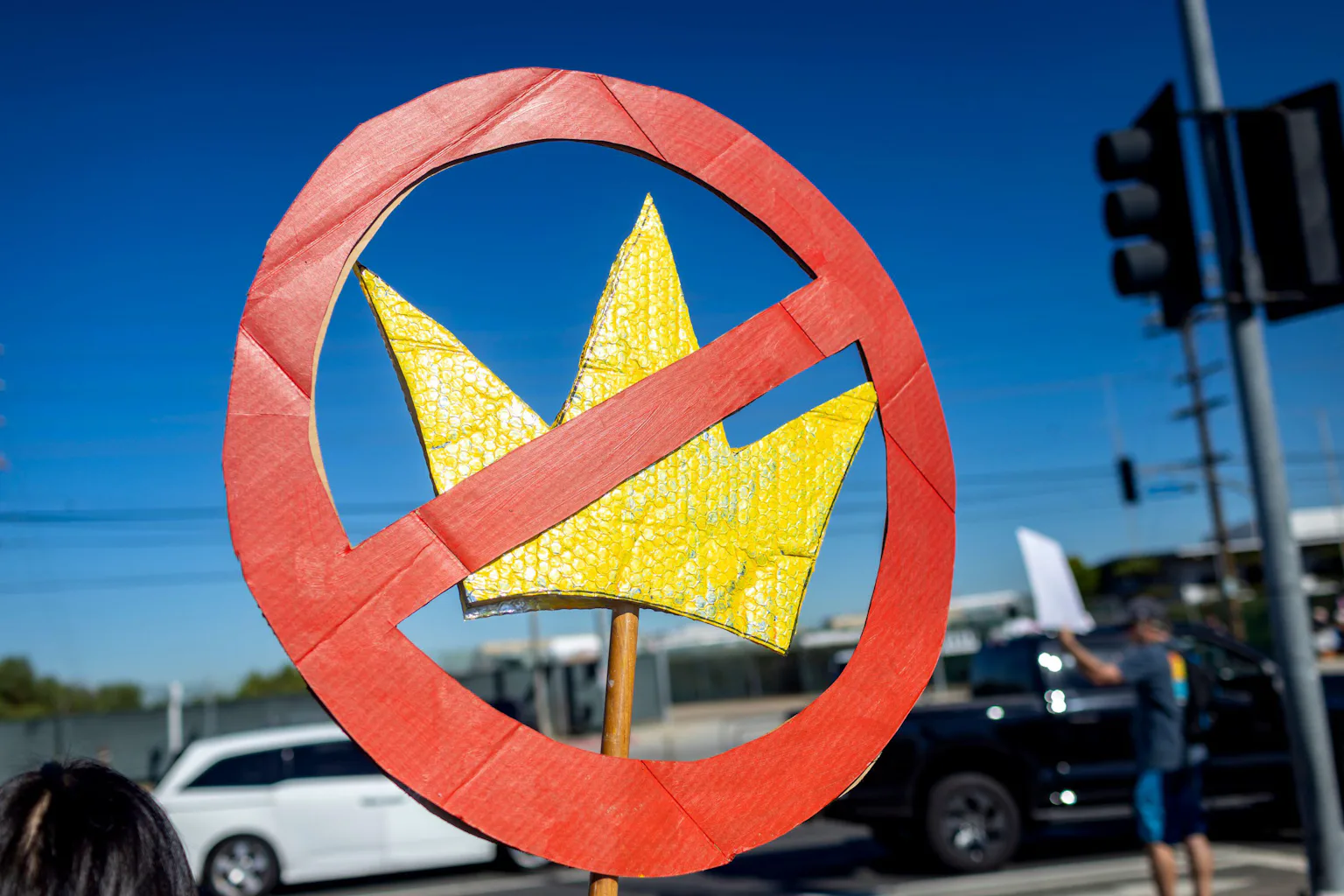
Every few decades, Americans rediscover that their republic was built on a rejection – the rejection of being ruled by a monarch. Now, in one of the largest protest movements in many years, the phrase “No kings” is everywhere: on placards, online memes, and in chants aimed at a president who seems to want to rule rather than serve.
Yet the words are hardly new. They are the first note in the American political scale, the country’s founding slogan before it even had a flag.
Long before it echoed through the colonies, the slogan “No king but Jesus” rang out in the English civil war, where it was used to declare that divine authority, not royal prerogative, should rule the conscience.
When it crossed the Atlantic, colonial Americans inherited a phrase, a stance and an image that could turn theology into politics and rebellion into virtue.
As Thomas Paine put it in his 1776 pamphlet, Common Sense: “Of more worth is one honest man than all the crowned ruffians that ever lived.” Republican speech was invented by rejecting monarchy.
When independence was achieved, America’s experiment rested on a paradox: it needed strong leadership but feared the aura of command. “No kings” was a self-diagnosis of a nervous republic. A way of keeping the charisma of a leader on a leash.
That allergy to grandeur shaped the early republic. In the 1790s when John Adams proposed that the president be addressed as “His Highness”, he was swiftly mocked as “His Rotundity”. The laughter mattered. It expressed the conviction that democracy could not survive reverence.
By the 1830s, this suspicion of pomp had become visual. Critics of the seventh president, Andrew Jackson, issued a famous broadside “King Andrew the First” showing him crowned and trampling the constitution. It wasn’t just partisan art – it was an act of democratic hygiene.
Abraham LIncoln depicted as a king in 1864. Lincoln Financial Foundation Collection
A generation later, Abraham Lincoln faced the same charge. During the American civil war, a notorious 1864 pamphlet Abraham Africanus I accused him of seeking to become a “hereditary ruler of the United States”. His sweeping wartime powers fed old fears that emergency rule would harden into monarchy.
Sometimes, the charge is justified. When Puck magazine in 1904 depicted Theodore Roosevelt crowning himself Louis XIV (or perhaps Napoleon), it captured the public’s mixture of thrill and alarm at his trust-busting, canal-building, imperial swagger. Citizens wanted vitality in office, but not vanity.
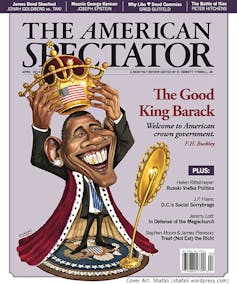
How the American Spectator depicted Barack Obama in 2014. American Spectator
Other times, the imagery seemed to speak more to American paternal longings. Take images of Dwight Eisenhower as “King Ike” in the 1950s, a genial ruler among smiling courtiers, soothing cold war nerves.
In our own century, the crown returns in sharper form. The American Spectator’s 2014 cover, “The Good King Barack” showed Obama beaming beneath a red velvet crown.
When Donald Trump triumphed in 2016, crown memes returned as America’s simplest moral shorthand for power that has gone too far.
It fell to his successor Joe Biden to officially declare, in response to the July 2024 Supreme Court ruling that Trump was not immune from prosecution: “This nation was founded on the principle that there are no kings in America.”
Why the crown keeps returning
The crown is both insult and safety valve at once. It’s an instantly legible piece of political folk art reminding citizens that authority is temporary, fallible and – like its wearer – mortal.
When protesters revive “No kings”, they aren’t just quoting the revolution. They’re translating an older language of civic republican virtue into an accent everyone can understand. No person above the law, no office above criticism, no citizen beneath respect.
The slogan reawakens the moral reflex that freedom depends on vigilance, and that dignity belongs to the governed as much as the governors.
And here’s the irony: both parties were founded on that same cry. Democrats and Republicans trace their roots to the anti-monarchical Democratic-Republicans of Thomas Jefferson and James Madison, who defined their movement against the spectre of kingly power. That party later fractured, giving rise to both modern traditions.
In that sense, “No kings” was the nation’s first party platform, the point of agreement from which every later disagreement grew.
Can it still work?
In today’s fractured America, “No kings” offers something rare: a language of protest that feels constitutional rather than ideological. It has the potential to speak to conservatives alarmed by executive overreach, to progressives wary of authoritarian drift, and to independents nostalgic for civic balance.
"CONGESTION PRICING IS DEAD. Manhattan, and all of New York, is SAVED. LONG LIVE THE KING!" –President Donald J. Trump pic.twitter.com/IMr4tq0sMB
That gives it unusual rhetorical strength. Unlike most modern slogans – “Drill baby, drill”, “Make America great again” (Maga), or “Defund the police” – it doesn’t divide, it recalls a principle. “No kings” reminds Americans that what unites them is the rejection of tyranny.
The phrase also appeals to exhaustion as much as outrage. After years of political spectacle, “No kings” gestures toward humility, order and self-restraint: the virtues both parties claim to miss.
The movement may go nowhere. But if this moment does turn out to be an inflection point, it is a fitting way to frame it.
To chant “No kings” now is not nostalgia but muscle memory. That is how a republic tests its pulse: by mocking grandeur, refusing awe and rediscovering equality in the act of saying no.
Orcas discuss how Trump was re-elected and him being an obviously insane, xenophobic Fascist.Donald Trump urges you to be a Climate Science denier like him. He says that he makes millions and millions for destroying the planet, Burn, Baby, Burn and Flood, Baby, Flood.Orcas discuss Donald Trump and the killer apes’ concept of democracy. Front Orca warns that Trump is crashing his country’s economy and that everything he does he does for the fantastically wealthy.