Despite Trump-Musk Feud, CO2 Milestone Is the ‘Important News of the Day’

Spread the love

Original article by Olivia Rosane republished from Common Dreams under Creative Commons (CC BY-NC-ND 3.0). 
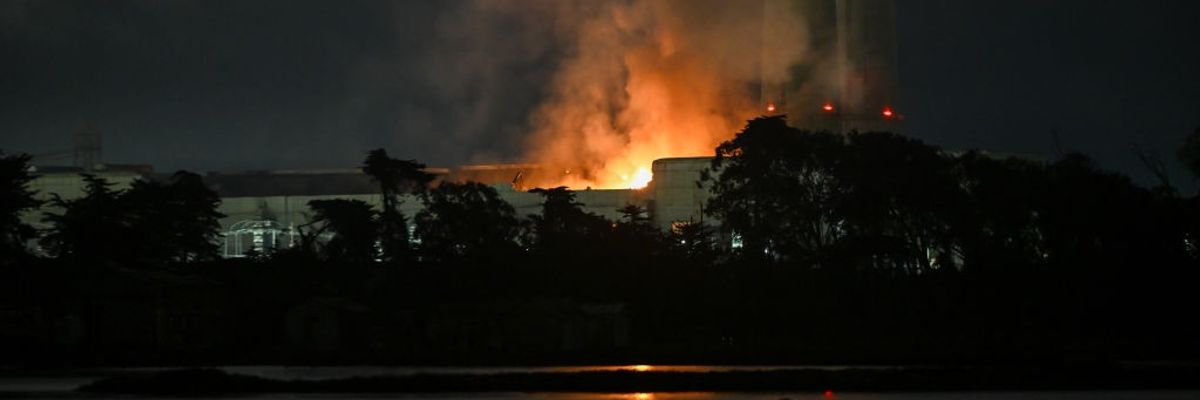
A view of flames and giant smoke is seen over the sky as a fire erupted at the natural gas Moss Landing Power Plant in Moss Landing of Monterey Bay, California, United States on January 17, 2025. (Photo: Tayfun Coskun/Anadolu via Getty Images)

Scientists said that atmospheric carbon dioxide concentrations peaked above 430 parts per million for the first time in perhaps 30 million years.

The concentration of carbon dioxide in the atmosphere peaked above 430 parts per million in 2025—the highest it has been in millions of years—according to data released by the National Oceanic and Atmospheric Administration and Scripps Institution of Oceanography at the University of California, San Diego on Thursday.

The news was overshadowed by the explosive feud between U.S. President Donald Trump and his erstwhile backer Elon Musk, but climate activist Bill McKibben argued that it was ultimately more consequential.

“In the long run, this is actually going to be the important news of the day—CO2 in the atmosphere passes another grim milestone,” McKibben wrote on social media.

In the long run, this is actually going to be the important news of the day–co2 in the atmosphere passes another grim milestone

Bill McKibben (@billmckibben.bsky.social) 2025-06-05T20:33:11.672Z

Carbon dioxide has been accumulating in the atmosphere due primarily to the human burning of fossil fuels, as well as by the clearing of forests and other natural carbon sinks. There, it acts as a greenhouse gas, trapping heat from the Earth, and is the primary gas responsible for the rise of global temperatures by approximately 1.1°C from the 1850 -1900 average. This warming has already had a host of dramatic impacts, from extreme weather events to sea-level rise to polar ice melt, and scientists warn these impacts will only accelerate under current energy policies, which put the world on track for around 3°C of warming by 2100.

The last time that atmospheric CO2 concentrations topped 430 ppm was most likely more than 30 million years ago, Ralph Keeling, who directs the Scripps CO2 Program, told NBC News.

“It’s changing so fast,” he said. “If humans had evolved in such a high-CO2 world, there would probably be places where we wouldn’t be living now. We probably could have adapted to such a world, but we built our society and a civilization around yesterday’s climate.”

“While largely symbolic, passing 430 ppm should be a wake-up call.”

Scripps and National Oceanic and Atmospheric Administration both measure carbon dioxide levels from NOAA’s Mauna Loa Observatory in Hawaii, where Charles Keeling began taking measurements in 1958. As CO2 levels rise over time, they also follow a seasonal cycle—peaking in May before falling in the Northern Hemisphere summer and rising again in the fall.

This May, Scripps Oceanography calculated an average of 430.2 ppm for 2025, which is 3.5 ppm over the average for May 2024. NOAA’s Global Monitoring Laboratory, meanwhile, calculated a monthly average of 430.5 ppm, a 3.6 ppm jump from the year before and the second-steepest yearly climb since 1958.

“Another year, another record,” Keeling said in a statement. “It’s sad.”

The news comes two months after Mauna Loa daily measurements surpassed 430 ppm for the first time in March, which Plymouth Marine Laboratory professor Helen Findlay called “extremely disappointing and worrying.”

“While largely symbolic, passing 430 ppm should be a wake-up call, especially given the accelerated response we are seeing of glaciers and ice sheets to current warming,” Dr. James Kirkham, chief scientist of the Ambition on Melting Ice coalition of governments, said at the time.

“This upward trajectory is a direct result of continued fossil fuel use, likely exacerbated by emissions from extreme wildfires last year, methane leaks from fossil fuel extraction and possibly greater permafrost emissions, alongside decreased ability of very warm oceans to absorb CO2,” Kirkham said.

The monthly record also comes a little more than a week after a United Nations report warned that there was a small chance global temperatures could surpass 2°C in at least 1 of the next 5 years, only a decade after world leaders pledged in the Paris agreement to keep global temperatures “well-below” that level.

“Carbon emissions are still rising, and the atmosphere is going to keep heating further until greenhouse gas concentrations stabilize,” Matt Kean, who chairs Australia’s Climate Change Authority, wrote in response to the Scripps and NOAA figures. “What sort of climate do we want to leave our children and those who come after them?”

Original article by Olivia Rosane republished from Common Dreams under Creative Commons (CC BY-NC-ND 3.0). 

Orcas discuss Donald Trump and the killer apes' concept of democracy. Front Orca warns that Trump is crashing his country's economy and that everything he does he does for the fantastically wealthy.
Orcas discuss Donald Trump and the killer apes’ concept of democracy. Front Orca warns that Trump is crashing his country’s economy and that everything he does he does for the fantastically wealthy.
Neo-Fascist Climate Science Denier Donald Trump says Burn, Baby, Burn.
Elon Musk urges you to be a Fascist like him, says that you can ignore facts and reality then.
Continue ReadingDespite Trump-Musk Feud, CO2 Milestone Is the ‘Important News of the Day’

GB News Owner Paul Marshall Calls for BBC’s Fact-Checking Service to be Shut Down

Spread the love

Original article by Adam Barnett and Joey Grostern republished from DeSmog.

The right-wing multi-millionaire, who also owns The Spectator, called for the public broadcaster to be part-privatised at a Pharos Foundation event.

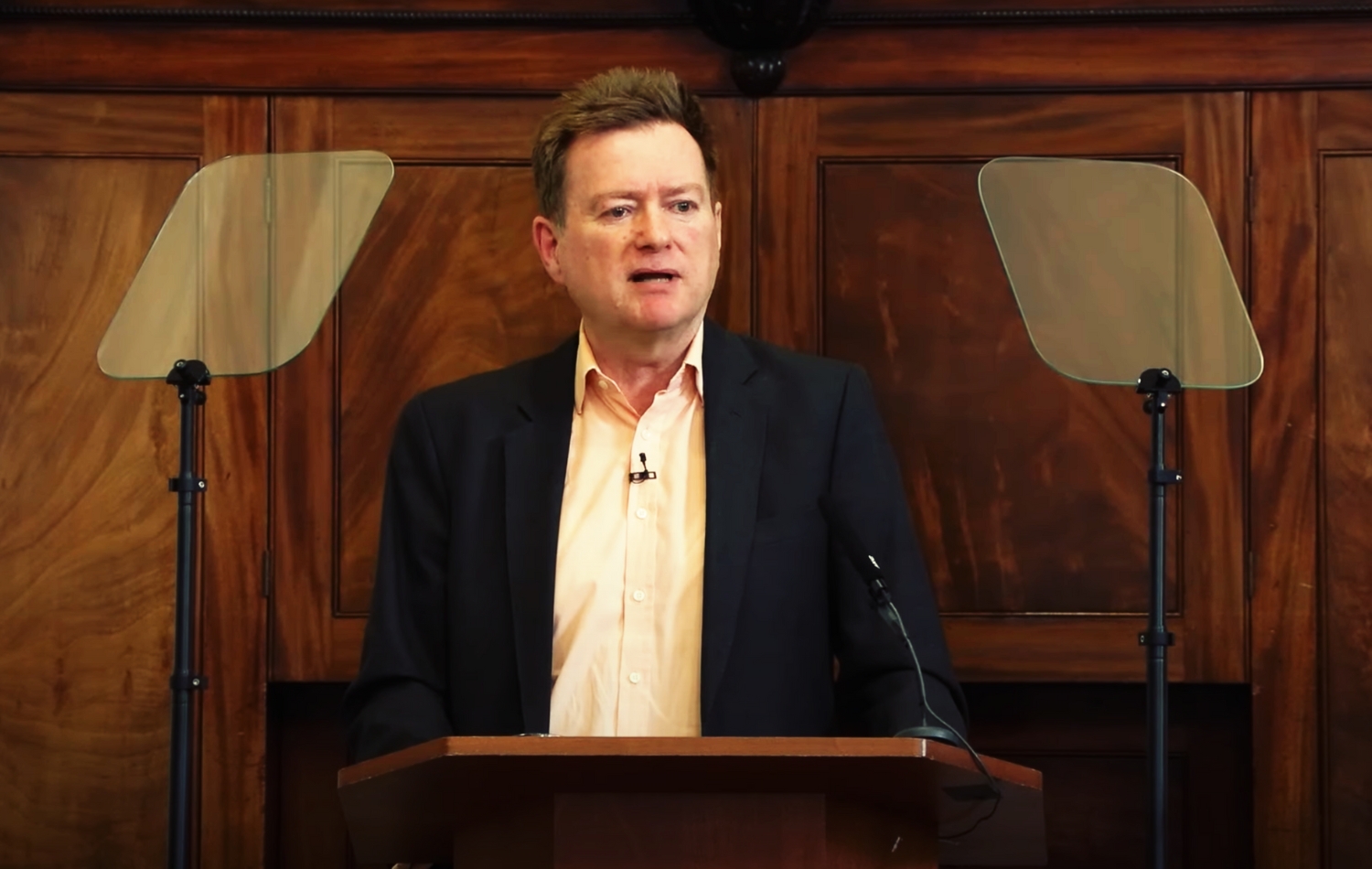
GB News co-owner Paul Marshall speaking at the Pharos Foundation on 20 May 2025. Credit: Pharos Foundation / YouTube

A hedge fund manager who owns three right-wing UK media outlets has called for the BBC to be “broken up” and its fact-checking service “shut down”.

Sir Paul Marshall – proprietor of GB News, The Spectator, and Unherd – was speaking last week (20 May) at the Pharos Foundation, an educational charity that received £350,000 from Marshall’s charity Sequoia Trust in 2023.

Pharos co-founder and director Neil Record, chair of Net Zero Watch, a climate science denial campaign group, is a significant backer of Conservative Party leader Kemi Badenoch.

In his speech, titled ‘Reflections of an Accidental Media Owner’, Marshall said: “the BBC squats like a giant toad in the middle of the UK media landscape”, calling it “a propaganda arm of the state, who [sic] are ultimately its paymasters.”

The multi-millionaire, who runs the hedge fund Marshall Wace, added that “the BBC should be broken up” to separate its “public service elements” like news and documentaries from “entertainment, drama, sport”, adding: “The latter should be privatised and allowed to complete to compete with other entertainment companies.”

Marshall also took aim at BBC Verify, the corporation’s fact-checking service founded in 2023 to cover and debunk online misinformation, calling for the service to be “shut down”.

Marshall accused progressive groups like Stop Funding Hate, HOPE not hate, and Led by Donkeys of acting like “school yard bullies” on social media.

“Unfortunately most of the disinformation agents who seek to track sites or individuals under the misinformation rubric have an explicit or near explicit left-wing agenda,” Marshall said. “This very much includes BBC Verify which is frankly an abuse of taxpayer money and should be shut down.”

GB News has accused of spreading misleading information – including conspiracy theories – since it launched in June 2021, and has been regularly probed by broadcast regulator Ofcom.

In February 2024, HOPE not hate revealed that Marshall had been liking and retweeting posts on X expressing a wide variety of anti-Muslim views, including a post that called for the “mass expulsions” of refugees. Responding to HOPE not hate, a representative for Marshall said: “He posts on a wide variety of subjects and those cited represent a small and unrepresentative sample of over 5,000 posts. This sample does not represent his views.”

As DeSmog has reported, GB News frequently platforms individuals who deny basic climate science, while its guests and presenters attacked climate action nearly 1,000 times in the immediate run-up and aftermath of the 2024 general election.

BBC Verify has debunked false claims about climate issues, including whether the UK is meeting its net zero targets, on the supposed need for new North Sea oil and gas extraction, and false claims about extreme weather events.

As DeSmog has revealed, Marshall’s hedge fund Marshall Wace had billions invested in fossil fuels as of June 2023. One of its major investors, the private equity giant KKR, which is tipped to buy Thames Water, is itself a significant fossil fuel investor.

Richard Wilson, founder of Stop Funding Hate, told DeSmog: “A fossil fuel magnate is pushing for the break-up of the BBC – and lobbying for its fact-checking service to be shut down – while bankrolling a TV channel that pumps out toxic misinformation on climate change.

“GB News has lost over £100 million as advertisers continue to steer clear. So it’s understandable that the channel’s owner would want to lash out at Stop Funding Hate supporters. But we’re happy to take these attacks as a badge of honour – and another sign that our campaigning is working.”

Marshalling the Right

Marshall is a major player in the transatlantic network of radical right-wing politics. He is a co-founder with Canadian activist Jordan Peterson of the Alliance for Responsible Citizenship (ARC), an anti-climate lobby group to which Marshall’s Sequoia Trust gave £1 million in 2023.

His attacks on the BBC echo those of Reform UK, whose leader Nigel Farage receives a six-figure salary to host his own show on GB News.

Reform’s manifesto for the 2024 election included a pledge to scrap the BBC licence fee, labelling the broadcaster “institutionally biased” and “wasteful”.

“Marshall and his professional disinfluencers know they’ve utterly lost the fight on facts, and instead of being correct, they’ve started attacking the fact checking referees at the BBC,” said Philip Newell, communications co-chair of the Climate Action Against Disinformation coalition.

“In a healthy democracy, unbiased news is a vital tool of holding the rich accountable – which is exactly why one part of the disinformation playbook is to attack fact checkers and media institutions that speak truth to power. That an oily hedge fund baron has attacked the BBC only further confirms its validity and value.”

More recently, Donald Trump’s administration in the U.S. cut government funding for public broadcasters NPR and PBS, accusing them of bias.

The Pharos Foundation, which offers “Marshall fellowships” in Sir Paul’s honour, is also politically connected.

Pharos director Neil Record donated £10,000 and the use of office space to Kemi Badenoch’s campaign for the Tory leadership last autumn. Badenoch stayed at Record’s Gloucestershire estate in February ahead of a flagship speech attacking net zero targets.

Record is chair of Net Zero Watch, the campaign arm of the Global Warming Policy Foundation (GWPF), which claims carbon dioxide emissions are “not pollution” and could be a “benefit” to the planet.

He is also a life vice president of the Institute of Economic Affairs (IEA), an anti-regulation think tank that has received funding from the oil giant BP.

Pharos was also co-founded by historian Nigel Biggar, who was nominated for a peerage by Badenoch in late 2024.

After purchasing The Spectator in September 2024 for £100 million, Marshall appointed former Conservative Party Cabinet minister Michael Gove as its editor.

Gove is the founder of think tank Policy Exchange, whose head of political economy James Vitali is a current Pharos research fellow. Marshall donated £890,000 to Policy Exchange between 2020 and 2023.

The chair of Pharos’ development committee, Sian Hansen, until recently worked as chief operating officer at CT Group, the lobbying firm that has represented the Prosperity Institute (formerly known as the Legatum Institute), whose funder the Legatum Group co-owns GB News with Paul Marshall.

CT Group has lobbied on behalf of oil and gas companies, and its clients have included the Australian Petroleum Production and Exploration Association and BHP, which has mining and oil assets.

Original article by Adam Barnett and Joey Grostern republished from DeSmog.

Orcas discuss Donald Trump and the killer apes' concept of democracy. Front Orca warns that Trump is crashing his country's economy and that everything he does he does for the fantastically wealthy.
Orcas discuss Donald Trump and the killer apes’ concept of democracy. Front Orca warns that Trump is crashing his country’s economy and that everything he does he does for the fantastically wealthy.

Continue ReadingGB News Owner Paul Marshall Calls for BBC’s Fact-Checking Service to be Shut Down

Swiss Glacier Collapse That Buried Village Likely a ‘Direct Result of Our Warming Climate’

Spread the love

Original article by Brett Wilkins republished from Common Dreams under Creative Commons (CC BY-NC-ND 3.0). 

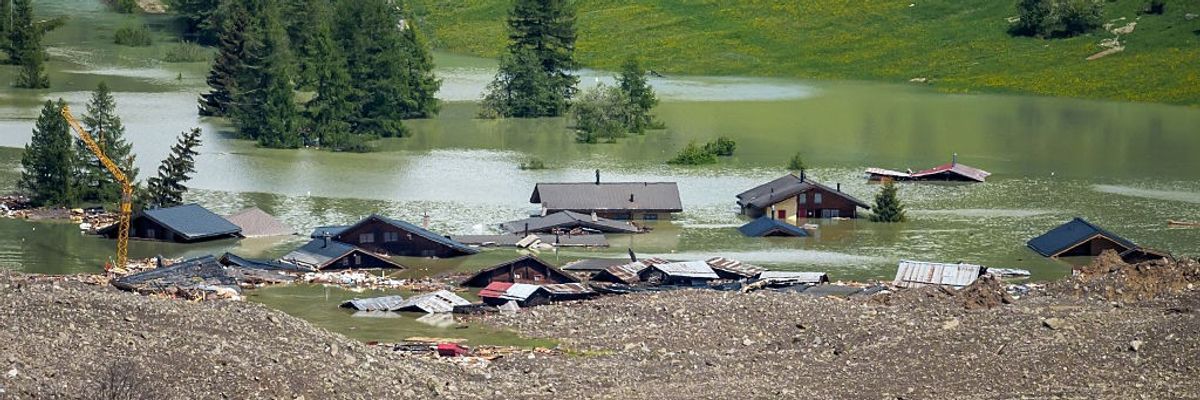
This May 29, 2025 aerial photograph shows the town of Blatten, in the Bietschhorn mountain of the Swiss Alps, destroyed by a landslide after part of the huge Birch Glacier collapsed and was swallowed up by the river Lonza the day before. (Photo: Fabrice Coffrini/AFP via Getty Images)

“What happened to Birch Glacier is what we would expect from rising temperatures in the Alps and elsewhere,” one scientist said.

Thawing permafrost exacerbated by human-caused global heating is the likely culprit behind a massive glacier collapse that buried nearly the entire Swiss town of Blatten, one scientist said Thursday while warning of the likelihood of similar disasters in the future.

The alpine hamlet of 300 inhabitants—who were evacuated earlier amid warning signs of disaster—was almost completely wiped out on Wednesday after the Birch Glacier, located in the Lötschental Valley in northern Switzerland, collapsed. The glacial avalanche, laden with boulders and other debris, cascaded down the mountainside and into the village, obliterating everything in its path. Local officials said around 90% of Blatten was buried.

“We’ve lost our village,” Blatten Mayor Matthias Bellwald told reporters. “The village is under rubble. We will rebuild.”

before and after today’s glacier collapse that buried 90% of blatten, switzerland

ian bremmer (@ianbremmer.com) 2025-05-28T22:01:19.155Z

While there are no verified casualties from the disaster, one 64-year-old man has been reported missing.

Mathieu Morlighem, a glaciologist at Dartmouth College in New Hampshire, told ABC News that permafrost thaw under and along the sidewalls surrounding the glacier likely caused the collapse.

“What happened to Birch Glacier is what we would expect from rising temperatures in the Alps and elsewhere,” he explained. “I think we can expect more events like this in the future.”

As ABC News reported:

Glaciers in Switzerland have lost almost 40% of their volume since 2000, and the loss is accelerating, according to the Swiss Federal Institute for Forest, Snow, and Landscape Research. Record-high summer temperatures in 2022 and 2023 caused a 10% glacial ice loss in the country.

Experts warn that Switzerland’s glaciers could disappear completely by 2100 due to the climate emergency.

As Common Dreams reported in March, the crisis is planetary and is predicted to adversely affect nearly 2 billion people who depend upon glaciers for agricultural irrigation and drinking water.

“Most of the world’s glaciers, including those in mountains, are melting at an accelerated rate worldwide,” a United Nations Educational, Scientific, and Cultural Organization report published earlier this year warned. “Combined with accelerating permafrost thaw, declining snow cover, and more erratic snowfall patterns… this will have significant and irreversible impacts on local, regional, and global hydrology, including water availability.”

The Swiss collapse happened a day before Thursday’s opening of the High-Level International Conference on Glaciers’ Preservation in Tajikistan, which aims to “highlight the vital role of glaciers in maintaining global ecological balance and addressing water-related challenges.”

Original article by Brett Wilkins republished from Common Dreams under Creative Commons (CC BY-NC-ND 3.0). 

Orcas comment on killer apes destroying the planet by continuing to burn fossil fuels.
Neo-Fascist Climate Science Denier Donald Trump says Burn, Baby, Burn.
Elon Musk urges you to be a Fascist like him, says that you can ignore facts and reality then.
Continue ReadingSwiss Glacier Collapse That Buried Village Likely a ‘Direct Result of Our Warming Climate’

Record January heat suggests La Niña may be losing its ability to keep global warming in check

Spread the love
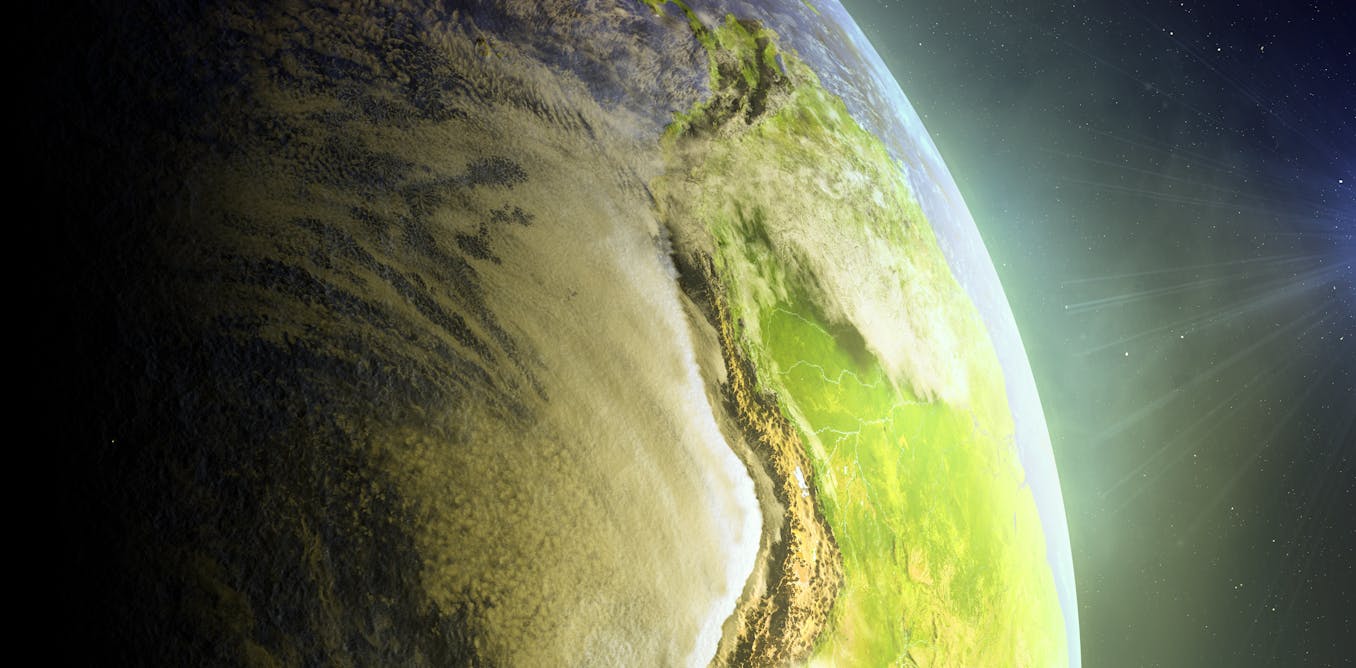
The eastern Pacific is cooling, but the world keeps warming. Harvepino / NASA / Shutterstock

Richard P. Allan, University of Reading

January 2025 was the hottest on record – a whole 1.7°C above pre-industrial levels. If many climate-watchers expected the world to cool slightly this year thanks to the natural “La Niña” phenomena, the climate itself didn’t seem to get the memo. In fact, January 2025’s record heat highlights how human-driven ocean warming is increasingly overwhelming these natural climate patterns.

La Niña is a part of the El Niño southern oscillation, a climate fluctuation that slowly sloshes vast bodies of water and heat between different ocean basins and disrupts weather patterns around the world. El Niño was first identified and christened by Peruvian fishermen who noticed a dismal drop in their catch of sardines that coincided with much warmer than usual coastal waters.

El Niño is now well known to be part of a grander climate reorganisation that also has a reverse cool phase, La Niña. As vast swathes of the eastern Pacific cool down during La Niña, this has knock on effects for atmospheric weather patterns, shifting the most vigorous storms from the central Pacific to the west and disrupting the prevailing winds across the globe.

This atmospheric reaction also helps to amplify the sea surface temperature changes. Typically, La Niña will lower the global temperature by a couple of tenths of a degree Celsius.

In 2024 the Pacific swung from moderate El Niño conditions to a weak La Niña. However, this time around, it’s apparently not enough to stop the world warming – even temporarily. So what’s different this time?

Each La Niña cycle is unique

Scientists aren’t entirely surprised. Each El Niño and La Niña cycle is unique. Following a surprisingly lengthy “triple dip” La Niña starting in 2020, the El Niño that developed in 2023 was also unusual, struggling to stand out against globally warm seas. The switch to a weak La Niña has only slightly cooled a narrow band along the equatorial Pacific, while surrounding waters have remained unusually hot.

Recent research shows human caused warming of the ocean is accelerating – so a year on year rise in temperature is itself getting bigger – and this is dominating to an ever greater extent over El Niño and other natural oscillations in the climate. This means that even during La Niña – when equatorial eastern Pacific waters are cooler than normal – the rest of the world’s oceans have remained remarkably warm.

More carbon, less reflection

There is also a sense of inevitability as greenhouse gas levels continue to grow, even despite the demise of El Niño. During El Niño years, the land tends to absorb less carbon from the atmosphere as large continental areas, such as parts of South America, temporarily dry out causing less plant growth and more carbon-emitting plant decay.

La Niña tends to have the opposite effect. In the strong La Niña of 2011, so much extra rain fell on the normally dry lands of Australia and parts of South America and southeast Asia that sea levels dropped as the land held on to this excess moisture borrowed temporarily from the ocean. This meant more carbon was taken from the atmosphere to feed extra plant growth. But despite the switch to La Niña, the rate of rise in atmospheric carbon in 2024 and January 2025 remains above the already high levels of previous years.

To this we can also add the diminishing effects of particle pollution from industry, big ships and other sources of “aerosols”, which in some regions had added a reflective haze in the atmosphere meaning the world absorbed less sunlight. Clean air policies introduced over time have made the world less smoggy, but they also seem to have caused clouds to reflect less sunlight back to space, adding to global heating.

As industrial activity continues to spew greenhouse gases into the air, while air cleansed of particle pollution causes more sunlight to reach the ground, this growing heating effect is beginning to drown out natural fluctuations, tipping the balance toward record warmth and worsening hot, dry and wet extremes.

The long-term trend is clear

But, just as one swallow doesn’t make a summer, a single month is not reflective of the overall trajectory of climate change. Changing weather patterns from week to week can rapidly shift temperatures especially over big landmasses, which warm up and cool down more quickly than the oceans (it takes a long time to boil up water for your vegetables but not long to super heat an empty pan).

Large areas of Europe, Canada and Siberia experienced much less cold weather than is normal for January (by up to about 7°C). Parts of South America, Africa, Australia and Antarctica also experienced above average temperatures. Along with the balmy oceans, this all contributed to an unexpectedly warm start to 2025.

While this particular warm January isn’t necessarily cause for immediate alarm, it suggests natural cooling phases may become less effective at temporarily offsetting the impact of rising greenhouse gas levels on global temperatures. And to limit the scale of the inevitable, ensuing climate change, there is a clear, urgent need to rapidly and massively cut greenhouse gas emissions and to properly account for the true cost of our lifestyles on societies and the ecosystems that underpin them.


Don’t have time to read about climate change as much as you’d like?
Get a weekly roundup in your inbox instead. Every Wednesday, The Conversation’s environment editor writes Imagine, a short email that goes a little deeper into just one climate issue. Join the 40,000+ readers who’ve subscribed so far.


Richard P. Allan, Professor of Climate Science, University of Reading

This article is republished from The Conversation under a Creative Commons license. Read the original article.

Orcas discuss Donald Trump and the killer apes' concept of democracy. Front Orca warns that Trump is crashing his country's economy and that everything he does he does for the fantastically wealthy.
Orcas discuss Donald Trump and the killer apes’ concept of democracy. Front Orca warns that Trump is crashing his country’s economy and that everything he does he does for the fantastically wealthy.
Neo-Fascist Climate Science Denier Donald Trump says Burn, Baby, Burn.
Elon Musk urges you to be a Fascist like him, says that you can ignore facts and reality then.
Continue ReadingRecord January heat suggests La Niña may be losing its ability to keep global warming in check