NHS news review

Spread the love

40 health care experts warn that the Destroy the NHS / Health and Social Care Bill will “[usher in] a significantly heightened degree of commercialisation and marketisation that will lead to the harmful fragmentation of patient care; aggravate risks to individual patient safety; erode medical ethics and trust within the healthcare system; widen health inequalities; waste much money on attempts to regulate and manage competition; and undermine the ability of the health system to respond effectively and efficiently to communicate disease outbreaks and other public health emergencies”.

David Cameron responds: “Of course there are doctors and others within the NHS that are wary about parts of our proposals, about greater choice for patients, about greater competition with the NHS.

“There have always been opponents to that, but the point of the exercise we held in the summer, when we paused and restarted the reforms, was to bring more of the health service on board, and many GPs, many doctors and many in the health service recognise that change is necessary if we are going to drive up standards in the health service, in which we invest and care about so much.”

He added: “I think the reforms are right, I think they will improve patient care. Above all, they will be good for patients. They are going to give you more power and control over the care you get, a greater choice too, which I think patients will welcome.”

It appears that there is a choice between 40 accomplished health professionals and a former Bullingdon Clubber with a track record of lying and broken promises to get elected.

Professor Norman Williams, head of the Royal College of Surgeons warns that rationing operations in the short term will cost more in the long term.

Andrew Lansley to address the NHS-destroying Conservative Party Conference today.
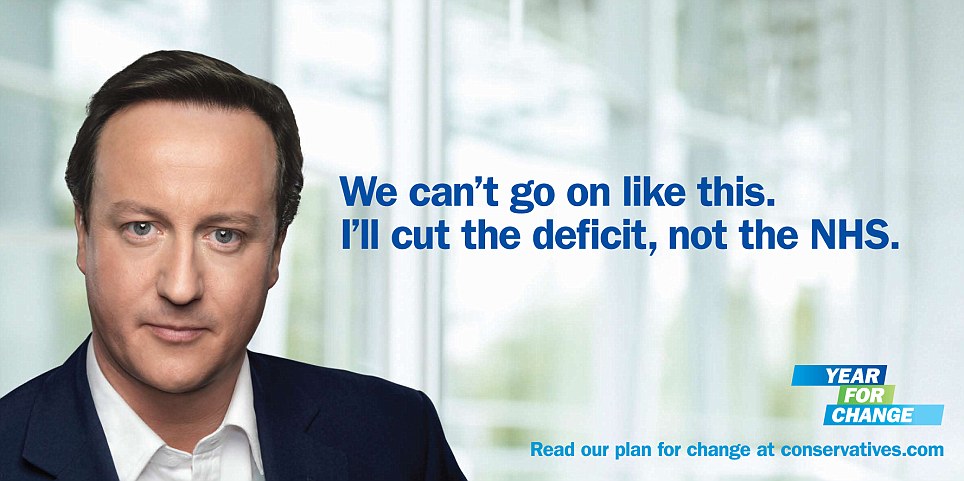
Conservative election poster 2010

A few recent news articles about the UK’s Conservative and Liberal-Democrat coalition government – the ConDem’s – brutal attack on the National Health Service.

Scrap NHS reforms, doctors tell Lords | Society | The Guardian

Experts including 40 directors of public health say government’s health and social care bill will cause ‘irreparable harm’

Sarah Boseley

More than 400 senior doctors and public health experts are calling on the House of Lords to throw out the government’s health and social care bill, saying it will do “irreparable harm to the NHS, to individual patients and to society as a whole”.

The signatories include Professor Sir Michael Marmot, the author of several reports on the links between wealth and health that suggest children born into poverty are penalised for life.

Marmot has until now not been openly critical of the coalition’s approach, and instead has offered encouragement for David Cameron and Andrew Lansley’s apparent enthusiasm for public health.

But Marmot and others in senior positions have now concluded the bill will damage all aspects of the health service.

“While we welcome the emphasis placed on establishing a closer working relationship between public health and local government, the proposed reforms as a whole will disrupt, fragment and weaken the country’s public health capabilities,” says the letter.

“The government claims that the reforms have the backing of the health professions. They do not. Neither do they have the general support of the public.”

The letter details the harms the experts believe the health reform bill will do.

“It ushers in a significantly heightened degree of commercialisation and marketisation that will lead to the harmful fragmentation of patient care; aggravate risks to individual patient safety; erode medical ethics and trust within the healthcare system; widen health inequalities; waste much money on attempts to regulate and manage competition; and undermine the ability of the health system to respond effectively and efficiently to communicate disease outbreaks and other public health emergencies,” the letter says.

In their judgment, the signatories say, the bill “will erode the NHS’s ethical and co-operative foundations” and “will not deliver efficiency, quality, fairness or choice”.

The signatories include around 40 directors of public health from around the country who have taken the difficult decision to go public with their concerns. There are also two senior members of the Faculty of Public Health, one of whom, Dr John Middleton, is a vice-president. Other well-known names include Professor John Ashton, director of public health in Cumbria, and Professor Michel Coleman from the London School of Hygiene and Tropical Medicine.

Dr David McCoy, consultant in public health medicine at the Inner North West London primary care trust, one of the organisers of the letter, said he was surprised at the number of people prepared to sign. “I think if we had continued to collect signatures, I’m quite sure we would have collected another 200 It is having a snowball effect,” he said. “I think the feeling is incredibly strong.”

There was a lot of debate about whether we should call for outright rejection or amendments, but there is a feeling the whole package of reforms is harmful and we need to express our position in the strongest terms. I think there was a feeling the forthcoming reading in the House of Lords is the last chance of minimising the harm and damage.”

The public health community has not spoken out in this way before. “I think there has been an attempt to work with the reforms and work behind the scenes to optimise the proposed reforms,” said Dr McCoy.

Dr Middleton said there was no great opposition to the planned move to place public health services such as smoking cessation within local authorities. “But the letter is a recognition from the public health community that the reforms proposed around the NHS are deeply damaging to the public health in themselves,” he said. There was concern that they would lead to inequalities in healthcare and less access for the poorest and most deprived to the services they need.

Cameron defends coalition NHS reforms – UK Politics, UK – The Independent


Mr Cameron told ITV1’s Daybreak: “Of course there are doctors and others within the NHS that are wary about parts of our proposals, about greater choice for patients, about greater competition with the NHS.

“There have always been opponents to that, but the point of the exercise we held in the summer, when we paused and restarted the reforms, was to bring more of the health service on board, and many GPs, many doctors and many in the health service recognise that change is necessary if we are going to drive up standards in the health service, in which we invest and care about so much.”

He added: “I think the reforms are right, I think they will improve patient care. Above all, they will be good for patients. They are going to give you more power and control over the care you get, a greater choice too, which I think patients will welcome.”

Commentary: these reforms will leave NHS a poorer service – Telegraph

* Dr David McCoy is a Consultant in Public Health Medicine in Inner North West London and Senior Clinical Research Fellow at the Centre for International Health and Development, University College London

[snipped a long but interesting section on the health service in Apartheid South Africa]

Now in the midst of the NHS’s transformation, I am struck by the contrasts to South Africa. Instead of strengthening the functional integrity of the health system, the reforms have created chaos and disorganisation.

Instead of protecting the public and patients from the corrosive effects of commercialisation, competition, private capital and the financial motive is being encouraged. And instead of directing more money towards benefiting patients, a rising proportion of expenditure will be siphoned out of the NHS as surplus value for private profit or on the infrastructure required to“manage competition”.

The NHS may remain publicly funded and mostly free at the point of service. But it will become a poorer service; and it will stop being a single, comprehensive and universal system for all. It will become a more fragmented and uneven collection of service points operating in parallel to systems of private insurance and with multiple tiers of care.

As for public health, when the reforms were first announced, many professionals saw the glint of a silver lining. The government was proposing to elevate the profile of public health by creating a dedicated public health agency and ringfencing public health budgets.

The proposal to move certain functions to local government was welcomed as a means of placing greater emphasis on ‘upstream’ determinants of health such as education, housing, diet, leisure and exercise. Even the ‘Big Society’ chimed with the evidence that social empowerment and solidarity underpin good health.

However, there are a many threats to public health. Organisational disruption has resulted in huge amounts of money, time and energy being diverted from real work, including the sustained development of shared knowledge, understanding and trust across the different elements of the health care system, local government and communities – vital for the building of participatory and integrated responses to rising unemployment, youth alienation, fuel poverty, social inequality and homelessness.

Public health will also be downsized and subjected to competition and commercialisation, including a ‘reductionism’ in which it will be broken up into discrete interventions, some of which will be commoditised and outsourced.

The direct involvement of businesses in the formulation of public health policy, contrary to professional advice and evidence,also signals a backward step in the urgent need to regulate the food, alcohol, sugar and tobacco industries.

The relationship between public health and clinical care may also become more distant. At the moment, local public health and clinical budgets are mostly held together within Primary Care Trusts.

But in the future, public health and clinical budgets will be spread across different organisations, potentially undermining the public health function of bridging clinical medicine with the social context and physical environment of families and patients. Cancer screening, immunisations and communicable disease control will become harder and more costly to deliver.

Critics of the reforms are frequently labelled as being ‘anti-privatisation’. But it is commercialisation, the intrinsic tendency for health care markets to fail and the damage that competition does to patient care, trust and ethical practice that lie at the heart of most objections.

Health is a lottery in out-of-control NHS, warns top surgeon – Health News, Health & Families – The Independent

A postcode lottery has returned to the NHS with “a vengeance”, the leader of Britain’s surgeons warned yesterday, as hospitals look to secretly cut costs without consulting doctors or patients.

Professor Norman Williams, the new head of the Royal College of Surgeons, said some hospitals were now rationing operations that would have otherwise saved the NHS money in the long term, because of a short-term desire to cut costs.

“We are back at the moment to a postcode lottery with a vengeance,” he told a fringe meeting at the Conservative party conference. “This is happening without any transparency of public debate and often without clinical involvement.”

Today Andrew Lansley, the Health Secretary, will address the conference and highlight some of the progress the NHS has made in investing in frontline services by taking away “bureaucracy” from the NHS. He will also announce new mandatory language checks for NHS doctors to ensure only those who can speak “a good level of English” are allowed to practise.

Highlighting some of the problems thrown up by the Government’s reorganisation of the NHS, Professor Williams said some health authorities were now unilaterally restricting operations which had significant clinical benefit.

Some were refusing to give gastric bands to morbidly obese patients while others who needed hip or hernia operations were also being denied them.


27/11/13 Having received a takedown notice from the Independent newspaper for a different posting, I have reviewed this article which links to an article at the Independent’s website in order to attempt to ensure conformance with copyright laws.

I consider this posting to comply with copyright laws since
a. Only a small portion of the original article has been quoted satisfying the fair use criteria, and / or
b. This posting satisfies the requirements of a derivative work.

Please be assured that this blog is a non-commercial blog (weblog) which does not feature advertising and has not ever produced any income.

dizzy

Continue ReadingNHS news review

NHS news review

Spread the love

An influential House of Lords committee [named?] is objecting to the wording of the Health and Social Care / Destroy the NHS Bill since it no longer requires the Health Secretary to provide a health service. The [which?] committee suggests retaining the wording of the previous health bill to ensure that this responsibilty continues. This is an issue that has been identified before e.g. by Colin Leys and 38degrees’ legal advice.

Nurses anticipate serious attacks on their numbers and conditions of work – fewer hours, downgrading, etc.

The privatisation / destruction / abolition of the NHS has started before the bill ends its parliamentary journey.

Conservative election poster 2010

A few recent news articles about the UK’s Conservative and Liberal-Democrat coalition government – the ConDem’s – brutal attack on the National Health Service.

NHS shakeup poses threat to political control, Lords committee claims | Society | The Guardian

Constitutional flaw spotted in Andrew Lansley’s bill as regulator issues warning to Manchester foundation trusts

Randeep Ramesh

The coalition’s reorganisation of the NHS risks diluting the government’s “constitutional responsibilities” to the health service, an influential Lords committee has warned.

The health secretary currently has to a legal duty provide key NHS services, such as hospital accommodation, ambulances, maternity and nursing. The NHS bill going through parliament envisages that the health secretary would only have to monitor their provision and intervene in the case of failure. The government would not be legally and constitutionally responsible.

The committee examining the constitutional implications of public bills, chaired by Lady Jay, suggests the House of Lords, which will debate the changes later this month, ought to “carefully to consider whether these changes pose an undue risk either that individual ministerial responsibility to parliament will be diluted or that legal accountability to the courts will be fragmented.”

Ministers have promised to amend the bill to ensure the secretary of state remains “responsible and accountable” for the NHS, but the report says “it may well be necessary to amend the bill in order to put this matter beyond legal doubt”.

The committee suggests retaining the “relevant wording contained” in the last Labour health bill to ensure full accountability. The peers argue the current bill only makes “a modest contribution towards accountability… the house [of Lords] will wish carefully to consider whether they are sufficient”.

The warning comes as peers are about to vote on the shakeup planned by the health secretary, Andrew Lansley, and as more evidence has emerged that patients are losing out in a cash-constrained, more market-responsive system.

Monitor, the NHS regulator, has announced that management in nine foundation trusts in Manchester could be removed for repeatedly failing to meet cancer targets if their performance did not improve.

Another 37 trusts have been warned for failing to ensure that patients are protected “from risk of harm” and failing to provide “treatment and support that meets their needs”.

NHS nurses in England ‘fear job losses or downgrades as cuts bite’, poll finds | Society | The Guardian

One in twenty nurses expect to lose their post in next year while similar proportions expect fewer hours or responsibilities

Denis Campbell

Almost 75,000 nurses expect to lose their jobs, have their hours cut or see their roles downgraded in the next year, according to a survey that highlights the growing impact of the NHS’s financial squeeze.

Five per cent of the NHS in England’s 410,000 nurses – some 20,500 in all – believe their posts will disappear in the next 12 months. Another 24,600 anticipate a cut in hours, while another 28,700 expect to have their jobs reassessed as involving fewer responsibilities.

The findings, extrapolated from a Royal College of Nursing (RCN) poll of 8,000 of its members, have prompted renewed claims that the coalition is not honouring repeated promises to protect the NHS frontline from cuts.

The nurses’ fears come as more acute and mental health trusts across England decide to reduce their nursing workforce as part of efforts to help in the NHS’s £20bn cost-saving drive.

For example, Plymouth hospitals NHS trust plans to cut 281 posts, including 145 nursing jobs, to save £31m this year. The RCN is concerned that 130 existing nursing vacancies at the trust have led to staff shortages in some areas of medical care, and that patient safety could be at risk.

As part of plans to restructure community services in London, Camden and Islington NHS foundation trust, which deals with mental health services, will lose 69 posts, including those of nurses, psychologists and social workers.

Portsmouth hospitals NHS trust aims to shed 99 posts by next April, including at least six nurses, three of which are specialist nursing posts, giving care to people with long-term medical conditions.

In the RCN’s biannual employment survey:

• 54% of respondents reported that staffing levels of nurses had decreased in their workplace in the past year.

• 57% said they worked over and above their contracted hours either every shift or several times a week, with 16% saying that they did so every shift. Forty per cent said their employer had initiated a recruitment freeze.

• 19% had seen posts disappear in the past year.

• 13% had seen beds or wards closed.

Doctors to take over health spending – Main Section – Yorkshire Post

FAMILY doctors in Calderdale, Kirklees, Wakefield, Hull, the East Riding and northern Lincolnshire today take over the spending of hundreds of millions pounds in NHS resources in landmark reforms.

GPs in Leeds, Bradford and Craven and most of South Yorkshire are likely to do so in coming weeks, while those in Barnsley and North Yorkshire will take on budgets probably from April.

They are being handed devolved responsibility for spending from NHS managers running primary care trusts (PCTs) although officials will retain ultimate legal authority for business carried out until they hand decision-making for the bulk of NHS expenditure to GPs from April 2013.

In Hull, the East Riding and northern Lincolnshire, four new clinical commissioning group committees led by GPs are taking the lead in planning and delivering £1.1bn in health services.

GP Gina Palumbo, who will head the East Riding group, said its vision was to deliver better care, more locally and within budget through transforming services.

“It’s about doing things differently. As with all public services we have a financial challenge and that’s all the more reason for us to be creative, innovative and work in more efficient ways,” she said.

GP Peter Melton, shadow accountable officer at North East Lincolnshire Care Trust Plus, said: “The NHS reforms are confusing and can be unsettling for all of us.

Continue ReadingNHS news review

NHS news review

Spread the love

There are two main news stories concerning the NHS in the past few days: Opposition to privatisation of the NHS at the Labour Party Conference and campaigners succeeding in – at least temporarily – preventing NHS Gloucestershire from transferring NHS staff and facilities to a private ‘Community Interest Company’.

A report by the Royal College of Surgeons identifies poor and inconsistent levels of critical care contributing to deaths.

NHS Direct to close three call centres.

Cherry Blair intends to profit from NHS privatisation.

Conservative election poster 2010

A few recent news articles about the UK’s Conservative and Liberal-Democrat coalition government – the ConDem’s – brutal attack on the National Health Service.

Tories not to be trusted with the NHS, Miliband warns | GPonline.com

Labour leader Ed Miliband has hit out at the government’s plans for NHS reform, warning that the changes will ‘betray the values of the NHS’.

Speaking at the Labour party annual conference in Liverpool on Tuesday, Mr Miliband received a standing ovation and the largest applause during his speech when he warned ‘you can’t trust the Tories with the NHS’.

He said the government’s reform plans will undermine the values of the NHS as the reorganisation will create a ‘free-market healthcare system’.

The Labour leader also criticised prime minister David Cameron, outlining that he ‘betrayed voters’ trust’ by U-turning on his election promise to end top-down reorganisations in the NHS.

Mr Miliband said: ‘When I look at everything this Tory government is doing, frankly it is the NHS that shocks me most. Why? Because David Cameron told us he was different. You remember. The posters. The soundbites.

‘David Cameron knew the British people did not trust the Tories with the NHS. So he told us he wasn’t the usual type of Tory. And he asked for your trust. And then he got into Downing Street. And within a year he’d gone back on every word he said.’

NHS hospitals will not be privatised under Labour, Healey says | Society | The Guardian

John Healey, the shadow health secretary, has pledged that a Labour government would ensure NHS hospitals remain in public sector hands as he rounded on government plans to open up all parts of the NHS to private companies.

Healey also seized on the crisis witnessed at Southern Cross care homes earlier this year to admit that Labour “did not act before” against predatory fund managers who saw “elderly people as commodities”.

But he promised that a future Labour government would do so by regulating the care home sector not just on the basis of best care standards but also on “best business practices”.

Healey delivered a combative speech to the Labour party conference in Liverpool after delegates debated a motion condemning the government’s controversial health and social care bill as unnecessary and representing “the biggest top-down reorganisation in the history of the NHS at a time when finances are squeezed”.

Despite changes to the bill, the motion stated that health professionals are still opposed to it “because the essential elements … remain in place, which will fragment the NHS through exposing the NHS to the full force of EU and UK competition law with a commercial regulated market designed to give the impression of patent choice”. The new NHS commissioning board will be “the largest quango the world has ever seen”, it said.

Healey warned that the battle was “not over” against the legislative plans in the health and social care bill, which would break up the national service and set it up as a “full scale market, ruled for the first time by the full of competition law”.

Accusing David Cameron of betrayal, he said. “No one wants this. No one voted for this.”

He said the proposals threatened to destroy Labour’s “golden legacy” to NHS patients, as he hailed the founding of the NHS under a post-war Labour government, and the great improvements he said patients saw under the party’s 13 years in power through investment and reform.

Referring to reports that ministers were privately eyeing up the “huge opportunities for the private sector”, Healey said any move to privatise NHS hospitals would drive a wedge between hospitals and the wider health service as private companies driven by the bottom line to make profits would refuse to collaborate with others. But he ruled out barring private sector involvement in any shape in the NHS.

Healey, whose predecessors introduced independent treatment centres, said Labour believed there would always be an important contribution for non-NHS providers, “including private providers” in the NHS, but as supplements to, not substitutes for, the NHS.

But loud applause followed when he drew a line on private companies moving in to run NHS hospitals.

“Hospitals are at the heart of our NHS. They should be in public not private hands, dedicated totally to patients, not profits. So we will oppose any move to privatise NHS hospitals. We will guarantee under Labour that the NHS hospitals remain in the NHS.”

Campaigners halt NHS service transfer to social enterprise – Civil Society – Finance – News – providing news and in-depth coverage of charities, voluntary organisations and not-for-profits

Gloucestershire NHS has reportedly agreed to delay the proposed transfer of primary health services and 3,000 staff to a community interest company after local campaigners threatened legal action.

In an eleventh-hour legal challenge, the campaign group Stroud Against Cuts has issued a ‘letter before claim’ to the NHS management warning that it plans to seek a judicial review of the decision to farm out local Primary Care Trust services.

NHS Gloucestershire had awarded a contract to deliver primary and community care services, including nine hospitals, to Gloucestershire Care Services, creating the largest Community Interest Company in the UK. No competitive tendering process took place.

The contract, reportedly worth around £100m a year for three years, was due to start on 1 October but according to the campaigners, the NHS has now agreed to delay it while it takes legal advice on its position.
First example

Campaign co-ordinator James Beecham told civilsociety.co.uk: “We believe this is the first example where a social enterprise has got this far and been halted by a legal challenge.

“The current state of play is that the transfer is off while NHS Gloucestershire management assess their legal position.

“In the meantime they have given us an absolute guarantee that they won’t transfer anyone or anything out of the NHS without giving us three days clear notice.”
NHS would not confirm delay

However, NHS Gloucestershire refused to confirm or deny this was true, only saying that it was still assessing the legal situation. In a statement, its chief executive Jan Stubbings said: “We are responding to the correspondence received.

“In deciding on the future management of our community services to meet local needs and circumstances, we have followed all applicable policy and guidance.

“Through this process, we believe we have identified the most appropriate solution for the future. We now have a clear direction with the majority of our community health services becoming part of a social enterprise – working in the community interest and for the social good.

“With a membership model, the new organisation will give staff and service users a stronger voice on how services are run for the benefit of local communities.”
Lawsuit on behalf of service-user

The action is being brought by local resident Michael Lloyd, a user of the PCT’s services, with backing from Stroud Against Cuts. Lloyd’s costs are covered by legal aid but the campaign group is fundraising to cover the community element of the lawsuit.

The campaigners want the services to remain in public hands, fearing that contracting them out is the first step to NHS privatisation.
Contract ‘unlawful’

Caroline Molloy of Stroud Against Cuts said: “We have been advised that NHS Gloucestershire is acting unlawfully. It cannot just hand over all its NHS Primary Care Trust services to an unaccountable social enterprise or community interest company.

“It must either keep the NHS services itself, or have a proper process that would allow services to be provided by another NHS body. Both these options would keep our health services in the NHS, and accountable to the public.”

Lloyd’s solicitor, Rosa Curling of Leigh Day & Co, added: “If the PCT intends to enter into arrangements with a community interest company, it is first required in law to go through a process which allows other economic operators the opportunity of being awarded those contracts.

“No such opportunity has been given and the attempt by the PCT to enter into a contract with a company outside the NHS, in such circumstances, constitutes an unlawful procurement process.”

The campaign brought hundreds of people out onto the streets of Stroud last weekend in protest at the plans (pictured).

Yesterday Stroud District Council hosted a heated ‘extraordinary meeting’ on the issue and passed a motion calling on the local Health Community and Care Scrutiny Committee to examine the proposed move.

Poor critical care ‘risking lives’ – Health News, Health & Families – The Independent

Thousands of patients needing emergency surgery are having their lives put at risk by poor NHS care and delays in accessing treatment, according to a damning report.

The Royal College of Surgeons study found that only a minority of patients who need critical care following surgery receive it, while some die or suffer major complications because of delays in finding space in operating theatres.

Junior staff are often left in charge of dealing with post-surgical complications, which can rapidly lead to death if not treated promptly, the report went on.

A patient’s chance of survival also varies widely between NHS hospitals, and even within the same hospital depending on the day of the week.

NHS Direct to close three call centres | Healthcare Network | Guardian Professional

NHS Direct is to close three of its call centres next year, following landlord East of England ambulance service trust, giving it notice to quit two of the sites in Chelmsford and Norwich. A third site in Ipswich will close because it is supported by the other two.

A spokeswoman for the digital and telephone advice service said the closures were regrettable, but NHS Direct had no choice. A total of 120 staff will be affected, the majority of whom are nurses, although the organisation is hoping to redeploy where possible.

Nick Chapman, the chief executive of NHS Direct trust, said: “There is much work we need to do to understand the full implications of these closures, before a final plan can be agreed by the trust board.”

“Every option will be explored to redeploy those staff affected. We already have over 100 members of our nursing staff currently working from home permanently and there are sites in surrounding areas. No decision has been made to make staff redundant at this time.”

Related: UNISON Press | Press Releases Front Page

Cherie Blair “stands to gain from NHS privatisation” – Telegraph

Cherie Blair is a director of a company which is preparing to profit from the growing privatisation of the health service, it can be disclosed.

The wife of the former Labour prime minister is one of the founders of a business planning to open private clinics in supermarkets.

Her choice of venture is likely to prove controversial among Labour supporters, who will today set out their opposition to greater private involvement in the health system.

Party members jeered at a mention of Tony Blair’s name earlier this week during Ed Miliband’s conference speech.

The company is thought to represent Mrs Blair’s first foray into commerce. It is approaching City financiers just as her husband’s business interests have come under renewed scrutiny.

Mrs Blair was thought to have concentrated on her legal career since he stood down as prime minister in 2007 but she now appears to be seeking to capitalise on Coalition plans to open parts of the NHS to more private sector involvement.

Mee, the company she is involved in, claims that it will provide a “revolutionary new way of delivering health care”.

A prospectus adds that there is “potential to grow into other primary health areas in line with the new proposals for the health services”.

27/11/13 Having received a takedown notice from the Independent newspaper for a different posting, I have reviewed this article which links to an article at the Independent’s website in order to attempt to ensure conformance with copyright laws.

I consider this posting to comply with copyright laws since
a. Only a small portion of the original article has been quoted satisfying the fair use criteria, and / or
b. This posting satisfies the requirements of a derivative work.

Please be assured that this blog is a non-commercial blog (weblog) which does not feature advertising and has not ever produced any income.

dizzy

Continue ReadingNHS news review

NHS news review

Spread the love

Conservative election poster 2010

A few recent news articles about the UK’s Conservative and Liberal-Democrat coalition government – the ConDem’s – brutal attack on the National Health Service.

Tories not to be trusted with the NHS, Miliband warns | GPonline.com

Labour leader Ed Miliband has hit out at the government’s plans for NHS reform, warning that the changes will ‘betray the values of the NHS’.

Speaking at the Labour party annual conference in Liverpool on Tuesday, Mr Miliband received a standing ovation and the largest applause during his speech when he warned ‘you can’t trust the Tories with the NHS’.

He said the government’s reform plans will undermine the values of the NHS as the reorganisation will create a ‘free-market healthcare system’.

The Labour leader also criticised prime minister David Cameron, outlining that he ‘betrayed voters’ trust’ by U-turning on his election promise to end top-down reorganisations in the NHS.

Mr Miliband said: ‘When I look at everything this Tory government is doing, frankly it is the NHS that shocks me most. Why? Because David Cameron told us he was different. You remember. The posters. The soundbites.

‘David Cameron knew the British people did not trust the Tories with the NHS. So he told us he wasn’t the usual type of Tory. And he asked for your trust. And then he got into Downing Street. And within a year he’d gone back on every word he said.’

Unions call for civil disobedience – Channel 4 News

Channel 4 News learns union bosses are calling for a campaign of civil disobedience and sit-ins as well as strikes over the spending cuts, with one leader saying he is “prepared to go to jail”.

Len McCluskey, the general secretary of Unite, said activists should “rule nothing out” as they prepare to fight the coalition’s austerity measures with increasing militancy.

He blamed this summer’s riots on the cuts and predicted worse violence next year as the effects of spending cuts take effect. Addressing a fringe event at the Labour Party conference in Liverpool, Unison General Secretary Dave Prentis called the Conservatives and Liberal Democrats “b******ds and ended his speech to union members by declaring that a revolution “starts here”.

GMB General Secretary Paul Kenny said he was prepared to go to jail as part of a wave of non-violent protests and occupations.

Mr Kenny said: “I want direct action – I’m not talking about violent direct action. If that means I go to jail then I’m prepared to go to jail. I’m not prepared to be a martyr. But when I look at my kids and grandchildren I want to be able to say I did everything I did to protect them and their inheritance.”

Mr McCluskey accused the coalition of “peddling fear” before predicting that government measures would lead to a repeat of the riots seen across England earlier this year.

He said: “You’ve only got to look around as these attacks start to take place and social cohesion breaks down. We have one million young people out of a job and without hope, and people wonder why in our inner cities they get drawn into gang culture. There’s nowhere else to go. There’s nowhere else to belong.”

He went on: “I don’t take any pleasure in what we’ve seen in our inner cities”, but added that as the cuts continue to bite, “next summer we could find ourselves with even worse riots on our streets”.

The Unite boss urged the coalition to consider alternatives to cutting public services, saying: “Find the money. We’ve found the money for illegal wars. We found the money to bail out the banks. By the billion, we’ve found the money when it suits them.”

NHS chief challenges Andrew Lansley’s foundation hospitals plan | Politics | The Guardian

Sir David Nicholson says health minister is wrong to block failing foundation hospitals from returning to direct NHS control

The government’s health reforms ran into further trouble on Tuesday when the chief executive of the NHS publicly challenged a key proposal.

As peers prepare to table a series of amendments to the health and social care bill, Sir David Nicholson said the government was wrong to block failing foundation hospitals from returning to direct NHS control.

Andrew Lansley, the health secretary, wants to repeal a provision in the 2006 National Health Service Act which allows for the “de-authorisation” of failing foundation trusts, triggering their return to NHS control. The change is designed to strengthen foundation trusts – a central element of the government’s plans to decentralise power in the NHS – which will eventually take over the running of all hospitals in England.

In evidence to the public inquiry into failings at the Mid-Staffordshire NHS Trust, Nicholson called on the government to retain the renationalisation of a failing trust in its “armoury”. Nicholson is understood to have voiced, in private, reservations about the Lansley plan, which was introduced as an amendments to the bill after the government’s “listening exercise” on the NHS reforms.

Nicholson told the inquiry: “I do think that the opportunity in a sense to renationalise a foundation trust should be part of the armoury of any government in these circumstances. It’s not one shared, I have to say, by the government. But it’s something that I believe to be the case.”

Asked by Tom Kark QC, counsel to the inquiry, whether his proposal went against the government’s central policy, Nicholson hesitated, then said: “They want all organisations to be foundation trusts, but I believe that from time to time it may be necessary for the state to take the direct management of an organisation.” Labour will lambast the health reforms at the party’s conference in Liverpool on Wednesday.

Continue ReadingNHS news review

NHS news review

Spread the love

Conservative election poster 2010

A few recent news articles about the UK’s Conservative and Liberal-Democrat coalition government – the ConDem’s – brutal attack on the National Health Service.

The Press Association: ‘Unprecedented’ cuts threat to NHS

The NHS is facing an “unprecedented financial challenge” that may force cuts to services and numbers of hospital beds, the head of an organisation representing health service organisations has said.

Mike Farrar, the chief executive of the NHS Confederation said the need to make £20 billion of financial savings by 2015 “means our finances are under more strain than ever”.

And he warned that few users of the NHS were prepared for the scale of the changes likely to be forced upon the service by financial pressures.

Mr Farrar told The Guardian: “I am deeply concerned that the gravity of this problem for the NHS is not widely understood by patients and the public.

“There is a real risk we will sleepwalk into a financial crisis that patients will feel the full force of.

“This could see the NHS forced to salami-slice its way out of financial trouble, cutting services and use of less effective treatments.”

Mr Farrar, whose organisation represents most NHS hospitals, primary care trusts, ambulance services and mental health trusts in England, said the health service faced an uncertain future.

“There are three scenarios,” he said. “The NHS maintains service standards but goes bust while doing so; it sees standards slip but maintains financial balance; or it keeps improving and stays in the black. Clearly, we all want the third option.”

NHS reforms pose ‘lethal’ threat to David Cameron, Labour claims | Politics | The Guardian

Shadow health secretary John Healey warns of voter backlash against ‘broken promises’ on protecting health service

David Cameron faces a “lethal” threat as a growing number of voters decide that the government’s health reforms have raised serious questions about the future of the NHS, Labour will claim this week.

As peers prepare to table amendments to the health and social care bill, the shadow health secretary, John Healey, will tell the Labour conference that the first signs of danger for the prime minister could come as early as this winter.

In an interview with the Guardian, before his speech to the Labour conference on Wednesday, Healey said: “Cameron made promises on the NHS he is now breaking. The NHS is being cut, services are being cut … When you combine that with how important the NHS is as a security for us and our families, if people start to feel there are question marks over that – in the long run that is likely to be lethal for Cameron and the Tories. We have been preparing the ground on the NHS for next year, the year after, [and] for a winter of possible pressure on hospitals and a winter where it may be the service pressures and the financial pressures which really start to tell.”

Healey, who is joining forces with Liberal Democrat, Tory and crossbench peers to try to amend the health and social care bill in the Lords next month, will identify a series of problems with the NHS:

• More than 400,000 people have suffered longer waits for diagnosis and treatment since Cameron became prime minister compared with the same period under Labour. This represents a 50% leap in the number of patients who have waited longer than the target times.

• A looming financial crisis in the NHS is a “consequence of the legislation and the requirement by the [new economic regulator] Monitor for efficiency cuts.Not just 4% but 6% or 7% savings every year. Now, they may be able to cover this year but not the year after or the year after that.”.

• Hospitals would not be able to protect frontline services – a government pledge backed by keeping budgets stable. “You cannot make these level of cuts by salami slicing. You do that by fundamentally changing the way you provide services.”

Leader of Green Party speaks out about planned changes to NHS in Gloucestershire | This is Gloucestershire

The Leader of the Green Party has spoken out in support of people campaigning about plans to transfer the running of community health services in Gloucestershire to a social enterprise.

Campaigners argue the move to transfer county hospitals and various health services to a social enterprise company, as early as October 1, is a step towards privatisation. It comes as legal action is expected to be taken against NHS Gloucestershire over its decision.

A legal case has been launched by Stroud resident Michael Lloyd, to stop the transfer of more than 3,000 NHS health staff out of the NHS to the social enterprise company.

An interim injunction will also be sought to stop the proposed transfer of services taking place on October 1.

Leader of the Green Party Caroline Lucas has offered her support to those opposing the plans.

She said: “The attempts by health commissioners in Gloucestershire to transfer staff and health services out of the NHS and into the hands of a ‘social enterprise’ company are causing real anxiety for local people, who do not feel that they have been properly consulted – and are concerned about the impact on the quality and availability of key services.

“By drafting in private companies to deliver essential healthcare, the county risks dangerously undermining the very principles on which the NHS is built.”

Continue ReadingNHS news review