A UK climate security report backed by the intelligence services was quietly buried – a pattern we’ve seen many times before
Spread the love
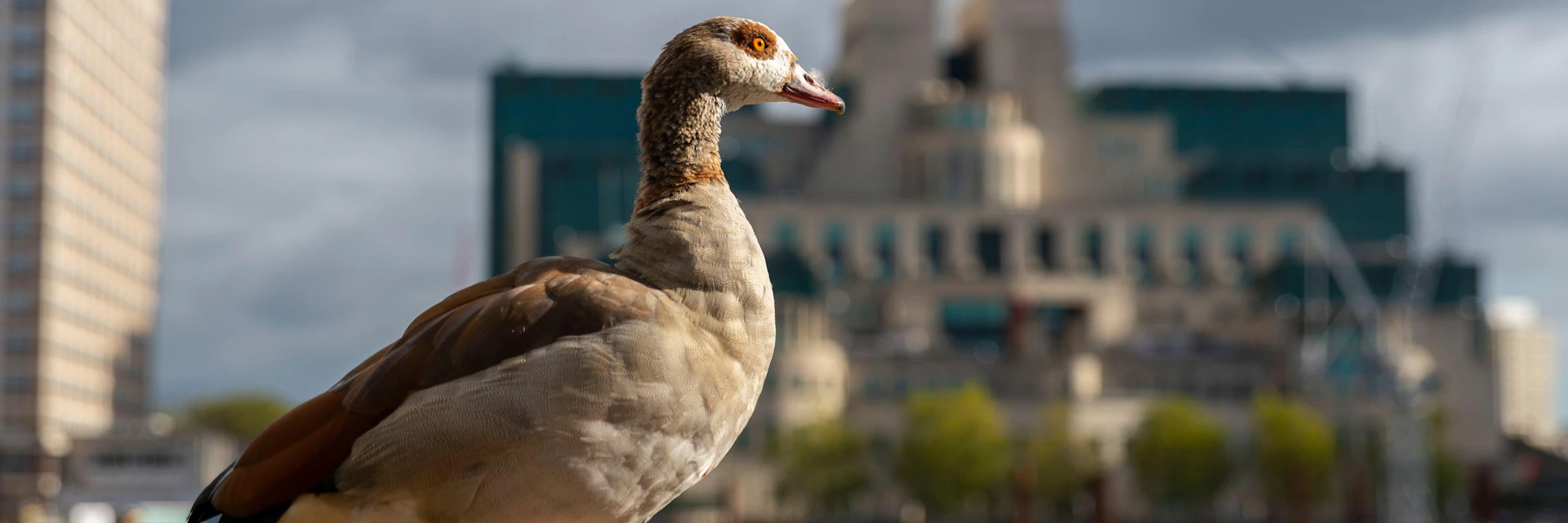
[dizzy; That’s the MI6 Building at Vauxhall, London and a goose.]

Marc Hudson, University of Sussex

Last autumn, a UK government report warned that climate-driven ecosystem collapse could lead to food shortages, mass migration, political extremism and even nuclear conflict. The report was never officially launched.

Commissioned by Defra – the Department for Environment Food and Rural Affairs – and informed by intelligence agencies including MI5 and MI6, the briefing assessed how environmental degradation could affect UK national security.

At the last minute the launch was cancelled, reportedly blocked by Number 10. Thanks to pressure from campaigners and a freedom of information request, a 14-page version of the report was snuck out (no launch, not even a press release) on January 22.

That report says: “Critical ecosystems that support major food production areas and impact global climate, water and weather cycles” are already under stress and represent a national security risk. If they failed, the consequences would be severe: water insecurity, severely reduced crop yields, loss of arable land, fisheries collapse, changes to global weather patterns, release of trapped carbon exacerbating climate change, novel zoonotic disease and loss of pharmaceutical resources.

In plainer terms: the UK would face hunger, thirst, disease and increasingly violent weather.

An unredacted version of the report, seen by the Times, goes further. It warns that the degradation of the Congo rainforest and the drying up of rivers fed by the Himalayas could drive people to flee to Europe (Britain’s large south Asian diaspora would make it “an attractive destination”), leading to “more polarised and populist politics” and putting more pressure on national infrastructure.

The Times describes a “reasonable worst case scenario” in the report, where many ecosystems were “so stressed that they could soon pass the point where they could be protected”. Declining Himalayan water supplies would “almost certainly escalate tensions” between China, India and Pakistan, potentially leading to nuclear conflict. Britain, which imports 40% of its food, would struggle to feed itself, the unredacted report says.

The report isn’t an outlier, and these concerns are not confined to classified briefings. A 2024 report by the University of Exeter and think-tank IPPR warned that cascading climate impacts and tipping points threaten national security – exactly the risk outlined in the Defra report.

River flows through jagged mountains
Melting glaciers in remote mountains ultimately pose a security threat for the UK, say intelligence services. Hussain Warraich / shutterstock

The government has not publicly explained why the launch was cancelled. In response to the Times article, a Department for Environment, Food and Rural Affairs spokesperson said: “Nature underpins our security, prosperity and resilience, and understanding the threats we face from biodiversity loss is crucial to meeting them head on. The findings of this report will inform the action we take to prepare for the future.”

Perhaps there are mundane reasons to be cautious about a report linked to the intelligence services that warns of global instability. But the absence of any formal briefing or ministerial comment is itself revealing – climate risks appear to be treated differently from other risks to national security. It’s hard to imagine a report warning of national security risks from AI, China or ocean piracy getting the same treatment.

This episode is not even especially unusual, historically. Governments have been receiving warnings about climate change – and downplaying or delaying responses – for decades.

Decades of warnings

In January 1957, the Otago Daily Times reported a speech by New Zealand scientist Athol Rafter under the headline “Polar Ice Caps May Melt With Industrialisation”. And Rafter was merely repeating concerns already circulating internationally, including by a Canadian physicist whose similar warning went around the world in May 1953. Climate change first went viral more than seven decades ago.

By the early 1960s, scientists were holding meetings explicitly focused on the implications of carbon dioxide build-up. In 1965, a report to the US president’s Science Advisory Council warned that “marked changes in climate, not controllable though local or even national efforts, could occur”.

Senior figures in the UK government were aware of these discussions by the late 1960s, while the very first environment white paper, in May 1970, mentions carbon dioxide build-up as a possible problem.

But the story we see today was the same. Reports are commissioned, urgent warnings are issued – and action is deferred. When climate change gained renewed momentum in the mid-1980s, following the discovery of the ozone hole and the effects of greenhouse gases besides carbon dioxide, the message sharpened: global warming will come quicker and hit harder than expected.

Margaret Thatcher finally acknowledged the threat in a landmark 1988 speech to the Royal Society. But when green groups tried to get her to make specific commitments, they had little success.

Since about 1990, the briefings have barely changed. Act now, or suffer severe consequences later. Those consequences, however, are no longer theoretical.

Why does nothing happen?

Partly, it’s down to inertia. We have built societies in which carbon-intensive systems are locked in. Once you’ve built infrastructure around, say, the private petrol-powered automobile, it’s hard for competitors to offer an alternative. There’s also a mental intertia: it’s hard to let go of assumptions you grew up with in a more stable era.

Secrecy plays a role too. As the Defra report illustrates, uncomfortable assessments are often softened, delayed or buried. Then, if you do accept the need for action, you are then up against the problem of responsibility being fragmented across sectors and institutions, making it hard to know where to aim your efforts. Meanwhile, social movements fighting for climate action find it hard to sustain momentum for more than three years.

Here’s the final irony. Conspiracy theorists and climate deniers insist governments are exaggerating the threat. In reality, the evidence increasingly suggests the opposite. Official assessments tend to lag behind scientific warnings, and the most pessimistic scenarios are often confined to technical or classified documents.

The situation is not better than we are told. It’s actually far worse.


Don’t have time to read about climate change as much as you’d like?
Get a weekly roundup in your inbox instead. Every Wednesday, The Conversation’s environment editor writes Imagine, a short email that goes a little deeper into just one climate issue. Join the 47,000+ readers who’ve subscribed so far.


Marc Hudson, Visiting Fellow, SPRU, University of Sussex Business School, University of Sussex

This article is republished from The Conversation under a Creative Commons license. Read the original article.

Nigel Farage urges you to ignore facts and reality and be a climate science denier like him and his Deputy Richard Tice. He says that Reform UK has received £Millions and £Millions from the fossil fuel industry to promote climate denial and destroy the planet.
Donald Trump urges you to be a Climate Science denier like him. He says that he makes millions and millions for destroying the planet, Burn, Baby, Burn and Flood, Baby, Flood.
Orcas discuss Donald Trump and the killer apes' concept of democracy. Front Orca warns that Trump is crashing his country's economy and that everything he does he does for the fantastically wealthy.
Orcas discuss Donald Trump and the killer apes’ concept of democracy. Front Orca warns that Trump is crashing his country’s economy and that everything he does he does for the fantastically wealthy.
Continue ReadingA UK climate security report backed by the intelligence services was quietly buried – a pattern we’ve seen many times before

Britain’s relentless rain shows climate predictions playing out as expected

Spread the love
ernesto rogata / Alamy

Jess Neumann, University of Reading and Hannah Cloke, University of Reading

Large parts of the UK are experiencing relentless rainfall, with some places seeing rain for 41 consecutive days and counting. In Reading, in the south east of England, our university’s official rain gauge has recorded precipitation on 31 consecutive days – unprecedented in records stretching all the way back to 1908.

The pattern has not just made 2026 a bit dreary. It also reveals one way in which climate change is making the already naturally variable (some would say gloriously variable) British weather increasingly extreme.

In those 31 days, Reading has received 141mm of rain, compared to the 30-year average over that period of just 58mm – well over twice what we would expect at the time of year.

Higher than average rainfall totals are expected, well, half of the time. This is just how mean averages work. But it’s the nature of this current weather pattern that is so unusual, and is in keeping with the type of wetter winter situation for UK weather that climate scientists have been warning us to expect – even if we are still only just learning why exactly this is happening on a regional level.

Over the full breadth of a British year, the bigger picture is even more revealing. Last year, the UK was grappling with one of the hottest and driest summers on record. A succession of hot spells, combined with long periods that saw less than average rainfall, meant water supplies dwindled and widespread hosepipe bans were put in place.

As a whole, 2025 from spring onwards was exceptionally dry. Fast forward to the new year, and we’re facing the opposite – weeks of rainfall and flooding. These extremes are what we expect to see in this part of the world, as heat builds up in the global atmosphere and oceans. For British people, this is what climate change right now feels like.

More rain, more intense rain

What is causing this link between a warmer planet and wetter British winters? One fundamental link is in basic physics of the atmosphere as temperatures rise. Warmer air can hold more moisture – about 7% more for every one degree celsius of warming. This means that when it rains, on average it rains harder. Bigger, heavier downpours become more common.

Climate change is also disrupting the patterns of currents and cycles within the atmosphere and oceans that bring the UK much of its weather. As an island archipelago on the edge of three competing climate masses – the wet, mild Atlantic, the cold, dry Arctic, and the wildly variable temperatures of the Eurasian landmass – it is used to variability.

But one constant feature plays an oversized role in the type of weather we get: the jet stream – a ribbon of fast-flowing air high in the atmosphere. The position of the jet stream makes a big difference. Sometimes it flows to the north of Scotland, sometimes it is hundreds of miles further south towards Spain. This location matters, because the jet stream helps to blow whole weather systems – think of a big “bubble” of air carrying its own weather with it – from the Atlantic towards the UK.

Currently, the jet stream is positioned further south than typical for the time of year, steering consecutive wet and often windy weather systems directly towards the UK. At the same time, a high pressure system is sitting over parts of northern Europe, blocking the wet weather from moving further east.

The impact of climate change on the jet stream is complex, because this river of air circling the north pole from west to east is influenced by a lot of different factors. One thing we do know: the Arctic, at surface level, is warming faster than other parts of the planet. This means that the temperature difference between the poles and the equator, for air at lower levels at least, is not as big as it used to be. This may be influencing the jet stream to weaken and meander.

With less energy to push them along, these weather patterns can get stuck in one location, meaning that the systems of low air pressure associated with rainfall and storms can slow down or get stuck. When a system bringing rain parks itself over the UK for days on end, only to be followed by another system, and another, the result is relentless rainfall.

To complicate things further, high up in the atmosphere where the jet stream blows, climate change is actually making the temperature difference between equator and poles increase. This may be strengthening the speed and turbulence within the jet stream itself, and just adds to a complex picture of varying influence on UK rainfall.

The challenge of managing extremes

These rapid swings between drought and deluge pose serious practical challenges for everyone in the UK. Water companies must plan for both droughts and floods, even within the same year. Farmers face uncertain growing conditions, with crops rotting in the wet soil one month, and drying out in droughts a few months later. Infrastructure designed for the climate of the past may not cope with the extremes of the future.

Understanding these changes isn’t just an academic exercise. It’s essential for helping communities, businesses and governments prepare for what’s coming. As Britain experiences these climate extremes at first-hand, it is crucial to build resilience into plans for hotter and drier summers, and warmer wetter winters.

Jess Neumann, Associate Professor of Hydrology, University of Reading and Hannah Cloke, Professor of Hydrology, University of Reading

This article is republished from The Conversation under a Creative Commons license. Read the original article.

Nigel Farage urges you to ignore facts and reality and be a climate science denier like him and his Deputy Richard Tice. He says that Reform UK has received £Millions and £Millions from the fossil fuel industry to promote climate denial and destroy the planet.
Donald Trump urges you to be a Climate Science denier like him. He says that he makes millions and millions for destroying the planet, Burn, Baby, Burn and Flood, Baby, Flood.
Elon Musk urges you to be a Fascist like him, says that you can ignore facts and reality then.
Continue ReadingBritain’s relentless rain shows climate predictions playing out as expected

Coming Soon :: How to punish climate criminals

Spread the love
Nigel Farage urges you to ignore facts and reality and be a climate science denier like him. He says that Reform UK has received millions and millions from the fossil fuel industry to promote climate denial and destroy the planet.

It should be accepted that the climate criminals have destroyed the World’s – collectively our World’s – climate for profit despite being fully aware of the consequences of their actions. This has caused extreme weather events worldwide, far more extreme hurricanes, wildfires and floods while here in the UK we’ve suffered far worse flooding and almost constant raining. We are now starting to see and feel the first consequences of the climate criminals’ actions.

The climate criminals knew this, Donald Trump knows or should be treated as knowing it despite denying it. I would be so angry if I was young or even a little younger. Capitalists have destroyed younger peoples’ lives, nature and the environment for ever for short-term profit.

Their punishment doesn’t need to follow logic e.g. punish their descendents, why not? I’m thinking along the lines of dispossessing them – since they love money so much – and prevent them from all sources of income.

ed: It’s not acceptable to punish their descendents unfortunately, would breach their human rights. Can create the concept of ‘dirty money’ the proceeds from and polluted by climate destruction that should be seized from individuals. later ed: It follows that if an individual’s income has been sourced from climate destruction for some time, then it should all be seized. later later edit: This is not new of course. It is established that people should not benefit from crimes or the proceeds of crimes. What’s needed is to formally recognise climate destruction as a crime. I would expect that to no doubt happen in coming years. A different approach would be to accept the obvious consequences of climate destruction i.e. that those crimes are committed through the action of climate destruction.

I need to give this some thought and it may not be too soon …

Donald Trump urges you to be a Climate Science denier like him. He says that he makes millions and millions for destroying the planet, Burn, Baby, Burn and Flood, Baby, Flood.
Continue ReadingComing Soon :: How to punish climate criminals

Trump’s racist rhetoric: a lifelong strategy, not a series of slips

Spread the love

https://morningstaronline.co.uk/article/trumps-racist-rhetoric-lifelong-strategy-not-series-slips

 US President Donald Trump speaks to reporters after signing a spending bill that ends a partial shutdown of the federal government in the Oval Office of the White House in Washington, February 3, 2026


The US president’s career is defined by a consistent use of racist tropes and provocation. Why are world leaders so silent over his repeated vitriolic prejudice, asks ROGER McKENZIE

THE recent racist meltdown by United States President Donald Trump is no aberration.

It is in fact part of a deep history of racism by the far-right US president.

It is a disgrace that there is any doubt that Trump was personally responsible for posting a video that depicted Barack and Michelle Obama as apes — a well-worn racist trope against black people.

What is perhaps even more of a disgrace is the pass that he seems to be given over this in the US and by the so-called international community.

There was barely a whimper from world leaders over the posting by Trump. This perhaps says as much about them as it does against racist Trump.

The fact is that Trump’s racism has been crystal clear from the moment he entered public life.

One of the many problems I have around Trump’s racism, having known of his racism for years and attempted to raise the alarm from the beginning, is that he continues to get away with his despicable behaviour and world leaders still rush to be photographed next to him.

The man is a racist and should be called out at every opportunity by everyone including so-called world leaders — regardless of diplomatic niceties.

https://morningstaronline.co.uk/article/trumps-racist-rhetoric-lifelong-strategy-not-series-slips

Elon Musk urges you to be a Fascist like him, says that you can ignore facts and reality then.
Climate science denier Nigel Farage explains that it's simple to blame asylum-seekers or Muslims for everything.
Climate science denier Nigel Farage explains that it’s simple to blame asylum-seekers or Muslims for everything.
Donald Trump explains why he established his Bored of Peace

Continue ReadingTrump’s racist rhetoric: a lifelong strategy, not a series of slips

We can move beyond the capitalist model and save the climate – here are the first three steps

Spread the love

Jason Hickel and Yanis Varoufakis

https://www.theguardian.com/environment/commentisfree/2026/feb/12/capitalist-model-climate-growth-capitalism-species-humanity

‘Capitalism cares about our species’ prospects as much as a wolf cares about the lamb’s.’ Photograph: Minerva Studio/Alamy

Capitalism cares about our species’ prospects as much as a wolf cares about a lamb’s. But democratise our economy and a better world is within our grasp

We have an urgent responsibility. Our existing economic system is incapable of addressing the social and ecological crises we face in the 21st century. When we look around we see an extraordinary paradox. On the one hand, we have access to remarkable new technologies and a collective capacity to produce more food, more stuff than we need or that the planet can afford. Yet at the same time, millions of people suffer in conditions of severe deprivation.

What explains this paradox? Capitalism. By capitalism we do not mean markets, trade and entrepreneurship, which have been around for thousands of years before the rise of capitalism. By capitalism we mean something very odd and very specific: an economic system that boils down to a dictatorship run by the tiny minority who control capital – the big banks, the major corporations and the 1% who own the majority of investible assets. Even if we live in a democracy and have a choice in our political system, our choices never seem to change the economic system. Capitalists are the ones who determine what to produce, how to use our labour and who gets to benefit. The rest of us – the people who are actually doing the production – do not get a say.

And for capital, the purpose of production is not primarily to meet human needs or to achieve social progress, much less to deliver on any ecological goals. The purpose is to maximise and accumulate profit. That is the overriding objective. This is the capitalist law of value. And to maximise profits, capital requires perpetual growth – ever increasing aggregate production, regardless of whether it is necessary or harmful.

We urgently need to overcome the capitalist law of value and democratise our economy, so that we can organise production around urgent social and ecological priorities. After all, we are the producers of the goods, the services, the technologies. It is our labour and our planet’s resources that are at stake. And so we must claim the right to decide what is produced, how, and for what purpose.

https://www.theguardian.com/environment/commentisfree/2026/feb/12/capitalist-model-climate-growth-capitalism-species-humanity

Donald Trump urges you to be a Climate Science denier like him. He says that he makes millions and millions for destroying the planet, Burn, Baby, Burn and Flood, Baby, Flood.
Nigel Farage urges you to ignore facts and reality and be a climate science denier like him and his Deputy Richard Tice. He says that Reform UK has received £Millions and £Millions from the fossil fuel industry to promote climate denial and destroy the planet.
Orcas discuss Donald Trump and the killer apes' concept of democracy. Front Orca warns that Trump is crashing his country's economy and that everything he does he does for the fantastically wealthy.
Orcas discuss Donald Trump and the killer apes’ concept of democracy. Front Orca warns that Trump is crashing his country’s economy and that everything he does he does for the fantastically wealthy.

Continue ReadingWe can move beyond the capitalist model and save the climate – here are the first three steps