Survey shows support for electoral reform now at 60% – so could it happen?

Spread the love

Alan Renwick, UCL

Public support for reforming the UK’s first past the post electoral system has risen markedly of late. So is there any serious chance that such reform could actually happen?

The annual British Social Attitudes survey (BSA) has been tracking public attitudes to electoral reform (and other issues) since 1983. It found consistent majorities for the status quo up to 2017, but charts a dramatic shift since then. In the latest BSA, support for reform has risen to 60%, with just 36% backing the current arrangements.

It’s true that these views are unlikely to be deeply held: most people rarely think about electoral systems. But they do reflect a profound disillusionment with the way the political system is working.

Significant electoral reforms are very rare outside times of regime change. When I wrote a book on the subject in 2010, there had been just six major reforms (from one system type to another) in national parliaments in established democracies since the second world war. That number has increased a little since then, but only because Italy has got into a pattern of endless tinkering. The basic pattern is one of stability.

The main reason for that is obvious: those who gain power through the existing system rarely want to change it.

Yet the cases where reform has happened reveal two basic routes through which such change can take place.

First, those in power can conclude that a different system would better serve their interests. In 1985, for example, France’s president François Mitterrand replaced the system for electing the National Assembly because he feared heavy losses for his Socialist party in the looming elections.

Second, leaders can cave into public demands for reform because they fear that failing to do so will add to their unpopularity. This requires a scandal that affects people in their daily lives, and campaigners who successfully pin blame for that scandal on the voting system. It typically also needs at least a few reform advocates within government.


Want more politics coverage from academic experts? Every week, we bring you informed analysis of developments in government and fact check the claims being made.

Sign up for our weekly politics newsletter, delivered every Friday.


These conditions characterised three major reforms in the 1990s, in Italy, Japan, and New Zealand. In the first two cases, rampant corruption fed economic woes and was attributed to the voting system. In New Zealand, first past the post enabled extreme concentration of power, which allowed successive governments to unleash radical, and widely disliked, economic restructuring.

Prospects for reform in the UK

If Labour continues to lag in the polls and votes remain fragmented across multiple parties, we might imagine reform by the first route in the UK. Ministers could calculate that a more proportional system would cut Labour’s losses, clip Nigel Farage’s wings, and reduce uncertainty.

Yet majority parties facing heavy defeat almost never change the system in this way. Mitterrand’s reform of 1985 was a rare exception. Such parties always hope things will turn around. They don’t want to look like they have given up. And they are used to playing a game of alternation in power: they want to hold all the levers some of the time, and will tolerate years in the wilderness to get that.

Reform by the second route is equally improbable. Notwithstanding great public dissatisfaction with the state of politics in the UK, there is little narrative that the electoral system is the source of the problem.

But, depending on the results, the chances of reform could grow after the next general election.
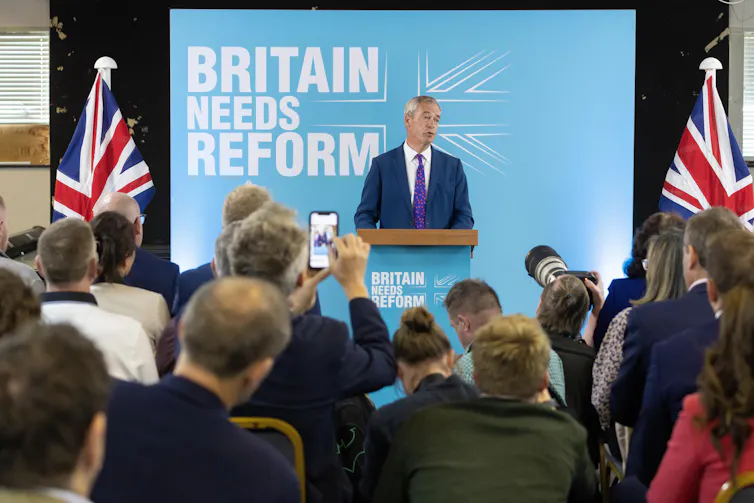
A Reform win could spark change. EPA

Change by the first route is most likely if no party comes close to a majority and a coalition is formed from multiple fragments. Those parties might all see reform as in their interests. Perhaps more likely, the smaller parties in such a coalition might push their larger partner into conceding a referendum – much as the Liberal Democrats did with the Conservatives in 2010. If support for the two big parties is disintegrating, referendum voters might opt for change – though that is not guaranteed.

As for the second route, a majority victory for Reform UK that was generated by first past the post from a small vote share could – given the party’s marmite quality – trigger widespread public rejection of the voting system. A clear path to change might open up if Reform then lost a subsequent election, particularly if it lost to a coalition of parties, some of which backed reform already.

In short, the shifting sands of politics are making electoral reform more likely. But almost certainly not before the 2030s. And much will depend on how the party system evolves in the years to come.

This article includes links to bookshop.org. If you click on one of the links and go on to buy something from bookshop.org The Conversation UK may earn a commission.

Alan Renwick, Professor of Democratic Politics, UCL

This article is republished from The Conversation under a Creative Commons license. Read the original article.
Continue ReadingSurvey shows support for electoral reform now at 60% – so could it happen?

🩻 Climate Reality: The Diagnosis We Can’t Escape

Spread the love

Original article by Roger Hallam republished from https://rogerhallam.com/. I don’t have permission to republish this article, hopefully he doesn’t mind.

The climate crisis is no longer a future threat — it’s a terminal diagnosis, and the only moral response now is to act like everything depends on us, because it does.

🩻 Climate Reality: The Diagnosis We Can’t Escape
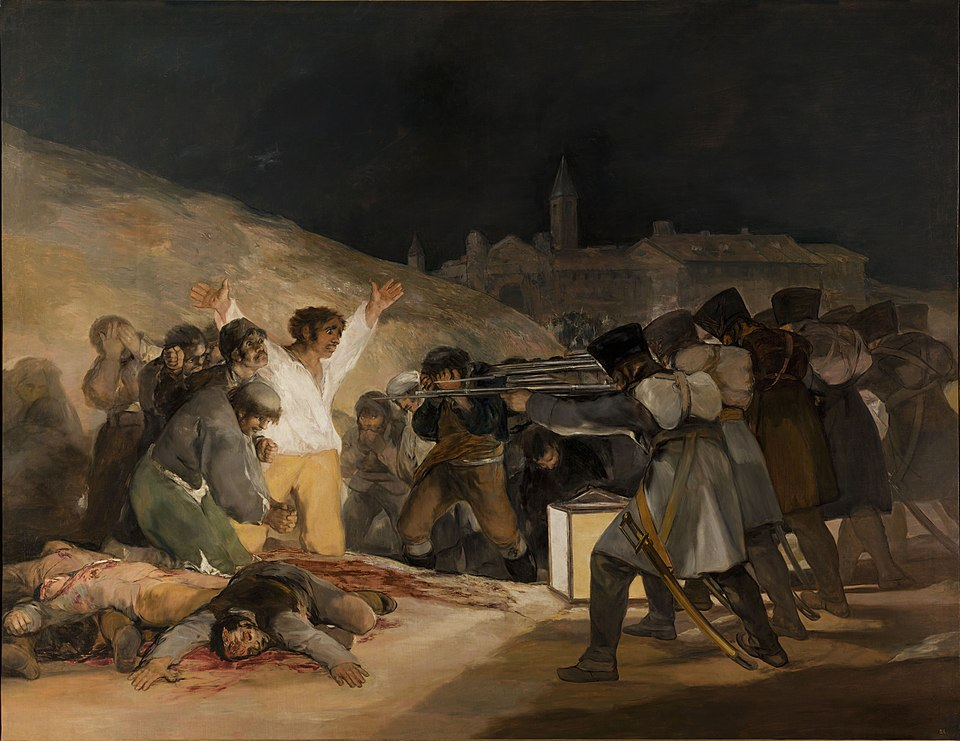
Francisco Goya – The Third of May 1808 (1814), A scream against institutional violence and helplessness.

There comes a point in your life when the facts won’t let you look away. You feel it before you know it: something is terribly wrong, and we are running out of time.

So let’s begin with something simple. How do you know something is true?

Take the example of cancer. If you feel a lump or have symptoms, you don’t just ask your mate what they think. You go to a doctor. And not just any doctor — you want a specialist. Someone who’s legally obliged to tell you the truth, however hard it is to hear. You want the tests, the scan, the data. And above all, you want a number: “What’s the likelihood I have it?” Because that number changes everything.

You don’t want vague reassurances. You want the truth. If the doctor says there’s a 50% chance, your life changes in that moment. You go into action. You start making decisions — fast. Because the alternative is death. And no one can run from that.

It’s this same clarity, this same objectivity, that we need to bring to the climate crisis. Because the truth is — and I mean this literally — the planet has cancer. It is spreading. It is terminal. And it is going to kill us if we don’t act, immediately.

This isn’t ideology. It’s not politics. It’s not “just your opinion.” It is physical reality. And just like cancer, it doesn’t care what you believe.

In 1989, NASA scientist James Hansen warned the UN that if we didn’t slash emissions, society would collapse. That was 35 years ago. In 2025, global temperatures have now risen to 1.6°C above pre-industrial levels. And the rate of warming is accelerating. For most of the 20th century, the rise was around 0.18°C per decade. In the last ten years, it’s more than doubled to 0.37°C per decade. We’re now on course to hit 2°C around 2035 — and that’s being optimistic.

But what does that number mean?

A landmark peer-reviewed paper, “The Future of the Human Niche,” published by Tim Lenton and colleagues, makes it brutally clear: at 2°C of warming, around 1 billion people will no longer be able to live where they currently do. That’s 25% of the Earth’s surface becoming uninhabitable. One billion refugees — in just a few years.

To put that into context: there were 50 million refugees after the Second World War. That was the worst war in human history. What’s coming is twenty times worse.

And that figure — one billion — only covers the effects of extreme heat. It doesn’t include what happens when rising sea levels drown coastal cities, when droughts kill crops, when wildfires consume whole regions, when freshwater disappears. The truth is, climate collapse is not just an environmental issue. It is a full-system breakdown. It affects food, health, housing, energy, migration, and war — all at the same time.

Still think this is just about polar bears?

If you’re still not convinced, don’t take it from me. Take it from the insurance industry. In 2024, the British actuarial society — a group of people whose job it is to measure risk for a living — released a report projecting that at 2°C of warming, we’ll see 2 billion deaths. At 3°C? 4 billion. That’s half the population of the Earth.

And this is not worst-case modelling. This is their baseline. This is what the people who insure your life, your business, your pension, believe is most likely to happen if we stay on our current course.

It gets worse. Because climate breakdown isn’t a one-off crisis — it triggers runaway feedback loops. Ice melts and reduces the planet’s ability to reflect sunlight, which makes it heat up faster. Permafrost thaws and releases methane, a greenhouse gas 80 times more potent than CO₂. Forests burn and release carbon. Soils lose their ability to absorb emissions. Everything begins to feed on itself. Even if we stopped all human emissions tomorrow, these systems may continue warming the planet — potentially beyond the point of recovery.

Most tipping points are estimated to be triggered between 1°C and 2°C. We are already at 1.6°C. We are now in the danger zone. There is no longer a buffer. There is no margin of error. This is happening in real time.

So what do we do?

Well, the answer is no different from the cancer patient. Two things: stop making it worse, and start trying to repair the damage. That means ending fossil fuel emissions as fast as humanly possible. That means scaling up emergency carbon removal. That means mobilising everything we’ve got.

Will it work? We don’t know. But what we do know is this: if we do nothing, billions will die. And not in some abstract future. In our lifetimes. In the lifetimes of our children.

This is not a problem for “someone else to solve.” This is your responsibility, your emergency, your world.

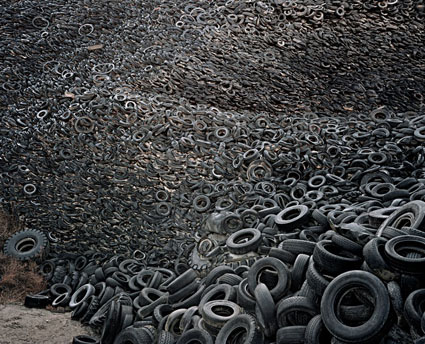
Edward Burtynsky – Manufactured Landscapes, a pyre waiting to burn.

And if you think you still have a choice — let me be blunt: you don’t. If your actions or inactions contribute to this collapse, you don’t just destroy your own future. You destroy the lives of everyone around you. You condemn entire generations to hell on Earth because you couldn’t face the truth.

It’s not just foolish. It’s not just selfish. It’s evil.

Let me speak personally for a moment. I’ve met hundreds of people who, after hearing this reality, decided to act. Ordinary people. Teachers, nurses, students, grandparents. They quit their jobs. They faced arrest. Some went to prison. Not because they were heroes. But because they understood this one, simple thing: if we don’t fight, we die. If we don’t rise up, we burn.

You can’t half-commit to this. You can’t give a little donation, feel a bit guilty, and move on. Once you’ve heard the truth, you are accountable. And the only question left is what you’re going to do about it.

So this is your moment. This is the turning point. If you’ve read this far, you already know. You know what’s coming. You know the scale of the crisis. You know the failure of our leaders.

You also know this: we are not powerless. There are millions of us waking up. Rising up. Organising. We are building the resistance that history will remember.

Join us.

Because history is watching.
And your children will ask what you did.
And one day, in the final hours of your life, you will ask yourself the same question.

Don’t wait for the flood. Don’t wait for the fire.
We have no choice but to act. And act we will.

Support the Revolution


This was meant to be Roger Hallam’s climate briefing for the Rev21 Convention.
But prison authorities blocked it.
They’ve now banned him from posting on social media altogether.

To keep up with Roger’s work and the revolutionary movement he helped build, follow Rev21 across platforms:

📺 YouTube: youtube.com/@Revolution21c
📸 Instagram: instagram.com/revolution.21c
✖️ X / Twitter: x.com/revolution_21c
📘 Facebook: facebook.com/profile.php?id=61575178389798
📢 Telegram: t.me/revolution_21C
🧵 Threads: threads.net/revolution.21c
🔵 Bluesky: bsky.app/profile/revolution21c.bsky.social
🎵 TikTok: tiktok.com/revolution.21c
👥 Reddit: reddit.com/r/Rev21


Update on Roger’s Imprisonment

Roger’s release has once again been delayed — originally expected in March, then May, and now postponed indefinitely. First, his designated home was deemed “unsuitable” for rehabilitation because someone associated with Just Stop Oil was present. Then, following press coverage that included the name of his probation officer (quoted directly in the piece), Roger was placed on a high-risk list — supposedly due to the psychological impact on staff. That probation officer has since been replaced, but the new officer has refused to respond to legal communications from Roger’s team.

It now appears that prison staff are refusing to meet with Roger directly, citing the “risk” he poses to them. His lawyers have written to the prison, but there is no legal requirement for them to respond within a set timeframe, leaving him in a state of limbo.

At the same time, Roger’s ability to contribute to public work has been severely restricted. Prison authorities have blocked over 20,000 words of his writing, and his input into the Convention and our social media efforts has been censored. Despite this, Roger continues to engage with projects through prison phone and email, where possible. He remains deeply committed to the cause and continues to support our work with unwavering clarity and determination.

Original article by Roger Hallam republished from https://rogerhallam.com/. I don’t have permission to republish this article, hopefully he doesn’t mind.

Donald Trump urges you to be a Climate Science denier like him. He says that he makes millions and millions for destroying the planet, Burn, Baby, Burn and Flood, Baby, Flood.
Nigel Farage urges you to ignore facts and reality and be a climate science denier like him. He says that Reform UK has received millions and millions from the fossil fuel industry to promote climate denial and destroy the planet.
Orcas discuss how Trump was re-elected and him being an insane, xenophobic Fascist.

Continue Reading🩻 Climate Reality: The Diagnosis We Can’t Escape

Nigel Farage’s Reform Party Has Accepted £2.3 Million from Fossil Fuel Interests, Climate Deniers, and Polluters Since 2019 Election

Spread the love

Original article by Adam Barnett and Sam Bright republished from DeSmog.

Reform UK leader Nigel Farage, and deputy leader Richard Tice. Photo: Sipa US / Alamy

The anti-net zero party has been bankrolled by oil and gas investors, aviation entrepreneurs, and those who reject climate science.

Reform UK has received more than £2.3 million from oil and gas interests, highly polluting industries, and climate science deniers since December 2019, amounting to 92 percent of the party’s donations. 

This week, Nigel Farage confirmed he would be returning as leader of Reform and standing in the general election, threatening to split the already fragile Conservative vote. His populist party, which campaigns to “scrap all of net zero”, claims to represent ordinary people against out of touch elites. 

Yet Reform’s official register of donations reveals the party is bankrolled by rich businessmen who reject climate science or make money from polluting industries.

In the past 12 months, Reform has received £200,000 from First Corporate Consultants. The firm is owned by Terence Mordaunt, a director and former chair of the Global Warming Policy Foundation (GWPF), the UK’s leading climate science denial group. 

The GWPF has in the past expressed the view that carbon dioxide has been mis-characterised as pollution, when in fact it is a “benefit to the planet”. Mordaunt himself told openDemocracy in 2019 that “no one has proved yet that CO2 is the culprit” of climate change.

The UN’s Intergovernmental Panel on Climate Change (IPCC), the world’s top climate science body, has stated that it is “unequivocal that human influence has warmed the atmosphere, ocean and land”. It has also stated that carbon dioxide “is responsible for most of global warming” since the late 19th century, which has increased the “severity and frequency of weather and climate extremes, like heat waves, heavy rains, and drought”.

Reform has also received more than £500,000 since the last election from Jeremy Hosking, whose investment firm Hosking Partners had more than $134 million (around £108 million) invested in the energy sector at the close of 2021, two thirds of which was in the oil industry, along with millions in coal and gas. 

Hosking previously told DeSmog: “I do not have millions in fossil fuels; it is the clients of Hosking Partners who are the beneficiaries of these investments.” 

Since December 2019, Reform has also received £465,000 from Christopher Harborne, owner of AML Global, an aviation fuel supplier with a distribution network that includes “main and regional oil companies”, according to its website. Harborne is also the CEO of Sheriff Global Group, which trades in private jets. 

Aviation emissions accounted for eight percent of the UK’s annual greenhouse gas emissions before the pandemic, according to the government’s Climate Change Committee. 

In response to DeSmog’s request for comment, Harborne posted a lengthy statement on the AML Global website. He said: “I am not a climate science denier and … I do not seek to influence any government through donations or lobbying regarding their policies on climate change or in favour of corporate interests.”

Harborne added that “there is overwhelming scientific evidence that human activity and in particular the use of hydrocarbons as an energy source is accelerating climate warming due to the greenhouse effect.”

Reform has also received more than £1.1 million in donations from Richard Tice, a property millionaire and the party’s leader until this week. Tice has now become the party’s chairman. 

In addition (and not included in the overall figures for this analysis), Reform has received more than 50 loans collectively worth around £1.4 million from a company called Tisun Investments, which is owned by Tice, since the start of 2020.

Tice is one of the UK’s most prominent climate deniers, his presenting role on the right-wing broadcaster GB News to attack net zero policies and the science behind them. Tice has claimed that “there is no climate crisis” and expressed the view that “CO2 isn’t a poison. It’s plant food”.

DeSmog has also revealed that the governing Conservative Party has received £8.4 million since December 2019 from oil and gas interests, highly polluting industries, and individuals who have expressed or supported climate science denial.

“No political party should be taking any money from fossil fuel interests whatsoever,” Caroline Lucas, until recently the Green Party MP for Brighton Pavilion, told DeSmog. 

Reform’s Climate Science Denial

Reform’s platform on climate change conforms to the views and business interests of its major donors. 

The party’s manifesto falsely claims that “scientists disagree as to how much” humans have had an impact on global warming. 

A number of climate consensus studies conducted between 2004 and 2015 found that between 90 percent and 100 percent of experts agree that humans are responsible for climate change. A study published in 2021, which reviewed over 3,000 scientific papers, found that over 99 percent of climate science literature says that global warming is caused by human activity.

Reform wants to develop new oil and gas fields in the North Sea, open onshore fracking sites across the country, end the windfall tax on oil and gas companies, and “restart opencast coal mines using the latest cleanest techniques”.

The party has campaigned for a referendum on the UK’s 2050 net zero emissions target, and supports scrapping the policy entirely. 

Farage himself also has a long history of opposing green reforms and criticising established climate science. 

Speaking on GB News in August 2021, Farage said that he was “very much an environmentalist” and that he couldn’t “abide things like plastics in our seas, pollution in our rivers.” However, on the issue of climate change, he added: “What annoys me though, is this complete obsession with carbon dioxide almost to the exclusion of everything else, the alarmism that comes with it, based on dodgy predictions and science.”

Reform’s only MP, Lee Anderson, who defected from the Conservative Party in March, has repeatedly attacked the government’s net zero policies, arguing in February 2024 that a net zero UK “wouldn’t make a blind bit of difference to the Earth’s atmosphere”.

Anderson is also a vocal backer of new oil, gas, and coal extraction in the UK. In 2022 he supported the government’s decision to approve a new coal mine in Cumbria – the UK’s first new coal mine for 30 years.

A Reform UK spokesman said: “Climate change is real, Reform UK believes we must adapt, rather than foolishly think you can stop it. We are proud to be the only party to understand that economic growth depends on cheap domestic energy and we are proud that we are the only party that are climate science realists, realising you can not stop the power of the sun, volcanoes or sea level oscillation.

“The deniers are those who continually gaslight the public into thinking you can stop these powerful natural forces. We must use the energy under our feet, rather than send our money and jobs abroad.”

Original article by Adam Barnett and Sam Bright republished from DeSmog.

Nigel Farage urges you to ignore facts and reality and be a climate science denier like him. He says that Reform UK has received millions and millions from the fossil fuel industry to promote climate denial and destroy the planet.
Donald Trump urges you to be a Climate Science denier like him. He says that he makes millions and millions for destroying the planet, Burn, Baby, Burn and Flood, Baby, Flood.
Nigel Farage explains the politics of Reform UK: Racism, Fake anti-establishmentism, Deregulation, Corporatism, Climate Change Denial, Mysogyny and Transphobia.
Continue ReadingNigel Farage’s Reform Party Has Accepted £2.3 Million from Fossil Fuel Interests, Climate Deniers, and Polluters Since 2019 Election

Have you noticed that Nigel Farage doesn’t talk about Donald Trump anymore?

Spread the love
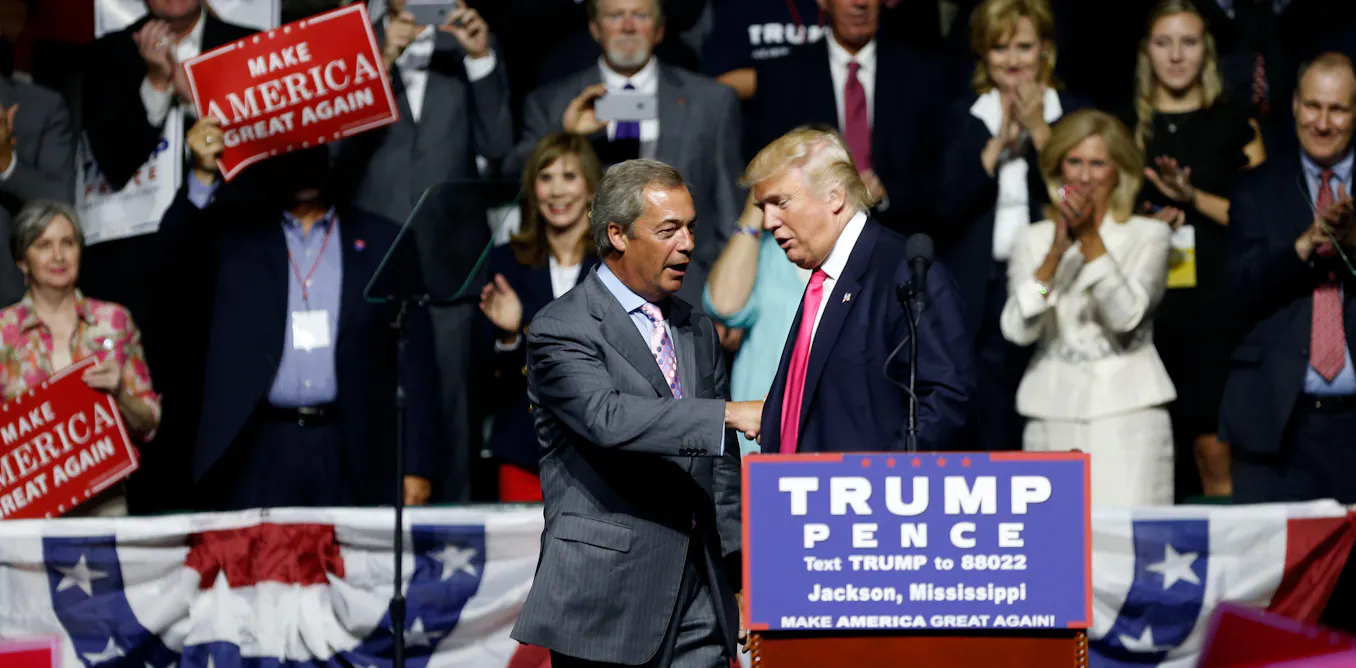
Farage on stage with Trump at a 2016 rally. Alamy/Gerald Herbert

Martin Farr, Newcastle University

Each is the main political subject in their country, and one is the main political subject in the world. Each rode the populist wave in 2016, campaigning for the other. In 2024 the tandem surfers remounted on to an even greater breaker. Yet, though nothing has happened to suggest that bromance is dead, neither Donald Trump nor Nigel Farage publicly now speak of the other.

Trump’s presidential campaign shared personnel with Leave.eu, the unofficial Brexit campaign. Farage was on the stump with Trump, and his “bad boys of Brexit” made their pilgrimage to Trump Tower after its owner’s own triumph in the US election. Each exulted in the other’s success, and what it portended.

Trump duly proposed giving the UK ambassadorship to the United States to Farage. Instead, Farage became not merely MP for Clacton, but leader of the first insurgent party to potentially reset Britain’s electoral calculus since Labour broke through in 1922.

Then, Labour’s challenge was to replace the Liberals as the alternative party of government. It took two years. Reform UK could replace the Conservatives in four.


Get your news from actual experts, straight to your inbox. Sign up to our daily newsletter to receive all The Conversation UK’s latest coverage of news and research, from politics and business to the arts and sciences.


Trump, meanwhile, has achieved what in Britain has either been thwarted (Militant and the Labour party in the 1980s) or has at most had temporary, aberrant, success (Momentum and the Labour party in the 2010s): the takeover of a party from within. Farage has been doing so – hitherto – from without.

At one of those historic forks in a road where change is a matter of chance, after Brexit finally took place, Farage considered his own personal leave – to go and break America.

The path had been trodden by Trump-friendly high-profile provocateurs before him: Steve Hilton, from David Cameron’s Downing Street, via cable news, now standing to be governor of California; Piers Morgan, off to CNN to replace the doyen of cable news Larry King, only to crash, but then to burn on, online. Liz Truss, never knowingly understated, has found her safe space – the rightwing speaking circuit.

But Farage remained stateside. He knew his domestic platform was primed more fully to exploit the voter distrust that his nationalist crusade had done so much to provoke.

The Trump effect

Genuine peacetime transatlantic affiliations are rare, usually confined to the leaders of established parties: Ronald Reagan and Margaret Thatcher, Bill Clinton and Tony Blair. One consequence of the 2016 political shift is that the US Republicans and the British Conservatives, the latter still at least partially tethered to traditional politics, have become distanced.

During the first Trump administration, and even in the build up to the second, it was Farage who was seen as the UK’s bridge to the president. But today, at the peak of their influence, for Farage association can only be by inference, friendship with the US president is not – put mildly – of political advantage. For UK voters, Trump is the 19th most popular foreign politician, in between the King of Denmark and Benjamin Netanyahu.

There is, moreover, the “Trump effect”. Measuring this is crude – circumstances differ – but the trend is that elections may be won by openly criticising, rather than associating with, Trump. This was the case for Mark Carney in Canada, Anthony Albanese in Australia, and Nicușor Dan in Romania.

Trump’s second state visit to the UK will certainly be less awkward for Farage than it will be Starmer, the man who willed it. Farage will likely not – and has no reason to – be seen welcoming so divisive a figure.

Farage and Trump were pictured together during the latter’s visit to his golf course in South Ayrshire in 2023 but didn’t do any public events together. Alamy

Starmer has no choice but to, and to do so ostentatiously. It is typical of Starmer’s perfect storm of an administration that he will, in the process, do nothing to appeal to the sliver of British voters partial to Trump while further shredding his reputation with Labour voters. Farage would be well served in taking one of his tactical European sojourns for the duration. Starmer may be tempted too.

Outmanoeuvring the establishment

Reflecting the historic cultural differences of their countries, Trump’s prescription is less state, Farage’s is more. The Farage of 2025 that is. He had been robustly Thatcherite, but has lately embraced socialist interventionism, albeit through a most Thatcherite analysis: “the gap in the market was enormous”.

Reform UK now appears to stand for what Labour – in the mind of many of its voters – ought to. Eyeing the opportunity of smokestack grievances, Farage called for state control of steel production even as Trump was considering quite how high a tariff to put on it. Nationalisation and economic nationalism: associated restoratives for national malaise.

Aggressively heteronormative, Trump and Farage dabble in the natalism burgeoning in both countries – as much a cultural as an economic imperative. Each has mastered – and much more than their adversaries – social media. Each has come to recognise the demerits in publicly appeasing Putin.

And Reform’s rise in a hitherto Farage-resistant Scotland can only endear him further to a president whose Hebridean mother was thought of (in desperation) as potentially his Rosebud by British officials preparing for his first administration.

Given their rhetorical selectivity, Trump and Farage’s rolling pitches are almost unanswerable for convention-confined political opponents and reporters. These two anti-elite elitists continue to confound.

Unprecedentedly, for a former president, Trump ran against the incumbent; Farage will continue to exploit anti-incumbency, despite his party now being in office. Most elementally, the pair are bound for life by their very public near-death experiences. Theirs is, by any conceivable measure, an uncommon association.

Farage’s fleetness of foot would be apparent even without comparison with the leaden steps of the leaders of the legacy parties. His is a genius of opportunism. That’s why he knows not to remind us of his confrere across the water.

Martin Farr, Senior Lecturer in Contemporary British History, Newcastle University

This article is republished from The Conversation under a Creative Commons license. Read the original article.

Nigel Farage urges you to ignore facts and reality and be a climate science denier like him. He says that Reform UK has received millions and millions from the fossil fuel industry to promote climate denial and destroy the planet.
Donald Trump urges you to be a Climate Science denier like him. He says that he makes millions and millions for destroying the planet, Burn, Baby, Burn and Flood, Baby, Flood.
Nigel Farage explains the politics of Reform UK: Racism, Fake anti-establishmentism, Deregulation, Corporatism, Climate Change Denial, Mysogyny and Transphobia.

Continue ReadingHave you noticed that Nigel Farage doesn’t talk about Donald Trump anymore?

Greens denounce “Britannia Card” as Reform UK’s latest wheeze to prop up the super wealthy 

Spread the love
Green Party Co-leader Adrian Ramsay. Wikipedia CC.

Reacting to Reform UK’s plans for a “Britannia Card” which would offer wealthy foreigners and returning British expats a bespoke tax regime in exchange for a one-off payment of £250,000 – with all funds collected redistributed to Britain’s lowest-paid workers – Green Party co-leader Adrian Ramsay MP said:  

“Nigel Farage’s latest wheeze to prop up the super wealthy, dressed up as helping the poorest, would result in an estimated loss of a whopping £34bn to the Treasury. Rather than enabling the super-rich to buy their way out of paying UK tax, the Green Party would tax investment income as equivalent to earned income and introduce a wealth tax based on assets. This is the way to fix our public services to benefit everyone. 

“This is another reminder that Reform UK is a Party run by multi-millionaires out to look after their own and with net zero interest in the rest of us. There’s nothing patriotic about a “Britannia card” that would let the ultra-wealthy avoid paying taxes and contributing to society.” 

Nigel Farage says he's too stupid to answer questions about the hit to the UK economy of his plans to suck up to the uber-rich.
Nigel Farage says he’s too stupid to answer questions about the hit to the UK economy of his plans to suck up to the uber-rich.
Continue ReadingGreens denounce “Britannia Card” as Reform UK’s latest wheeze to prop up the super wealthy