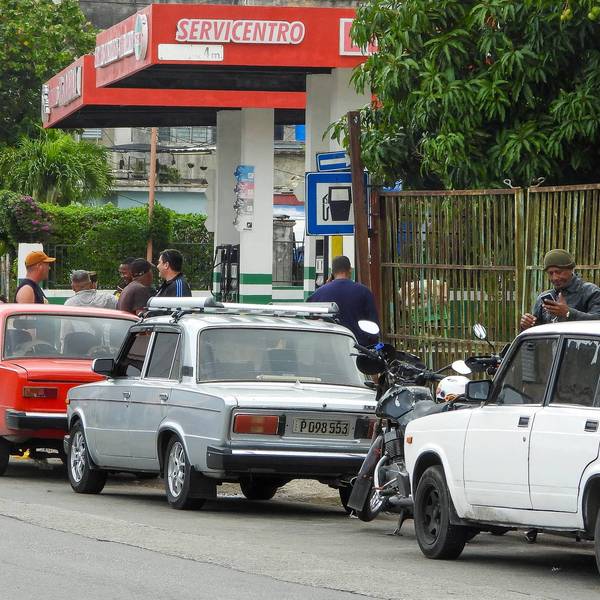
For the Cuban people, surrender is not an option

Spread the love

Original article by Manolo De Los Santos republished from peoples dispatch under a Creative Commons Attribution-ShareAlike 4.0 (CC BY-SA) license.

Thousands marched on January 26, 2026 in Havana, Cuba, to honor José Martí’s legacy. Photo: Progressive International

Claims by officials in Washington that “Cuba’s collapse is imminent” usually coincide with a tightening of the blockade. Yet, once again, Cubans have reaffirmed their commitment to the revolution and their creative resistance in the face of the latest US attacks.

The halls of power in Washington are echoing with a familiar, predatory chorus. Once again, the White House, various think-tank experts, and US politicians are predicting the “imminent collapse” of Cuba. This is a tune the world has heard for over sixty years, usually sung at its highest volume whenever the United States decides to tighten the economic noose around the island’s neck. However, in 2026, the rhetoric has shifted from sanctions to an overt campaign of total strangulation. Under a new executive order signed in late January, the second Trump administration has escalated the decades-long blockade into a proactive fuel blockade.

Cuban President Miguel Díaz-Canel laid bare the intended consequences in a press conference on February 5, 2026: “Not allowing a single drop of fuel to enter our country will affect transportation, food production, tourism, children’s education, and the healthcare system.” The objective is clear: to induce systemic failure, sow popular discontent, and create conditions for political destabilization. The White House rhetoric confirms this intent. Press Secretary Karoline Leavitt’s statement on the same day, that “the Cuban government is on its last leg and its country is about to collapse,” is not an analysis but public signaling, a psychological operation meant to reinforce the narrative of inevitable doom and pressure Cuban leadership into unilateral concessions.

This policy is not merely a “sanction” in the traditional sense; it is a calculated attempt to suffocate a nation by blocking every drop of fuel from reaching its shores. The administration has authorized aggressive tariffs and sanctions on any foreign country or company that dares to trade oil with the island, effectively treating Cuban territorial waters as a zone of exclusion. Since December, multiple oil tankers headed to Cuba have been seized by US naval forces in the Caribbean or forced to return to their ports of origin under threat of asset forfeiture. In direct response to this intensifying siege, Cuba has announced sweeping fuel rationing measures designed to protect essential services. The plan prioritizes fuel for healthcare, water, food production, education, public transportation, and defense, while strictly limiting sales to private drivers. To secure vital foreign currency, the tourism sector and key export industries, such as cigar production, will continue operating. Schools will maintain full in-person primary education, with hybrid systems implemented for higher levels. The leadership of the Cuban Revolution has affirmed that Cuba “will not collapse.”

To the planners in the White House, Cuba is a 67-year-old problem to be solved with starvation and darkness. But to the Cuban people, the current crisis is a continuation of a long-standing refusal to trade their sovereignty for Washington’s demands of submission.

The ghost of the “Special Period” 

To understand why the Cuban people have not descended into the chaos Washington predicted, one must look to the historical precedent of the “Special Period in Time of Peace.” Following the collapse of the Soviet Union in 1991, Cuba experienced an economic shock that would have toppled almost any other modern state. Overnight, the island lost 85% of its international trade and nearly all of its subsidized fuel imports. The resulting statistics were staggering: the Gross Domestic Product plummeted by 35%, and the daily caloric intake of the average citizen dropped from over 3,000 calories to roughly 1,800. During this era, the lights went out across the island for more than 16 hours a day, and the bicycle became the primary mode of transportation as the public transit system collapsed.

At the same time, Washington escalated its assault through the Torricelli Act (1992) and the Helms-Burton Law (1996), each tightening the noose around Cuba’s economy. However, instead of fracturing under the weight of this tightened blockade, Cubans developed “Option Zero”, a survival plan designed to keep hospitals running and children fed without any fuel, and the Cuban social fabric tightened. The government prioritized the distribution of remaining resources to the most vulnerable, ensuring that infant mortality rates remained lower than those in many parts of the United States despite the scarcity. This period proved that when a population is politically conscious of the external forces causing their suffering, they become extraordinarily resilient. The “Special Period” was not just a time of hunger; it was a period of forced innovation that gave rise to the world’s first national experiment in organic urban farming and mass-scale energy conservation.

The return of the energy crisis

The crisis of 2026 is, in many ways, a sequel to the 1990s, but with higher stakes and more advanced technological targets. The roots of the current energy shortage can be traced back to the first Trump administration’s decision in 2019 to target Cuban oil imports as a means of punishing the island for its solidarity with Venezuela. By designating Cuba as a “State Sponsor of Terrorism” and activating Title III of the Helms-Burton Act, the US successfully scared off international shipping lines and insurance companies. This was followed by a focused campaign against the PDVSA (Venezuela’s state oil company) and the shipping firms involved in the trade agreement between countries in the region known as ALBA-TCP.

By 2025, the impact on Cuba’s energy grid was catastrophic. The island’s thermal power plants, most of which were built with aging Soviet technology, were never designed to burn the heavy, sulfur-rich crude that Cuba produces domestically without constant maintenance and expensive imported additives. The lack of foreign exchange, caused by the tightening of the blockade, meant that spare parts were non-existent. By the time the 2026 fuel blockade began, the national grid was already operating at 25% below its required capacity. President Miguel Díaz-Canel has been transparent with the public, noting that without fuel, everything from the morning school bus to the refrigeration systems for the nation’s advanced biotech medicines is under constant threat, a reality that has now precipitated the stringent new rationing regime.

The threat of intervention: from Caracas to Havana

The current US stance toward Cuba cannot be viewed in isolation from its recent military interventions in the Middle East and Latin America. The “regime change” efforts in Cuba are being modeled after the maximum pressure campaigns used against Iran and the military incursions seen in Venezuela on January 3, 2026. The threat of a US military attack is no longer a rhetorical flourish used by Havana to drum up nationalism; it is a documented strategic option discussed in Washington.

The logic behind such an intervention is twofold. First, there is the ideological drive to eliminate the “contagion” of a country that questions the Monroe Doctrine and US domination in the region. Cuba’s existence serves as a reminder that sovereignty is possible even in the shadow of a superpower. Second, and more pragmatically, the US is motivated by a thirst for strategic minerals. Cuba sits on some of the world’s largest reserves of nickel and cobalt, essential components of lithium-ion batteries that power the global transition to electric vehicles and advanced weaponry. In a world where the US is scrambling to compete with China for control of the mineral and energy supply chain, a sovereign Cuba that controls its own mines is seen as an obstacle to American hegemony. If the US can force a collapse, these minerals would no longer belong to the Cuban people; they would be auctioned off to US corporations as it was before 1959.

The new resistance: extraordinary efforts in renewable energy

However, the Cuban response to this renewed strangulation is not a white flag of surrender. Recognizing that fossil fuel dependence is a vulnerability the US will always exploit, Cuba has, in recent years, launched an extraordinary national effort to transform its energy matrix. Building on this momentum, the country completed 49 new solar parks in 2025 alone. This massive undertaking added approximately 1,000 megawatts of power to the national grid, marking a 7% increase in total grid capacity and accounting for a remarkable 38% of the nation’s energy generation. By the end of March 2026, with support from China, the island is on track to add over 150 MW of renewable power to its grid through the rapid deployment of solar parks.

The strategy is clear: if the empire can shut off the oil, Cuba will harvest the sun. “The way the US energy blockade has been implemented reinforces our commitment to the renewable energy strategy,” President Miguel Díaz-Canel declared. The government has committed to a plan to generate 24% of the country’s electricity from renewable sources by 2030, with a long-term goal of achieving total energy independence. This involves not just large-scale solar farms, but the decentralization of the grid through the installation of thousands of small-scale solar panels on homes and state buildings. This “energy sovereignty” movement is the 21st-century equivalent of the 1990s urban gardens. It is a way of overcoming the US blockade by removing the very commodity, oil, that Washington uses as a leash.

The narrative of Cuba’s “imminent collapse” has been written a thousand times by people who do not understand the depth of the island’s historical memory. The 2026 fuel blockade is a brutal crime against a civilian population, designed to create the very chaos that the US media then reports on as “proof” of government failure. It is the arsonist blaming the house for being flammable. The newly imposed fuel rationing is not a sign of surrender, but a tactical maneuver of national defense, a structured effort to outlast the assault while safeguarding the pillars of Cuban society that precisely make it an alternative to the US model.

Yet, Cuba’s message to the world remains consistent. They are willing to talk and trade, but not to be owned or become a neo-colony of the United States. The story of Cuba is not one of a failed state, but of a people who have decided that the most potent fuel for their future isn’t oil, it’s the will to remain independent. As the sun rises over the new solar arrays in the Cuban countryside, it serves as a silent, glowing testament to a nation that refuses to disappear.

Manolo De Los Santos is Executive Director of The People’s Forum and a researcher at Tricontinental: Institute for Social Research. His writing appears regularly in Monthly Review, Peoples Dispatch, CounterPunch, La Jornada, and other progressive media. He coedited, most recently, Viviremos: Venezuela vs. Hybrid War (LeftWord, 2020), Comrade of the Revolution: Selected Speeches of Fidel Castro (LeftWord, 2021), and Our Own Path to Socialism: Selected Speeches of Hugo Chávez (LeftWord, 2023).

Original article by Manolo De Los Santos republished from peoples dispatch under a Creative Commons Attribution-ShareAlike 4.0 (CC BY-SA) license.

Donald Fuhrump says that Amerikkka doesn't bother with crimes or charges anymore, not being 100% Amerikkkan and opposing his real estate intentions is enough.
Donald Fuhrump says that Amerikkka doesn’t bother with crimes or charges anymore, not being 100% Amerikkkan and opposing his real estate intentions is enough.
Elon Musk urges you to be a Fascist like him, says that you can ignore facts and reality then.

Continue ReadingFor the Cuban people, surrender is not an option

How Venezuela poses an “unusual and extraordinary threat” to the US agenda

Spread the love

Original article by Celina della Croce republished from peoples dispatch under a Creative Commons Attribution-ShareAlike 4.0 (CC BY-SA) license.

Las abuelas del Panal (The Grandmothers of the Panal, a commune in Caracas) dance as part of their regular exercise class. Photo: Celina della Croce

Unlike social democratic projects in the West, Venezuela’s Bolivarian Revolution has set out to fundamentally transform society and build a socialist project rooted in class struggle and run by its people.

Lee en español aquí

US President Donald Trump has not shied away from admitting his thirst for Venezuelan oil. On December 16, 2025, in the leadup to the January 3 bombing of Caracas and kidnapping of the country’s president and first lady, Nicolás Maduro and Cilia Flores, he claimed ownership over Venezuela resources, stating that “America will not … allow a hostile regime to take our Oil, Land, or any other Assets, all of which must be returned to the United States, IMMEDIATELY”. In his previous administration, he echoed the same obsession with resource-driven regime change, decrying in June 2023 that “When I left [office], Venezuela was ready to collapse. We would have taken it over. We would have gotten all that oil. It would have been right next door.” Yet Venezuela is not only home to the world’s largest known oil reserve, but also the continent’s largest gold reserves and an ample supply of bauxite, diamonds, iron ore, nickel, and coal … And, not least of all, hope.

Trouble at home

Within his own borders, Trump faces heightened civil unrest, with over 100,000 people in Minneapolis alone taking to the streets (roughly a quarter of the city’s population) during a January 23 general strike (an action that has not been seen on this scale for decades) and again during a January 30 nationwide shutdown. Similar uprisings have spread across the country, from Los Angeles to New York, following ICE’s murder of Renée Good and Alex Pretti. This massive outpouring follows a year of discontent and marches decrying Trump’s anti-immigrant, anti-poor policies.

The escalation of ICE’s tactics under the Trump administration has cost US taxpayers, reaching an all-time high of 85 billion USD in allocated funds (compared to annual spending that has hovered around 10 billion USD or less for the past decade). Much of these funds go to benefit private corporations: for instance, 86% of detainees are held in private, for-profit prisons (whose stocks skyrocketed as a result of Trump’s election and subsequent policies), and the cost of deportation flights, also run by private companies, is astronomically higher than commercial flights (the per-person cost of a deportation flight from El Paso to Guatemala, for example, is USD 4,675—five times higher than a commercial first-class ticket for the same route). At the same time, Trump’s administration has slashed social spending, with a 186-billion USD reduction to Supplemental Nutrition Assistance Program (SNAP) benefits alone (a program that, up to that point, helped 1 in 8 people in the US with the basic provision of food).

In the United States, and the West in general, there is a deep-seated narrative that this is just the way things are. Perhaps we can tone back the violence – swap out a Donald Trump for a Joe Biden who is more cautious with his tactics and open to mild concessions but no less interested in protecting capitalist profits at all costs. Even key figures in Trump’s own party, from Senators Josh Hawley (R-MO) and Todd Young (R-IN) to Trump’s former Vice President Mike Pence, have sought to distance themselves from his extreme tactics and distaste for liberal democracy (a general audacity that risks backfiring lest it create sufficient dissent and turmoil to provoke a mass uprising and turn to the left). Yet neither party is willing to allow anything further than a meek liberal democracy beholden to the interest of a small but powerful elite, at most with enough provisions to keep the general population at bay.

Venezuela’s break with the end of history

The US population, like much of the world, has been told, time and time again, that History has ended. We may be able to eke out higher wages, and certainly demand that the heightened assault on liberal democracy through ICE and the openly fascistic declarations by Donald Trump be brought under control, but anything beyond that is painted as impractical at best, and perilous at worst. Just look at the Soviet Union, we are told – it just doesn’t work. Socialism sounds nice, but look at the suffering in Venezuela and Cuba. You don’t want that, do you?

Yet this way of understanding the past, present, and future not only seeks to protect the interests of capital, tricking many working-class people into betraying their own interests, but is wildly inaccurate through both omission and outright lies. And it seeks to cover up another extraordinary resource that Venezuela represents: a living example of hope, of unmovable dignity, of the success of a revolution that has not only brought a population out of extreme poverty but has lifted up its confidence and consciousness. In a country under extreme siege by more than 1,000 US-led unilateral coercive measures, there are nonetheless a fraction of the amount of homeless people in the US (where there are roughly 28 vacant homes to every 1 homeless person).

At the height of the crisis in Venezuela, as Trump ramped up his maximum pressure campaign40,000 Venezuelans died in a single year (2017-2018) due to the lack of medicines and healthcare that had previously been provided freely to the population. Even then, the vast majority of Venezuelans have continued to fight to defend not only their right to self-determination, but also to revolution and transformation. What exactly are the Venezuelan people fighting for that the US government tries so hard to cover up? What is the source of resiliency and loyalty to the Bolivarian Revolution, despite the tremendous human cost of US-led efforts to overthrow it? And, what is the “unusual and extraordinary threat” that Venezuela poses to the US – as then President Barack Obama decreed in a 2015 executive order that paved the way for the economic siege?

The Venezuelan “threat”

When President Hugo Chávez came to power in 1999, a revolutionary process began that would set out to repay the “social debt” owed to the Venezuelan people, beginning by dedicating 75% of national spending to social investment – funds, importantly, generated by the country’s historically predominant oil sector. Through missions that began the year Chávez was elected, the country elevated its population out of poverty and illiteracy, reaching a 100% literacy rate, with more than three million people learning how to read and write (Mission Robinson); training 6,000 professionals in universities and graduating one million high school students (Mission Sucre); granting nearly 5 million homes to families across the country (Mission Vivienda); building health clinics in 320 of Venezuela’s 355 municipalities (Mission Barrio Adentro); and restoring the eyesight of some 300,000 Venezuelans while providing eye surgery to 1 million (Mission Milagro).

President Nicolás Maduro has continued this legacy, despite the duress imposed by the US-led unilateral coercive measures imposed in the years following Chávez’s death, ensuring not only that the country’s resources benefit the well-being of the majority, but also that power is given back to the people through a model of direct democracy. Weeks before he was kidnapped, for instance, Maduro convened the Constitutional Congress of the Working Class, the culmination of 22,110 assemblies in workplaces across the country in which delegates debated and made proposals to the president about the future of the country’s labor sector and productive processes, such as strengthening domestic production of machinery components in order to reduce external technological dependency. Aprobada (“approved”), Maduro told delegate María Alejandra Grimán Rondón as she presented him with the conclusions of the congress in front of a packed auditorium; for another proposal, “the method still needs to be refined”, he replied, outlining next steps for further debate. Furthermore, communes (grassroots organizations at the heart of Venezuela’s direct democracy through which communities exercise self-governance) have engaged in quarterly national consults since 2024, with millions voting on the allocation of government funding for thousands of projects that most need attention in their communities, from updating medical equipment in their local health clinics to investing in water filtration supplies to ensure access to potable water.

Read more: One month after the attack on Venezuela: the resurgence of imperialist “diplomacy”

Both of these processes are part of a model of direct democracy that, in the 27 years of the Bolivarian Revolution, has held 31 elections, carried out constitutional reform, and created structures for everyday people to make direct decisions about the path of the country. In short, while the accomplishments of the revolution are far too numerous to list here, at their core is a people who have reclaimed their dignity, taken control of their future, and made the irreversible decision to stand upright.

 Fruto Vivas Recycling School, Venezuela
Members of the Fruto Vivas Recycling School (Escuela de Reciclaje Fruto Vivas) in Barcelona, Anzoátegui, assemble a playground with materials they produced from recycled plastic. Members of the school collect the plastic, sort it, melt it, and then mold it into the pieces required to build a given product based on the needs of the community as well as other paid contracts which generate funds to continue the school’s work. Photo: Celina della Croce

Unlike social democratic projects in the West, Venezuela’s Bolivarian Revolution has set out to fundamentally transform society and build a socialist project rooted in class struggle and run by its people. That means that the social advances are also tied to a process of raising consciousness among the population, whereby people become the protagonists of their own struggle in a process that ultimately seeks to give them the power and tools to run the country, replacing the bourgeois state with a communal one. In this system, decisions are made by the population which is organized into communes and various social and political movements across the country. Through these processes, people learn how to run productive processes, from coffee to construction materials, and be effective owners of their own means of production; how to engage in popular decision-making processes across thousands of households; run communications teams; carry out education programs; identify, prioritize, and fix issues in their communities; and other elements that are necessary for a productive society that prioritizes the well-being of its people. All of this is done in line with core principals such as protecting the planet (with some communes collecting recyclable plastics and turning them into playgrounds, benches and chairs for the elderly and schoolchildren, and other needs expressed by the community) and centering the leadership and rights of women and marginalized sectors.

What does the future hold for the nobodies?

This dynamic process is a continuation of the path set out by Chávez, one that called upon the “nobodies” to be the makers of their own destiny. These “nobodies” (today the protagonists of one of the world’s most resilient and equitable democracies) have shown, time and time again, that they will not sacrifice their dignity nor sovereignty at any cost, no matter how severe the threat. This example is no less valuable a resource than the country’s oil, nor any less of a threat to the Trump regime and US agenda at large. The example set by the Bolivarian Revolution and its people creates a fissure in the narrative that the US (and the world) population must make the best of what we have, go to work every day with our heads down and spirits crushed, and forfeit our dreams of a better world. It opens a window for the nobodies of the world (and especially of the US) to see that on the other side of events like the mass uprisings sweeping the country, they, too, could live in a society where the wealth that they themselves generate is reinvested into the common good rather than paying for bombs and lining the pockets of the few.

Read more: Venezuela and Iran: oil and survival

Celina della Croce is a writer, editor, and the publications director of Tricontinental: Institute for Social Research. She has been an organizer and leader in internationalist, anti-imperialist, and working-class struggles in the United States for over a decade.

This article was produced by Globetrotter.

Original article by Celina della Croce republished from peoples dispatch under a Creative Commons Attribution-ShareAlike 4.0 (CC BY-SA) license.

Donald Fuhrump says that Amerikkka doesn't bother with crimes or charges anymore, not being 100% Amerikkkan and opposing his real estate intentions is enough.
Donald Fuhrump says that Amerikkka doesn’t bother with crimes or charges anymore, not being 100% Amerikkkan and opposing his real estate intentions is enough.
Elon Musk urges you to be a Fascist like him, says that you can ignore facts and reality then.
Continue ReadingHow Venezuela poses an “unusual and extraordinary threat” to the US agenda

Fight builds against U.S. plan to deprive Cuba of oil

Spread the love

Original article by W. T. Whitney, Jr republished from People’s World under http://creativecommons.org/licenses/by-nc-nd/3.0/us/

A driver refuels others wait in a long line behind to fill up at a gas station in Havana, Cuba, Jan. 27, 2026. | Ramon Espinosa / AP

The U.S. president issued an executive order on Jan. 29 “declaring a national emergency and establishing a process to impose tariffs on goods from countries that sell or otherwise provide oil to Cuba.” The order mentioned “confronting the Cuban regime” and “countering Cuba’s malign influence.” “I think we would like to see the regime there change,” declared Secretary of State Rubio, testifying before the Senate Foreign Relations Committee the day before.

Cuba faces catastrophe. At work now are the cumulative effects of six decades of the U.S. economic blockade, a tightened stranglehold during the two Trump administrations, increasingly desperate living conditions, worsening shortages of essential goods, serious electrical power shortages, and the cut-off of oil from Venezuela after the U.S. invasion there on Jan. 3.

Mounting humanitarian danger and U.S. assault on Cuba’s sovereign independence are moving the international and U.S. Cuba solidarity movements into action.

The matter is urgent. In a statement, the U.K. Cuba Solidarity Campaign declares that, “This latest escalation…will cripple the electricity system and devastate every aspect of daily life” in Cuba. Th organization predicts:

“Hospitals without power. Incubators and life-support machines unable to function. Emergency surgeries carried out without light. Schools and workplaces forced to close. Bakeries unable to operate. Fuel shortages preventing the transport of food and medical supplies. Food spoiling in fridges and freezers. Hunger, illness, and suffering will spread. This is a deliberate attack on an entire civilian population, intended to inflict pain, deprivation and desperation. It is cruel, calculated, and it will cost lives.”

Victory for U.S. imperialism over Cuba’s socialist revolution would have dire implications. A European analyst explains that, “Cuba remains the only living example of a country that continues to attempt socialist construction on the basis of social ownership, planning, and working-class power, rather than market dominance and capitalist accumulation.”

Trump’s executive order sanctioning suppliers of oil to Cuba prompted a crescendo of statements supportive of Cuba, including from many Communist Parties of the world, from China, Russia, Vietnam, the Arab League, the African National Congress, the Bolivarian Alliance for the Peoples of Our America, multiple Cuba solidarity organizations, organizations of Cubans living abroad, and the World Federation of Trade Unions.

Cuban President Miguel Díaz-Canel commented on Jan. 30 that, “Under a false pretext and empty arguments, peddled by those who engage in politics and enrich themselves at the expense of our people’s suffering, President Trump seeks to stifle the Cuban economy by imposing tariffs on countries that trade oil with Cuba as is their sovereign right.”

Denying U.S. accusations, Cuba’s Foreign Ministry insisted that Cuba “does not harbor, support, finance, or permit terrorist or extremist organizations.” Nor does Cuba “harbor foreign military or intelligence bases” or represent “a threat to the security of the United States.”

Cuba soon may be unable to import any oil at all. According to a Financial Post report on Jan. 29, “Cuba has 15 to 20 days left of oil left as Donald Trump turns the screws.”

As explained by analyst Gabriel Vera Lopes, Cuba itself produces 30% of the 120,000 barrels of oil (BPD) used in the country each day. Venezuela in 2025 provided up to 35,000 BPD, representing 29% of the total. Mexico sold Cuba 17,200 BPD during the first nine months of 2025, until oil exports lagged due to U.S. pressure.

Vera Lopes indicates that even oil sent for humanitarian reasons will be blocked, as will be the small amounts of oil sent to Cuba through China or Russia. Apart from oil produced in Cuba itself, all that remains is oil from Mexico. Crucially, “The new executive order now appears to be aimed directly at Mexican supplies.”

Mexican President Claudia Sheinbaum, speaking to reporters on Jan. 30, highlighted humanitarian considerations and respect for international law. Insisting that Mexico’s government will negotiate with officials in Washington, she stated that “contractual considerations,” not political pressures, accounted for the PEMEX oil company’s recent suspension of shipments. Sheinbaum added that “ Mexico will always stand in solidarity, always seeking the best way to support the Cuban people.”

Mexico has been sending only 1% of its total oil production to Cuba. Up to 84% of it goes to the United States. In fact, Mexico and the United States have a mutually dependent but asymmetric relationship as regards hydrocarbon products. Maintaining that relationship may take precedence over Cuba’s needs.

Mateo Crossa’s recent article appearing in Monthly Review titled “The Shale Revolution, U.S. Energy Imperialism, and Mexico’s Dependence” is relevant. He writes:

“In the context of the Shale Revolution positioning the United States as the world’s top oil producer and as the leading exporter of refined oil, Mexico has become the largest market for the United States, importing $30 billion worth of refined oil in 2023—accounting for 28% of the $107 billion the United States exported that year.”

He adds: “This pattern highlights a troubling shift in energy dynamics, with Mexico increasingly locked into a subordinate role that weakens its economic autonomy and energy independence…. Mexico has not only become the largest importer of U.S. natural gas but also plays a pivotal role in the broader U.S. imperial energy strategy, serving as a platform for liquefied natural gas exports to Asia.”

Cuba solidarity activists in the United States are responding. In a communication shared with the International U.S.-Cuba Normalization Coalition Committee, labor activist Mark Friedman, associated with the Los Angeles Hands off Cuba Coalition, stated:

“We need to go on an emergency footing and reach out to those forces who in the past have not been willing to take a stand.… We need to fight for unity in the Cuba solidarity movement.”

At an emergency meeting of the coalition on Feb. 1, emphasis was given to significant expanding the existing material aid campaign for Cuba, outreach to the labor movement and to activists mobilizing against ICE and U.S. wars, local teach-ins, and a focus on defending Cuba’s sovereign independence.

Renewed action now on Cuba’s behalf is continuation of the struggle for Cuba that began in earnest in the United States under the leadership of Cuba’s national hero, José Martí. Revolutionaries inside Cuba who opposed the U.S.-dominated pseudo-republic (1902-59) carried it on. Anti-imperialist struggle intensified after 1959 with the defense of Cuba’s socialist revolution.

Under unprecedented threat now, the revolution’s fall would undo the long struggle of untold numbers of people against U.S. imperialism.

Fidel Castro, in his “Second Declaration of Havana” of Feb. 4, 1962, gave voice to Cuba’s struggle against U.S. Imperialism. A relevant excerpt follows:

“In 1895, Martí already pointed out the danger hovering over America and called it by its name: imperialism. He pointed out to the people of Latin America that more than anyone, they had a stake in seeing that Cuba did not succumb to the greed of the Yankee.… Sixty-seven years have passed. Puerto Rico was converted into a colony and still is a colony…. Cuba also fell into the clutches of imperialism. Their troops occupied our country. The Platt Amendment was imposed on our first Constitution, as a humiliating clause which sanctioned the odious right of foreign intervention. Our riches passed into their hands, our history was falsified, our government and our politics were entirely molded in in the interest of the overseers; the nation was subjected to 60 years of political, economic, and cultural suffocation. But Cuba was able to redeem itself.… Cuba broke the chains which tied its fortunes to those of the imperialist oppressor…and unfurled its banner as the Free Territory of America.”

We hope you appreciated this article. At People’s World, we believe news and information should be free and accessible to all, but we need your help. Our journalism is free of corporate influence and paywalls because we are totally reader-supported. Only you, our readers and supporters, make this possible. If you enjoy reading People’s World and the stories we bring you, please support our work by donating or becoming a monthly sustainer today. Thank you!

Original article by W. T. Whitney, Jr republished from People’s World under http://creativecommons.org/licenses/by-nc-nd/3.0/us/

Donald Fuhrump says that Amerikkka doesn't bother with crimes or charges anymore, not being 100% Amerikkkan and opposing his real estate intentions is enough.
Donald Fuhrump says that Amerikkka doesn’t bother with crimes or charges anymore, not being 100% Amerikkkan and opposing his real estate intentions is enough.
Elon Musk urges you to be a Fascist like him, says that you can ignore facts and reality then.
Orcas discuss Donald Trump and the killer apes' concept of democracy. Front Orca warns that Trump is crashing his country's economy and that everything he does he does for the fantastically wealthy.
Orcas discuss Donald Trump and the killer apes’ concept of democracy. Front Orca warns that Trump is crashing his country’s economy and that everything he does he does for the fantastically wealthy.

Continue ReadingFight builds against U.S. plan to deprive Cuba of oil

From blockade to asphyxiation: the US war on Cuba enters its most brutal phase

Spread the love

Original article by Manolo De Los Santos republished from peoples dispatch under a Creative Commons Attribution-ShareAlike 4.0 (CC BY-SA) license.

US Rep Maria Elvira Salazar and US President Donald Trump. Photos via Official Pages

On January 29, US President Donald Trump declared Cuba an “unusual and extraordinary threat” to US national security and tightened the blockade against the island nation

In the stillness of a Havana night, the only sounds are the hum of a generator in a distant hospital and the murmur of a family gathered in candlelight. For them, “US national security” is not an abstract concept debated on American cable news; it is the tangible reality of a 20-hour blackout, the smell of spoiled food, and the fear for a child’s refrigerated medicine. This is the face of a policy that the United States government calls a response to an “extraordinary threat.” The true threat, however, is not military. It is the 67-year defiance of a small island nation that has refused to relinquish its sovereignty.

On January 29, 2026, the Trump administration transformed a long-standing campaign of pressure into a blunt instrument of suffocation. With an executive order, it weaponized the US tariff system against any nation, including countries like Mexico, that dares to sell oil to Cuba. This is no longer about isolating or containing the Cuban people from the rest of the hemisphere; it is a deliberate strategy of total economic asphyxiation, a move unseen in its aggression since the Cold War.

The machinery of suffocation

Cuba’s electrical grid, water pumps, public transport, hospitals, and schools run on imported fuel. By coercing third countries, the US aims not merely to sanction but to disrupt a nation’s very metabolism. The Cuban government’s statement cut to the core: this is “blackmail, threats, and direct coercion” designed to prevent fuel from entering the country. The result is collective punishment, a violation of international law that uses hunger, darkness, and disease as political weapons to break the will of a people.

A constant war: the imperial playbook from Eisenhower to Trump

To call this a “foreign policy” is to undersell its nature. It is an evolving, multilateral instrument of war, relentlessly pursued by ten consecutive US presidencies with a single goal: the destruction of Cuba’s socialist project.

  • Eisenhower (1960) initiated the aggression with the first blockade after Cuba nationalized US-owned refineries.
  • Kennedy (1961-1962) escalated with the failed Bay of Pigs invasion, made the blockade total, and greenlit Operation Mongoose, a secret program of sabotage and attempted assassination of Cuban leaders, including over 630 attempts against Fidel Castro.
  • Clinton (1992-1996) delivered what was hoped to be a “knockout blow” after the Soviet Union’s fall, passing the Torricelli and Helms-Burton Acts. These laws extended the US blockade extraterritorially, punishing foreign companies for trading with Cuba and asserting US authority over global commerce.
  • Trump (2017-2026), after a fragile thaw under Obama, not only reversed course but plunged deeper into cruelty. He added Cuba back to the “State Sponsors of Terrorism” list, a move widely condemned as political fiction, and enacted 243 new sanctions. His most recent act, the 2026 executive order, seeks to seal the island’s fate by starving it of energy.

The strategy has always been naked in its intent. A declassified 1960 State Department memo by Lester D. Mallory advocated creating “hunger, desperation and overthrow of government” by denying “money and supplies.” The human cost is the point, not a side effect.

The “brutal dilemma” and its human toll

This engineered crisis has measurable, horrific consequences. By the 1990s, the tightened blockade caused a 40% drop in caloric intake and a 48% surge in tuberculosis deaths. Today, it blocks the purchase of medical ventilators, spare parts for water purification, and, crucially, the fuel to power them.

This suffering is framed as a necessary sacrifice by members of the Cuban-American mafia that serve in the US Congress. US Representative Maria Elvira Salazar of Florida, recently articulated the chilling calculus: “It’s devastating to think about a mother’s hunger, a child who needs immediate help… But that is precisely the brutal dilemma we face…: to alleviate short-term suffering or to free Cuba forever.”

This promised “freedom” is a return to the pre-1959 past, when US corporations controlled 80% of Cuba’s public utilities and 70% of all arable land. It is the “freedom” to exploit, purchased with the calculated suffering of an entire generation.

The “Donroe Doctrine”: imperialism unleashed

Trump’s escalation is the cornerstone of his administration’s “Donroe Doctrine,” a 21st-century revival of the 1823 Monroe Doctrine that declares the whole of Latin America and the Caribbean to be US property. Following the illegal attack of January 3, 2026, on Venezuela, Trump stated plainly: “American dominance in the Western Hemisphere will never be questioned again.” Under this doctrine, any nation that chooses an independent path, especially one organizing its economy for human need, like Cuba’s world-renowned healthcare system, is deemed a “national emergency”.

The war abroad and the war at home

For the American people, it is critical to see this not as a distant issue but as part of a continuous logic. The same administration that invokes “national emergencies” to strangle Cuba’s economy uses “emergencies” to unleash ICE raids in US cities and kill its own citizens like Renee Good and Alex Pretti. The same mindset that labels 11 million Cubans a collective threat for practicing self-determination labels migrants and minorities as domestic threats. The logic of the blockade and the logic of the border are one and the same: the violent control of populations and resources, and the designation of entire groups of human beings as disposable.

The flickering candle in that Havana home, then, is more than a light against the darkness. It is a defiance of an imperial order. The struggle of the Cuban people to keep their lights on is a fundamental struggle for the right of all peoples to determine their destiny, free from the coercion of an empire that confuses dominance with security and mistakes cruelty for strength. As in the past, Cubans will collectively rise to the challenge in order to not only survive, but overcome the blockade.

Manolo De Los Santos is Executive Director of The People’s Forum and a researcher at Tricontinental: Institute for Social Research. His writing appears regularly in Monthly Review, Peoples Dispatch, CounterPunch, La Jornada, and other progressive media. He coedited, most recently, Viviremos: Venezuela vs. Hybrid War (LeftWord, 2020), Comrade of the Revolution: Selected Speeches of Fidel Castro (LeftWord, 2021), and Our Own Path to Socialism: Selected Speeches of Hugo Chávez (LeftWord, 2023).

Original article by Manolo De Los Santos republished from peoples dispatch under a Creative Commons Attribution-ShareAlike 4.0 (CC BY-SA) license.

Orcas discuss Donald Trump and the killer apes' concept of democracy. Front Orca warns that Trump is crashing his country's economy and that everything he does he does for the fantastically wealthy.
Orcas discuss Donald Trump and the killer apes’ concept of democracy. Front Orca warns that Trump is crashing his country’s economy and that everything he does he does for the fantastically wealthy.
Elon Musk urges you to be a Fascist like him, says that you can ignore facts and reality then.
Donald Fuhrump says that Amerikkka doesn't bother with crimes or charges anymore, not being 100% Amerikkkan and opposing his real estate intentions is enough.
Donald Fuhrump says that Amerikkka doesn’t bother with crimes or charges anymore, not being 100% Amerikkkan and opposing his real estate intentions is enough.

Continue ReadingFrom blockade to asphyxiation: the US war on Cuba enters its most brutal phase

Cuba Condemns Trump Claim That It Poses ‘Extraordinary Threat’ to US

Spread the love

Original article by Julia Conley republished from Common Dreams under Creative Commons (CC BY-NC-ND 3.0).

Cuban President and First Secretary Miguel Diaz-Canel is seen in Rio de Janeiro, Brazil, on July 7, 2025, and US President Donald Trump boards Air Force One at Haneda Airport in Tokyo on October 29, 2025. (Photo by Mauro Pimentel and Andrew Caballero-Reynolds/AFP via Getty Images)

The White House accused Cuba of supporting terrorist groups as the Trump administration cut off much of the island’s energy supply and threatened countries with tariffs if they continue to send Cuba oil.

Cuba’s Ministry of Foreign Affairs on Monday said the country is open to expanding “bilateral cooperation” with the US, following President Donald Trump’s comments that the White House is “going to make a deal with Cuba”—but diplomatic officials emphasized that they vehemently reject Trump’s recent accusations that they harbor terrorists and pose an “unusual and extraordinary threat” to the US.

Cuba categorically declares that it does not harbor, support, finance, or permit terrorist or extremist organizations,” said the ministry.

RECOMMENDED…

Cuba's President Miguel Diaz-Canel and Trump

Cuba Vows to Defend Itself Against Trump to ‘The Last Drop of Blood’

CUBA-VENEZUELA-US-CONFLICT-CRISIS-FUNERAL

Thousands of Cubans Protest US Assault on Venezuela, Demand Maduro’s Release

The statement was released days after the White House issued an executive order to address what it called threats that Cuba poses to the US, threatening to impose new tariffs on countries that sell oil to Cuba.

Trump’s invasion of Venezuela—which had been the top energy supplier to Cuba—and his push to take control of the South American country’s oil has left Cuba’s economy struggling with a virtual energy blockade and rolling blackouts. The US has also been pressuring Mexico to stop supplying energy to the island nation, prompting fears of a potential humanitarian crisis.

White House Deputy Chief of Staff Stephen Miller said last month that the US has the right to take over any country if doing so furthers its interests, and said the Trump administration should “secure our interests unapologetically in our hemisphere.”

In the executive order last week, the president made sweeping accusations against Cuba, claiming that it provides support for countries including Russia and China—though the Trump administration has also sought improved relations with Russian President Vladimir Putin and Chinese President Xi Jinping—and offering no evidence for the allegation that it also supports Hamas and Hezbollah.

The Cuban storytelling platform Belly of the Beast called the accusation “laughable, if it weren’t so serious,” and spoke to some of the hundreds of Palestinian medical students who are studying to be doctors at the Latin American School of Medicine and other institutions.

“The vast majority of Palestinians in Cuba are medical students,” said Ihab Masri, who is studying there alongside students from about 100 other countries. “Trump is a person who says he stopped 10 or 12 wars… a person who not only justifies but also denies the genocide in Gaza that they commit and have committed. You can’t trust someone like that.”

In his attempt to block oil shipments to Cuba, Donald Trump now claims the country is a safe haven for Hamas and Hezbollah, without presenting any evidence. Cubans say it’s complete nonsense. The real story? Hundreds of Palestinian students training to be doctors in Havana. pic.twitter.com/3X24dhF6mN
— Belly of the Beast (@bellybeastcuba) February 1, 2026

Trump’s executive order also accused Cuba of spreading “its communist ideas, policies, and practices around the Western Hemisphere, threatening the foreign policy of the United States.”

The Ministry of Foreign Affairs on Monday emphasized that “Cuba does not host foreign military or intelligence bases and rejects the characterization that it is a threat to the security of the United States. Nor has it supported any hostile activity against that country, nor will it allow its territory to be used against another nation.”

The US has maintained a trade embargo on Cuba for more than six decades and has had hostile relations with the country since the communist revolution gave rise to the late President Fidel Castro and overthrew authoritarian leader Fulgencio Batista, who was backed by the US.

US Rep. Jesús “Chuy” García (D-Ill.) warned that Trump’s “latest economic assault against the island is designed to cause a humanitarian collapse, deepening our collective punishment of the Cuban people and forcing more migration.”

“Cuba poses no threat to the United States, but that’s not the point. Trump is manufacturing an excuse for cruelty and regime change,” added the congressman, while Rep. Rashida Tlaib (D-Mich.) denounced Trump’s executive order as “pure cruelty” that could “kill countless innocent Cubans.”

Cuban President Miguel Diaz-Canel said last week that Trump’s threat against countries that continue to supply energy “reveals the fascist, criminal, and genocidal nature of a clique that has hijacked the interests of the American people for purely personal ends.”

On Monday, the global organization Progressive International joined Cuban officials in denouncing Trump’s executive order as a “cruel and criminal act of economic warfare that will bring nothing but starvation, deprivation, and despair to [Cuba’s] people.”

“With this new executive order, the logic of siege has reached its apotheosis: Sanction not only Cuba but every nation that dares show solidarity, effectively demanding that sovereign states choose between the interests of their own people and the dictates of an empire,” said the Cabinet of Progressive International.

The group called on the international community to “coordinate diplomatic resistance, demand that governments refuse to enforce secondary tariffs, and amplify Cuban voices against this assault on international law, human dignity, and basic human rights.”

“History will judge those who saw this moment and turned away. Cuba stood with oppressed peoples globally—from defeating apartheid in South Africa to sending doctors to the frontlines of epidemics—and now it is our time to act with audacity, moral courage, and collective force,” said Progressive International.“

“Stand with the Cuban people now,” the group added. “Stand against this siege, this economic assault, this unfolding humanitarian disaster; join together in the provision of key supplies to the island, from medicine to food to fuel for its people; and stand for the right of all nations to self-determination and human dignity, or be complicit in its destruction.”

Original article by Julia Conley republished from Common Dreams under Creative Commons (CC BY-NC-ND 3.0).

Orcas discuss Donald Trump and the killer apes' concept of democracy. Front Orca warns that Trump is crashing his country's economy and that everything he does he does for the fantastically wealthy.
Orcas discuss Donald Trump and the killer apes’ concept of democracy. Front Orca warns that Trump is crashing his country’s economy and that everything he does he does for the fantastically wealthy.
Elon Musk urges you to be a Fascist like him, says that you can ignore facts and reality then.
Donald Fuhrump says that Amerikkka doesn't bother with crimes or charges anymore, not being 100% Amerikkkan and opposing his real estate intentions is enough.
Donald Fuhrump says that Amerikkka doesn’t bother with crimes or charges anymore, not being 100% Amerikkkan and opposing his real estate intentions is enough.

Continue ReadingCuba Condemns Trump Claim That It Poses ‘Extraordinary Threat’ to US