‘Political Stunt Wrapped in Badges’: New Orleans Readies Resistance as Trump Operation Begins

Spread the love

Original article by Brett Wilkins republished from Common Dreams under Creative Commons (CC BY-NC-ND 3.0).
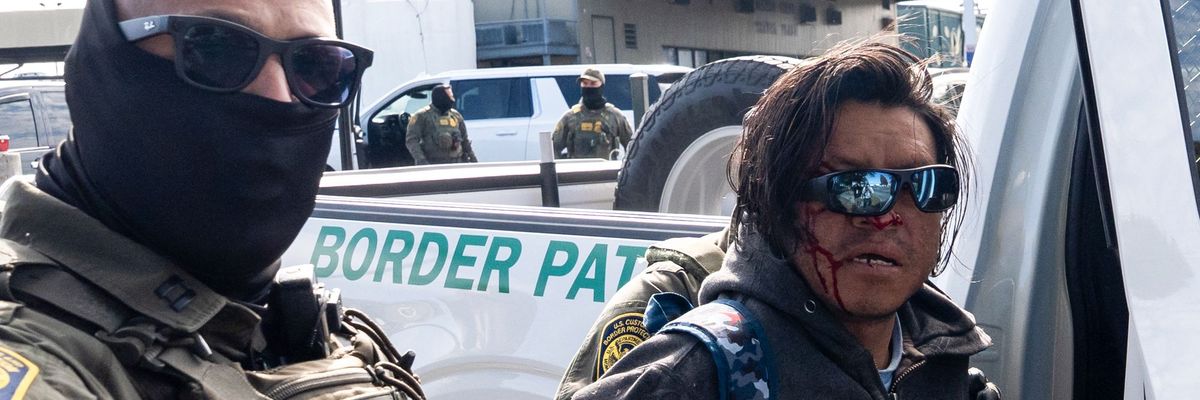
A [man] with a bloody face and sunglasses askew suggests a violent arrest by masked US Customs and Border Patrol agents in New Orleans on December 3, 2025. (Photo by Adam Gray/AFP via Getty Images)

“Our city is not a stage for political theater,” said the Democratic congressman representing New Orleans. “Our people are not props.”

The Trump administration on Wednesday launched a major operation against what it said are “criminal illegal aliens” in New Orleans but that critics contend is political theater targeting what the Louisiana city’s mayor-elect called people “just trying to survive and do the right thing.”

The Department of Homeland Security (DHS) said in a statement that it launched Operation Catahoula Crunch—which some Trump administration officials are also calling “Swamp Sweep”—because New Orleans is a sanctuary city that refuses to cooperate with the anti-immigrant crackdown ordered by President Donald Trump.

The blitz—which began on the same day as a similar operation in Minneapolis and follows federal invasions of cities including Charlotte; Chicago; Los Angeles; Memphis; Portland, Oregon; and Washington, DC—is expected to involve at least hundreds of federal agents and National Guard troops and reportedly aims for 5,000 arrests in Louisiana and Mississippi.

“Sanctuary policies endanger American communities by releasing illegal criminal aliens and forcing DHS law enforcement to risk their lives to remove criminal illegal aliens that should have never been put back on the streets,” Assistant Homeland Security Secretary Tricia McLaughlin said Wednesday.

While McClaughlin claimed the targets of the operation will be “monsters” that “include violent criminals who were released after arrest for home invasion, armed robbery, grand theft auto, and rape,” examination of detention statistics of similar operations in other communities has shown that a large percentage of those swept up have no criminal record.

Academic studies and analyses by both left– and right-wing groups and have repeatedly affirmed that undocumented immigrants commit crime at a dramatically lower rate than native-born US citizens. The libertarian Cato Institute last week published data showing that nearly three-quarters of the 44,882 people booked into Immigration and Customs Enforcement (ICE) custody since October had no criminal conviction and just 5% had been convicted of violent crimes.

Detention data published last month by the Department of Justice revealed that just 16 out of 614 people arrested in the Chicago area during DHS’s Operation Midway Blitz had criminal histories that present a “high public safety risk.”

Elected officials representing New Orleans called the DHS operation an unnecessary and unwelcome stunt.

“It’s one thing if you would have a real strategic approach on going after people… who have criminal felonies or are being accused of some very serious and violent crimes. But that’s not what the public is seeing,” Democratic New Orleans Mayor-elect Helena Morena told the Washington Post on Wednesday.

“They’re seeing people who are just trying to survive and do the right thing—and many of them now have American children who are not causing problems in our community—treated like they are violent, violent criminals,” she added.

Moreno’s website published a “know your rights” resource page with tips from the National Immigrant Justice Center—a move that could possibly run afoul of a state law cited by Republican Louisiana Attorney General Liz Murrill to threaten felony prosecution of people who nonviolently resist Trump’s crackdown. On Wednesday, the American Civil Liberties Union filed a federal lawsuit arguing that the law is a violation of the right to free speech.

Congressman Troy Carter (D-La.) said in a statement Tuesday that “if the administration truly wants to support public safety in New Orleans, they can help us recruit and retain well-trained local officers, invest in modern policing tools, and build transparent partnerships with city and parish leaders.”

New Orleans welcomes partnership. We do not welcome occupation.What we are seeing unfold in our community is not public safety; it is a political stunt wrapped in badges, armored vehicles, and military uniforms.

Congressman Troy A. Carter, Sr. (@reptroycarter.bsky.social) 2025-12-03T14:35:30.453Z

“Dropping armed federal agents and National Guard troops into our communities without coordination is not cooperation—it is chaos,” Carter continued. “As Congressman for New Orleans, I want to be clear: We will always stand for the rule of law. We will always stand for safe communities. And we will always stand against tactics that terrorize families and undermine public trust.”

“Our city is not a stage for political theater,” he added. “Our people are not props. If the administration wants to be a partner, then act like one; share the plan, respect local law, and work with us, not around us.”

Hundreds of New Orleans residents took to the streets Monday night despite cold, heavy rain to protest the impending DHS operation. Demonstrators shared umbrellas and held signs showing support for immigrants. They chanted messages, including “No ICE! No fear! Immigrants are welcome here!” and “Chinga la Migra”—roughly translated as “Fuck the Border Patrol.”

“We have to fight for the rights of everyone. I’m out here to support the immigrant community because it’s an integral part of New Orleans. New Orleans was built by immigrants,” protester Jamie Segura told Gambit.

Addressing the crowd at Monday’s rally, resident Mitch Gonzalez said: “This is my home. My trans sister was kidnapped and taken from me. Now she has to fight from Mexico, not even her home country, because they’re snatching people.”

https://twitter.com/i/status/1995859350053601339

As New Orleans residents anticipated the impending operation, mutual aid groups kicked into action in defense of immigrant communities, citing effective rapid response efforts in Chicago.

“What we’ve learned is that even a street witness who is not recording makes these interactions less traumatic and less violent,” Beth Davis, press liaison officer at Indivisible NOLA, told the Washington Post on Wednesday. “So we need to get eyes on these people.”

The New Orleans branch of Democratic Socialists of America—which is hosting training sessions—said ahead of the federal blitz: “We call upon all of New Orleans to get organized and resist this fascist occupation. Protect your neighbors and make these troops and federal agents feel unwelcome in every part of our city.”

Other Orleanians prepared by closing or displaying signs telling the federal invaders that they are not welcome.

“We’re going to make sure that any hotel that they stay at, any neighborhood that they try to terrorize, we’re going to bring as many people there to stop them in their tracks, whether it’s in New Orleans, Los Angeles, Chicago—anywhere in this country,” Antonia Mar of Freedom Road Socialist Organization told Verite News during Monday’s protest.

Suggesting that the crackdown could backfire, Mar added that “if there’s one thing Trump does well, he gets people organized against him.”

Original article by Brett Wilkins republished from Common Dreams under Creative Commons (CC BY-NC-ND 3.0).


Orcas discuss how Trump was re-elected and him being an obviously insane, xenophobic Fascist.

Continue Reading‘Political Stunt Wrapped in Badges’: New Orleans Readies Resistance as Trump Operation Begins

After Trump’s Latest Racist Rant, Ilhan Omar Hopes ‘He Gets the Help He Desperately Needs’

Spread the love

Original article by Jake Johnson republished from Common Dreams under Creative Commons (CC BY-NC-ND 3.0).

Rep. Ilhan Omar (D-Minn.) is seen before President Donald Trump’s address to a joint session of Congress in the House Chamber of the US Capitol on March 4, 2025. (Photo by Tom Williams/CQ-Roll Call, Inc. via Getty Images)

“His obsession with me is creepy,” said Rep. Ilhan Omar, the first Somali American ever elected to the US Congress.

Rep. Ilhan Omar, the first Somali American ever elected to the US Congress, said Tuesday that she hopes President Donald Trump “gets the help he needs” after he ended a Cabinet meeting with a bigoted tirade against Somali immigrants.

Trump specifically attacked Minnesota’s Somali community—falsely claiming that “they contribute nothing”—and singled out Omar (D-Minn) by name, calling her “garbage” and a “terrible person.”

Omar hit back in a brief social media post, characterizing the president’s remarks as clear evidence that he’s unwell.

“His obsession with me is creepy,” Omar wrote.

His obsession with me is creepy. I hope he gets the help he desperately needs. https://t.co/pxOpAChHse
— Ilhan Omar (@IlhanMN) December 2, 2025

Trump’s comments came as his administration prepared to target Somali immigrants with Immigration and Customs Enforcement (ICE) raids in the Minneapolis-St. Paul region. Around 80,000 Somalis live in Minnesota.

The New York Times reported Tuesday that the directive for ICE raids in Minnesota “came immediately after” Trump used his social media platform to launch an appalling attack on Somalis and others in the wake of the shooting of two National Guard members. The man charged with the shooting is an Afghan national who worked as a member of a CIA-backed “Zero Unit” during the war in Afghanistan before resettling in the US.

Kristi Noem, head of the US Department of Homeland Security, has exploited the shooting to ramp up the administration’s anti-immigrant agenda, proposing what she called “a full travel ban on every damn country that’s been flooding our nation with killers, leeches, and entitlement junkies,” echoing Trump’s white nationalist rhetoric.

Following Trump’s latest attack on Somalis, Minnesota Attorney General Keith Ellison said in a statement that the president’s “disgraceful attacks on Minnesota’s Somali community are injecting more of his poisonous racism into our beloved home state.”

“Hearing him single out our people based solely on their race and country of origin is downright disgusting,” Ellison said. “Minnesotans stand up for our neighbors when they’re under attack. And as Minnesota’s attorney general, I will use every tool I have to protect all our neighbors, including our vibrant Somali community, from these dangerous, racist threats. Our neighbors deserve no less.”

Original article by Jake Johnson republished from Common Dreams under Creative Commons (CC BY-NC-ND 3.0).

Orcas discuss how Trump was re-elected and him being an obviously insane, xenophobic Fascist.

Continue ReadingAfter Trump’s Latest Racist Rant, Ilhan Omar Hopes ‘He Gets the Help He Desperately Needs’

Ten years after the Paris Agreement, the super-rich are widening the emissions gap and putting world on track for catastrophe

Spread the love
Jeff Bezos's superyacht 'Koru' often travels accompanied by a smaller 'support' superyacht. Image by Conmat13 under the Creative Commons Attribution-Share Alike 4.0 International license via wikimedia.
Jeff Bezos’s superyacht ‘Koru’ often travels accompanied by a smaller ‘support’ superyacht. Image by Conmat13 under the Creative Commons Attribution-Share Alike 4.0 International license via wikimedia.

In response to the UNEP Emissions Gap Report published 4th November 2025, Nafkote Dabi, Climate Policy Lead at Oxfam, said:  

“Just days before global leaders arrive in Brazil for COP30, this report is a blaring siren calling for greater climate action.   

“Since the Paris Agreement, the richest 1% have used up more than twice the carbon budget of the poorest half of humanity. This inequality is more than unjust—it’s deadly. The extreme emissions of the richest people and countries are burning through the little remaining the amount of CO2 that can be emitted while avoiding climate disaster. Meanwhile, the poorest communities suffer the most devastating impacts.  

“Governments cannot close the emissions gap without slashing the carbon footprint of the super-rich and addressing extreme inequality. COP30 must be a turning point. Global leaders must cut the emissions of the richest, tax rich polluters and their profits, and deliver a just transition—one that creates decent green jobs, builds resilient economies, and puts people and planet before profit.”  

Image of a private jet by Andrew Thomas from Shrewsbury, UK. Licensed under the Creative Commons Attribution-Share Alike 2.0 Generic license.
Image of a private jet by Andrew Thomas from Shrewsbury, UK.

Oxfam’s recent report, “Climate Plunder: How a powerful few are locking the world into disaster”, presents new data which finds that a person from the richest 0.1% produces more carbon pollution in a day than the poorest 50% emit all year. If everyone emitted like the richest 0.1%, the carbon budget would be used up in less than 3 weeks.  

The “UN Emissions Gap report: Off Target” finds that global warming projections over this century, based on full implementation of updated government climate pledges, are 2.3-2.5°C, while those based on current policies are 2.8°C.

Elon Musk urges you to be a Fascist like him, says that you can ignore facts and reality then.
Donald Trump urges you to be a Climate Science denier like him. He says that he makes millions and millions for destroying the planet, Burn, Baby, Burn and Flood, Baby, Flood.
Nigel Farage urges you to ignore facts and reality and be a climate science denier like him and his Deputy Richard Tice. He says that Reform UK has received £Millions and £Millions from the fossil fuel industry to promote climate denial and destroy the planet.

Continue ReadingTen years after the Paris Agreement, the super-rich are widening the emissions gap and putting world on track for catastrophe

The angry tide of the Latin American far right

Spread the love

This article by Vijay Prashad republished from peoples dispatch under a Creative Commons Attribution-ShareAlike 4.0 (CC BY-SA) license.

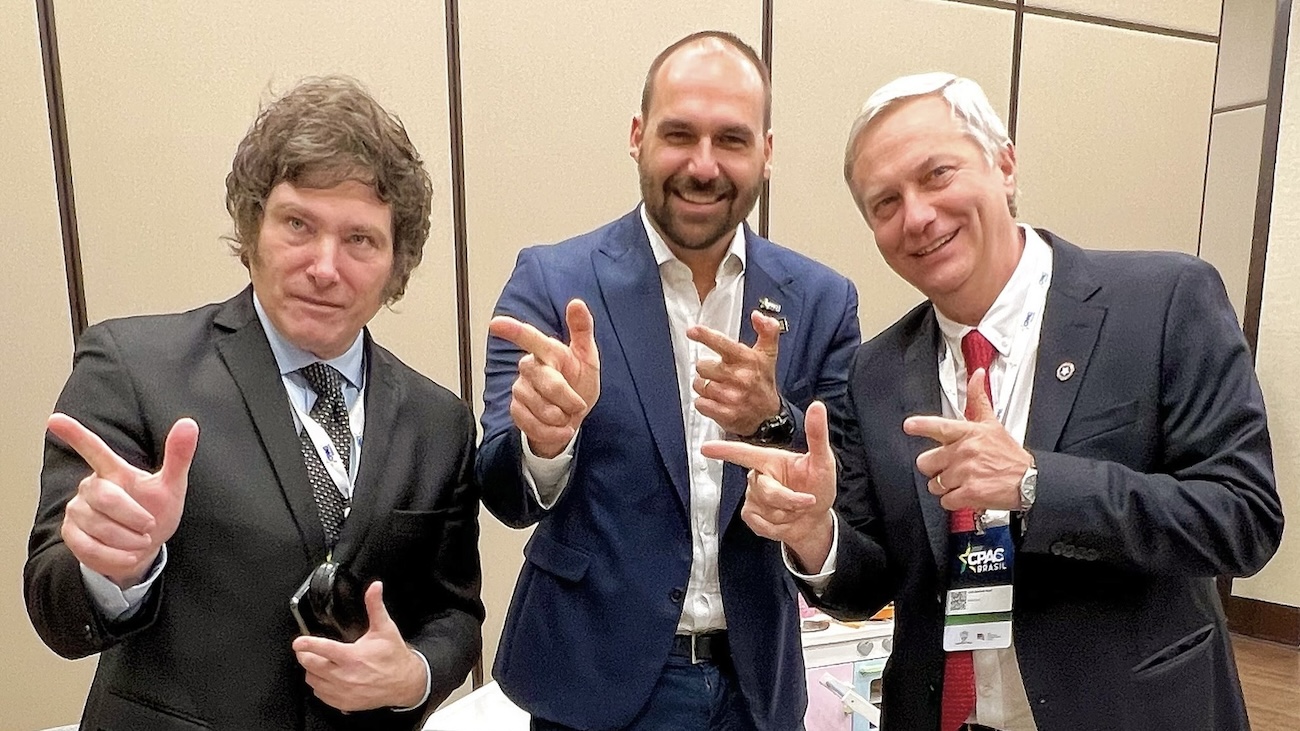
Argentine President Javier Milei, Brazilian legislator Eduardo Bolsonaro, and Chilean far-right presidential candidate José Antonio Kast at CPAC Conference in 2022. Photo: Eduardo Bolsonaro / X

The far right in Latin America is angry. Brazil’s Jair Bolsonaro and Argentina’s Javier Milei always look furious, and they always speak loudly and aggressively. Testosterone leaks from their pores, a toxic sweat that has spread across the region. It would be easy to say that this is the impact of Donald Trump’s own brand of neo-fascism, but this is not true. The far right has much deeper pedigrees, linked to the defense of the oligarchical families that have roots in the colonial era across the virreinatos (viceroyalties) from New Spain to Rio de la Plata. Certainly, these far right men and women are inspired by Trump’s aggressiveness and by the entry of Marco Rubio, a furious defender of the far right in Latin America, to the position of US Secretary of State. This inspiration and support are important but not the reason for the return of the far right, an angry tide that has been growing across Latin America.

On the surface, it looks as if the far right has suffered some defeats. Jair Bolsonaro is in prison for a very long time because of his role in the failed coup d’état on January 8, 2023 (inspired by Trump’s own failed coup attempt on January 6, 2021). In the first round of the presidential election in Chile, the candidate of the Communist Party, Jeannette Jara won the most votes and will lead the center-left bloc into the second round (December 14). Despite every attempt to overthrow the government of Venezuela, President Nicolás Maduro remains in charge and has mobilized large sections of the population to defend the Bolivarian Revolution against any threats. And, in late October 2025, most of the world’s countries voted for a UN General Assembly resolution that demands an end to the blockade on Cuba. These indicators – from Bolsonaro’s imprisonment to the vote on Cuba – suggest that the far right has not been able to move its agenda in every place and through every channel.

However, beneath the surface, there are indications that Latin America is not seeing the resurgence of what had been called the Pink Tide (after the election of Hugo Chávez in Venezuela in 1998) but is experiencing the emergence of an angry tide that slowly has begun to sweep the region from Central America down to the Southern Cone.

Elections in South America

The first round of the Chilean presidential election produced a worrying result. While Jara of the Communist Party won 26.85% of an 85.26% turnout, the far right’s José Antonio Kast came in second with 23.92%. Evelyn Matthei of the traditional Right won 12.5%, while the extreme right candidate who was once with Kast and now to his right, Johannes Kaiser, won 14%. It is likely that Jara will pick up some of the votes of the center, but not enough to overcome the advantage of the far right which looks to have at least more than 50% of the voters on its side. The so-called social liberal, Franco Parisi, who came in third, endorsed Kast in 2021 and will likely endorse him again. That means that in Chile, the presidency will be in the hands of a man of the far right whose ancestry is rooted in German Nazism (Kast’s father was a member of the Nazi Party who escaped justice through the intercession of the Vatican) and who believes that the dictatorship in Chile from 1973 to 1990 was on balance a good idea.

North of Chile, in Bolivia, the new president Rodrigo Paz Pereria, son of a former president, beat the far right’s Jorge Tuto Quiroga (a former president) in the second round of the election. This round had no candidate of the left, after the Movement for Socialism governed Bolivia continuously from 2006 to 2025. Paz’s own party has a minority position in the legislature and he will therefore have to align himself with the Quiroga’s Libre coalition and he will likely adopt a pro-US foreign policy and a libertarian economic policy. Peru will have its own election in April, where the former mayor of Lima – Rafael López Aliaga – is expected to win. He rejects the label far right but adopts all the generic policies of the far right (ultra-conservative Catholic, advocate for harsh security measures, and favors a libertarian economic agenda). Iván Cepeda of Colombia is the left’s likely candidate in their presidential election in May 2026, since Colombia does not permit second terms (so President Gustavo Petro cannot run again). Cepeda will face strong opposition from Colombia’s oligarchy which will want to return the country to their rule. It is too early to say who Cepeda will face, but it might be journalist Vicky Dávila, whose far right opposition to Petro is finding traction in unexpected parts of Colombian society. It is likely that by the middle of 2026, most of the states along the western edge of South America (from Chile to Colombia) will be governed by the far right.

Even as Bolsonaro is in prison, his party, the PL (or Liberal Party), is the largest bloc in Brazil’s National Congress. It is likely that Lula will be re-elected to the presidency next year due to his immense personal connection with the electorate. The far right’s candidate – who could be possibly Tarcísio de Freitas, the governor of São Paulo state, or one of the Bolsonaro’s (wife Michelle or son Flavio) – will struggle against him. But the PL will make inroads into the Senate. Their control over the legislature has already tightened the reins on the government (at COP30, Lula’s representative made no proposals to confront the climate catastrophe), and a Senate win will further their control over the country.

Common agenda of the angry tide

The Angry Tide politicians who are making waves have many things in common. Most of them are now in their fifties – Kast (born 1966), Paz (born 1967), Venezuelan politician María Corina Machado (born 1967), and Milei (born 1970). They came of age in the post-dictatorship period in Latin America (the last dictatorship to end was in Chile in 1990). The decade of the 1990s continued the economic stagnation that characterized the 1980s: the Lost Decade (La Década Perdida) that convulsed these countries with low growth rates and with poorly developed comparative advantages forced into globalization. It was in this context that these politicians of the Angry Tide developed their common agenda:

Anti-Communism. The far right in Latin America is shaped by an anti-left agenda that it inherits from the Cold War, which means that its political formations typically endorse the era of US-backed military dictatorships. The ideas of the left, whether from the Cuban Revolution (1959) or from the era of the Pink Tide (after 1998), are anathema to these political forces; these ideas include agrarian reform, state-led finance for industrialization, state sovereignty, and the importance of trade unions for all workers and peasants. The anti-communism of this Angry Tide is rudimentary, mother’s milk to the politicians and used cleverly to turn sections of society against others.

Libertarian Economic policies. The economic ideas of the Angry Tide are shaped by the Chilean “Chicago Boys” (including Kast’s brother Miguel who was the head of General Augusto Pinochet’s Planning Commission, his Minister of Labor, and his head of the Central Bank). They directly take their tradition from the libertarian Austrian School (Friedrich Hayek, Ludwig von Mises, and Murray Rothbard as well as Milton Friedman). The ideas were cultivated in well-funded think tanks, such as the Centro de Estudios Macroeconómicos de Argentina (founded in 1978) and the Chilean Centro de Estudios Públicos (founded in 1980). They believe the State should be a force to discipline the workers and citizens, and that the economy must be in the hands of private interests. Milei’s famous antics with a chainsaw illuminate this politics not only of cutting social welfare (the work of neoliberalism) but of destroying the capacity of the State itself.

Culture Wars. Drawing on the wave of anti-gender ideology and anti-migration rhetoric, the Angry Tide has been able to appeal to conservative evangelical Christians and to large sections of the working class that has been disoriented by changes seen to come from above. The far right argues that the violence in working class neighborhoods created by the drug industry is fostered by “liberalism” and that only tough violence (as demonstrated by El Salvador’s president Nayib Bukele) can be the solution; for this reason, they want to strengthen the military and police and set aside constitutional limitations on use of force (on October 28, the government of Bolsonaro ally Cláudio Castro in Rio de Janeiro sent in the police who killed at least 121 people in Operation Containment). It helps the far right that it adopted various conspiracy theories about how the “elites” have spread “globalized” ideas to damage and destroy the “culture” of their nations. This is a ludicrous idea coming from far right and traditional right political forces that champion full-scale entry of US corporations into their society and culture, and that have no respect for the histories of struggle of the working class and peasantry to build their own national and regional cultural worlds. But the Angry Tide has been able to construct the idea that they are cultural warriors out to defend their heritage against the malignancies of “globalization”. Part of this culture war is the promotion of the individual entrepreneur as the subject of history and the denigration of the necessity of social reproduction.

It is these three elements (anti-communism, libertarian economic policies, and the culture wars) that brings together the far right across Latin America. It provides them with a robust ideological framework to galvanize sections of the population to believe that they are the saviours of the hemisphere. This Latin American far right is backed by Trump and the international network of the Spanish far right (the Foro Madrid, created in 2020 by Fundación Disenso, the think tank of the far right Vox party). It is heavily funded by the old elite social classes, who have slowly abandoned the traditional Right for these new, aggressive far right parties.

Crisis of the Left

The Left is yet to develop a proper assessment of the emergence of these parties and has not been able to drive an agenda that sparkles with vitality. A deep ideological crisis grips the Left, which cannot properly decide whether to build a united front with the traditional right and with liberals to contest elections or to build a popular front across the working class and peasantry to build social power as a prelude to a proper electoral push. The example of the former strategy (the electoral alliance) comes from Chile, where first the Concertación de Partidos por la Democracia (Concertación) formed in 1988 to keep out the parties of the dictatorship from power and second the Apruebo Dignidad formed in 2021 that brought Gabriel Boric of the centrist Broad Front to the presidency. But outside Chile, there is little evidence that this strategy works. The latter has become harder as unionization rates have collapsed, and as uberization individualizes the working class to erode working class culture.

It is telling that Bolivia’s former socialist Vice President Álvaro García Linera looked northwards to New York City for inspiration. When Zohran Mamdani won the mayor’s race, García Linera said, “Mamdani’s victory shows that the left must commit to boldness and a new future.” It is hard to disagree with this statement; although, Mamdani’s own proposed agenda is mostly to salvage a worn-out New York infrastructure rather than to advance the city to socialism. García Linera did not mention his own time in Bolivia, when he tried with former president Evo Morales to build a socialist alternative. The left will have to be bold, and it will have to articulate a new future, but it will have to be one that emerges from its own histories of building struggles and building socialism.

Vijay Prashad is an Indian historian, editor, and journalist. He is a writing fellow and chief correspondent at Globetrotter. He is an editor of LeftWord Books and the director of Tricontinental: Institute for Social Research. He has written more than 20 books, including The Darker Nations and The Poorer Nations. His latest books are On Cuba: Reflections on 70 Years of Revolution and Struggle (with Noam Chomsky), Struggle Makes Us Human: Learning from Movements for Socialism, and (also with Noam Chomsky) The Withdrawal: Iraq, Libya, Afghanistan, and the Fragility of US Power.

(*) First published in People’s Democracy

This article by Vijay Prashad republished from peoples dispatch under a Creative Commons Attribution-ShareAlike 4.0 (CC BY-SA) license.

Donald Fuhrump says that Amerikkka doesn't bother with crimes or charges anymore, not being 100% Amerikkkan and opposing his real estate intentions is enough.
Donald Fuhrump says that Amerikkka doesn’t bother with crimes or charges anymore, not being 100% Amerikkkan and opposing his real estate intentions is enough.
Continue ReadingThe angry tide of the Latin American far right

Democracy vs. intervention: Honduras votes amid US pressure campaign

Spread the love

This article by Zoe Alexandra republished from peoples dispatch under a Creative Commons Attribution-ShareAlike 4.0 (CC BY-SA) license.

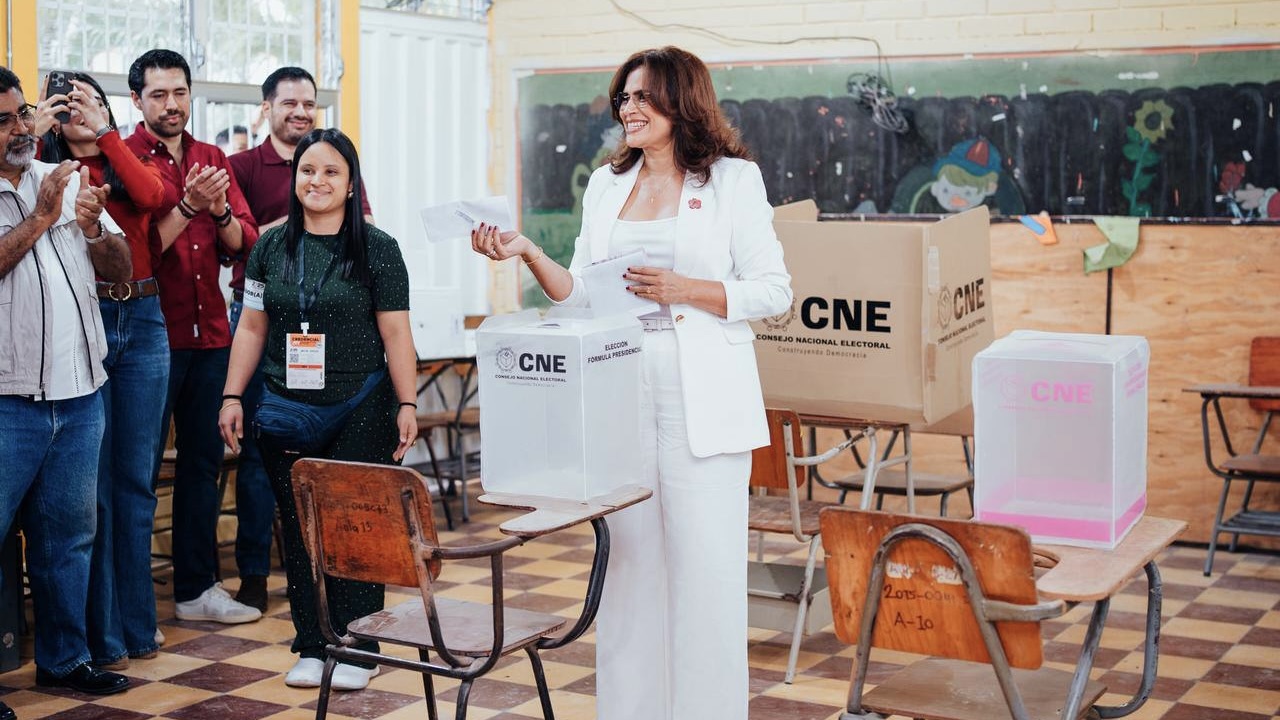
Progressive candidate Rixi Moncada voting on Sunday, November 30, 2025. Photo: LIBRE Party / X

The US escalation of interventionist discourse regarding the polls in Honduras reveals the deep-seated fear of the victory of a progressive project in the Americas

The people of Honduras are voting in general elections to decide their next president, 128 deputies to the Honduran Congress, 20 deputies to the Central American Parliament, 298 mayors, and more than 2,000 councilors. Most of the attention has been focused on the presidential election, which will be decided in a single round. The three frontrunners for the presidency are progressive candidate for the LIBRE Party Rixi Moncada; right-wing Liberal Party candidate Salvador Nasralla; and far-right National Party candidate Nasry Asfura.

Read more: Between progressivism and neoliberalism: Honduras decides its future

Six million Hondurans are eligible to vote in these general elections which have become the subject of debate of far-right figures from across the world, who are all warning about the possible “triumph of communism” in the Central American country. However, the external intervention in the elections has gone beyond comments on social media about the “danger” represented by progressive candidate from the LIBRE Party Rixi Moncada.

In a move shocking many, on Friday, November 28, US President Donald Trump announced that he would pardon former Honduran president Juan Orlando Hernández (JOH), adding, “according to many people that I greatly respect, [he has been] treated very harshly and unfairly. This cannot be allowed to happen, especially now, after Tito Asfura wins the Election, when Honduras will be on its way to Great Political and Financial Success.” In the message, Trump reiterated his support to National Party candidate Tito Asfura and declared that if he doesn’t win the US will “not be throwing good money after bad, because a wrong Leader can only bring catastrophic results to a country.”

Is communism really on the ballot? Why has the electoral process in the Central American country become a focus of the right wing internationally? Peoples Dispatch spoke to Camilo Bermúdez, the Director of Strategic Litigation and Management of the Civic Council of Popular and Indigenous Organizations of Honduras (COPINH) about what is at stake in this political moment in the country.

Beyond who, what is on the ballot?

As previously mentioned, the candidates polling the highest ahead of the elections are Rixi Moncada, Salvador Nasralla, and Tito Asfura. For Bermúdez, while there are three candidates, there are “clearly two political models in confrontation”.

He explains that at the base of the political project represented by LIBRE veteran Moncada is “a strong criticism of the economic system and the economic elites in Honduras”. Moncada, he emphasizes, “has been very open in criticizing, from her positions as Finance Minister and other roles she has held, the control of the country’s economy by ten families and about 26 economic groups that have [historically] controlled the main sectors of the country’s economy. She has criticized this control, the lack of tax justice, and the lack of economic democratization.” In addition to her critiques of the neoliberal economic model dominant in the country, Rixi represents “a project of continuity with President Xiomara Castro’s social program and LIBRE Party, who are heirs to the resistance and opposition to the 2009 coup d’état that overthrew Manuel Zelaya Rosales.” It is a progressive project which calls itself socialist, but mired with “many internal contradictions due to the same contradictions in LIBRE Party’s composition,” Bermúdez adds.

The other model is represented by Asfura and Nasralla, who, despite running with the country’s historically opposed parties, represent a very similar political project. This is “a traditional project of the Honduran right” which is one aligned with “private enterprise, aligned with the interests of large landowners, of large national and international corporations, and that seeks the approval of the United States Embassy in order to govern.”

The difference, Bermúdez underscores, is that Asfura is “more related to the post-coup regime, an authoritarian regime very linked to organized crime and drug trafficking. He’s from the party of President Juan Orlando, who was extradited and sentenced to 45 years in prison in the United States for drug trafficking.”

Meanwhile, Nasralla, while maintaining similar political and economic proposals to the National Party, has attempted to distance himself from organized crime, declaring himself “clean” and corruption free. Nevertheless, the COPINH organizer warns, “the political support and backing for candidate Nasralla clearly also comes from that background – for example, from business groups, corporate media groups, and also financial companies like Banco FICOHSA, which is linked to the assassination of Berta Cáceres and also to money laundering from drug trafficking.”

Under the National Party rule following the coup d’état in 2009, an all out neoliberal offensive was unleashed in the country to accelerate natural resource plundering in Indigenous and Garifuna territories, establish Special Economic Development Zones ( ZEDES) to favor international investment with the suspension of labor laws, and the privatization of state companies. Rolling back this model, which caused environmental devastation, social conflict, territorial breakdown, deep inequality and poverty, and the extraction of the country’s wealth by national and international private companies, was a cornerstone of Xiomara Castro’s 2021 campaign.

This effort has been the basis of much of the opposition she faces both by Honduran elites and international capital that, for years, had heeded the call of “Honduras is open for business” and profited immensely from the country’s cheap labor, natural resources, and relaxed labor and environmental laws. In 2017, the National Party committed outright electoral fraud, recognized even by the Organization of American States (OAS) in order to maintain their grasp on power.

Is fraud or non-recognition on the table?

The 2017 fraud is fresh in people’s minds, not only for how US President Donald Trump provided the necessary stamp of approval to his ally Juan Orlando Hernández to consolidate the fraud, but also how the event provoked mass protests and unrest across the country and the death of at least 35 protesters, with dozens imprisoned.

This time around, the possibilities for the right wing to influence the outcome of the polls are different. The leading scenario that analysts predict is an attempt by the right wing to orchestrate a non-recognition in the case of Moncada’s victory, which for Bermúdez has the sole purpose of “triggering a process of instability”. Suspicion has already been raised both within Honduras and outside the country by right-wing actors questioning the effectiveness of the electoral system for the mere reason that there is a progressive government in office. Some analysts warn that right-wing media and figures may seek to heavily promote exit polls and any results from the rapid count that would contradict the official results that will take some time to be released. Some may remember this formula from the 2019 Bolivian elections which were followed by a month of right-wing street protest against “fraud”, and ended with the overthrow of Evo Morales. Last year’s elections in Venezuela, saw a similar formula implemented: right-wing fraud allegations, echoed by the United States, which fed and fomented violent street protests a day after the elections, yet popular mobilization by Chavismo was successful in defeating this coup attempt.

Bermúdez explains, “We believe this could be what the opposition wants, with the backing of the United States government: a process of instability in which they seek to delegitimize Rixi Moncada’s victory and try to apply pressures similar to what has happened in Venezuela, trying to destabilize a progressive project, a possible progressive government project like Rixi Moncada’s.”

In this scenario, the COPINH organizer underlines, “The position taken by the Honduran Armed Forces will be very important, since they are supposedly called upon to defend the electoral process – but in 2009 they carried out the coup.” Notably though, “the current Xiomara Castro government has had a very close relationship with this Armed Forces sector.”

Bermúdez highlights that the streets will become the most important scenario in coming days if actions of non-recognition and attempts to destabilize the country after a Rixi Moncada victory go forward. In this case, “the Libre Party militants will take to the streets, because this is a militancy that emerged in the streets, from the post-coup resistance movement, and it’s a party and militancy accustomed to social protest. So we foresee that faced with any such action, there will also be a response of popular mobilization.”

“What will be very important won’t really be election day itself, because there isn’t an immediate vote counting system – moreover, it has been denounced as a system that could have been hacked or is unreliable. So the results won’t come on the same day; results will possibly come the following day, a couple of days later, after all the tally sheets from the polling stations have arrived at a location for manual counting of each sheet, and then that becomes the official result,” Bermúdez emphasizes.

US interference

A constant in Honduran politics, has been the outsized role of the United States leaders, in shaping the country’s present and future. Yet, Trump’s recent statements and actions have gone a step further.

“There is great concern in the country about that statement from the United States government…Obviously the US Embassy and State Department have great influence in Central American countries and great influence in Honduras, but we’ve never seen such blatant and interventionist pronouncements, which demonstrate the nature of US government policy,” Bermúdez remarks.

This in reference to the pardon of JOH couched in the endorsement of National Party candidate Asfura.

JOH was arrested on February 16, 2022, by Honduran police following an extradition request from the United States for conspiring to traffic drugs in the US. Two months later, on April 21, 2022, Hernández was extradited to the United States. In June 2024, JOH was sentenced by a US judge to 45 years in prison for the crime of exporting more than 400 tons of cocaine to the United States and for the possession of “destructive devices”. At the time, the judge, Kevin Castel, called Hernández “a two-faced politician” because, on the one hand, he claimed to fight drug trafficking in his country, while, on the other hand, he supported the drug cartels. Prosecutors alleged that the former president built a “Narco-State” in which he personally received millions of dollars in bribes from drug traffickers.

Read more: Hondurans intensify protests demanding JOH’s resignation after report links him to drug trafficking

Bermúdez believes that the explicit support from Trump and other US officials for Asfura, and the explicit rejection of Moncada and LIBRE, “has to do with an international campaign to fight against any kind of progressive perspective in Latin America, under the outdated discourse of communism linked to a supposed fight against drug trafficking and what they call ‘narcoterrorism.’” “Narcoterrorism”, he explains, “is the policy the United States government develops to attack Venezuela, to enter into deep contradiction with the governments of Colombia, Mexico, and Brazil. So we believe this fits within this dynamic of the growth of the right-wing that we are seeing internationally, of these authoritarian and extreme-right discourses that seek shelter in this narcoterrorism discourse, attempting to link it to the revolutionary processes in Venezuela and Cuba.”

Yet, the outright violations of Honduran sovereignty and rule of law by the US president and their potential to sow chaos, are also telling. Bermúdez said, such actions show “the fear they have of a progressive project that could be executed by candidate Rixi Moncada, and also the expectation and perspective they have that she could be the candidate favored by the popular vote – because if that weren’t the case, we believe they wouldn’t take such a decisive, forceful, and strong position like that of the US president, who, it goes without saying, very possibly doesn’t even know where Honduras is, yet is speaking in favor of one of the candidates.”

Bermúdez states that at the end of the day, “no matter how blatant this interference is and no matter how powerful Donald Trump’s government is, the decision lies with the people. And I think it’s also a call to awareness for the people to take the reins and make decisions about their future.”

This article by Zoe Alexandra republished from peoples dispatch under a Creative Commons Attribution-ShareAlike 4.0 (CC BY-SA) license.

Donald Fuhrump says that Amerikkka doesn't bother with crimes or charges anymore, not being 100% Amerikkkan and opposing his real estate intentions is enough.
Donald Fuhrump says that Amerikkka doesn’t bother with crimes or charges anymore, not being 100% Amerikkkan and opposing his real estate intentions is enough.

Continue ReadingDemocracy vs. intervention: Honduras votes amid US pressure campaign