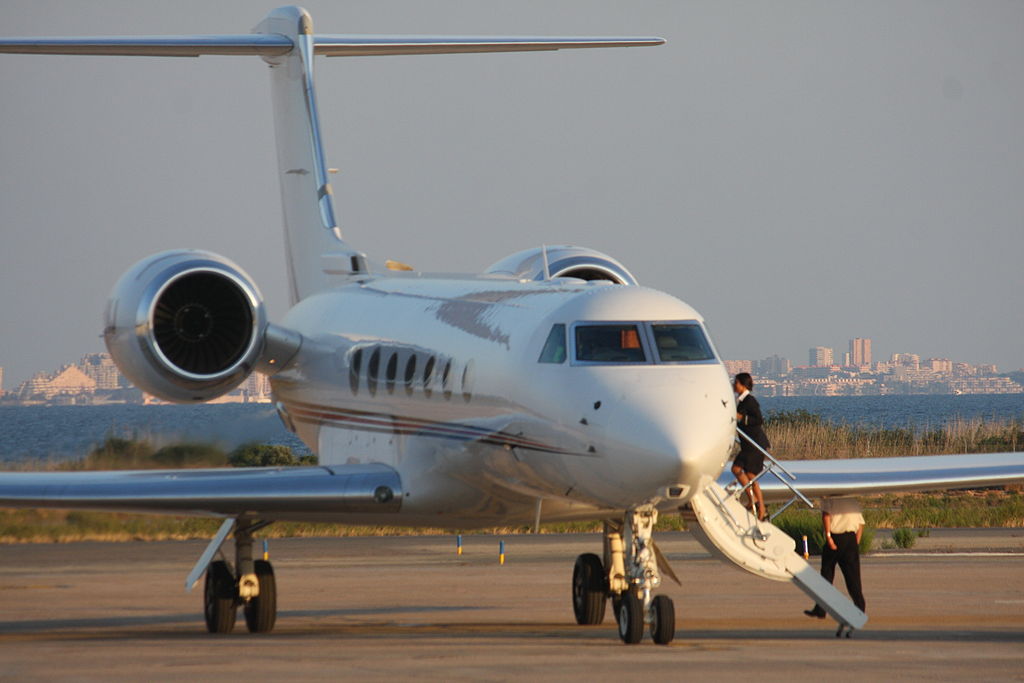
Image of a private jet by Andrew Thomas from Shrewsbury, UK.
Billionaire investments in polluting industries such as fossil fuels and cement double the average for the Standard and Poor group of 500 companies – Oxfam
The investments of just 125 billionaires emit 393 million tonnes of CO2 each year – the equivalent of France – at an individual annual average that is a million times higher than someone in the bottom 90 percent of humanity.
Carbon Billionaires: The investment emissions of the world’s richest people, is a report published by Oxfam based on a detailed analysis of the investments of 125 of the richest billionaires in some of the world’s biggest corporates and the carbon emissions of these investments. These billionaires have a collective $2.4 trillion stake in 183 companies.
The report finds that these billionaires’ investments give an annual average of 3m tonnes of CO2e per person, which is a million times higher than 2.76 tonnes of CO2e which is the average for those living in the bottom 90 percent.
The actual figure is likely to be higher still, as published carbon emissions by corporates have been shown to systematically underestimate the true level of carbon impact, and billionaires and corporates who do not publicly reveal their emissions, so could not be included in the research, are likely to be those with a high climate impact.
“These few billionaires together have ‘investment emissions’ that equal the carbon footprints of entire countries like France, Egypt or Argentina,” said Nafkote Dabi, Climate Change Lead at Oxfam “The major and growing responsibility of wealthy people for overall emissions is rarely discussed or considered in climate policy making. This has to change. These billionaire investors at the top of the corporate pyramid have huge responsibility for driving climate breakdown. They have escaped accountability for too long,” said Dabi.
Jeff Bezos’s superyacht ‘Koru’ often travels accompanied by a smaller ‘support’ superyacht. Image by Conmat13 under the Creative Commons Attribution-Share Alike 4.0 International license via wikimedia.
“Emissions from billionaire lifestyles, their private jets and yachts are thousands of times the average person, which is already completely unacceptable. But if we look at emissions from their investments, then their carbon emissions are over a million times higher,” said Dabi.
Contrary to average people, studies show the world’s wealthiest individuals’ investments account for up to 70 percent of their emissions. Oxfam has used public data to calculate the “investment emissions” of billionaires with over 10 percent stakes in a corporation, by allocating them a share of the reported emissions of the corporates in which they are invested in proportion to their stake.
The study also found billionaires had an average of 14 percent of their investments in polluting industries such as energy and materials like cement. This is twice the average for investments in the Standard and Poor 500. Only one billionaire in the sample had investments in a renewable energy company.
The choice of investments billionaires make is shaping the future of our economy, for example, by backing high carbon infrastructure – locking in high emissions for decades to come. The study found that if the billionaires in the sample moved their investments to a fund with stronger environmental and social standards, it could reduce the intensity of their emissions by up to four times.
“The super-rich need to be taxed and regulated away from polluting investments that are destroying the planet. Governments must put also in place ambitious regulations and policies that compel corporations to be more accountable and transparent in reporting and radically reducing their emissions,” said Dabi.
Oxfam has estimated that a wealth tax on the world’s super-rich could raise $1.4 trillion a year, vital resources that could help developing countries – those worst hit by the climate crisis – to adapt, address loss and damage and carry out a just transition to renewable energy. According to the UNEP adaptation costs for developing countries could rise to $300 billion per year by 2030. Africa alone will require $600 billion between 2020 to 2030. Oxfam is also calling for steeply higher tax rates for investments in polluting industries to deter such investments.
The report says that many corporations are off track in setting their climate transition plans, including hiding behind unrealistic and unreliable decarbonization plans with the promise of attaining net zero targets only by 2050. Fewer than one in three of the 183 corporates reviewed by Oxfam are working with the Science Based Targets Initiative. Only 16 percent have set net zero targets.
Donald Trump urges you to be a Climate Science denier like him. He says that he makes millions and millions for destroying the planet, Burn, Baby, Burn and Flood, Baby, Flood.Nigel Farage urges you to ignore facts and reality and be a climate science denier like him and his Deputy Richard Tice. He says that Reform UK has received £Millions and £Millions from the fossil fuel industry to promote climate denial and destroy the planet.Keir Starmer commits to play the caretaker role for Capitalism through the “hard times”.
Since then, Reeves – now Britain’s chancellor – has barely mentioned the scheme that leases 300,000 cars a year to people with mobility problems, aside from criticising Tory cuts affecting its users.
Nor did it crop up in Labour’s manifesto, which promised to put disabled people’s “views and voices at the heart of all we do”.
But late last year, the idea that Motability was offering disabled people “free” BMWs and Mercedes became a repeated rightwing talking point fuelled by social media accounts on Elon Musk’s X.
In fact, the cars are funded by people’s disability benefit payments, topped up with their own contributions.
From there, articles began to spring up in the tabloid press reproducing social media memes calling for Motability vehicles to be made more ugly, and the furore spread to the speeches of Kemi Badenoch and Nigel Farage – and, finally, grabbed the attention of the Treasury.
At the budget, Reeves for the first time publicly identified the programme as a problem, saying it “was set up to protect the most vulnerable, not to subsidise the lease on a Mercedes-Benz”.
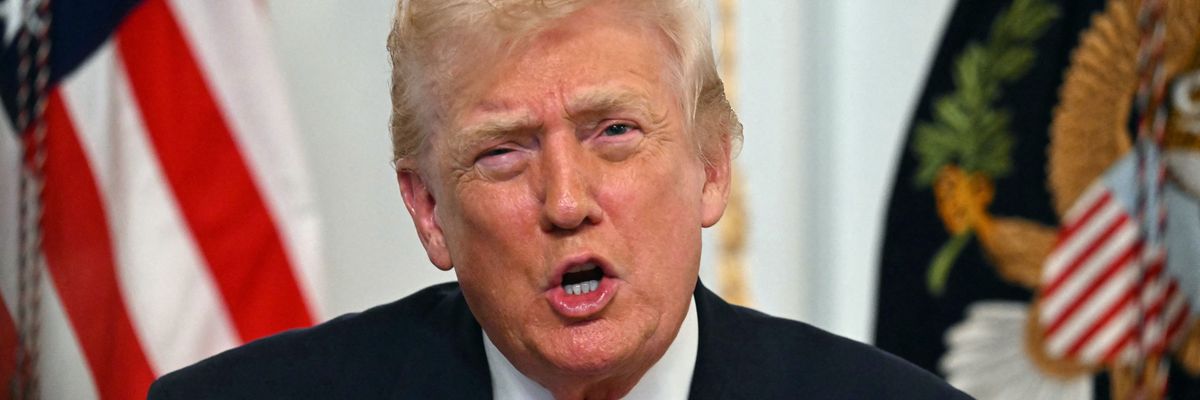
US President Donald Trump participates in a video call with service members from his Mar-a-Lago residence in Palm Beach, Florida, on November 27, 2025, during the Thanksgiving holiday. (Photo by Jim Watson/AFP via Getty Images)
“Even if unenforced, Trump’s declaration functions as an improvised, extralegal no-fly zone created through fear, FAA warnings, and military pressure,” said the anti-war group CodePink.
Policy experts and advocates on Saturday denounced President Donald Trump’s claim that he had ordered the airspace above and around Venezuela “to be closed in its entirety”—an authority the US president does not have but that one analyst said signaled a “scorched earth” policy in the South American country and that others warned could portend imminent airstrikes.
Francisco Rodriguez, a senior research fellow at the Center for Economic and Policy Research, said that after months of escalating tensions driven by Trump’s strikes on boats in the Caribbean and other aggressive actions, the US government was treating the Venezuelan people as “chess pieces.”
“A country subject to air isolation is a country where medicine and essential supplies cannot enter, and whose citizens cannot travel even for emergency reasons,” Rodriguez told Al Jazeera.
US strikes on vessels in the Caribbean and the eastern Pacific have killed at least 83 people since early September, with Defense Secretary Pete Hegseth reportedly ordering US military officers to “kill everybody” on board when he directed the first strike. The administration claims it is conducting the strikes to stop drug trafficking from Venezuela, though US and international intelligence has shown the South American country is not involved in trafficking fentanyl to the US and serves as only a transit hub—but not a major production center—of cocaine.
The Trump administration has claimed it is engaged in an “armed conflict” with Venezuela, though Congress has not authorized any such conflict. Lawmakers from both sides of the aisle have introduced war powers resolutions to stop Trump from conducting more attacks on boats and inside Venezuela, where the president has also authorized covert CIA operations and has threatened to launch strikes.
On Thursday, Trump said in a statement to US service members that the military could begin targeting suspected drug traffickers on land “very soon,” before claiming the country’s airspace was closed Saturday morning.
To all Airlines, Pilots, Drug Dealers, and Human Traffickers, please consider THE AIRSPACE ABOVE AND SURROUNDING VENEZUELA TO BE CLOSED IN ITS ENTIRETY. Thank you for your attention to this matter! PRESIDENT DONALD J. TRUMP
The US has also sent an aircraft carrier and 10,000 troops to the region in the largest US deployment to Latin America in decades.
The Federal Aviation Administration (FAA) last week urged civilian aircraft to “exercise caution” when flying over Venezuela due to the “worsening security situation and heightened military activity in or around” the country.
That warning led six airlines to suspend flights to Venezuela, which in turn prompted President Nicolás Maduro’s government to ban the companies, including Turkish Airlines, Spain’s Iberia, Portugal’s TAP, Colombia’s Avianca, Chile and Brazil’s LATAM, and Brazil’s GOL. Maduro accused the airlines of “joining the actions of state terrorism promoted by the United States government.”
The anti-war group CodePink said Trump’s claim about Venezuelan airspace represented “a dangerous escalation with no legal basis and enormous regional consequences.”
“The United States has no authority to close another country’s airspace,” said the group. “Under international law, only Venezuela can determine the status of its skies and enforcing a foreign no-fly zone without UN authorization or host-state consent would constitute an act of war. Even if unenforced, Trump’s declaration functions as an improvised, extralegal no-fly zone created through fear, FAA warnings, and military pressure.”
Trump’s actions in Venezuela in recent weeks—which come two years after the president explicitly said he wanted to take control of the country’s vast oil reserves—“form a familiar pattern,” said CodePink.
“Manufacture a crisis, then paint a sovereign government as a danger to US interests, and finally use the manufactured urgency to justify military measures that would otherwise be politically impossible,” said the group. “Trying to ‘close’ the airspace of another country is an act of aggression. It risks flight disruptions, economic panic, and aviation accidents. It is also an attempt to isolate Venezuela without admitting that the US is imposing a de facto blockade. The people of Venezuela have lived with the consequences of Washington’s reckless interventions. They deserve peace, not another manufactured war.”
“Diplomacy, not domination, remains the only path that respects international law and regional sovereignty,” added CodePink. “Hands off Venezuela. Hands off Latin America.”
Charles Samuel Shapiro, a former US ambassador to Venezuela, emphasized that Trump’s latest move in what he claims is a battle against drug trafficking came a day after he announced a pardon for right-wing former Honduran President Juan Orlando Hernández, who was convicted of working with drug traffickers.
“The whole drug trafficking thing is simply a pretext,” Shapiro told Al Jazeera. “If you look at the US government’s own reports, drugs coming into the United States from Venezuela are minimal, so declaring these people to be ‘narcoterrorists’—it makes no sense.”
Donald Fuhrump says that Amerikkka doesn’t bother with crimes or charges anymore, not being 100% Amerikkkan and opposing his real estate intentions is enough.
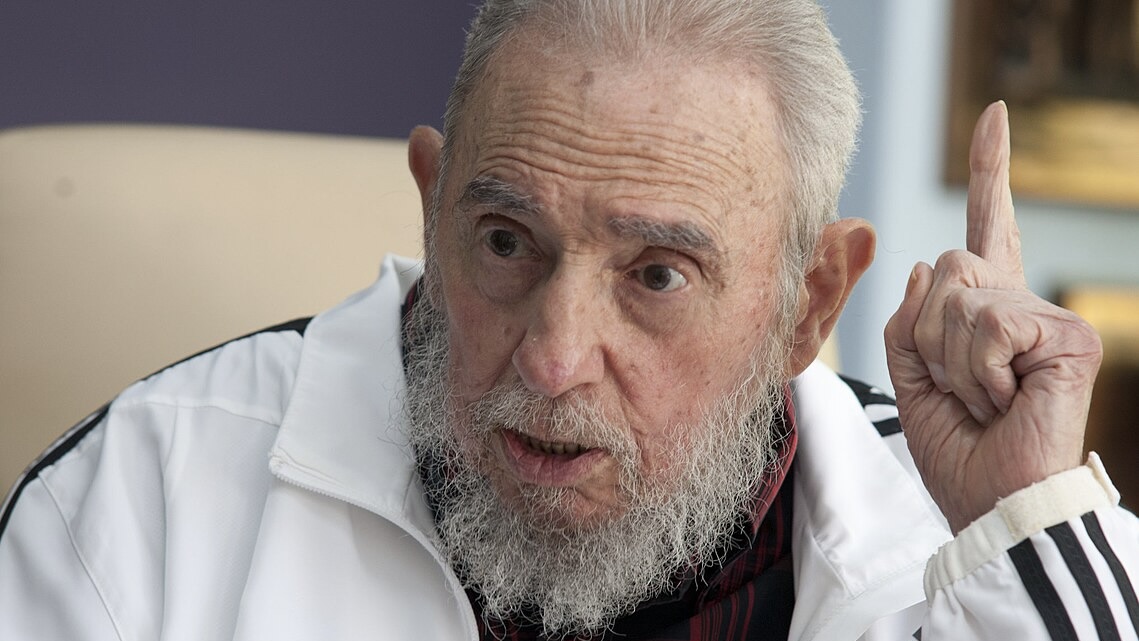
Cuban revolutionary leader Fidel Castro in 2014. Photo: Wikimedia Commons
Nine years after his death, we look back at some of the most relevant themes in Fidel Castro’s final writings after stepping down as President of Cuba.
Fidel Castro is often remembered as one of the most iconic leaders of the 20th century. Despite Washington’s unrelenting attempts to overthrow and even assassinate him, Fidel continued his rule and the development of the Cuban Revolution, which began in 1959 after the overthrow of Fulgencio Batista.
Much is written on his reflections on the development of the revolutionary struggle in the second half of the 20th century, his emblematic speeches, and his universal vision that combined the best of Leninist pragmatism with the sharpness of anti-colonial critical thinking. But Fidel’s vision of the future of humanity during his last years of life, an activity that demanded many hours of reading and writing, is often overlooked.
In fact, Fidel resigned as President of Cuba in 2008, with the aim of ensuring that the transition to another leader would not jeopardize the existence of the Cuban Revolution; many believed that after his death, the Communist Party of Cuba’s government would collapse.
And while many said that Fidel continued to lead the country after his resignation, the truth is that his production of essays and articles increased exponentially. Foreign policy, ecology, coups d’état, and even reflections on baseball and sports were all topics that Castro covered in his copious written work, generally published in Cuban and international newspapers.
The right to live
Fidel insisted that if human beings continued down the path of savage capitalism, they would bring about the end of their own existence. For Fidel, climate change was not only a transformation of certain environmental aspects, but also the destruction of human existence: “Continuing the battle and demanding at all meetings, particularly those in Bonn and Mexico, the right of humanity to exist… is, in our opinion, the only way forward.”
Here Fidel took a stance far removed from any short- or medium-term ideological dispute to adopt a long-term vision, according to which human beings have been incapable of properly managing a legacy of billions of years once they appeared on Earth: “[Human beings] benefit from a fabulous legacy of 4 billion years provided by the Earth… They are only 200,000 years old, but they have already changed the face of the world.”
Furthermore, he found any kind of military spending deeply inappropriate in the face of the inexorable arrival of the end of humanity. “The world is suffering the consequences of climate change at the same time;… A war was the most inappropriate thing that could happen at this time.”
The nuclear danger
Few people knew more about an almost imminent nuclear war than Fidel Castro. During the Cuban Missile Crisis, the world was on the brink of self-destruction. This concern never left Castro, when he warned of the massacre that would take place years later in Palestine: “As soon as the warships of the United States and Israel take their positions… the terrible war will begin.”
Furthermore, he clearly understood that a large-scale war, especially a nuclear one, would not transform the balance of power between social classes. Thus, he warned that after such a war, only “the administration of goods and services” would remain, and it would be carried out by the same elites that currently exist.
Imperialism as a method of domination
Fidel never abandoned the idea that imperialism continued to be the capitalist system’s most refined method for extracting value and subjugating the peoples of the Third World. Militaristic policy, the essence of imperialism, could never abandon its development, even at the expense of other more pressing needs.
He emphasized that in 2008, 42% of global spending was on military expenses: “While USD 1.5 trillion is spent on defense, the number of hungry people in the world reaches 1 billion.” This disparity was no accident, but rather a strategy executed by the great powers, under the pretext of defense cooperation, to impose economic programs and projects that further dispossess Third World countries. Thus, he openly criticized Obama’s foreign policy for Latin America as a ploy to control the Amazon
Science and technology
Fidel’s Marxism could not ignore the impressive technological transformation that took place during the first decades of the 21st century. In this sense, his reflections often focused on the use that transnational companies were making, and could make, in the field of production.
“If robots in the hands of transnational corporations can replace imperial soldiers in wars of conquest… (they can) flood it with robots that displace millions of workers.” Thus, Fidel announced a new process of dispossession of labor, as carried out by the merchant bourgeoisie at the dawn of the Modern Age.
Thus, technology, climate change, imperialism, and so on, could give the impression of rampant pessimism. However, thinking that could be a mistake. It is true that there was a great deal of caution and concern in Fidel’s final reflections, but this should not be confused with a renunciation of collective struggle.
Castro’s final texts always called for organization, for not giving up the strength of will, for continuing to think and work toward another future, one that is not at the mercy of the designs of a few. In short, as Romain Rolland stated and Gramsci popularized, Fidel’s thinking perfectly executed the maxim “Pessimism of the intellect, optimism of the will.”
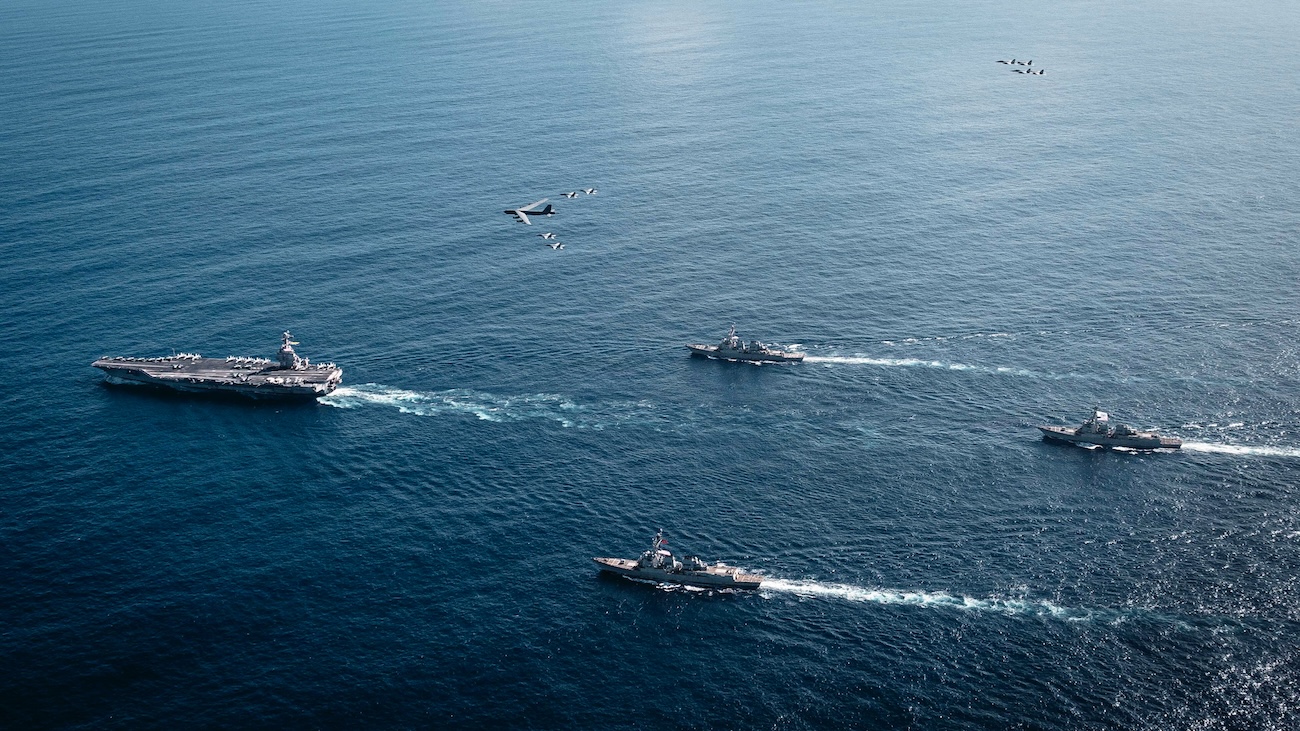
US war ships in the Caribbean. Photo: US Secretary of Defense/War
The US aggression against Venezuela has fomented divisions within the Caribbean, with many calling on countries like Trinidad and Tobago to refuse cooperation with the US in its military endeavors against the peoples of the region
US President Donald Trump has authorized the USS Gerald R. Ford to enter the Caribbean. It now floats north of Puerto Rico, joining the USS Iwo Jima and other US navy assets to threaten Venezuela with an attack. Tensions are high in the Caribbean, with various theories floating about regarding the possibility of what seems to be an inevitable assault by the US and regarding the social catastrophe that such an attack will occasion. CARICOM, the regional body of the Caribbean countries, released a statement affirming its view that the region must be a “zone of peace” and that disputes must be resolved peacefully. Ten former heads of government from Caribbean states published a letter demanding that “our region must never become a pawn in the rivalries of others”.
Former Trinidad and Tobago Prime Minister Stuart Young said on August 21, “CARICOM and our region is a recognized zone of peace, and it is critical that this be maintained”. Trinidad and Tobago, he said, has “respected and upheld the principles of non-intervention and non-interference in the internal affairs of other countries and for good reason”. On the surface, it appears as if no one in the Caribbean wants the United States to attack Venezuela.
However, the current Prime Minister of Trinidad and Tobago, Kamla Persad-Bissessar (known by her initials as KPB), has openly said that she supports the US actions in the Caribbean. This includes the illegal murder of eighty-three people in twenty-one strikes since September 2, 2025. In fact, when CARICOM released its declaration on the region being a zone of peace, Trinidad and Tobago withdrew from the statement. Why has the Prime Minister of Trinidad and Tobago gone against the entire CARICOM leadership and supported the Trump administration’s military adventure in the Caribbean?
Backyard
Since the Monroe Doctrine (1823), the United States has treated all Latin America and the Caribbean as its “backyard”. The United States has intervened in at least thirty of the thirty-three countries in Latin America and the Caribbean (90 percent of the countries, in other words) – from the US attack on Argentina’s Malvinas Islands (1831-32) to the current threats against Venezuela.
The idea of the “zone of peace” emerged in 1971 when the UN General Assembly voted for the Indian Ocean to be a “zone of peace”. In the next two decades, when CARICOM debated this concept for the Caribbean, the United States intervened in, at least, the Dominican Republic (after 1965), Jamaica (1972-1976), Guyana (1974-1976), Barbados (1976-1978), Grenada (1979-1983), Nicaragua (1981-1988), Suriname (1982-1988), and Haiti (1986).
In 1986, at the CARICOM summit in Guyana, the Prime Minister of Barbados, Errol Barrow, said “My position remains clear that the Caribbean must be recognized and respected as a zone of peace… I have said, and I repeat, that while I am prime minister of Barbados, our territory will not be used to intimidate any of our neighbors be that neighbor Cuba or the USA.” Since Barrow made that comment, Caribbean leaders have punctually affirmed, against the United States, that they are nobody’s backyard and that their waters are a zone of peace. In 2014, in Havana, all members of the Community of Latin American and Caribbean States (CELAC) approved a “zone of peace” proclamation with the aim “of uprooting forever [the] threat or use of force” in the region.
Persad-Bissessar or KPB has rejected this important consensus across political traditions in the Caribbean. Why is this so?
Betrayals
In 1989, trade union leader Basdeo Panday formed the United National Congress (UNC), a centre-left formation (whose former name was the Caucus for Love, Unity, and Brotherhood). KPB joined Panday’s party and has remained in the UNC since then. Throughout her career till recently, KPB stayed at the center of the UNC, arguing for social democratic and pro-welfare policies whether as opposition leader or in her first term as Prime Minister (2010-2015). But even in her first term, KPB showed that she would not remain within the bounds of the centre-left but would tack Far-Right on one issue: crime.
In 2011, KPB declared a State of Emergency for a “war on crime”. At her home in Phillipine, San Fernando, KPB told the press, “The nation must not be held to ransom by groups of thugs bent on creating havoc in our society”, “We have to take very strong action”, she said, “very decisive action”. The government arrested seven thousand people, most of them released for lack of evidence against them, and the government’s Anti-Gang Law could not be passed: this was a policy that mimicked the anti-poor campaigns in the Global North. Already, in this State of Emergency, KPB betrayed the legacy of the UNC, which she dragged further to the Right.
When KPB returned to power in 2025, she began to mimic Trump with “Trinidad and Tobago First” rhetoric and with even harsher language against suspected drug dealers. After the first US strike on a small boat, KPB made a strong statement in support of it: “I have no sympathy for traffickers, the US military should kill them all violently”. Pennelope Beckles, who is the opposition leader in Trinidad and Tobago, said that while her party (the People’s National Movement) supports strong action against drug trafficking, such action must be “lawful” and that KPB’s “reckless statement” must be retracted. Instead, KPB has furthered her support of the US militarization of the Caribbean.
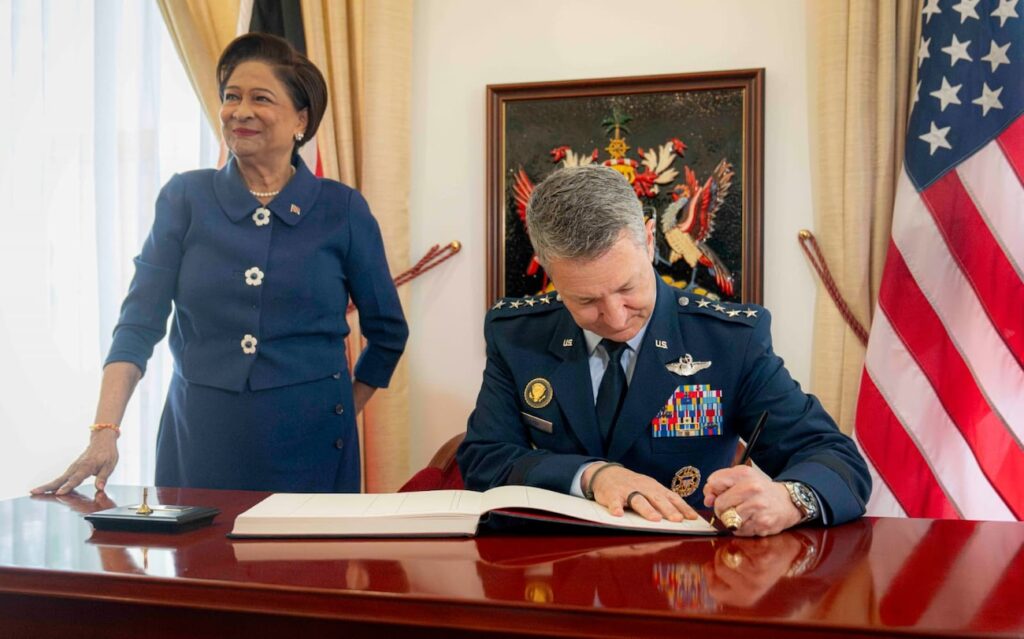
Trinidad and Tobago PM Kamla Persad-Bissessar with US Joint Chief of Staff General Dan Caine on November 25, 2025. Photo: US Embassy / X
Problems
Certainly, Trinidad and Tobago faces a tight knot of economic vulnerability (oil and gas dependence, foreign exchange shortages, slow diversification) and social crises (crime, inequality, migration, youth exclusion). All of this is compounded by the weakness of State institutions to help overcome these challenges. The weakness of regionalism further isolates small countries such as Trinidad and Tobago, which are vulnerable to pressure from powerful countries. But KPB is not only acting due to pressure from Trump; she has made a political decision to use US force to try and solve her country’s problems.
What could be her strategy? First, get the United States to bomb small boats that are perhaps involved in the centuries-old Caribbean smuggling operations. If the US bombs enough of these little boats, then the small smugglers would rethink their transit of drugs, weapons, and basic consumer commodities. Second, use the goodwill generated with Trump to encourage investment into Trinidad and Tobago’s essential but stagnant oil industry. There might be short-term gain for KPB. Trinidad and Tobago requires at least USD 300 million if not USD 700 million a year for maintenance and for upgrading its petrochemical and Liquified Natural Gas plants (and then it needs USD 5 billion for offshore field development and building new infrastructure). ExxonMobil’s massive investment in Guyana (rumored to be over USD 10 billion) has attracted attention across the Caribbean, where other countries would like to bring in this kind of money. Would companies such as ExxonMobil invest in Trinidad and Tobago? If Trump wanted to reward KPB for her unctuousness, he would tell ExxonMobil CEO Darren Woods to expand on the deepwater blocks investment his company has already made in Trinidad and Tobago. Perhaps KPB’s calculation to set aside the zone of peace ideas will get her some more money from the oil giants.
But what does this betrayal break? It certainly disrupts further any attempt to build Caribbean unity, and it isolates Trinidad and Tobago from the broader Caribbean sensibility against the use of the waters for US military confrontations. There are real problems in Trinidad and Tobago: rising gun-related violence, transnational trafficking, and irregular migration across the Gulf of Paria. These problems require real solutions, not the fantasies of US military intervention. US military interventions do not resolve problems, but deepen dependency, escalate tensions, and erode every country’s sovereignty. An attack on Venezuela is not going to solve Trinidad and Tobago’s problems but might indeed amplify them.
The Caribbean has a choice between two futures. One path leads toward deeper militarization, dependency, and incorporation into the US security apparatus. The other leads toward the revitalization of regional autonomy, South-South cooperation, and the anti-imperialist traditions that have long sustained the Caribbean’s political imagination.
Donald Fuhrump says that Amerikkka doesn’t bother with crimes or charges anymore, not being 100% Amerikkkan and opposing his real estate intentions is enough.Elon Musk urges you to be a Fascist like him, says that you can ignore facts and reality then.