Between invasion and diplomacy: Trump’s options with Venezuela

Spread the love

Original article by Pablo Meriguet republished from peoples dispatch under a Creative Commons Attribution-ShareAlike 4.0 (CC BY-SA) license.
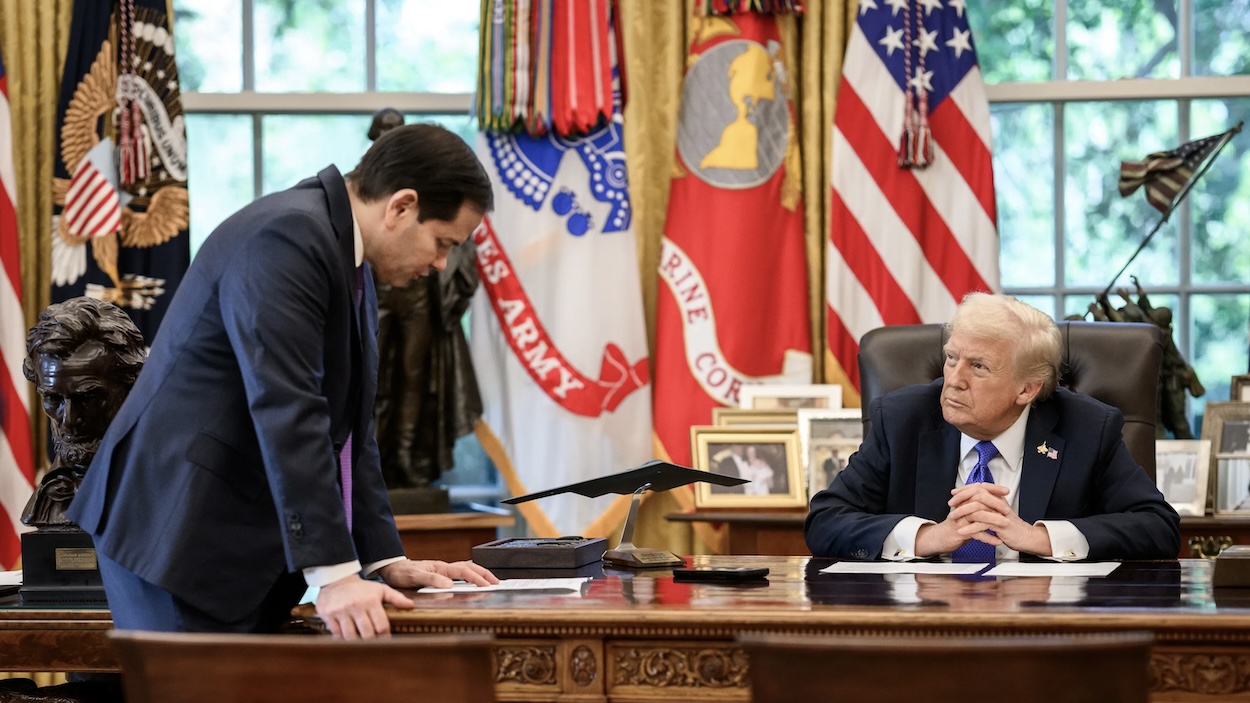
US President Donald Trump and US Secretary of State Marco Rubio in the Oval Office. Photo: The White House

While Trump increases military pressure in the Caribbean Sea, he hasn’t ruled out the possibility of resuming talks with Caracas. Meanwhile, Maduro supports the diplomatic route and rejects the possibility of war

At a press conference on November 17, US President Donald Trump stated that he does not rule out using his armed forces in Venezuela. This military buildup has involved the Pentagon deploying thousands of soldiers to the Caribbean Sea and to countries collaborating with Washington in the so-called Southern Spear military operation. Most recently, the USS Gerald R. Ford, the largest aircraft carrier in the United States, arrived in the Caribbean to, according to the Pentagon, “combat transnational threats”.

The Trump administration claims that a large amount of the drugs entering the United States comes from Venezuela, whose government is allegedly part of a criminal structure called the “Cartel of the Suns”.

Caracas has flatly denied these accusations and claimed that they are part of a justification to overthrow the Venezuelan government (which controls the world’s largest oil reserves) and thus force a change of direction in the country that is aligned with Washington’s economic and geopolitical interests.

Washington insists on its accusations

On November 16, the US State Department announced that it will designate the Cartel of the Suns (Cartel de los Soles) a foreign terrorist organization. Defense Secretary Marco Rubio stated: “The Cartel of the Suns, along with other designated foreign terrorist organizations, including the Aragua Train and the Sinaloa Cartel, are responsible for terrorist violence throughout the hemisphere, as well as drug trafficking to the United States and Europe.”

According to US authorities, this designation gives the US military carte blanche to attack the assets and infrastructure of what they consider to be part of the Cartel de los Soles, despite the fact that a large number of international law experts argue that this is not sufficient to legally justify an attack outside its borders.

Despite these warnings, the Trump administration has already launched attacks on small boats in the Caribbean Sea that, according to Washington, were carrying drugs to the United States, although no reliable evidence has yet been presented to prove this. Dozens of deaths have been reported so far.

Read More: From Palestine to Venezuela: The US is behind the door

The big question arising from the recent military and administrative maneuvers by the United States is whether Washington will dare to attack Venezuelan territory on the grounds that it is an attack to destroy a terrorist organization. For the moment, Trump has moved forward with these measures, although he has been cautious in stating that the attack will take place.

Trump says he will speak with Maduro soon

While the Trump administration increases pressure on Venezuela, even authorizing covert actions in the Caribbean country according to the New York Times, it also claims that there may be an open channel of communication with Caracas.

This was seemingly confirmed at the November 17 press conference, when, in response to questions from reporters about possible communication with Maduro, Trump said, “At some point, I will talk to him.”

Maduro’s response

In response to these statements, the Venezuelan president reacted by saying that the conversation should take place: “Only through diplomacy can differences be resolved … Anyone who wants to talk to Venezuela will talk face to face, but the Venezuelan people cannot be allowed to be massacred.”

Maduro warned that one of the consequences of a possible military invasion of Venezuela would be the loss of legitimacy of the Trump administration: “A war against Venezuela would be the political end of his leadership and his name. [Some people are trying to push Trump to] make the most serious mistake of his entire life.” He also said that public opinion in the United States is increasingly rejecting a possible military intervention in South America.

For now, Washington wants to maintain all options available when negotiating with Maduro’s government, whether through military or diplomatic means. Thus, Trump is deploying his military and intelligence assets in South America while keeping the lines of communication open with Maduro. For its part, the Venezuelan government is betting on diplomacy while preparing for a possible military invasion that would seek to end more than 25 years of Chavista rule, although such an operation could have unforeseen effects in the region, even for Washington.

Original article by Pablo Meriguet republished from peoples dispatch under a Creative Commons Attribution-ShareAlike 4.0 (CC BY-SA) license.

Donald Fuhrump says that Amerikkka doesn't bother with crimes or charges anymore, not being 100% Amerikkkan and opposing his real estate intentions is enough.
Donald Fuhrump says that Amerikkka doesn’t bother with crimes or charges anymore, not being 100% Amerikkkan and opposing his real estate intentions is enough.
Orcas discuss how Trump was re-elected and him being an obviously insane, xenophobic Fascist.

Continue ReadingBetween invasion and diplomacy: Trump’s options with Venezuela

How the rich world is fortifying itself against climate migration

Spread the love
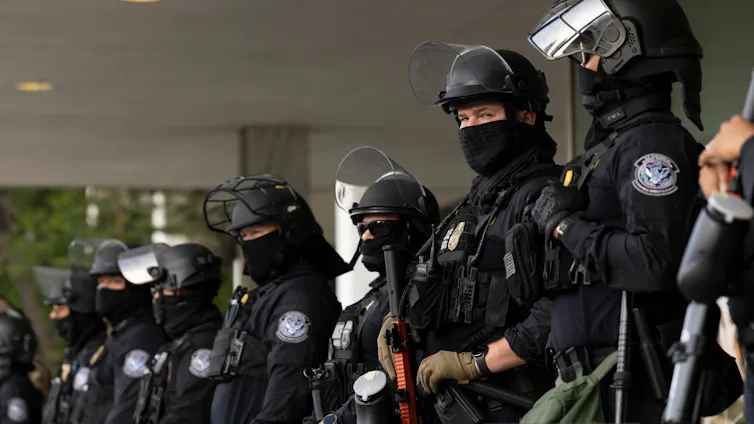
US Customs and Border Protection field officers during ICE deportation protests in Los Angeles, June 2025. Matt Gush / shutterstock

Andrea Rigon, UCL

The UK has announced much harsher rules for asylum seekers including the prospect of more deportations for those whose applications fail. The US is trebling the size of its deportation force. The EU is doubling its border budgets. And in the coming decades, hundreds of millions of people might be displaced by ecological changes.

In the face of this challenge, those countries which are most responsible for climate change have two options. Either they can share resources more equitably, and fund adaptation plans on a massive scale. Or they can prevent others from accessing resources and liveable land through physical and regulatory walls, enforced through mass deportation.

Recent events show that, faced with this choice, many governments are choosing not to share resources to anywhere near the extend needed, and are instead building higher walls.

Climate change is already making life unliveable in some parts of the world. According to a 2020 report from thinktank the Institute for Economics and Peace (IEP), 2.6 billion people face high or extreme water stress. By 2040, this may jump to 5.4 billion. Droughts, heatwaves, floods, cyclones, food shortages and related conflicts will force millions from their homes.

The IEP warns that up to 1.2 billion people globally might be displaced by 2050, while even the more-cautious World Bank predicts 216 million climate migrants.

Most of these people will move internally within nations, but this too is likely to mean more walls and borders. In very unequal countries, internal migration has already triggered security-driven responses, with a rise in gated communities and other segregated living arrangements to keep the poorer away from the wealthy.

Many other climate migrants will be pushed to travel internationally. It’s likely their motivation will be characterised by many as economic rather than due to climate change. But it’s misleading to separate “economic” from “climate” migrants. When drought kills crops in Somalia or floods wash away farmland in Pakistan, the loss of income is inseparable from the climate shocks that caused it.

Even before the worst impacts hit, climate change is already woven into the economic pressures that push people to move – shrinking harvests, emptying wells and ruining livelihoods. The most severe climate-driven displacement is still ahead, but it has already begun.

Importantly, these pressures come with inequalities in causing climate change and bearing the costs. The richest 1% of the world’s population produces as much carbon as the poorest two-thirds, according to a study of global emissions in 2019 by Oxfam. Northern Europe and the US alone account for 92% of historical emissions.

Those who have contributed the least to climate change are the worst affected and often have the fewest resources to adapt, forcing many people to migrate.

More walls, more deportations

In this context, governments of wealthier countries are massively increasing spending on migration policing. In the US, proposed funding levels are extraordinary.

Recent legislation allocates nearly US$30 billion (£22 billion) to the Immigration and Customs Enforcement agency (Ice) for enforcement and deportation operations – roughly three times its current budget.

The US has also authorised US$45 billion for new detention centres – a 265% increase, more than the entire defence budget of Italy – and US$46.6 billion for additional border walls. Under this plan, Ice would become the largest US law enforcement agency, three times the size of the FBI.

Donald Trump’s policies can be easily labelled as the excess of one would-be autocrat, but this is a global trend across the political spectrum, albeit implemented with more acceptable language by the centre-left.

Introducing the UK Labour government’s new asylum and returns policy, Prime Minister Keir Starmer said: “We need an approach with a stronger deterrent effect and rules that are robustly enforced.” But previously-supportive MPs from his own party have warned this will mean “Ice-style raids” to deport asylum seekers.

The European Commission’s 2028–34 budget proposal earmarks €25.2 billion (£21.7 billion) for border management and €12 billion for migration, plus €11.9 billion for the Frontex border agency – more than double its current resources.

All this effectively triples current migration and border spending. In 2024, the EU ordered 453,000 non-EU nationals to leave, and actually deported 110,000 of them.

This is part of a much wider pattern, with borders today being far more militarised than at the end of the cold war. After decades of globalisation, states are now reterritorialising, building armoured fortifications against unwanted flows.

In the past two decades, more than 70 new international barriers have gone up, including Poland’s barbed-wire fence with Belarus, Greece’s steel wall on the Turkish border, Turkey’s stone wall on its Iranian border, and the new sections of the infamous wall between the US and Mexico.

Israel has built an “iron wall” around Gaza and border fences through much of the West Bank. Supposedly built to prevent Palestinians moving into Israel, these barriers have become a clear example of migration control tied to power grabs for land and resources.

A crossroads for human rights

Resource-driven migration pressures are rising just as the world is hardening its borders. In July 2025, the International Court of Justice declared that countries have a legal responsibility to address and compensate for climate change – and can be held accountable for their emissions. It is another signal that as humanity, we are at a crossroads.

The world can either prioritise universal human rights by sharing resources. Or it can attempt to protect a small, wealthy minority through walls, mass deportations and border violence on an unprecedented scale.

Andrea Rigon, Professor, Politecnico di Milano, and, UCL

This article is republished from The Conversation under a Creative Commons license. Read the original article.

Keir Starmer refuses to be outcnuted by Nigel Farage's chasing the racist bigot vote.
Keir Starmer refuses to be outcnuted by Nigel Farage’s chasing the racist bigot vote.
Climate science denier Nigel Farage explains that it's simple to blame asylum-seekers or Muslims for everything.
Climate science denier Nigel Farage explains that it’s simple to blame asylum-seekers or Muslims for everything.
Continue ReadingHow the rich world is fortifying itself against climate migration

Gaza reveals how Britain is run, and why we must change it

Spread the love

https://www.declassifieduk.org/gaza-reveals-how-britain-is-run-and-why-we-must-change-it

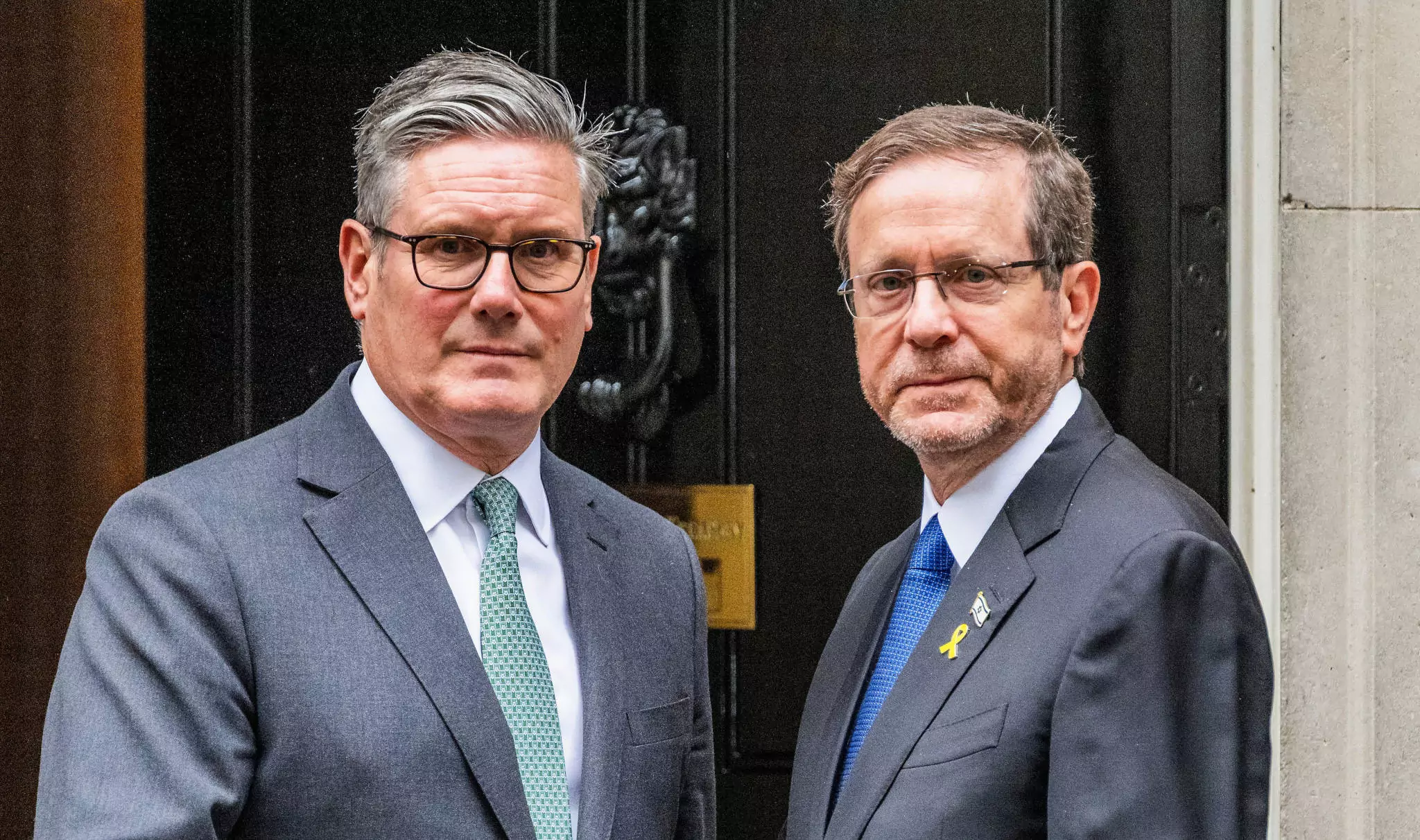
Keir Starmer welcomed Israel’s president to Downing Street in September (Photo: Guy Bell / Alamy)

The horror of Israel’s genocide exposes the UK’s oligarchic governance system, and implores us to transform our political system

This should be a pivotal moment in British history. Our political system has utterly failed to confront a genocide. 

Rather, that system has allowed the British establishment to be complicit in one of the worst horrors of our time — Israel’s two-year offensive against Palestinians, complete with ethnic cleansing, systematic attacks on schools and hospitals, and crimes against humanity. 

Now, under a current supposed ceasefire, Israel is still killing Palestinians and their plight in Gaza remains dire, as the world sees the extent of the mass destruction visited on them. 

Throughout the attacks on Palestinians in Gaza, British leaders have actively cooperated with Israel in their military, trade and diplomatic policies. 

Still now, significant sanctions on Israel are completely off the government’s agenda – a striking contrast to Russia – because the establishment chooses to back Israel even in its criminality. 

There is little morality in British political and economic decision-making. But this doesn’t mean the system is “broken”; it’s working as it’s intended to. 

What we’re witnessing is the pinnacle of ministerial impunity for complicity in crimes overseas, and the utter irrelevance of human rights and international law to UK policy-making. More important to the establishment than these has been protecting Israel, and the British and Israeli arms industries. 

Gaza illustrates many deep problems in British governance and exposes the illusion that the UK is a democracy. A mass movement is needed to address ten major issues.

Upholding human rights

Most obviously, Gaza shows how Whitehall’s foreign policy-making doesn’t prioritise human life, or even take it seriously. 

From the outset in October 2023, UK ministers put their strategic alliance with Israel above the lives of dehumanised Palestinians, even as the death toll mounted in the tens of thousands. Ministers in both Conservative and Labour governments overtly apologised for obvious Israeli breaches of international law and human rights.

Upholding international law

Every UK government says it upholds international law but this is plainly untrue. Gaza highlights that ministers think they can behave like criminals, supporting the laws they like and ignoring those they don’t. 

Whitehall has repeatedly refused to acknowledge Israeli war crimes and given ‘special immunity’ for Israeli military leaders to visit Britain. It has done nothing to support the various international bodies demanding the UK fulfils its obligations to stop aiding Israel’s occupation policies and “prevent and punish” it, as the Genocide Convention demands. 

Holding ministers accountable

We have to face the fact there is currently little chance of holding British ministers to account for their complicity in Israel’s genocide. The UK’s governance system has been designed so this cannot happen. 

A mediaeval concept called ‘crown immunity’ makes ministers immune from prosecution for deaths overseas, as in Palestine, or at home due to Covid or austerity. 

The majority of the British public has opposed Israel’s attack on Gaza and sympathises with the Palestinians. 

Public pressure – including dozens of big national marches – eventually forced the government to pull back (at least rhetorically) from its initial unadulterated public support for Israel’s mass attacks.  

Britain has all the fancy trimmings of democracy but little of the real practice of it. UK foreign policy is in reality made by an elite few and routinely doesn’t promote the national public interest or real national security. 

Greater MP accountability

What is parliament for? If our elected MPs cannot collectively ensure the establishment is not complicit in genocide – the most heinous international crime – or that governments uphold international law – another basic duty – then frankly the power they have is fictitious and they’ve lost the right to represent the British people. 

MPs do not routinely hold ministers to account and have utterly failed to do so over Gaza. 

Barring a general election there are very few mechanisms at the disposal of UK citizens to formally hold their MP to account for their actions between elections. 

MPs failing to challenge British backing for Israel’s genocide should be booted out of office by the electorate.

Ending excessive government secrecy

The UK system thrives on official secrecy, the chief currency of Whitehall which has been described as the ‘English disease’. 

We put up with the extreme state of official secrecy only because we’ve so far had to, because there has been no serious attempt by a political party to open up the system and make it less secretive. 

We have to finally address this ‘national security’ bullshit which all governments hide behind. 

Supporting independent media

Gaza clearly shows the media routinely function as de facto assets of the state, amplifying its views and failing to adequately report independent or contradictory narratives. 

Compare Declassified’s numerous revelations about the extent to which the UK has been supporting Israel with Britain’s ‘mainstream’ national media, which regularly parrots Israeli propaganda. 

Public anger with the way the legacy media have reported on the genocide is palpable. 

But there’s little genuine media accountability in the UK and outlets routinely publish false information with no comeback. Stronger democratic regulation that promotes higher media standards, whilst of course preserving free speech, is needed.

Curbing the power of the Israel lobby

A foreign power wielding undue influence over UK politics is neither democratic nor acceptable – it’s why many people voted for Brexit. The government is rightly keen to prevent influence from states like Russia or China but actively welcomes it from Israel.

Ensuring independence from the US

Britain’s kow-towing to Israel is substantially due to Whitehall’s unwillingness to offend the US, for whom support for Israel is a cardinal feature of foreign policy. This again shows that Britain is not truly an independent state.

Perhaps few needed reminding of this, especially those who lived through Tony Blair’s defiance of the public to work alongside Washington in the illegal 2003 invasion of Iraq.

Protecting civil liberties

The government’s willingness to shelve some of our democratic rights on the altar of backing a foreign state, and one engaged in genocide, is an alarming sign of establishment priorities. 

Faced with major opposition to its policies, the government has resorted to policing the opposition to them and in restricting civil liberties. The clampdown on the right to protest has included repeated attempts to restrict protest routes and the police questioning MPs under caution for breaching protest “conditions”. This shows elite contempt for free speech and reveals also the weakness of the establishment’s arguments. 

Building a movement against war, militarism and impunity

The establishment will not concede any of these changes willingly. It is obvious to say, but the UK needs an organised movement against war, militarism and impunity. 

UK complicity in the genocide endured. These last two years should cause a sober assessment of how the state responds to challenges and what is necessary to defeat the British war machine.

I am not able to republish the entire article. See the original at https://www.declassifieduk.org/gaza-reveals-how-britain-is-run-and-why-we-must-change-it

Orcas discuss Genocide-supporting and complicit Zionists. Donald Trump, Keith Starmer, David Lammy, Rachel Reeves, Angela Rayner and Wes Streeting are acknowledged as evil genocide-complicit and supporting cnuts.
Keir Starmer objects to criticism of the IDF. He asks how could anyone object to them starving people to death, forced marches like the Nazis did, bombing Gaza's hospitals and universities, mass-murdering journalists, healthworkers and starving people queuing for food, killing and raping prisoners and murdering children. He calls for people to stop obstructing his genocide for Israel.
Keir Starmer objects to criticism of the IDF. He asks how could anyone object to them starving people to death, forced marches like the Nazis did, bombing Gaza’s hospitals and universities, mass-murdering journalists, healthworkers and starving people queuing for food, killing and raping prisoners and murdering children. He calls for people to stop obstructing his genocide for Israel.
Experiencing issues with this image not appearing. I suspect because it's so critical of Zionist Keir Starmer's support of and complicity in Israel's genocides.
Genocide denier and Current UK Prime Minister Keir Starmer is quoted that he supports Zionism without qualification. He also confirms that UK air force support has been essential in Israel’s mass-murdering genocide. Includes URLs https://www.declassifieduk.org/keir-starmers-100-spy-flights-over-gaza-in-support-of-israel/ and https://youtu.be/O74hZCKKdpA

Continue ReadingGaza reveals how Britain is run, and why we must change it

“We Will REPLACE LABOUR”: Zack Polanski Says Labour’s Time Over

Spread the love

Keir Starmer says that the Labour Party under his leadership is intensely relaxed about assaulting those least able to defend themselves - the very poorest and most vulnerable.
Keir Starmer says that the Labour Party under his leadership is intensely relaxed about assaulting those least able to defend themselves – the very poorest and most vulnerable.
Keir Starmer objects to criticism of the IDF. He asks how could anyone object to them starving people to death, forced marches like the Nazis did, bombing Gaza's hospitals and universities, mass-murdering journalists, healthworkers and starving people queuing for food, killing and raping prisoners and murdering children. He calls for people to stop obstructing his genocide for Israel.
Keir Starmer objects to criticism of the IDF. He asks how could anyone object to them starving people to death, forced marches like the Nazis did, bombing Gaza’s hospitals and universities, mass-murdering journalists, healthworkers and starving people queuing for food, killing and raping prisoners and murdering children. He calls for people to stop obstructing his genocide for Israel.
Orcas discuss Genocide-supporting and complicit Zionists. Donald Trump, Keith Starmer, David Lammy, Rachel Reeves, Angela Rayner and Wes Streeting are acknowledged as evil genocide-complicit and supporting cnuts.
Continue Reading“We Will REPLACE LABOUR”: Zack Polanski Says Labour’s Time Over

Campaigners Urge Countries to Seize ‘Momentum’ at COP30 and Deliver Roadmap for Green Transition

Spread the love

Original article by Julia Conley republished from Common Dreams under Creative Commons (CC BY-NC-ND 3.0). 

A projection urges leaders to “get serious” about drawing down fossil fuel emissions in Rio de Janeiro, Brazil ahead of the United Nations Climate Change Conference on November 5, 2025. (Photo by Fabio Teixeira/Anadolu via Getty Images)

“We need to make sure that any and all plans towards a fossil fuel-free future are built with community and frontline needs at the heart, and implemented in a way that does not leave vulnerable communities behind.”

Despite concerns over the presence of hundreds of corporate lobbyists peddling “false solutions” at the United Nations Climate Change Conference in Belém, Brazil, campaigners on Monday expressed optimism about the “remarkable speed” with which global support has grown at the summit for a Transition Away From Fossil Fuels Roadmap.

Brazilian President Luiz Inácio Lula da Silva opened the Leader’s Summit on November 6 with a call for the TAFF Roadmap, which would build on the 2023 conference’s (COP28) promise to “transition away from fossil fuels” in a “just, orderly, and equitable manner.”

He urged leaders to map out how their countries will “overcome dependence on fossil fuels,” reverse deforestation, and mobilize resources to achieve those goals, as the presidencies of this year’s conference (COP30) and last year’s released a Baku to Belém Roadmap with a plan to mobilize $1.3 trillion per year in climate finance for developing countries.

350.org found on Monday that within nine days, support for the TAFF Roadmap grew from one to 62 countries.

Suluafi Brianna Fruean, a 350.org Pacific Council elder, acknowledged that a call for “a transition away from fossil fuels is not a new concept for the Pacific, it’s a demand we’ve made at every COP and every room we’ve been in.”

Still, she said, “the growing support for a roadmap to this reality is a sign that the age of fossil fuels is over. We need to make sure that any and all plans towards a fossil fuel-free future are built with community and frontline needs at the heart, and implemented in a way that does not leave vulnerable communities behind.”

“The presidency calls on developing countries to lead, prioritize public, grant-based, concessional finance to protect the world’s most vulnerable, and break the vicious debt cycle. However, it misses the urgency to simplify direct access to finance for communities, especially Indigenous peoples.”

350.org analyzed public statements and written inputs from countries and country groups to the COP30 presidency, and released its analysis of the conference’s momentum as the Brazil presidency released its “consultation text.”

That document lays out options for a final agreement at COP30, including “the ingredients for a highly ambitious outcome,” said 350.org.

Options in the text include establishing a three-year program to implement Article 9.1 in the Paris Agreement, which requires wealthy countries to finance adaptation and a transition away from fossil fuels for the Global South; tripling adaptation finance; and implementing Article 3.5 of the UN Framework Convention on Climate Change, which requires parties to support an economic system that leads “to sustainable economic growth and development in all parties… thus enabling them better to address the problems of climate change.”

“Finance is the engine of climate action. The presidency calls on developing countries to lead, prioritize public, grant-based, concessional finance to protect the world’s most vulnerable, and break the vicious debt cycle,” said Fanny Petitbon, France team lead for 350.org. “However, it misses the urgency to simplify direct access to finance for communities, especially Indigenous peoples, who hold solutions on the ground yet face enormous barriers to securing the funds needed to scale them up.”

A second package of options is set to be released in the coming days and “will cover the more technical negotiating areas,” according to the World Wildlife Fund (WWF).

Andreas Sieber, associate director of policy and campaigns at 350.org, credited Lula with injecting “real momentum into a global roadmap to move away from fossil fuels.”

But Sieber noted that Brazil recently gave its state-owned oil and gas company, Petrobras, license to drill a well in the Amazon rainforest, and Brazil is still one of the top 10 producers of crude oil globally.

“Lula spoke powerfully about justice and cooperation in a divided world, highlighting the need to get rid of fossil fuels and accelerate the energy transition,” Sieber told Argus Media after the Leaders’ Summit. “But he cannot be both a champion of climate justice and one of the world’s biggest oil expanders.”

350.org added that in a TAFF Roadmap, “finance, technology transfer, and capacity-building must be central pillars—not peripheral details—if the transition is to lift up communities rather than deepen inequality.”

WWF also applauded the “momentum” at COP30, and urged “decisive political leadership” in order to “get back on track to the 1.5°C Paris Agreement temperature limit.”

Manuel Pulgar-Vidal, WWF global climate and energy lead, and the president of COP20, said that “COP30 could make history by agreeing on roadmaps for both a transition away from fossil fuels and to combat deforestation. It must also respond to the emissions gap in national climate plans, and make advances on finance, including to help countries adapt to climate change.”

Original article by Julia Conley republished from Common Dreams under Creative Commons (CC BY-NC-ND 3.0). 

Donald Trump urges you to be a Climate Science denier like him. He says that he makes millions and millions for destroying the planet, Burn, Baby, Burn and Flood, Baby, Flood.
Nigel Farage urges you to ignore facts and reality and be a climate science denier like him and his Deputy Richard Tice. He says that Reform UK has received £Millions and £Millions from the fossil fuel industry to promote climate denial and destroy the planet.
Orcas comment on killer apes destroying the planet by continuing to burn fossil fuels.
Continue ReadingCampaigners Urge Countries to Seize ‘Momentum’ at COP30 and Deliver Roadmap for Green Transition