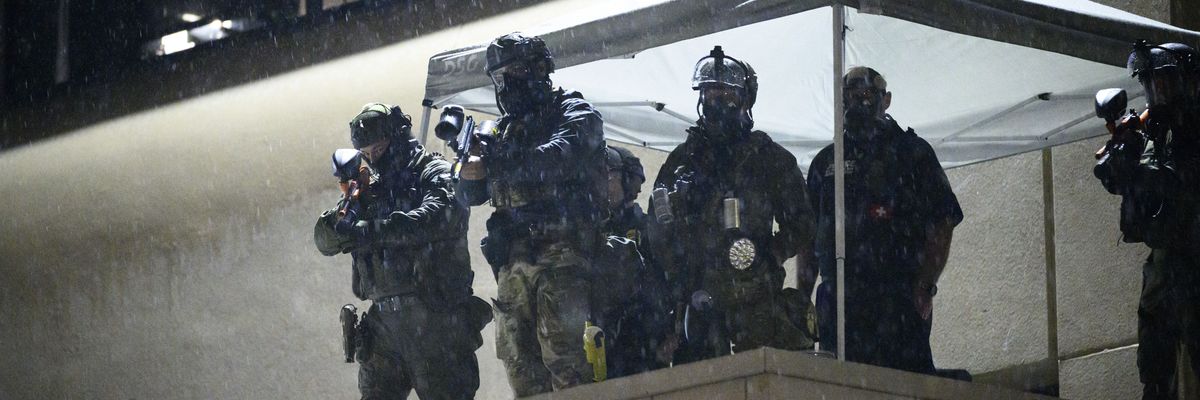
Federal agents target protesters with “less lethal” weapons at the US Immigration and Customs Enforcement building on October 18, 2025 in Portland, Oregon. (Photo by Mathieu Lewis-Rolland/Getty Images)
“ICE was always going to be Trump’s private military to deploy domestically against Americans,” said one critic.
The $170 billion in new funding for immigration enforcement operations that the Republican Party included in the One Big Beautiful Bill Act earlier this year led some to warn that the Trump administration was ramping up spending at anti-immigration agencies not just to fund its attacks on migrants, but to deploy federal forces against anyone it wanted to across US communities.
New reporting on Monday detailed just how much US Immigration and Customs Enforcement has spent on weaponry since President Donald Trump took office—weapons that have been purchased as the administration has turned federal agents on US cities such as Chicago and Portland, illustrating how the president is treating increasingly armed ICE officers as his “private military,” as one progressive critic said.
As images spread online of immigration agents deploying pepper spray and tear gas at nonviolent protesters, Judd Legum at Popular Information recently delved into government contracting records from the Federal Procurement Data System and found that ICE has increased its spending on “small arms, ordnance, and ordnance accessories manufacturing” by 700% this year compared to 2024 numbers.
The agency spent $71,515,762 on small arms from January 20—the day Trump began his second term—through October 18.
The number dwarfs ICE’s spending during the first Trump term, during which the agency spent about $8.4 million annually on small arms, and during President Joe Biden’s administration.
The type of weaponry purchased by ICE also raised alarm Monday, with Legum reporting that while most of the agency’s spending was on guns and armor, “there have also been significant purchases of chemical weapons and ‘guided missile warheads and explosive components.’”
“If the immigration enforcement apparatus of the United States were its own national military, it would be the 13th most heavily funded in the world. This puts it higher than the national militaries of Poland, Italy, Australia, Canada, Turkey, and Spain—and just below Israel.”
The reporting comes as ICE and other immigration agencies continue to deploy armed, masked agents in major Democratic-leaning US cities, where officers have been filmed and photographed pointing a weapon at a protester; firing a pepper ball at a pastor, and pointing a firearm at bystanders who saw one agent arresting a man.
A CBS reporter in Chicago also accused an ICE officer of firing a pepper ball at her vehicle, causing the chemical to “engulf the inside of her truck.”
Sally Duval, a Texas state House candidate in last year’s election, said she was “curious to know why ICE needs ‘guided missile warheads.’”
The report came days after the Trump administration used the US military for what Democratic California Gov. Gavin Newsom called “a profoundly absurd show of force that could put Californians directly in harm’s way,” when the Marines fired 155-millimeter artillery shells over a section of the busy Interstate 5 freeway to celebrate the military branch’s 250th anniversary.
Newsom accused Trump of “using our military to intimidate people [he disagrees] with” and called the exercise “reckless.”
Melanie D’Arrigo, executive director of the Campaign for New York Health, said Legum’s reporting on Monday showed that “ICE was always going to be Trump’s private military to deploy domestically against Americans.”
Legum’s analysis—which likely understated total spending on weapons by Trump’s deportation forces, as it did not include spending by other anti-immigration agencies—followed a report on ICE’s recent funding increase by In These Times.
With the $170 billion included in the OBBBA, reported the outlet, “if the immigration enforcement apparatus of the United States were its own national military, it would be the 13th most heavily funded in the world. This puts it higher than the national militaries of Poland, Italy, Australia, Canada, Turkey, and Spain—and just below Israel.”
The budget, Brandon Lee of the Illinois Coalition for Immigrant and Refugee Rights told In These Times, “shows the misplaced priorities of this administration, where they are cutting healthcare and cutting vital programs for people across the country, and putting all of this money into a domestic terrible force.”
“And it shows the cruelty,” said Lee, “that the Trump administration intends to enact on all people in the United States.”
Orcas discuss how Trump was re-elected and him being an obviously insane, xenophobic Fascist.Donald Fuhrump says that Amerikkka doesn’t bother with crimes or charges anymore, not being 100% Amerikkkan and opposing his real estate intentions is enough.
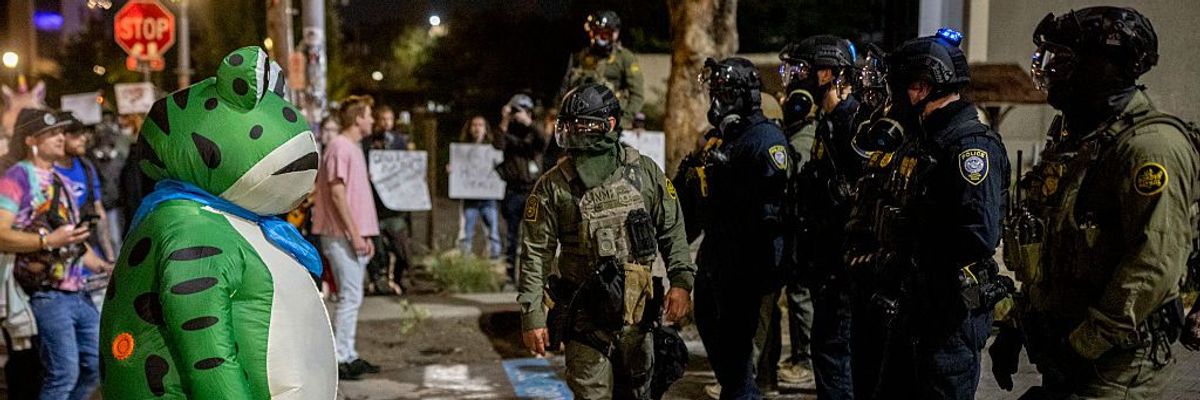
A protester in a frog costume stands in front of a line of federal law enforcement officers outside a United States Immigration and Customs Enforcement (ICE) facility in Portland, Oregon, on October 6, 2025. (Photo by Stephen Lam/San Francisco Chronicle via Getty Images)
In a dissent, Judge Susan Graber accused her 9th Circuit colleagues of eroding “core constitutional principles.”
Two federal judges are giving President Donald Trump the green light to send National Guard troops into Portland, Oregon on Monday.
The US Court of Appeals for the 9th Circuit granted the US Department of Justice’s (DOJ) request to put a hold on US District Judge Karin Immergut’s earlier order blocking deployment of the National Guard to Oregon’s largest city.
The two judges who ruled in the DOJ’s favor were appointed by Trump, while the lone dissenter in the case, Judge Susan Graber, was appointed by former President Bill Clinton.
The court’s majority ruled that the protests outside the Portland Immigration and Customs Enforcement (ICE) facility were sufficiently disruptive to justify deploying the National Guard, despite the fact that demonstrations outside the facility in recent weeks had not disrupted operations.
Judge Ryan Nelson, one of the Trump appointees, went so far as to issue a concurring opinion stating that the president’s right to deploy the National Guard, even over the objections of state and local officials, cannot be reviewed by the judiciary.
In a scathing dissent, Graber noted that “the record contains no evidence whatsoever that, on September 27… ICE was unable either to protect its Portland facility or to execute the immigration laws it is charged with enforcing.” This is relevant, she said, because the law states that the president may only deploy the National Guard “to repel a foreign invasion, quell a rebellion, or overcome an inability to execute the laws.”
Graber then accused her colleagues of eroding “core constitutional principles, including sovereign states’ control over their states’ militias and the people’s First Amendment rights to assemble and to object to the government’s policies and actions.”
Graber’s argument echoed a ruling made earlier this month by Immergut, who was also appointed to the bench by Trump and who said his declarations that violent protests at the Portland ICE facility prevented the enforcement of the law were “untethered to facts.”
Sandy Chung, executive director of the ACLU of Oregon, said in a statement responding to the ruling that “we are very disappointed that the majority on this 9th Circuit panel were unable to see through President Trump’s political theater, divisive rhetoric, and extreme abuse of power and misuse of our military.”
“The fact remains that Portland is peaceful,” Chung added. “Portland protesters have shown a remarkable level of humor, creativity, and community care in the face of this administration’s persistent and violent abuses of power. Inflatable frog and unicorn costumes, bike rides, and musical events are hardly a threat or reason to take the extremely dangerous and anti-democratic action of sending American troops into our communities.”
In addition to Portland, Trump is also seeking to send National Guard troops to Chicago over the objections of both Mayor Brandon Johnson and Illinois Gov. JB Pritzker. The administration has appealed that case to the US Supreme Court.
This article has been updated with comment from the ACLU.
Orcas discuss how Trump was re-elected and him being an obviously insane, xenophobic Fascist.Donald Fuhrump says that Amerikkka doesn’t bother with crimes or charges anymore, not being 100% Amerikkkan and opposing his real estate intentions is enough.
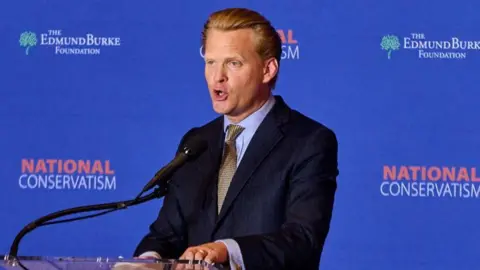
Professor James Orr is understood to be close to JD Vance and influential in Donald Trump’s administration with his right-wing views on abortion and immigration
Reform has been accused of “importing divisive and dangerous ideas” from Maga politics in the US after a right-wing theologian who opposes abortion in all cases joined the party as Nigel Farage’s adviser.
Cambridge University professor James Orr, who heads the Centre for a Better Britain think tank, is an influential figure in Donald Trump’s administration and is admired by vice-president JD Vance.
His arrival comes soon after the defection from the Tories of right-wing MP Danny Kruger, who holds similar views to Professor Orr.
James Orr (BBC)
…
Green Party leader Zack Polanski said: “Reform UK’s decision to welcome James Orr as a senior advisor to Nigel Farage is further evidence that Farage is embracing dangerous and divisive right wing ideology.
“By choosing someone close to JD Vance to be by his side – someone who describes asylum seekers as ‘invaders’ and someone who is anti abortion – he is signalling that Reform UK have nothing to offer but fuel for divisive, inflammatory politics.
“Orr’s Reform linked think tank The Centre for Better Britain has embraced Trumpian policies in cutting state services, reducing NHS funding and blaming migrants.”
Nigel Farage urges you to ignore facts and reality and be a climate science denier like him and his Deputy Richard Tice. He says that Reform UK has received £Millions and £Millions from the fossil fuel industry to promote climate denial and destroy the planet.Elon Musk urges you to be a Fascist like him, says that you can ignore facts and reality then.Nigel Farage attacks the NHS
“If you’re a woman, you’ve just been shown how Reform will treat your dignity and rights.”
Nigel Farage has been labelled misogynistic and disrespectful for the way he spoke to Mishal Husain during an interview with the journalist.
The Reform UK leader was speaking to Husain as part of an interview for Bloomberg when she challenged him over his recent comments saying he would ‘shoot down’ Russian planes that enter NATO airspace.
…
When Husain pushed the politician over the potential consequences of shooting down Russian planes, Farage condescendingly butted in: “Listen love, you’re trying ever so hard.”
As Husain asked him if he was suggesting Russia “needs to be taught a lesson,” Farage again said: “Listen love, you’re trying ever so hard.
Nigel Farage urges you to ignore facts and reality and be a climate science denier like him and his Deputy Richard Tice. He says that Reform UK has received £Millions and £Millions from the fossil fuel industry to promote climate denial and destroy the planet.Elon Musk urges you to be a Fascist like him, says that you can ignore facts and reality then.Donald Trump urges you to be a Climate Science denier like him. He says that he makes millions and millions for destroying the planet, Burn, Baby, Burn and Flood, Baby, Flood.
“Extreme” wildfires emitted more than 8bn tonnes of carbon dioxide during the 2024-25 “global fire season”, according to a new report.
The annual “state of wildfires” report from an international team of scientists finds that fires burned at least 3.7m square kilometres of land – an area larger than India – between March 2024 and February 2025.
This is almost 10% below the average annual area burned over the past two decades.
But, due to an increase in wildfires in carbon-rich forests, the CO2 emissions resulting from these fires were almost 10% above average.
The report also zooms in on four of the most prominent extreme wildfire events during this time: southern California; north-east Amazonia; South America’s Pantanal-Chiquitano region; and the Congo Basin.
All of these events were found to have been more likely to occur as a result of human-caused climate change.
The researchers identify that, in some cases, the area burned by these fires was 25-35 times larger than it would have been without global warming.
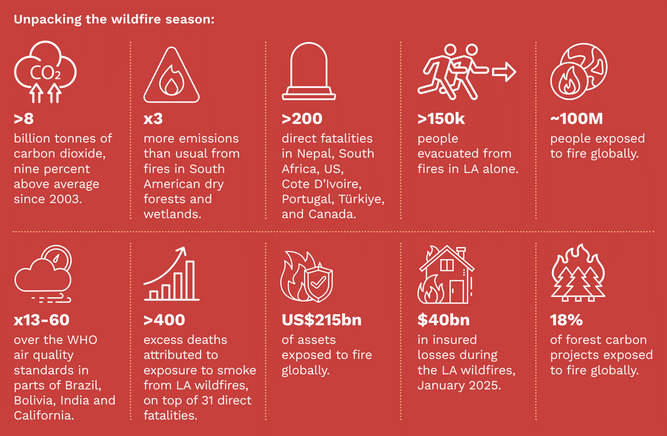
The report also estimates that more than 100 million people around the world were exposed to wildfires in 2024 and 2025.
These fires are “reshaping lives, economies and ecosystems on a global scale”, one of the report authors, Dr Carmen Steinmann from ETH Zürich, said in a statement.
‘Increasing extent and severity’
Scientists from dozens of institutions analyse “extreme wildfires” globally between March 2024 and February 2025 in the second annual edition of the report.
The report explains that the “March-February definition of the global fire season latest global fire season is chosen so as to align with an annual lull in the global fire calendar in the boreal spring months”.
According to the report, the authors “harness and adopt new methodologies brought forward by the scientific community”. They add that in future reports, they hope to “enhance the tools presented in this report to predict extremes with increasing lead times, monitor emerging situations in near-real time and explain their causes rapidly”.
“[The report] focuses on the global extreme wildfire events of the global fire season, explains why they happened and fingerprints the role of climate change as one of the key drivers of changing wildfire risk globally.”
The authors aim to “deliver actionable information” to policy experts and wider society about wildfires, the report says.
Using satellite data, the authors find that 3.7m square kilometres (km2) of land burned globally between March 2024 and February 2025. This means that the 2024-25 fire season ranks 16th out of all fire seasons since 2002, indicating below-average burned area compared to the rest of the 21st century.
However, the global fire emissions database shows that the 2024-25 wildfire season drove more than 8bn tonnes of CO2 emissions, according to the report. This is 10% above the average of wildfire seasons since 2002.
Jones explains that this is indicative of a trend towards “increasing extent and severity of fire in global forests, which are carbon-rich”, as opposed to less carbon-rich grassland biomes.
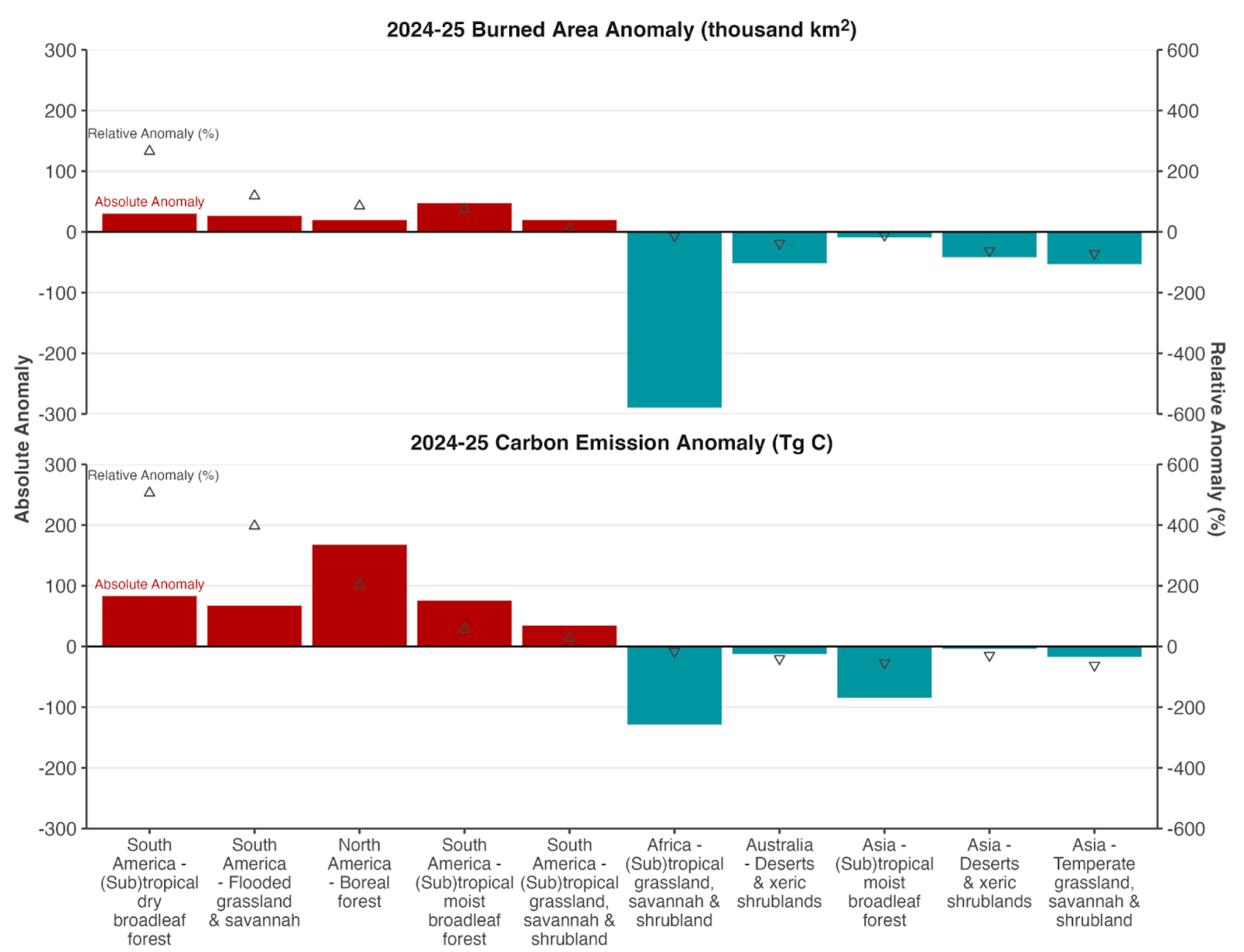
The chart below shows global burned area (top) and carbon emissions (bottom) during the 2024-25 wildfire season, compared to the average over 2002-24, for different world regions. Red bars indicate that the 2024-25 wildfire season had higher-than-average burned area or emissions for the given region, while blue indicates lower-than-average numbers.
Burned area, in thousands of km2 (top) and carbon emissions in teragrams (equivalent to millions of tonnes) of carbon (bottom) during the 2024-25 wildfire season, compared to the 2002-24 average, for different world regions and biomes. The triangles (right y-axis) indicate the percentage of the relative anomaly compared to the average. Source: Kelley et al. (2025)
Savannas, grasslands and shrublands account for more than 80% of the burned area in a typical year, with forests and croplands making up the rest.
According to the report, burned area in tropical and subtropical grasslands, savannah and shrublands was 10% below the 2002-24 average over 2024-25, but still contributed 70% towards the total global burned area.
The 2024-25 wildfire season was the second consecutive year that African savannahs “experienced a low fire season”, the report notes, with below average burned area and carbon emissions.
Meanwhile, the report finds that the greatest increases in burned area and carbon emissions during the 2024-25 wildfire season were seen in the Canada’s boreal forests, the moist tropical forests in the Amazon region, the Chiquitano dry forests of Bolivia and the Cerrado – a tropical savannah in central Brazil.
The graphic below shows some key figures from the 2024-25 wildfire season.
Key figures from the 2024-25 wildfire season. Source: State of wildfires project, summary for policymakers (2025).
The team identified four “focal events” – extreme wildfire events that were chosen both for the severity of the fire and the impacts on people and the environment.
For each focal point, the study authors assessed the drivers of the wildfire. They also used attribution – a field of climate science that aims to identify the “fingerprint” of climate change on an extreme event – to determine the contribution of human-caused climate change.
Finally, the authors estimated the likelihood of similar events occurring in the future as the climate continues to warm over the coming century.
Kelley told the press briefing that “capturing fires themselves can be quite tricky”, because they are affected by a range of different factors.
The report notes that wildfires are affected by changes in weather, with hot and dry weather providing the best conditions for wildfires. It adds that changes in land use are also important, as they can affect ignition.
Kelley explained that the report authors used “multiple types of attribution” to capture these different factors, using a range of fire models, weather forecasting models and land use data.
North America
In North America, 2024-25 was an “extreme” fire year, the report says.
Both burned area and carbon emissions reached their second-highest levels since records began in 2002 and 2003, respectively. Across the continent, the burned area was 35% higher than the average since 2002 and the carbon emissions were more than double the average emissions since 2003.
In Canada, 46,000km2 of land burned during the 2024-25 fire season, releasing 282m tonnes of carbon (Mt). The burned area was 85% higher than average, but the associated emissions were more than 200% higher than average, according to the report.
The report also notes that the wildfire season started early in Canada in 2024, due to earlier-than-normal snowmelt, as well as persistent, multiyear drought and “holdover fires” that reignited in the spring after smouldering through the winter months.
In the US, more than 64,000 individual wildfires contributed to a total burned area larger than 36,000km2. More than 8,000 wildfires in Mexico led to a record 16,500km2 of burned area.
The regions experiencing record or near-record burned area and carbon emissions were varied: from the Canadian tundra and the north-western US mountain ranges to California’s grasslands and Mexico’s tropical forests. In the far-northern boreal forest – which contains around 20% of the world’s forest carbon – the season trailed only the record-breaking 2023-24 fire season in burned area and associated emissions.
The researchers select the January 2025 southern California wildfires as one of the four “focal events” of the report.
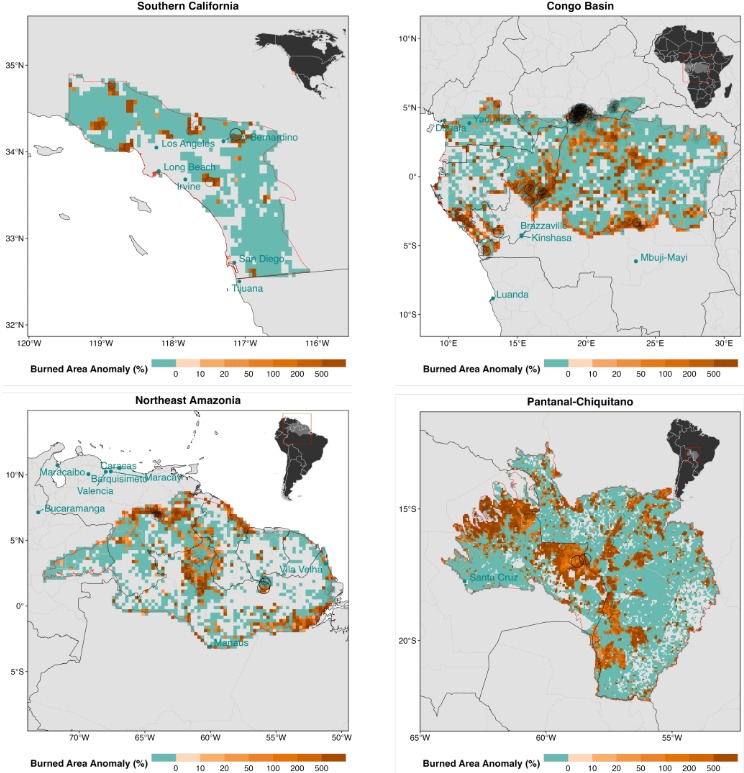
The maps below show the locations of the four focal events: southern California, the Congo Basin, north-east Amazonia and the Pantanal-Chiquitano. The colours show the percentage difference from the average burned area, with blue indicating less burned area than average and darker browns showing more burned area.
The burned area anomaly, expressed as a percentage difference from the 2002-24 average, for each of four focal events (clockwise from top left): southern California, Congo Basin, Pantanal-Chiquitano and north-east Amazonia. The inset on each chart shows the location of the event. Blue colours indicate negative anomalies (less burned area than usual) and browns indicate positive anomalies. Source: Kelley et al. (2025)
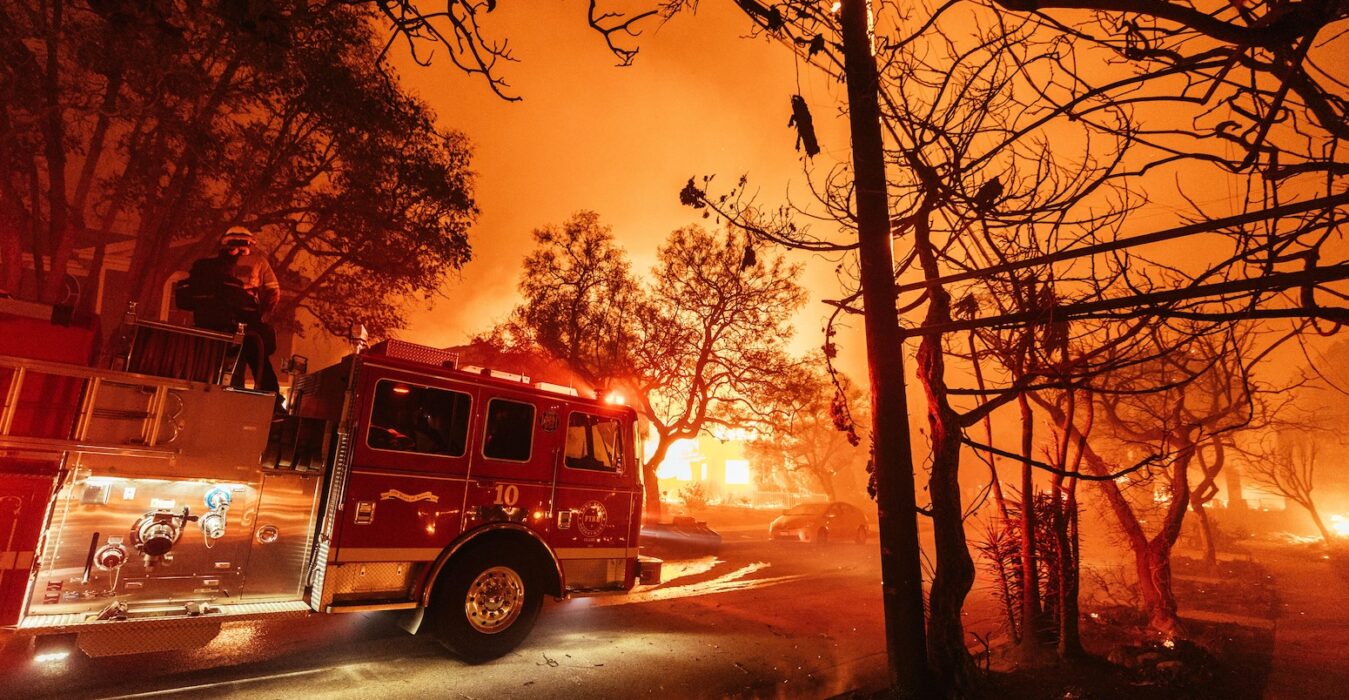
In early January 2025, more than a dozen fires broke out in and around Los Angeles. Although January is “well outside the typical fire period”, the fires “became the most expensive wildfires ever recorded in just a few short days”, Prof Crystal Kolden – a study author and the director of the University of California, Merced’sFire Resilience Center – wrote in the report.
The two largest fires, named the Palisades fire and the Eaton fire, resulted in at least 30 deaths, more than 11,500 homes destroyed and more than 153,000 people being evacuated from their homes.
The fires resulted in estimated economic losses of $140bn, placing “substantial pressure on the already volatile home insurance market in California”, according to the report. It notes that the fires also contributed to the “housing and affordability crisis” in southern California.
The report says that the severity of the January fires was largely due to intensifying extremes in the water cycle – an unusually wet period that allowed vegetation to flourish, followed by an unusually arid winter that dried out that vegetation, turning it into fuel. It notes:
“Between 5 and 25 January, favourable weather, fuel availability and ignition sources aligned, leading to create ideal conditions for ignition and rapid fire spread.
“The substantial suppression efforts deployed is unaccounted for in our modelling framework and could be one of the possible reasons the fires did not escalate even further.”
Previous attribution analysis found that the January 2025 fires were “likely influenced” by human-driven climate change. The report authors also find that the burned area in the southern California event was 25 times greater due to climate change.
However, whether extreme fire activity in southern California continues to intensify depends largely on how the region’s plants and trees respond to increased atmospheric CO2, the report says. It also notes that climate models disagree as to whether wintertime rainfall will increase or decrease in future climates.
South America
The report finds that South America had a total area burned by wildfires of 120,000km2 during the 2024-25 fire season – 35% higher than average.
That translated into the release of 263Mt of carbon – the “highest carbon emissions on record for the continent” and 84% above average, the report says.
Jones, a study author, said in a press briefing that South America “hasn’t seen carbon emissions like this on record before”.
The report underlines that South America’s fire season was “unprecedented” in many ways, such as fire extent, emission levels, intensity and their impacts on society and the environment, although not in the number of fires.
For example, fires in the north-east Amazon impacted air quality, crops, houses and native vegetation, affecting people living in the region, including Indigenous peoples such as the Yanomami, the report says.
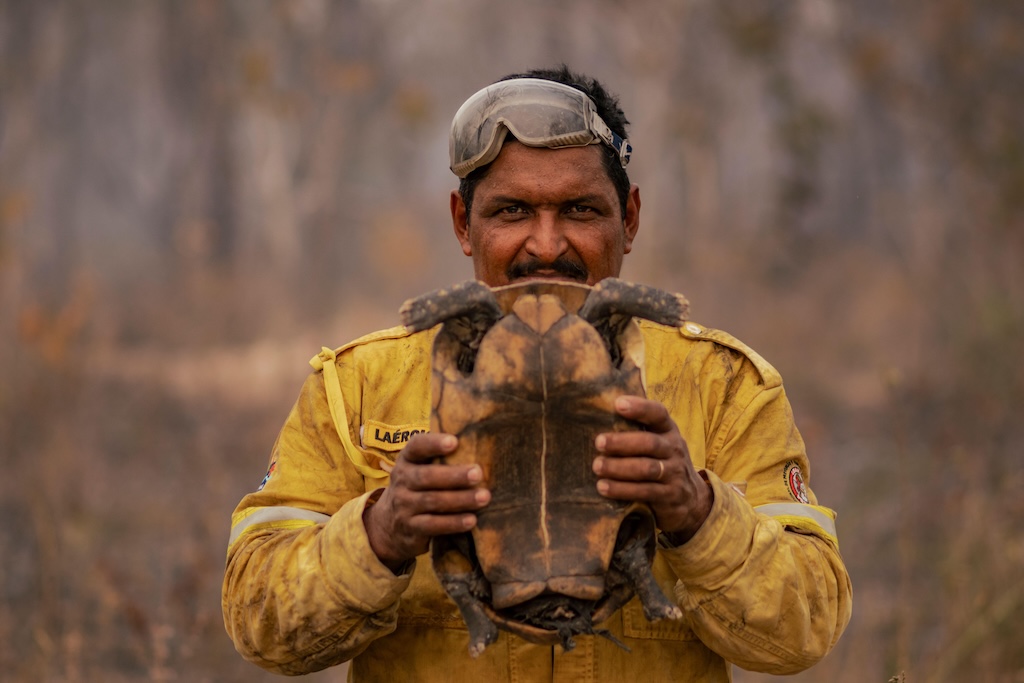
Laercio Fernandes, a volunteer firefighter and Indigenous man, holds a shell of a turtle found dead after a forest fire hit the Kadiwéu Indigenous land, in Mato Grosso do Sul, Brazil, in 2024. Credit: Diego Cardoso / Alamy Stock Photo
The country with the largest area burned by wildfires during the 2024-25 fire season was Brazil, with a total burned area of 243,000km2, followed by Bolivia, with a total of 107,000km2 of burned area, and Venezuela, with a total of 43,000km2 of burned area.
The most-affected biomes in the region were the Amazon rainforest, with 47,000km2 of wildfires above the average since 2002.
Second was the Chiquitano and Chaco dry forests – encompassing parts of Bolivia, Brazil, Paraguay and Argentina. These biomes experienced a “record-breaking” fire season with more than 46,000km2 of burned area. These fires resulted in 100Mt of carbon emissions – six times higher than the average since 2003.
More than 46,000km2 of the Pantanal – the largest tropical wetland located in Brazil, Bolivia and Paraguay – burned in 2024-25, with associated carbon emissions of 67Mt above the average.
According to the report, fire activity in the region was primarily driven by “anomalous dry weather”.
In the north-eastern Amazon, the severity of the fire season between January and April 2024 was compounded by natural sources of climate variability, such as El Niño and the Atlantic Meridional Mode, which contributed to very high temperatures and absence of rainfall. There, deep soil moisture dropped to 1%.
Meanwhile, in Pantanal and Chiquitano, “extreme dry weather” since 2023 and “multiple years of below-average rainfall” contributed to the severe fires, the report says. Study author Dr Francesca Di Giuseppe said in a briefing that the “wet season that usually happens between February and May failed completely to recharge the soil that kept completely dry and this drove most of the fire season” in the region.
The authors conduct an attribution analysis and find that the fire weather conditions in the north-eastern Amazon that season were “significantly more likely” due to climate change. In the Pantanal and Chiquitano, the conditions were 4.2-5.5 times more likely due to climate change.
Africa
Overall, the scale of fires across Africa was “well-below average” in 2024 and 2025, the report finds, except in certain areas, including the Congo Basin, northern Angola and South Africa.
In 2024, a record-high amount of land was burned in the Congo Basin – a biodiverse region in central Africa spanning six countries that holds the world’s second-largest tropical forest. This burned area was 28% higher than the annual average and there were 4,000 fires in total, 20% more than usual, in 2024.
Fires also caused “hazardous” air pollution and contributed to the Congo Basin’s highest loss of primary forest in a decade.
The analysis in the report finds that it is “virtually certain” that human-caused climate change contributed to the extreme fire weather in this region in July and August 2024.
The hot, dry and windy conditions were 3-8 times more likely to occur as a result of climate change and the area scorched by fires was three times greater than it would have been otherwise, the findings show.
Climate change has also driven an increase of more than 50% in the average annual burned area in the Congo Basin, which the researchers say is “one of the most robust signals of climate influence” in the fire trends they analysed.
Drought was a major factor behind the fires, the report finds, and water stress is expected to be the main driver shaping future fires in the Congo Basin.
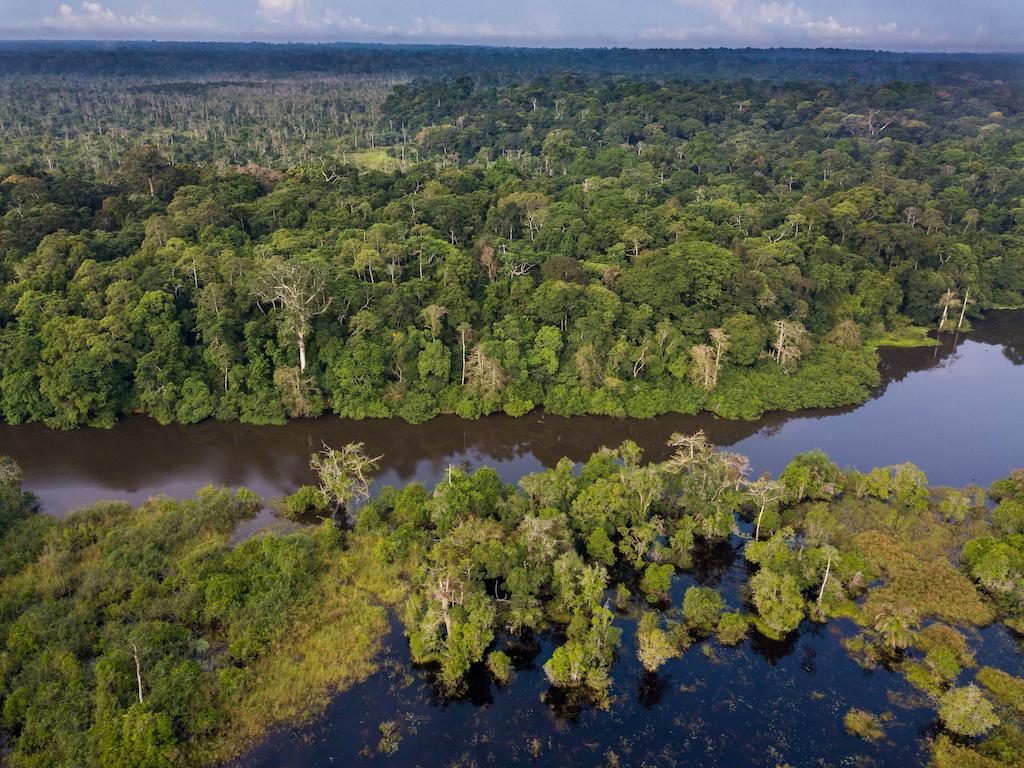
Congo rainforest along Rembo Ngowe river in Akaka, Loango National Park, Gabon. Credit: Lee Dalton / Alamy Stock Photo.
These fires are “part of a long-term trend of increasing fire encroachment into African moist forests, driven by climate change and human pressure”, says Prof Michael Wimberly, a professor at the University of Oklahoma who was not involved in the report, but has researched wildfires in Africa. He tells Carbon Brief:
“The increased fire activity in the Congo Basin is troubling because of the vast expanses of unfragmented forests and peatlands that store massive amounts of carbon, provide habitat for threatened species and supply vital resources to local populations.”
The report notes that there is “sparse reporting and poor media coverage” on the impacts of fires in the Congo Basin in 2024, despite millions of people being impacted.
In South Africa, 34 people were killed and thousands of livestock and homes were destroyed in fires last year. In Ivory Coast, 23 people were killed and 50km2 of land was burned.
Dr Glynis Humphrey, a postdoctoral research fellow at the University of Cape Town, who was not involved in the study, adds that a below-average burned area across Africa “does not necessarily indicate a decline in fire risk or impact”. She tells Carbon Brief:
“In some ecosystems, fewer but more intense fires are being observed, which can still have severe ecological and atmospheric consequences.”
Using climate models, the researchers project that fires to the extent of those in the Congo Basin last year could occur up to 50% more often by 2100, under a medium-emissions pathway.
The region is also projected to see more increases in extreme wildfire risk by the end of this century. Gabon, Equatorial Guinea and the central part of the Democratic Republic of the Congo could see some of the largest increases in burned area, which, the report estimates, could double or quadruple in some cases.
Humphrey notes that fire patterns are “shifting” in response to climate change, which is “leading to significant consequences for ecosystems that don’t typically burn – like the forests in the Congo Basin”. She tells Carbon Brief:
“This is of concern, as primary forests harbour critical biodiversity that supports ecosystem functioning and provide services to people…These forests are also sanctuaries for endangered species.”
Nigel Farage urges you to ignore facts and reality and be a climate science denier like him and his Deputy Richard Tice. He says that Reform UK has received £Millions and £Millions from the fossil fuel industry to promote climate denial and destroy the planet.Donald Trump urges you to be a Climate Science denier like him. He says that he makes millions and millions for destroying the planet, Burn, Baby, Burn and Flood, Baby, Flood.Elon Musk urges you to be a Fascist like him, says that you can ignore facts and reality then.