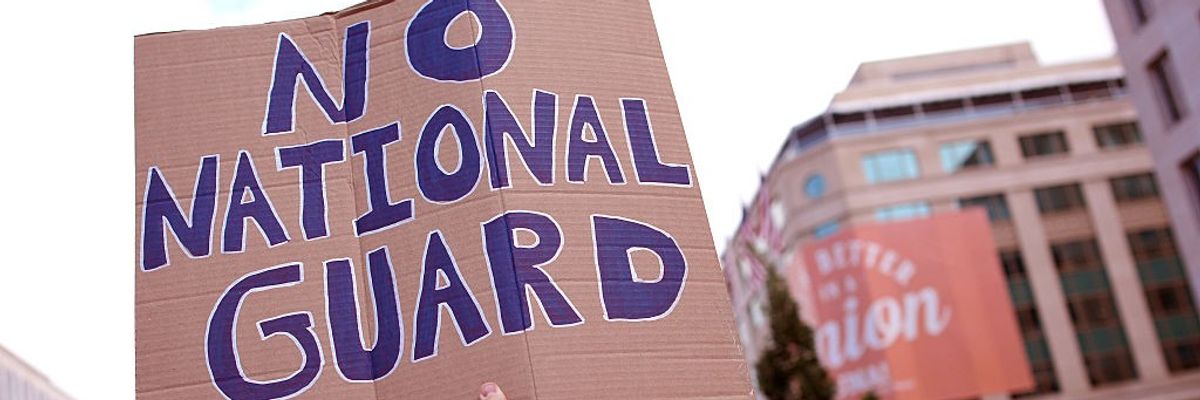
People participate in a rally against the Trump Administration’s federal takeover of the District of Columbia, outside of the AFL-CIO on August 11, 2025 in Washington, DC. President Trump announced he is placing the DC Metropolitan Police Department under federal control, and will deploy the National Guard to the District in order to assist in crime prevention in the nation’s capital. (Photo by Kevin Dietsch/Getty Images)
“If people aren’t allowed to peacefully protest and the elections are being rigged through gerrymandering and voter suppression, how are Americans supposed to respond when they figure out their lives are being actively destroyed by a corrupt, fascist government?”
Internal documents obtained by The Washington Post and reported on Tuesday reveal a secret Pentagon plan by the Trump administration to create a standing force of military personnel that could be rapidly deployed to U.S. cities or communities to quell public protests or any situation President Donald Trump deems “domestic civil unrest.”
The proposal to create what it dubs a “Domestic Civil Disturbance Quick Reaction Force”—which evidence shows has been under serious consideration by the administration over recent months—would utilize existing statute, including invocation of Title 32, to authorize the deployment of specialized National Guard units anywhere in the country within hours, according to the documents.
The plan calls for 600 troops to be on standby at all times so they can deploy in as little as one hour, the documents say. They would be split into two groups of 300 and stationed at military bases in Alabama and Arizona, with purview of regions east and west of the Mississippi River, respectively.
“This isn’t normal!!!” declared one social media user, a U.S. Navy veteran, in response to the reporting.
The leaked documents detailing the plan, which the Post noted “represents another potential expansion of [Trump’s] willingness to employ the armed forces on American soil,” comes just a day after the president sparked serious concerns (and local protests) by deploying National Guard troops in the city of Washington, D.C. and announcing a federal takeover of the D.C. police force.
Trump is a wannabe dictator, and his takeover of DC shows us exactly what he wants to do to cities across this country.
We must continue to stand up to protect our cities and our people.
Civil liberties advocates and critics of Trump’s growing authoritarianism warn the president is raising “a trial balloon” to see just how much he can get away with when it comes to deploying U.S. soldiers onto the nation’s streets.
Coupled with the D.C. takeover, Tuesday’s revelations about the Pentagon’s more expansive plan served to increase those fears, especially in the light of looming political battles regarding gerrymandered districts for next year’s congressional elections and growing disgust with the broader Trump policy agenda.
“If people aren’t allowed to peacefully protest and the elections are being rigged through gerrymandering and voter suppression, how are Americans supposed to respond when they figure out their lives are being actively destroyed by a corrupt, fascist government?” asked Wisconsin state Rep. Chris Larson, a Democrat.
“The U.S. military should never be used against peaceful civilians,” said Larson. “The criminal president who thinks it’s cool can f*ck all the way off.”
Joseph Nunn, an attorney at the Brennan Center for Justice specializing in the domestic use of the U.S. military, told the Post that the lawfulness of the proposal is far from clear and that the creation of such a force would be deeply troubling.
“You don’t want to normalize routine military participation in law enforcement,” Nunn warned. “You don’t want to normalize routine domestic deployment.”
“When you have this tool waiting at your fingertips, you’re going to want to use it,” he added. “It actually makes it more likely that you’re going to see domestic deployments—because why else have a task force?”
Nicolás Maduro greets thousands of supporters outside of MIraflores Palace on July 28, 2024. Photo: Zoe Alexandra
The reaction came after the US Attorney General increased the reward to USD 50 million for information leading to the arrest of the Venezuelan president.
The Venezuelan government has said that the increase in the reward for the arrest of President Nicolás Maduro by US Attorney General Pam Bondi is “ridiculous” and that it is part of a “propaganda operation” and a “desperate distraction” from the internal problems facing the United States.
Bondi published a video on August 7, announcing that the US Department of Justice and Department of State are offering USD 50 million for “information leading to the arrest of Nicolás Maduro”.
This is not the first time the US government has tried to pressure the Bolivarian government in this way. In 2020, the US Department of Justice offered USD 15 million for Maduro’s arrest. The accusations were based on alleged acts of “narco-terrorism” by the Venezuelan government.
According to the US government, Maduro allegedly collaborated with the Revolutionary Armed Forces of Colombia (FARC) “to use cocaine as a weapon to ‘flood’ the United States”.
During the Biden administration, this figure was increased to USD 25 million (the same amount offered for the capture of Osama Bin Laden after the attacks of September 11, 2011).
This time, Washington is doubling the “bet” to USD 50 million. According to the Trump administration, Maduro is one of the world’s most prominent drug traffickers, as he allegedly works closely with the criminal gangs the Sinaloa Cartel, the Tren de Aragua, and the Cartel de Los Soles.
“Under President Trump’s leadership, Maduro will not escape justice, and he will be held accountable for his despicable crimes,” said US Attorney General Pamela Bondi in a video. Bondi accused Maduro of using Foreign Terrorist Organizations (FTO) Tren de Aragua, Sinaloa Cartel, and the Cartel de Los Soles to “to bring deadly drugs and violence into our country”.
For his part, Venezuelan Foreign Minister Yván Gil said the accusations are nothing more than a media show aimed at satisfying Trump’s most extremist supporters.
“Pamela Bondi’s pathetic ‘reward’ is the most ridiculous smokescreen we have ever seen. While we dismantle the terrorist plots orchestrated from your country, this lady comes out with a media circus to please Venezuela’s defeated far right,” Gil affirmed in response to Bondi’s statements.
According to Caracas, the accusations have no real basis and are part of a smear campaign against the Venezuelan government, in addition to the sanctions and economic and trade blockades imposed by the United States on Venezuela.
Maduro also reacted to Bondi’s accusations, describing them as part of a “fascist conspiracy” to destabilize his government: “Colombian drug trafficking linked to [ex-President Álvaro] Uribe, criminal gangs and recycled criminals that still exist in the country, and the fascist conspiracy financed by the United States, are a disastrous equation against Venezuela.”
The Cuban government also rejected the decision to increase the reward for Maduro’s “head”. The country’s Foreign Minister, Bruno Rodríguez, posted on X: “We condemn the fraudulent reward announced by the US government against the legitimate President of Venezuela, Nicolás Maduro, which constitutes a new act of aggression against that sister nation. The US government lacks the legal and moral authority to take such a measure.”
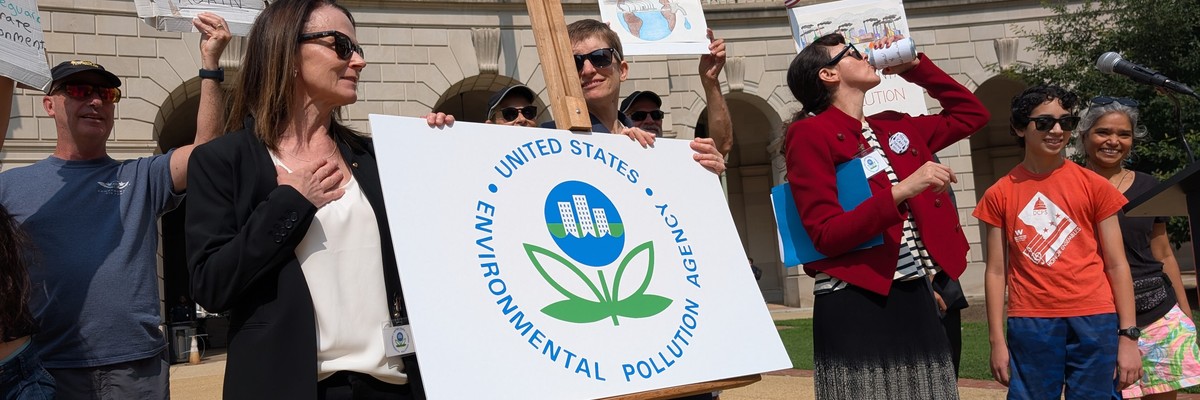
Protesters renamed the U.S. Environmental Protection Agency the Environmental Pollution Agency at its Washington, D.C. headquarters on August 7, 2025. (Photo: Extinction Rebellion D.C.)
“The days of shackling America’s oil, gas, and coal companies are over,” said spokesperson Melinda McFossilShill.
A renaming ceremony for the U.S. Environmental Protection Agency was held at its Washington, D.C. headquarters on Thursday to give the EPA a name that reflects its priorities under Administrator Lee Zeldin and Republican President Donald Trump.
On the heels of Zeldin’s visit to New England that spotlighted a push for the Constitution gas pipeline, a small group gathered outside the EPA building on Thursday to reintroduce it as the Environmental Pollution Agency and unveil its new logo.
“The days of shackling America’s oil, gas, and coal companies are over,” said Environmental Pollution Agency spokesperson Melinda McFossilShill. “The Trump administration stands for freedom, and that includes the freedom to pollute.”
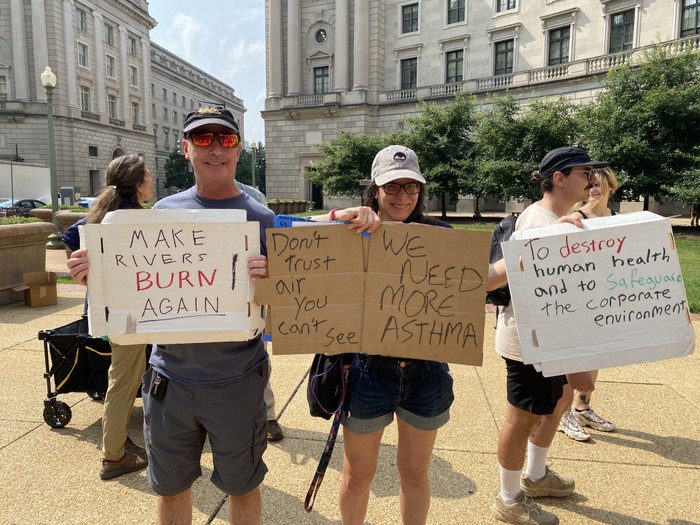
McFossilShill is not a real representative of the agency, but rather a critic of what it’s become. Thursday’s “Make Pollution Great Again!” event was a protest, led by groups including Shut Down D.C. and the local arm of Extinction Rebellion.
In addition to McFossilShill, protesters took on the personas of fossil fuel executives and backers, including Joe Gasfracker, vice president for corporate capture of government (a false name and position) at the (real) American Petroleum Institute.
“I want to extend my deepest gratitude to Administrator Zeldin and President Trump for finally ending the charade of so-called ‘environmental protection’ and making government work for our patriotic fossil fuel corporations again,” he said.
“There are hundreds of people dying in floods, thousands dying in hurricanes, and millions being sickened by particulate matter pollution, wildfire smoke, and extreme heat, but we must balance that against the billions of dollars in profit that our members make,” Gasfracker continued. “Billions are more than millions, so obviously our profits must take precedence.”
Another protester—dubbed Pete Pollution, executive director of Energy Villains for Increased Leakage (EVIL)—declared that “the American Dream has always been about the freedom to pour toxic chemicals into every community.”
“If we don’t pollute America’s environment, who will?” added Pollution. Other participants held signs that called for making rivers burn, causing more asthma, and destroying human health.
Protesters renamed the U.S. Environmental Protection Agency the Environmental Pollution Agency at its Washington, D.C. headquarters on August 7, 2025. (Photo: Extinction Rebellion D.C.)
During Trump’s second term, the EPA has faced intense criticism for a range of actions. Over the past month, the agency has put 144 employees on leave after they signed a letter criticizing the administration’s “harmful” policies, eliminated its scientific research arm in the “ultimate Friday night purge,” proposed reregistering a pesticide twice banned by federal courts, and moved to cancel $7 billion in solar grants for low- and middle-income households.
Perhaps most notably, the agency also unveiled a rule to rescind the 2009 “endangerment finding” that has enabled federal regulations aimed at the fossil fuel-driven climate emergency over the past 15 years.
Further, Trump last month signed a series of proclamations to provide what he called “regulatory relief” to over 100 coal, chemical manufacturing, iron ore processing, and sterile medical equipment facilities, with the White House claiming that rules imposed on them under former Democratic President Joe Biden’s EPA were “burdensome.”
At the time, John Walke, clean air director for the environmental group Natural Resources Defense Council, accused Trump of signing a “literal free pass for polluters,” and warned that “if your family lives downwind of these plants, this is going to mean more toxic chemicals in the air you breathe.”
Elected Democrats—who have minorities in both chambers of Congress—have joined climate, environmental, and public health advocates in calling out Trump and Zeldin for various moves.
Jay Inslee: Trump and Zeldin have turned EPA into ‘Environmental Pollution Agency’ by revoking essential climate rule www.msnbc.com/ali-velshi/w…
On Thursday, U.S. Senate Minority Leader Chuck Schumer (D-N.Y.) and Environment and Public Works Committee Ranking Member Sheldon Whitehouse (D-R.I.) led a letter to Zeldin about his proposal to gut power plant pollution standards.
“Climate change and toxic air pollution are serious issues,” dozens of Senate Democrats wrote to the EPA administrator. “We represent millions of constituents who risk poisoning from mercury and air toxics and who are facing the rising costs of the climate crisis.”
“Congress established the Clean Air Act to protect our constituents from these dangers. We urge EPA to follow its directive,” they added, urging Zeldin to withdraw two proposals on fossil fuel plant emissions.
In a Thursday statement, Schumer said that “the Trump administration is saying to hell with five decades worth of protection against deadly pollution and neurotoxins that has saved thousands of lives, made communities safer, and our economy stronger. Why? To appease Big Oil and fossil fuel billionaires.”
“The Trump administration’s obsession with gutting clean air protections and allowing more poison into the air is reckless, dangerous, and a clear reminder: Republicans care about their donors, not you,” he charged. “The EPA needs to stop ignoring the science and the facts and immediately reverse course and put the health and safety of Americans first.”
Donald Trump urges you to be a Climate Science denier like him. He says that he makes millions and millions for destroying the planet, Burn, Baby, Burn and Flood, Baby, Flood.
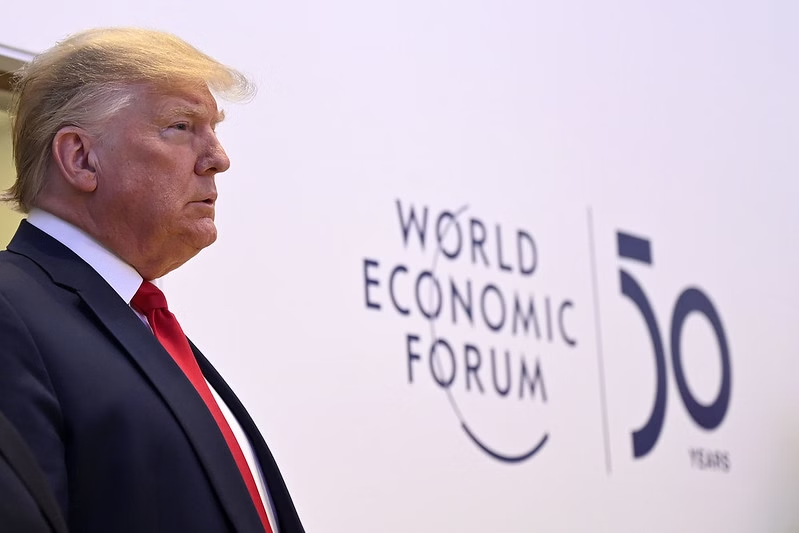
U.S. President Donald Trump and corporate image-crafter the World Economic Forum have perfected the tactic of creating “pseudo-realities” to help avoid accountability for damaging actions. Credit: World Economic Forum/Valeriano Di Domenico .
This week, the EU agreed to 15% tariffs with the United States, half of President Donald Trump’s threatened rate, before the August 1 deadline. With Mexico and Brazil trade deals on the horizon, Trump appears to have the world’s pocketbooks, supply chains, and eyeballs precisely where he wants them: in a state of uncertainty, and focused on him.
“We didn’t believe him,” a Wall Street executive told the Financial Times. “We assumed that someone in the administration that had an economic background would tell him that global tariffs were a bad idea.” Trump seemed surprised by the executives’ surprise: “I said this would exactly be the way it is,” he noted, correctly.
But perhaps CEOs can be forgiven for assuming that the self-proclaimed “Tariff Man” was bluffing. Perhaps it’s understandable that some of the world’s most powerful and highly compensated executives, including fossil fuel leaders, filed Trump’s campaign pledges — “tariffs are the greatest thing ever invented,” he declared last fall — in the category of “things politicians say.”
After all, making high-profile promises on which they have no intention of following through — promises that are based largely on what they want people to think is true, or simply what is convenient to say in the moment — is how corporations operate every day.
Indeed, with the help of well-paid public relations firms, prestigious consultants, and elite conveners like the World Economic Forum, executives and their organizations construct what might be considered “pseudo-realities”: alternative portrayals of the world that serve a company’s interests but have little bearing on how the company actually makes money.
In the digital age, in fact, operating in the space between word and deed, between image and action, between theater and reality, has become the modus operandi of the corporate world, especially fossil fuel companies.
The Big Oil Autocratic Playbook
Big Oil has honed this playbook to near perfection. For decades, the industry has enlisted PR agencies to construct elaborate narratives so polished and pervasive that they’ve managed to stave off meaningful climate action while painting the oil and gas giants as working toward — in what might be a first in the history of modern capitalism — its own obsolescence.
Take Saudi Arabia’s state-backed oil giant Aramco, which is one of the most profitable companies in the world. As DeSmog’s TJ Jordan has pointed out, the company’s relentless advertising constructs a narrative of responsibility and green innovation. Aramco frames its advanced fuels and F1 motorsport sponsorship as a credible pathway to decarbonization — part of a broader Saudi push for a clean energy transition.
That argument omits a key piece of reality: not just that the kingdom is a major fossil fuel producer, but that it has stated its commitment to this extractive business model for years to come. (McCann, Publicis, and Hill+Knowlton, which is now part of Burson, are among the PR firms that have worked for Aramco.)
Or consider DeSmog’s deeply researched investigation into how Edelman, one of the world’s largest PR firms, polished the image of the United Arab Emirates, creating an alternate reality that convinced the public and heads of state that it was a leader on climate action, obscuring its oil-producing legacy.
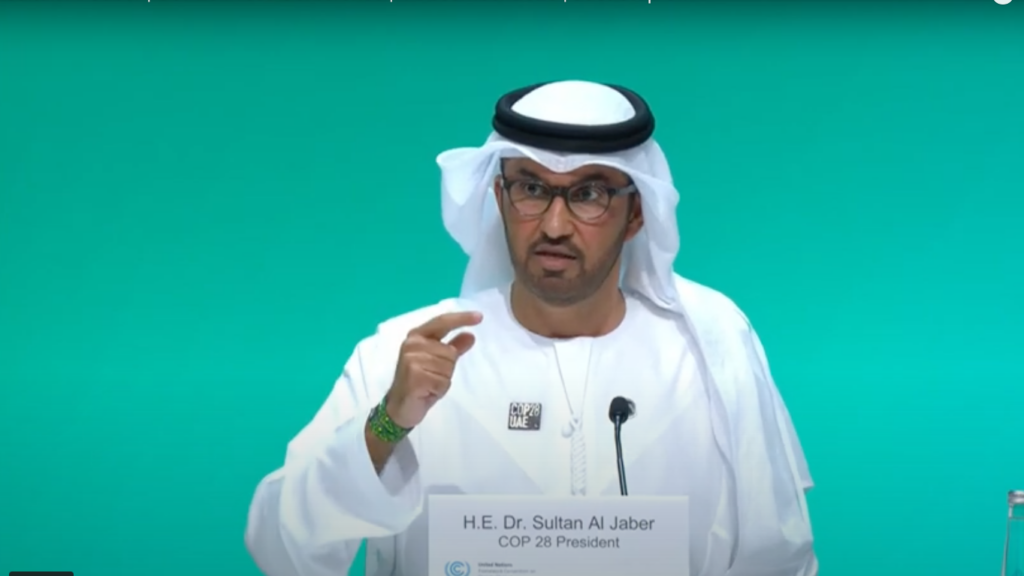
The PR campaign helped propel oil baron Sultan Ahmed Al Jaber to the top levels of climate diplomacy as host of COP28, the UN’s annual climate gathering, even as the UAE was pumping more and more oil — a case study in manifesting an effective pseudo-reality.
Sultan Ahmed Al Jaber addresses a news conference in Dubai, December 4, 2023. Credit: Just Stop Oil YouTube Channel.
Meanwhile, this July, barely a year after Edelman won an “eight-figure” contract with Shell, one of the world’s leading oil and gas producers, the agency signed an agreement to manage PR for the upcoming COP30 climate conference in Brazil.
The goal of campaigns like these does not appear to be to convince everyone, everywhere, forever. Instead, like an authoritarian propagandist (or an aspiring one), these efforts seek to flood society’s information channels with alternate visions of how the world might be.
As long-serving autocrats have discovered, the resultant mixture of true belief, skepticism, and confusion creates doubt that the truth — in this case, about the severity of climate change, and the complicity of those responsible for it — can ever really be known. Such doubt helps prevent the emergence of public consensus and stalls momentum for accountability and change.
A Performative Ally
In pursuit of these efforts, fossil fuel companies have found an ally in an organization that is ostensibly committed to tackling the climate crisis and transitioning the world to clean energy.
Indeed, few organizations demonstrate the performative nature of corporate image-crafting as transparently as the World Economic Forum (WEF), the nonprofit that hosts the annual gathering of corporate and political elites of the same name in Davos, Switzerland, each January.
“The big issues in the world, like climate change, cannot be solved by governments alone,” said WEF’s founder and former CEO Klaus Schwab in 2019. “We need new technologies, so business has a role to play. Civil society has a big role to play. We are all stakeholders in our global future. And the World Economic Forum acts as a kind of catalyst for this process.”
(Earlier this year, Schwab resigned from the WEF following allegations that included misappropriating funds and creating a toxic work environment rife with racial discrimination and sexual harassment.)
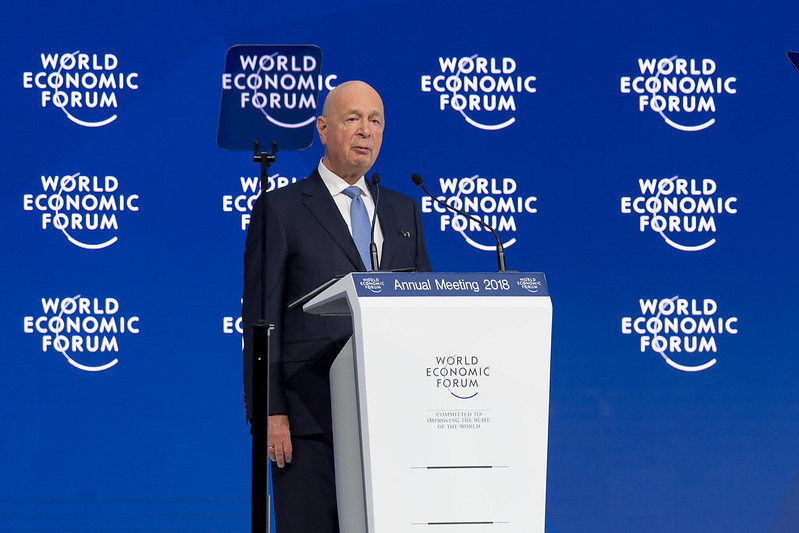
WEF CEO Klaus Schwab speaks at the group’s 2018 annual meeting. Credit: World Economic Forum/Remy Steinegger
The WEF is decidedly inaccessible to the public: Membership can cost companies more than $650,000 a year, with individual attendees paying upwards of $30,000 for top-tier access to the four-day Davos conference. But it is nevertheless a performance for the public. WEF elites want to be seen and think of themselves as “using their powers for good,” as one of my former bosses in the corporate world used to say.
To that end, the organization publishes a steady stream of content, including reports, white papers, articles, podcasts, YouTube videos, and social media posts. Most of this corporate “thought leadership” shares two distinct but related goals: to position the organization that publishes it as an expert in a problem being discussed (such as climate change), and to portray the company — and “business” more generally — as critical to addressing that problem.
The WEF did not respond to an emailed request for comment.
For instance, in a January 2023 paper published with the consulting firm (and WEF “strategic partner”) PwC, the WEF outlined a “business case” for corporations to pursue climate adaptation strategies. One recommendation: “Capitalize on opportunities” created by the climate crisis. “These adaptation efforts will generate demand for products and services and open new markets,” the report noted.
The language in these publications is typically grandiose. “The future of our planet depends on it,” its foreword concluded, referring to the corporations taking action — of which authoring a report is presumably one part.
The business models of, say, a consulting firm like McKinsey & Co. that is determined, in the words of its boss, to continue “[doing] business with greenhouse-gas emitters,” or of a global nonprofit like the WEF, which brought in more than $500 million in revenue last year, much of it from extractive corporations and oil-reliant governments, do not include concrete actions that would make fossil fuel production less lucrative. (McKinsey, Chevron, Aramco, BP, and Rio Tinto are among WEF’s other “strategic partners.”)
‘Organized Lying’
A revealing example of how companies use thought leadership to spin pseudo-realities into existence comes from a PR firm with close ties to Schwab and the WEF.
The late 2010s and early 2020s marked a short-lived era in which executives decided that their workers, customers, and other “stakeholders” — such as politicians and regulators — wanted to hear that businesses were solving global challenges like climate change, inequality, and racism. This self-serving notion was called “stakeholder capitalism,” which also became the title of a 2021 book by Klaus Schwab.
Edelman, one of the largest PR firms in the world, helped drive this corporate reimagining. “CEOs expected to lead on change” was among the findings of the agency’s 2019 “trust barometer,” a survey it releases in Davos every January.
The following year, company CEO Richard Edelman highlighted the “stunning” finding that employees “expect their employer’s CEO to speak up on one or more issues.” In 2021, Richard Edelman proclaimed that “the events of this past year reinforced business’ responsibility to lead on societal issues.” Citing the trust survey, the CEO wrote in a 2023 blog post titled “Companies Must Not Stay Silent,” that, “Business leaders must not only speak out on incidents of injustice and the pressing issues of the day, but they must take action.”
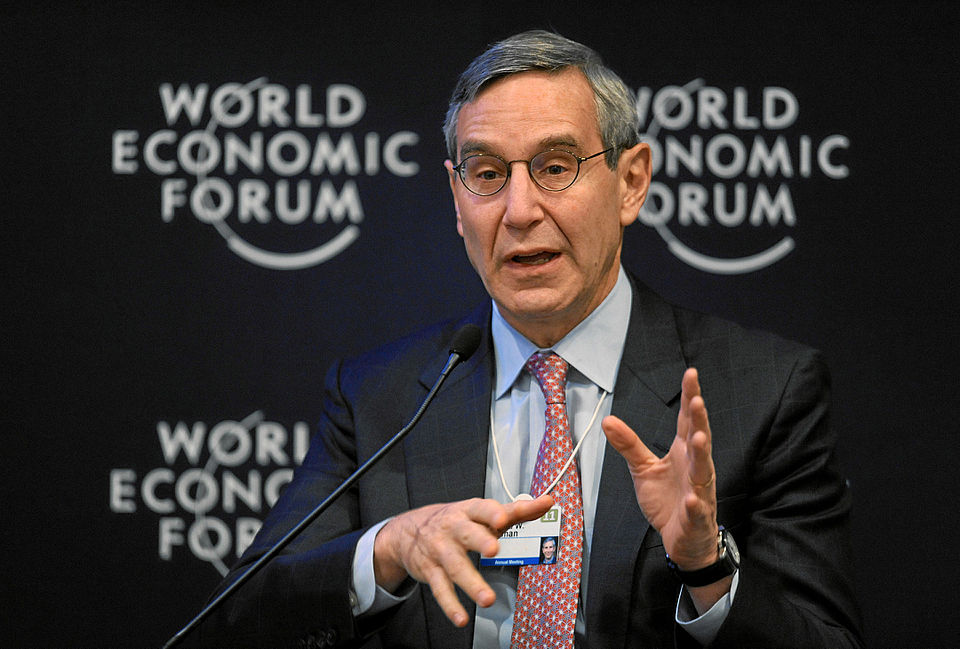
PR firm CEO Richard Edelman writes an annual trust survey that a researcher said “consistently paints the picture that best served the interests” of Edeman and its clients. Credit: Wikimedia Commons
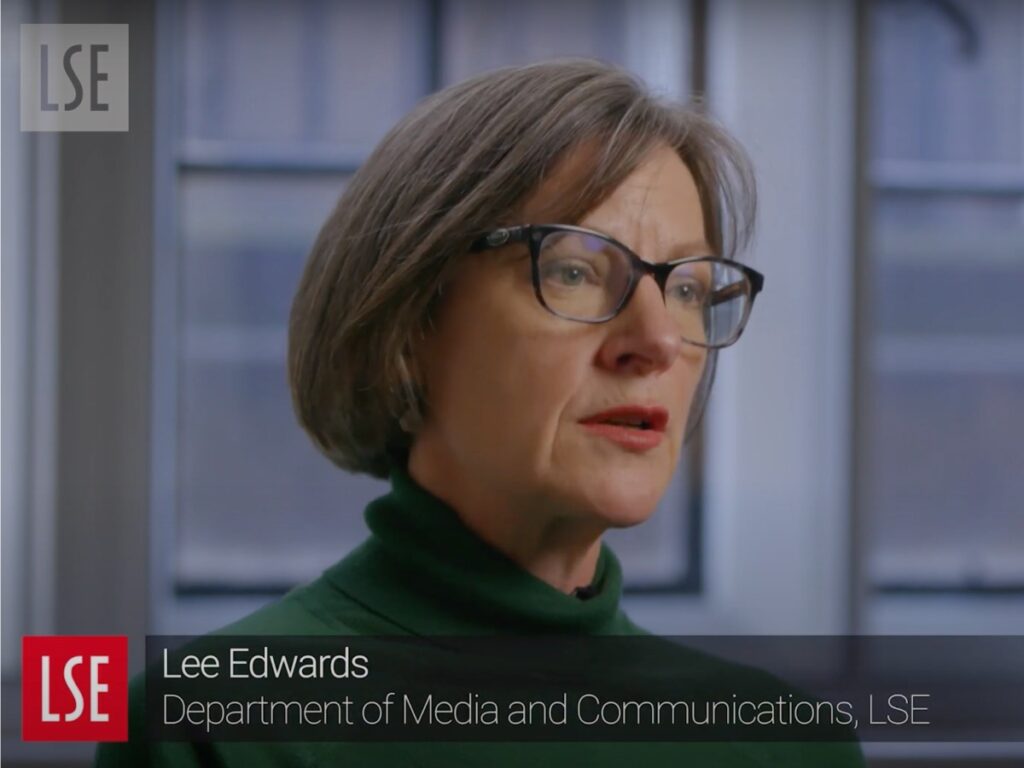
In a 2024 paper, Lee Edwards, a professor of strategic communications and public engagement at the London School of Economics, looked closely at the surveys Edelman published between 2018 and 2022. She studied not only their findings and conclusions, but the entire package — the headlines, the imagery, the tone, the formatting, the branding.
Edwards found that Edelman consistently painted the picture that best served the interests of the firm and its clients: that public trust in governments, nonprofit organizations, and the media was collapsing — meaning, in turn, that businesses had an obligation to step into the breach.
In a nod to Hannah Arendt, the late philosopher and scholar of totalitarianism, Edwards described the trust barometer as an example of “organized lying,” which “reconstitutes … reality on the basis of whatever the organization deems necessary to achieve their goals.” Corporate thought leadership “might be based on deception,” Edwards argued, “but the appearance of truth is what matters most for its value in the production of trust.”
In short, you do not need to convey what is true. You only need convince people to believe that something is true, a tactic that Trump and his Maga movement specialize in.
Corporate Trust Narratives as Alternative Realities
Edwards concluded that “the production of trust narratives by the public relations industry is not a commentary on a pre-existing reality, but a construction of an alternative reality, that in many ways obscures — intentionally or otherwise — many inconvenient but factual truths about the role of business in society.”
Because these alternative realities are driven by what is most useful for companies to portray as the truth at a given moment in time, their conclusions can shift quickly. The rhetorical emergence of stakeholder capitalism was promptly followed by a right-wing backlash that saw furious pundits and political parties in the United States and elsewhere, especially the MAGA movement and its emulators around the world, gain momentum — and sometimes win elections — in part by decrying what they called “woke capitalism.”
In turn, as the cheery narrative that companies would use market forces to fight injustice and solve climate change began to incur reputational and political risks from the right, companies did not hesitate to pivot to a different message — one that, in many ways, appeared incompatible with what they had been touting widely only months before.
“My advice to all of you for your companies is stay out of politics,” Richard Edelman told the WEF in January 2024, less than a year after advising that “this is not the time for CEOs and the companies they lead to remain silent or stand down.”
One organization that appeared to follow Edelman’s change of heart was the WEF itself. In 2024, Semafor reported that Richard Edelman was among the executives counseling the WEF to shift its politics rightward to avoid alienating conservative politicians and governments reliant on oil and gas extraction.
“The Gulf monarchies, whose oil money flows down the [Davos] Promenade and helps underwrite the forum, have also grown weary of criticism of fossil fuels and signaled to the forum that, ‘we can do this elsewhere,’” Semafor wrote. A few months later, in April 2024, WEF hosted a “special meeting” in Riyadh, Saudi Arabia, where a panel about “an equitable energy transition” featured the Saudi energy minister, the CEO of Occidental Petroleum, and the CEO of ExxonMobil.
In an emailed statement, an Edelman spokesperson said: “The guardrails on speaking out have changed because public expectations of business have evolved. The broad permission once granted to business leaders to speak freely has become more selective, requiring careful consideration of when and where to engage. Our recent data shows that there are specific instances where people expect business leaders to engage on a societal issue such as when the issue harms their employees, customers, or communities.”
Boorstin’s ‘Pseudo-events’
In her 2024 book Invisible Rulers: The People Who Turn Lies Into Reality, Georgetown University professor Renée DiResta discusses what the late historian Daniel J. Boorstin called “pseudo-events”: events manufactured specifically for the purpose of generating media coverage. Like a news conference that announces the formation of a task force that will produce a non-binding report, pseudo-events have no significance in and of themselves; they exist to create the illusion of significance.
Once a pseudo-event has been hallucinated into existence — such as an announcement in a news release or, these days, a mention in an Instagram influencer’s story — its significance cascades outward as more news outlets and social media influencers and online scrollers report on it and cite it and share it. This “narrative laundering,” as DiResta calls it, helps transform a pseudo-event into reality — or, at least, pseudo-reality.
“Once a pseudo-event has been hallucinated into existence — such as an announcement in a news release or, these days, a mention in an Instagram influencer’s story — its significance cascades outward as more news outlets and social media influencers and online scrollers report on it and cite it and share it.”
The WEF and its corporate members are master crafters of pseudo-events. Indeed, the gatherings of the WEF high in the Swiss Alps, or at June’s “Summer Davos” in Tianjin, China, are themselves pseudo-events.
They attract legions of wealthy and powerful people, alongside their PR teams and journalists. From behind closed doors emerge plenty of headlines and pledges, endless content and commitments — but no new laws, no binding emissions reductions, no new taxes to help pay for the climate adaptation that “the future of our planet depends on.” And, crucially, their high-profile pronouncements and publications can say whatever they deem most helpful for them to say in that moment.
Out of nothing emerges a pseudo-reality that portrays corporations as they wish to be seen. And in this alternate reality, the real world — in which companies operate as they always have, capitalizing on the sociopathicimperatives of capitalism — is mostly irrelevant.
Trump, Tariffs, and Pseudo-Realities
Of course, what validated, to some extent, the disbelief of the executives and Wall Street analysts on “Liberation Day” is the fact that Trump is a serial fabricator. Over the past decade, no one has been more successful than this president of the United States in spinning up and cashing in on pseudo-realities largely untethered from what he is actually doing.
Shamelessly promising whatever is convenient in the moment, with no intention of following through; profiting off the manipulation of supporters while condescending to them; acquiring power by constructing an alternative narrative of how the world is; performing that pseudo-reality into existence by repeating it over and over again: This is the Trump playbook. But it is also the corporate playbook.
Many say that President Trume aquired power by constructing an alternative narrative of how the world really is. Credit: Public Domain
Despite their initial shock, companies quickly found that there was value in the tariff narrative. Reports are already documenting executives explaining how the expectation of tariff-driven price increases provided an ideal cover for increasing prices — even on products not impacted by tariffs.
In April, asked on CNBC whether corporations were “raising their prices…just because they can,” one oil executive responded, “Exactly. Yes. … It gives them room to move prices up,” as The Lever’s Luke Goldstein noted.
Whether price-gouging under the cover of tariffs, or offering tired-but-effective national security justifications for doubling down on fossil fuels, predicting something and then using your prediction to justify what you already wanted and/or planned to do is a key two-step in what LSE’s Edwards called “organized lying.”
Only in an alternative reality could the PR and influence industry, whose business model includes laundering the reputations of autocrats and creating astroturf front groups to generate the illusion of broad public support, be seen as an authority on public trust. Yet it seems not to matter whether the pseudo-realities they manufacture are genuinely believable — only that they are just believable enough to serve a purpose.
And that purpose is often as simple as preventing the coherence of an alternative narrative, like the fact that corporate profiteering, which rose during the COVID crisis, is exacerbating tariff consequences for consumers. Or that the fossil fuel industry is (still) exploiting public anxieties to preserve its lucrative business model as long as possible, as Amy Westervelt discussed recently for Drilled.
Were narratives like these to cohere, they might generate broad public enthusiasm for new taxes or regulations or consumer protections or unions or even popular movements. As long as a pseudo-reality prevents the truth from cohering, it serves its purpose.
In Invisible Rulers, DiResta notes a consequence of living in a world of pseudo-realities, one in which it becomes difficult for ordinary people to be certain about what is true and what is not (which is also a defining characteristic of authoritarian propaganda states).
“People are simply overwhelmed,” DiResta writes. “The world feels unimaginably complex, and millions believe that they are being manipulated — they’re just not sure by whom and to what end.”
Those millions are often correct.
Donald Trump urges you to be a Climate Science denier like him. He says that he makes millions and millions for destroying the planet, Burn, Baby, Burn and Flood, Baby, Flood.Neo-Fascist Climate Science Denier Donald Trump says Burn, Baby, Burn.
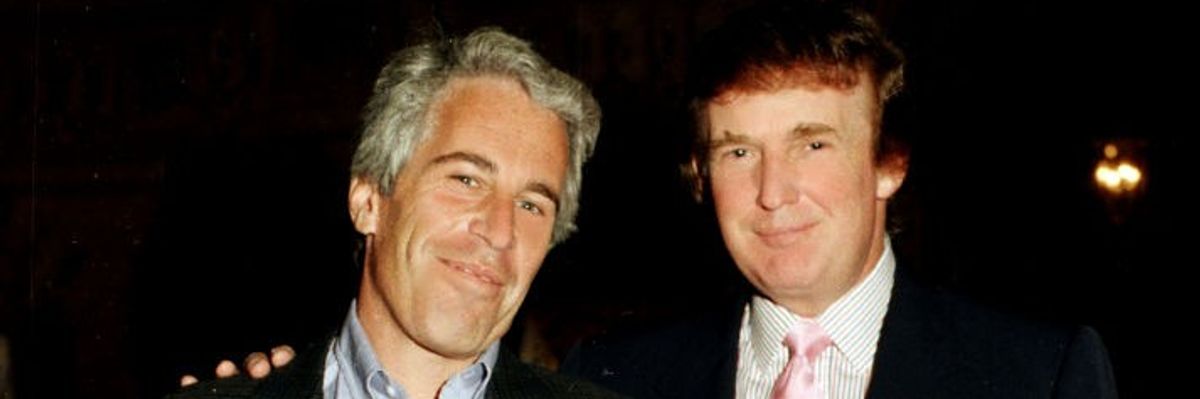
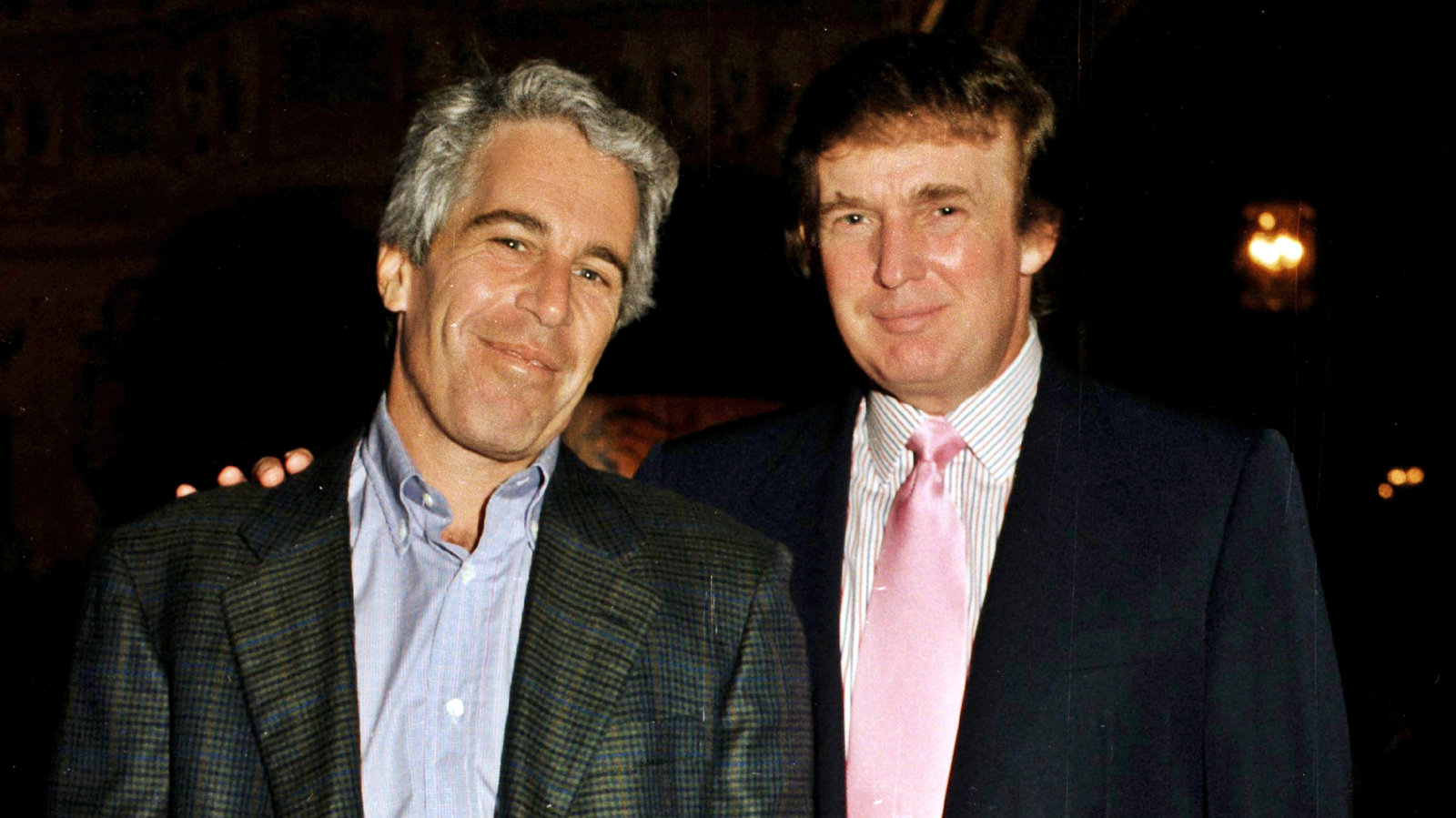
American financier Jeffrey Epstein (left) and then-real estate developer Donald Trump posed together at the Mar-a-Lago estate in Palm Beach, Florida in 1997. (Photo: Davidoff Studios/Getty Images)
The names of other high-profile figures were also redacted, according to Bloomberg.
Bloombergreported on Friday that FBI officials earlier this year redacted the name of U.S. President Donald Trump from the agency’s files on late convicted sex offender Jeffrey Epstein.
Three unnamed sources confirmed to Bloomberg that the FBI had redacted the names of Trump and other prominent public figures even before the U.S. Department of Justice (DOJ) announced last month that “no further disclosure” of the Epstein files “would be appropriate or warranted.”
Bloomberg’s sources explained that “Trump’s name, along with other high-profile individuals, was blacked out because he was a private citizen when the federal investigation of Epstein was launched in 2006.”
The reviewers applied two Freedom of Information Act (FOIA) exemptions to justify their redactions, according to the report: One that “protects individuals against ‘a clearly unwarranted invasion of personal privacy'” and another that protects against disclosures that “could reasonably be expected to constitute an unwarranted invasion of personal privacy.”
Bloomberg noted that there is nothing particularly exceptional about this because these standards have long been employed by the FBI when it comes to redacting FOIA requests, even when it comes to high-profile public figures such as Trump.
The revelations about Trump’s name being redacted from the files came on the same day The New York Timesreported that Ghislaine Maxwell, Epstein’s longtime accomplice who is serving a 20-year sentence on sex-trafficking charges, was transferred from a federal prison in Florida to a minimum-security women’s prison in Texas.
The DOJ’s decision to not release the Epstein files ignited a firestorm last month that the president has struggled to contain. At times Trump, who was friends with Epstein for several years, has even chastised his own voters for continuing to ask questions about the files, while at the same time insisting that he had nothing to do with Epstein’s sex trafficking ring that involved the sexual abuse of multiple underage girls.
Donald Trump and his paedophile friend Jeffrey Epstein.Donald Trump and his paedophile friend Jeffrey Epstein.Donald Trump, his paedophile friend Jeffrey Epstein and Trump’s daughter.Donald Trump picture with one of his wives, Jeffrey Epstein and Ghislaine Maxwell.Donald Trump with his paedophile friend Jeffrey Epstein’s associate Ghislane Maxwell.