Donald Trump urges you to be a Climate Science denier like him. He says that he makes millions and millions for destroying the planet, Burn, Baby, Burn and Flood, Baby, Flood.
Companies and individuals linked to the fossil fuel industry donated more than $19 million to Donald Trump’s inaugural fund, new Global Witness analysis reveals. The analysis, based on itemised data published by the US Federal Election Commission, identified 47 individual donations from November 2024 to January 2025, accounting for around 7.8% of the total $245 million raised by the fund. Presidential inaugural funds are used to cover the costs of inauguration events, such as parades, galas and receptions.
Donald Trump used funds from his first inaugural fund in 2017 to organise a party at his own hotel, for which he was sued by the D.C. Attorney General. Of fossil fuel-linked donors, US oil giant Chevron made the largest contribution – $2 million – and was the joint fourth-largest donor overall. A string of other fossil fuel companies made donations of $1 million, including ExxonMobil, ConocoPhillips and Occidental Petroleum. A Chevron spokesperson said that “Chevron has a long tradition of celebrating democracy by supporting the inaugural committees of both parties” and that they were “proud to have done so again this year.” None of the other companies mentioned above responded to our inquiries.
In his inaugural address, Donald Trump promised to “drill, baby, drill” and said that the US “will be a rich nation again, and it is that liquid gold under our feet that will help to do it”. In the following months, the President signed a blitz of Executive Orders aimed at boosting the fossil fuel industry and kneecapping federal climate action. These include:
Opening up federal lands and waters to fossil fuel exploration as official US policy and revoking several climate action policies;
Establishing a new group to advise his office on how to accelerate the ‘permitting, production, generation, distribution, regulation, and transportation’ of oil and gas;
Removing regulations on coal production to revive the flagging industry; and,
Ordering the US Attorney General to quash state-level “polluters pay” laws that would push fossil fuel companies to pay their fair share of climate damages.
Neo-Fascist Climate Science Denier Donald Trump says Burn, Baby, Burn.
Global Witness Senior Data Investigator Nicu Calcea said: “It’s no surprise the oil and gas industry handed millions to Donald Trump for his inauguration, and they seem to have reaped a huge return on their investment.
“Every month that Donald Trump has been in power, we’ve seen a raft of anti-climate measures come out which are music to the fossil fuel industry’s ears. From plans to steamroll through dirty new coal plants, to the attempted quashing of ‘polluter pays’ laws that would hold oil giants accountable, it’s clear where his political priorities lie.
“While Trump sides with his friends in oil and gas, we must keep up the fight for a fair, green future – that means pushing for wind and solar where we live, backing polluters pay bills, and resisting the development of oil, gas and coal projects across the country.”
Many of the world’s worst environmental and human rights abuses are driven by the exploitation of natural resources and corruption in the global political and economic system. Global Witness is campaigning to end this. We carry out hard-hitting investigations, expose these abuses, and campaign for change. We are independent, not-for-profit, and work with partners around the world in our fight for justice.
Orcas discuss how Trump was re-elected and him being an insane, xenophobic Fascist.Nigel Farage urges you to ignore facts and reality and be a climate science denier like him. He says that Reform UK has received millions and millions from the fossil fuel industry to promote climate denial and destroy the planet.
The government has announced its strategy for “giving every child the best start in life”, laying out proposals covering early years care, education and support in England.
The strategy builds on the current local family hub model of services, which offer a range of support aimed at babies and young children. Best Start family hubs will further bring together early years and family services in a similar way to the previous Sure Start programme. The government’s commitment includes £1.5 billion in investment to implement these reforms.
The Best Start Hubs will be a one-stop shop to support families with their child’s early development, from breastfeeding advice to speech and language support and stay and play sessions. The hubs will also support families with wider challenges such as housing and benefits, and provide courses for parents.
The attempt to bring services together to deliver local, holistic support to families is understandable given the impact of the original Sure Start initiative, introduced by Tony Blair’s Labour government.
Get your news from actual experts, straight to your inbox.Sign up to our daily newsletter to receive all The Conversation UK’s latest coverage of news and research, from politics and business to the arts and sciences.
The Sure Start Local Programmes that were established from 1999 onwards had a significant positive effect on those families who had access to them. From 2010, though, when the Conservative-Liberal Democrat coalition came into power, funding was cut and many Sure Start centres closed.
In May 2025 the Institute for Fiscal Studies published a summary report on the short- and medium-term effects of Sure Start on children’s lives.
They found that the impact of the Sure Start services for under-fives was remarkably long-lasting, with improvements during their teenage years in educational attainment and behaviour in school, and reductions in hospital admissions. The Institute for Fiscal Studies estimates that these long-term benefits significantly outweigh the cost of the Sure Start programme.
Like Sure Start, the Best Start strategy has the potential to be transformational for young children and their families.
However, the current range of challenges faced by families and the depth of child poverty in the country will make bringing about this transformation challenging. A 2023 report from charity the Joseph Rowntree Foundation estimates that there are one million children growing up destitute in the UK, without the means to stay warm, dry, clean and fed.
The challenge of poverty
The day after the Best Start strategy was launched, the children’s commissioner for England published a research report on children’s experience of growing up in a low-income family. Based on interviews with 128 children, the report outlines the “almost-Dickensian” levels of poverty experienced by children whose basic needs are not being met. Children described poor housing conditions, mouldy food and lack of hot water.
The significant impact that poverty has on children’s educational attainment, health and future lives will be difficult for the benefits that the Best Start programme may provide to negate.
I have witnessed these financial challenges and the wider range of issues families are dealing with on a daily basis in my own role as the director of the Early Years Community Research Centre at Sheffield Hallam University, and through my wider research with families.
In March 2024 I was part of a team of researchers who were commissioned by the Ministry for Housing, Community and Local Government to explore how multiple insecurities, such as financial difficulties, health problems, precarious work, poor housing and lack of support networks affected people’s lives.
Parents described the difficulties of making ends meet. They talked about having to deal with many different national and local agencies, the stress this created within their family and the toll on their health and wellbeing.
Even working full-time did not necessarily make families more secure. In one family, the working pattern the parents had to adopt to make ends meet meant that they only had one day a fortnight to be together.
We have to do stupid hours. I mean my partner, she works nights. I work mainly days … we’re kind of like passing ships in the night.
The places these families turned to were local community centres run by a range of organisations. The common themes about why they accessed these centres were the warm, welcoming, non-judgemental approach taken by staff, trusting relationships with staff and the range of services and support that were offered.
This bodes well for the Best Start strategy – if it is able to deliver the full range of services the government has outlined in a local trusted space. However, this will be a significant challenge in communities that have lacked support over recent years, are suffering the hardships of poverty and that may have lost trust in government services.
Keir Starmer says that the Labour Party under his leadership all feel a small part of Scunthorpe.Keir Starmer confirms that he’s proud to be a red Tory continuing austerity and targeting poor and disabled scum.Keir Starmer explains that he feels no shame or guilt benefitting personally from gifts from the rich and powerful while insisting on policies of severe austerity causing suffering and death.
New government statistics released today show the reach of the two-child limit. There are 1,665,540 children in England, Scotland and Wales living in households affected by the two-child limit, an increase of over 35,000 from the same time in 2024.
The two-child limit restricts means-tested child benefits to the first two children in a household, subject to some exceptions.
Its sister policy, the benefit cap, affects over 115,000 households, including 300,000 children. It routinely pushes families into deep poverty, far below the standard poverty line of 60% of median income.
The benefit cap places a limit on the total amount a household can receive if no-one in the household earns a minimum amount, again subject to some exceptions linked to receipt of disability benefits.
Get your news from actual experts, straight to your inbox.Sign up to our daily newsletter to receive all The Conversation UK’s latest coverage of news and research, from politics and business to the arts and sciences.
Over the past five years, we have been part of a team of academic researchers investigating the impact of both policies on families with three or more children. We’ve found that these policies drive up poverty, creating deprivation and hardship. This in turn causes sustained and severe harm to children and their families.
The two-child limit and benefit cap leave many families living with extreme financial insecurity. They harm parental mental health, as mothers and fathers struggle to try and make an inadequate income stretch to meet the needs of their children.
In addition, these policies do not fall evenly across the population when looking at ethnicity. Overall, 70% of the families affected by the two-child limit are white, as are 66% affected by the benefit cap. But our new analysis shows that children from an ethnic minority are up to three times as likely as white children to be affected by the two-child limit. They are also up to four times as likely to be affected by the benefit cap.
Alongside administrative statistics, we have analysed household survey data, published today as a policy brief. We find that one in five children from Pakistani families and one in four children from Bangladeshi families are now affected by the two-child limit.
Rising poverty
Our analysis also indicates that these policies are contributing to very high and rising levels of poverty. We estimate that 66% of Bangladeshi children, 60% of Pakistani children, and nearly half (48%) of black children live in poverty. This compares to one in four (24%) white children living below the poverty line – still far too many.
This new analysis provides us with better understanding of where the damage done by both policies is falling. It’s an important reminder of how the two-child limit and benefit cap directly conflict with ambitions not only to act on child poverty, but also to reduce systematic inequalities linked to ethnicity.
Scrapping the two-child limit would give larger families access to benefits they currently miss out on – but it would not have any effect on smaller families living in poverty, so isn’t the only policy solution needed.
Nonetheless, analysis by the Resolution Foundation has shown that getting rid of the two-child limit – which would cost £1.4 billion – is by far the most cost-effective way to reduce the number of children living in poverty. Spending £1.4 billion in other ways – for example by increasing benefits for all families – would make less difference to child poverty than if the two-child limit were ended.
It’s also important to keep in mind the impact on the depth of poverty. Larger families tend to be living further below the poverty line. Scrapping the two-child limit will make a big difference in many households, even if they are not lifted out of poverty as a result.
Labour came into government on a manifesto of “change”, and Keir Starmer has promised to be “laser-focused” in his commitment to drive down poverty.
Labour have already said that they want to get rid of the two-child limit, arguing that they just need to find the money to do so. The government has established a child poverty taskforce, due to report in the autumn, and made a first concrete policy commitment with the extension of free school meals provision for families in England. But there is no alternative to serious action on social security benefits if significant progress is to be made.
Keir Starmer says that the Labour Party under his leadership all feel a small part of Scunthorpe.Keir Starmer explains that he feels no shame or guilt benefitting personally from gifts from the rich and powerful while insisting on policies of severe austerity causing suffering and death.
U.S. President Donald Trump and Vice President JD Vance acknowledge the crowd after Trump’s second inauguration in the U.S. Capitol Rotunda on January 20, 2025 in Washington, D.C. (Photo: Kenny Holston/Pool/Getty Images)
“Every month that Donald Trump has been in power, we’ve seen a raft of anti-climate measures come out which are music to the fossil fuel industry’s ears,” said one investigator.
Oil, gas, and coal companies and individuals linked to the climate-wrecking fossil fuel industry contributed more than $19 million to U.S. President Donald Trump’s second inaugural fund, an analysis by a leading international environmental and human rights group revealed Wednesday.
Scouring itemized U.S Federal Election Commission data, Global Witness identified 47 individual donations to the Trump-Vance Inaugural Committee between November 2024 and January 2025 totaling $19,151,933. Using an artificial intelligence tool developed by Global Witness to identify corporate lobbyists, the group’s researchers were able to automatically determine each donor’s ties to the fossil fuel industry.
SUBSCRIBE TO OUR FREE NEWSLETTER
Quality journalism. Progressive values. Direct to your inbox.
Global Witness said the $19.15 million figure “is likely an underestimate, as we did not count donations from diversified investors and businesses who couldn’t be said to primarily represent the fossil fuel industry,” and individuals with common names that couldn’t be identified were not included in the final report.
According to the analysis:
The list of donors includes individuals who were given ambassadorships or key positions in the Trump Cabinet.
For example, billionaire Warren Stephens donated $4 million on December 2, 2024, the same day Trump nominated him to be U.S. ambassador to the U.K. Stephens has extensive links to the oil and gas industry but also invests in other sectors and wasn’t included in our calculations of fossil fuel industry donors.
Trump also nominated Melinda Hildebrand—who donated $500,000 to the president’s inaugural fund—to be U.S. ambassador to Costa Rica.
Hildebrand is the vice president of Hilcorp Ventures, which claims to be of the largest privately owned oil and gas producers in the U.S. Her husband, founder and chairman of Hilcorp, donated another $500,000.
Among fossil fuel corporations, Chevron was by far the largest contributor to Trump’s inauguration fund, giving $2 million. Other companies including ExxonMobil, ConocoPhillips, and Occidental Petroleum each donated $1 million.
Overall, Big Oil gave $445 million to Trump and other Republican candidates during the 2024 election cycle.
Trump accepted over $23 million from Fossil Fuel Lobby & Big Oil independently spent $445 million in 2024 elections.
In return Trump eroded our environmental regulations, hired a Fossil Fuel Executive as his Energy Secretary & let Musk defund FEMA. He is responsible for this ⤵️ https://t.co/wZuqUUbf9hpic.twitter.com/rKoRPTnive
Trump, who ran on a “drill, baby, drill” energy policy, has signed a series of executive orders aimed at boosting fossil fuel production, including by declaring a fake “energy emergency” in a push to fast-track permit approvals. He also tapped former fossil fuel executives to head the Department of Energy and Interior Department, which have pursued a policy of opening up more public lands and waters for fossil fuel development.
At the same time, the Trump administration dropped out of the Paris climate agreement for the second time and moved to roll back the modest climate progress achieved under former President Joe Biden.
“It’s no surprise the oil and gas industry handed millions to Donald Trump for his inauguration, and they seem to have reaped a huge return on their investment,” Global Witness senior data investigator Nicu Calcea said in a statement Wednesday.
“Every month that Donald Trump has been in power, we’ve seen a raft of anti-climate measures come out which are music to the fossil fuel industry’s ears,” Calcea continued. “From plans to steamroll through dirty new coal plants, to the attempted quashing of ‘polluter pays’ laws that would hold oil giants accountable, it’s clear where his political priorities lie.”
“While Trump sides with his friends in oil and gas, we must keep up the fight for a fair, green future—that means pushing for wind and solar where we live, backing polluters pay bills, and resisting the development of oil, gas and coal projects across the country,” he added.
Donald Trump urges you to be a Climate Science denier like him. He says that he makes millions and millions for destroying the planet, Burn, Baby, Burn and Flood, Baby, Flood.Nigel Farage urges you to ignore facts and reality and be a climate science denier like him. He says that Reform UK has received millions and millions from the fossil fuel industry to promote climate denial and destroy the planet.Neo-Fascist Climate Science Denier Donald Trump says Burn, Baby, Burn.
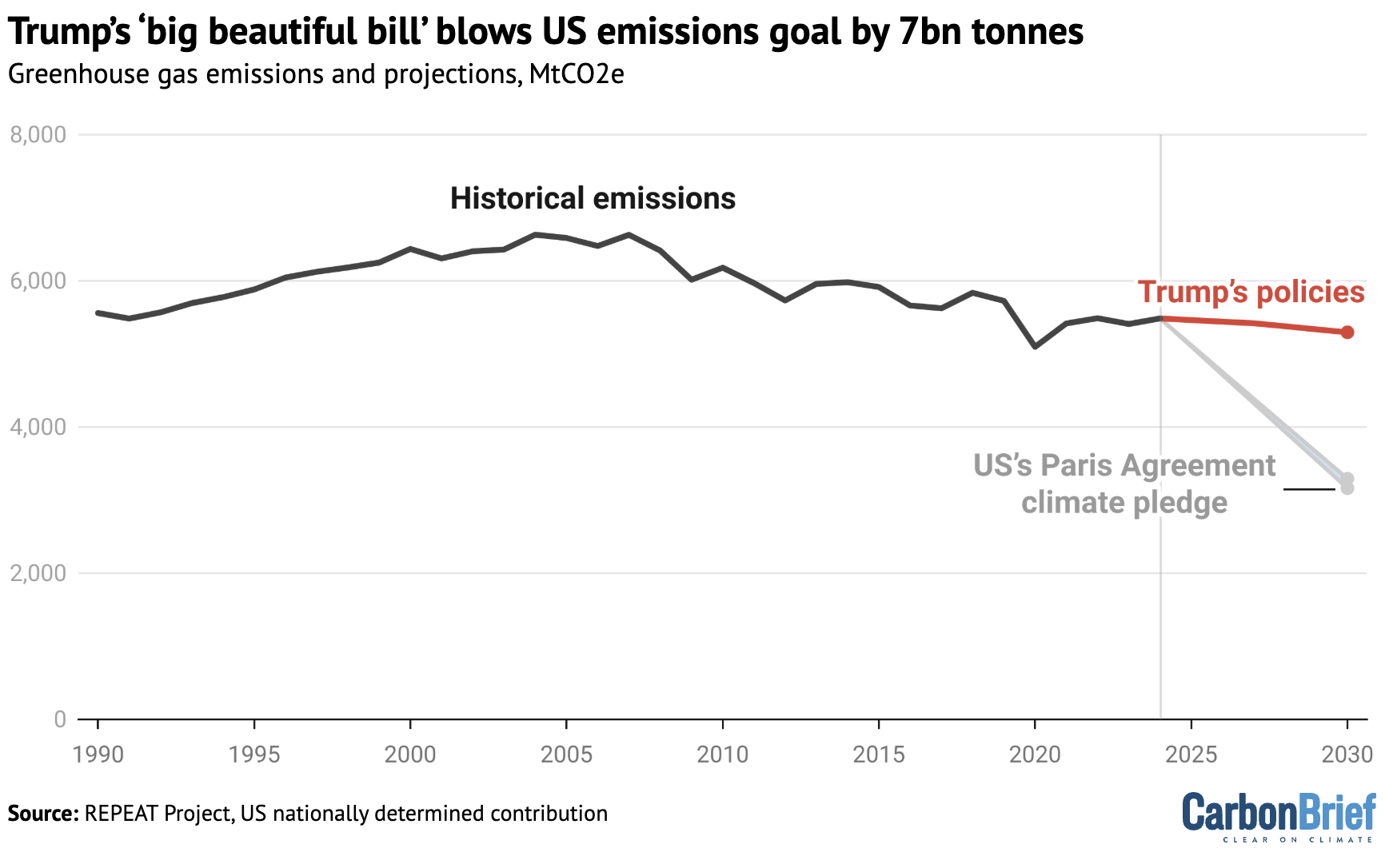
President Donald Trump’s dismantling of climate policy means the US will add an extra 7bn tonnes of emissions to the atmosphere from now until 2030, compared to meeting its former climate pledge under the Paris Agreement.
Since winning office last November, he has issued a series of executive orders and is poised to sign his “big beautiful bill” that effectively terminates Biden-era climate policies.
Carbon Brief’s analysis of modelling from the Princeton University REPEAT Project shows that this means US emissions are now set to drop to just 3% below current levels by 2030 – effectively flatlining – rather than falling 40% as required to hit the now-defunct target.
This would leave the US around 2bn tonnes short of its greenhouse-gas emissions target for that year, adding emissions equivalent to around 4% of the current global total each year
To put this in context, it is roughly the annual output of Indonesia, the world’s sixth-largest emitter.
Trump is already withdrawing his nation from its international climate obligations under the Paris Agreement.
The passage of the new Republican-backed “megabill” means that US climate targets pursued by Trump’s predecessor now appear firmly out of reach.
7bn tonnes
Trump is due to sign the so-called “big beautiful bill” into law after it was approved by the Republican-controlled US Congress on 3 July.
This “megabill” removes virtually all of the tax credits for renewable energy, electric vehicles and clean manufacturing that were at the core of Biden’s landmark Inflation Reduction Act (IRA).
(Ahead of the US presidential election last year, Carbon Brief estimated that, by reversing the IRA and other key policies, a Trump administration would add 4bn tonnes of emissions by 2030, compared to a continued Biden administration.)
Since his return to the White House, Trump has moved to strip away his predecessor’s climate policies, including via a series of executive actions. This includes targeting vehicle fuel-efficiency standards and power sector emissions standards.
The passage of the new bill means US solar and wind power expansion will likely slow down, as will sales of electric vehicles and energy efficiency improvements. The combined effect of these policy rollbacks can be seen in the chart below, based on modelling by the REPEAT Project.
Carbon Brief has compared the impact of Trump’s policies, including the megabill, to a pathway on which the US meets its former target, under the Paris Agreement, to cut greenhouse gas emissions by 50-52% from 2005 levels by 2030.
The cumulative gap between this pathway and the Trump administration’s trajectory amounts to 7bn tonnes of emissions over the next five years.
Based on the most recent central estimate of the “social cost of carbon” in 2030 from the US Environmental Protection Agency (EPA), published under the Biden administration, those 7bn tonnes of extra emissions would cause global climate damages worth more than $1.6tn.
Under this new set of US policies, emissions are only expected to be 20% lower than 2005 levels by 2030, rather than 50-52%, meaning the nation would be 2bn tonnes short of its goal.
This amounts to just a 3% drop from 2024 levels by 2030, meaning emissions are effectively flatlining.
Renewables down, prices up
Among the hundreds of provisions in the new Republican-backed bill are several key rollbacks that are expected to affect US emissions.
Under the IRA, wind and solar projects could receive tax credits up to 2034. Following the Republican bill, most projects would need to start construction within the next year to qualify.
Without federal support, the pipeline of new renewable-energy projects is expected to contract.
The REPEAT analysts estimate that cumulative new solar capacity additions will drop by 29 gigawatts (GW) by 2030 and around 140GW by 2035. For wind power, the decrease is set to be 43GW by 2030 and 160GW by 2035.
Some renewable projects will likely be built without support, but developers will need to contend with other Trump administration policies, such as stopping federal windfarm approvals.
The lost renewable capacity is unlikely to be entirely replaced by fossil fuels, due to a multi-year backlog in the construction of gas-fired power plants.
Tax credits for nuclear and geothermal power have been retained until 2036 in the bill. While these projects generate clean electricity, they can also take a long time to build.
Other key policies in the new bill include the removal of tax credits worth up to $7,500 to purchase electric vehicles, which could result in tens of millions fewer such cars and vans being sold. Ending tax credits for low-carbon manufacturing is also expected to undo progress in building clean technologies, such as solar panels and electric cars, domestically.
Beyond its effect on US emissions, various early analyses have suggested the Republican-backed bill is likely to increase energy prices and lead to job losses.
REPEAT estimates household energy costs are likely to be $165 higher in 2030 and more than $280 higher by 2035, following the passing of the bill.
Some of this increase can be attributed to fewer electric vehicles on the road, leading to higher petrol and diesel consumption and prices. Slowing construction of solar and wind projects as power demand increases will also likely affect the cost of electricity.
Without tax credits to boost the construction of new generation capacity, residential electricity prices are set to increase by 7% – or $110 – by 2026, for the average US customer, according to analysis conducted for trade body the Clean Energy Buyers Association.
In the state of Wyoming, the same analysis found that electricity prices may rise by as much as 30% over the next year. Other firmly Republican states, such as North Carolina and Tennessee, are also expected to see near-term price rises in the double digits.
The project has assessed the emissions impact of the executive actions that the Trump administration has already taken to unwind Biden-era policies, as well as the bill itself.
Carbon Brief compared this trajectory out to 2030 with a straight-line pathway towards the official US climate target for 2030. This is set out in the US’ nationally determined contribution (NDC) under the Paris Agreement. It is worth noting that the Trump administration is withdrawing the US from the Paris Agreement.
Donald Trump urges you to be a Climate Science denier like him. He says that he makes millions and millions for destroying the planet, Burn, Baby, Burn and Flood, Baby, Flood.Nigel Farage urges you to ignore facts and reality and be a climate science denier like him. He says that Reform UK has received millions and millions from the fossil fuel industry to promote climate denial and destroy the planet.Orcas discuss Donald Trump and the killer apes’ concept of democracy. Front Orca warns that Trump is crashing his country’s economy and that everything he does he does for the fantastically wealthy.