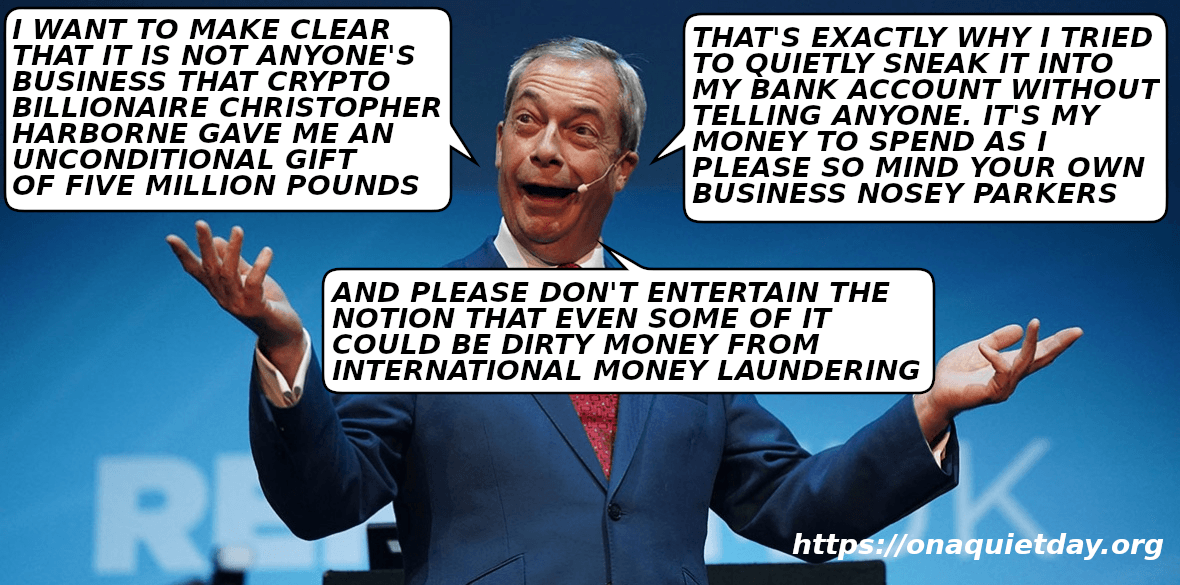
Three Millionaires Behind Farage’s “People’s Revolt”

Spread the love

https://www.open-britain.co.uk/blog/the-three-millionaires-behind-reform-uk

The cost of relying on three donors

Nigel Farage wants you to think he’s leading a grassroots rebellion. A party of ordinary people finally rising up against the establishment. But when you follow the money, the truth is a lot less romantic: in many ways, Farage is the establishment.

Not three million supporters – just three millionaires

Since 2019, around 75% of all donations to Reform UK have reportedly come from just three men: Christopher Harborne, Jeremy Hosking, and Richard Tice.

Not three million ordinary contributors. Three millionaires.

It’s not unusual for wealthy people to back a party because they like its politics. But when a party is reliant on a flood of cash from a tiny number of donors, the obvious question arises: whose interests does that party end up serving?

When you look at what these men are known for, and you look at what Reform UK’s leadership has been saying and promising, the overlaps are hard to miss.

Article continues at https://www.open-britain.co.uk/blog/the-three-millionaires-behind-reform-uk

Nigel Farage reminds you that he's the man that brought you Brexit and asks what could possibly go wrong.
Nigel Farage reminds you that he’s the man that brought you Brexit and asks what could possibly go wrong.
Nigel Farage explains the politics of Reform UK: Racism, Fake anti-establishmentism, Deregulation, Corporatism, Climate Change Denial, Mysogyny and Transphobia.
Keir Starmer refuses to be outcnuted by Nigel Farage's chasing the racist bigot vote.
Keir Starmer refuses to be outcnuted by Nigel Farage’s chasing the racist bigot vote.
Continue ReadingThree Millionaires Behind Farage’s “People’s Revolt”

Farage regrets move to run ‘bankrupt’ council

Spread the love

https://www.bbc.com/news/articles/c93wv0ylq9yo

Reform UK leader Nigel Farage said he wished the party “hadn’t bothered” to take minority control of Worcestershire County Council

Reform UK leader Nigel Farage has said he wishes the party “hadn’t bothered” to take minority control of Worcestershire County Council, because of its financial problems.

The Reform-led authority recently approved a council tax rise of almost 9%, one of the largest in its history, in a bid to balance its books and avoid effective bankruptcy amid a budget shortfall.

When questioned about the decision to increase tax, which is higher than the standard 5% normally allowed, Farage said the party had inherited the council and “didn’t make it bankrupt”.

A Reform UK spokesman, addressing Farage’s comments, said the party had “stepped up” and had done its “civic duty”.

He added: “Despite inheriting a catastrophic mess from the Tories and a council that had to be propped up by government bailouts, our team has fought hard to deliver a responsible budget and avoid raising council tax to the maximum.”

Reform UK, which had previously pledged to cut tax during its election campaign, took over leadership of the authority from the Conservatives following the local elections in May, but has no overall majority.

Article continues at https://www.bbc.com/news/articles/c93wv0ylq9yo

Nigel Farage reminds you that he's the man that brought you Brexit and asks what could possibly go wrong.
Nigel Farage reminds you that he’s the man that brought you Brexit and asks what could possibly go wrong.
Nigel Farage explains the politics of Reform UK: Racism, Fake anti-establishmentism, Deregulation, Corporatism, Climate Change Denial, Mysogyny and Transphobia.
Nigel Farage blames the Muzzies.
Continue ReadingFarage regrets move to run ‘bankrupt’ council

How Europe’s Climate and Sustainability Rules Were Shredded While Citizens Remained in the Dark

Spread the love

Original article by Hugh Wheelan and Raj Thamotheram republished from DeSmog

(Credit: Mahen Rin/Unsplash)

Policymakers, civil society, investors, business, and the media all must answer key questions fast — before the regulatory rollback turns into a rout.

The European Union’s package of major corporate environment and sustainability laws was years in the making — and has just been quietly gutted.

A debate that reshaped corporate Europe unfolded almost entirely within Brussels policy circles. Millions of Europeans who believe climate action should be prioritised and favour greater corporate accountability never realized the regulations were under threat

This should prompt serious reflection among those of us who believe that the climate and human rights focus of the regulations was deadly serious, but that support among politicians was not.

The so-called “Omnibus” rollback — a regulatory rationalisation ascribed to competitiveness concerns amid pressure from the United States – has exempted 90 percent of Europe’s companies from climate reporting. In parallel, supply chain reporting has been seriously watered down and postponed until the end of the decade.

The overturned rules included mandatory reporting by most EU companies of their impact on climate change, and how environmental dangers could affect their business. They also forced companies selling products on the continent to report on child and forced labour issues, as well as potentially dangerous working conditions in their international supply chains.

In today’s economy, corporate lobbyists seize moments of regulatory weakness to ram home anti-growth or relative competitiveness arguments that instantly gather financial and political support.

Indeed, the printer ink had barely dried on the official publication of the EU Omnibus — finalised this month — before companies started attacking the EU’s 20-year-old Emissions Trading System (ETS) carbon pricing regime on similar international competition grounds.

If we don’t quickly digest the lessons of the Omnibus debacle, sterner tests will come as populists challenge for power across the bloc. 

Why Was the Rollback Invisible?

Why was the European public largely unaware of such a huge regulatory rollback?

The reason is that it took place in a legacy media vacuum. No major polling organisation measured citizen awareness. The BBC, The Guardian, Le Monde, and Der Spiegel barely — if at all — covered the vote. 

Further, how can we support and defend policies when we hide them behind letter jumbles like CSRD, SFDR, CSDDD — acronyms that mean nothing to the public? (The Corporate Sustainability Reporting Directive, Sustainability Finance Disclosure Regulation, and Corporate Sustainability Due Diligence Directive, respectively.)

Fluency in Brussels acronyms becomes a political liability when success requires public mobilisation. 

Campaigns succeed with vivid phrases that citizens quickly understand. Surveys consistently show that large numbers of Europeans support corporate accountability when it’s described in plain language. Germany’s “Supply Chain Law” campaign gathered over 200,000 supporters by using a clear, native-language label.

No comparable EU-wide branding effort for the sustainable finance regulations emerged. Defenders of the EU sustainability rules never attempted an equivalent translation.

By contrast, industry lobbyists framed their arguments with accessible language such as “simplification” and “cutting red tape,” while pushing the convenient elements of the Draghi report on EU competitiveness.  Advocates countered with “transposition deadlines,” “ESRS requirements,” and “regulatory coherence.” The contrast was decisive.

Post-defeat reflection on this communications failure has been nearly non-existent.

Green Groups: Bureaucratised and Compromised? 

Typically, the rallying call to voters on environmental and rights regulations comes from non-governmental organisations (NGOs). In the case of the EU climate and sustainability Omnibus, more than 360 NGOs and other civil society organisations signed a coalition statement against the “disastrous” and “dangerous” deregulation.

Over the decades, many European climate and human rights groups have evolved into Brussels-based policy shops that are staffed by lawyers and technical experts fluent in EU procedure, but which seem to be relatively poorly equipped for mass public and political campaigning.

Their efforts produced no mass protests, no breakthrough petitions, and no broad public mobilisation. 

Some NGO funding structures appear to reinforce this limitation. Major foundations often restrict grants against “political or partisan activities,” while EU funding frameworks have introduced reputational-risk benchmarks that discourage confrontational advocacy. Funders also often seek short-term results to long-term problems that require deep, structural change, not “hope-for-the-best” strategy thinking. 

A coalition spanning 27 countries that relies on consensus decision-making could not move quickly. The NGOs deployed the only tools their structures supported: letters, technical briefings, and procedural complaints. The limitation was not a strategic choice; it was institutional. 

Big-spending corporate lobbyists, meanwhile, began organising months before public announcements on the Omnibus were made. In addition, the accelerated legislative timeline of the Omnibus compressed the opposition response time from multiple years to less than one, leaving opponents flat-footed. 

ExxonMobil alone is reported to have had more than 25 meetings with the European Commission to lobby against the CSDDD, and allegedly threatened to withhold $20bn in renewables spending in Europe if it was not rolled back.

We hear there have been reflections by major NGOs on what went wrong. To stop mistakes from recurring, the publication of these learnings is essential.

Why Doesn’t Capital Defend Itself?

Institutional investors representing €6.6 trillion in assets had strong financial incentives to oppose the Omnibus. Their risk analysis was clear: Stranding of major fossil-fuel assets would likely accelerate without transition planning; weakened disclosure rules would leave investors short of necessary climate information; regulatory uncertainty would stall long-term investment; and Europe would forfeit advantages in green technology. 

Citizens’ pensions and long-term savings could face potential portfolio-wide losses if systemic climate risks go unmanaged. 

Investors wrote detailed letters explaining these dangers. 

Then they watched the regulations collapse. 

They did not mobilize beneficiaries, fund public campaigns, or coordinate with the 362 NGOs in the field. The UN-backed Principles for Responsible Investment, the huge investor environment, sustainability and governance (ESG) coalition, could only muster a hundred or so of its 5,000-plus investors to sign a letter warning against a serious unravelling of the regulations. Many of the heavyweight investors in its ranks weren’t there.

The failure reveals a deeper structural problem: Even when capital’s interests align with regulation, financial institutions often lack the political capacity and institutional mechanisms to defend those interests against coordinated opposition.

Why Didn’t Progressive Business and Labour Fight?

Allies with different tools and constituencies struggled to convert shared positions into effective action.

Eighty-eight companies — including Unilever, Mars, Nestlé, Ferrero, DP World, and Primark — signed letters opposing the rollback and acknowledged that customers demanded consistent sustainability standards.

Why didn’t they also launch consumer campaigns, threaten relocation, withdraw from trade associations backing deregulation, or apply coordinated market pressure?

Competitive dynamics discouraged unilateral action by business, and company executives feared appearing overtly political during an ESG backlash. Meanwhile, trade associations often lobbied in the opposite direction.

Trades unions showed similar restraint. Despite representing tens of millions of workers, major confederations limited their involvement largely to signing coalition letters.

Unions excel at domestic workplace negotiations but often struggle with international supply chain issues and EU-level regulatory processes. When industry framed the debate as “regulation kills jobs,” unions faced an apparent dilemma between global labour protections and local employment security. 

Did the Regulation Work?

Businesses and investors respond to clear regulatory signals. They rarely get out ahead of politics or the market without a strong policy or pricing foundation to lean on.

One of the overarching responses we’ve heard from business and finance professionals to the Omnibus policy rollback is that the EU regulatory approach in its Action Plan on green and sustainable finance suffered from a “first principles” problem, skewing heavily towards bureaucratic solutions for policy or incentives problems. 

Many told us, for example, that the EU was not prepared to put the budget stimulus alongside hard regulations to seize the future green technology opportunity. Instead, they opted for a lower cost, weaker, reporting-led investment approach (more data encourages more finance) where actual green output (business R&D, investment flows) may be slow or unclear.

This risks creating a sort of Potemkin Village of climate and sustainability progress, because reporting and compliance solutions cannot replace market drivers such as incentives, infrastructure, or price signals.  

Some of these issues are being addressed, but they have been long in the amendment, despite concerns being raised.

To work, reporting frameworks require a clear, gradual shift in rules or pricing that can surmount competition barriers by underpinning market shifts.

Without it, data collection and research are costly and lack an underlying economic “materiality” (policy push, pricing, time-horizon). They quickly become a comparative drag.

The addition of important but complicated regulations, like supply chain reporting, then gets scapegoated as a further cost to EU companies in globally competitive markets. Bureaucratic overreach is easily lobbied against on competitiveness grounds. Policy row-back then becomes itself highly disruptive, creating a cycle of negativity.

Rationalising data points for corporate reporting and focusing, for example, on the biggest corporate CO2 emitters, as the Omnibus proposes, are not in themselves problematic reforms.  

But it is vital to ensure that policy is smart, joined-up, backed by developments in the real economy, competitive, and road-tested for outcome. 

This will be key to embedding regulations that align with the capital spending decisions that companies are already taking (according to EU data) as a result of the EU’s green taxonomy for sustainable activities.

How Should We Understand the Authoritarian-Fossil Fuel Alliance? 

The Omnibus was not a result of routine corporate lobbying. It reflected a broader geopolitical alignment.

Corporate actors, political movements, and transnational advocacy networks converged around shared economic and ideological interests. Months before public announcement, extensive lobbying campaigns began, leveraging substantial financial resources to coordinate messaging across institutions.

This alignment shifted the terrain from a conventional policy dispute to a power asymmetry.

Civil society coalitions and institutional investors faced opponents with larger budgets and stronger political backing. Investor inaction and NGO limitations become more understandable in this context: The imbalance was structural, not incidental.

We need to reflect deeply on this and what it means for EU sustainability regulations. 

Europe’s Own Leverage: What Can Still Work?

The Omnibus outcome is not final. The EU rules can be improved and made to work with the right public and business support, political will, and technical know-how.

Member states can move ahead independently, setting stronger national standards like Germany’s Supply Chain Law, which companies must meet to access their markets. The EU can lean in to sustainability initiatives via issues of global security, energy transition, and justice.

The economic momentum favours transition: Renewable energy capacity continues to expand and market trends are rewarding low-carbon shifts.

Practical paths forward include coordinated member-state regulation, economic-sovereignty instruments tied to market access, judicial challenges, cross-sector coalitions among cities and businesses, and clearer public narratives that link sustainability to competitiveness and security.

Europe’s regulatory influence remains significant when it acts decisively. Large markets can still set de facto global standards. But to get there we need to start answering these hard questions.

Original article by Hugh Wheelan and Raj Thamotheram republished from DeSmog

Donald Trump urges you to be a Climate Science denier like him. He says that he makes millions and millions for destroying the planet, Burn, Baby, Burn and Flood, Baby, Flood.
Nigel Farage urges you to ignore facts and reality and be a climate science denier like him and his Deputy Richard Tice. He says that Reform UK has received £Millions and £Millions from the fossil fuel industry to promote climate denial and destroy the planet.
Elon Musk urges you to be a Fascist like him, says that you can ignore facts and reality then.
Continue ReadingHow Europe’s Climate and Sustainability Rules Were Shredded While Citizens Remained in the Dark

The war on Iran is Washington’s most unpopular war in history among the US public

Spread the love

Original article by Devin B. Martinez republished from peoples dispatch under a Creative Commons Attribution-ShareAlike 4.0 (CC BY-SA) license.

Rally against the war on Iran in Los Angeles. Photo: PSL LA

As the US-Israeli war on Iran reaches its third week, polls, protests, and congressional pushback suggest opposition in the United States is deepening to historic levels.

Over 1,400 people have been killed and 18,000 injured in Iran since the start of the US-Israeli war against the country on February 28. Major civilian casualties have been reported, including 160 school girls killed in an attack on their elementary school. As the conflict reaches its third week, the vast majority of people in the US are flatly rejecting another war launched in their name.

According to a recent Ipsos poll, only 27% of the US public supports the attacks on Iran. Unlike previous conflicts, this aggression is unfolding amid what appears to be the deepest and most immediate opposition to a US war in modern history. The US war on Iran is reportedly even less popular than the Vietnam War was in its final years. 

It may also be one of the most expensive wars in modern history. In the first six days, US taxpayers had already spent an estimated 11.3 billion USD. This number doesn’t factor in major costs like troop deployments, aircraft operations and maintenance, equipment losses, long-term care for wounded troops, rebuilding munitions stockpiles, and more. The total cost is much higher. The Pentagon reportedly burned through 5.6 billion USD worth of munitions in just the first 48 hours. 

“We could spend this money on universal healthcare, affordable housing, schools..” said Layla, an Iranian-American protestor in the Bay Area, during a mass march against the war.

Gas prices in the North American country have also soared about 60 cents a gallon so far, after the Islamic Republic shut down the world’s most critical maritime energy chokepoint, the Strait of Hormuz. About 20-30% of the world’s oil supply has been jammed in the region, lowering its availability and raising its price. A barrel of oil sold for 60 USD before Washington launched the war on Iran. Today the price has reached 100 USD per barrel. A spokesperson for Iran’s military command, Ebrahim Zolfaqari, warned this week: “Get ready for oil to be $200 a barrel, because the oil price depends on regional security, which you have destabilized.”

As the economic and humanitarian effects accelerate, polls, protests, strikes, and even pushback in the US Congress are reflecting a population that is increasingly opposed to funding this war. 

Trump officials: “Death and destruction from the sky”

Despite the opposition across the country, the White House has resolved to continue the war “until the mission is complete”. The question circulating within the US government, however, remains: what exactly is the mission?

US officials have offered a range of different answers, including: preventing Iran from acquiring nuclear weapons, destroying Iran’s missile capabilities, weakening the Iranian government, and even regime change.

In a Pentagon update on March 4, Secretary of Defense Pete Hegseth described the strategy this way: “Every minute of every day until we decide it’s over … Death and destruction from the sky all day long.”

“No one is putting us in danger. We’re putting the other guys in danger. The only people who need to be worried right now are Iranians who think they are going to live,” he said, a few days later in a 60 Minutes interview.

On Fox News on March 8, Senator Lindsey Graham said: “We’re gonna blow the hell out of these people. This regime is in a death row now. It is gonna be on its knees. It’s going to fall.”

While several officials have commented about defeating the regime in Iran, in an early press conference about the war, Hegseth said that this was not a “regime-change war” – the mission was to “destroy Iran’s missiles, navy and deny Tehran nuclear weapons”.

When asked why Washington is waging war on Iran, White House Press Secretary Karoline Leavitt said, “Well look, Iran chants ‘death to America,’ so you tell me if that’s a threat”.

From declarations of total destruction to casual boasts about civilian casualties, the administration’s rhetoric has been as extreme as it is inconsistent.

Despite the brazenness of Trump officials, there are signs that confidence may be shakier behind closed doors. The Guardian recently reported that Iranian officials have rejected multiple ceasefire requests. Instead, Iranian leaders “believe there can be no end to the conflict until it believes Trump has been shown the economic, political and military cost is so high that it is not worth repeating.”

The contrast between public bravado and private negotiation highlights the administration’s lack of a clear strategy.

Congressional pushback: No endgame, no strategy

With objectives unclear and costs reaching the tens of billions, opposition within Congress surfaced quickly. Senate Democrats and lawmakers expressed genuine frustration with the administration’s war justifications and oversight in general.

Key lawmakers emerged from a series of classified briefings earlier this week visibly alarmed and dismayed at what they had just been told about the strategy and goals of the conflict.

Senator Chris Murphy was among the most outspoken. He described the administration’s war plans as “totally incoherent” and lacking any clear endgame. He claimed that neither destroying Iran’s nuclear program nor regime change were listed as goals, raising serious questions about what possible objectives this military aggression was meant to achieve. The senator also noted that congressional authorization for the war would almost certainly fail because “the American people would demand their members of Congress vote no”.

The classified briefings left Senator Richard Blumenthal “dissatisfied and angry”. He said it was one of the most frustrating security briefings of his career, highlighting that there appears to be no endgame. “We seem to be on a path toward deploying American troops on the ground in Iran to accomplish any of the potential objectives here”, a prospect the senator says Congress and the public deserve much clearer explanations for.

A bloc of Senate Democrats, including Elizabeth Warren, and Chris Van Hollen, has pressed for more public accountability, demanding not just better strategic information but accountability for strikes that have caused severe harm, such as the confirmed US strike on a girls elementary school in Minab, Iran.

Meanwhile, congressional efforts to pass war-powers resolutions to force the president to seek formal authorization have so far failed.

The people of the US, on the other hand, are asserting that there is no justification for the war at all. Instead of seeking an explanation or even congressional authorization, a new anti-war movement is demanding an immediate end to the aggression. People have continued to mobilize since the first bombs fell on Tehran.

Anti-war movement builds in the streets

In the days immediately after the initial US-Israeli airstrikes on Iran, emergency protests broke out across the country. Following this first wave of demonstrations, actions have continued and are gaining momentum as the war escalates.

A coalition of organizations, including ANSWER, The Peoples Forum NYC, the Palestinian Youth Movement, and the Party for Socialism and Liberation, held a national day of action on March 7 against the war on Iran. Protests and rallies were seen in cities both large and small chanting “Stop bombing Iran now!” and “Money for jobs and education!”

Anti-war veterans were particularly outspoken at these actions, especially after veteran and anti-war activist Brian McGinnis was assaulted by Capital police in Washington DC for protesting the war on Iran. Several men broke his arm in the assault as he yelled “No one wants to fight for Israel!” during a US Senate Subcommittee meeting.

At an anti-war protest in Chicago, veteran Daniel Lakemacher had a message for US soldiers:

“To all those who are not yet deployed: Now is the time to resist!”

The very next day, International Women’s Day, various cities held yet another wave of protests against the war on Iran. The demonstrations highlighted how women and children are increasingly the direct victims of wars and among the first to suffer from displacement and economic devastation. Iranian-American women in particular spoke out at many of these rallies, highlighting the cost to US taxpayers.

“This war is costing us about one billion dollars a day. That is insane,” said Hanieyh, a protestor in the Bay Area.

Protestors have vowed to continue mobilizing on US streets until the human and economic cost of the war abroad becomes impossible to ignore.

Civilian casualties, black rain, and disaster: the toll of a war without limits

War crimes and violations of international law have been alleged since the opening days of the war. In one instance, a US submarine torpedoed and sank a defenseless Iranian frigate, “IRIS Dena”, in the Indian Ocean as it was returning from participating as a guest in the multinational naval exercise MILAN, hosted by India. The vast majority of the crew (160 sailors) were killed in the strike. In another horrific attack, US-Israeli airstrikes targeted fuel depots near Tehran, triggering massive oil fires that raged for days. Eyewitnesses reported giant black clouds covering the capital and “oily rain” falling on a city of 10 million civilians. Scientists say burning oil at this scale releases massive amounts of hydrocarbons, sulfur dioxide, nitrogen oxides, heavy metals, and soot into the atmosphere. When rain forms in such a polluted environment, it falls as toxic and oily “black rain”.

When one of the opening strikes killed Supreme Leader Ayatollah Seyed Ali Khamenei, Iran responded in the way it had long warned the United States and the region it would if attacked. The Islamic Republic targeted Israel, US bases across West Asia, and allied military installations in Qatar, Bahrain, Kuwait, Iraq, Jordan, Saudi Arabia, and others. Iran is currently launching its 40th wave of retaliatory strikes under “Operation True Promise 4”, according to the Iranian Revolutionary Guard Corps (IRGC).

Read more: As US wages war for regime change, Iran affirms continuity

After Reuters reported 150 US soldiers had been wounded from these attacks, the Pentagon revised its initial report of fewer than a dozen wounded US service members, now acknowledging about 140 injuries.

Western media has claimed 7 US soldiers have been killed so far in Iran’s retaliatory attacks. Although, some critics and analysts question that total, suggesting casualties are likely higher based on the scale of the war. Trump himself famously said about the first dead soldiers, “Sadly, there will likely be more before it ends. That’s the way it is.”

Escalation abroad, opposition at home

As the war enters its third week, the gap between the White House’s policy and public opinion continues to widen. While the Trump administration insists the bombing will continue “until the mission is complete,” it remains unclear what that mission actually is and how many lives, billions of dollars, and devastated cities it will take to achieve it.

For millions of people in the United States, the answer is increasingly simple: there is no justification for the war at all.

Between the staggering financial cost, the mounting civilian casualties (many of them children), and the absence of a coherent strategy, opposition to the war has spread far beyond traditional anti-war circles. Polls show overwhelming public disapproval, members of Congress are openly questioning the administration’s objectives, and a growing movement in the streets is demanding an immediate end to the bombing.

Whether Washington chooses to search for an exit to the war it started remains to be seen. But one fact is clear: the vast majority of people in the US are unwilling to support another endless war fought in their name.

Original article by Devin B. Martinez republished from peoples dispatch under a Creative Commons Attribution-ShareAlike 4.0 (CC BY-SA) license.

Continue ReadingThe war on Iran is Washington’s most unpopular war in history among the US public

For Trump and Netanyahu, the Iran war is a problem of their own making

Spread the love

Original article by Paul Rogers republished from OpenDemocracy under a Creative Commons Attribution-NonCommercial 4.0 International licence

Trump and Netanyahu have a problem of their own making in Iran | Joe Raedle/Getty Images

The US president’s claim that the war is ‘very complete’ was little more than wishful thinking

“I think the war is very complete, pretty much,” was Donald Trump’s assessment of the Israeli-American war in Iran earlier this week, after nearly a fortnight of death and destruction.

“[Iran has] no navy, no communications, they’ve got no air force,” the US president continued. “Their missiles are down to a scatter. Their drones are being blown up all over the place, including their manufacturing of drones.”

Iran thinks otherwise: it struck three merchant ships near the Strait of Hormuz days later.

The US military’s recent actions are also in contradiction with Trump’s boasts of success. Having depleted its stocks of missiles and anti-drone weapons, the Pentagon is making plans to move reserves from South Korea, to the evident concern of the government in Seoul. In a further unexpected twist, the US is even turning to Ukraine to supply it with cheap anti-drone defences made locally and costing a tiny fraction of the commercial systems.

For Israel and the US, which began the war with surprise airstrikes on Iran on 28 February, Tehran’s ability to survive is proving far greater than expected. More than 1,000 Iranians have been killed, including the former supreme leader, but the regime is still able to respond to attacks.

As the war intensifies with no end in sight, two key elements are emerging.

The first is that Binyamin Netanyahu, in particular, has fallen into a trap of his own making.

Israel’s prime minister likely imagined Israel and the US would be able to quickly declare victory after assassinating Iran’s supreme leader, bolstering his approval ratings ahead of this year’s Israeli general election.

But with the supreme leader’s son now appointed as his successor, a victory for Israel can only involve completely destroying Iran’s ability to resurrect a nuclear weapon programme. Anything short of this, and its resurrection will be the first aim of any surviving regime – leaving Israel in an even less secure position than before it attacked Tehran.

This total destruction is proving harder than expected, not least because of Iran’s extensive network of tunnels, which I noted in openDemocracy last week. Footage released by Iran’s Islamic Revolutionary Guard Corps last year, which purportedly shows a tunnel full of naval drones, anti-ship missiles, and sea mines, resurfaced this week after the attacks on the merchant ships.

The second issue is more surprising and has emerged only in the past few days.

Having failed to terminate the Iranian regime in the first leadership assassination, Israel and the US are falling back on the Dahiya Doctrine, an Israeli military tactic rooted in wrecking a neighbourhood, a city or even a country to undermine public support for a recalcitrant leadership. In theory, it forces the enemy leadership to give up and thereby lose the war.

The two nations have embarked on an expanded bombing campaign that increasingly targets Iran’s civilian population. As well as the spiralling death toll, thousands of residential properties have been destroyed, displacing more than a million people from their homes.

Civil infrastructure has also been targeted, including banks needed to pay wages. There are numerous reports of hospitals and health centres being hit.

Israel and the US’s use of the Dahiya Doctrine is unsurprising; Israel first used the tactic to attack Hezbollah’s stronghold district of Dahiya in southern Beirut in 2006, and it has since become a valuable tool in its arsenal. Despite Hezbollah’s survival – indeed, 20 years on, Israel is again pummelling Dahiya – Israel used the same approach in four assaults on Hamas in Gaza between 2007 and 2021, and it has been its main policy in the devastating war in Gaza since 2023.

In Iran, expect many more attacks from Israel and the US, killing or maiming many thousands more. Yet a remarkable sting in the tail is emerging that is already changing everything.

Put bluntly, Iran is using Israel’s Dahiya Doctrine against Israel itself.

Iran cannot defeat the combined military power of the US and Israel, but what it can do, and is already doing, is engage in economic warfare on a global scale by targeting the 20% of the world’s oil and gas that originates in the Persian Gulf and passes through the Strait of Hormuz.

Its aim is simple: cause such problems in world energy markets that, in a matter of weeks, there will be huge pressure on Trump and his people to force a pause in the fighting, whatever Netanyahu says.

And the International Energy Agency has already described the situation as one of “dire straits’, warning that “the war in the Middle East is creating the largest supply disruption in the history of the global oil market”.

It continued: “With crude and oil product flows through the Strait of Hormuz plunging from around 20 mb/d before the war to a trickle currently, limited capacity available to bypass the crucial waterway, and storage filling up, Gulf countries have cut total oil production by at least 10 mb/d. In the absence of a rapid resumption of shipping flows, supply losses are set to increase.”

The implication is that a very difficult time of global energy shortages lies ahead.

So while Trump may say the war is “very complete”, it’s far from it.

Original article by Paul Rogers republished from OpenDemocracy under a Creative Commons Attribution-NonCommercial 4.0 International licence.


Donald Trump explains why he established his Bored of Peace

Continue ReadingFor Trump and Netanyahu, the Iran war is a problem of their own making