THE top 10 per cent of Britain’s population has more wealth than the other 90 per cent combined, according to TUC analysis of official Office for National Statistics (ONS) figures released today.
The huge inequality between rich and poor has widened under 14 years of Tory rule, which saw an “explosion” in insecure work and a decline in living standards.
Under the Conservatives, real wages grew by just 0.3 per cent a year — compared with 1.5 per cent from 1997 to 2010 under Labour.
The TUC estimates that the average worker would be £117 a week better off had pay increased since 2010 at the same pace as between 1997 and 2010.
Pay growth during Conservative-led governments from 2010-2024 was worse than for any other period of government since the 1920s.
The Tories also oversaw the worst fall in living standards since records began in 1955, the TUC said.
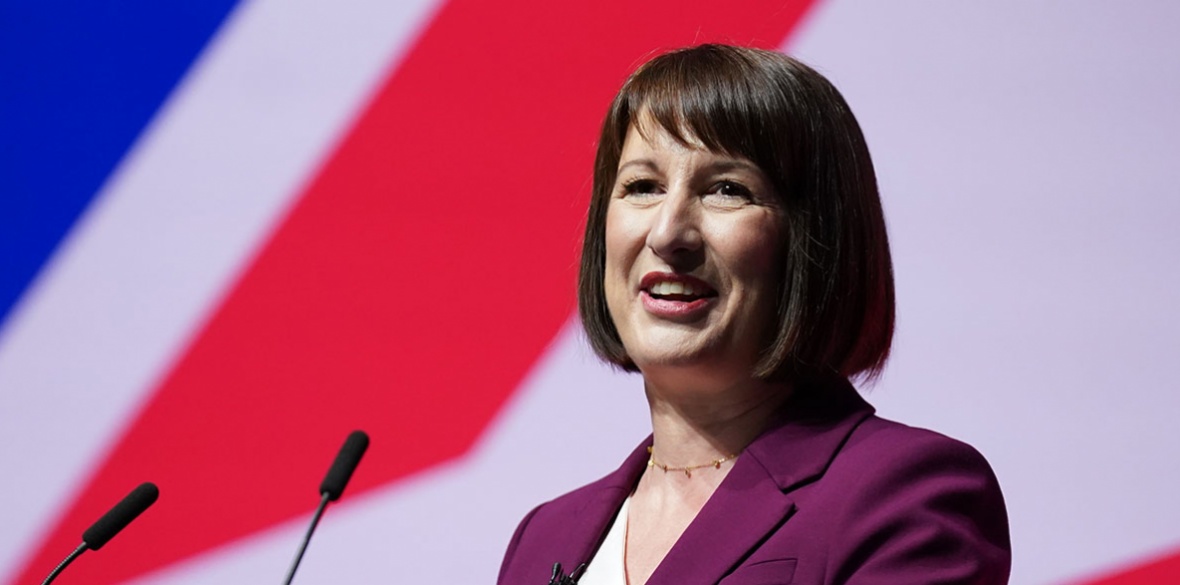
Chancellor of the Exchequer Rachel Reeves at the Labour Party Conference at the ACC Liverpool, September 23, 2024
…
One of Labour’s few redistributive policies attempting to tap the immense wealth of the filthy rich — a crackdown on the abuse of non-dom status to avoid tax — is to be softened, Chancellor Rachel Reeves says, because she has been “listening to the concerns” raised by the non-dom “community.”
She won’t listen to concerns over children trapped in poverty by the discriminatory two-child benefit cap.
Or over the impact of restricting winter fuel payments when energy prices are twice what they were a couple of years ago, even when those concerns convince her own party to vote against the policy at its conference, and prompt Labour’s biggest affiliate Unite to challenge the government in court.
Keir Starmer says pensioners can freeze to death and poor children can starve and be condemned to failure and misery all their lives.
Or even over the U-turn on compensating the Waspi women, despite leading Labour politicians having championed their cause for years.
Reeves’s selective approach to people’s concerns applies to the environment too, even as yet another severe storm closes schools and transport systems, and despite years of worsening floods and failing crops. Sod the science, says Reeves, growth trumps net zero.
Orcas comment on killer apes destroying the planet by continuing to burn fossil fuels.
Limiting action on the accelerating climate catastrophe to measures which don’t affect corporate profits is one reason the world continues to warm uncontrollably.
…
Labour’s growth policies across the board simply turn government into a doormat for big business. Rather than publicly fund infrastructure projects in the public interest, Labour will scrap regulations to weaken rights to object to construction by the private sector.
Keir Starmer, Angela Rayner and Rachel Reeves wear the uniform of the rich and powerful. They have all had clothes bought for them by multi-millionaire Labour donor Lord Alli. CORRECTION: It appears that Rachel Reeves clothing was provided by Juliet Rosenfeld.
The same deference to the right of construction firms to do as they please applies to housing. But it is not over-regulation which stymies house-building in Britain but land-banking aimed at keeping prices high. Urban development in major cities like London and Manchester is blighted by developers’ lack of accountability to communities, as working-class neighbourhoods are driven out by construction of luxury flats designed to accumulate value, not house locals.
Keir Starmer confirms that his government is cnutier than Suella Braverman on killing the right to protest.
The question of the day is democracy versus capitalism. Defending our communities and rights as citizens means building resistance through any means we can: trades councils, People’s Assembly branches, even Morning Star supporters’ groups can be hubs to bring activists together. The future is looking ugly if we cannot unite to do that.
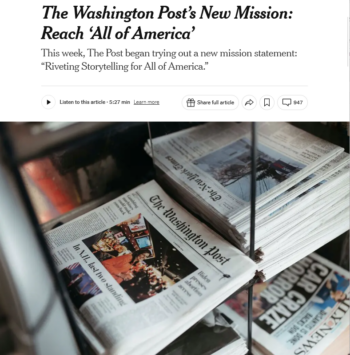
As the Washington Post faces a staff rebellion and plummeting subscription rates, billionaire owner Jeff Bezos has introduced a new mission statement: “Riveting Storytelling for All of America.”
The Washington Post‘s new slogan, “Riveting Storytelling for All of America,” is “meant to be an internal rallying point for employees,” the New York Times (1/16/25) reported.
The new path forward, as introduced in a slide deck to staff by Suzi Watford, the paper’s chief strategy officer, demands that the paper “understand and represent interests across the country,” and “provide a forum for viewpoints, expert perspectives and conversation” (New York Times, 1/16/25). It will do this as “an AI-fueled platform for news” that delivers “vital news, ideas and insights for all Americans where, how and when they want it.”
This appears to mean shifting resources toward opinion, specifically opinions from the right. According to the New York Times report:
Bezos has expressed hopes that the Post would be read by more blue-collar Americans who live outside coastal cities, mentioning people like firefighters in Cleveland. He has also said that he is interested in expanding the Post’s audience among conservatives.
The Post has already begun to consider ways to sharply increase the amount of opinion commentary published on its website, according to two people with knowledge of the talks. An adviser to the Post, Lippe Oosterhof, has conducted brainstorming sessions about a new initiative that would make it easier to receive and publish opinion writing from outside contributors.
How AI is meant to play into this is unclear.
The Post already has more columnists than you can shake a stick at. This new direction sounds like the Foxification of the Washington Post, a move away from any attempt to hold the powerful to account, toward inexpensive clickbait punditry.
‘Make money’
The red area represents the proportion of Jeff Bezos’s total wealth that would be required to cover the Washington Post‘s losses for a year.
Watford’s slide deck presented three pillars of the Post‘s new model: “great journalism,” “happy customers” and “make money.” The Postlost roughly $77 million in 2023. (It also lost some 250,000 subscribers after Bezos killed the paper’s planned endorsement of Kamala Harris—FAIR.org, 10/30/24.)
In order to make money, its new “Big Hairy Audacious Goal” (yes, that’s what the Post slide deck apparently called it) is to reach 200 million “paying users.” The paper currently has about 3 million subscribers, making it an “audacious” goal indeed. As the Times pointed out, even if the Post could achieve the impossible task of monetizing every visit to its website, no major corporate media outlet has been getting more than 100 million monthly unique visits—paying and non-paying—outside of the spike in traffic around the election.
Back in 2019, the Post was claiming 80–90 million unique visitors per month. Those visits peaked in November 2020 at 114 million, but quickly and steadily dropped after Biden’s inauguration. The Post stopped posting its audience numbers online after January 2023, when they were down to 58 million.
Of course, most online corporate media have been struggling. The thing about the Post is that its absurdly wealthy owner, the second-richest person on Earth, can easily afford to lose $77 million a year. That’s 0.03% of Bezos’s current net worth.
‘We are deeply alarmed’
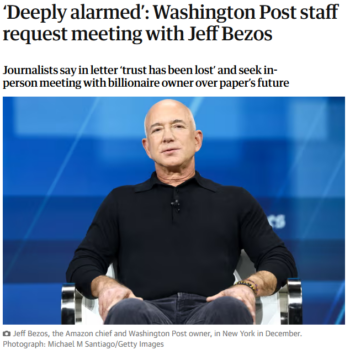
Guardian (1/15/25): “The plea from staff…comes a week after the Post laid off roughly 100 employees…roughly 4% of the publication’s staff.”
No doubt the Post needs help. Just days before the new mission statement was revealed, over 400 staff members signed a letter to Bezos asking for a meeting (Guardian, 1/15/25). The letter read:
We are deeply alarmed by recent leadership decisions that have led readers to question the integrity of this institution, broken with a tradition of transparency, and prompted some of our most distinguished colleagues to leave, with more departures imminent.
Bezos’s response—a slide deck about “riveting storytelling” on “an AI-driven platform” that prioritizes churning out opinions to draw in conservatives—is hardly likely to ease the mind of any serious journalist at the paper.
Nor is trying to “expand the Post audience among conservatives,” while still paying lip service to “great journalism,” likely to solve the Post‘s problems. As CNN‘s former CEO Chris Licht discovered (FAIR.org, 6/8/23), you can’t do good journalism while trying to appeal to both sides in the context of an increasingly radical right, because that side demands acceptance of lies and conspiracy theories that are incompatible with actual journalism.
When Bezos bought the Post (Extra!, 3/14), he assured the paper’s employees that “the paper’s duty will remain to its readers and not to the private interests of its owners.” That sentiment was repeated in Watford’s slide deck this week. But Bezos’s actions in the past months—including the killing of the Harris endorsement, Amazondonating $1 million donation to Trump’s inaugural fund and paying Melania Trump $40 million for her self-produced documentary, and, most recently, Bezos appearing onstage with other multibillionaires at Trump’s inauguration—make clear that the principle is as meaningless to Bezos as the slogan that debuted after Trump’s first election: “Democracy Dies in Darkness.”
That slogan will continue to adorn the front page for the time being, perhaps in the hope that readers searching for an actual news organization that holds those in power to account will be fooled into subscribing.
ACTION ALERT: You can send a message to the Washington Post at letters@washpost.com.
Please remember that respectful communication is the most effective. Feel free to leave a copy of your message in the comments thread here.
FAIR’s work is sustained by our generous contributors, who allow us to remain independent. Donate today to be a part of this important mission.
“We must ask who these decisions would be made for and why. Whose advice is the Government listening to, when record-high wealth inequality is causing harm to the economy and society in many different ways, while frequent flying is the preserve of the super-rich?
“The aviation lobby is loud and well-funded, but the Government should instead be listening to scientists and its own Climate Change Committee, which has already urged a halt to overall airport expansion. The previous Labour government’s poor record on airport expansion doesn’t have to continue.
“If Ed Miliband is serious in his role as Net-Zero Minister, he will work to prevent the Chancellor and Transport Secretaries making a huge mistake, and advise the Chancellor to not make any dangerous new decisions until they have heard and listened to the new advice from the Climate Change Committee which is due in February.”
Orcas comment on killer apes destroying the planet by continuing to burn fossil fuels.
The UK government is set to back plans for a third runway at Heathrow, the country’s busiest airport, and to expand two other airports near London: Gatwick and Luton. The move is designed to support the government’s “mission” to grow the economy.
Air transport is notoriously hard to decarbonise. Unlike the energy system, or even road transport, there is no renewable alternative to switch to immediately. If electric or hydrogen planes become reality, it won’t be for many years yet. Therefore it’s not clear this airport expansion can fit within the UK’s legal and arguably moral requirement to cut emissions and remain within its carbon budget.
It certainly goes against what the government’s official advisory body the Committee on Climate Change (CCC) recommends. The CCC’s 2023 report to parliament stated that: “No airport expansions should proceed until a UK-wide capacity management framework is in place to annually assess and, if required, control sector GHG [greenhouse gas] emissions and non-CO₂ effects.”
Those non-CO₂ effects of aviation include water vapour, soot and other gases like nitrous oxides and sulfur dioxide, all released directly into the high atmosphere where they help form heat-trapping clouds. Estimates suggest they could triple the greenhouse impact of aviation.
In 2019, the last year of available data pre-COVID, domestic and international aviation accounted for around 8% of the UK’s total emissions. The non-CO₂ effects makes aviation a larger contributor to climate change than that number suggests.
The sector itself struggles to build a coherent decarbonisation roadmap based solely on “supply-side” improvements to things like fuel efficiency or, in a recent example from EasyJet, thinner paint. The demand side – taking fewer flights, frequent flyer levies, or restrictions on domestic flights as have been introduced in France – is rarely mentioned.
Unfortunately aviation is a prime example of the Jevons effect where any improvement in efficiency has been wiped out by increased demand. With a growing global middle class pursuing a higher consumption lifestyle, aviation emissions continue to grow even while other sectors have shows some efforts to reduce their own.
A third runway at Heathrow was first proposed back in the 2000s. This photo is from a 2016 protest. Dinendra Haria / shutterstock
The UK has mandated that synthetic aviation fuel (SAF), a more sustainable alternative to regular jet fuel, must make up 10% of aviation fuel by 2030. But only 1.2% of aviation fuel is currently SAF and the industry has not published any plans to show it can scale up in time. Indeed, the sector’s own plans for growth will outstrip efforts to decarbonise through synthetic fuel, delivering a neutral effect at best.
The consumer-facing airport sector has also been accused of greenwash. For instance, Luton Airport recently published adverts making the claim that its own expansion would be stopped if it did not meet stringent environmental targets. However, the Advertising Standards Authority found that consumers would naturally believe that would include air traffic and not just terminal operations (a terminal’s heating or lighting is, of course, largely irrelevant when its core business is as emissions-intensive as flying).
The difficulty of decarbonising aviation while the sector still grows is exemplified by the government’s recently launched consultation on adopting the Corsia carbon offsetting scheme for international flights and how it might work with existing cap and trade schemes. All of which encourage or excuse excess emissions through a charging mechanism.
Growing pains
“Kickstarting economy growth” and “Make Britain a clean energy superpower” are two of the UK government’s six “missions”. However, by expanding airports in support of the former, it risks failing the latter.
A new report by thinktank the New Economics Foundation shows that airport expansion could balance out all of the emissions saved by the government’s clean power plans by 2050.
There is evidence that airport expansion can bring some of the economic benefit that government needs. However, another New Economics Foundation report has found that air travel is no longer a catalyst for productivity growth. So the economic benefits of a new runway are really confined to the airport operation itself – projects for engineers and builders, service jobs for people living near Heathrow, and so on.
Aviation is the privilege of the richer part of society, both globally and within the UK. Figures from Our World in Data shows the richest 50% of the global population produces 90% of the aviation emissions.
While many more UK residents have experienced flying than in the past, most flights are still taken by a small, wealthy subset of the population, which will typically capture the largest share of any new capacity. Each year, around half of British residents do not fly at all.
The focus on London airports for the largest scale expansions will shift the balance of the economy further towards south-east England, and increase inequality within the UK economy. And while these plans might bring some of the GDP gains the government is desperate to deliver, all the evidence shows they will be at the expense of its environmental targets.