‘Time to Ground These Fat Cats’: Markey Proposes Tax Hike on Private Jet Travel

Spread the love

Original article by Jake Johnson republished from Common Dreams under Creative Commons (CC BY-NC-ND 3.0).

Tesla CEO Elon Musk boards his private jet before departing from Beijing Capital International Airport on May 31, 2023.

“Billionaires and the ultra-wealthy are getting a bargain, paying less in taxes each year to fly private and contribute more pollution than millions of drivers combined on the roads below.”

U.S. Sen. Ed Markey announced legislation on Wednesday that would hike fuel taxes for private jet travel and transfer the revenue to a new federal fund aimed at bolstering clean public transportation and other climate initiatives.

The bill, titled the Fueling Alternative Transportation With a Carbon Aviation Tax (FATCAT) Act, would add a $1.73-per-gallon surcharge to the current fuel tax for private jet travel, which is around $0.22 per gallon. Markey’s new surcharge would amount to the equivalent of roughly $200 per metric ton of a private jet’s carbon emissions, according to the senator’s office.

Private jet flights—a significantly more polluting form of travel than commercial flights or trains—surged during the coronavirus pandemic. One recent study by the Institute for Policy Studies (IPS) and the Patriotic Millionaires estimated that private jets’ planet-warming emissions jumped by more than 23% during the Covid-19 crisis.

Elon Musk, Tesla’s billionaire CEO, is the most frequent private jet flyer in the U.S., helping produce more than 2,100 tons of carbon emissions last year while paying minimal taxes, according to IPS and the Patriotic Millionaires. The groups pointed to research showing that just 1% of the world’s population is responsible for half of all aviation emissions.

“The 1 percent can’t free ride on our environment and our infrastructure at a discount,” Markey (D-Mass.) said in a statement. “Billionaires and the ultra-wealthy are getting a bargain, paying less in taxes each year to fly private and contribute more pollution than millions of drivers combined on the roads below. It’s time to ground these fat cats and make them pay their fair share so that we can invest in building public transportation that communities across the country and our economy desperately need.”

Rep. Nydia Velázquez (D-N.Y.) introduced companion legislation in the House.

“Working families shouldn’t subsidize the ultra-wealthy to fly private and destroy our environment,” said Velázquez. “If billionaires want to travel on private jets, they should pay similar taxes to those flying commercial. It’s time for the rich to pay for their pollution so we can fund environmental justice initiatives and affordable public transportation across the country.”

Climate campaigners have been targeting private jets with growing frequency in recent years as research has more closely examined their impacts on the planet. The European group Transport & Environment found that private jets are five to 14 times more polluting than commercial planes and 50 times more polluting than trains.

In May, dozens of climate activists and scientists disrupted Europe’s largest private jet sales fair to demand a total ban on the planes. IPS and the Patriotic Millionaires estimated that the median net worth of a full private jet owner is $190 million.

“Sales of private jets are skyrocketing, and with them the one percent’s hugely unfair contribution to the climate crisis—while the most vulnerable people deal with the damage,” Klara Maria Schenk of Greenpeace’s Mobility for All campaign said during the May protest. “It is high time for politicians to put a stop to this unjust and excessive pollution and ban private jets.”

This story has been updated with additional details about the bill.

Original article by Jake Johnson republished from Common Dreams under Creative Commons (CC BY-NC-ND 3.0).

Continue Reading‘Time to Ground These Fat Cats’: Markey Proposes Tax Hike on Private Jet Travel

Militant vegetarian Ibizzans Futuro Vegetal attack conspicuous consumption

Spread the love

https://youtu.be/aP_VLbzr9AY

The Ibizzan group Futuro Vegetal attacks the filthy rich’s conspicuous planet-killing consumption.

https://www.cbsnews.com/news/yacht-kaos-vandalized-climate-activists/

In a report published in September 2020, the Stockholm Environment Institute estimated that the richest 10% of people, globally, contributed to roughly 50% of worldwide carbon emissions in the years 1995 and 2015 — the timeframe in which the institute conducted its study. By comparison, the poorest 50% were responsible for 7% or 8% of emissions. 

Citing portions of that study in its own report on greenhouse gases and climate change, the International Energy Agency noted that the world’s richest 0.1% contribute more to global carbon emissions each year than the rest of the wealthiest 10% combined, with the richest 1% polluting roughly 1,000 times more than the poorest 1%. Another report by Oxfam last November suggested that just 125 of the world’s wealthiest billionaires emit 3 million tons of carbon dioxide per person, on average, each year, which is about a million times higher than the average annual emissions of the bottom 90%.

Continue ReadingMilitant vegetarian Ibizzans Futuro Vegetal attack conspicuous consumption

World’s 500 Richest People Added $852 Billion to Their Wealth in First Half of 2023

Spread the love

Original article by JAKE JOHNSON republished from Common Dreams under Creative Commons (CC BY-NC-ND 3.0).

Image of mega-rich Elon Musk and Zuckenberg.
Image of mega-rich Elon Musk and Zuckenberg. Imge:James Duncan Davidson
Copyright: CC BY-NC 3.0

“They can afford to pay their fair share in taxes.”

The 500 richest people on the planet collectively added $852 billion to their fortunes in the first half of 2023 due in large part to a record-breaking rally in the U.S. stock market.

According to a Bloomberganalysis of its Billionaires Index, the world’s richest people added an average of $14 million per day to their wealth over the past six months, “the best half-year for billionaires since the back half of 2020, when the economy rebounded from a Covid-induced slump.”

Tesla CEO and Twitter owner Elon Musk saw the largest net worth boost of any global billionaire, adding nearly $97 billion in the first half of the year. Mark Zuckerberg, the chief executive of Meta, saw his wealth grow by close to $59 billion, the second-largest gain of any billionaire.

“They can afford to pay their fair share in taxes,” Americans for Tax Fairness said Wednesday in response to the Bloomberg analysis.

In the U.S., capital gains are only taxed when they’ve been realized, such as when stock is sold. That’s how Musk and other mega-billionaires have massive fortunes but small tax bills, as ProPublica detailed last year in its reporting on a trove of IRS documents.

“With the exception of one year when he exercised more than a billion dollars in stock options, Musk’s tax bills in no way reflect the fortune he has at his disposal,” the investigative outlet noted. “In 2015, he paid $68,000 in federal income tax. In 2017, it was $65,000, and in 2018 he paid no federal income tax. Between 2014 and 2018, he had a true tax rate of 3.27%.”

In his budget proposal for fiscal year 2024, U.S. President Joe Biden called for a tax on the unrealized gains of the ultra-wealthy—an idea previously put forth by Sen. Ron Wyden (D-Ore.). But the measure is unlikely to get through the Republican-controlled House, which is currently looking to slash taxes for the wealthiest Americans.

The already-slim prospects of getting a wealth tax approved in the near future could soon get even worse.

Late last month, the conservative-dominated U.S. Supreme Court agreed to take up a case that “could preempt Congress and the Biden administration from instituting a federal wealth tax,” The Leverreported.

“The new case, Moore v. United States, is tailored to try to block Democrats’ promised agenda by defining what can—and cannot—count as taxable ‘income’ under the Constitution. It specifically challenges a one-time levy on some shareholders for their foreign corporate earnings that was included in the 2017 Republican tax law,” The Lever explained. “The real goal of the case is ‘to slam shut the door on a federal wealth tax,’ as the couple’s lawyers wrote in a 2021 column. The couple’s petition to the Supreme Court expressly decries previous wealth tax proposals from Democrats, including Biden, and urges the justices to ‘head off a major constitutional clash down the line.'”

Wyden, the chair of the Senate Finance Committee, warned in a statement that “the petitioners in Moore are hoping the Supreme Court will toss out a Ninth Circuit ruling along with potentially decades of settled tax law and bipartisan agreement on congressional authority, all for the benefit of the ultra-wealthy.”

“If the Republicans on the Supreme Court take the petitioners’ side, they’d be handing a massive windfall to multinational corporations and could potentially lock in a right for billionaires to opt out of paying anything remotely close to a fair share in taxes,” the senator said. “I designed my approach to taxing billionaires, the centerpiece of which is an accounting method already used in our tax code, with the understanding that special interests would come at it with well-funded legal challenges. I’m totally confident that it’s constitutional.”

Original article by JAKE JOHNSON republished from Common Dreams under Creative Commons (CC BY-NC-ND 3.0).

Continue ReadingWorld’s 500 Richest People Added $852 Billion to Their Wealth in First Half of 2023

Here’s How the ‘Jet-Owning Oligarchy’ Harms Both Planet and Workers

Spread the love

Original article by KENNY STANCIL republished from Common Dreams under Creative Commons (CC BY-NC-ND 3.0).

A new analysis catalogs alarming facts about the destructive private jet industry, which is emblematic of runaway economic and carbon inequality.

Research published Monday details how the working class is paying the price, in more ways than one, for the “jet-owning oligarchy” to hop around the globe in their personal luxury planes.

It’s well-established that private jet travel by the super-rich is worsening the fossil fuel-driven climate crisis. Adding insult to injury, this conspicuously carbon-intensive consumption is being subsidized by ordinary taxpayers, as the Institute for Policy Studies (IPS) and Patriotic Millionaires make clear in their new analysis.

Entitled High Flyers 2023: How Ultra-Rich Private Jet Travel Costs the Rest of Us and Burns Up Our Planet, the report catalogs alarming facts about the private jet industry and makes recommendations about how to rein in this potent symbol and manifestation of escalating inequality.

To begin with, “private jets emit at least 10 times more pollutants than commercial planes per passenger,” the report notes. “Unsurprisingly, approximately 1% of people are believed to be responsible for about half of all aviation carbon emissions.”

Amid a surge in wealth inequality since the start of the Covid-19 pandemic, “private jet use has increased by about a fifth, and private jet emissions have increased more than 23%,” the report points out. “The private jet sector set industry records with regards to transaction and dollar volume in 2021 and 2022.”

While a coronavirus-era boom is evident, the industry has been growing steadily alongside wealth inequality since the turn of the century. As the report states: “The size of the global fleet has increased 133% in the last two decades from 9,895 in 2000 to 23,133 in mid-2022. This bonanza was accompanied by an unprecedented number of business jet operations, 5.3 million in 2022.”

“If we can’t ban private jets, we should at least tax them and require them to pay to offset their environmental damage and subsidies.”

According to the report, “The median net worth of a full and fractional private jet owner is $190 million and $140 million respectively.” A minuscule 0.0008% of the global population belongs to the jet-owning class, which consists mostly of financial and real estate tycoons.

Last year, billionaire Elon Musk, “the most active high flyer in the United States,” bought a new jet and took 171 private flights, or about one every other day, the report notes.

In so doing, he single-handedly “contributed to the consumption of 837,934 liters of jet fuel,” states the report, and he “was responsible for 2,112 tons of carbon emissions”—132 times more than the entire carbon footprint of an average person in the United States.

In a statement, report co-author Kalena Thomhave, a researcher with the Program on Inequality and the Common Good at IPS, called private jets “a microcosm of our system of wealth inequality even beyond their image of extravagance.”

“Private flyers pay just 2% of the taxes that primarily fund the Federal Aviation Administration, yet nearly 17% of flights handled by the FAA are private,” said Thomhave. “Meanwhile, private jets contribute disproportionately to carbon emissions while often representing significant tax savings for their wealthy owners.”

As the report observes: “Thousands of municipal airports in the U.S. are funded by the public, but many primarily serve private and corporate jets. These airports may not offer scheduled passenger service, but they still offer airport runways subsidized by taxes.”

Such regressive taxation is the product of industry lobbying, the report explains:

The largest player in the private jet lobby, the National Business Aviation Association, has spent an average $2.4 million each year since 2008 lobbying the federal government, primarily for tax giveaways. During the Covid-19 pandemic, the industry specifically lobbied for Covid relief, particularly “medium to long-term liquidity assistance and relief from air transportation excise taxes,” even though industry demand was quickly climbing.

As wealth inequality soars, so too does the value of the private jet market, which grew from $32.3 billion in 2021 to $34.1 billion in 2022, the report notes. With wealth being concentrated in fewer and fewer hands and little to no downward redistribution on the horizon, the private jet industry is projected to expand further in the coming years.

Report co-author Omar Ocampo, a researcher with the Program on Inequality and the Common Good at IPS, said that the private jet industry’s expected growth this decade “provides us with a great opportunity to levy a luxury transfer tax on private jet sales.” He added that “the revenue raised from this tax can be invested towards developing a green transportation system.”

According to the report, “A 10% and 5% transfer fee on pre-owned and new private aircraft would have raised $2.4 billion in 2021 and $2.6 billion in 2022.”

In addition to imposing a transfer tax on all private jet sales, IPS and Patriotic Millionaires recommend the following steps be taken:

  • Levy a private jet fuel tax;
  • Institute a “short hop” surcharge;
  • Resist efforts to increase passenger facility charges until private jet owners pay their fair share;
  • Create a sustainable transportation equity trust fund;
  • Increase TSA security oversight of private jets; and
  • Pass the Aircraft Ownership Transparency Act.

According to the report, Musk would have paid nearly $4 million in additional taxes last year if a transfer fee and jet fuel tax had been in place.

“Private jet travel by billionaires and the ultra-wealthy imposes a tremendous cost on the rest of us,” said Chuck Collins, another co-author of the report.

“Not only do ordinary travelers and taxpayers subsidize the air space for private jets, but the high flyers also contribute considerably more pollution than other passengers,” said Collins. “If we can’t ban private jets, we should at least tax them and require them to pay to offset their environmental damage and subsidies.”

Original article by KENNY STANCIL republished from Common Dreams under Creative Commons (CC BY-NC-ND 3.0).

Continue ReadingHere’s How the ‘Jet-Owning Oligarchy’ Harms Both Planet and Workers

Climate activists block holes on Spanish golf courses over water use

Spread the love

https://www.france24.com/en/live-news/20230702-climate-activists-block-holes-on-spanish-golf-courses-over-water-use

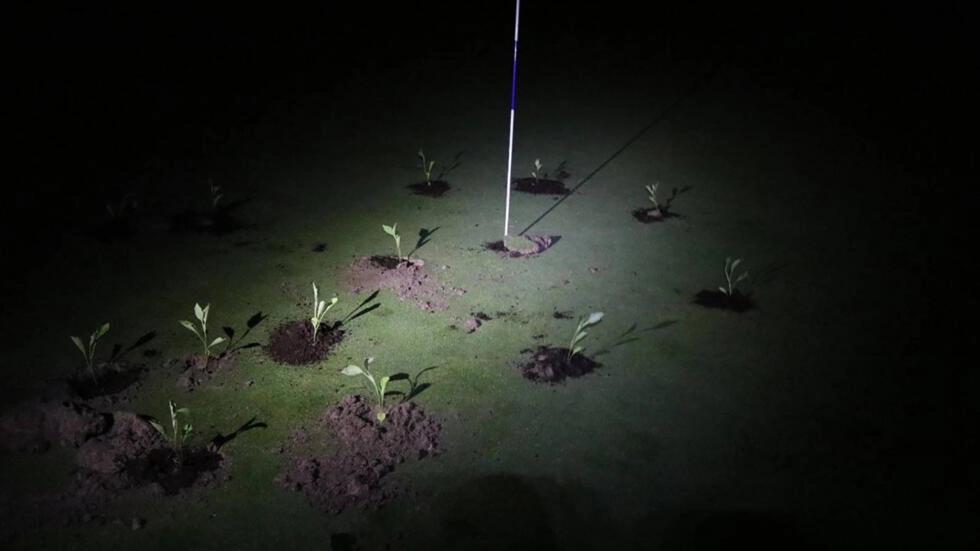
Madrid (AFP) – Climate activists said Sunday they had plugged the holes on 10 golf courses across Spain to protest at the sport’s excessive water usage as Europe lives through a severe drought.

Some activists blocked holes with cement while others filled the holes with seedlings, Extinction Rebellion said © Handout / Extinction Rebellion/AFP

Activists from Extinction Rebellion (XR) filled in the holes under cover of darkness in Barcelona, Madrid, Valencia, the Basque Country, Navarra and the Balearic Island of Ibiza to denounce “the waste of water during one of the worst droughts Europe has ever suffered”.

“Golf has no place in a world without water,” said a statement from the group, which uses direct action to underline its warnings about the dangers to the planet.

“Just one hole of a golf course consumes more than 100,000 litres of water a day to maintain the surrounding green,” XR said, citing figures from the Spanish NGO Ecologists In Action.

Experts say parts of Spain — which is the world’s biggest exporter of olive oil and a key source of Europe’s fruit and vegetables — are the driest they’ve been in a thousand years, with the prolonged drought depleting reservoirs to half their normal capacity.

Extinction Rebellion said it was part of a series of international protests “targeting the richest 1 percent of the population” through their golf courses, private jets and high-end cars to make clear that “the rich and their leisure activities that waste essential resources are a luxury we cannot afford”.

It should be clear – if you bother to engage your brain – that the climate crisis is already affecting inflation and the cost of living crisis. Less precipitation (rain) and disrupted weather [patterns] through climate change mean less crops and increased prices in the supermarket for your fruit and veg, vegetable and olive oil, all those goods made from wheat, corn, beans, etc. The Capitalists will tell you it’s all because of the war in Ukraine. Bollocks, climate change is adversely affecting crops everywhere, Ukraine is not the only place growing crops. Climate change is affecting everyone now.

It’s also noted that the rich are specifically addressed targeted.

Related: Climate change crisis: Golf courses on borrowed time as Earth’s weather patterns become wilder

Continue ReadingClimate activists block holes on Spanish golf courses over water use