Facing record temperatures, record droughts, wildfires and severe weather events not only are governments failing to address the climate crisis, they’re fecking accelerating climate destruction.
Governments are in thrall to the obscenely rich and it is the obscenely rich that are destroying our planet. We have to depose and discard these politicians who are totally failing humanity. The planet simply can’t afford them sucking up to the rich and powerful any longer. Enough is enough.
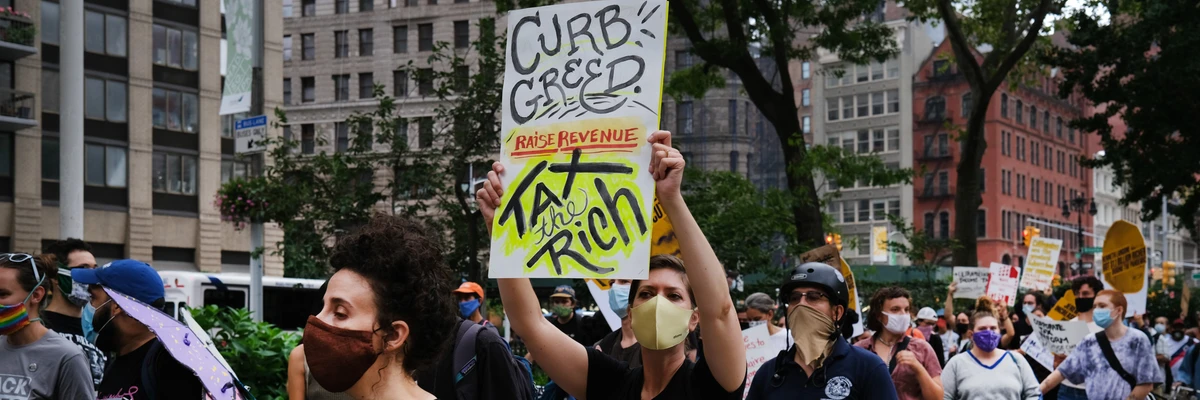
People participate in a “march on billionaires” event on July 17, 2020 in New York City. (Photo: Spencer Platt/Getty Images)
“Americans overwhelmingly prefer raising taxes on the ultra-wealthy and huge corporations to making cuts to critical programs like healthcare, medical research, and infrastructure,” said Sen. Elizabeth Warren.
The United States’ astronomical levels of economic inequality are poised to become further entrenched in the coming years as what The New York Timesdescribed Sunday as “the greatest wealth transfer in history” gets underway, with the richest members of the Baby Boomer generation set to pass trillions of dollars in assets on to their descendants—often paying little or nothing in taxes.
“Most will leave behind thousands of dollars, a home, or not much at all. Others are leaving their heirs hundreds of thousands, or millions, or billions of dollars in various assets,” the Times reported. “Of the $84 trillion projected to be passed down from older Americans to millennial and Gen X heirs through 2045, $16 trillion will be transferred within the next decade.”
The newspaper added that thanks to the loophole-ridden U.S. tax system, “heirs increasingly don’t need to wait for the passing of elders to directly benefit from family money, a result of the bursting popularity of ‘giving while living‘—including property purchases, repeated tax-free cash transfers of estate money, and more—providing millions a head start.”
“The trillions of dollars going to heirs will largely reinforce inequality,” the Times observed. “The wealthiest 10% of households will be giving and receiving a majority of the riches. Within that range, the top 1%—which holds about as much wealth as the bottom 90%, and is predominantly white—will dictate the broadest share of the money flow. The more diverse bottom 50% of households will account for only 8% of the transfers.”
1/Months in the making, here's the final cut of my story on the long-awaited wealth transfer, no longer in the future tense: We're closer to 2053 than 1992. Elites are already disbursing to heirs while alive. The masses likely need luck or a paradigm shifthttps://t.co/FDKNafpCyV
Don Moynihan, a professor at Georgetown University’s McCourt School of Public Policy, argued that the Times analysis further demonstrates that “we are not taxing the very wealthy enough.”
The Times noted that individuals in the U.S. can pass nearly $13 million in assets to heirs without paying the federal estate tax, which only applies to around two of every 1,000 American estates.
“As a result, although high-net-worth and ultrahigh-net-worth individuals could inherit more than $30 trillion by 2045, their prospective taxes on estates and transfers is $4.2 trillion,” the Times observed.
The explosion of wealth inequality in the U.S. over the past several decades has prompted growing calls for systemic reform but little substantive action from lawmakers. In 2017, congressional Republicans and then-President Donald Trump contributed to the inequality boom by ramming through tax legislation that disproportionately benefited the wealthiest Americans.
Now in control of the U.S. House, Republicans are trying to make the Trump tax cuts for individuals permanent and eliminate the estate tax altogether—a move that would give the nation’s wealthiest households another $2 trillion in tax breaks.
In April, Sen. Bernie Sanders (I-Vt.) led several of his colleagues in offering an alternative proposal: Legislation that would impose progressively higher taxes on estates worth between $3.5 million and $1 billion, as well as a 65% levy on estates worth more than $1 billion.
“At a time of massive wealth and income inequality, we need to make sure that people who inherit over $3.5 million pay their fair share of taxes,” Sanders said last month. “We do not need to provide a huge handout to multi-millionaires and billionaires. It is unacceptable that working families across the country today are struggling to file their taxes on time and put food on the table, while the wealthiest among us profit off of enormous tax loopholes and giant tax breaks.”
Sen. Elizabeth Warren (D-Mass.), a co-sponsor of Sanders’ legislation, tweeted Monday that “Americans overwhelmingly prefer raising taxes on the ultra-wealthy and huge corporations to making cuts to critical programs like healthcare, medical research, and infrastructure.”
“Congressional Republicans need to get on board,” the senator added.
Americans overwhelmingly prefer raising taxes on the ultra-wealthy and huge corporations to making cuts to critical programs like health care, medical research, and infrastructure. Congressional Republicans need to get on board.
Morris Pearl, a former managing director at the asset management behemoth BlackRock and the chair of the Patriotic Millionaires, stressed in an interview with the Times that structural changes to the U.S. tax code—not just a crackdown on wealthy tax cheats—are necessary to slow the rise of inequality.
“People are following the law just fine. I generally don’t pay much taxes,” said Pearl, whose group has warned that democracy “will not survive” unless the rich are taxed much more aggressively.
Stressing the ease with which rich families in U.S. are able to pass assets on to their heirs tax-free, Pearl told the Times that he currently holds stock that his wife’s father, “who died a long time ago, bought in the 1970s,” an investment that “has gone from a few thousand dollars to many hundreds of thousands of dollars”—unrealized capital gains that are not subject to taxation.
University of California, Berkeley economists Emmanuel Saez and Gabriel Zucman have estimated that $2.7 trillion of the $4.25 trillion in wealth held by U.S. billionaires is unrealized.
“I’ve never paid a penny of taxes on all that,” Pearl said of his inherited equities, “and I may not ever, because I might not sell and then my kids are going to have millions of dollars in income that’s never taxed in any way, shape, or form.”
International fund set up at Cop27 is intended to provide compensation to countries worst hit by climate breakdown
A tax on wealthy Britons of just 0.5% could more than meet the UK’s entire “fair share” contribution to the international loss and damage fund established to support countries worst hit by global climate breakdown, a charity has suggested.
Taxing 5p of every £10 of individuals’ wealth over £1m would raise £15bn a year by 2030, well in excess of an estimated $15bn (£12bn) UK contribution to the new fund, according to an analysis by the anti-poverty campaigners Christian Aid.
The loss and damage fund, established at last year’s Cop27 climate summit in Egypt, is intended to provide compensation for climate-related disasters that are beyond the possibility of adaptation.
Estimates of its potential cost differ, but the range of $290bn-$580bn a year by 2030 is often cited, with a midpoint of about $400bn, taking into account inflation and rising climate impacts. Christian Aid estimates the UK’s “fair share” of this to be about 3.5%, or $15bn.
The richest 10% of citizens are responsible for 50% of global carbon emissions. Taxing private jets would be a good place to start – and raise money for cleaner alternatives.
e tend to say ‘we are all in the same boat’, but frankly we are not. We are all in the same ocean, but not in the same boat.” EU Climate Change Commissioner Frans Timmermans was thinking of vulnerable, low-income countries when he made this remark, but the thrust of his quote also holds true for the division between the richest and the less well off in all countries. While the poorest everywhere are trying to stay afloat, battered by a storm of high energy and food prices and falling real wages for many, the richest continue to hop around in their private jets.
Yes, we must all change our behaviour and drastically reduce our emissions, but in 2023 let’s stop pretending we are all in this together. We need policies that force the very rich to pay for the outsized amount of pollution they cause.
Kevin Anderson, professor at the University of Manchester’s Tyndall Centre for Climate Change Research in the UK, and economist Ann Pettifor have been making this case for years. “The green movement has lost its way by making us feel we are all equally responsible for the [climate] crisis,” Pettifor said when I interviewed her in 2021. Both have called for emission reduction efforts to be focused on the world’s wealthiest 10% of individuals, who are responsible for 50% of global carbon emissions – and especially the top 1%. The super rich contribute close to 17% of global emissions.
The private jet sector has boomed since the start of the pandemic, reveals a report from the progressive think tank Institute for Policy Studies (IPS) and nonpartisan organisation Patriotic Millionaires. While there was a drop in private flights in 2020, the sector picked up quickly again and saw an unprecedented number of 5.3 million business jet operations in 2022.
Compared to 2019, the number of flights globally and in the US increased by around a fifth last year. A 2022 study found that because of the increased flights, private jet emissions have increased by 23%. In the last two decades, the global private jet fleet size increased 133% – from 9,895 in 2000 to 23,122 in mid-2022.
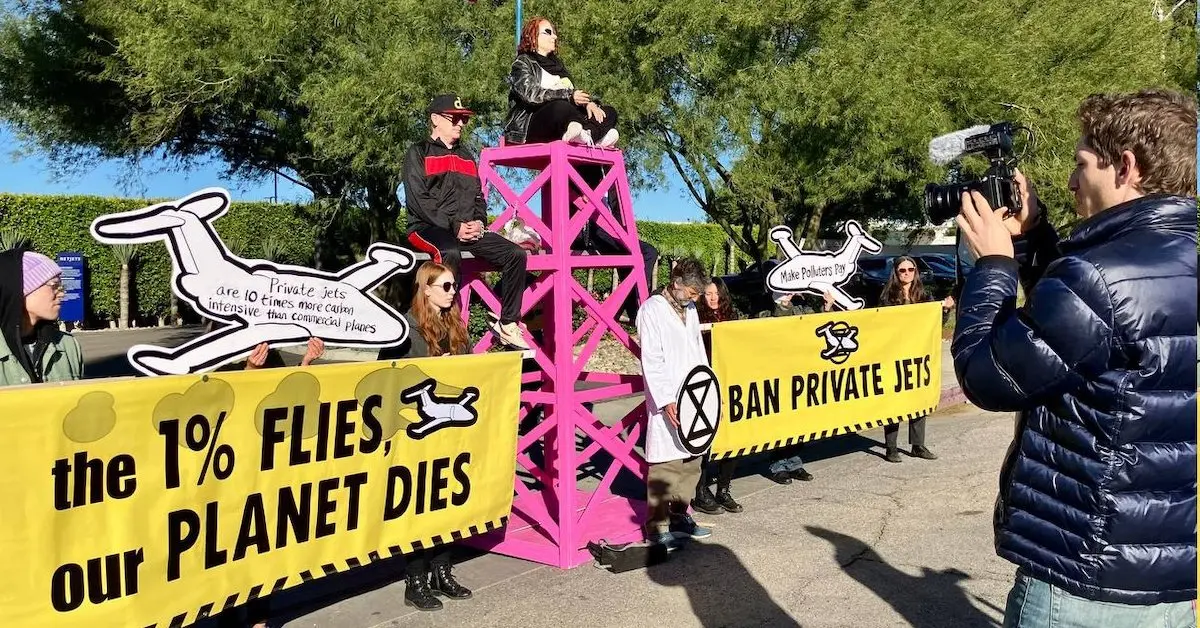
Private jet travel is reserved for the few. The typical private jet owner has a net worth of $190m, according to the report. Since private jets emit at least ten times more than commercial planes per passenger, these ultra-rich private flyers are causing a disproportionate amount of emissions.
Awareness about the environmental costs of private jets has been increasing, putting frequent flyers under scrutiny. Celebrity Kylie Jenner made headlines last summer when she used her private jet for a short hop of just 17 minutes, a trip that would have taken less than an hour by car. A Twitter account tracking private jet flights of celebrities – since suspended, together with a similar account tracking Elon Musk’s flights – showed that this trip was far from unusual for the rich and famous.