Members of the Revolutionary Armed Forces attend a rally in support of former President Raul Castro in front of the U.S. Embassy in Havana, Cuba, May 22, 2026
ROGER D HARRIS and SARA FLOUNDERS challenge propaganda against the blockaded socialist island
MAY Day is the most important public celebration in Cuba. This year, which marked the 100th anniversary of Fidel Castro’s birth, carried special significance in light of heightened US aggression. Over 5 million Cubans reportedly mobilised island-wide under the slogan of la patria se defiende (the homeland must be defended). The largest demonstration took place in Havana in front of the US embassy.
The symbolism of International Workers’ Day was not lost on the White House. President Trump chose that day, May 1, to impose yet more sanctions on top of the already draconian illegal measures immiserating Cuba. Cuban journalist Norland Rosendo Gonzalez called this latest escalation Trump’s “imperial order to kill the Cuban people without bullets.”
The world’s leading imperial power falsely claims that Cuba poses “threats to United States national security.” Secretary of State Marco Rubio subsequently announced additional measures to “defend” the US homeland from its peaceful neighbour.
Jill Clark-Gollub with the Americas Without Sanctions Campaign explains the underlying reason for Washington’s animosity: “Cuba is sanctioned for the crime of being a good example.” A small, formerly colonised country, Cuba simply claims its sovereign right to determine its own destiny without foreign interference.
…
In 1976, Cuban voters ratified a constitutional referendum with a reported 97 per cent approval rate and high voter turnout, which formally defined Cuba as a socialist state. Last year in the United States, the House of Representatives passed a resolution “denouncing the horrors of socialism” by a lopsided bipartisan margin of 285–98.
Capitalism itself, however, has never been subject to a democratic vote of the American people. Perhaps for good reason: recent polls show a growing popularity for socialism, especially among the youth.
Shortly before May Day, President Miguel Diaz-Canel addressed the Cuban nation: “The socialist character of our revolution is not a phrase from the past; it is the shield of the present and the guarantee of the future.” With characteristic Cuban humility, he acknowledged “our own mistakes in this process of social construction” but added that “the main cause of our problems is the genocidal blockade.”
Directly addressing Washington – “gentlemen of manipulation and lies” – Díaz-Canel proclaimed: “Cuba is not a failed state; Cuba is a besieged state.”
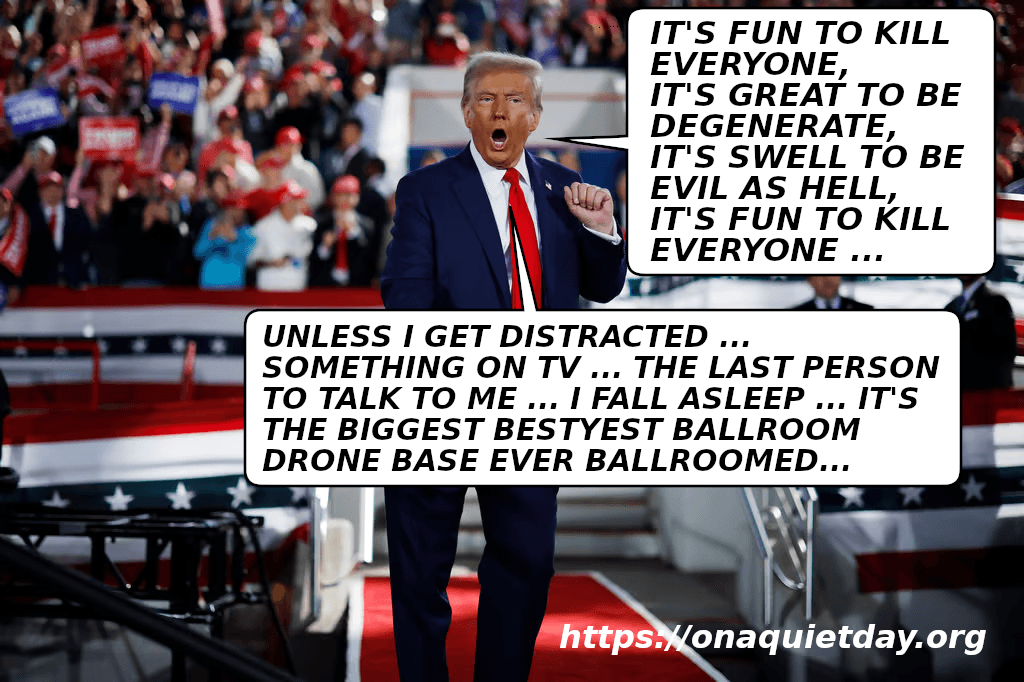
Orcas discuss Donald Trump and the killer apes’ concept of democracy. Front Orca warns that Trump is crashing his country’s economy and that everything he does he does for the fantastically wealthy.Donald Trump sings and dances, says that it’s fun to kill everyone … unless he gets distracted or falls asleep.
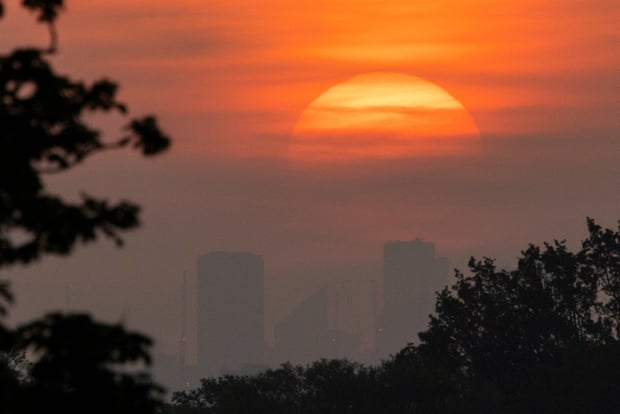
The sun rising over London, seen from Richmond Park, on Sunday. Photograph: Brook Mitchell/AFP/Getty
Highest temperatures of 2026 in England, Wales and Northern Ireland as Kew Gardens in London reaches 32.3C
England, Wales and Northern Ireland recorded their highest temperatures of 2026 on Sunday, which was also the UK’s hottest May day for at least 79 years.
Kew Gardens in west London recorded 32.3C (90.1F), Cardiff 27.4C and Armagh 23.4C.
Scotland reached 23.5C in Edinburgh, just 0.1C below the record of 23.6C set in Aboyne on 1 May.
The first area of the UK to hit the heatwave threshold was Santon Downham in Suffolk, which reached the criteria of recording temperatures of more than 27C for three consecutive days at 11.30am on Sunday.
The other areas officially in heatwave conditions are Heathrow, Kew Gardens and Northolt in London, Benson in Oxfordshire, Brooms Barn in Suffolk, and High Beach and Writtle in Essex.
Temperatures could rise again on Monday, with possible highs of between 33C and 34C.
The climate crisis is increasing the likelihood of extreme heat. Large parts of western Europe are experiencing similar peaks, and the French national weather agency, Météo-France, said periods of exceptional heat are to be expected “more and more often and more and more prematurely, and to be more and more intense”.
Nigel Farage urges you to ignore facts and reality and be a climate science denier like him and his Deputy Richard Tice. He says that Reform UK has received £Millions and £Millions from the fossil fuel industry to promote climate denial and destroy the planet.Donald Trump urges you to be a Climate Science denier like him. He says that he makes millions and millions for destroying the planet, Burn, Baby, Burn and Flood, Baby, Flood.Elon Musk urges you to be a Fascist like him, says that you can ignore facts and reality then.
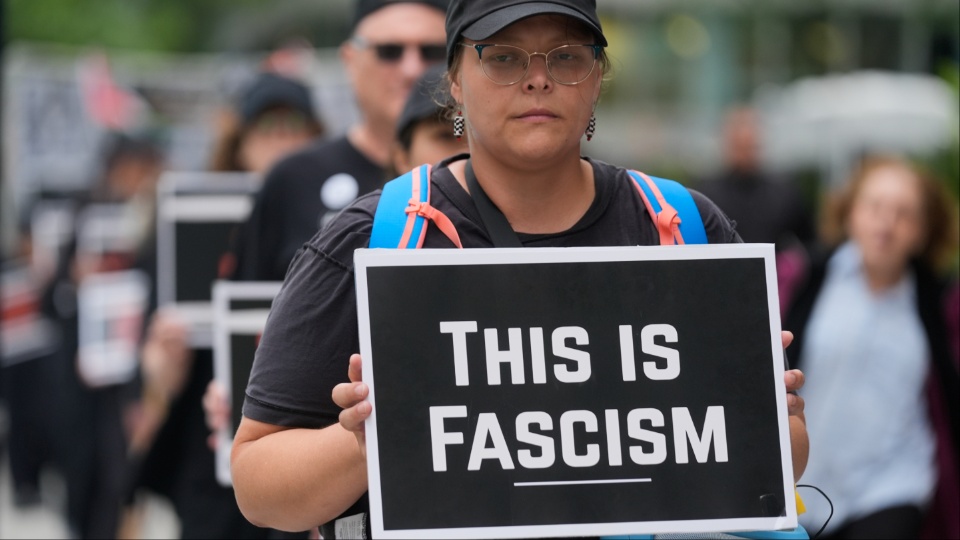
In what can only be described as an acceleration and expansion of the bellicose and dangerous far-right populist movement around the globe, the U.S. government of Donald Trump is reportedly seeking to build an international coalition to oppose the anti-fascist left.
Washington says U.S. counterterrorism officials are organizing a summit in the summer to discuss and develop “strategies to counter the anti-fascist movement.”
White House and State Department officials have described such groups as a “serious threat to national security,” lumping together “anarchists, Marxists, and violent extremists.” The State Department claimed these organizations have waged “a terrorist campaign in the United States and across the Western world for decades, involving bombings, beatings, shootings, and riots in the service of their extreme agenda.”
The move comes as Trump has faced significant domestic opposition to many of his policies. This includes a sustained two-month popular uprising in Minnesota against violent anti-migrant sweeps by ICE, which ultimately forced the president to back down and withdraw the federal agents.
Labelling virtually all opposition as “terrorist” is an alarming escalation in Trump’s rhetoric, and it suggests a significant shift in counterterrorism priorities. The fact that the U.S. is trying to internationalize this effort—invitees to the summit include Canada, Britain, Germany, France, Italy, Hungary, Brazil, Mexico, Argentina, India, and Indonesia—suggests that such a shift may be underway in other countries as well.
Reuters reported that sources within U.S. counterterrorism say the summit will encourage intelligence sharing and common strategies. Other reports suggest that Washington is considering multiple international conferences, beginning in May with a workshop with foreign law enforcement officials in The Hague to “teach them about the dangers of far-left groups and how to counter them.”
The U.S. push comes as right-wing political forces in Canada are also agitating to label dissent as “terrorist.” In a move eerily reminiscent of the McCarthy era, Conservative MP Garnett Genuis has reportedly asked federal departments and agencies to determine whether any of their employees or members have current or prior association with anti-fascist and anti-racist left movements.
Right-wing politicians and media typically use the term “antifa” to refer to a sweeping range of organizations and movements that oppose fascist, racist, and far-right groups. With such a broad interpretation, virtually any political grouping, however large or small, can be described as “terrorist” or “a threat to national security” and subject to state repression.
In no small part, this is the desperate response of a system that is in crisis and decay. As capitalism’s social contradictions sharpen—evidenced by recurring and deepening social and economic crises, increased inter-imperialist rivalry and competition, and the accelerating drive to militarism and war—an increasingly broad section of the population becomes drawn into opposition and resistance.
Cutting off the organizational and political leadership of this growing movement against capitalism, even if it is nascent, is of utmost importance to the ruling class. If the commanders of capitalism, at least those in the U.S., are indeed planning ahead through their “anti-anti-fascist summit,” then working people had better start doing the same.
The working-class movement needs to get to work on developing its own independent political action plan and building up organizations and alliances that can carry it out. This includes working to win more people over to political positions like opposing NATO and other imperialist military alliances, rejecting corporate trade deals and tripartite “social dialogue” with the bosses and their governments, and insisting on the necessity of class struggle.
It also means combatting anti-socialist and anti-communist propaganda, including within labor and “left” movements. Narratives that deny the achievements of the Soviet people, or which draw false distinctions between the Cuban people and the Cuban government, or which equate communism with fascism and terror—these kinds of lies are all designed to divide and weaken the working-class movement, and to reinforce the dictatorship of capital over working people.
It’s true that capitalism is not always fascist. But it’s also true that fascism is always capitalist, and when capitalism is in crisis, it is anti-anti-fascist. This is what we are seeing now, and this is why the working class, which alone has the power to transform society, must get organized.
People’s Voice
As with all op-eds published by People’s World, the views expressed here are those of the author.
We hope you appreciated this article. At People’s World, we believe news and information should be free and accessible to all, but we need your help. Our journalism is free of corporate influence and paywalls because we are totally reader-supported. Only you, our readers and supporters, make this possible. If you enjoy reading People’s World and the stories we bring you, please support our work by donating or becoming a monthly sustainer today. Thank you!
Donald Trump sings and dances, says that it’s fun to kill everyone …Orcas discuss Donald Trump and the killer apes’ concept of democracy. Front Orca warns that Trump is crashing his country’s economy and that everything he does he does for the fantastically wealthy.
U.S. Presidents have been known for their wealth. George Washington was one of the wealthiest men of his day and a slave owner. The vast estate of Mt. Vernon accounts for a considerable amount of wealth for his day. When the current price of land and livestock is added, it is difficult to ascertain. However, reliable sources say that George Washington’s assets upon entering the presidency, adjusted for inflation, were approximately $594 million in today’s money. About the only good thing one can say about this vast estate is that one part did not wish to be counted, and that was due to Ona Judge, who refused to be his slave and escaped to New Hampshire. They say Washington’s salary alone was approximately worth 2% of the national budget. In terms of relativity, it would amount to billions of dollars.
Perhaps Donald Trump is a little better than George Washington. No, he did not dispatch the Secretary of the Treasury to bring back an escaped slave. Yet he presides over a nation with a minimum wage of $7.25, at a time when the average rent for a one-bedroom apartment ranges from $1,510 to $1,642. Many readers believe fast-food workers work 40 hours a week, when in reality many only work 30 hours, and some only work during lunch time for only 15 hours. Perhaps this is the modern-day version of chattel slavery. But reports vary: some say Trump’s personal fortune has risen from $1 billion to $4 billion. Some reporting estimates even more.
In an article by Jenny Smyth, Trump entered his first term of office with a net worth of $2.3 billion, and now has a net worth of $6.5 billion. Perhaps it was due to his aggressive purloining of Venezuelan oil. If it didn’t go to China, it had to go somewhere, right? Maybe it was due to his sons, Donald Trump Jr. and Eric Trump, perfect management of his affairs… However, it seems that the President has used investment brokers.
While Donald Trump, according to U.S. law, has every right to trade on the U.S. market, this right seems to smack of gross immorality given his enormous cuts to SNAP and social security. People are earning less, and with DEI on the President’s hit list, African Americans appear to be targeted for further wage cuts. He seems to have no respect for the law or humanity. He has increased the ferocity of the Cuban blockade and has threatened military action against her. I suppose Greenland had to make a deal. Trump appeared to make some political profit for his billionaire alliance. While, according to the Western media, he has not made any profit in Greenland, his billionaire colleagues Bill Gates and Jeff Bezos have invested in Greenlandic mining operations. This is not nearly as lucrative as the gift of the luxury jet from the Qatar government. The opulent Boeing 747-8 will undergo modifications at L3Harris Technologies before entering service for presidential (Trump’s) use. The plane is said to be scheduled to make its debut on the Fourth of July in honor of the nation’s 250th birthday.
However, the president’s latest financial maneuvers have left a good portion of the public aghast. It seems the president has made active stock trades influenced, or at least guided, by his governmental decisions. According to Wion, the disclosures show around 3,600 to 3,700 stock and ETF transactions from January to March. The reported value of these transactions ranges from $220 milion to $750 million, all this while there is massive hunger and deprivation suffered by the working class—in particular minority groups—within the United States of America.
Many of the stocks were made by the government for defense, government private contracts, and other concerns that required direct government involvement. For example, NBC News said in February and March that the president purchased stock seven times. On January 12, President Trump purchased $100,000 to $250,000 worth of Oracle stock on the same day he finalized a U.S.-backed deal for a stake in TikTok. From January through March, President Trump purchased DoorDash stock twelve times, around the same time he held an event with a DoorDash representative being praised at the White House. On January 6, the President purchased $500,000 of Nvidia Stock, and shortly after, on January 14, he approved a US-backed deal for Nvidia to sell chips to China. The president invested heavily in Palantir Industries, a defense contractor that builds AI-driven strategies for defense from “space to mud.” The stock has dropped 25% while the President has urged investors to buy on Truth Social.
While the President has the right to purchase, the cry has grown louder for stricter controls to prevent insider trading and self-profit and gain by influential politicians. There is an imbalance in the system. The President cannot be allowed to make billions while many of his fellow Americans starve.
As with all op-eds published by People’s World, the views reflected here are those of the author.
We hope you appreciated this article. At People’s World, we believe news and information should be free and accessible to all, but we need your help. Our journalism is free of corporate influence and paywalls because we are totally reader-supported. Only you, our readers and supporters, make this possible. If you enjoy reading People’s World and the stories we bring you, please support our work by donating or becoming a monthly sustainer today. Thank you!
Climate science denier Donald Trump confirms that he knows nothing about democracy and that more liquid gold is being secured according to his policy of global privateering.Orcas discuss how Trump was re-elected and him being an obviously insane, xenophobic Fascist.
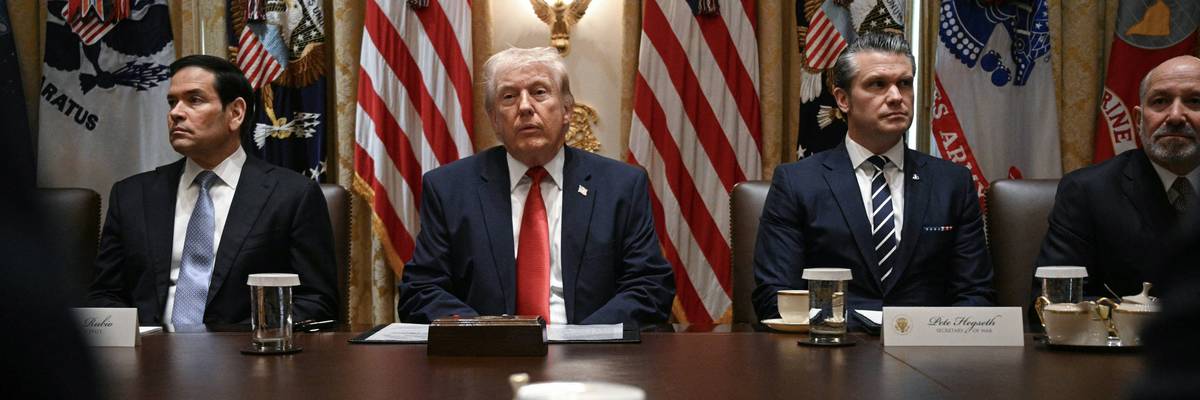
US President Donald Trump hosts a cabinet meeting in the Cabinet Room of the White House in Washington, DC, on March 26, 2026. (Photo by Jim Watson/AFP via Getty Images)
“Apparently you’re not allowed to kill people in international waters now?” said one progressive organizer.
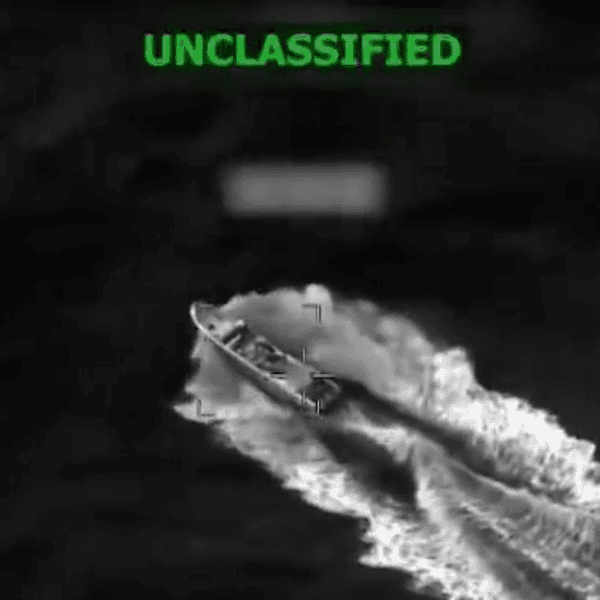
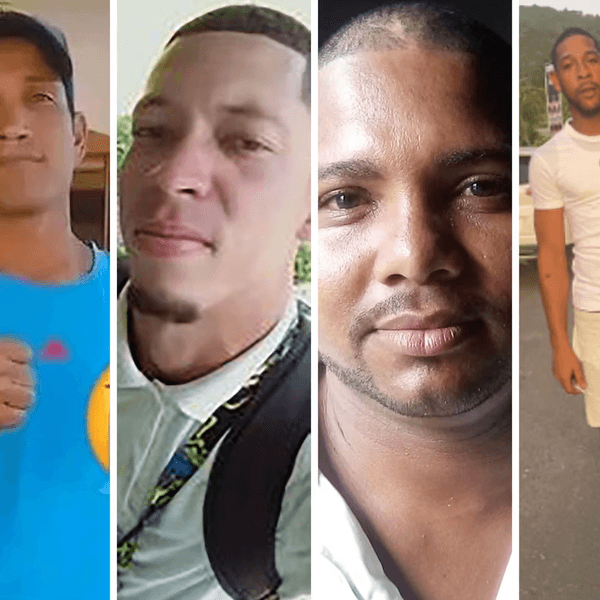
Over the last eight months, at the direction of President Donald Trump and Secretary of Defense Pete Hegseth, the US military has bombed at least 57 boats and killed close to 200 people—among them fishermen, a young man known in his town for his indoor soccer playing, and working people who had recently struggled to make ends meet—in what human rights experts have called “murders” and extrajudicial killings.
But the indictment filed this week regarding unlawful killings by government forces in the Caribbean region had nothing to do with Trump’s boat bombing spree, which the White House has claimed it aimed at stopping drug trafficking. Instead, the target of the indictment filed by the US Justice Department was 94-year-old former Cuban President Raúl Castro, who was charged with one count of conspiracy for his alleged role in shooting down planes that flew into Cuba’s airspace in 1996.
The planes were operated by an anti-Fidel Castro group, Brothers to the Rescue, and four Cuban-Americans were killed in the operation.
In expressing support for the indictment, US Rep. Carlos Giménez (R-Fla.), a Cuban-American immigrant, said that “there will be consequences to pay if you harm American citizens in international waters, in international airspace for no reason at all, and believe me, this was no reason at all.”
Michael Galant, a member of the secretariat of the Progressive International, commented with feigned surprise: “Apparently you’re not allowed to kill people in international waters now? Someone tell Hegseth.”
The organization’s co-general coordinator, David Adler, added, “I simply do not understand how we, as a country, tolerate the hypocrisy of indicting Raúl Castro for defending Cuban airspace—while our own government celebrates the extrajudicial assassinations of innocent fishermen sailing across the sea below,” while Ryan Grim of Drop Site News noted the indictment also followed the bombing of a school in Iran—an attack that investigators said was likely carried out by the US.
Trump bombs fishing boats at sea, at least once bombed the shipwrecked survivors, and bombed an elementary school, killing more than 165 little girls. And he wants to indict Raul Castro. https://t.co/zxRfbPM6FD
The indictment of Castro, noted the Progressive International, was set to coincide with Cuba’s Independence Day and came as Secretary of State Marco Rubio, the son of Cuban immigrants who has long desired regime change in the communist country, mused that the Cuban government has “plundered billions of dollars, but nothing has been used to help the people”—echoing his criticism of Iran, another target of the US military under Trump.
The timing of and ramp-up to the indictment was “a piece of political theater calibrated to one audience only: the Miami exile lobby that has spent decades pursuing its commercial and ideological vendetta against the Cuban Revolution,” said the group’s Cabinet.
“US officials themselves acknowledge they do not believe Cuba is an imminent threat, nor actively planning to attack American interests—and yet in the same breath, the administration has laundered a set of alarming claims about Cuban drone acquisitions, presented with all the breathless urgency of a casus belli,” the Progressive International added, referring to Axios’ reporting last weekend on claims from an administration official that Cuba is preparing to attack the US with drones—a report that ultimately acknowledged the Cubans are not planning any preemptive strikes on the US but are rather thought to be strategizing on self-defense as the US intensifies its anti-Cuba rhetoric and continues the oil blockade it imposed in February.
The Cuban embassy in the United Kingdom on Thursday said it rejected US claims about the downing of the Brothers to the Rescue plane, which it called “an irrefutable act of sovereign self-defense” that took place after “25 deliberate, calculated violations of our national airspace” by the exile group.
3/4 On 24 Feb 1996, they deviated from flight plans, penetrating restricted zones near Havana. Under Article 4 of the Chicago Convention, civil aviation must never be used for sabotage. By executing these hostile incursions, they immediately forfeited all civilian status. pic.twitter.com/vIdZKv8Nja
“To criminalize our nation, the US manipulated the official [International Civil Aviation Organization] investigation, deliberately erasing the first six minutes of radar and radio recordings to conceal the territorial incursion,” the embassy asserted. “The narrative of an attack in international waters is an absolute juridical fraud.”
In a column at Common Dreams Thursday, Codepink co-counder Medea Benjaminadded that she was in Cuba in 1996 when the planes were shot down. The leader of Brothers to the Rescue, José Baulto, she said, openly stated that he was “trained as a terrorist by the United States,” and said after one mission in which the group dropped leaflets over Havana that the group was seeking “confrontation.”
“The Cuban government repeatedly warned Washington, the Federal Aviation Administration (FAA), and international aviation authorities that these flights were illegal and dangerous. US officials knew the risks,” wrote Benjamin. “The hypocrisy of indicting Raúl Castro nearly 30 years later is staggering, given the long history of anti-Cuban extremists operating from US soil to wreak havoc against the island with bombings, sabotage, and airline terrorism.”
Those US-based extremists include the perpetrators of the 1976 midair bombing of Cubana Flight 455, a commercial airliner carrying 73 crew and passengers, many of them teenage members of Cuba’s junior Olympic fencing team.
The Trump administration’s boat bombings, meanwhile, have been called likely “war crimes” by some legal experts and “murders” by others. The White House has insisted the US is in an “armed conflict” with drug cartels in Latin America, but no conflict has been officially declared. In at least one instance, US military members were ordered to bomb the survivors of an initial strike—a clear violation of international law.
The US in the past has treated suspected drug trafficking as a criminal issue—not one to be dealt with militarily. Before the boat bombings began, one top military legal adviser warnedPentagon officials, “There is no world where this is legal,” and said carrying out the attacks could expose everyone involved, from top White House officials to rank-and-file service members ordered to carry out the strikes, to legal liability.
“The same US government now pursuing charges against Raúl Castro has itself been carrying out deadly strikes on alleged drug-smuggling boats in the Caribbean and Pacific, strikes that have killed at least 193 people since September 2025, with no transparency or due process,” wrote Benjamin.
Following the Castro indictment, the Progressive International called on “governments, movements, and peoples of conscience everywhere to call out this escalation for what it is—a naked effort to recolonize Cuba and the hemisphere at large—and to stand firmly against it.”
“We have seen this playbook before—in Iraq, in Libya, in Venezuela, and in other sites of manufactured consent for illegal war across the world. The Progressive International will not stand silent as it is deployed against Cuba,” said the group. “Hands off Cuba.”

 Members of the Revolutionary Armed Forces attend a rally in support of former President Raul Castro in front of the U.S. Embassy in Havana, Cuba, May 22, 2026