Met Office: A review of the UK’s climate in 2025

Spread the love

Original article by Dr Mark McCarthy republished from Carbon Brief under a CC license

Low water levels in Scar House Reservoir during the 2025 heatwave and drought, UK. Credit: Jonathan Mills / Alamy Stock Photo

The UK’s climate saw a record-breaking 2025, with the year being both the warmest and sunniest seen since observations began.

The year 2025 has joined 2024, 2023, 2022 and 2014 in the UK’s top-five warmest years. 

In this review, we take a look back at the UK’s climate in 2025 and place the record-breaking year in the context of human-caused climate change. We find:

  • It was the warmest and sunniest year on record. January and September were the only months that were cooler than average.
  • A Met Office attribution study estimates that 2025’s average temperature would have been exceptionally unlikely in pre-industrial times – but could now occur, on average, every three years. 
  • Spring was the warmest on record, breaking a record set in 2024.  
  • Spring was not only the sunniest on record, but the fourth-sunniest season ever recorded, after the summers of 1976, 1996 and 1911. 
  • It was the warmest summer on record. The summer temperature record was made around 70 times more likely due to human-induced climate change.
  • The persistent high-pressure systems in spring and summer, which contributed to the warm and sunny conditions, also resulted in an extended dry spell – including the driest spring since 1974.
  • Wetter conditions at the end of the year alleviated some of the rain shortfall. The year concluded with 90% of average annual rainfall.
  • Storm Éowyn in late January was the most powerful wind storm in over a decade and the most severe storm in Northern Ireland since 1998. 
  • Storm Floris in early August was not unprecedented for a storm, but was one of the most severe wind storms to affect Scotland during the summer.
  • Storm Amy in early October hit north-western parts of the UK, with heavy rain falling widely, resulting in the wettest day of the year for the UK overall.

(See our previous annual analysis for 202420232022202120202019 and 2018.) 

The year in summary

The Met Office relies on the long-running HadUK-Grid dataset to place recent UK weather and climate into its historical context. The gridded, geographically complete dataset combines observational data for monthly temperature since 1884, rainfall since 1836 and sunshine since 1910.

Unless stated otherwise, the rankings of events and statements (such as “warmest on record”) in this article relate to the HadUK-Grid series.

The “climate anomaly” maps below show the difference between the average temperature (left), rainfall total (middle) and sunshine duration (right) between 2025 and the 1991-2020 period. In other words, they show how much warmer, cooler, wetter, drier, sunnier or cloudier the year was than average for each county of the UK.
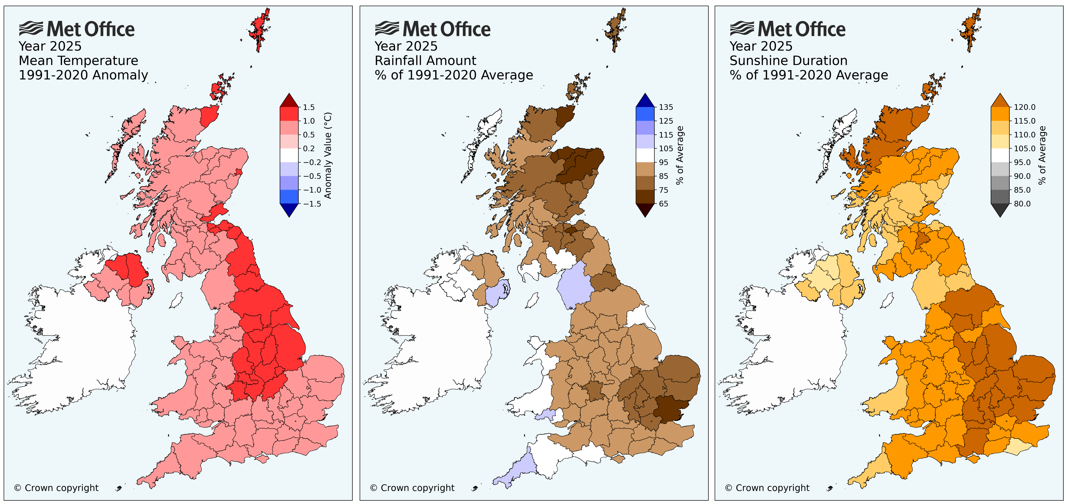
Maps showing anomalies in 2025 relative to a 1991-2020 reference period for temperature (C), precipitation (%) and sunshine (%). The darker shading indicates a greater departure from average. Credit: Met Office

The maps show that the whole country was warmer than average, with central and north-east England, parts of Northern Ireland and the tip of north-west Scotland, Orkney and Shetland seeing the greatest change. 

The UK overall had 90% of average rainfall. The driest regions relative to average were around Essex, Moray and Aberdeenshire, which received less than 75% of normal annual rainfall. 

In contrast, some western counties were slightly wetter than average – including Cornwall (110%) and Cumbria (107%). 

Sunshine was above average across the UK, with eastern England and north Scotland exceeding 120% of the average.

Attribution

The UK’s absolute temperature averaged at 10.09C in 2025. This follows 2022 (at 10.03C) as the second time that the annual average temperature has exceeded 10C. 

In our analysis of the UK’s climate in 2022 for Carbon Brief, we reported on a Met Office attribution study that found that human-caused climate change had increased the likelihood of UK annual absolute temperature averaging above 10C by a factor 160.

That study concluded that exceeding 10C – while unprecedented in the historical observational record – would become increasingly common and would likely occur every three-to-four years.  

Three years on from that analysis and the 10C threshold has been breached for a second time – and an updated attribution analysis has been produced exploring the likelihood of a return of temperatures above the 10.09C recorded in 2025.  

The study, which uses the same methodology as the 2022 paper, finds that UK annual mean temperatures above 10.09C are estimated to occur approximately every three years in the current climate. In contrast, they would have occurred around every 780 years in pre-industrial times.

Human-caused climate change has, therefore, increased the probability of average temperatures in excess of 10.09C by a factor of 260.

These results show that 2025’s record-breaking annual temperature – while unprecedented in the historical observational record – should be considered fairly normal in the current climate. 

Climate projections indicate that, by the later part of the 21st century, a year like 2025 could be a relatively cool year. 

The figure below compares observations of UK annual average temperatures (black line) – relative to the long-term average – to climate model simulations that include (red/purple) or exclude (green) human-caused emissions of greenhouse gases and land-use change. 

The green and red curves start to diverge from around the 1980s, suggesting that human influence is indeed the dominant factor in the warming trend. The shaded range of the simulations show that in our current and future climate, much warmer years than 2025 are plausible. 

Colder years are also still possible, but it is much less likely that we would experience a cold year like 2010 – and exceptionally unlikely for a year to be in the top-10 coldest years for the UK. The most recent year to feature in the top-10 coldest years was 1963. 
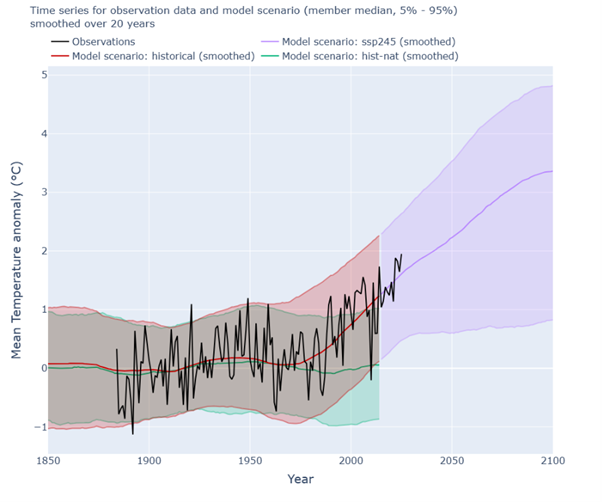
Chart showing the time series for observation data and model scenario smoothed over 20 years
Timeseries of the UK annual mean temperature anomaly (w.r.t. 1901 – 1930). Observational data from HadUK-Grid (black). Simulations from the CMIP6 historical simulation including natural and human-caused drivers (red), SSP2-4.5 projections of future climate based on a “medium” emissions scenario (purple) and “hist-nat” simulations that include only natural drivers of climate such as solar and volcanic activity (green). Simulation data is represented as median values and filled 5-95th percentile ranges explored by members of the multi-model ensemble. Percentiles of simulation data are smoothed with a rolling window of 20 years, with historical and SSP2-4.5 combined into one continuous series. Observed data runs from 1884-2025. Credit: Met Office

Warmer, wetter, sunnier

Four of the UK’s last five years all appear in the top-five warmest years since 1884.

The Central England Temperature (CET) series is the longest continuous instrumental climate record in the world, dating back to 1659. Covering a region roughly enclosed by Lancashire, London and Bristol, it does not represent the whole of the UK. However, when averaged across a year and analysed across centuries, it does provide a multi-century perspective that is representative of climate variations and changes that impacted the UK. 

As with the HadUK-Grid temperature record, the CET series also identifies 2025 as the warmest year on record. The longer-running temperature series identifies the same five years – in the same order – as the warmest on record. This is shown in the table below. 

YearUK (from HadUK-Grid)Central England Temperature
202510.09C11.23C
202210.03C11.18C
20239.97C11.13C
20149.88C11.04C
20249.79C10.96C

The graph below of the CET series shows that temperatures recorded in recent years are well outside the range of variability recorded over more than 300 years.
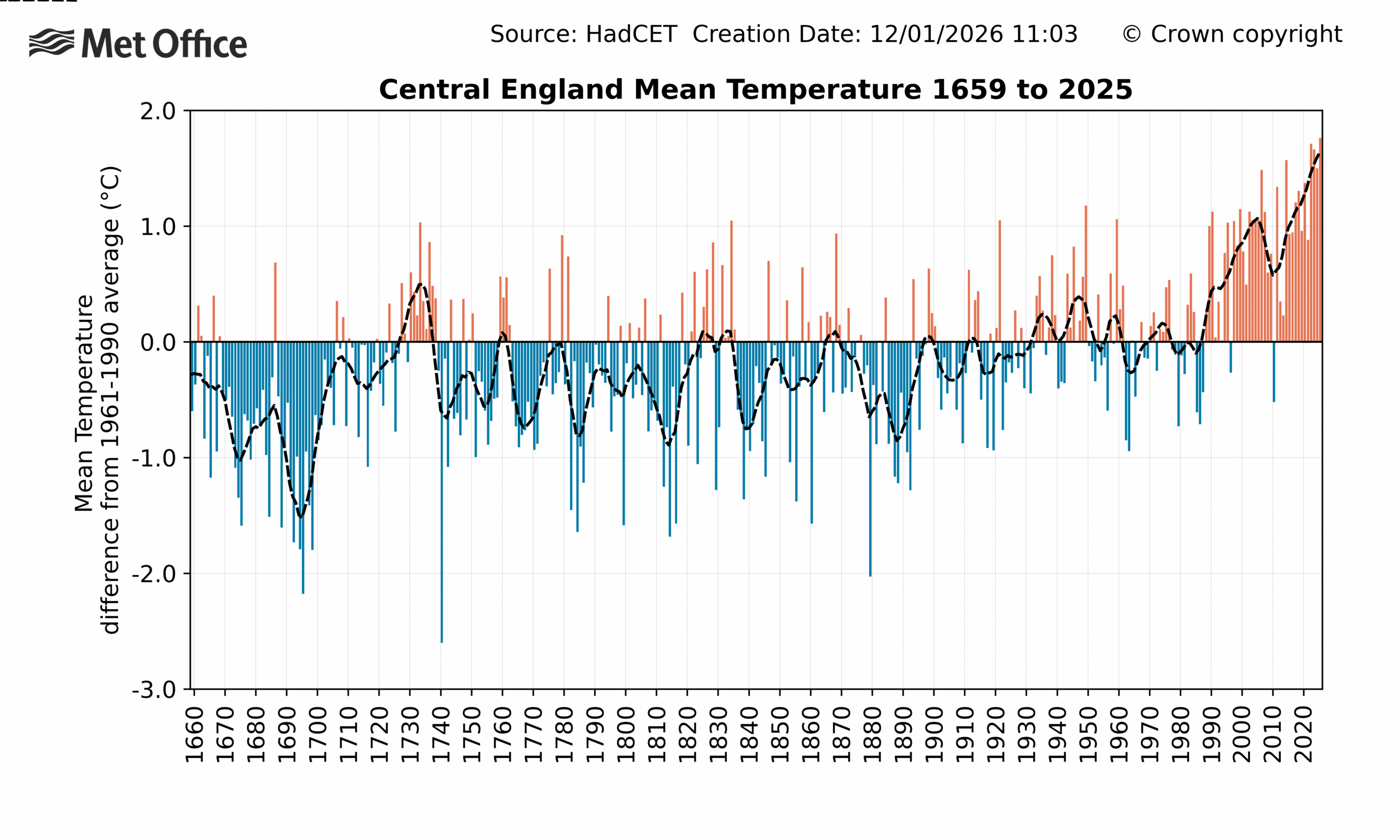
Chart showing the mean temperature in England from 1659 to 2025
Average temperature anomalies (relative to a 1961-90 average) for each year in the CET series from 1659 to 2025. Colours show years that are above (red) or below (blue) average. The dashed line is a smoothed series to show the decadal variations and trend. Credit: Met Office

However, the UK is not only warming, it is also getting wetter and sunnier. The year 2025 was relatively dry, recording 90% of average rainfall. This made it the driest year recorded since 2010 and put it in contrast to relatively wet years in 2023 and 2024. 

The longer-term trend can be seen in the figure below, which shows that 2025 was relatively dry compared to recent decades, but not exceptional in the longer-term historical context. 

The last time the UK had a year in the top-10 driest was in 1955, whereas all five of the top-10 wettest years have occurred this millennium. The wettest year on record still stands as 1872.
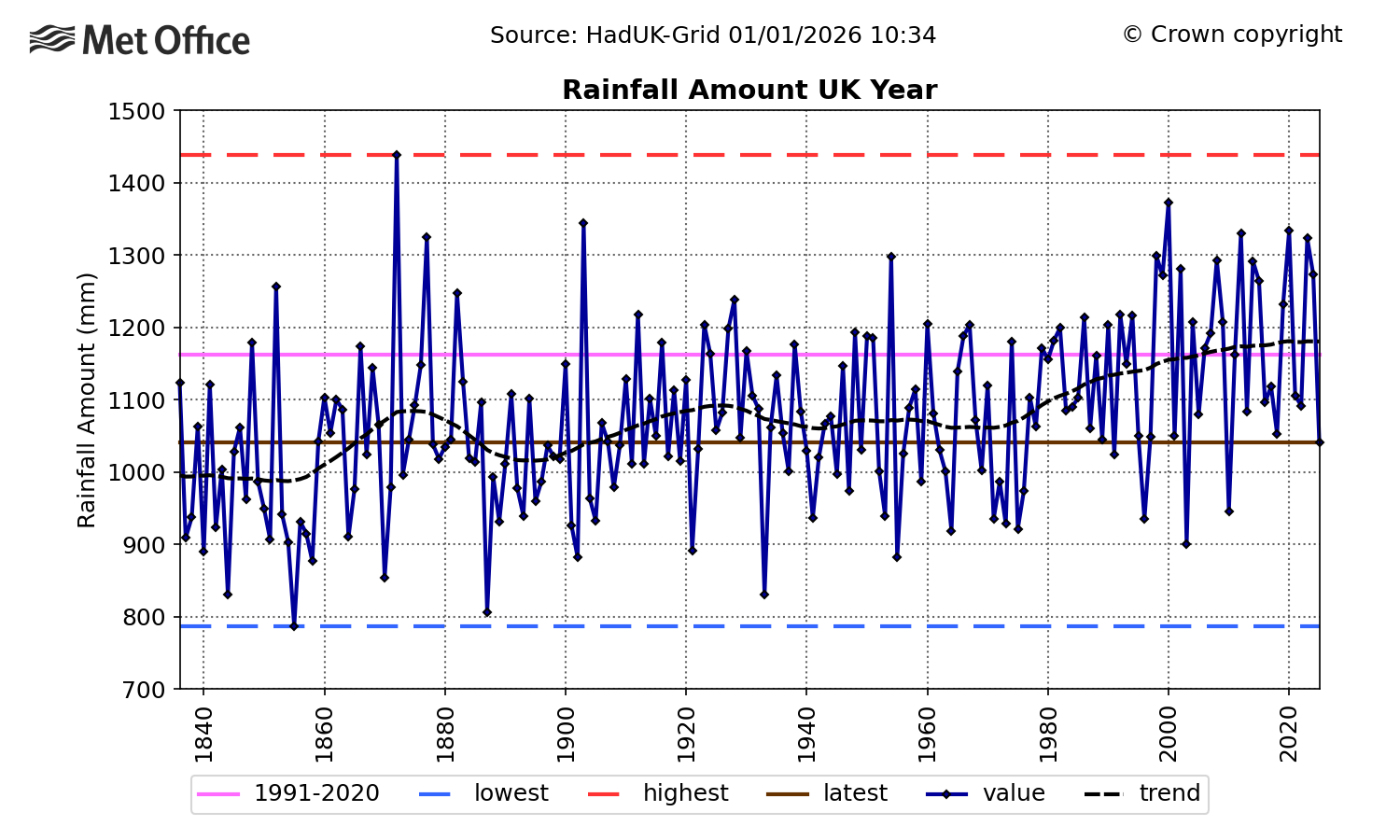
Chart showing the total rainfall from 1836 to 2025 in the UK.
Timeseries of UK total rainfall from 1836 to 2025. The trend is represented by a black dashed line, the 1991-2020 average is shown in pink and the highest and lowest values in the series are shown by the red and blue dashed lines, respectively. The 2025 value is represented by the horizontal brown line. Credit: Met Office

The drivers of annual rainfall trends are more complex than for temperature. 

A significant factor in rainfall trends is a warming atmosphere’s ability to hold more moisture. However, this does not completely account for recent increases in rainfall.

Large-scale atmospheric circulation patterns – particularly features such as the jet stream and associated storm tracks across the North Atlantic – also play a crucial role. These are influenced by annual and decadal fluctuations in the Earth’s climate, as well as human-caused climate change.

UK annual sunshine totals have also been rising since the 1980s, with 2025 setting a record by a considerable margin. This is in sharp contrast to 2024, which was the dullest year since 1998. This is shown in the graph below, where the dotted line shows the underlying long-term trend, with year-to-year variations removed.
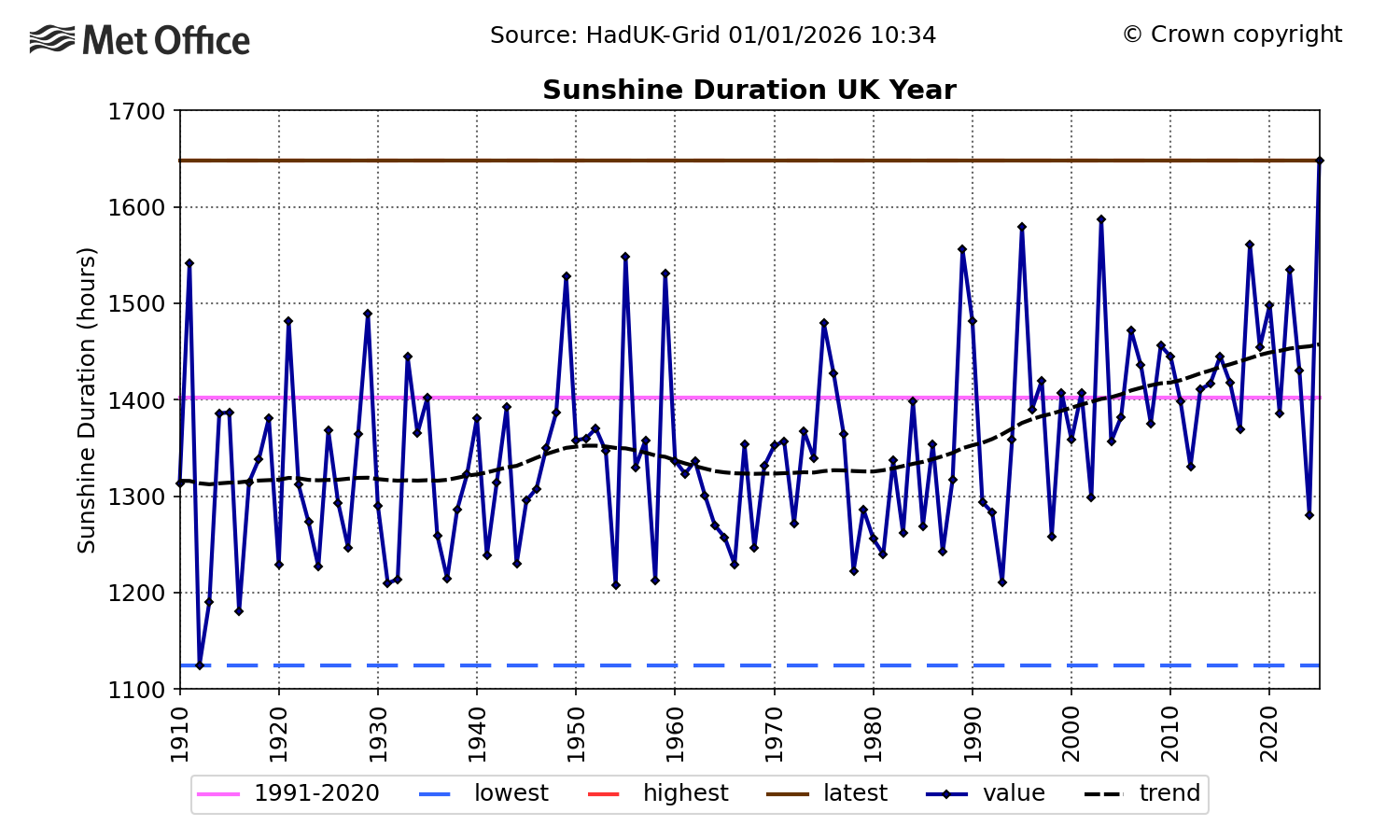
Chart showing the total annual sunshine hours from 1910 to 2025 in the UK.
Timeseries of UK total annual sunshine hours from 1910 to 2025. The trend is represented by a black dashed line, the 1991-2020 average is shown in pink and the highest and lowest values in the series are shown by the red and blue dashed lines, respectively. The 2025 value is represented by the horizontal brown line (which covers the red line for the highest in the record). Credit: Met Office

The cause of the sunshine trend is also uncertain, with both natural climate variability and human activity (through reduced regional air pollution caused by a reduction in aerosol emissionspotential contributors. Climate projections do not provide any strong evidence for how sunshine trends might develop.

The year in storms

The Met Office has been naming storms since 2015. Each storm-naming period runs from September to August.

(For more on storm naming in the UK, read Carbon Brief’s explainer.) 

The criteria for storm naming has changed over time. It accounts for meteorological conditions, as well as the potential severity of impacts. As a result, comparisons between years can indicate relative levels of storm activity, but should not be done on a like-for-like basis.  

Between the 2015-16 and 2024-25 storm seasons, there have been, on average, 7.7 named storms each year, with a high of 12 recorded in the 2023-24 season and a low of four over 2022-23. This is shown in the line chart below.
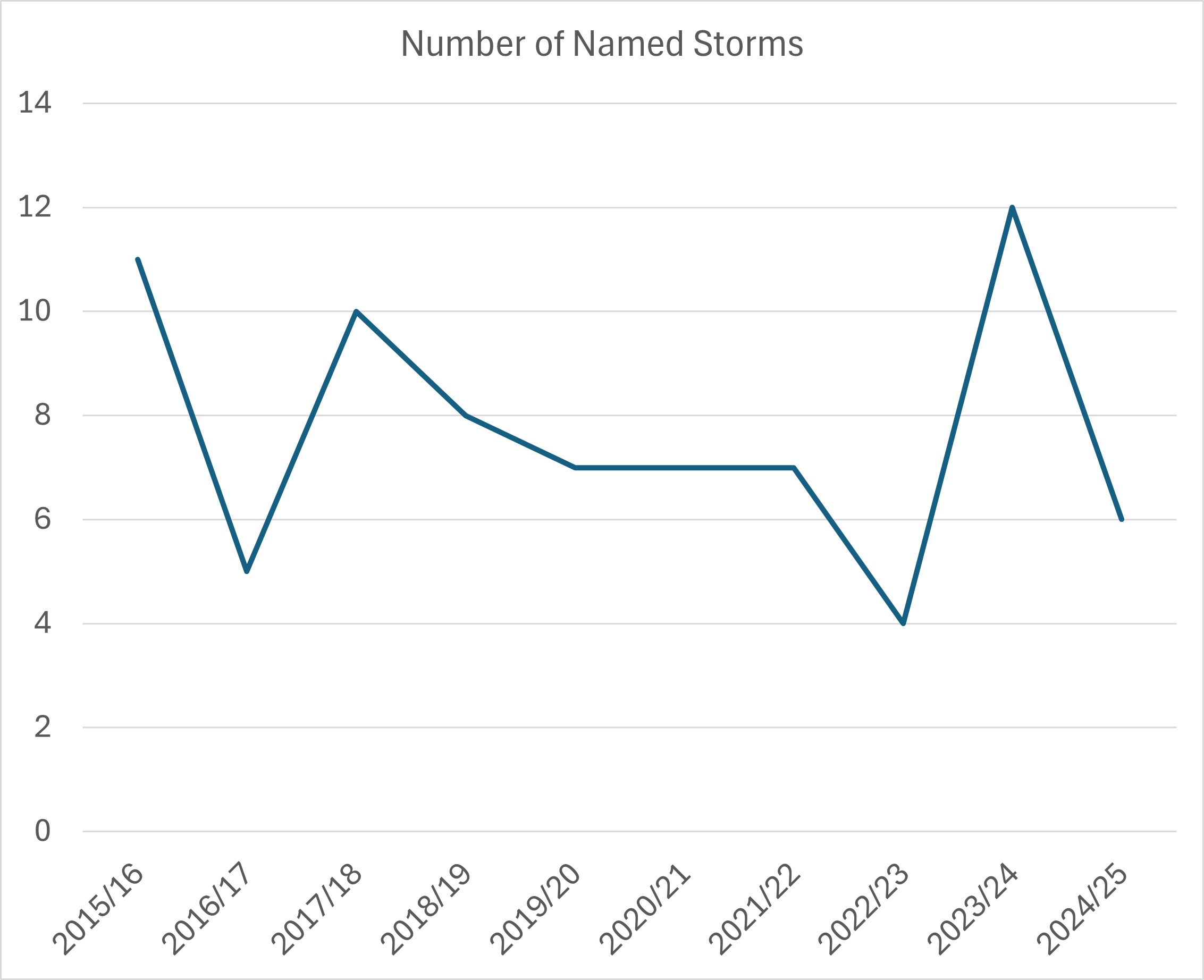
Chart showing the total number of named storms in UK from 2015 to 2025.
Timeseries of the number of named storms for each storm-naming period (which runs from September to August) since 2015. It includes storms named by other Met Services that impacted the UK. Source: Met Office

By this measure, 2025 was not exceptional with six named storms – two from the 2024-25 season and four from 2025-26. These are listed in the table below. 

Storm nameDate(s) of impact in UKMaximum wind gustNotable features
2024-25 names
Éowyn24 January87Kt (100mph), Drumalbin, LanarkshireMost powerful storm for over a decade
Floris4-5 August71Kt (82mph) at Wick Airport, CaithnessEqualled Scotland’s August gust speed record
2025-26 names
Amy3-4 October83Kt (96mph) at Tiree, ArgyllSignificant disruption from flooding.
Benjamin (named by Meteo France)22-23 October52Kt (60mph) Needles, Isle Of WightStrongest winds affected northern France
Claudia (named by AEMET, Spain)14 November59Kt (68mph) Warcop Range, CumbriaExtensive heavy rainfall across England and Wales
Bram8-10 December73Kt (84mph), Capel Curig, ConwyFlooding from heavy rainfall on saturated ground.

Credit: Met Office storm centre

Storm Éowyn in January had the most severe winds of any storm in 2025. The Met Office issued a red warning for wind across Northern Ireland and the south-west and central belt of Scotland. An amber warning was issued for the northern half of the UK. At the peak of the storm, power outages were reported at around 1m homes.

Storms from October to December were notable for bringing some persistent and heavy rain during a period of wetter weather, in contrast to the extended dry spell earlier in the year.

Weather through the year

The charts below show the progression of temperature and rainfall through the course of 2025. 

The plot below charts average daily temperature over the course of 2025, with orange shading showing warmer-than-average conditions. Overall, the year had 244 days – 66% of the total – where temperatures were above average. 

On the other hand, cold spells – indicated by blue shading – were generally short-lived and not very severe, with the exception of events in early January and November.
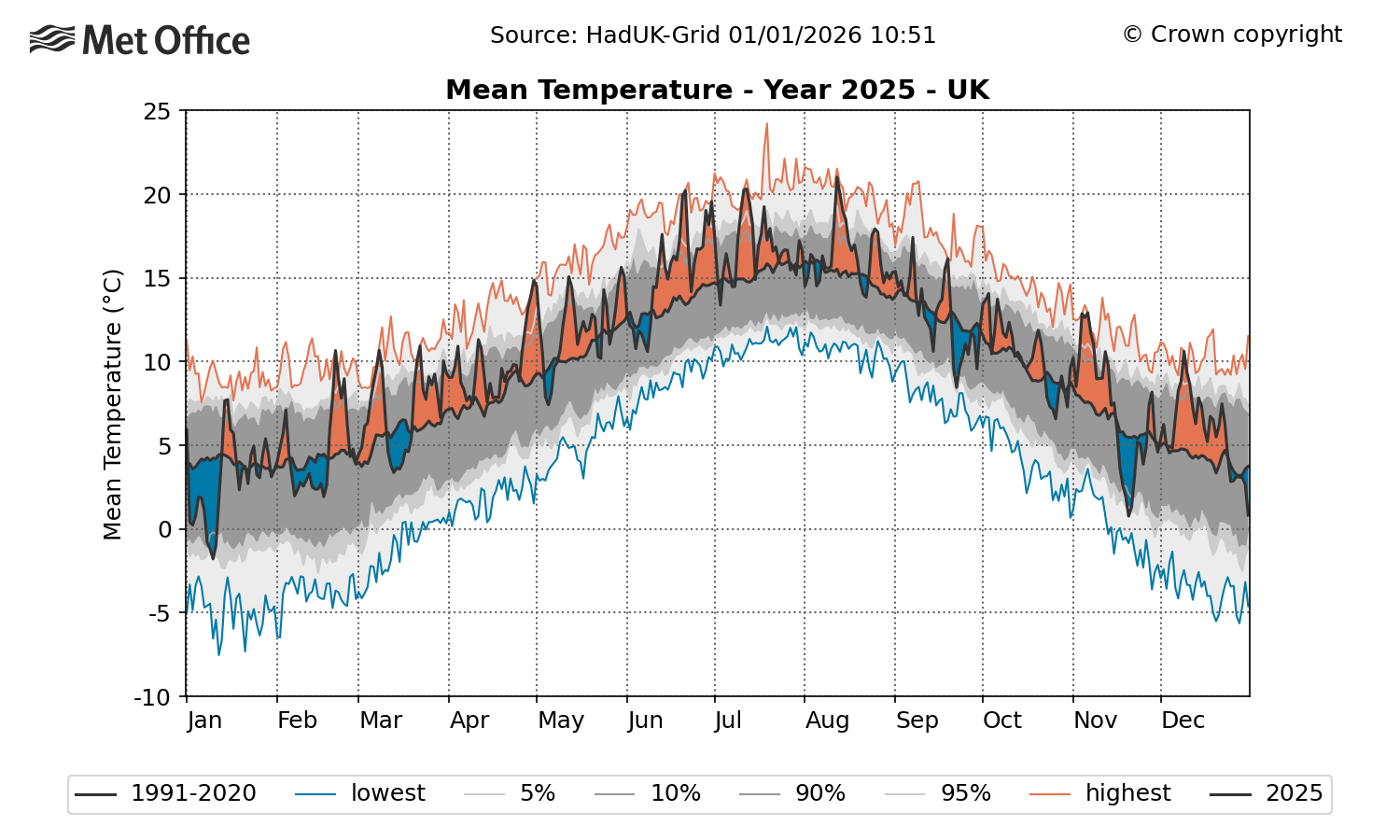
Chart showing mean temperature in the UK in 2025
Timeseries of daily UK average temperature during 2025. Orange shading indicates periods of above-average temperature and blue shading below average. The solid black line is the 1991-2020 reference period by day of the year. The grey shading reflects the 5th, 10th, 90th and 95th percentiles of the temperature distribution and the red and blue lines are the highest and lowest values for each day of the year, based on a dataset of daily data from 1960. Credit: Met Office

Fifty-one days in 2025 were in the top 5% warmest for the time of year in the historical record, but only one day – 20 November – was in the 5% of coldest. 

The significant number of warmer days and absence of cool ones helps build a picture of how 2025 was the warmest year overall. 

The highest daily maximum temperature recorded in the year was 35.8C at Faversham, Kent on 1 July during an early summer heatwave. The lowest minimum temperature was -18.9C, recorded at Altnaharra, Sutherland on 11 January. 

A maximum annual temperature of 35.8C is not an exceptional high for recent years – especially when compared with 2022’s record of 40.3C. However it would have been a rare event in the 20th century, when just three years – 1932 (36.1C), 1976 (35.9C) and 1990 (37.1C) – saw a higher temperature. 

In the 21st century, six years have seen temperatures above 35.8C – 2003, 2006, 2015, 2019, 2020, and 2022.

The plot below illustrates 2025’s below-average rainfall accumulation.

The brown shading – which represents the deficit in rainfall at that point of the year compared to the 1991-2020 average – highlights how rainfall totals were particularly low during the dry spring and summer period. The lower blue line shows how rainfall accumulation in 2025 came close to – but did not quite reach – a record low in late May and late August.

Wetter conditions in the autumn saw rainfall totals recover a little to reach 90% at the end of the year – which is below average, but not exceptional. As noted previously, there were regional variations.
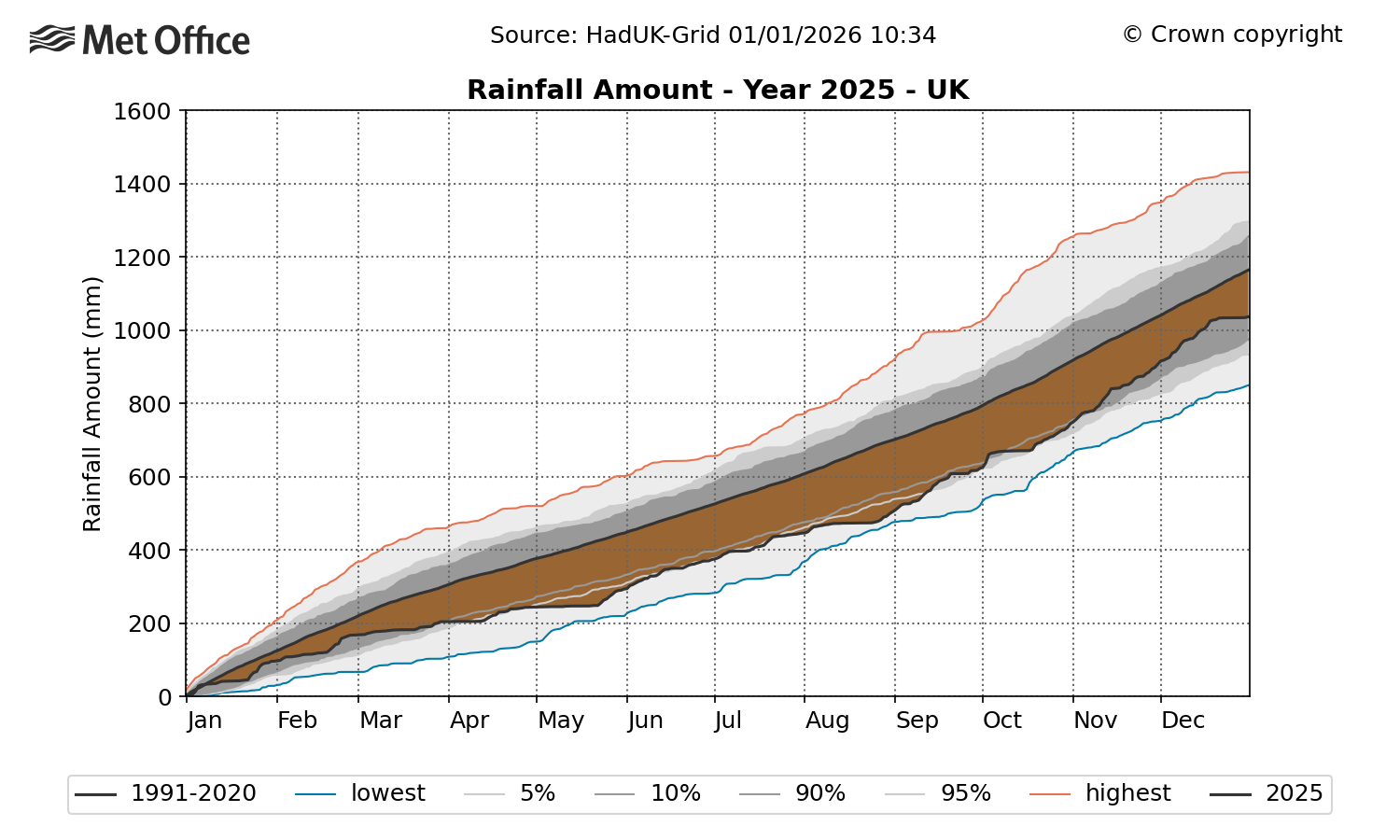
Chart showing the total amount of rainfall in the UK in 2025
Timeseries showing rainfall accumulation through 2025 for the UK. Brown shading represents a deficit in rainfall compared to average for that point in the year, and blue shading is an excess of rainfall compared to average. The solid line represents the 1991-2020 average and grey shading shows the 5th, 10th, 90th and 95th percentiles of the distribution. The blue and red lines represent the lowest and highest values based on a dataset of daily rainfall from 1891 to 2022. Credit: Met Office

Winter

In climate terms, the UK winter spans the calendar months of December, January and February. 

The winter of 2024-25 was slightly warmer than average, but not exceptional, with an average temperature of 4.62C. This is 0.53C above the 1991-2020 average. The winter months had 89% of average rainfall and 94% of average sunshine. 

New Year’s Day saw significant flooding that affected parts of Lancashire and the south side of Manchester. The River Mersey reached record levels in the wake of two days of heavy, persistent rain.

The coldest spell of 2025 occurred in early January, with significant snowfall in some regions. 

Storm Éowyn and heavy rain at the end of January were the winter’s most impactful events, bringing high winds and flooding that resulted in considerable disruption.

Spring

Spring – which encompasses the months of March, April and May – was the warmest and sunniest on record, as well as the sixth driest. 

The record high temperature came only one year after the previous record set in 2024, continuing a trend of increasing spring time temperature for the UK. 

(A Met Office attribution analysis which explored the record-breaking temperatures of May 2024 showed that the temperatures were caused by a combination of a marine heatwave which persisted through May and into June and human-induced climate change.)

The timeseries below shows average spring temperature in the UK over 1884-2025. It shows a significant warming trend since the 1970s, with temperatures in 2024 and 2025 sitting well outside the range of variability observed in the late 19th and 20th centuries.
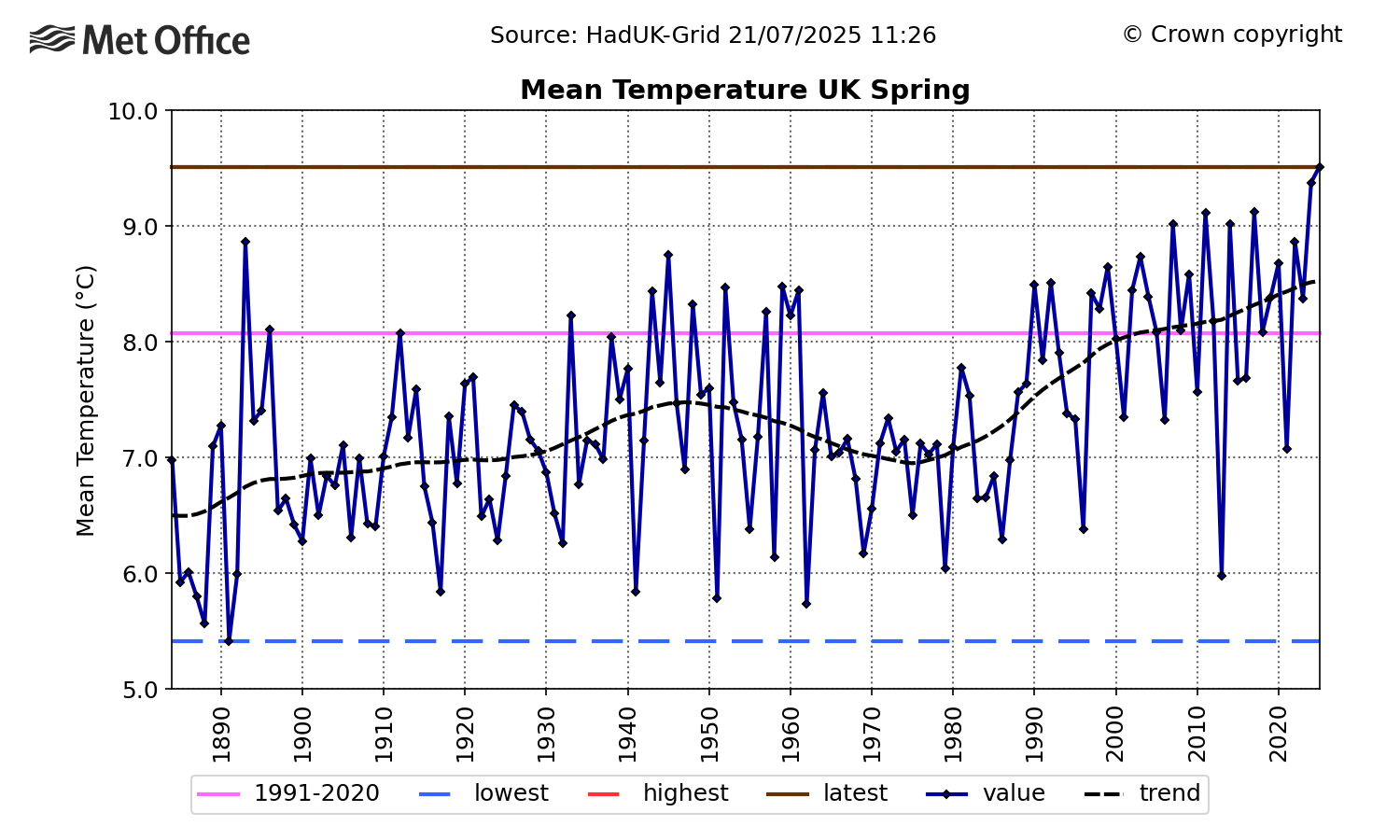
Chart showing the mean temperature for UK spring from 1885 to 2025.
Timeseries of spring average absolute temperature for the UK over 1884-2025. The trend is represented by a black dashed line, the 1991-2020 average is shown in pink and the highest and lowest values in the series are shown by the red and blue dashed lines, respectively. The 2025 value is represented by the horizontal brown line (which covers the red line for the highest in the record). Credit: Met Office

The UK’s changing climate is having an impact on the natural cycles of many species and habitats. Citizen science initiatives have highlighted how “signs of spring” – for instance, the first flowering or first nest-building – occur increasingly early in the year.

Summer

Warm, sunny and dry conditions persisted into the summer season, drying out soils.

There were four heatwave events, which impacted almost all regions of the UK. Two of these events took place in June. 

marine heatwave also took place, with sea surface temperatures of 1.5-3C above the 1983-2012 average in the Celtic Sea, English Channel and southern North Sea. 

An attribution study by the World Weather Attribution service estimated that human-caused climate change had made exceeding June heatwave thresholds around 10 times more likely. The research also found that one of the June heatwaves had been made 2-4C more intense as a result of human influence. 

The five warmest summers recorded in the UK to date are 2025 (16.10C), 2018 (15.76C), 2006 (15.75C), 2003 (15.74C) and 2022 (15.71C).

Met Office analysis estimates that in a pre-industrial climate, a summer like 2025 would be expected to occur every 340 years. However, in the current climate, we could expect to see these sorts of summers roughly once every five years. 

The study also shows that the UK could plausibly experience much hotter summers in the current and future climate. Events that would have been seen as extremes in the past are becoming more common.

A Met Office attribution study published in 2019 estimated that the then record-breaking summer of 2018 had a statistical return period of approximately eight-to-nine years. The summer of 2025 has broken that record in seven years, consistent with these previous findings.  

The science is clear that UK summers are becoming warmer and extreme heat events are becoming more common. This could mean more significant impacts on people, infrastructure and the environment – both now and in the future. 

The map below plots the number of heatwaves that took place in June, July and August across the UK. It shows how a significant number of regions across saw three (green shading) or four (pink shading) heatwaves over the summer months.
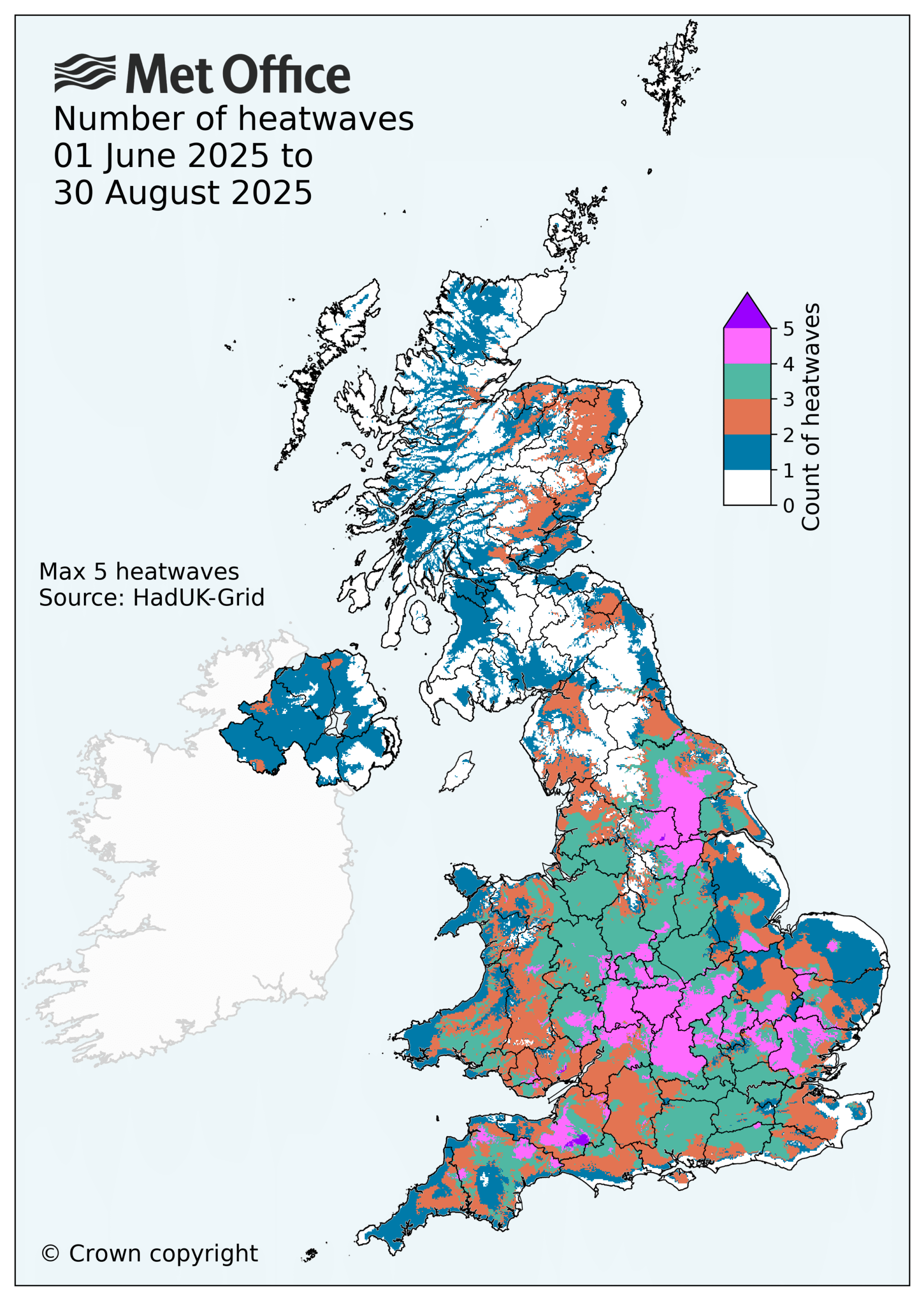
Map of the UK showing the number of heatwaves from June to August 2025
Map showing the number of heatwaves by location during the summer of 2025. Source: Met Office

Autumn

Autumn and the month of December were marked with unsettled weather, with mild and wet conditions over the four-month period. 

The season was warmer and wetter than average. Northern Ireland had its third-wettest autumn on record, Northern England its fifth wettest and Wales its 10th wettest.

Storm Amy set a record for highest gust speed for a storm in October, with 80Kt (92mph) recorded at Magilligan, County Londonderry. 

Other major storms were notable for heavy rainfall that caused flooding. Storm Claudia brought heavy rainfall to central England and Wales in mid-November, which fell on already saturated ground. 

The second half of November saw snow cause across the North York Moors during a cold northerly spell which saw some hard frosts. This was followed by generally mild and unsettled conditions until late December, when strong easterly winds brought more low temperatures and hard frosts.

The UK chalked up a number of significant climate records in 2025, particularly for high temperatures. This aligns with the well-established warming trend that is the result of human-caused climate change

Climate attribution studies continue to provide further evidence that human factors are increasing the likelihood and severity of UK climate extremes. 

Many of 2025’s records will not stand for long. There is a high chance they will be broken again in the near future as the climate continues to warm. 

Original article by Dr Mark McCarthy republished from Carbon Brief under a CC license

Donald Trump urges you to be a Climate Science denier like him. He says that he makes millions and millions for destroying the planet, Burn, Baby, Burn and Flood, Baby, Flood.
Nigel Farage urges you to ignore facts and reality and be a climate science denier like him and his Deputy Richard Tice. He says that Reform UK has received £Millions and £Millions from the fossil fuel industry to promote climate denial and destroy the planet.
Elon Musk urges you to be a Fascist like him, says that you can ignore facts and reality then.

Continue ReadingMet Office: A review of the UK’s climate in 2025

Back to basics 2

Spread the love

Personal private transport has been identified as one of the Capitalists’ / Fascists’ vulnerabilities. Their traffic signals are vulnerable.

Orcas discuss Donald Trump and the killer apes' concept of democracy. Front Orca warns that Trump is crashing his country's economy and that everything he does he does for the fantastically wealthy.
Orcas discuss Donald Trump and the killer apes’ concept of democracy. Front Orca warns that Trump is crashing his country’s economy and that everything he does he does for the fantastically wealthy.
Continue ReadingBack to basics 2

Back to basics

Spread the love

It’s the rich that have destroyed the climate to be richer, far richer than they ever need to be.

Orcas discuss Donald Trump and the killer apes' concept of democracy. Front Orca warns that Trump is crashing his country's economy and that everything he does he does for the fantastically wealthy.
Orcas discuss Donald Trump and the killer apes’ concept of democracy. Front Orca warns that Trump is crashing his country’s economy and that everything he does he does for the fantastically wealthy.

Continue ReadingBack to basics

Trump has a plan to steal the 2026 elections

Spread the love

Original article by Mark Gruenberg republished from People’s World under http://creativecommons.org/licenses/by-nc-nd/3.0/us/

Trust him to count your vote? Donald Trump spies on his wife, Melania Trump, to see how she’s marking her ballot on Election Day 2016. The president is now angling to have his administration take over voting and ballot counting from the states, a move that is blatantly unconstitutional. | Evan Vucci / AP

WASHINGTON—Donald Trump wants to take over the 2026 elections, though “steal” might be a better word.

No, the president isn’t planning to send another 1,600 invaders—Proud Boys and other assorted thugs—to rampage through the U.S. Capitol, as they did five years ago in an attempted coup. Nor is he asking secretaries of state to “find” ballots for him this time around.

Instead, he’s working to rig things to ensure certain votes either aren’t cast in the first place or don’t get counted even if they do make it to the ballot box.

Since his 2020 loss to Democratic presidential nominee Joe Biden, Trump has tried to stuff state and local elections boards with his sycophants. In some red states and red sections of “purple” states, he’s succeeded. But it’s not enough.

He’s once again talking about election “fraud” in majority-Black cities like Milwaukee, Philadelphia, Atlanta, and Detroit and using that as justification for what he calls the “nationalization” of elections.

Trump has a four-part plan to commandeer states’ election machinery and have the federal government run the voting and the counting. Thus, no matter who you vote for at the ballot box this fall, it’s his administration that will take the tally.

Though many Republicans are downplaying the likelihood of Trump pursuing the plan, it’s clear that he’s got some willing helpers on Capitol Hill, especially in the GOP-run U.S. House. Last year, lawmakers there pushed a massive voter restriction bill called the SAVE Act. They tried to insert it into the money bill Congress approved the first week of February and have signaled that they’ll try again.

There’s just one big thing wrong with Trump’s plan: It’s unconstitutional. But when did the U.S. Constitution, which Trump swore an oath to “preserve, protect and defend,” ever stop him?

Unconstitutional

Trump’s been quite open about what he wants to do and how he wants to do it. The federal government should “get involved” in running the voting, he says—everything from demanding voter registration rolls from every state to banning mail-in ballots.

All but a few states have already received such demands. Half (24) have refused, so Trump’s Justice Department is suing them. Voter rolls contain personal information, such as addresses, phone numbers, and Social Security numbers.

Besides, the Constitution is explicit: Article 1 Section 4 says the states shall run elections. “The Times, Places and Manner of holding Elections for Senators and Representatives, shall be prescribed in each State by the Legislature thereof; but the Congress may at any time by Law make or alter such Regulations, except as to the Places of chusing Senators” it says.

“The Supreme Court has interpreted the Elections Clause expansively, enabling states to provide a complete code for congressional elections, not only as to times and places, but in relation to notices, registration, supervision of voting, protection of voters, prevention of fraud and corrupt practices, counting of votes, duties of inspectors and canvassers, and making and publication of election returns,” says an authoritative source lawmakers use, The Constitution Annotated.

Now listen to Trump at an Oval Office ceremony this week:

“If a state can’t run an election, I think the people behind me”—Republican members of Congress—“should do something about it,” Trump said. “Because, you know, if you think about it, the state is an agent for the federal government in elections. I don’t know why the federal government doesn’t do ’em anyway.

“The federal government should get involved. These are agents of the federal government to count the votes. If they can’t count the votes legally and honestly, then somebody else should take it over.”

The Constitution’s rather explicit about that, too. Its 10th Amendment, part of the Bill of Rights, says powers “not reserved to the federal government” are “reserved to the states or the people.” Running elections is one of those latter powers.

Needless to say, Trump’s drawn flak for his comments. But his prior attempts to rig the outcome this fall appear to have flopped, so now he’s turning to the takeover.

Gerrymandering prelude

First, Trump demanded Texas redo its congressional districts to elect more Republican U.S. House members and preserve or even expand the GOP’s slim control there. The party’s majority is now 218-214, with three vacancies. Defection by two or three Republicans would doom Trump policy initiatives.

The Texas GOP complied with Trump’s order and redistricted the state’s map, potentially adding five GOP congressional districts. But it boomeranged. Democratic-run states, led by California, redistricted, too. Independent analysts call the national result a virtual wash.

And it didn’t help Trump’s temper when the GOP won only one off-year House election—in Tennessee, narrowly, in a GOP-gerrymandered district Trump carried by double digits in 2024.

MAGA Republicans have lost everywhere else since he’s returned to power: Governorships in New Jersey and Virginia, open-seat congressional races, the New York City mayoral race, where Trump endorsed loser Andrew Cuomo, and even two statewide Public Service Commission seats in Georgia.

The latest Trump loss was a 14-point win for a Democratic Machinists union local president, Taylor Rehmet, running on a progressive platform, in a Texas State Senate district. Trump won there in 2024 by 17%. The district had elected Republicans since 1979.

So, with the gerrymandering effort and off-year elections all failing to decisively shift the political terrain in Trump’s favor, he’s turned to the election “nationalization” scheme.

Trump’s four-part plan

Mark Elias, an election law specialist who often works with Democrats, says Trump would cancel the 2026 election, if he could. Barring that, though, Elias sees a four-step Trump plan to rig the vote.

“First, he will falsely claim there is widespread illegal voting,” Elias said in a post at Democracy Docket. “He will merge his demonization of immigrants with his long-standing election denialism.

Second, he will “use the pretext of non-citizen voting to execute a partisan takeover of voting rules and election administration in swing districts with high concentrations of Democratic voters.”

Trump is executing part one already and trying to launch into part two. At the White House this week, referring to undocumented immigrants, the president claimed, falsely: “These people were brought to our country to vote, and they vote illegally.”

He said the GOP in Congress has to be “tougher” in cracking down on non-existent migrant voter fraud. “The Republicans should say, ‘We want to take over.’ We should take over the voting—the voting in at least many—15 places. The Republicans ought to nationalize the voting.”

Saying he must prevent illegal voting, Elias speculates that Trump may even “use federal paramilitary forces already at his disposal to block voting access.” That means ICE and other federal agents could potentially be sent to patrol polling places.

Georgia General Election 2020 ballots are loaded by the FBI onto trucks at the Fulton County Election HUB, Jan. 28, 2026, in Union City, Ga., near Atlanta. The seizure aims to prop up Trump claims that the 2020 election was stolen from him while also making the federal seizure of ballots seem like a normal election procedure. | Mike Stewart / AP

Third, Trump will “use the Department of Justice to seize ballots and take over vote counting.” Elias argues that recent raid to seize ballots in Fulton County, Georgia, was in part “a dry run to work out the logistics” of how this could happen in the future in more places.

“With the public now accustomed to ballot seizures,” Trump will have set the stage, Elias believes, for trying to seize control of elections in at least 15 states in 2026.

“If this targeted approach does not guarantee a Republican majority,” Trump will go even further—to the fourth part of his scheme—“a complete federal takeover,” or what Trump is calling nationalization.

Voter purge already underway

Trump’s demand that the feds take over elections drew immediate criticism from non-partisan groups as well, with Eileen O’Connor of the Brennan Center for Law at New York University leading the way. She says that even if Trump’s nationalization plan isn’t carried out to the last detail, the situation is still bad enough.

“The Trump administration’s campaign to undermine future elections is in full swing,” O’Connor warns. “One part is its bid to sweep up voter rolls across the nation, which began last spring and has now made its way to the courts.”

Trump’s Justice Department began its voter roll campaign in May, demanding the lists from at least 44 states and D.C. “Most have refused to provide these records and instead provided publicly available versions of their voter files,” O’Connor says, so Trump Attorney General Pam Bondi is now suing 24 of the states. Trump and Bondi have already lost in California and Oregon.

“Make no mistake about what these actions represent: An attempt to take over election administration, a role the Constitution grants to states, not the federal government,” O’Connor continues.

“The Trump administration has made clear one of its goals in collecting nationwide voter files is to run its own analyses and attempt to force states to remove voters from the rolls based on incomplete and likely inaccurate information.”

In plain English, that amounts to a voter roll purge. The past U.S. history of such purges shows voters most likely to be tossed off the rolls, almost always illegally, are voters of color. As Trump and his allies know, they mostly vote Democratic.

Multiprong attack on democracy

Then, added to the mix, is the House GOP majority’s own voter suppression scheme: The SAVE Act, or the Safeguard American Voter Eligibility Act, by its full name. It would require voters to prove they’re citizens before they can register to vote for a federal election.

The forms of proof would be limited, and the cost of getting them would be prohibitive for many. Only a passport or original birth certificate would suffice; driver’s licenses and tribal IDs won’t cut it. The legislation would invert the responsibility of eligibility verification from election officials to citizens and force them to convince the government that they have the right to vote.

In August, Elias explained this multipronged attack on democracy in stark detail and also predicted Trump will attempt to ban mail-in voting and decertify voting equipment he does not like. With fewer ways to vote, Elias expects the electorate to skew more Republican. If that fails, Trump would, he forecast, take over vote counting and ballot tabulation from the states. That is where we are now.

“The States,” Trump wrote on Truth Social, “are merely an ‘agent’ for the Federal Government in counting and tabulating the votes. They must do what the Federal Government, as represented by the president of the United States, tells them…to do.”

As a matter of constitutional law, this is flat-out wrong. “But Trump is not interested in following the Constitution. As we have seen before, he prefers to act by force” Elias said.

We hope you appreciated this article. At People’s World, we believe news and information should be free and accessible to all, but we need your help. Our journalism is free of corporate influence and paywalls because we are totally reader-supported. Only you, our readers and supporters, make this possible. If you enjoy reading People’s World and the stories we bring you, please support our work by donating or becoming a monthly sustainer today. Thank you!

Original article by Mark Gruenberg republished from People’s World under http://creativecommons.org/licenses/by-nc-nd/3.0/us/

Donald Fuhrump says that Amerikkka doesn't bother with crimes or charges anymore, not being 100% Amerikkkan and opposing his real estate intentions is enough.
Donald Fuhrump says that Amerikkka doesn’t bother with crimes or charges anymore, not being 100% Amerikkkan and opposing his real estate intentions is enough.
Elon Musk urges you to be a Fascist like him, says that you can ignore facts and reality then.
Orcas discuss Donald Trump and the killer apes' concept of democracy. Front Orca warns that Trump is crashing his country's economy and that everything he does he does for the fantastically wealthy.
Orcas discuss Donald Trump and the killer apes’ concept of democracy. Front Orca warns that Trump is crashing his country’s economy and that everything he does he does for the fantastically wealthy.

Continue ReadingTrump has a plan to steal the 2026 elections

Fight builds against U.S. plan to deprive Cuba of oil

Spread the love

Original article by W. T. Whitney, Jr republished from People’s World under http://creativecommons.org/licenses/by-nc-nd/3.0/us/

A driver refuels others wait in a long line behind to fill up at a gas station in Havana, Cuba, Jan. 27, 2026. | Ramon Espinosa / AP

The U.S. president issued an executive order on Jan. 29 “declaring a national emergency and establishing a process to impose tariffs on goods from countries that sell or otherwise provide oil to Cuba.” The order mentioned “confronting the Cuban regime” and “countering Cuba’s malign influence.” “I think we would like to see the regime there change,” declared Secretary of State Rubio, testifying before the Senate Foreign Relations Committee the day before.

Cuba faces catastrophe. At work now are the cumulative effects of six decades of the U.S. economic blockade, a tightened stranglehold during the two Trump administrations, increasingly desperate living conditions, worsening shortages of essential goods, serious electrical power shortages, and the cut-off of oil from Venezuela after the U.S. invasion there on Jan. 3.

Mounting humanitarian danger and U.S. assault on Cuba’s sovereign independence are moving the international and U.S. Cuba solidarity movements into action.

The matter is urgent. In a statement, the U.K. Cuba Solidarity Campaign declares that, “This latest escalation…will cripple the electricity system and devastate every aspect of daily life” in Cuba. Th organization predicts:

“Hospitals without power. Incubators and life-support machines unable to function. Emergency surgeries carried out without light. Schools and workplaces forced to close. Bakeries unable to operate. Fuel shortages preventing the transport of food and medical supplies. Food spoiling in fridges and freezers. Hunger, illness, and suffering will spread. This is a deliberate attack on an entire civilian population, intended to inflict pain, deprivation and desperation. It is cruel, calculated, and it will cost lives.”

Victory for U.S. imperialism over Cuba’s socialist revolution would have dire implications. A European analyst explains that, “Cuba remains the only living example of a country that continues to attempt socialist construction on the basis of social ownership, planning, and working-class power, rather than market dominance and capitalist accumulation.”

Trump’s executive order sanctioning suppliers of oil to Cuba prompted a crescendo of statements supportive of Cuba, including from many Communist Parties of the world, from China, Russia, Vietnam, the Arab League, the African National Congress, the Bolivarian Alliance for the Peoples of Our America, multiple Cuba solidarity organizations, organizations of Cubans living abroad, and the World Federation of Trade Unions.

Cuban President Miguel Díaz-Canel commented on Jan. 30 that, “Under a false pretext and empty arguments, peddled by those who engage in politics and enrich themselves at the expense of our people’s suffering, President Trump seeks to stifle the Cuban economy by imposing tariffs on countries that trade oil with Cuba as is their sovereign right.”

Denying U.S. accusations, Cuba’s Foreign Ministry insisted that Cuba “does not harbor, support, finance, or permit terrorist or extremist organizations.” Nor does Cuba “harbor foreign military or intelligence bases” or represent “a threat to the security of the United States.”

Cuba soon may be unable to import any oil at all. According to a Financial Post report on Jan. 29, “Cuba has 15 to 20 days left of oil left as Donald Trump turns the screws.”

As explained by analyst Gabriel Vera Lopes, Cuba itself produces 30% of the 120,000 barrels of oil (BPD) used in the country each day. Venezuela in 2025 provided up to 35,000 BPD, representing 29% of the total. Mexico sold Cuba 17,200 BPD during the first nine months of 2025, until oil exports lagged due to U.S. pressure.

Vera Lopes indicates that even oil sent for humanitarian reasons will be blocked, as will be the small amounts of oil sent to Cuba through China or Russia. Apart from oil produced in Cuba itself, all that remains is oil from Mexico. Crucially, “The new executive order now appears to be aimed directly at Mexican supplies.”

Mexican President Claudia Sheinbaum, speaking to reporters on Jan. 30, highlighted humanitarian considerations and respect for international law. Insisting that Mexico’s government will negotiate with officials in Washington, she stated that “contractual considerations,” not political pressures, accounted for the PEMEX oil company’s recent suspension of shipments. Sheinbaum added that “ Mexico will always stand in solidarity, always seeking the best way to support the Cuban people.”

Mexico has been sending only 1% of its total oil production to Cuba. Up to 84% of it goes to the United States. In fact, Mexico and the United States have a mutually dependent but asymmetric relationship as regards hydrocarbon products. Maintaining that relationship may take precedence over Cuba’s needs.

Mateo Crossa’s recent article appearing in Monthly Review titled “The Shale Revolution, U.S. Energy Imperialism, and Mexico’s Dependence” is relevant. He writes:

“In the context of the Shale Revolution positioning the United States as the world’s top oil producer and as the leading exporter of refined oil, Mexico has become the largest market for the United States, importing $30 billion worth of refined oil in 2023—accounting for 28% of the $107 billion the United States exported that year.”

He adds: “This pattern highlights a troubling shift in energy dynamics, with Mexico increasingly locked into a subordinate role that weakens its economic autonomy and energy independence…. Mexico has not only become the largest importer of U.S. natural gas but also plays a pivotal role in the broader U.S. imperial energy strategy, serving as a platform for liquefied natural gas exports to Asia.”

Cuba solidarity activists in the United States are responding. In a communication shared with the International U.S.-Cuba Normalization Coalition Committee, labor activist Mark Friedman, associated with the Los Angeles Hands off Cuba Coalition, stated:

“We need to go on an emergency footing and reach out to those forces who in the past have not been willing to take a stand.… We need to fight for unity in the Cuba solidarity movement.”

At an emergency meeting of the coalition on Feb. 1, emphasis was given to significant expanding the existing material aid campaign for Cuba, outreach to the labor movement and to activists mobilizing against ICE and U.S. wars, local teach-ins, and a focus on defending Cuba’s sovereign independence.

Renewed action now on Cuba’s behalf is continuation of the struggle for Cuba that began in earnest in the United States under the leadership of Cuba’s national hero, José Martí. Revolutionaries inside Cuba who opposed the U.S.-dominated pseudo-republic (1902-59) carried it on. Anti-imperialist struggle intensified after 1959 with the defense of Cuba’s socialist revolution.

Under unprecedented threat now, the revolution’s fall would undo the long struggle of untold numbers of people against U.S. imperialism.

Fidel Castro, in his “Second Declaration of Havana” of Feb. 4, 1962, gave voice to Cuba’s struggle against U.S. Imperialism. A relevant excerpt follows:

“In 1895, Martí already pointed out the danger hovering over America and called it by its name: imperialism. He pointed out to the people of Latin America that more than anyone, they had a stake in seeing that Cuba did not succumb to the greed of the Yankee.… Sixty-seven years have passed. Puerto Rico was converted into a colony and still is a colony…. Cuba also fell into the clutches of imperialism. Their troops occupied our country. The Platt Amendment was imposed on our first Constitution, as a humiliating clause which sanctioned the odious right of foreign intervention. Our riches passed into their hands, our history was falsified, our government and our politics were entirely molded in in the interest of the overseers; the nation was subjected to 60 years of political, economic, and cultural suffocation. But Cuba was able to redeem itself.… Cuba broke the chains which tied its fortunes to those of the imperialist oppressor…and unfurled its banner as the Free Territory of America.”

We hope you appreciated this article. At People’s World, we believe news and information should be free and accessible to all, but we need your help. Our journalism is free of corporate influence and paywalls because we are totally reader-supported. Only you, our readers and supporters, make this possible. If you enjoy reading People’s World and the stories we bring you, please support our work by donating or becoming a monthly sustainer today. Thank you!

Original article by W. T. Whitney, Jr republished from People’s World under http://creativecommons.org/licenses/by-nc-nd/3.0/us/

Donald Fuhrump says that Amerikkka doesn't bother with crimes or charges anymore, not being 100% Amerikkkan and opposing his real estate intentions is enough.
Donald Fuhrump says that Amerikkka doesn’t bother with crimes or charges anymore, not being 100% Amerikkkan and opposing his real estate intentions is enough.
Elon Musk urges you to be a Fascist like him, says that you can ignore facts and reality then.
Orcas discuss Donald Trump and the killer apes' concept of democracy. Front Orca warns that Trump is crashing his country's economy and that everything he does he does for the fantastically wealthy.
Orcas discuss Donald Trump and the killer apes’ concept of democracy. Front Orca warns that Trump is crashing his country’s economy and that everything he does he does for the fantastically wealthy.

Continue ReadingFight builds against U.S. plan to deprive Cuba of oil