Prime Minister Keir Starmer (right) and Peter Mandelson, February 27, 2025
PRESSURE mounted on Sir Keir Starmer to resign today as backbenchers joined opposition parties saying the PM must have been aware Lord Peter Mandelson had failed vetting before appointing him US ambassador.
The Labour leader said it was “unforgivable” that he was not told that the Foreign Office had overruled the UK Security Vetting team’s recommendation not to clear the so-called “Prince of Darkness” for the post.
“That I wasn’t told that Peter Mandelson had failed security vetting when he was appointed is staggering,” the PM said.
“That I wasn’t told that he had failed security vetting when I was telling Parliament that due process had been followed is unforgivable.
…
Sir Keir was already under fire over the decision to give the twice-resigned cabinet minister the job, despite it being known that his dealings with Epstein continued after the financier’s conviction for child sex offences.
Questions over his judgement intensified after the first batch of documents related to the decision, published last month, showed that he was warned before announcing Lord Mandelson’s ambassadorship of a “general reputational risk” over his association with Epstein.
That warning stemmed from the first part of the checks, carried out by the Cabinet Office, which was based on information in the public domain at the time.
Keir Starmer discusses Peter Mandelson, Jeffrey Epstein and the UK Labour Party’s tradition of excusing and protecting child rapists.Keir Starmer says that the Labour Party under his leadership is intensely relaxed about assaulting those least able to defend themselves – the very poorest and most vulnerable.
The US is bracing for another cycle of elections, with November’s midterms determining the scope of Donald Trump’s power in the final two years of his presidency. All seats in the House of Representatives will be contested, as will one-third of the Senate.
Trump’s Republican party currently controls both branches of Congress. However, polls are indicating a swing to the Democrats that would see them retake the House. A current RealClear generic congressional vote poll, in which people are asked whether they will vote for Democrats or Republicans for Congress, gives the Democrats a five percentage point lead over the Republicans at 47.4% to 42%.
One major variable that is likely to affect the outcome of November’s elections is the war in Iran. Some Republican political operatives believe the conflict and its repercussions, namely the increased cost of living, could prove fatal to their party’s hopes of securing a slim retention of the House.
A March poll by the Pew Research Center revealed 61% of Americans disapproved of Trump’s handling of the conflict. One voting demographic of particular concern for Republicans is people aged 18 to 29. An Economist/YouGov poll also from March showed that 63% of these people opposed the war.
Men within this age bracket were an important factor in Trump’s 2024 election victory. Philip Wang, political reporter for Time magazine, argued in an article on April 8 that this “same voting bloc … is showing far less interest in voting in the midterms”.
William A. Galston, a senior fellow at the Brookings Institution, has asserted that the affordability issue is affecting Trump’s standing. He has also stated that, for a majority of Americans, the president’s “priorities do not align with theirs”. A recent survey conducted by American non-profit Consumer Action for a Strong Economy revealed that voters’ most pressing concern was the price of groceries, with the cost of healthcare coming second.
Over the past year, both parties have also engaged in redistricting efforts designed to increase their respective chances of controlling the House. In a number of mainly – though not exclusively – Republican controlled states, legislators have redrawn congressional maps in an attempt to secure more seats.
The redistricting war has come down to two final states: Democratic-led Virginia and Republican-dominated Florida. On April 21, voters in Virginia will decide the fate of proposed new congressional boundaries heavily favouring Democrats. Florida’s legislature will vote days later on a revised Republican-leaning electoral map.
However, there are growing concerns in both political camps about these votes and their impact on the result of the midterms. Florida Republicans fear Trump’s low approval ratings could cost them redrawn districts, while Democrats are encountering tepid backing from their supporters for their aggressive redistricting in Virginia.
Growing Democrat momentum
There have already been significant election results in recent weeks that have shed light on the trajectory of the upcoming midterms. In Republican-led Texas, a fascinating race is shaping up between both parties for a Senate seat. The last time a Democrat won here was in 1988.
In primary elections in March, Democratic voters chose state representative James Talarico as their candidate for November’s election. Republicans are yet to confirm theirs, with incumbent Senator John Cornyn facing Texas attorney-general Ken Paxton in a run-off election in May.
Primary voting numbers in Texas are encouraging for Democrats. For the first time in six years, more of its supporters cast early vote ballots in a March primary than Republicans. Democrats also saw a major shift in Latino voters to their side, a voting bloc that had swung to Trump in record numbers in 2024.
According to analysis by American broadcaster NPR: “In the ten most populous counties in Texas that are also at least 50% Latino, votes in the Democratic primary increased by an average of 128%.” The same analysis concluded that, in those same counties, the Republican primary saw an average drop in votes of 4.8%.
Then, in early April, liberal judge Chris Taylor won a seat on the state of Wisconsin’s supreme court. She secured 60.1% of the vote to her conservative opponent’s 39.8%. Taylor’s statewide vote is an impressive 21 percentage points higher than Democratic presidential candidate Kamala Harris’s vote share was in the state in 2024.
Also in early April, an election took place in Georgia to fill the congressional seat vacated by former Trump ally Marjorie Taylor Greene. Greene, who has publicly broken with Trump over his handling of the Epstein files, won in 2024 by almost 29 percentage points. Her replacement, Clay Fuller, held the seat for the Republican party by a much narrower margin of just 12 percentage points.
The forecasts for November’s midterm elections are moving in the Democrats direction, especially for taking control of the House. But there is some reason for hope among Republicans.
Figures from CBS News and CNN/SSRS show that at the same point in 2006 and 2018 – also midterm election years where a Republican president was in office – Democrats were ahead on party favourability by 18 points and 12 points respectively. At this stage in 2026, the data reveals Republicans are actually sitting with a five-point favourability lead.
Seven months out from November’s midterms, Democrats have momentum on their side as well as a Republican president whose poll ratings are plummeting. The most likely outcome is that the Democrats will emerge with control of at least one branch of Congress.
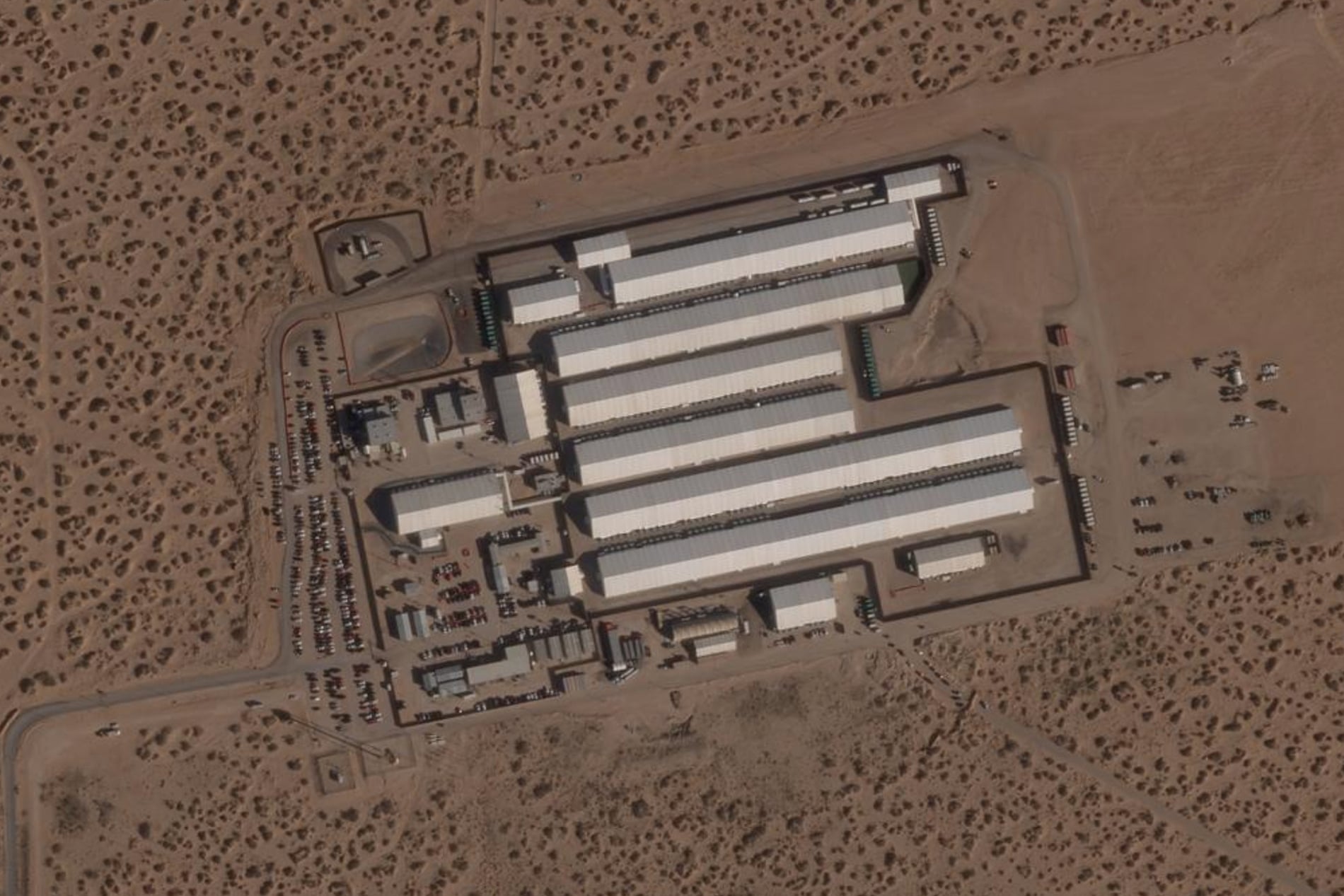
Large white tents and steel fencing at Camp East Montana at the Fort Bliss army base in Texas. Photograph: AP
Detainees tell of abuse at sprawling Texas facility whose giant generators gobble energy and fuel climate crisis
Dust was everywhere, covering people’s blankets and clogging their airways inside Camp East Montana, the huge tent facility for immigration detention in west Texas, said D, a young Venezuelan man who was held there.
The air conditioning blasted constantly, keeping the living areas inside tents the length of two football fields at what felt like near-freezing temperatures despite the balmy weather outside, and rain leaked through the tarps, so people awoke on wet mattresses, he recalled.
“Everyone was coughing a lot – and with the same problem to breathe,” said D, who has since been released and spoke with the Guardian via video interview.
Camp East Montana is the facility with the largest number of immigration-related detainees in the US, with a capacity of 5,000 and an estimated daily average of 2,505 locked up. After just nine months in operation it has become a health and human rights scandal – and also an environmental hazard that affects the inhabitants and the area, while fueling the climate crisis.
Reports of harsh conditions, abuse, sickness and death have accumulated since the camp was erected last summer on the Fort Bliss army base in El Paso. And flying thousands of people often hundreds of miles to be locked up in an encampment run on electricity generators in the desert gobbles energy and produces emissions that are heating the planet.
Donald Fuhrump says that Amerikkka doesn’t bother with crimes or charges anymore, not being 100% Amerikkkan and opposing his real estate intentions is enough.
The UN just released its 2025 Global Climate Report, and, predictably, the outlook for our earth is incredibly dire. The past 11 years were the 11 warmest on record, and Earth’s energy imbalance—the amount of solar energy absorbed versus the amount Earth radiates back into space—is also the highest on record. Greenhouse gas emissions continued to increase through 2025, despite the world crossing the 1.5°C threshold marked in the Paris Agreement above which the worst effects of global heating will take place.
There is no shortage of urgent climate news right now. The scientific consensus that we need to phase out fossil fuels fast has not changed, despite President Donald Trump’s anti-climate policies rolling back environmental protections and clean energy growth. But data shows coverage about climate change in US news outlets has plunged.
Downward trend
FAIR’s research has found that online news coverage of climate change has been trending down. A search of the term “climate change” in Media Cloud’s US–National dataset, which indexes 248 online outlets, found that there was almost 32% less climate coverage in 2025 than 2024.
This trend is similar in TV news. A recent Media Matters (3/4/26) study found that climate coverage on major US commercial broadcast TV networks was down 35% in 2025.
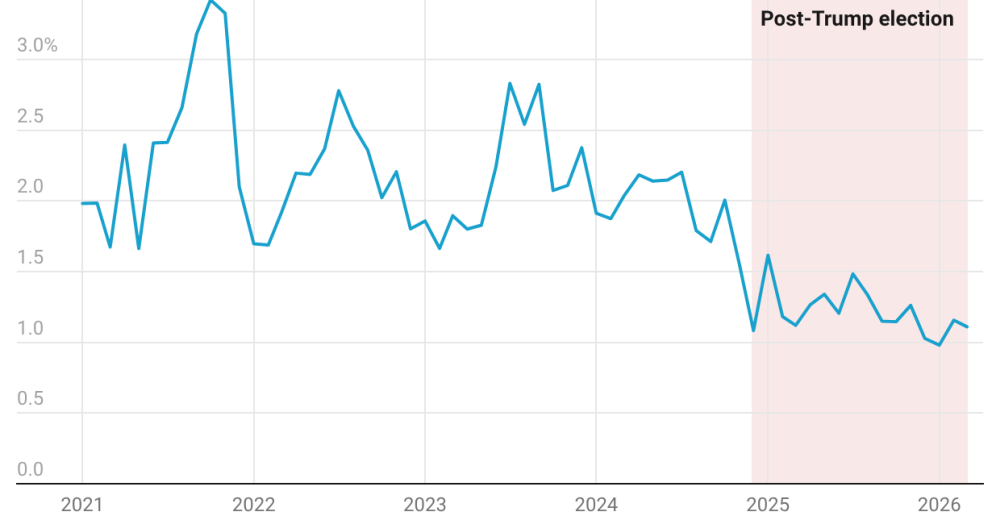
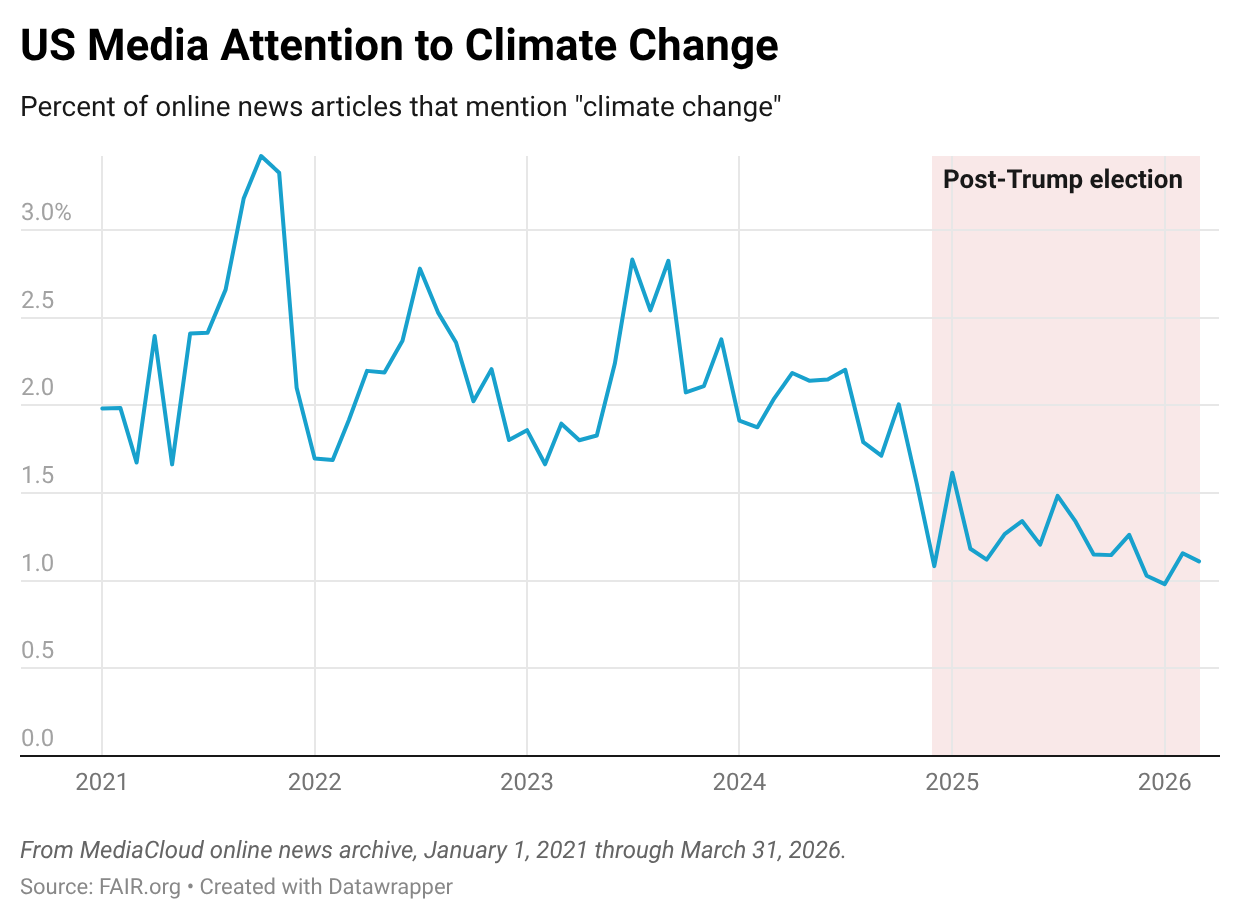
Zooming out to the past five years to date, results show a steep downward trend. In 2021, 2.4% of US online news pieces in MediaCloud contained the phrase “climate change.” In 2025, that percentage was 1.3%, which is a nearly 46% decrease.
This trend continues in 2026. Between January 1 and March 31 2026, climate stories made up 1.1% of total US news coverage. That’s a 42% decrease compared to the same period in 2021, when climate stories made up 1.9% of coverage.
Coverage of climate change in MediaCloud’s US news database peaked at 3.4% of content in October 2021. This was in the runup to the COP26 climate conference in Glasgow (10/31/21–11/13/21), and was at the time the world’s fourth-warmest October on record, although now it’s only the seventh-warmest. Coverage reached its nadir in January 2026, at just under 1%, and as of March 31, 2026, sat at 1.1%.
The unlabeled ‘crisis’
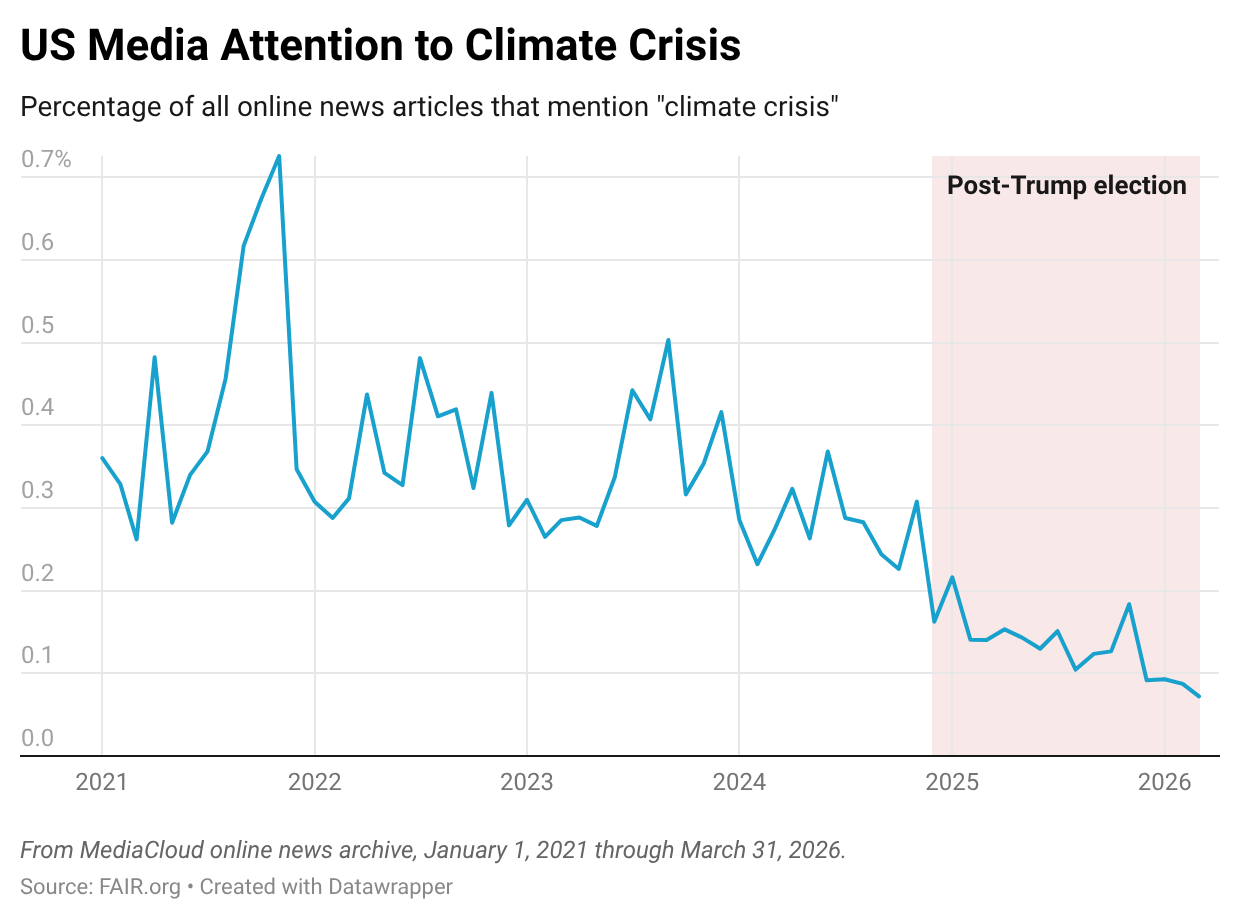
The term “climate crisis,” which carries with it a more urgent connotation than the more familiar “climate change,” has nearly disappeared from media lexicon. The term, which averaged 0.4% of coverage in 2021, reaching its peak in November 2021 at 0.7%, has averaged 0.1% of content in the first quarter of 2026.
Though it has never approached the usage of “climate change,” there was a time when the terms “crisis” or “emergency” to describe the heating planet were popularized in media and political lexicon (Public Citizen, 6/22/19). In 2019, activist Greta Thunberg (Twitter/X, 6/4/19) declared:
It’s 2019. Can we all now please stop saying “climate change” and instead call it what it is: climate breakdown, climate crisis, climate emergency, ecological breakdown, ecological crisis and ecological emergency?
Months later, the Guardian (10/16/19) changed its style guide to “introduce terms that more accurately describe the environmental crises facing the world.” The editors explained:
Climate change is no longer considered to accurately reflect the seriousness of the overall situation; use climate emergency or climate crisis instead to describe the broader impact of climate change.
In 2026, this terminology is arguably more applicable now than it has ever been. The years 2015–25 were the hottest on record. Yet while the Guardian continues its policy, it appears increasingly isolated.
Trump and climate silence
Under a president who called climate change a “con job” at the UN, and whose EPA edited its “Climate Change Science” page to blame global heating on debunked “natural causes” theories like changes in Earth’s orbit and volcanic activity, news media should be redoubling their efforts to tell climate change stories with accuracy.
Instead, one cannot help but notice a correlation between Trump’s second presidency and dwindling media attention to the climate. From January 2021 through November 2024, climate pieces were an average of 2.2% of total news content per month. From December 2024, after Trump was elected, through March 2026, climate pieces averaged more than 46% lower, at 1.2%.
The lack of recent coverage is not for lack of newsworthy climate stories. In addition to the release of the 2025 UN report, in March alone:
The University Corporation for Atmospheric Research filed a lawsuit charging that the Trump administration shut down the Colorado-based National Center for Atmospheric Research to get back at Colorado Gov. Jared Polis, whom Trump has clashed with (NCAR/UCAR, 3/16/26).
Scientists found that March’s record-shattering heatwave in the Western US would have been “virtually impossible” without the climate crisis. The heatwave included the hottest March days on record in the US, with two 112°F days in Arizona (NBC New York, 3/30/26).
The Trump administration paid a French energy giant $1 billion to cancel its offshore wind projects and invest in fossil fuels instead (Grist, 3/25/26).
More than 160 environmental and public health groups called for the firing of EPA administrator Lee Zeldin, who has rolled back national environmental regulations, including air quality standards, pollution limits for oil and gas drilling, and regulations on power plant and vehicle emissions (Earth.org, 3/26/26).
An oil spill in the Gulf of Mexico began in late March, killing wildlife and damaging reefs (Al Jazeera, 3/27/26).
Iran War and climate
The US and Israel’s unprovoked war on Iran is causing global oil and gas price shocks—and is being reported as the worst energy crisis in history, topping the crises of the 1970s and the Ukraine invasion of 2022 (Fortune, 3/23/26). With the war dominating headlines—the terms “Iran” and “war” made up 10.5% of US news coverage in March, per MediaCloud’s data—there were plenty of opportunities to discuss the war’s impact on climate.
While 5,012 stories in MediaCloud’s US news database mentioned Iran and oil or gas prices during March 2026, only 219 (4.4%) mentioned those topics in relation to renewable energy or climate change.
Simon Stiell, executive secretary of the UN Framework Convention on Climate Change, spoke at the 2026 Green Growth Summit in Brussels, explaining that a just transition from fossil fuels is not only an environmental imperative, but also an economic and national security one:
Sunlight doesn’t depend on narrow and vulnerable shipping straits, wind blows without massive taxpayer-funded naval escorts [and] renewable energy allows countries to insulate themselves from global turmoil and to side-step might-is-right politics.
Renewables like solar and wind are less beholden to geopolitics than fossil fuels, which are vulnerable to volatile shipping lanes and international relations in the specific regions of the world they are produced. Once solar panels and wind turbines are installed, they allow for energy to be produced locally and predictably. As a result, their prices remain stable over time (Global Witness, 4/2/26).
Solar and wind have also been cheaper than fossil fuels for quite some time. A 2025 Lazard report found that utility-scale solar and wind have been the lowest-cost generation sources for 10 years, even without tax subsidies.
This is not the first time in recent years the corporate press failed to make the connection between war-inflated gas prices and the need for renewable energy. In June 2022, after Russia invaded Ukraine, UN sanctions on Russian oil led to a global shortage, causing the national gas price average to top $5 a gallon. Out of 93 nightly news episodes in June 2022 that discussed gas prices, only 18 made even a passing climate connection, and only one made a pro-climate argument (FAIR.org, 7/29/22).
Impacts of climate
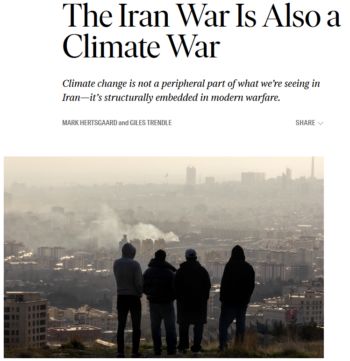
The Nation (3/5/26): “The climate implications of this new war are not the center of attention at the moment, but they are essential context for understanding what’s at stake.”
What’s more, as Mark Hertsgaard and Giles Trendle wrote for The Nation (3/5/26), “Modern warfare is inextricably linked with climate change.” Whether or not a war is fought over oil, the authors note, it cannot be fought without it. If the world’s militaries were a country, they would have the fourth-largest national carbon footprint.
Modern warfare emits astronomical amounts of carbon, which cause extreme heat and other dangerous weather events that impact livelihoods and destabilize economies—conditions that lead to more war.
And warfare also has immediate environmental and public health impacts, some directly linked to fossil fuels. After Israel attacked Iran’s oil facilities, black rain fell in Tehran. The heavy metals and toxic chemicals unleashed have the potential for major public health ramifications, leaching into food supplies and waterways in addition to air. Health risks from this pollution include lung problems, heart problems and cancer.
Climate change does not occur in a vacuum. It is relevant to virtually everything that happens on Earth, from natural disasters to your weekly expenses. Studies show that 80–89% of people worldwide want to see stronger action on climate change from their governments.
It is news media’s responsibility to reflect reality and to address the concerns of the communities they serve, regardless of the priorities of the administration in power. Failing to mention climate change where it is relevant will not stop it from occurring, but inattention will surely make it worse.
This story is part of the 89 Percent Project, an initiative of the global journalism collaboration Covering Climate Now.
FAIR’s work is sustained by our generous contributors, who allow us to remain independent. Donate today to be a part of this important mission.
Elon Musk urges you to be a Fascist like him, says that you can ignore facts and reality then.Nigel Farage urges you to ignore facts and reality and be a climate science denier like him and his Deputy Richard Tice. He says that Reform UK has received £Millions and £Millions from the fossil fuel industry to promote climate denial and destroy the planet.Donald Trump urges you to be a Climate Science denier like him. He says that he makes millions and millions for destroying the planet, Burn, Baby, Burn and Flood, Baby, Flood.

 Prime Minister Keir Starmer (right) and Peter Mandelson, February 27, 2025