Net-zero scenario is ‘cheapest option’ for UK, says energy system operator

Spread the love

Original article by Simon Evans republished from Carbon Brief under a CC license

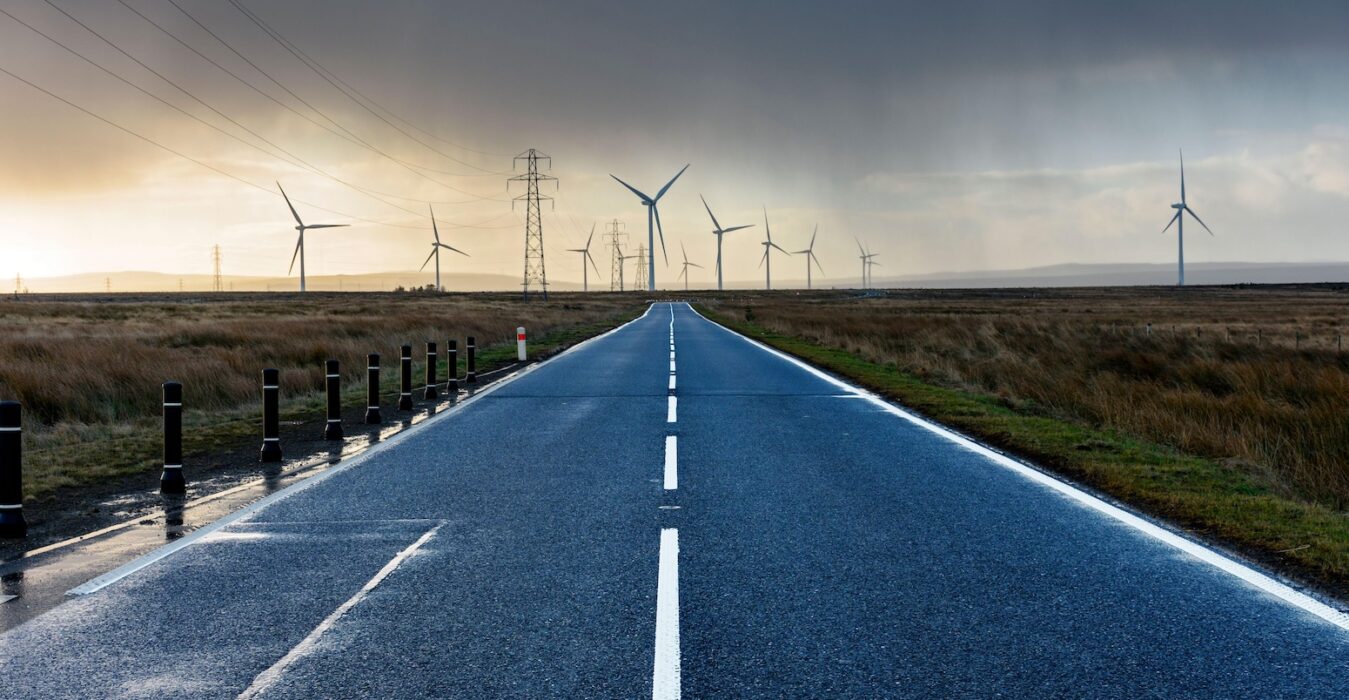
Wind mills along the A9 trunk road in Caithness, Scotland. Credit: Vincent Lowe / Alamy Stock Photo

A scenario that meets the “net-zero by 2050” goal would be the “cheapest” option for the UK, according to modelling by the National Energy System Operator (NESO).

In a new report, the organisation that manages the UK’s energy infrastructure says its “holistic transition” scenario would have the lowest cost over the next 25 years, saving £36bn a year – some 1% of GDP – compared to an alternative scenario that slows climate action.

These savings are from lower fuel costs and reduced climate damages, relative to a scenario where the UK fails to meet its climate goals, known as “falling behind”.

The UK will need to make significant investments to reach net-zero, NESO says, but this would cut fossil-fuel imports, support jobs and boost health, as well as contributing to a safer climate.

Slowing down these efforts would reduce the scale of investments needed, but overall costs would be higher unless the damages from worsening climate change are “ignored”, the report says.

In an illusory world where climate damages do not exist, slowing the UK’s efforts to cut emissions would generate “savings” of £14bn per year on average – some 0.4% of GDP.

NESO says that much of this £14bn could be avoided by reaching net-zero more cheaply and that it includes costs unrelated to climate action, such as a faster rollout of data centres.

Notably, the report appears to include efforts to avoid the widespread misreporting of a previous edition, including in the election manifesto of the hard-right, climate-sceptic Reform UK party.

Overall, NESO warns that, as well as ignoring climate damages, the £14bn figure “does not represent the cost of achieving net-zero” and cannot be compared with comprehensive estimates of this, such as the 0.2% of GDP total from the UK’s Climate Change Committee (CCC).

Net-zero is the ‘cheapest option’

Every year, NESO publishes its “future energy scenarios”, a set of four pathways designed to explore how the nation’s energy system might change over the coming decades.

(Technically the scenarios apply to the island of Great Britain, rather than the whole UK, as Northern Ireland’s electricity system is part of a separate network covering the island of Ireland.)

Published in July, the scenarios test a series of questions, such as what it would mean for the UK to meet its climate goals, whether it is possible to do so while relying heavily on hydrogen and what would happen if the nation was to slow down its efforts to cut emissions.

The scenarios have a broad focus and do not only consider the UK’s climate goals. In addition, they also explore the implications of a rapid growth in electricity demand from data centres, the potential for autonomous driving and many other issues.

With so many questions to explore, the scenarios are not designed to keep costs to a minimum. In fact, NESO does not publish related cost estimates in most years.

This year, however, NESO has published an “economics annex” to the future energy scenarios. It last published a similar exercise in 2020, with the results being widely misreported.

In the new annex, NESO says that the UK currently spends around 10% of GDP on its energy system. This includes investments in new infrastructure and equipment – such as cars, boilers or power plants – as well as fuel, running and maintenance costs.

This figure is expected to decline to around 5% of GDP by 2050 under all four scenarios, NESO says, whether they meet the UK’s net-zero target or not.

For each scenario, the annex adds up the total of all investments and ongoing costs in every year out to 2050. It then adds an estimate of the economic damages from the greenhouse gas emissions that primarily come from burning fossil fuels, using the Treasury’s “green book”.

When all of these costs are taken into account, NESO says that the “cheapest” option is a pathway that meets the UK’s climate goals, including all of the targets on the way to net-zero by 2050.

It says this pathway, known as “holistic transition”, would bring average savings of £36bn per year out to 2050, relative to a pathway where the UK slows its efforts on climate change.

The overall savings, illustrated by the dashed line in the figure below, stem primarily from lower fuel costs (orange bars) and reduced climate damages (white bars).
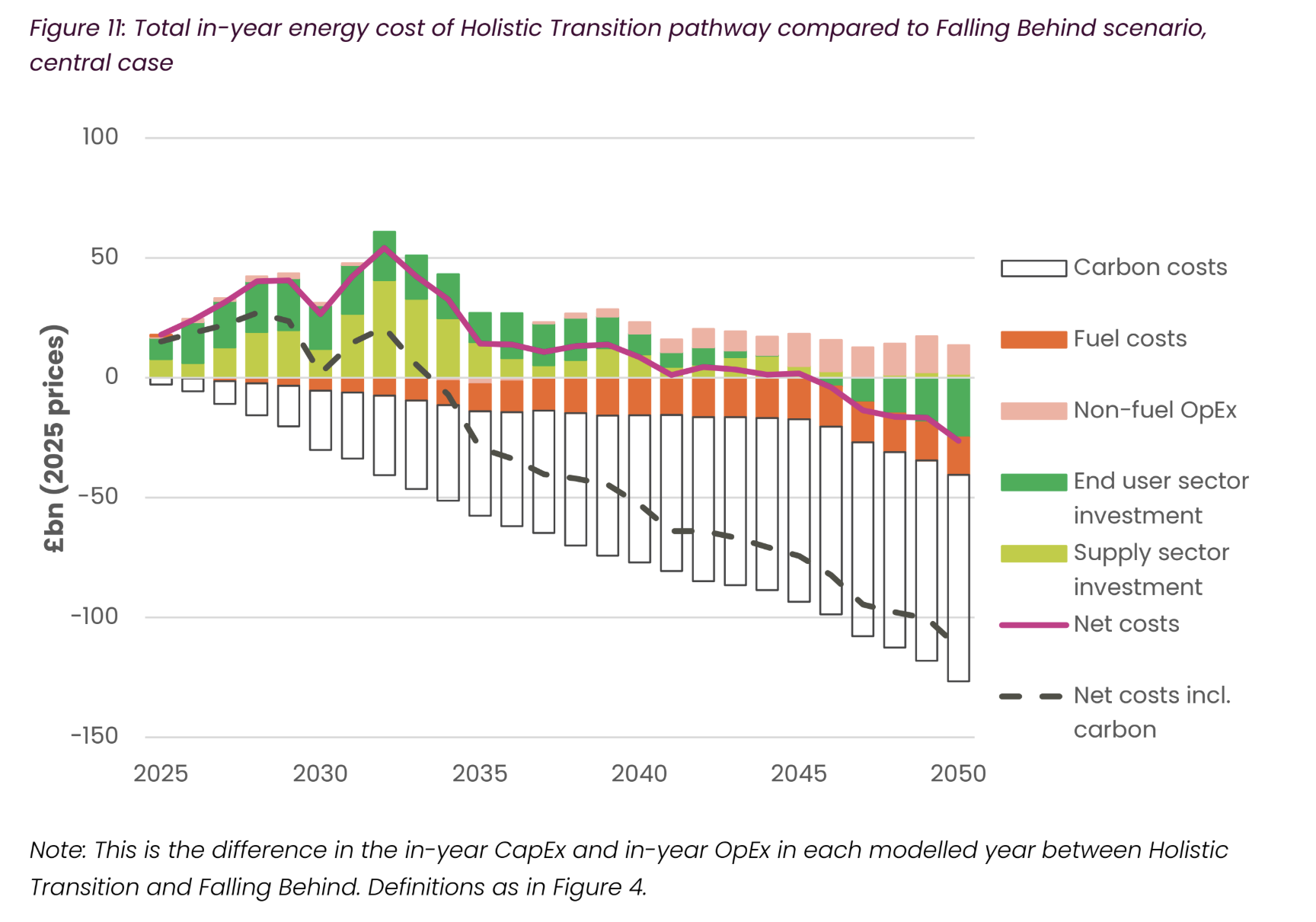
In-year energy costs of the “holistic transition” pathway relative to “falling behind”
In-year energy costs of the “holistic transition” pathway relative to “falling behind”, £bn in 2025 prices and assuming central estimates for future fossil-fuel prices. Credit: NESO.

Note that the carbon pricing that is already applied to power plants and other heavy industry under the UK’s emissions trading system (ETS) is excluded from running costs in the annex, appearing instead within the wider “carbon costs” category. 

This makes the running costs of fossil-fuel energy sources seem cheaper than they really are, when including the ETS price.

Net-zero requires significant investment

While NESO says that its net-zero compliant “holistic transition” pathway is the cheapest option for the UK, it does require significant upfront investments.

The scale of the additional investments needed to stay on track for the UK’s climate goals, beyond a pathway where those targets are not met, is illustrated in the figure below.

This shows that the largest extra investments would need to be made in the power sector, such as by building new windfarms (shown by the dark yellow bars). This is followed by investment needs for homes, such as to install electric heat pumps instead of gas boilers (dark red bars).

These additional investments would amount to around £30bn per year out to 2050, but with a peak of as much as £60bn over the next decade.

These investments would be offset by lower fuel bills, including reduced gas use in homes (pale red) and lower oil use in transport (mid green).

Notably, NESO says it expects EVs to be cheaper to buy than petrol cars from 2027, meaning there are also significant savings in transport capital expenditure (“CapEx”, dark green).

Detailed breakdown of in-year energy costs of the “holistic transition” pathway relative to “falling behind”
Detailed breakdown of in-year energy costs of the “holistic transition” pathway relative to “falling behind”, £bn in 2025 prices and assuming central estimates for future fossil-fuel prices. Credit: NESO.

Again, the biggest savings in “holistic transition” relative to “falling behind” would come from avoided climate damages – described by NESO as “carbon costs”.

Net-zero cuts fossil-fuel imports

In addition to avoided climate damages, NESO says that reaching the UK’s net-zero target would bring wider benefits to the economy, including lower fuel imports.

Specifically, it says that climate efforts would “materially reduce” the UK’s dependency on overseas gas, with imports falling to 78% below current levels by 2050 in “holistic transition”. Under the  “falling behind” scenario, imports rise by 35%”, despite higher domestic production.

This finding, shown in the figure below, is the opposite of what has been argued by many of those that oppose the UK’s net-zero target.

Annual gas imports to the UK
Annual gas imports to the UK, billion cubic metres (bcm) 2024-2050, under different NESO scenarios. Credit: NESO.

NESO goes on to argue that the shift to net-zero would have wider economic benefits. These include a shift from buying imported fossil fuels to investing money domestically instead, which “could bring local economic benefits and support future employment”.

The operator says that there is the “potential for more jobs to be created than lost in the transition to net-zero” and that there would be risks to UK trade if it fails to cut emissions, given exports to the EU – the UK’s main trading partner – would be subject to the bloc’s new carbon border tax.

Beyond the economy, NESO points to studies finding that the transition to net-zero would have other benefits, including for human health and the environment.

It does not attempt to quantify these benefits, but points to analysis from the CCC finding that health benefits alone could be worth £2.4-8.2bn per year by 2050.

Investment is higher for net-zero than for ‘not-zero’

It is clear from the NESO annex that its net-zero compliant “holistic transition” pathway would entail significantly more upfront investment than if climate action is slowed under “falling behind”.

This idea, in effect, is the launchpad for politicians arguing that the UK should walk away from its climate commitments and stop building new low-carbon infrastructure.

As already noted, the NESO analysis shows that this would increase costs to the UK overall.

Still, NESO’s new report adds that “falling behind” would “save” £14bn a year – relative to meeting the UK’s net-zero target – as long as carbon costs are “ignored”.

Specifically, it says that ignoring carbon costs, “holistic transition” would cost an average of £14bn a year more out to 2050 than “falling behind”, which misses the net-zero target. This is equivalent to 0.4% of the UK’s GDP and is illustrated by the solid pink line in the figure below.

In-year energy costs of the “holistic transition” pathway relative to “falling behind”
In-year energy costs of the “holistic transition” pathway relative to “falling behind”, £bn in 2025 prices and assuming central estimates for future fossil-fuel prices. Credit: NESO.

Some politicians are indeed now willing to ignore the problem of climate change and the damages caused by ongoing greenhouse gas emissions. These politicians may therefore be tempted to argue that the UK could “save” £14bn a year by scrapping net-zero.

However, NESO’s report cautions against this, stating explicitly that the “costs discussed here do not represent the cost of achieving net-zero emissions”. It says:

“Our pathways cannot provide firm conclusions over the relative costs attached to the choices between pathways…We reiterate that the costs discussed here do not represent the cost of achieving net-zero emissions.”

It says that the scenarios have not been designed to minimise costs and that it would be possible to reach net-zero more cheaply, for example by focusing more heavily on EVs and renewables instead of hydrogen and nuclear.

Moreover, it says that some of the difference in costs between “holistic transitions” and “falling behind” is unrelated to climate action. Specifically, it says that electricity demand from data centres is around twice as high in “holistic transitions”, adding some £5bn a year in costs in 2050.

In addition, NESO says that most of the “saving” in “falling behind” would be wiped out if fossil fuel prices are higher than expected – falling from £14bn per year to just £5bn a year – even before considering climate damages and wider benefits, such as for health.

Finally, NESO says that failing to make the transition to net-zero would leave the UK more exposed to fossil-fuel price shocks, such as the global energy crisis that added 1.8% to the nation’s energy costs in 2022. It says a similar shock would only cost 0.3% of GDP in 2050 if the country has reached net-zero – as in “holistic transition” – whereas costs would remain high in “falling behind”.

Original article by Simon Evans republished from Carbon Brief under a CC license

Nigel Farage urges you to ignore facts and reality and be a climate science denier like him and his Deputy Richard Tice. He says that Reform UK has received £Millions and £Millions from the fossil fuel industry to promote climate denial and destroy the planet.
Donald Trump urges you to be a Climate Science denier like him. He says that he makes millions and millions for destroying the planet, Burn, Baby, Burn and Flood, Baby, Flood.
Elon Musk urges you to be a Fascist like him, says that you can ignore facts and reality then.
Continue ReadingNet-zero scenario is ‘cheapest option’ for UK, says energy system operator

Yale Historian Warns Trump Is Putting US on Path to World War III

Spread the love

Original article by Brad Reed republished from Common Dreams under Creative Commons (CC BY-NC-ND 3.0).

President Donald Trump stands and salutes troops during the celebration of the Army’s 250th birthday on the National Mall on June 14, 2025 in Washington, DC. (Photo by Doug Mills – Pool/Getty Images)

Historian Greg Grandin argued that Trump’s foreign policy will likely result in “more confrontation, more brinkmanship, more war.”

Yale historian Greg Grandin believes that President Donald Trump’s foreign policy is putting the US on a dangerous course that could lead to a new world war.

Writing in The New York Times on Monday, Grandin argued that the Trump administration seems determined to throw out the US-led international order that has been in place since World War II.

RECOMMENDED…

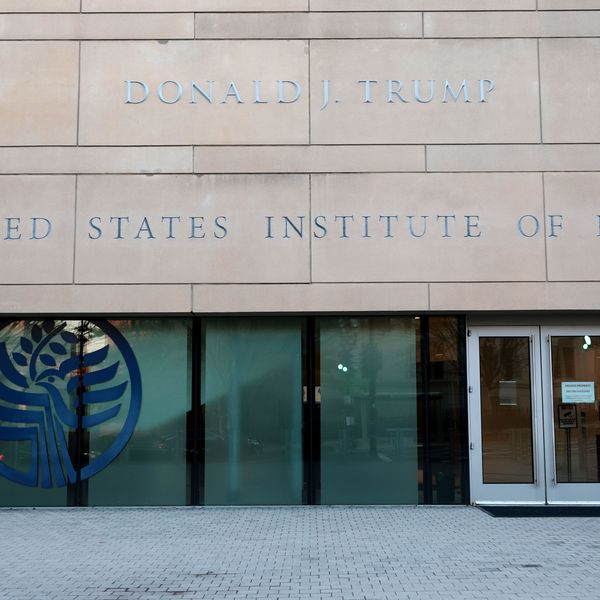
President Donald Trumps Name Added To The US Institute of Peace Building

Genocide Backer and Narcissist Donald J. Trump Puts His Name on ‘US Institute of Peace’

Donald Trump

Trump Says Ground Attack on Venezuela Imminent—Plus Colombia, Mexico Also in US Crosshairs

In its place, Grandin said, is “a vision of the world carved up into garrisoned spheres of competing influence,” in which the US has undisputed control over the Western Hemisphere.

As evidence, he pointed to the Trump White House’s recently published National Security Strategy that called for reviving the so-called Monroe Doctrine that in the past was used to justify US imperial aggression throughout Latin America, and that the Trump administration is using to justify its own military adventures in the region.

Among other things, Grandin said that the Trump administration has been carrying out military strikes against purported drug smuggling boats in the Caribbean and the Pacific Ocean, and has also been “meddling in the internal politics of Brazil, Argentina, and Honduras, issuing scattershot threats against Colombia and Mexico, menacing Cuba and Nicaragua, increasing its influence over the Panama Canal, and seizing an oil tanker off the coast of Venezuela.”

Most ominously, Grandin said, is how the US Department of Defense has been “carrying out a military buildup in the Caribbean that is all but unprecedented in its scale and concentration of firepower, seemingly aimed at effecting regime change in Venezuela.”

A large problem with dividing the globe into spheres controlled by major powers, Grandin continued, is that these powers inevitably come into violent conflict with one another.

Citing past statements and actions by the British Empire, Imperial Japan, and Nazi Germany, Grandin argued that “as the world marched into a second global war, many of its belligerents did so citing the Monroe Doctrine.”

This dynamic is particularly dangerous in the case of Trump, who, according to Grandin, sees Latin America “as a theater of global rivalry, a place to extract resources, secure commodity chains, establish bulwarks of national security, fight the drug war, limit Chinese influence, and end migration.”

The result of this policy shift, Grandin concluded, “will most likely be more confrontation, more brinkmanship, more war.”

Original article by Brad Reed republished from Common Dreams under Creative Commons (CC BY-NC-ND 3.0).

Donald Fuhrump says that Amerikkka doesn't bother with crimes or charges anymore, not being 100% Amerikkkan and opposing his real estate intentions is enough.
Donald Fuhrump says that Amerikkka doesn’t bother with crimes or charges anymore, not being 100% Amerikkkan and opposing his real estate intentions is enough.
Continue ReadingYale Historian Warns Trump Is Putting US on Path to World War III

Petition Signers Want Elon Musk to Be ‘The Richest Man in Town’ This Christmas

Spread the love

Original article by Julia Conley republished from Common Dreams under Creative Commons (CC BY-NC-ND 3.0).

… by giving nearly half of his $500 billion fortune to the children of the world.

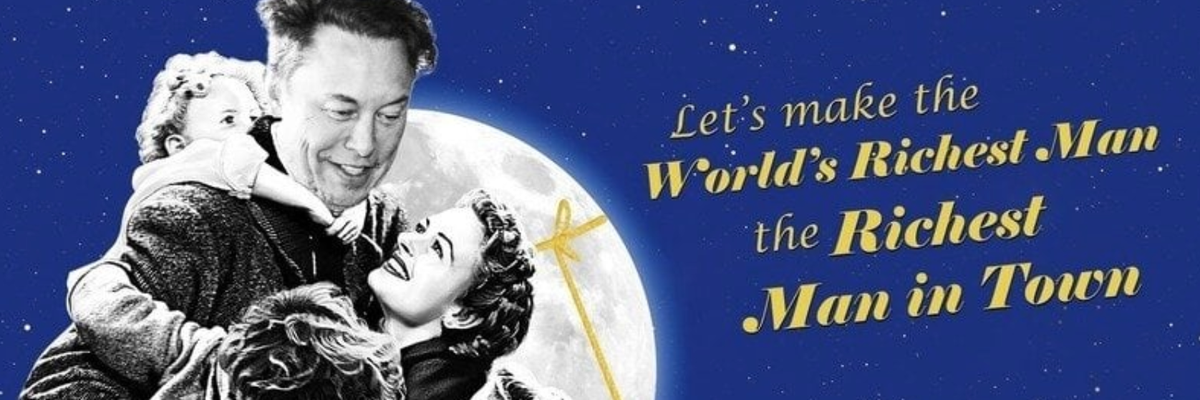
“Let’s make the world’s richest man the richest man in town!” urges a new campaign launched Friday by the economic advocacy group Tax Justice Network, borrowing a memorable line from the classic film “It’s a Wonderful Life.”

The group’s global petition emphasizes that SpaceX owner Elon Musk is already the richest person in the world, with a net worth of $508.4 billion—more than double the assets of the planet’s next-richest person, Google co-founder Larry Page.

RECOMMENDED…

The Inauguration Of Donald J. Trump As The 47th President

‘We Must Overturn Citizens United,’ Says Sanders as Analysis Details Billionaire Takeover of US Politics

President Donald Trump Makes An Announcement From The White House

Global System ‘Rigged for the Wealthy’ Delivers World With ‘More Billionaires Than Ever’

Tax Justice Network’s (TJN) petition invites Musk to give 44% of his wealth—$223.6 billion—to the children of the world. That amount of money would allow the purchase of a $90 gift card for all 2.4 billion of the planet’s children under the age of 18, and could stop more than 100 million children from going hungry this holiday season.

And Musk would still be the richest person alive, emphasized the group.

Let’s make the world’s richest man feel like the richest man in town this Christmas! Sign our Christmas card inviting Elon Musk to gift 44% of his wealth to the children of the world to create 2 billion smiles and still be the world’s richest man alive! #WealthTax #TaxTheSuperRichc.org/jnnZhmp6J4

Tax Justice Network (@taxjustice.net) 2025-12-12T15:39:55.927Z

The campaign quotes Harry Bailey’s famous line declaring his brother George Bailey, played by Jimmy Stewart, “the richest man in town” in “It’s a Wonderful Life,” after George’s neighbors donate money to save him from financial ruin.

“We’re obviously poking a little fun here but the point is to show how extreme the concentration of wealth has become,” said Alex Cobham, chief executive at TJN. “Depending on where you are in the world, if you earn the average wage, you’d need to work anywhere from 20 times to a thousand times longer than humans have existed to earn as much wealth as Elon Musk has collected.”

The petition notes that TJN and the world’s children “would also settle for a 2% wealth tax on the superrich,” which would allow countries around the world to raise $2 trillion per year if it was applied to the richest 0.5% of people on the planet.

“That’s enough public money to meet most countries’ climate finance needs, and leave billions to spare for local public services,” the group said.

The group pointed to a recent G20 report declaring a global “inequality emergency” and last week’s World Inequality Report, which found that fewer than 60,000 multimillionaires—just 0.001% of the world’s population—own three times more wealth than the entire bottom 50% of humanity.

“Within almost every region, the top 1% alone hold more wealth than the bottom 90% combined,” noted TJN.

The petition emphasizes the difference between collected wealth—the kind enjoyed by Musk and other superrich people—and earned wealth. The vast majority of people earn money for what they do, notes TJN. Musk and other billionaires “get paid for what [they] own, so dividends for owning stocks and rent money for owning real estate.”

Billionaires including Musk, Meta CEO Mark Zuckerberg, and Oracle executive Larry Ellison famously take salaries of just $1, but the money that’s made them part of the world’s superrich is their collected wealth, emphasized TJN.

“Earned wealth cannot create billionaires,” said TJN. “Only collected wealth grows fast enough to do so. It’s impossible to earn a billion dollars.”

ProPublica report in 2021 detailed how billionaires like Musk and Amazon founder Jeff Bezos paid a collective “true tax rate” of just 3.4% while the median American household made $70,000 and paid a tax rate of 14%.

“This special tax treatment has helped the superrich quadruple their wealth since the 1980s to extreme levels,” said TJN. “Studies directly link this rise in extreme wealth to lower economic productivity, to more households going into debt and to people living shorter lives.”

Musk in the past has pledged to use his extreme wealth to help people around the world—only to renege on his promises. In 2022, he challenged then-World Food Program chief David Beasley to prove, as Beasley had stated, that a small fraction of Musk’s wealth could help address world hunger. He pledged to donate $6 billion by selling his Tesla stock if the WFP could prove the contribution would “solve world hunger.”

The WFP responded with a report detailing how $6 billion could feed 42 million at-risk people and prevent them from going hungry for a year. But Musk didn’t follow through with his pledge, instead donating $5.7 billion of his Tesla shares to his own foundation.

This year, Musk spearheaded a push to slash government spending on foreign aid, with the US Agency for International Development a key target. The cuts have already proven deadly for children in impoverished nations.

Cobham on Monday pointed to research showing that the skyrocketing wealth of the richest 1% of Americans over the past 40 years has not led “to more investments, and instead resulted in dissaving among non-rich households.”

“We now have plenty of evidence showing that extreme wealth shrinks economies, makes people poorer, and threatens democracy,” said Cobham. “The best way to protect people, economies, and planet from the harms of extreme wealth is to end the special tax treatment that collected wealth gets over earned wealth. We must tax extreme wealth more effectively to protect the earner way of life we all rely on. Whether you’re a wealth collector or a wealth earner, we all have an equal responsibility to pitch in our fair share.”

Original article by Julia Conley republished from Common Dreams under Creative Commons (CC BY-NC-ND 3.0).

Orcas discuss Donald Trump and the killer apes' concept of democracy. Front Orca warns that Trump is crashing his country's economy and that everything he does he does for the fantastically wealthy.
Orcas discuss Donald Trump and the killer apes’ concept of democracy. Front Orca warns that Trump is crashing his country’s economy and that everything he does he does for the fantastically wealthy.
Continue ReadingPetition Signers Want Elon Musk to Be ‘The Richest Man in Town’ This Christmas

‘Total Amateur Hour’: FBI Official Says Antifa Is #1 Threat in US—But Can’t Say Where, Who, or What It Is

Spread the love

Original article by Brad Reed republished from Common Dreams under Creative Commons (CC BY-NC-ND 3.0). 

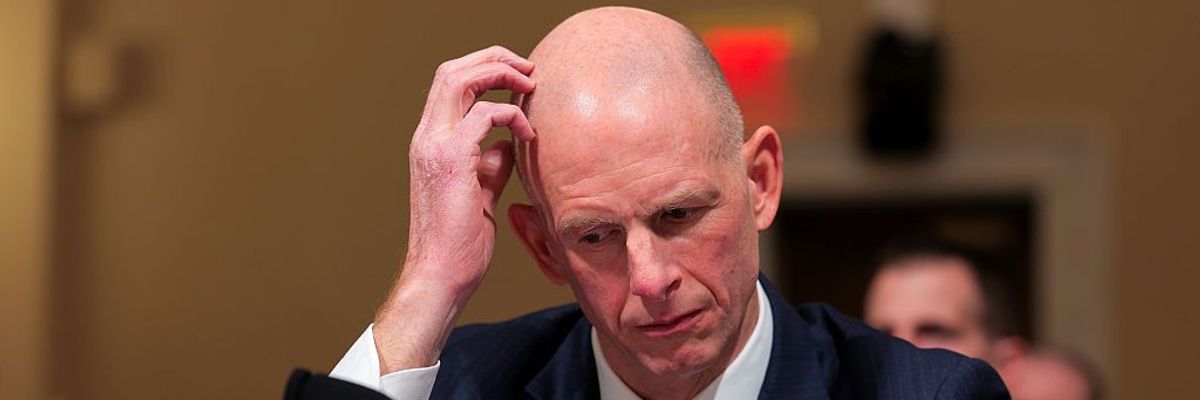
Operations Director of the National Security Branch at the Federal Bureau of Investigation Michael Glasheen testifies before the House Committee on Homeland Security on December 11, 2025 in Washington, DC. (Photo by Anna Moneymaker/Getty Images)

“Just a complete admission here that the entire ‘antifa’ threat narrative is totally manufactured by this administration,” said one critic.

A top FBI official struggled on Thursday to answer basic questions about antifa, a loosely organized collective of anti-fascist activists that he labeled the top terrorist threat facing the US.

Michael Glasheen, operations director of the FBI’s National Security Branch, testified before the US House Committee on Homeland Security that antifa was “the most immediate violent threat” facing Americans today when it comes to domestic terrorism.

RECOMMENDED…

Leaked Memo Shows Pam Bondi Wants List of 'Domestic Terrorism' Groups Who Express 'Anti-American Sentiment'

Leaked Memo Shows Pam Bondi Wants List of ‘Domestic Terrorism’ Groups Who Express ‘Anti-American Sentiment’

Defiant Democrats Slam Trump 'Intimidation' After FBI Seeks Interviews Over 'Illegal Orders' Video

Defiant Democrats Slam Trump ‘Intimidation’ After FBI Seeks Interviews Over ‘Illegal Orders’ Video

But when Rep. Bennie Thompson (D-Miss.), ranking member of the Homeland Security Committee, asked Glasheen for specifics about this purportedly dire threat, he mostly came up empty.

“So where is antifa headquarters?” Thompson asked him.

Glasheen paused for several seconds and then said, “What we’re doing right now with the organization…” before Thompson interrupted him.

“Where in the United States does antifa exist?” asked Thompson.

“We are building out the infrastructure right now,” Glasheen replied.

“So what does that mean?” asked a bewildered Thompson. “I’m just, we’re trying to get information. You said antifa is a terrorist organization. Tell us, as a committee, how did you come to that? Whether they exist, how many members do they have in the United States as of right now?”

“Well, that’s very fluid,” Glasheen said. “It’s ongoing for us to understand that… no different from al-Qaeda and ISIS.”

Thompson again interrupted and tried to make Glasheen answer his original question.

“If you said antifa is the No. 1 domestic terrorist organization operating in the United States,” he said, “I just need to know where they are, how many people. I don’t want a name, I don’t want anything like that. Just, how many people have you identified, with the FBI, that antifa is made of?”

“Well, the investigations are active…” Glasheen said.

Thompson then became incredulous.

“Sir, you wouldn’t come to this committee and say something you can’t prove,” he said. “I know you wouldn’t do that. But you did.”

Many observers were stunned that Glasheen appeared to know so little about what he proclaimed to be the top domestic terrorist threat facing the US.

“Total amateur hour in US law enforcement,” remarked Democracy Docket news editor Matthew Kupfer, “where the No. 1 terror threat is an organization that does not formally exist and a career FBI official is dancing around before a congressional committee trying to make the Trump strategy sound legit.”

Zeteo editor-in-chief Mehdi Hasan argued that Glasheen’s testimony was proof that the administration was simply concocting domestic terrorism threats with zero basis in reality.

“Wow,” Hasan marveled. “Just a complete admission here that the entire ‘antifa’ threat narrative is totally manufactured by this administration.”

Fred Wellman, a Democratic congressional candidate in Missouri, wondered how many actual dangerous criminals are running free while the FBI focuses on taking down an organization that it apparently knows nothing about.

“This would be comical if there wasn’t real world impact from this idiocy,” Wellman wrote. “We have real crimes and real threats and they are chasing a fake ‘organization’ for politics.”

Democrats on the House Homeland Security Committee also piled on Glasheen, citing his testimony as evidence that the Trump administration is completely unserious about law enforcement.

“If your ‘top threat’ has no headquarters, no organization, and no definition then it’s not a top threat,” they posted on social media. “The Trump administration is ignoring real threats, and the American people see right through it.”

Original article by Brad Reed republished from Common Dreams under Creative Commons (CC BY-NC-ND 3.0). 

Continue Reading‘Total Amateur Hour’: FBI Official Says Antifa Is #1 Threat in US—But Can’t Say Where, Who, or What It Is

Morning Star Editorial: Robinson’s ‘Christianity’ reflects US leadership of the global far right

Spread the love

https://morningstaronline.co.uk/article/robinsons-christianity-reflects-us-leadership-global-far-right

 Tommy Robinson, whose real name is Stephen Yaxley-Lennon arrives at Westminster Magistrates’ Court, London, November 4, 2025

ANTI-RACISTS, many of them Christians, will challenge far-right agitator “Tommy Robinson” over his attempt to identify Christianity with his message of hatred this weekend.

Robinson (real name Stephen Yaxley-Lennon) hosting a carol service is a surreal contrast to his normal routine of bigoted rants and spontaneous punch-ups.

He supposedly found God while in prison for contempt of court for repeating false claims against a Syrian refugee, though he hasn’t shown much contrition for his violation of the Ninth Commandment since. Indeed this is hardly a Damascene conversion given Robinson’s priorities (railing against immigrants and Muslims) seem exactly the same as before.

The recent emergence of Christian nationalism in Britain may have less to do with Robinson’s spiritual journey than with the influence of Donald Trump’s United States over the global far right.

Robinson is always acutely alert to where the money is and the US Christian right is awash with it. We also know, from the White House’s new national security strategy, that it hopes to reshape Europe in its own image.

It declares Europe at risk of “civilisational erasure” from immigration, commits itself to “help Europe correct its current trajectory” and identifies the “the growing influence of patriotic European parties” as the means to do so.

This is a potentially huge boost to the far right in countries like Britain. But it can be turned into a weakness.

A boost, because resources matter.

Robinson has already had legal fees paid by the world’s richest man, Elon Musk, who addressed the huge far-right demonstration held in London in September.

Their movement will have access to enormous funds, enabling effective propaganda operations and paid organisers.

It’s backed by the most powerful country on Earth — something we saw hints of in the succession of far-right figures hosted by US Vice-President JD Vance on a so-called holiday in England last summer, under the very noses of the supposedly allied British government he was working to undermine.

A factor which again benefits the far right: the liberal Establishment cannot conceive of a breach with Washington, and continues to lick the boots that are kicking it in the ribs. Most recently with a craven surrender to US demands over NHS drug pricing, which will raise the cost of medicine and cost British lives.

But that’s why the apparent asset of being a US asset can be turned against the insurgent right.

Robinson is not the only recipient of US largesse. Nigel Farage’s Reform UK is also linked to the US “Maga” movement (he has received free services from the PR firm Capital HQ, linked to Steve Bannon, and is notorious for his frequent transatlantic trips).

Its economic priorities, in particular an acceleration of healthcare privatisation by proposing vouchers allowing access to private providers, align with the US aim — openly avowed in documents like Project 2025 — of turning the NHS into a cash cow for US companies.

We should expose the foreign money behind these so-called “patriotic” movements — and the similarity between the far right’s fixation with privatisation and deregulation with that of Tory and Labour governments. The flood of ex-Tories joining Reform do so because it is a Tory party: it is not “anti-Establishment” at all.

And our message in calling out Robinson’s perversion of the Christian spirit needs to look beyond him to the normalisation of cruelty in the political mainstream.

At Christmas Christians celebrate the birth of Jesus of Nazareth, born in a stable, child refugee from King Herod, who urged his followers to feed the hungry, clothe the naked, welcome the stranger and visit the prisoner.

That message damns a government that cuts benefits, hounds asylum-seekers and is ready to let eight brave hunger-strikers, some jailed for over a year already though none have faced trial, starve to death rather than address the injustice it has done them.

https://morningstaronline.co.uk/article/robinsons-christianity-reflects-us-leadership-global-far-right

Elon Musk urges you to be a Fascist like him, says that you can ignore facts and reality then.
Orcas discuss how Trump was re-elected and him being an obviously insane, xenophobic Fascist.
Continue ReadingMorning Star Editorial: Robinson’s ‘Christianity’ reflects US leadership of the global far right