Your Party MP Zarah Sultana addresses the Village Hotel picket, December 19, 2025
YOUR PARTY MP Zarah Sultana and dozens of trade unionists braved the wind and rain to join striking workers on the Village Hotel picket in Govan on Thursday night.
Workers at the site made history over the summer with the first strike at a major hotel chain since 1979, winning equal pay with colleagues in Edinburgh.
But they returned to the picket line last month in a bid to win a minimum of the real living wage for all workers, regardless of age.
Unite convener Daniel Friel told the rally: “Village are more than happy to spend lots of money throughout this dispute bussing up workers from across the UK to cover the work that we would have been doing.
“This is hugely expensive for them, it’s a lot more expensive than it would be just to pay us equally at the new living wage, but they would rather do that because it avoids, from their perspective, a dangerous precedent.
“They know that as soon as we get it in Glasgow, we’re going to move across other sites in the UK.”
On Nov. 14, Nestlé Zimbabwe workers, led by UFAWUZ, staged a peaceful picket demanding living wages and an end to unfair labor practices. The action follows a protracted wage dispute in which Nestlé refused to increase wages.
Members of the United Food and Allied Workers Union of Zimbabwe (UFAWUZ) staged a picket at Nestlé Zimbabwe, demanding an end to unfair labor practices, restoration of decent wages, job security, and respect for workers’ rights.
According to UFAWUZ Secretary General Ady Mutero, the union was compelled to organize the picket after Nestlé, despite being chair of the Employers Association in the Food and Processing Industry, refused to grant any wage increase following a deadlock at the National Employment Council (NEC). Instead of championing fair wage discussions or proceeding to arbitration, Nestlé “obstructed both processes,” Mutero explained. This left workers without a wage agreement for the June–December period, effectively freezing them on poverty-level salaries. Under Section 74(6) of the Labour Act, workers are legally permitted to picket under such circumstances, leading to yesterday’s action.
Unfair labor practices inside the factory
Mutero calls out a series of unfair labor practices that workers have faced inside the factory. These include:
Refusal to award any wage increases, even after formal requests from both the Workers’ Committee and the union.
Violation of Nestlé’s own global Employer Relations Policy, which obligates all subsidiaries to align wages with each country’s Poverty Datum Line (PDL).
Use of labor brokers to hire workers on hourly rates below those agreed at the NEC, undermining sector standards.
Intentional wage suppression, even as senior management receives hefty salaries and corporate perks.
“These actions undermine both workers’ rights and Nestlé’s internationally accepted employment values,” Mutero noted, saying that the company’s local behavior sharply contradicts its global commitments to decent work.
Longstanding grievances, exhausted dialogue
The union’s grievances are not new, they have persisted throughout this year’s wage negotiation cycle, especially after the NEC wage talks collapsed earlier. Before calling for industrial action, UFAWUZ took several steps:
Participated in NEC wage negotiations for the sector.
Formally requested an internal wage adjustment, which the Labour Act allows even when NEC processes are stalled.
Urged Nestlé to respect its own global policy by ensuring wages align with the national PDL.
Pursued social dialogue, calling on Nestlé to lead by example as the sector’s most powerful employer.
“All these good-faith efforts were rejected,” Mutero said. “Industrial action became the last resort.”
Wages far below the poverty datum line
The wage crisis at Nestlé Zimbabwe is severe. The lowest-paid workers currently earn USD 250 per month, while the national PDL for a family of four stands at USD 650. This means Nestlé pays less than 40% of the living wage required, leaving workers USD 400 short every month.
Mutero highlighted the disparity: workers in the detergents sector, performing equivalent grades, earn USD 400, demonstrating that Nestlé is lagging far behind comparable industries despite commanding a strong global brand and significant local market share.
Inflation and the crisis of survival
Zimbabwe’s persistent inflation and soaring cost of living have eroded workers’ purchasing power to the point of survival crisis. At USD 250, workers cannot meet basic expenses, including food, transport, healthcare, or school fees. Families are forced into debt, informal side hustles, and other coping strategies that remain unsustainable.
“For employees of a multinational like Nestlé, the contradiction between corporate profits and workers’ daily struggles is stark and unjustifiable,” Mutero stressed.
A wider fight against exploitation
Mutero placed the workers’ struggle within a much broader African context. According to him, Nestlé’s actions reflect a pattern in which multinational corporations operating in Africa maximize profits while refusing to pay living wages.
“From Zimbabwe to the rest of the continent, neoliberal practices, outsourcing through labor brokers, wage suppression, and ignoring corporate social responsibility, have become entrenched,” he said. UFAWUZ therefore views the Nestlé picket as part of a wider continental resistance against exploitative corporate behavior.
By standing firm, the union hopes to push African governments, employers, and multinational corporations to uphold fair labor standards, respect workers’ rights, and ensure that economic growth benefits the very workers who create the wealth.
Organizers hold flags and a photo of labor martyr Febe Elizabeth Velasquéz during a press conference on the commemoration of the Day of the Salvadoran Trade Unionist. Photo: BRRP/X
The October 31 commemoration links past revolutionary struggles with today’s fight for labor rights and democracy
October 31 in El Salvador is recognized as the Day of the Salvadoran Trade Unionist.
This year’s commemoration event brought together veteran organizers and a new generation of grassroots leaders, bridging past and present struggles for workers’ rights and social change.
“This date brings us back to the origin of labor organizing in our country,” asserted Marisela Ramírez, a leader of the Popular Resistance and Rebellion Bloc, at the rally at Cuscatlán Park in San Salvador, organized by the group.
“We remember with dignity, the history of struggle, resistance, and sacrifice, of the labor movement in El Salvador.”
A few hundred people gathered with placards, flags, and banners representing various organizations, like the Salvadoran Social and Labor Front (FSS), the Permanent Roundtable for Labor Justice, the Movement of Victims of the Regime (MOVIR), and others.
Ramírez outlined the legacy that the day is tied to: the historic strikes of the 40s and 50s, the struggles for the 8-hour workday, for fair wages, and for the right to unionize. The event also paid tribute to “the thousands of women and men who, during the repression of the 70s and 80s, sacrificed their lives to defend justice and the dignity of the working class” against the US-backed Salvadoran government.
The Day of the Salvadoran Trade Unionist was established by Legislative Decree 589 (1990). It specifically honors the leaders of the National Union Federation of Salvadoran Workers (FENASTRAS) that were bombed by government forces on October 31, 1989.
Friday’s commemoration paid homage to prominent labor figure Febe Elizabeth Velasquéz and the nine other leaders martyred in the attack on the country’s principal organized labor front at the time.
A legacy of revolutionary struggle
The country’s trade groups have a long history of tying labor organizing to social change. These connections can be traced back to the formation of the Communist Party in 1930. Similarly, many of the 1989 FENASTRAS martyrs were affiliated with the National Unity of Salvadoran Workers (UNTS), the main federation tied to the popular movement aligned with the left guerilla force, the Farabundo Martí National Liberation Front (FMLN).
Legislative Decree 589 (1990) came two years before the 1992 Peace Accords, which officially ended the 12-year war between the FMLN (Farabundo Martí National Liberation Front) and the US-backed Salvadoran state.
By 1990, faced with continued armed opposition and a popular movement (made up of unions, student groups, and peasant associations) that had endured heavy repression, the Salvadoran government was under tremendous pressure to negotiate and recognize the legitimacy of the country’s social movements.
The deadly attack on FENASTRAS’ headquarters was a major factor in this outcome. Less than two weeks after the massacre, the FMLN would launch their historic final offensive, named in honor of the martyred union leader: “To the Limit, Period. Febe Elizabeth Lives”.
The Salvadoran military responded with intense fighting and indiscriminate aerial bombardment of residential neighborhoods, allegedly to dislodge the guerilla fighters. One US-trained Atlacatl Battalion unit stormed the Central American University (UCA) campus and murdered six Jesuit priests. The priests were known to advocate for a negotiated settlement to the conflict and spoke out against the military’s human rights abuses. The government and military claimed they were the “brain of the guerilla”.
International condemnation of the Salvadoran government grew louder than ever.
The FMLN was ultimately forced to retreat from the cities, but not before making it clear that a decisive military victory for the government was impossible. Negotiations became inevitable.
Decree 589 (1990) represented one of the first concessions by the state. It opened democratic space and acknowledged the sacrifices of trade unionists persecuted, imprisoned, or killed over the previous decade for their association with the revolutionary left. The FENASTRAS bombing and the martyrdom of Febe Elizabeth Velásquez was etched in history as the Day of the Salvadoran Trade Unionist.
Following these events, the power of the revolutionary movement and organized labor in El Salvador would completely restructure politics in the country through key democratic reforms signed into law in the 1992 Peace Accords.
Historical continuity and labor setbacks under Bukele
At the rally at Cuscatlán Park, the Bloc emphasized that this day is not only about remembrance, but also historical continuity: “the defense of labor rights today is part of the same battle for social justice that those martyrs defended with their lives,” Marisela Ramírez proclaimed.
The event’s organizers asserted that today, the Salvadoran trade unionist faces a new wave of “persecution and criminalization” by the “authoritarian regime of Nayib Bukele”.
“This regime has imposed a neoliberal and anti-union model that intends to eliminate all forms of independent organizing that defends labor rights,” says the Bloc leader.
The group has consistently denounced a systematic weakening of union structures by the Bukele regime. They claim that recently, dozens of union members have suffered arbitrary arrests, threats, and terminations without justification. Over 200 unions have been denied credentials.
Despite the increasing attacks, Ramírez tells Peoples Dispatch that the historic spirit of resistance in the Salvadoran labor movement is still alive.
“Just as before, today we see unionism as a collective and solidarity-based struggle, not only for economic improvements, but also for social transformation and justice,” she says.
Several Palestine flags were visible throughout the crowd, as well as placards that read “Respect our rights!” and “Freedom for political prisoners!” Some had photos of young men imprisoned or disappeared, asserting their innocence. Several placards displayed the image of Febe Elizabeth Velasquéz. Others, the image of Óscar Romero, the Archbishop of San Salvador, assassinated by government forces in 1980 after calling on the soldiers to disobey their orders amid escalating violence and massacres of civilians.
Commemoration event for the Day of the Salvadoran Trade Unionist. Photo: BRRP
“The impunity of yesterday is the impunity of today,” she declared.
“The only way to resist the impunity, the social injustice that we’re living under is through social struggle. We have to continue taking the streets and raising our voices.”
Rebuilding the labor movement in Bukele’s El Salvador
Ramírez says that what is lacking in the Salvadoran left is a political instrument that can “capture the discontent of the popular sectors and channel their demands towards a strategic commitment to social transformation.”
Amid Bukele’s “state of exception”, the challenge the new generation faces, she argues, is that of rebuilding and revitalizing Salvadoran trade unionism. Not just the infrastructure itself but the values and culture of historic movements. The new generation must promote “the active participation of women and young people in a process of organizational and ethical renewal that can re-articulate the labor struggles with broader social causes,” Ramírez says.
The Popular Resistance and Rebellion Bloc recently held a mass march on September 15, El Salvador’s Independence Day. It mobilized its various affiliated organizations, trade unions, civil society groups, and the general public against the human rights violations of the Bukele government.
September 15 mass march in El Salvador. Photo: BRRP
A new generation may be doing just that: revitalizing the historic struggles of the Central American country.
As resistance grows once again, organizers across generations maintain that commemorations like the Day of the Salvadoran Trade Unionist are crucial in giving shape, identity, and historical memory to the social movements of today.
The labor leaders targeted in the October 31, 1989 FRENASTRAS bombing are the following:
Febe Elizabeth Velásquez – General Secretary of FENASTRAS and member of the National Unity of Workers (UNTS); killed.
Ricardo Humberto Cestoni – Recording Secretary of the ANDA Workers’ Company Union (SETA); killed.
Rosa Hilda Saravia de Elías – Member of the Union of Workers of the Cotton, Synthetic, Textile Finishing and Related Industries (STITAS); killed.
Julia Tatiana Mendoza Aguirre – Member of the Gastronomic Union (STITGASC); killed.
Vicente Melgar – Secretary of Social Assistance of SETA; killed.
José Daniel López Meléndez – Member of SETA and Secretary of Conflicts of FENASTRAS; killed.
Luis Gerardo Vásquez – Member of the General Union of Bank Employees (SIGEBAN); killed.
María Magdalena Sánchez – FENASTRAS member; killed.
Carmen Hernández – FENASTRAS member; killed
Unidentified male worker – Died later from injuries sustained in the explosion
Luigi Borrelli during an action against arms tranfers via civilian transport hubs. Source: USB
Workers and activists rally in Brescia against company retaliation targeting trade unionist who resisted arms transfers through civilian airport
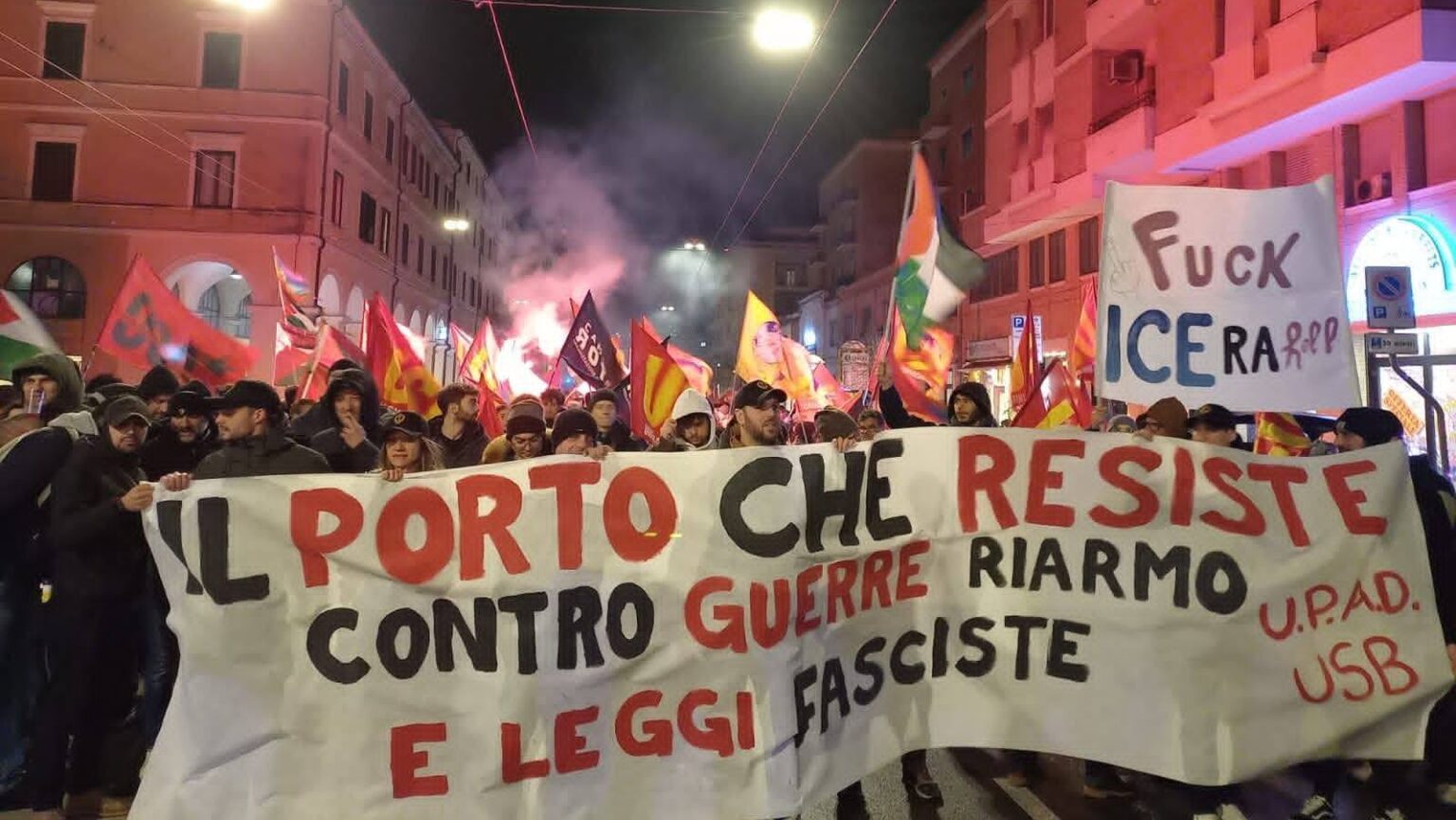
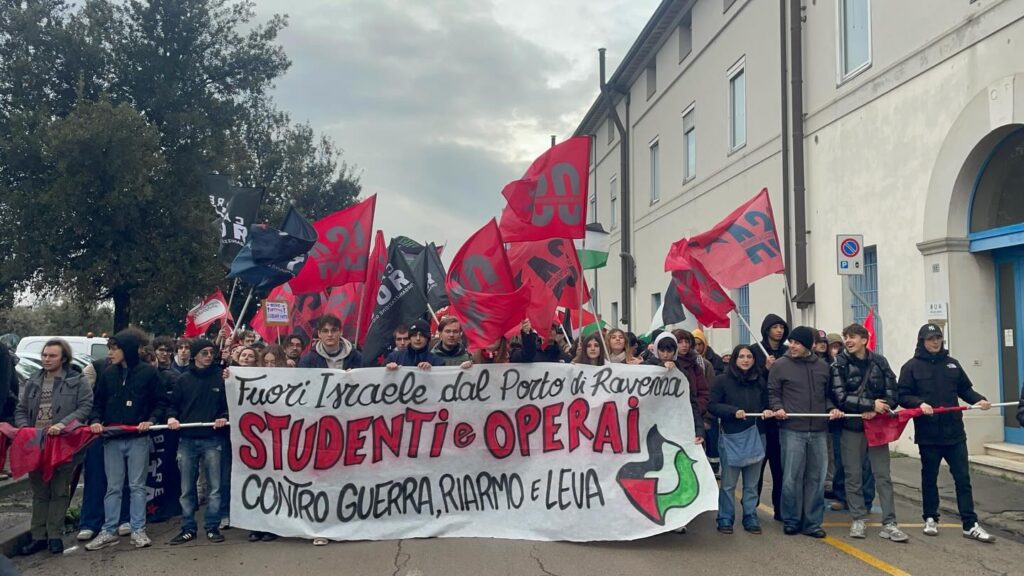
Workers from the trade union Unione Sindacale di Base (USB) and other anti-armament activists are protesting today in Brescia, Lombardy, against attempts to intimidate trade unionists who speak out and take action against the use of civilian transport hubs for arms deliveries. Ahead of the protest, USB’s Dario Filippini told Peoples Dispatch that the union expects a diverse range of groups to join the mobilization, building on a protest organized in June against an arms shipment via Montichiari Airport in Brescia.
At that time, long-time airport employee and trade unionist Luigi Borrelli raised concerns about the possible transfer of military goods through the airport, which, as Filippini points out, is intended for the transport of cargo such as mail, medicine, and food. Borrelli’s warning triggered an organized response and ultimately led to the cancellation of the flight. However, the airport operator, GDA Handling, retaliated by threatening Borrelli with dismissal for allegedly breaching confidentiality and “loyalty to the company.”
Filippini notes that this is not the first time GDA Handling has targeted Borrelli over his opposition to the airport’s apparent covert role in transporting military cargo. Since at least mid-2024, when he began raising concerns about suspicious packages moving through Montichiari, Borrelli has faced suspensions and fines – measures seemingly aimed at silencing him and deterring others.
“The obvious goal is to prevent any scrutiny of the repeated use of the airport for operations related to weapons deliveries to active war zones,” USB stated.
Nevertheless, trade unions and other organizations argue that Borrelli’s actions are legally sound and morally justified. The Italian Constitution clearly states that the Republic “repudiates war,” which raises questions about the legitimacy of transporting arms to countries engaged in conflict. There are also practical implications for workers, Filippini points out: “If you’ve been hired to handle mail or food, why should you suddenly be expected to handle weapons?” he asks. “If arms have to be handled in the first place, wouldn’t soldiers be better placed to do that?” he adds, noting the proximity of Ghedi Air Base.
In several cases across Europe, workers have refused to handle military shipments destined for Israel during its ongoing genocide in Gaza, including over health and safety concerns. As an elected workers’ representative, Borrelli echoed similar concerns when he publicly denounced military transports through Montichiari. But this appears to matter little to Italian authorities or airport management.
Instead, broader efforts to discredit and constrain workers taking industrial action against the arms trade have emerged. Some official interpretations have even said arms were “essential goods,” thereby potentially limiting workers’ ability to legally strike over such shipments. Giorgio Cremaschi of the left political party Potere al Popolo described this as a form of militarization of labor, where “workers at ports, railways, airports, and throughout logistics become de facto soldiers, carriers of arms.”
USB and Potere al Popolo have called for resistance to these efforts and for the protection of workers’ rights – both to strike and to speak out against war. “We are convinced that strike, disobedience, collective action, and individual refusal by working men and women can be the most effective forms of nonviolent resistance,” reads a statement issued by dozens of trade unionists, legal scholars, and academics ahead of the protest in Brescia. “Such actions can stop the warmongers and the madness of rearmament, allowing the Republic, founded on labor, to repudiate war and consign it to history.”
“This is about going beyond the slogan ‘not in my name’ and declaring through concrete acts: ‘not with my hands, not with my knowledge, not with my labor,’” the statement adds.
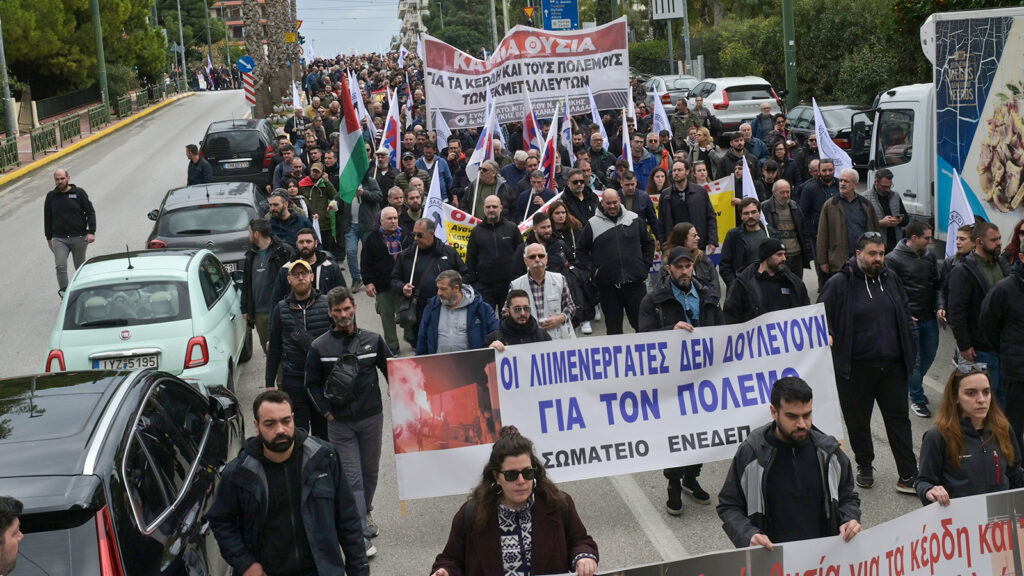
Reflecting this approach, the mobilizations in Brescia are contributing to a growing movement among transport and logistics workers in the region who are standing up against Europe’s armament agenda, Filippini says. These efforts have earned solidarity from workers’ organizations abroad. Among them is Greece’s All-Workers Militant Front (PAME), which stated: “The persecution and the threat of dismissal against trade unionist Luigi Borrelli is an attack on the unions that resist the plans and the wars of the imperialist, that fight for peace between peoples.”
As solidarity with Borrelli continues, USB and its allies remain committed to expanding the campaign against the arms trade and defending workers’ right to conscientiously object to participating in weapons transfers. “Wars should be boycotted,” Potere al Popolo wrote in a statement of support. “Blocking arms shipments is not only legitimate: it is an act of justice and democracy.”
Sharon Graham speaks at the Durham Miners’ Gala, July 13, 2025
Durham Miners’ Gala 2025
UNITE will forge an “authentic voice for the working class” if it votes to disaffiliate from Labour for attacking striking Birmingham bin workers, general secretary Sharon Graham has told the 139th Durham Miners’ Gala.
Deputy Prime Minister Angela Rayner’s name was booed by the crowd as Ms Graham chanted “shame on you” over her handling of the long-running strikes, as former Labour leader Jeremy Corbyn said that he agreed with her “absolutely.”
Delegates at Labour’s biggest union backer voted to rethink their relationship with the party and suspend Ms Rayner at their policy conference last week.
…
The Unite conference also called for the recognition of the state of Palestine and vowed to support “worker-led campaigns to boycott the handling of Israeli goods and services in their workplaces and campaigns for divestment from Israeli companies in their workplaces and the wider economy.”
Mr Corbyn hailed the decision as “historically important because we will stop the supply of weapons to the Israeli Defence Forces to kill people in Gaza.”
…
Following attacks from Durham Reform councillors over not being invited to the gala’s platform, Durham Miners’ Association chairman Stephen Guy told the Morning Star that the local Labour MP and Israel supporter Luke Akehurst wasn’t invited either.
“The message is the same, whether you are Labour or Reform, if you don’t share our values or beliefs you don’t get an invite. We have Labour MPs here today on the platform and they’ve been selected because they share our values,” he said.
Nigel Farage explains the politics of Reform UK: Racism, Fake anti-establishmentism, Deregulation, Corporatism, Climate Change Denial, Mysogyny and Transphobia.Nigel Farage urges you to ignore facts and reality and be a climate science denier like him. He says that Reform UK has received millions and millions from the fossil fuel industry to promote climate denial and destroy the planet.