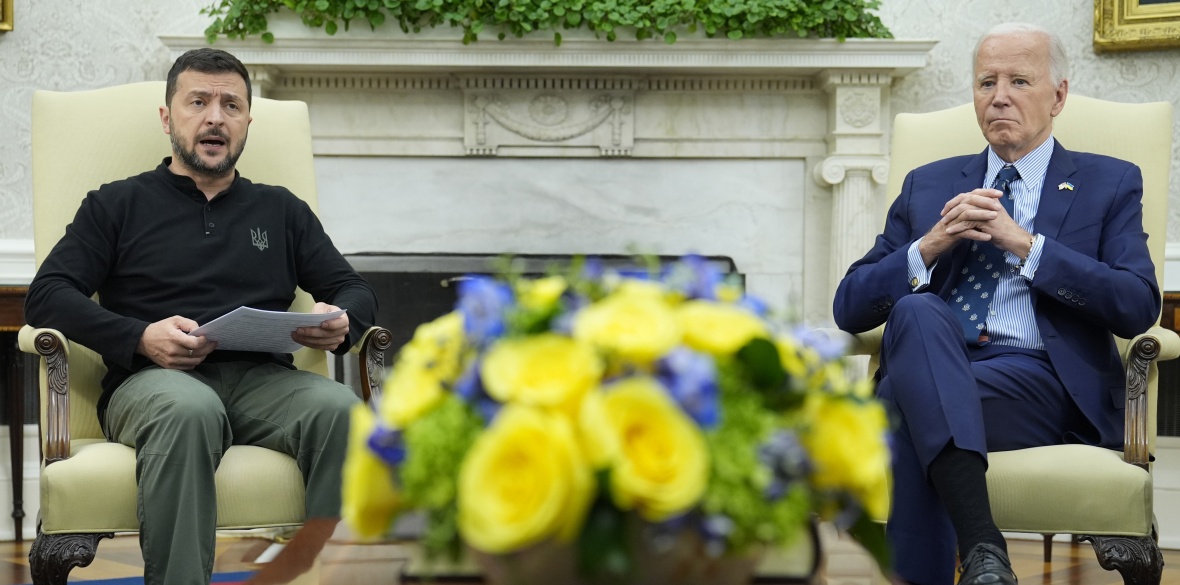
President Joe Biden (right) listens as Ukraine’s President Volodymyr Zelenskyy (left) speaks during their meeting in the Oval Office of the White House in Washington, September 26, 2024
IT SCARCELY gets more dangerous than this. The semi-senile President of the United States has determined to use his remaining months in office to dramatically ratchet up the war in Ukraine.
Joe Biden’s decision to allow Ukraine to fire US-supplied missiles deep into Russia, permission it has hitherto withheld, is a major step towards extending the conflict into an actual face-off between the world’s two major nuclear-armed powers.
Since the missiles concerned cannot easily be operated without full US logistical, intelligence and targeting support, this takes the prolonged proxy war much closer to a direct clash.
Biden’s move looks likely to be echoed, as ever, by Keir Starmer, who has been prevented by Washington from allowing Ukraine to use British Storm Shadow missiles to hit targets inside Russia. Those restrictions may now be cast aside.
Starmer is talking of “doubling down” on the war at the precise moment when hopes for an end to a bloody and unnecessary conflict should be rising.
…
The people must press for peace in Ukraine as a matter of urgency, on the basis of stable security for all. That is already the demand of most of the world’s nations, and it must be imposed on Labour’s warlords.
Protest against nuclear war outside Westminster Abbey, London 2019 | Wiktor Szymanowicz/Future Publishing via Getty Images
What’s the difference between the defence policies of Labour and Conservatives? Spoiler alert: there isn’t one
Days after Rishi Sunak announced the country would be going to the ballots, Tory MP Jacob Rees-Mogg released a campaign video in which he declared “security is at the forefront of this general election”.
It was a grand claim, but an astute one. Sunak and Keir Starmer have indeed spent much of the past six weeks fighting over who is leading the party of defence, while the subject has also dominated headlines (or it did until Nigel Farage re-entered politics and made the election considerably more about immigration).
From existential concerns about the size of the British army to debates about who supports Trident (and who doesn’t) and the shock announcement of the possible return of National Service, you’d be forgiven for thinking the election is less about voting red, blue, green or yellow, and more about what shade of camouflage you’d prefer your leaders in.
But how, exactly, do Labour and the Tories differ when it comes to matters of defence? And how will rising fears from politicians and pundits over threats from Russia, Iran and China affect British politics?
Early on in the election campaign, Labour leader Starmer declared his the ‘party of national security’ – a sentiment echoed by his shadow defence secretary, John Healey, who said “Labour is now the party of defence.” Their claims came weeks after Starmer took to the pages of the Daily Mail, not his natural ally, to proclaim: “We will back our Armed Forces. We will back our nuclear deterrent. We will back Britain.”
This messaging appears to be working. That same pro-Tory paper reported in March that Labour is now more trusted than the Conservatives on defence, with voters reportedly associating the latter with cutting military spending, not increasing it.
This is all quite a reversal. For a time, much of the media painted Labour as actively hostile to the military. It led to the BBC even asking “Has Jeremy Corbyn ever supported a war?” And, in 2019, when a video emerged showing members of the British parachute regiment firing at a poster of the then-Labour leader at a target range in Kabul, it seemed to reflect a wide sentiment that the military and the left were no longer friends.
Matters military, it was long felt, were best left to the Tories. After all, in 2021, a Byline Times analysis found that 91% of the veterans who sit in either the House of Commons or the Lords were Conservatives. Of the 44 veteran MPs, 40 were Conservative, while only 2 were Labour.
It was not always thus. The 1945 General Election, for instance, held as an army of men returned home from World War Two, saw a massive victory for Labour in the UK. Labour won decisively with 393 seats, the Conservatives securing only 197. Labour’s emphasis on social reform clearly resonated with those who had served – the promise of a better country for those who had been ready to die defending it.
It could be that Starmer is seeking to reignite this spirit, where national defence and the left are not deemed antithetical. And there are some canny election reasons for this.
At Action on Armed Violence, we analysed the locations of the ten arms manufacturers based in the UK that have received the highest value and quantity of domestic defence contracts over 2022/3 – finding a significant Conservative bias. The ten firms have 130 locations (listed offices or factories) across 94 parliamentary constituencies – 67% of which are represented by Tory MPs. Labour represents just 16% of the seats.
Of the 20 constituencies with two or more arms manufacturers present, 14 were held by Conservative MPs and just three by Labour. But predicted voting data suggests the Tories will hold onto just two of them on 4 July, while 13 will switch to Labour.
It is no wonder the Starmer wrote in the Mail: “With Labour, the defence industry will be hardwired into my national mission to drive economic growth across the UK.” If polls are to be believed, the military-industrial complex is about to be painted red – and it’s no coincidence that at least 14 prospective MPs standing for Labour today are ex-military.
Where does this leave the Tories, then? Conservative Campaign Headquarters (CCHQ) is frantically coming up with new, harder-right ideas to separate the party from Labour. Its National Service ploy, Sunak claims, is “to strengthen our country’s security”. Exactly why battalions of 18-year-olds on Salisbury Plain will make the UK more secure than its nuclear arsenals is not clear.
As for other differences, while the Conservatives focus on defence spending and global strategic engagement, Labour emphasises European alliances and a broader security perspective. The Liberal Democrats and SNP, meanwhile, both advocate for strong European ties and proactive foreign policies, and the Greens prioritise environmental security.
In truth, though, there is seemingly not much to distinguish Labour and Conservatives when it comes to matters of defence. As with Starmer working to avoid the red-tops claiming the nation is not safe in his hands, Labour has been deafeningly silent on issues such as the inquiry into Special Forces’ extra-judicial killings in Afghanistan, the widespread concerns about misogyny, sexual assault and systemic racism in the British military.
When there is not so much as a camouflage fag paper between the defence policies of the right and the left, the danger is that there are no oppositional voices of any merit. And, in a world where sentiments of war seem to be spreading much faster than sentiments of peace, this lack of critique could easily lead us all to very bad places indeed.
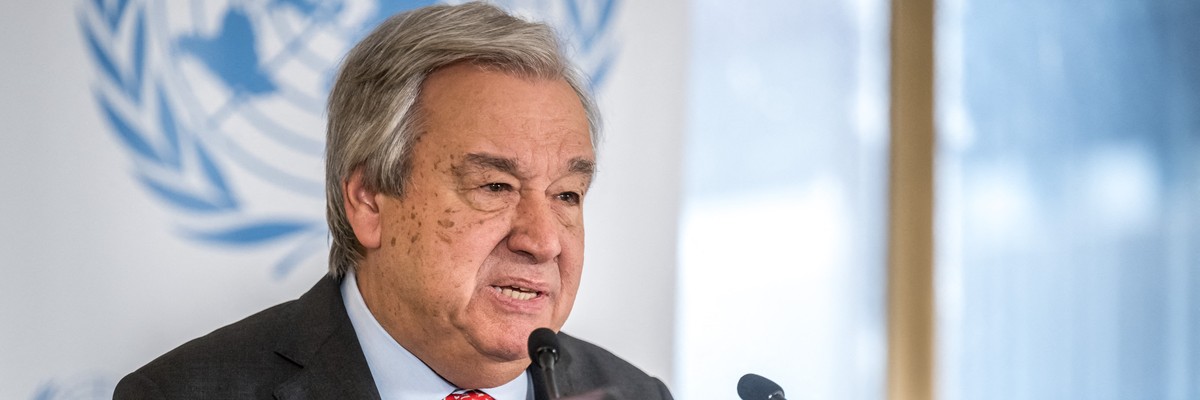
United Nations Secretary-General António Guterres speaks at the opening of the 55th session of the Human Rights Council in Geneva, Switzerland on February 26, 2024. (Photo: Fabrice Coffrini/AFP via Getty Images)
“Today’s warmongers cannot erase the clear lesson of the past,” said United Nations Secretary-General António Guterres. “Protecting human rights protects us all.”
The head of the United Nations said Monday that countries and groups involved in wars around the world are “turning a blind eye to international law” and imperiling the lives of millions of innocent people, including many children.
“The rule of law, and the rules of war, are being undermined,” U.N. Secretary-General António Guterres said in remarks to the Human Rights Council in Geneva.
Guterres pointed specifically to conflicts raging in Ukraine, Gaza, and Sudan and lamented that the U.N. Security Council has frequently been “deadlocked” in the face of mass atrocities, “unable to act on the most significant peace and security issues of our time.”
“The council’s lack of unity on Russia’s invasion of Ukraine, and on Israel’s military operations in Gaza following the horrific terror attacks by Hamas on 7 October, has severely—perhaps fatally—undermined its authority,” said Guterres, who delivered his address less than a week after the U.S. used its veto power for the third time since October 7 to tank a Gaza cease-fire resolution at the U.N. Security Council.
“Flouting international law only feeds insecurity and results in more bloodshed.”
Guterres’ speech marked the start of the Human Rights Council’s first high-level session of 2024. The U.N. chief said at the session that the world “urgently” needs a “new commitment to all human rights—civil, cultural, economic, political, and social—as they apply to peace and security, backed by serious efforts at implementation and accountability.”
Toward that end, Guterres announced the launch of a “systemwide United Nations Agenda for Protection” under which U.N. bodies “will act as one to prevent human rights violations, and to identify and respond to them when they take place.”
“Flouting international law only feeds insecurity and results in more bloodshed,” Guterres warned. “Human rights conventions and humanitarian law are based on cold, hard reality: They recognize that terrorizing civilians and depriving them of food, water, and healthcare is a recipe for endless anger, alienation, extremism, and conflict.”
“Today’s warmongers cannot erase the clear lesson of the past,” he added. “Protecting human rights protects us all.”
Around the world, violence is increasing.
We must not become numb to appalling & repeated violations of international humanitarian & human rights law.
Violations by one party don't absolve the other from compliance.
Guterres’ address came after Human Rights Watch and Amnesty International said in separate analyses published Monday that Israel is blatantly disregarding an interim ruling handed down last month by the U.N.’s highest legal body, the International Court of Justice (ICJ).
Israeli forces have killed more than 3,400 people in Gaza since the ICJ’s January 26 ruling, and nearly 30,000 total since their assault on the Palestinian enclave began following a deadly Hamas-led attack on October 7.
“Not only has Israel created one of the worst humanitarian crises in the world, but it is also displaying a callous indifference to the fate of Gaza’s population by creating conditions which the ICJ has said places them at imminent risk of genocide,” Heba Morayef, Amnesty’s regional director for the Middle East and North Africa, said in a statement.
“Time and time again,” Morayef added, “Israel has failed to take the bare minimum steps humanitarians have desperately pleaded for that are clearly within its power to alleviate the suffering of Palestinian civilians in Gaza.”
In his remarks Monday, Guterres warned that an Israeli ground assault on the southern Gaza city of Rafah “would not only be terrifying for more than a million Palestinian civilians sheltering there; it would put the final nail in the coffin of our aid programs.”
“International humanitarian law remains under attack. Tens of thousands of civilians, including women and children, have been killed in Gaza,” said Guterres. “I repeat my call for a humanitarian cease-fire and the immediate and unconditional release of all hostages.”
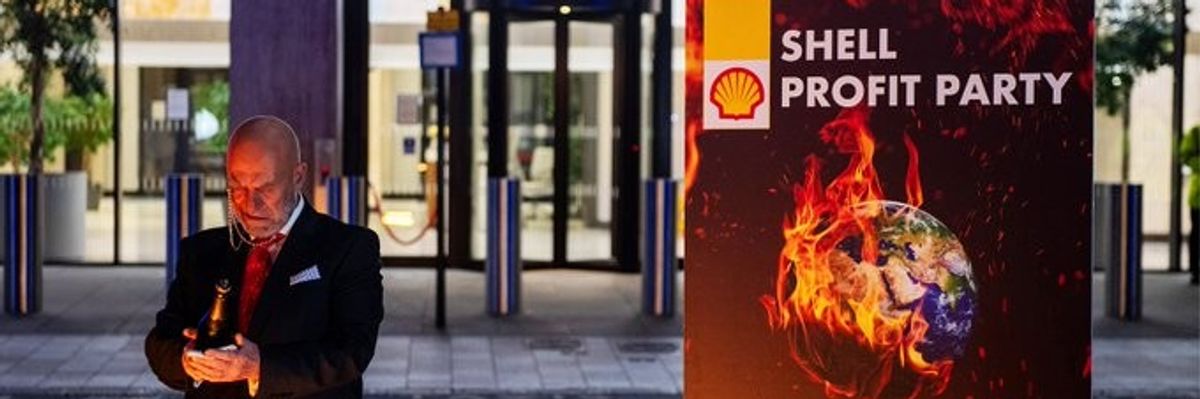
A protester pretends to celebrate outside Shell’s London headquarters. (Photo: Greenpeace U.K./X)
“They have amassed untold wealth off the back of death, destruction, and spiraling energy prices,” a Global Witness investigator said of a new analysis.
As Russia’s invasion of Ukraine approaches its second anniversary, one group has clearly benefited: the five biggest U.S. and European oil and gas companies.
BP, Chevron, ExxonMobil, Shell, and TotalEnergies have made more than a quarter of a trillion dollars in profits since the war began, according to an analysis published by Global Witness on Monday.
“This analysis shows that regardless of what happens on the front lines, the fossil fuel majors are the main winners of the war in Ukraine,” Global Witness senior fossil fuels investigator Patrick Galey said in a statement. “They have amassed untold wealth off the back of death, destruction, and spiraling energy prices.”
The world’s five largest listed oil companies have made profits of $281 billion since Russia invaded Ukraine
🗣️“…regardless of what happens on the frontlines, the fossil fuel majors are the main winners of the war in Ukraine.” Says our @patrickgaleyhttps://t.co/EzghPq4dFz
Big Oil’s profits were fueled in part by high wholesale gas prices, which were already elevated before Russia invaded Ukraine on February 24, 2022 and skyrocketed afterward. All five companies covered by the analysis reported record profits for 2022.
This bonanza came as the conflict killed more than 10,000 Ukrainian civilians.
“Russia’s invasion of Ukraine has been devastating for millions of people, from ordinary Ukrainians living under the shadow of war, to the households across Europe struggling to heat their homes,” Galey said.
During 2022, U.S. President Joe Biden accused Big Oil of “war profiteering.”
Global Witness calculated that BP and Shell have raked in enough since the war began—at £75 billion—to pay all British household electricity bills through July 2025. Chevron and ExxonMobil have made a combined $136 billion while Total has netted $50.4 billion.
These massive profits also come as the climate crisis, driven primarily by the burning of fossil fuels, continues to escalate. 2023 was the hottest year on record, and likely the hottest in 125,000 years. Yet instead of using their record profits to invest in renewable energy technology, the five major oil companies have cut back on their climate initiatives and handed massive payouts to shareholders.
“This is yet another way in which the fossil fuel industry is failing customers and the planet.”
Of the more than $280 billion the five companies have brought in since the war began, they returned what Global Witness said was an “unprecedented” $200 billion to shareholders. At the same time, Shell rescinded a promise to curb oil production by 2030 and said it would fire around 200 people employed by its green jobs division. BP, meanwhile, slashed its emissions reduction target from 35-40% of 2019 levels by 2030 to 20-30%.
The money paid to shareholders is also money that could have been paid to help communities adapt to the climate crisis or recover from the damage it has already caused. The $111 billion that the five companies paid to shareholders in 2023 alone is 158 times more than the money pledged to climate-vulnerable nations at COP28, and the €15 billion that TotalEnergies rewarded shareholders with was more than the €10 billion that France needed to recover from droughts and storms in 2022.
Galey said the companies were now “spending their gains on investor handouts and ever more oil and gas production, which Europe doesn’t need and the climate cannot take.”
“This is yet another way in which the fossil fuel industry is failing customers and the planet,” Galey said.
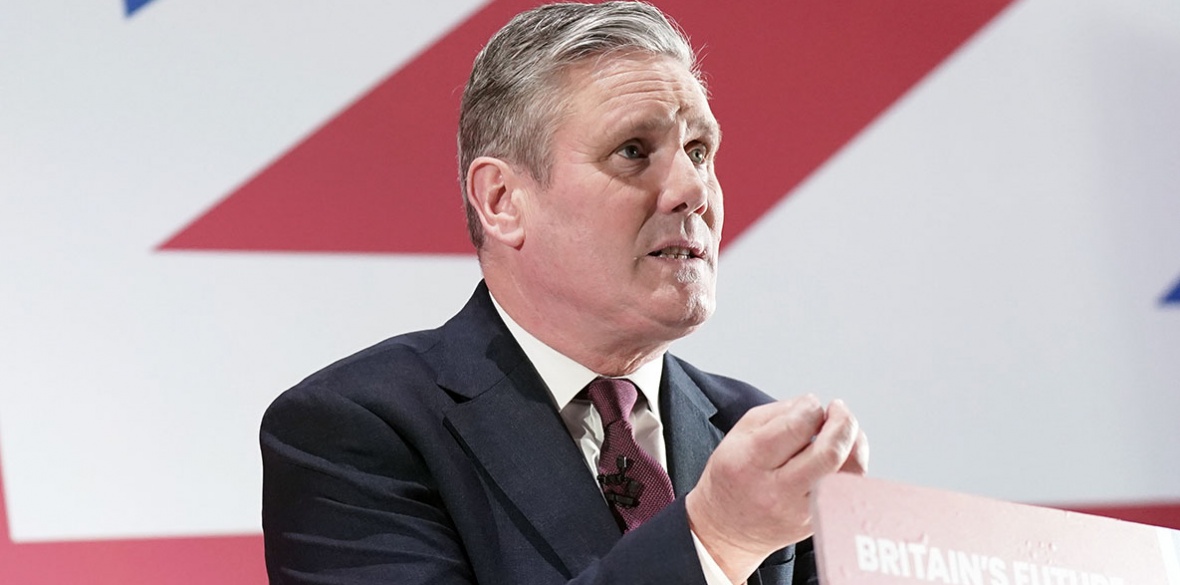
Labour leader Keir Starmer addressing 400 business leaders at the Kia Oval, London, during the launch of Labour Party’s plan for business, February 1, 2024
BRITAIN’S ruling class is eager to carry on the pretence that there is real choice under their political system.
Capitalism promises us that it’s the politicians that call the shots, there are real differences between those politicians and that we’re the ones that elect the politicians and they’re answerable to us.
But as with most tricks, when looked at too closely, reality and the nature of the fraud become clear.
Nowhere is it clearer that there is no real difference between the ruling-class parties than the imperialist consensus on questions of foreign policy, militarism and war.
Rather than questioning the Tory government’s policy or strategy on the burning issues of Palestine or Ukraine, Keir Starmer has bent over backwards (not hard when you’re spineless) at each and every turn to not only stymie any criticism, but to heartily endorse Tory policy.
…
Britain is a proud western democracy — the oldest in the world in fact: you can stand as a candidate for whoever you want; you can vote for whoever you want; just as long as they enthusiastically cheerlead genocide in 2024.
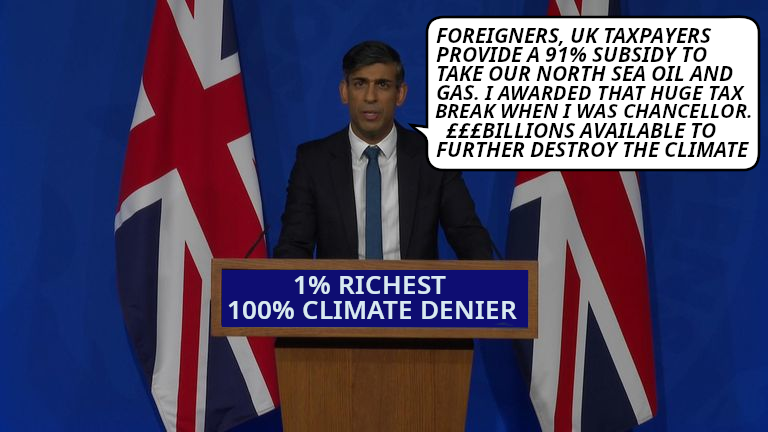
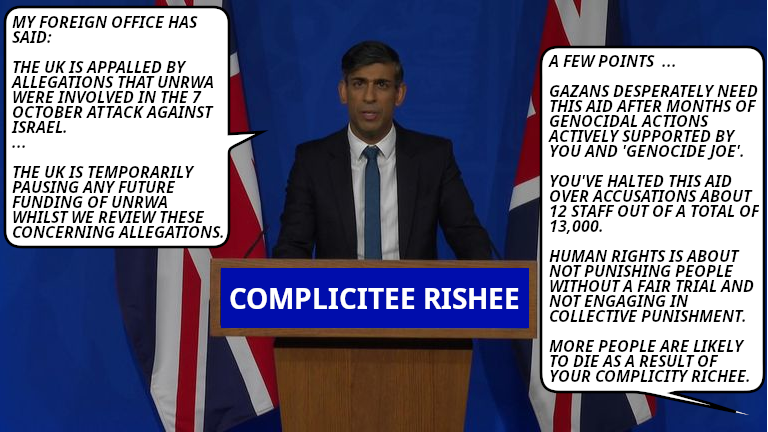
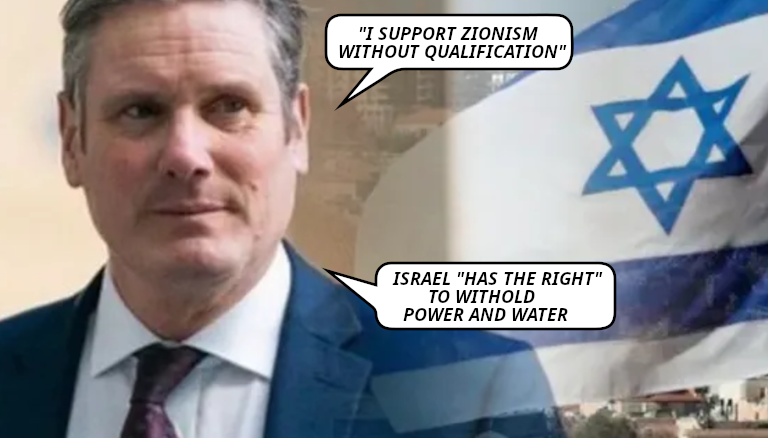
Image of UK Prime Minister Rishi Sunak. UK halts aid to UNRWA in Gaza over Israeli allegations that 12 staff from a total of 13,000 were involved in the 7 October 2024 attack on Israel.Zionist Keir Starmer supports Israel’s Gaza genocide.