Statement by Stop the War Coalition on the right to protest
Home Secretary Shabana Mahmood and Prime Minister Keir Starmer are seeking to weaponise the situation to ramp up the attack on the Palestine movement, with talk of “repeated protests” being a drain on police resources, the Stop the War Coalition has said.
In response to the home secretary’s announcement of plans to crack down on pro-Palestine protests, Stop the War convenor Lindsey German said:
“Stop the War is alarmed that the UK government intends to introduce greater restrictions on the right to protest in the wake of the appalling attack at the Manchester synagogue.
“It defies logic for the Home Secretary to suggest that there should be limits placed on how often people can protest against a genocide that has been waged on the people of Gaza for two years.
“Marches organised by the Palestine coalition, which Stop the War is a part of, have been attended by hundreds of thousands of people, and we believe they are representative of majority public opinion in this country which wants to see an end to the suffering of the Palestinian people.
“We condemn the attack on the Manchester synagogue, just as we condemn recent attacks on mosques and hotels accommodating asylum seekers.
“We wholeheartedly reject the implication that our peaceful marches are in any way responsible for the attack.
“Stop the War has never conflated Israel’s illegal actions with the British Jewish community and will continue to vociferously oppose any attempt to do so.
“Our movement is multi-ethnic, peaceful and opposed to all forms of racism, including antisemitism and Islamophobia.
“Thousands of Jewish people have taken part in our demonstrations, many as part of an organised block, and will continue to do so.
“The Palestine coalition has already faced more severe restrictions on our right to assemble and protest than any other protest group, and we oppose any attempts by the government to intensify this.
“The right to protest is fundamental in any democratic society and must be defended – we will be working with others to do this in the coming months.
“We call on all our supporters to join the Palestine coalition on the streets of London next Saturday (11 October) for what will be the thirty-second national demonstration for Palestine.
“This will be another massive mobilisation of support for the Palestinians, but also an expression of our absolute commitment to defend the right to protest.”
Keir Starmer objects to criticism of the IDF. He asks how could anyone object to them starving people to death, forced marches like the Nazis did, bombing Gaza’s hospitals and universities, mass-murdering journalists, healthworkers and starving people queuing for food, killing and raping prisoners and murdering children. He calls for people to stop obstructing his genocide for Israel.Genocide denier and Current UK Prime Minister Keir Starmer is quoted that he supports Zionism without qualification. He also confirms that UK air force support has been essential in Israel’s mass-murdering genocide. Includes URLs https://www.declassifieduk.org/keir-starmers-100-spy-flights-over-gaza-in-support-of-israel/ and https://youtu.be/O74hZCKKdpAOrcas discuss Genocide-supporting and complicit Zionists. Donald Trump, Keith Starmer, David Lammy, Rachel Reeves, Angela Rayner and Wes Streeting are acknowledged as evil genocide-complicit and supporting cnuts.
This work by Middle East Monitor is licensed under a Creative Commons Attribution-NonCommercial-ShareAlike 4.0 International License.
Aid workers are seen distributing aid parcels to Palestinians amid ongoing Israeli attacks during World Humanitarian Day in Khan Yunis, Gaza on August 18, 2024. [Hani Alshaer – Anadolu Agency]
A “perfect humanitarian storm” – that is how the International Federation of Red Cross and Red Crescent Societies (IFRC) describes Gaza, where aid workers endure the same hunger and fear as those they try to help, Anadolu reports.
The warning comes as Israel’s war nears its third year, following what aid agencies describe as the deadliest year on record for humanitarian workers – and 2025 is already following the same trajectory.
“Last year was the deadliest year on record for colleagues killed from different organizations – we’re talking about hundreds,” IFRC spokesperson Tommaso Della Longa told Anadolu. “The vast majority, sadly, are from Gaza, the West Bank and Sudan. And 2025 is already following the same trend.”
At least 265 aid workers had been killed worldwide as of Aug. 14, 2025, approaching the previous year’s toll of 383, according to the Aid Worker Security Database.
Latest figures from the UN show Israeli forces have killed at least 562 humanitarian workers in Gaza over the past two years, including 376 UN staff members and 54 staff and volunteers of the Palestine Red Crescent Society.
As violence against humanitarian workers reaches record levels, the IFRC warns that Gaza is at the heart of a trend threatening to make attacks on aid workers a new feature of war. “The risk here is to normalize something that should never be normalized,” said Della Longa, lamenting that people who devote their lives to saving others are instead “attacked, killed, wounded, detained.”
– Living with hunger and famine
Inside Gaza, where the UN officially declared famine in late August, the hardship is staggering. Aid workers describe colleagues telling children to go to bed early so they do not feel the hunger or holding on to a single piece of bread until the end of the day to give to their children.
“One colleague told me what it means to live with famine and hunger: you dream of food you cannot have, and when you finally get even a piece of bread, you must keep it for your child,” said Della Longa. “Then, after giving it to them, you have to say sorry and ask them to wait for more because you will not be able to provide. As a father myself, I found this absolutely shocking.”
Doctors and nurses in Gaza have been working frantically, often without rest and basic needs, enduring unimaginable personal loss and suffering while trying to save others falling prey to endless Israeli attacks.
“There was never anyone to replace them … even for a couple of days. They were killed, they were not protected, and now even they don’t know how to have meals during the day,” he said. “Weakening doctors and nurses means weakening entire communities.”
Carla Drysdale, a World Health Organization spokesperson, echoed the concern and drew attention to the attacks that not only destroyed the functionality of hospitals and ambulances, but also injured and killed thousands of health workers.
Both organizations say that without protection and access, humanitarian action in Gaza will remain paralyzed.
– ‘Impunity once risks impunity everywhere’
Over the past two years, Israel has killed more than 67,000 Palestinians in Gaza, most of them women and children, and wounded nearly 170,000, according to figures from Palestinian authorities confirmed by the UN and other international organizations.
A UN independent international commission of inquiry concluded last month that Israel is committing genocide in the enclave, where its siege and blockade on all essentials has also triggered a famine that has killed more than 450 Palestinians, including over 150 children.
Earlier in August, UN experts warned that Israel’s targeted destruction of Gaza’s health system amounts to “medicide.”
In a statement, UN special rapporteurs Tlaleng Mofokeng and Francesca Albanese said Israel was “deliberately attacking and starving healthcare workers, paramedics and hospitals to wipe out medical care in the besieged enclave.”
“In addition to bearing witness to an ongoing genocide we are also bearing witness to a ‘medicide,’ a sinister component of the intentional creation of conditions calculated to destroy Palestinians in Gaza which constitutes an act of genocide,” the experts said.
Della Longa warned that the erosion of respect for aid workers is no longer confined to war zones.
“If you think about 10 years ago, talking about the protection of humanitarians in this way would have been not understandable, because you don’t attack humanitarians. This trend is so widely spread that it is really deeply concerning and shocking.”
He called for enforcement of respect for existing laws and stressed the need for mechanisms to end impunity.
“If there is impunity once, it means there would be impunity everywhere. This is a precedent that we cannot accept,” he said.
“The issue is the political will. Humanitarians must do the humanitarian work and call on governments to take their own responsibility,” he said.
He concluded with one plea: “Don’t shoot the Red Cross. Don’t shoot humanitarians. Don’t shoot the people who are saving lives and alleviating suffering.”
This work by Middle East Monitor is licensed under a Creative Commons Attribution-NonCommercial-ShareAlike 4.0 International License.
Keir Starmer objects to criticism of the IDF. He asks how could anyone object to them starving people to death, forced marches like the Nazis did, bombing Gaza’s hospitals and universities, mass-murdering journalists, healthworkers and starving people queuing for food, killing and raping prisoners and murdering children. He calls for people to stop obstructing his genocide for Israel.Genocide denier and Current UK Prime Minister Keir Starmer is quoted that he supports Zionism without qualification. He also confirms that UK air force support has been essential in Israel’s mass-murdering genocide. Includes URLs https://www.declassifieduk.org/keir-starmers-100-spy-flights-over-gaza-in-support-of-israel/ and https://youtu.be/O74hZCKKdpAOrcas discuss Genocide-supporting and complicit Zionists. Donald Trump, Keith Starmer, David Lammy, Rachel Reeves, Angela Rayner and Wes Streeting are acknowledged as evil genocide-complicit and supporting cnuts.
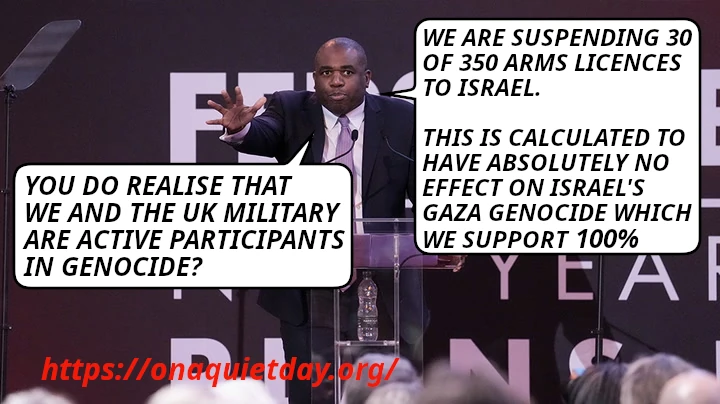
Keir Starmer objects to criticism of the IDF. He asks how could anyone object to them starving people to death, forced marches like the Nazis did, bombing Gaza’s hospitals and universities, mass-murdering journalists, healthworkers and starving people queuing for food, killing and raping prisoners and murdering children. He calls for people to stop obstructing his genocide for Israel.Genocide denying UK Foreign Secretary David Lammy says that UK is suspending 30 of 350 arms licences to Israel. He also confirms the UK government’s support for Israel’s Gaza genocide and the UK government and military’s active participation in genocide.Orcas discuss Genocide-supporting and complicit Zionists. Donald Trump, Keith Starmer, David Lammy, Rachel Reeves, Angela Rayner and Wes Streeting are acknowledged as evil genocide-complicit and supporting cnuts.
So disjointed is Labour’s annual meet, the messaging differs from room to room. Attendees agree only on fear of Reform
Demonstrators outside the Labour Party Conference get creative | Seth Thévoz
I’ve been attending political party conferences in the UK for over 20 years, but I’ve never seen anything like the Labour conference currently taking place in Liverpool.
The governing party is a broad coalition at the best of times. But this year’s event has been a series of “bubbles” that don’t – and won’t – interact with one another. You can experience a completely different reality from the people 50 feet away, just by going to different events.
That’s why, all week, when people have asked me, “What’s the feeling like at Labour conference?” I’ve replied that it depends on which Labour conference you’re attending. The real conference takes place not on the carefully choreographed main stage, but in a hundred meeting rooms dotted across the city, where fringe events are put on by members, activists and lobbyists – and it’s in those rooms that the party’s deep internal rifts can be seen.
On day one, in the space of four meetings, I was told, firstly, of the importance of immigrants being treated with dignity and respect; secondly, of the need for Labour to go further in cutting immigration as the only way to stop Reform UK; thirdly, of the desperate need for more immigration if we were serious about growing the economy; and fourthly, what a brilliant job the government was already doing of cutting immigration.
As an immigrant, I wasn’t quite sure what to make of this. But then, Labour conferences have always been a performance art – it’s an essential way to square the circle.
Exaggerated patriotism and mockney accents
You learn a lot by watching people at conference. A lot of play-acting goes on at Labour conference.
Take sharp-suited trade secretary Peter Kyle. Introduced to a rally organised by Labour First, a network representing those on the right of the party, Kyle spent a full minute explaining how he didn’t really like wearing suits, and protested: “I don’t own moccasins!”
Kyle isn’t alone. Elsewhere, well-spoken, public school-educated special advisers from the south-east suddenly put on mockney accents, deeply aware of the shame attached to sounding posh in Labour circles. And the party’s traumatised politicians, long nervous about having their patriotism questioned, try to take on the mantle of the keenest flag-shaggers, with fringe venues, exhibition stands, corridors and merchandise all draped in Union flags.
‘Flag-shaggers’: Labour is eager to prove its patriotism and rival Reform’s use of flags | Seth Thévoz
You soon pick up where the centres of power are around the conference hotel, its bar and its private business suites, as key party personnel are bundled away for hush-hush meetings with donors and diplomats. But for the people-watcher, there is a golden rule to observe: doughnutting.
VIPs make up the hole of a doughnut, and they’re surrounded by a gaggle of hangers-on. The more important you are, the bigger the doughnut: a backbench MP merits just one young diary secretary by their side, while a cabinet minister or a city mayor can have half a dozen staff flocking around them at all times. No one wants to be Billy No Mates.
I mention this because it was striking to see Keir Starmer’s chief of staff, Morgan McSweeney, shuttling around the lobby of the Pullman hotel at least eight times – always alone. Whether he prefers to work in isolation or is just being avoided, I don’t know. But I wasn’t the only seasoned conference-goer to observe, “That’s really weird.”
McSweeney has had a tough September. First, he’s synonymous with Starmer’s many resets and changes of strategy, which have seen Labour plummet in the polls. Second, he came under fire for having advocated for Peter Mandelson to be appointed as the UK’s Washington ambassador despite his known friendship with paedophile Jeffrey Epstein and despite concerns raised by the security services during the vetting process (Mandelson was fired after emails he sent to Epstein following his conviction emerged earlier this month). And now, thanks to a new book from investigative journalist Paul Holden, the peculiar tale of how more than £700,000 of donations to Labour Together went undeclared on McSweeney’s watch has resurfaced, heaping further pressure on the man many believe to be the architect of Starmerism.
But it was the sight of him hurrying around the conference on his own, not the many op-eds published questioning his political judgment in recent weeks, that made me realise McSweeney may be in deep trouble. I’ve never seen such a senior government figure alone at a party conference, let alone over and over again.
Reform agenda
Sienna Rodgers of The House magazine wasn’t wrong when she wrote, “the motivation for those targeting McSweeney is clear: Starmer, it is widely believed, is finished without him.” McSweeney has become a lightning rod because he is seen as the cause of so many of Starmer’s changes of direction.
Many of the Labour members who voted for Starmer in the party’s 2020 leadership election expected a more radical figure. Instead, they have been baffled by a series of policy U-turns and an increasingly socially conservative approach to policy, aimed at wooing Reform UK voters. McSweeney is seen as being behind this shift.
The dilemma over the rise and rise of Nigel Farage’s Reform party has hit Labour hard. It’s not just obvious in ministers’ speeches; all around the conference, you can hear the chatter of endless conversations along the same lines. “We’re quite fearful, to be honest,” activists tell one another. “It’s all about how to beat Reform, basically.”
Labour has historically taken its working-class voter base for granted, while it wins or loses elections on the back of middle-class voters. To suddenly find another party, claiming the mantle of being more working class, accusing Labour of being a party of southern elites, has really knocked people’s confidence. It goes to the heart of how Labour politicians see themselves: “Are we the baddies?”
And so activists seek solace in comfortable old certainties. In the conference’s ‘Labour shop’, a whole range of nostalgia merchandise has been launched this year, from mugs to T-shirts, commemorating 80 years since the Labour government of 1945. If Labour in 2025 can’t offer members a better future, it can at least offer up a better yesterday.
The Good Old Days: Labour is flogging a range of 1945 nostalgia merchandise | Seth Thévoz
Ad-libbing policies
This does not feel like a party that won a landslide only 14 months ago. Its conference has had a level of exhaustion normally seen only in parties that have been in power for over a decade. At fringe event after fringe event, the most interesting or lively guest speaker was usually the person brought in from outside the party: a social worker, an economist, or a local imam.
MPs and councillors, by contrast, often sounded shell-shocked and afraid to say too much. Part of this stems from how Starmer led Labour in opposition. The party’s strategists congratulated themselves on a brilliant wheeze, through the years of 2020 to 2024, of not being tied down to anything too specific. They were the textbook opposition, they believed: attacking the Tories in government, without having policies of their own that could be counter-attacked. They had learned from the Corbyn years, when lengthy manifestos were a hostage to fortune. No one wanted a repeat of Labour’s mammoth 1983 policy manifesto under Michael Foot, famously dubbed “The longest suicide note in history.” Policies could be left to the very end of the last Parliament, before being hammered out.
Unfortunately, Rishi Sunak’s call for an early election in May 2024 surprised many people, not least those strategists. And a lot of vital work never happened, from scheduled briefings with civil servants to agreeing on detailed policy proposals. Labour accidentally found itself in power several months too early and has been making up policy as it goes ever since.
This is how the government ended up quietly ditching several of its established policies, such as proportional representation and an elected House of Lords, while spending political capital on major new policies that weren’t even in its manifesto and which often divide people across political lines, such as last week’s new digital ID cards proposal.
Incidentally, a popular topic of conference gossip has been to speculate about which companies might get the lucrative government contract for ID cards, estimated by Labour Together as being worth up to £400m.
‘A ghastly job’
But the existential ennui has not stopped the glad-handing. There are plenty of lobbyists in town to do business, and Labour is in the middle of an election for a new deputy leader.
Education secretary Bridget Phillipson has been pushed by the party machine for that position at every stage, being unveiled at several rallies with slick leaflets promoting her campaign handed out by the entrance. In one flyer, Phillipson promises, “I won’t defend our mistakes” – a bold pitch, since being wheeled out to apologise for the party is basically the deputy leader’s job description. Indeed, earlier this month the role was described as “a terrible job, really ghastly” by Labour peer Margaret Beckett, who held the title in the 1990s.
At the rally by campaign group Labour to Win, Luke Akehurst MP put on a brave face, admitting the party has had “a couple of weeks where things have not gone well for us, and we need to put a stop to them not going well for us”. He pleaded with delegates not to go leaking stories to the press, with “a story of division and chaos and in-fighting”, and “taking the people at the top of the party out in front and critiquing them.”
And he lashed out at hints that Manchester’s Mayor Andy Burnham might challenge Keir Starmer: “Most of the cameras are following someone who isn’t even qualified to run!”
Akehurst – a veteran fixer on the Labour right – knows a thing or two about winning internal Labour elections. At the Labour First rally the next day, he boasted of how he was able to “completely confound” journalists with floor votes still favourable for the leadership, because of “organising all year”, electing “speaker after speaker after speaker” as delegates, “which is like bloody herding cats, trying to get people, just, oooh trust us, here’s seven really obscure topics that would be really quite ideal for us to debate. We got about 67% of the vote or something on that.”
There were theatrical pledges of support, as cabinet ministers at rallies lined up to praise the prime minister.
Health secretary Wes Streeting is an ambitious political operator, whom I’ve known since he was my student union’s president 20 years ago. Even back then, he was clearly already running to be prime minister; like Cassius in Shakespeare’s Julius Caesar, he often “has a lean and hungry look.” Yet at the Labour rally, he was doing his best to channel the manner of a North Korean MP theatrically clapping the Dear Leader, not wanting to be seen as half-hearted in his applause.
Health secretary Wes Streeting is among those keen to be seen loyally applauding | Seth Thévoz
But the mood of delegates was far less chipper. When chancellor Rachel Reeves told the rally, “It’s great to see Keir come out fighting this week!”, the Labour member next to me – who had been loyally applauding up until this point – muttered, “Yeah, too late!”
Ultimately, the Labour conference in Liverpool reminded me of grief. And grief has five stages. I saw plenty of denial, anger, bargaining and depression. I saw little of the last stage, acceptance. But then again, even some of the bargaining was surreal. One delegate I overheard in the café was musing on whether the coming England match might help the government’s popularity. He earnestly predicted, “When England do well, the whole community do well, so maybe if we, er, hope…?”
Keir Starmer objects to criticism of the IDF. He asks how could anyone object to them starving people to death, forced marches like the Nazis did, bombing Gaza’s hospitals and universities, mass-murdering journalists, healthworkers and starving people queuing for food, killing and raping prisoners and murdering children. He calls for people to stop obstructing his genocide for Israel.Keir Starmer says that the Labour Party under his leadership all feel a small part of Scunthorpe.Keir Starmer explains that he feels no shame or guilt benefitting personally from gifts from the rich and powerful while insisting on policies of severe austerity causing suffering and death.
‘Best way to deliver reform and a fair pay award is for government to negotiate directly with trade unions,’ RCN says
an Accident and Emergency sign
FOURTEEN health unions today jointly announced they will not take part in the “failed” and “defunct” NHS Pay Review Body (PRB) process, demanding talks with ministers instead.
The independent advisory body has settled pay issues for the majority of the health service’s staff since 2007.
In a letter to Health Secretary Wes Streeting, unions representing staff on “agenda for change” contracts called on the government to deliver on its promise of direct talks for next year’s pay instead.
Union frustrations over lengthy delays, below-inflation awards and suspected political interference come as questions linger over Sir Keir Starmer’s leadership ahead of the party’s conference starting next week.
GMB had been the last major health union to engage with the PRB last year, which makes annual pay recommendations for NHS staff excluding doctors, dentists and some senior managers.
Chairwoman of the NHS unions and Unison’s head of health Helga Pile said: “The government promised talks over a year ago and they still haven’t got round the table with unions with any proper plan to sort things out.




 an Accident and Emergency sign