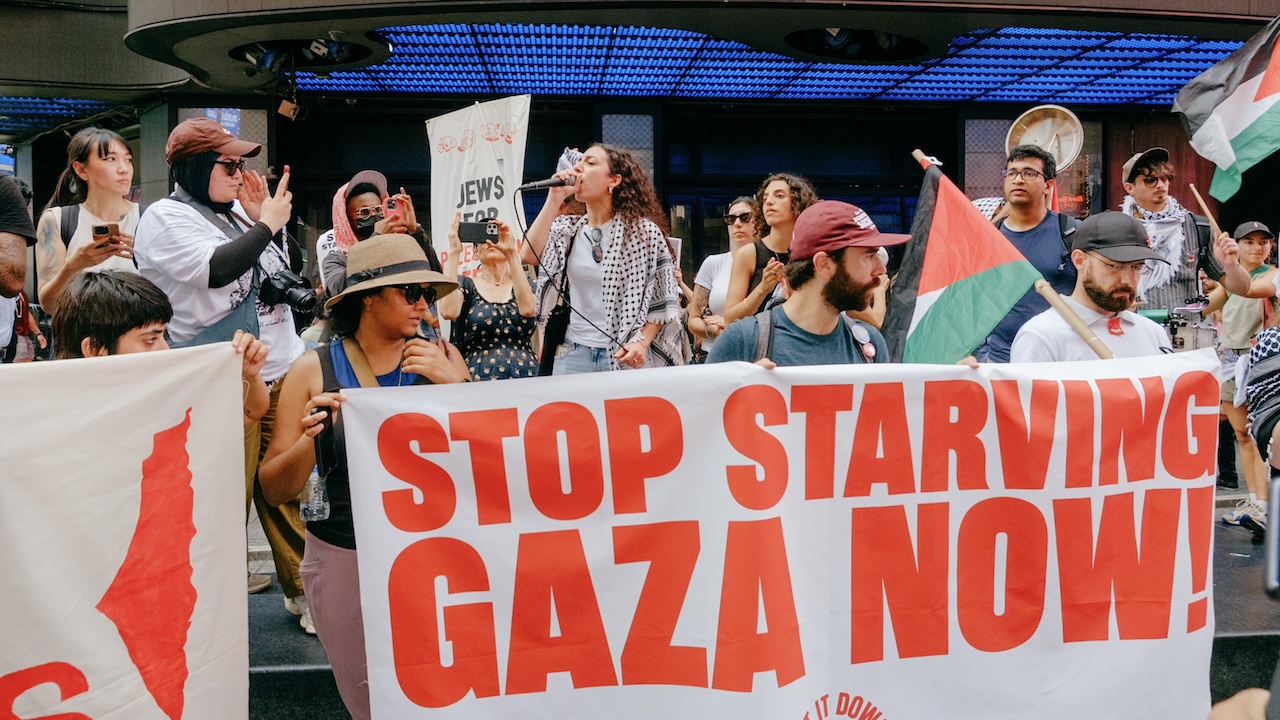
Protesters in New York City protest genocide in Gaza (Photo: Wyatt Souers)
Amid Israel’s starvation of Gaza, a broad coalition of pro-Palestine groups are planning a march of thousands through the streets of New York City
On Saturday, August 16, demonstrators are set to march in protest of Israel’s starvation of Gaza in a “Mass March for Humanity” through the streets of New York City. Over 200 organizations have endorsed, coming from an array of diverse backgrounds including the Palestinian diaspora, pro-Palestine solidarity groups, labor unions, anti-war groups, faith groups, and others. Buses are set to travel from across the northeastern United States, including from Baltimore, Boston, Burlington, New Hampshire, Philadelphia, Providence and Washington, DC.
Endorsing organizations include, but are not limited to, the Palestinian Youth Movement, the People’s Forum, the ANSWER Coalition, the Arab American Association of New York, the Palestinian American Organizations Network, American Muslims for Palestine, the Council on American-Islamic Relations (CAIR), Democratic Socialists of America, SEIU Local 509, Jewish Voice for Peace, CODEPINK, the American-Arab Anti-Discrimination Committee, the Green Party of the United States, Healthcare Workers For Palestine, the National Women’s Studies Association, and Doctors Against Genocide.
Doctors take a stand against mass death
“Genocide will never stop without global intervention,” Dr. Nidal Jboor, the cofounder of Doctors Against Genocide, told Peoples Dispatch. In May of this year, Jboor was arrested while sitting in a US congressional building holding a sign that read “Let the children eat. Let the children live,” while Secretary of State Marco Rubio spoke to the US Senate Committee on Foreign Relations.
“We cannot abandon the victims to the mercy of their killers. Humanity must rise, mobilize, and save the starved population of Gaza – because governments will not act unless we force them to through relentless, unyielding pressure,” said Jboor.
Members of Doctors Against Genocide, along with over 100 medical professionals across the globe who have volunteered in Gaza have signed onto a letter in solidarity with Palestinian medical workers.
“We refuse to remain silent while our colleagues are being starved, and shot by Israel,” the letter reads. “Palestinian health workers are collapsing from hunger while performing surgeries, operating without basic medical supplies, and enduring relentless attacks on hospitals, clinics, and ambulances.”
The letter demands urgent protection for Palestinian civilians and healthcare workers, an end to attacks on medical facilities, the lifting of Israel’s blockade to allow full humanitarian access, an immediate and permanent ceasefire, and accountability for those responsible for violence and abuses in Gaza.
Journalists’ contingent to denounce Israel’s targeting of Palestinian journalists
The recent assassination of six Palestinian journalists by Israeli forces, including Al Jazeera correspondent Anas al-Sharif on Sunday, August 10, has fueled a surge of outrage. On Saturday, journalists and media workers will join the demonstration to denounce the attacks on their colleagues in Gaza.
Among these journalists include a group of writers organized by Writers Against the War on Gaza, a group that has been active since the first weeks of the genocide in October of 2023. WAWOG’s organizing hit the ground running with bold, targeted action against mainstream media outlets, including blocking a shipment of the New York Times newspaper at its printing plant in Queens, New York in March of 2024.
According to Nicki Kattoura, a member of WAWOG, “there is no press freedom if Palestinian journalists are being killed.”
“Israel is targeting Palestinian journalists because they are threatened by the exposure of their war crimes,” says Kattoura. “But we also find, this is not the whole story, politically, although it may be, and also feels true, psychologically.”
“One thing that we can say with certainty is that Israel is killing Palestinian journalists because they are Palestinian. The Zionist entity’s clear stated intent is to exterminate the Palestinian people,” Kattoura continued. “And I would say the killing of Hossam Shabat or Anas Al-Sharif is as much about breaking the Palestinian spirit, because they are the beloved voices of the Palestinian people, as it is about ethnically cleansing the Gaza Strip.”
Genocide denier and Current UK Prime Minister Keir Starmer is quoted that he supports Zionism without qualification. He also confirms that UK air force support has been essential in Israel’s mass-murdering genocide. Includes URLs https://www.declassifieduk.org/keir-starmers-100-spy-flights-over-gaza-in-support-of-israel/ and https://youtu.be/O74hZCKKdpAKeir Starmer objects to criticism of the IDF. He asks how could anyone object to them starving people to death, forced marches like the Nazis did, bombing Gaza’s hospitals and universities,mass-murdering journalists, healthworkers and starving people queuing for food, killing and raping prisoners and murdering children. He calls for people to stop obstructing his genocide for Israel.
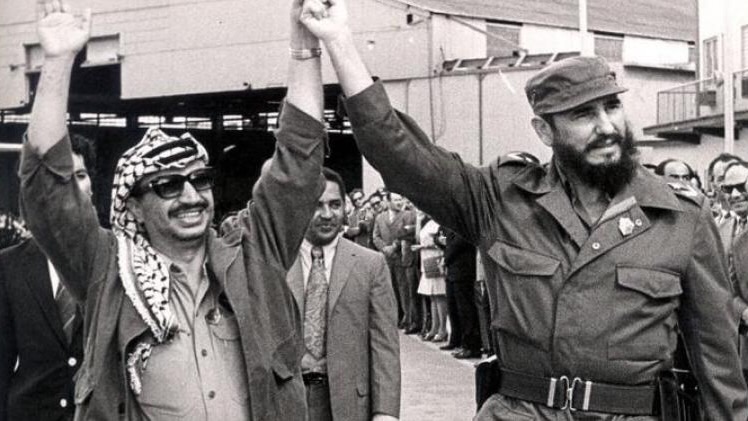
Palestinian leader Yasser Arafat and Cuban President Fidel Castro. Photo: Cuba Sí
On the 99th anniversary of Fidel Castro’s birth, we remember the revolutionary government’s support for Palestine, especially its condemnation of the genocide of the Palestinian people.
In a famous speech, Fidel Castro, the supreme leader of the Cuban Revolution, stated that medical, civil, and military support for the Angolan people was provided without expectation of any material reward. He pointed out that this way of thinking exposes an imperialist ideology, according to which one country supports another, always expecting to benefit materially in some way. “Revolutionaries expect nothing, which means that revolutionaries must devote themselves totally to a cause, to their ideas, to their noble goals, without expecting anything in return.”
This was the same principle that Fidel applied in supporting the Palestinian people’s struggle almost from the beginning of the revolutionary process he led since 1959. It is no coincidence that one of the most renowned Palestinian leaders, Yasser Arafat, visited the Caribbean Island eight times, on the personal invitation of Castro.
On October 12, 1979, at the United Nations Assembly, Fidel denounced before the world Israel’s process of territorial expansion, supported by the United States, at the expense of Palestinian territory. “The basis for a just peace in the region begins with Israel’s total and unconditional withdrawal from all occupied Arab territories and for the Palestinian people, the return of all their occupied territories and the restoration of their inalienable national rights, including the right of return to their homeland, self-determination, and the establishment of an independent state in Palestine, following General Assembly Resolution 3236,” Fidel said.
Castro acknowledged that this expansion was achieved through the killing of Palestinians, thus becoming one of the first world leaders to speak of “genocide” against the Palestinian people: “We repudiate with all our strength the ruthless persecution and genocide that Nazism unleashed against the Jewish people in its time. But I can think of nothing more similar in our contemporary history than the eviction, persecution, and genocide that imperialism and Zionism are carrying out today against the Palestinian people. Stripped of their lands, expelled from their homeland, scattered throughout the world, persecuted and murdered, the heroic Palestinians are an impressive example of self-sacrifice and patriotism, and they are the living symbol of the greatest crime of our time.”
Fidel also recognized that there are geopolitical interests that do not want peace to be established in the Middle East: “Can anyone be surprised that the Conference (of the Non-Aligned Movement) was forced, for reasons that do not stem from any political prejudice but from an objective analysis of the facts, to point out that US policy plays a fundamental role in preventing the establishment of a just and comprehensive peace in the region, by aligning itself with Israel, supporting it, and working to obtain partial solutions favorable to Zionist objectives and guaranteeing the fruits of Israeli aggression at the expense of the Arab people of Palestine and the entire Arab nation?”
“More than just rhetorical support, it was tangible support”
As historians point out, Fidel’s support for Palestine was not purely rhetorical, but also diplomatic. In 1974, Arafat arrived in Cuba and was received with the honors of a head of state, even though Palestine was not yet “officially” recognized as a state. Fidel’s message was clear: Palestine should be recognized by the international community as a state, and Arafat as its leader. In addition, Arafat was awarded the Playa Girón National Order, Cuba’s highest recognition for citizens “who have excelled in the struggle against imperialism, colonialism, and neo-colonialism, or who have done great deeds for peace and progress of mankind”.
The relationship between Cuban revolutionaries and the Palestine Liberation Organization (PLO) dates to the beginning of the Cuban Revolution. In 1959, Raúl Castro and Ernesto “Che” Guevara traveled to the Gaza Strip, disobeying the doctrine of hemispheric alignment whereby all Latin American countries, except for Cuba, supported Israel.
Thus, in 1964, thanks to Che Guevara’s tremendous efforts, Cuba recognized the PLO as soon as it was founded, becoming one of the first countries to do so. But its support went beyond official documents, according to Mansour Tahboub, former acting director of the Arafat Foundation: “Cuba has always been a strong supporter of Palestinians in all realms: political, military, vocational training. The Cubans trained Palestinian cadres, and Fidel himself was a staunch advocate of the Palestinian quest for freedom and independence.”
The truth is that one of the core principles of Castro’s administration was to support anti-imperialist and anti-colonialist struggles, wherever they took place. In a 1977 interview with French Weekly, Fidel stated: “The Palestinian movements have shown their ability to resist imperialist … aggression … [The Palestinian cause] will prevail sooner or later despite the betrayal by Arab reactionaries, imperialist maneuvers and Israeli aggression.”
That is why Cuba, along with Nicaragua, were the only two Latin American countries to condemn Israel’s actions after the Six-Day War. In 1973, Cuba severed diplomatic relations with Israel following the Non-Aligned Movement meeting in Algeria.
According to Abdel Majeed Sweilim, professor of political science at Al Quds University, the PLO also benefited from the relationship between Cubans and Palestinians, thanks to the political training of Palestinians on Cuban soil.
Today, despite the economic blockade imposed by the United States, which causes a perpetual economic crisis on the Caribbean Island, the Cuban government has reserved funding in the form of academic scholarships so that each year, 150 Palestinians can study medicine, engineering, and other professions at Cuban universities.
In his final years, Fidel continued to support the Palestinian cause. Thus, after resigning from his political posts, Castro signed an international manifesto in support of Palestine in 2014, which demanded Israel’s withdrawal from the Gaza Strip, the West Bank, and East Jerusalem, as well as respect for the resolutions passed by the United Nations regarding the conflict.
Arafat’s recognition of Cuban support
These and other measures have led countless Palestinians to see the revolutionary government of Cuba as an unwavering ally. Arafat himself acknowledged this when he stated: “I consider, Your Excellency President Fidel Castro, this demonstration of firmness and unwavering friendship that has taken place in Havana, as a strong and effective message from a beloved world leader who enjoys great international prestige among all the peoples and countries of the world, to mobilize them quickly to put an end to the suffering of the Palestinian people as a result of the Israeli occupation of their homeland, and the intensification of military, economic, and financial actions and blockades against our cities, villages, towns, farms, and water wells, and the closure of international border crossings by land, air, and water.”
In addition, the historic leader of the PLO said: “Every Palestinian today holds in their heart and conscience this glorious image of Your Excellency with the Palestinian hatta on your shoulders, which is irrefutable evidence of the justice of our cause and the magnitude of the injustice committed by the Israeli aggressors against our people. Have full confidence, Your Excellency President Castro, so beloved by our people and by all peoples, that our people, as resilient as the Palestinian mountains, take from your position and example, which makes us proud, more courage and determination to continue the struggle, the resistance, and the Intifada to remove the Israeli occupiers from our country, Palestine.”
In this way, Cuba continues to unreservedly support the demands for sovereignty, self-determination, and peace made by the Palestinian people in the face of the previous and most recent attacks by the Israeli government on their territory. This support, since 1959, is not given with the expectation of anything in return, but because of the anti-imperialist and anti-colonialist principles that guide the Cuban Revolution and that Fidel helped to establish as principles of the Cuban state itself.
Genocide denier and Current UK Prime Minister Keir Starmer is quoted that he supports Zionism without qualification. He also confirms that UK air force support has been essential in Israel’s mass-murdering genocide. Includes URLs https://www.declassifieduk.org/keir-starmers-100-spy-flights-over-gaza-in-support-of-israel/ and https://youtu.be/O74hZCKKdpAKeir Starmer objects to criticism of the IDF. He asks how could anyone object to them starving people to death, forced marches like the Nazis did, bombing Gaza’s hospitals and universities,mass-murdering journalists, healthworkers and starving people queuing for food, killing and raping prisoners and murdering children. He calls for people to stop obstructing his genocide for Israel.
This work by Middle East Monitor is licensed under a Creative Commons Attribution-NonCommercial-ShareAlike 4.0 International License.
Israeli Prime Minister Benjamin Netanyahu delivers a statement during the US Independence Day reception, known as the annual “Fourth of July” celebration, hosted by Newsmax in Jerusalem on August 13, 2025. [Photo by RONEN ZVULUN/POOL/AFP via Getty Images]
Israel’s Prime Minister Benjamin Netanyahu said that Israel can bomb Gaza like the Allies bombed Dresden during World War II.
His remarks were made during an interview with right-wing US network Newsmax on Wednesday.
When asked why the Israeli military does not “wipe Hamas and the Gaza Strip” off the map, he replied, “We can bomb them like the Allies [in World War II] bombed Dresden, we could starve them if we followed the vilifications, these false lies that are delivered against Israel, and nobody would be alive already.
He added that the events of 7 October had involved clear failures and intelligence mistakes.
At the beginning of his remarks, Netanyahu said that Israel was engaged in a war on eight fronts, explaining that seven of them were against Iran and its proxies, while the eighth was what he called a “battle for truth.”
He stressed that, in his view, the only way to overcome lies was through truth.
Turning to the war in Gaza, he claimed that the only deliberate starvation taking place there was that of the Israeli hostages.
He argued that this was evident when comparing the frail and tortured condition of the hostages with the well-fed state of their captors.
Netanyahu said the contrast was intended to expose lies and was linked to the “eighth front,” which he described as the fight for truth.
He also stated that Tel Aviv did not pursue a policy of starvation, and that it had adopted — and continued to follow — a policy aimed at separating civilians from fighters on two fronts.
This work by Middle East Monitor is licensed under a Creative Commons Attribution-NonCommercial-ShareAlike 4.0 International License.
Genocide denier and Current UK Prime Minister Keir Starmer is quoted that he supports Zionism without qualification. He also confirms that UK air force support has been essential in Israel’s mass-murdering genocide. Includes URLs https://www.declassifieduk.org/keir-starmers-100-spy-flights-over-gaza-in-support-of-israel/ and https://youtu.be/O74hZCKKdpAKeir Starmer objects to criticism of the IDF. He asks how could anyone object to them starving people to death, forced marches like the Nazis did, bombing Gaza’s hospitals and universities,mass-murdering journalists, healthworkers and starving people queuing for food, killing and raping prisoners and murdering children. He calls for people to stop obstructing his genocide for Israel.
This work by Middle East Monitor is licensed under a Creative Commons Attribution-NonCommercial-ShareAlike 4.0 International License.
Journalists gather to stage a protest in Ramallah, the West Bank, on August 11, 2025, against the Israeli army’s air strike on a tent reserved for journalists at the entrance to Shifa Hospital in the center of Gaza City, which killed Al Jazeera reporters. The protesters carried photos of their slain colleagues. [Issam Rimawi – Anadolu Agency]
Even in major democracies, of which Israel considers itself one, governments committing crimes typically try to conceal them from the public eye. They do so out of fear of the backlash, embarrassment, and—above all—accountability. Not so in Israel. In its ongoing war in Gaza, Israel is doing the exact opposite. It is openly defying international law and norms, broadcasting its actions with a public bravado that borders on celebration, even as it commits what many, including some of its allies and international organisations, classify as war crimes and a crimes against humanity. This is not a matter of a few rogue actors; it is a display of institutional and societal pride in a campaign of devastation.
Early in the war, then-Defence Minister Yoav Gallant set the tone with a statement that shocked the world’s capitals from Washington to Beijing. Announcing a “complete siege on Gaza,” he stated, “We are fighting human animals and we will act accordingly.” This dehumanising language provided a chilling moral license for a campaign of collective punishment, cutting off electricity, food, water, and fuel to over two million people. The sentiment has since been amplified on social media, where Israeli soldiers and citizens have uploaded a steady stream of videos mocking Palestinians, celebrating destruction, and flaunting their disregard for civilian life. These posts—often set to cheerful music—show soldiers gleefully detonating homes, rifling through personal belongings, and dedicating explosions to fallen comrades. The digital footprint of these actions creates a damning dossier of potential crimes, proudly broadcast for all to see.
This perverse sense of entertainment has even bled into the civilian sphere, creating a macabre form of “war tourism.” In towns bordering Gaza, like Sderot, “resilience tours” have emerged, where locals and visitors are given guided tours of communities targeted on 7 October. More disturbingly, viewing platforms have been set up with telescopes, offering a unique and ghoulish experience for a small fee: a chance to watch the destruction unfold in real time on the ground just a few kilometres away. This commodification of suffering is a stark testament to a societal shift, where the violence of war is not a tragedy to be mourned but a spectacle to be consumed.
A fundamental factor enabling this open celebration of violence is the public sentiment in Israel itself. Polls consistently show a nationalistic fervour and widespread support for the war’s military objectives, even at the cost of tens of thousands of Palestinian lives. The primary concern of the Israeli public, as articulated by commentators and political figures, is not a humanitarian crisis in Gaza but the fate of the hostages. According to a July 2025 survey by Israel’s Channel 12, a clear majority of Israelis—74 per cent, including 60 per cent of voters for the governing coalition—are willing to end the war in exchange for the release of all hostages. This desire to bring the captives home has become the most urgent national priority, overshadowing the government’s stated goal of eliminating Hamas. This is not to say that the public is ignorant of the suffering; rather, a majority of Jewish Israelis believe the IDF’s reporting on casualties and think Israel is making substantial efforts to avoid harming Palestinian civilians.
The widely held belief that Israel is a victim fighting for survival allows for a collective moral blindness to the devastation. As prominent Israeli journalist Gideon Levy has repeatedly argued, this war has been marked by a “moral blindness” on the part of the Israeli public. In his view, “a sane country does not wage war against civilians, does not kill babies as a hobby.” Levy’s columns and interviews often describe a society that has become numb to Palestinian suffering, prioritising its own narrative of victimhood and security above all else. This selective empathy, where the pain of Israeli families is paramount and the suffering of Gazan children is an unfortunate and often justified casualty, is a key pillar of the institutional pride that allows these crimes to be so openly broadcast.
The selective empathy of Israeli society is further illuminated by its reaction to the threat of international accountability. When the International Criminal Court (ICC) sought arrest warrants for Prime Minister Benjamin Netanyahu and former Defence Minister Yoav Gallant on charges of war crimes, the response from much of the Israeli public and political establishment was not one of introspection, but of outrage and defiance. Polls from late 2024 showed that the majority of Israelis viewed the ICC’s as a political body not a legal one and its warrants against Benjamin Netanyahu and his former defence minister, Yoav Gallant, are baseless and an anti-Semitic attack on their country’s right to self-defence, not as a legitimate legal challenge to their leaders’ conduct. A significant portion of the public, which consistently supports the war effort, has been unwilling to accept that the actions of their government or military could be criminal, despite the mounting evidence. This moral blind spot is particularly striking when juxtaposed with the country’s fixation on domestic political scandals.
The domestic and ideological factors enabling Israel’s proud defiance of international law are ultimately underpinned by a fundamental belief: that its actions will never result in meaningful international accountability. This conviction stems from the unwavering political and military protection afforded by major powers, particularly the United States. This protection insulates Israeli leaders from the very real consequences their actions would trigger for other nations. While the United States has vehemently rejected the International Criminal Court’s (ICC) arrest warrants for Netanyahu and Gallant, describing them as “outrageous,” a critical shift has occurred among some of Israel’s allies.
Unlike the US which rejects the ICC jurisdiction despite its legal efficacy, many other member states have indicated they would execute the warrants if the Israeli officials enter their territory. This has created a growing chasm in the Western world’s response. Countries such as France and the United Kingdom have stated they will respect the court’s independence and would be compelled to enforce the warrants, as have Belgium and other EU nations. This dynamic places Israel’s leaders in a precarious position, no longer able to travel freely to every allied capital without risk. This reality is a testament to the dangerous turning point in global politics that is now playing out—a state openly defying international law, betting that Western protection will shield it from consequences, even as the global consensus on its actions begins to crack.
The views expressed in this article belong to the author and do not necessarily reflect the editorial policy of Middle East Monitor.
This work by Middle East Monitor is licensed under a Creative Commons Attribution-NonCommercial-ShareAlike 4.0 International License.
Genocide denier and Current UK Prime Minister Keir Starmer is quoted that he supports Zionism without qualification. He also confirms that UK air force support has been essential in Israel’s mass-murdering genocide. Includes URLs https://www.declassifieduk.org/keir-starmers-100-spy-flights-over-gaza-in-support-of-israel/ and https://youtu.be/O74hZCKKdpAKeir Starmer objects to criticism of the IDF. He asks how could anyone object to them starving people to death, forced marches like the Nazis did, bombing Gaza’s hospitals and universities,mass-murdering journalists, healthworkers and starving people queuing for food, killing and raping prisoners and murdering children. He calls for people to stop obstructing his genocide for Israel.
This work by Middle East Monitor is licensed under a Creative Commons Attribution-NonCommercial-ShareAlike 4.0 International License.
Palestinians struggling with hunger flock to an aid distribution point near the Zikim Crossing in northwestern Gaza to access limited aid supplies amid Israeli attacks in Gaza Strip on August 8, 2025. [Saeed M. M. T. Jaras – Anadolu Agency]
A major Christian charity is among ten international NGOs whose permits to deliver humanitarian aid in Gaza have been revoked by Israel, as human rights organisations accuse the occupation state of ‘weaponising’ access to food and medicine during what experts say is a genocidal assault on the besieged enclave.
Catholic Relief Services, a US-based Christian aid agency with decades of experience operating in conflict zones, was stripped of its authorisation under new Israeli regulations targeting international NGOs that support Palestinians. The announcement, issued by Israel’s Ministry of Diaspora Affairs, follows the introduction of sweeping laws in March that enable the government to revoke the permits of groups accused—often without evidence—of “delegitimising” Israel or associating with banned organisations.
Two other groups named were Rahma Worldwide, also US-based, and Gaza Direct Aid, described by the ministry as a one-person operation run by a Palestinian activist. Israeli officials claimed Rahma has ties to the Society of the Revival of Islamic Heritage—an allegation Rahma has not been formally confronted with—while Gaza Direct Aid was targeted for allegedly using “inflammatory” social media language that denied Israel’s right to exist.
Several aid officials, speaking anonymously to Haaretz, expressed disbelief at the news, saying they had not been informed of the revocation of their permit and dismissed the ministry’s claims as unsubstantiated. “Rahma is one of the few organisations still able to bring in goods since the March siege,” said one official, who added that the group maintained a positive working relationship with the Israeli military body overseeing aid to Gaza.
Another international NGO official said they were highly sceptical of the move, noting that none of their colleagues had mentioned such delistings. “It feels more like a political message than an operational reality,” they said.
Under the regulations introduced in December, international NGOs must submit detailed documentation, including sensitive donor information and personal data about Palestinian staff. Groups that fail to comply risk having their permits denied or revoked. Several organisations have refused to share such information, citing legal restrictions in their home countries and ethical concerns over allowing one party to the conflict to vet their personnel.
Rights groups warned that these measures are part of a broader strategy by the Israeli government to obstruct independent humanitarian operations in Gaza and control the flow of aid as part of its ethnic cleansing strategy.
That concern was echoed today in a joint statement from more than 100 international NGOs, including, CARE, Doctors Without Borders and Oxfam, accusing Israel of “weaponising” humanitarian aid and deliberately blocking relief operations to inflict collective punishment on the civilian population.
“Since the full siege was imposed on 2 March, CARE has not been able to deliver any of our $1.5 million worth of pre-positioned supplies into Gaza,” said CARE’s country director Jolien Veldwijk. Oxfam stated it has $2.5 million in blocked aid stuck in warehouses, with dozens of delivery requests rejected by Israeli authorities on the grounds that the organisations were “not authorised.”
The statement revealed that in July alone, over 60 requests to deliver aid were denied, despite Israeli claims that there are no restrictions. Millions of dollars’ worth of essential supplies remain stranded in Jordan and Egypt as Gaza hospitals run out of medicine and children die from starvation.
Aid agencies say the revocations stem from vague and politically motivated criteria introduced in March, which allow Israel to reject applications based on perceived criticism or supposed links to banned entities. Officials say the process is being used to suppress independent reporting and silence groups critical of Israeli conduct.
As of this month, most of the 100 international NGOs that applied for registration were still awaiting final decisions, with delistings expected to rise. Some groups opted not to apply at all, fearing rejection or refusing to participate in what they described as an illegitimate vetting process.
Humanitarian organisations have warned that these measures are part of a broader strategy by the Israeli government to obstruct independent aid distribution in Gaza and control the flow of aid as part of its war effort.
Israel has also come under fire for militarising aid distribution by dismantling the UN-led humanitarian delivery network and replacing it with the Gaza Humanitarian Foundation (GHF), a system run jointly with US and Israeli military officials. Human rights groups and UN agencies have condemned the Gaza Humanitarian Foundation as an instrument of Israeli military control, accusing it of turning aid distribution sites into death traps.
Dozens of starving Palestinians have been killed by Israeli snipers while attempting to reach GHF distribution centres, where aid is now limited to a handful of heavily militarised locations. Observers warn that this model treats aid as a tool of control rather than relief.
This work by Middle East Monitor is licensed under a Creative Commons Attribution-NonCommercial-ShareAlike 4.0 International License.
Genocide denier and Current UK Prime Minister Keir Starmer is quoted that he supports Zionism without qualification. He also confirms that UK air force support has been essential in Israel’s mass-murdering genocide. Includes URLs https://www.declassifieduk.org/keir-starmers-100-spy-flights-over-gaza-in-support-of-israel/ and https://youtu.be/O74hZCKKdpAKeir Starmer objects to criticism of the IDF. He asks how could anyone object to them starving people to death, forced marches like the Nazis did, bombing Gaza’s hospitals and universities,mass-murdering journalists, healthworkers and starving people queuing for food, killing and raping prisoners and murdering children. He calls for people to stop obstructing his genocide for Israel.