Chris Sidoti, Member of the Commission, speaks during a press conference about the launch of the latest report of the Independent International Commission of Inquiry on the Occupied Palestinian Territory, including East Jerusalem, and Israel, at the European headquarters of the United Nations, in Geneva, Switzerland, March 13, 2025
UN-BACKED human rights experts accused Israel today of a “systematic use of sexual, reproductive and other gender-based violence” during its latest bombardment of the Gaza Strip.
Israeli Prime Minister Benjamin Netanyahu lashed out at the Human Rights Council, a UN-backed body that commissioned the team of independent experts, as an “anti-Israel circus” that “has long been exposed as an anti-semitic, rotten, terrorist-supporting, and irrelevant body.”
His statement did not address the findings themselves.
The Commission of Inquiry on the Occupied Palestinian Territory report – which seeks to document in minute detail allegations and evidence of crimes to bolster accountability for perpetrators – could be used by prosecutors at the International Criminal Court or in other jurisdictions to try to bring justice for victims and their relatives.
The commission’s research examines the widespread destruction of Gaza, use of heavy explosives in civilian areas and Israeli attacks on hospitals and health facilities.
It said all three led to “disproportionate violence against women and children.”
The commission documented a range of violations perpetrated against Palestinian women, men, girls and boys and accused Israeli security forces of rape and sexual violence against Palestinian detainees.
Genocide denier and Current UK Prime Minister Keir Starmer is quoted that he supports Zionism without qualification. He also confirms that UK air force support has been essential in Israel’s mass-murdering genocide. Includes URLs https://www.declassifieduk.org/keir-starmers-100-spy-flights-over-gaza-in-support-of-israel/ and https://youtu.be/O74hZCKKdpAUK Foreign Minister David Lammy confirms that UK government and military are active participants in Israel’s genocides and that the F-35 parts that they suspended from supplying to Israel are instead simply diverted via the United States. He says see https://youtu.be/QILgUHrdWRE
In the aftermath of the Iraq war, several attempts were made to establish an inquiry surrounding the conduct of British military operations. Published in 2016, the Chilcot inquiry found serious failings in the British government, which ignored the warnings of millions of ordinary people over its disastrous decision to go to war.
History is repeating itself. Today, the death toll in Gaza has reportedly exceeded 61,000. Two Israeli officials are wanted by the international criminal court for war crimes and crimes against humanity. Britain has played a highly influential role in Israel’s military operations, including the sale of weapons, the supply of intelligence and the use of Royal Air Force bases in Cyprus.
Transparency and accountability are cornerstones of democracy. Therefore we are demanding an independent, public inquiry into the UK’s involvement in Israel’s military assault in Gaza. This inquiry should establish exactly what decisions have been taken, how they have been made and what consequences they have had. Any meaningful inquiry would require the full cooperation of ministers involved in decision-making processes since October 2023.
Many people believe that the government has taken decisions that have implicated officials in the gravest breaches of international law. These charges will not go away until there is an inquiry with the legal power to establish the truth.
Jeremy CorbynIndependent Alliance, Brendan O’Hara Middle East spokesperson, Scottish National party, Carla Denyer Co-leader, Green party, Brian LeishmanScottish Labour, Diane AbbottLabour, Zarah SultanaIndependent, Richard Burgon Labour
UK Foreign Minister David Lammy confirms that UK government and military are active participants in Israel’s genocides and that the F-35 parts that they suspended from supplying to Israel are instead simply diverted via the United States. He says see https://youtu.be/QILgUHrdWRE
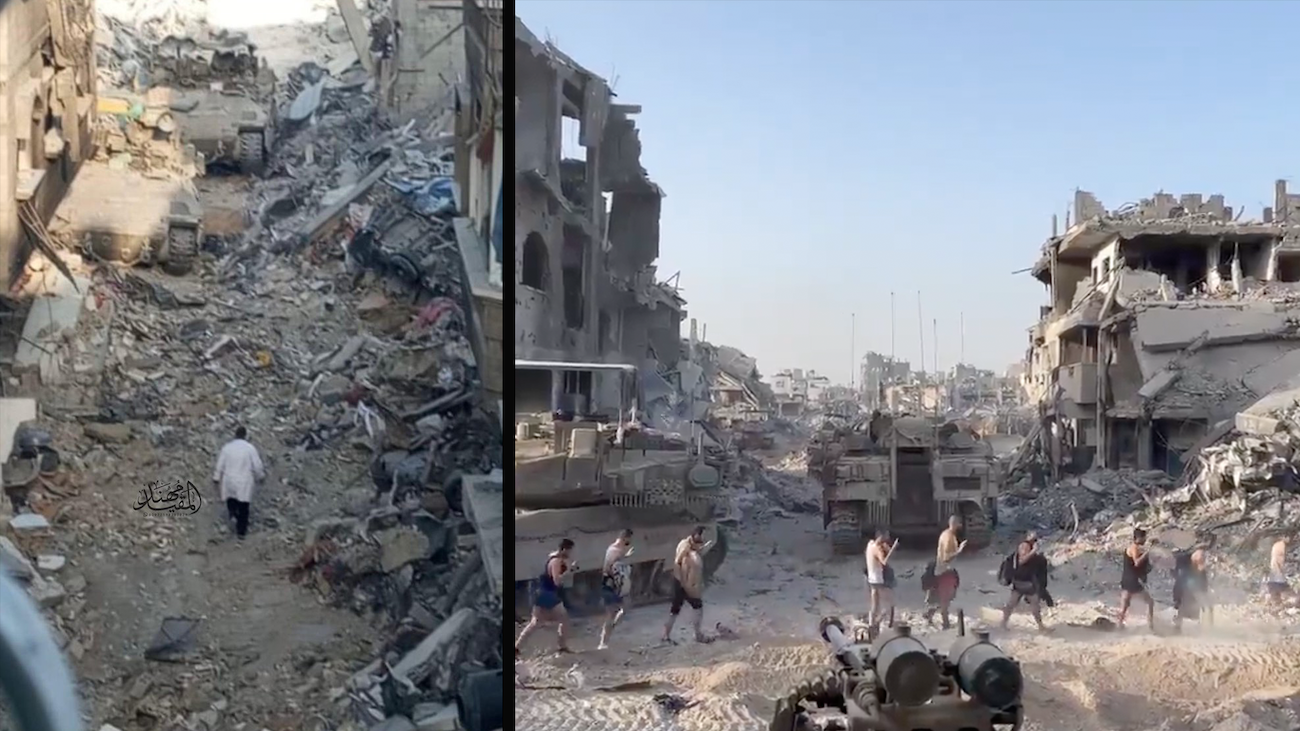
Scenes from Israel’s siege on Kamal Adwan Hospital. On the left, the last photo of Dr. Hussam Abu Safiya as he walks towards Israeli tanks. On the right, IOF forced health workers and patients to strip and evacuate the hospital. Photo: Screenshots
Despite being interrogated for 13 consecutive days, and subjected to brutal torture and abuse, a Palestinian lawyer confirmed that Dr. Hussam Abu Safiya has kept his morale high.
After over two months of imprisonment in Israeli jails, new information has been revealed about Dr. Hussam Abu Safiya, the director of Kamal Adwan hospital in Gaza. According to Palestinian lawyer Ghaid Qassem, who visited Dr. Abu Safiya last week, he has gone through long periods of sustained interrogation and torture and several prison transfers.
Dr. Abu Safiya was arrested amid a brutal siege of Kamal Adwan Hospital by Israeli forces, which culminated on December 27, when the Israeli Occupation Forces (IOF) set Kamal Adwan Hospital on fire. The IOF also ordered 350 people, including 75 patients and their escorts, along with 185 medical staff to evacuate the hospital.
In the months prior, Dr. Abu Safiya had been using his own social media page and giving interviews on local and western media in order to provide constant updates about Israel’s siege of the hospital and pleading for international institutions to take action to stop Israel’s attacks. He had become a visible spokesperson for the people of Gaza during the genocide and in particular, the healthcare workers who have faced disproportionate levels of violence as they struggled to keep the healthcare system online amid Israel’s blockade and targeted attacks.
While media reports had circulated indicating that Dr. Abu Safiya was set to be freed in the final stage of the first phase of the Hamas-Israel prisoners-for-captives swap deal at the end of February, Israel continues to imprison the hospital director, in defiance of the massive international campaign demanding his release.
Abu Safiya’s abuse and solitary confinement in Israeli detention
Prior to meeting Qassem on Thursday, March 6, Abu Safiya was only allowed to see a lawyer once throughout over two months of detention. During his imprisonment, he spent a couple of weeks in solitary confinement inside Israel’s infamous Sde Teiman detention camp, which he described as a “slaughterhouse”.
While at Sde Teiman, Dr. Hussam reported being “forcibly stripped, having his hands shackled, and being made to sit on sharp gravel for approximately five hours by Israeli forces.”
Moreover, he was subjected “to severe physical abuse, including beatings with batons and electric shock sticks, as well as repeated blows to the chest.”
The Palestinian doctor was later transferred to Ofer prison in the occupied West Bank, where he was placed in solitary confinement for 25 days, then he was moved to section 24 with other detainees from Gaza.
Qassem clarified that section 24, alongside section 23, is designated for prisoners from Gaza to keep them isolated from other Palestinian prisoners from the West Bank and the territories that were occupied by Israel in 1948.
Horrific accounts from the “slaughterhouse”
Based on Abu Safiya’s accounts, as well as other prisoners she met, Qassem described the conditions inside Sde Teiman, stating: “if we talk about this prison, it is a slaughterhouse in every sense of the word. The torture, violations, and starvation are unprecedented.”
The lawyer provided further details of atrocities practiced against Palestinian prisoners in the notorious detention facility, which included shackling prisoners for 10 months straight, denying amputees medical care, binding elderly detainees and blindfolding them.
In addition, prisoners narrated how they endure freezing temperatures in open-air cages, where they are constantly exposed to wind and rain, forced to sit on the ground, prevented from speaking, praying, or even reading the Quran.
In terms of psychological torture, Qassem was informed that the “Israeli intelligence often tells prisoners in Sde Teiman that their entire families have been killed, whether true or not”. “Such tactics leave deep psychological scars,” she said.
Israel placed Abu Safiya under “unlawful combatant” status
On February 12, the head of the IOF’s Southern Command, Yaron Finkelman, issued an order to detain Abu Safiya under the “unlawful combatant law” instead of conducting a standard legal trial,” according to the Palestinian Al-Mezan Center for Human Rights.
Qassem explained that Israeli authorities resorted to classifying Abu Safiya as an “unlawful combatant” as they could not build a case against him after failing to find any evidence against him following 45 days of interrogation.
With this classification, they stripped Abu Safiya of his basic legal rights, including representation or a formal indictment, and justified the repeated extension of his detention without charge.
Prolonged consecutive interrogation sessions and brutal torture
The testimonies of the Palestinian lawyer revealed that Abu Safiya was subjected to prolonged interrogation sessions throughout 13 consecutive days, and that each interrogation session lasted about 8 to 10 hours. Abu Safiya also experienced torture and beating, in addition to verbal and psychological abuse.
Qassem referred to the forced media appearance of Abu Safiya in an interview aired by Israel’s Channel 13, late February as evidence of the psychological abuse Abu Safiya endured.
The attorney pointed out that Abu Safiya was not aware that the interview was recorded. “He was caught off guard by the filming. He was not informed, and after the interview, he was isolated, humiliated, beaten, and tortured,” she said.
For many, the Israeli occupation authorities aimed to demoralize Abu Safiya and his supporters over the globe by filming him exhausted and shackled. Nevertheless, Qassem confirmed the steadfastness that Abu Safiya demonstrated.
Unshaken by the gross inhumane treatment and torture he suffered, the resilient iconic Palestinian doctor told Qassem: “a person creates a history, and history is built upon the stands one takes. Such history is to be recorded and taught to others.”
Genocide denier and Current UK Prime Minister Keir Starmer is quoted that he supports Zionism without qualification. He also confirms that UK air force support has been essential in Israel’s mass-murdering genocide. Includes URLs https://www.declassifieduk.org/keir-starmers-100-spy-flights-over-gaza-in-support-of-israel/ and https://youtu.be/O74hZCKKdpAUK Foreign Minister David Lammy confirms that UK government and military are active participants in Israel’s genocides and that the F-35 parts that they suspended from supplying to Israel are instead simply diverted via the United States. He says see https://youtu.be/QILgUHrdWRE
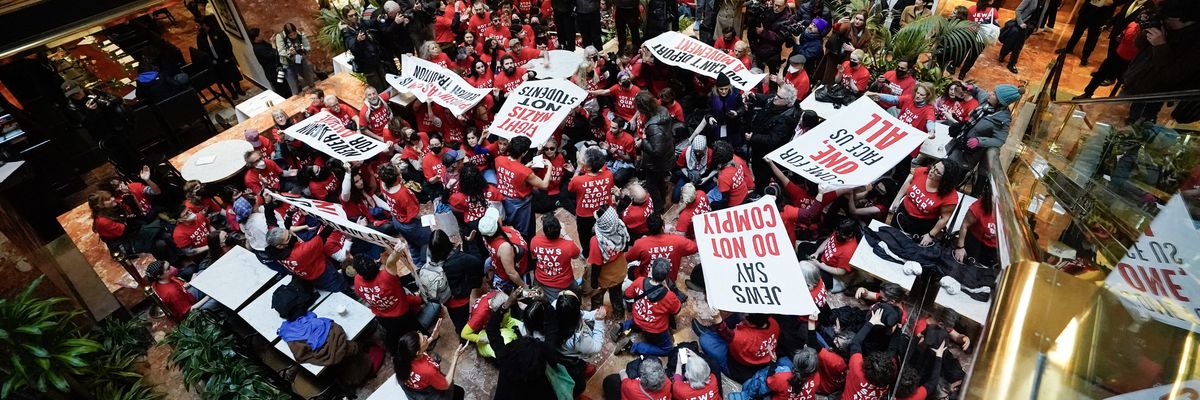
Demostrators from the human rights organization Jewish Voice for Peace hold a civil disobedience action inside Trump Tower in New York on March 13, 2025. (Photo: Timothy A. Clary/AFP via Getty Images)
“We know what happens when an autocratic regime starts taking away our rights and scapegoating and we will not be silent.”
This is a developing story… Please check back for possible updates…
Nearly a year and a half after the advocacy group Jewish Voice for Peace began leading nationwide demonstrations against Israel’s U.S.-backed assault on Gaza, hundreds of organizers and supporters of the group risked arrest Thursday as they assembled in the lobby of Trump Tower in New York City, demanding the release of Columbia University graduate Mahmoud Khalil.
“Three hundred Jews and friends in Trump Tower, because we know what happens when an autocratic regime starts taking away our rights and scapegoating and we will not be silent,” said Sonya Meyerson-Knox, communications director for Jewish Voice for Peace (JVP). “Come for one—face us all.”
The latter phrase was emblazoned on banners that were displayed by campaigners, who chanted, “Never again for anyone, never again is now!” and, “Free Mahmoud, free them all!”
New York City police officers began arresting participants in the sit-in early in the afternoon.
Jane Hirschmann, a Jewish New York resident whose grandfather and uncle were abducted by the Nazis in Germany as Adolf Hitler rose to power, said Khalil’s detention “is further proof that we are on the brink of a full takeover by an authoritarian regime.”
“As Jews of conscience, we know our history and we know where this leads,” said Hirschmann. “This is what fascists do as they cement control. This moment requires all people of conscience to take bold action to resist state violence and repression. Free Mahmoud now.”
Actors Morgan Spector, Debra Winger, and Arliss Howard were in attendance at the sit-in, along with writer and artist Molly Crabapple and New York City Council member Alexa Aviles.
Khalil was abducted by plainclothes Immigration and Customs Enforcement (ICE) agents last Saturday night as he was returning home to his Columbia-owned apartment with his wife, who is eight months pregnant. He was a graduate student at the university until this past December, and took a central organizing role in student-led protests and negotiations against Columbia’s investment in companies that profit from Israel’s apartheid policy in Gaza, including the bombardment it began in October 2023 in retaliation for a Hamas-led attack.
Khalil, a legal U.S. resident and a citizen of Algeria, was detained under the State Department’s “catch and revoke” program, with the Trump administration revoking his green card and threatening to deport him. Administration officials have admitted that they are not accusing Khalil of breaking any laws by participating in Palestinian solidarity protests, but they said he is viewed as “adversarial to the foreign policy and national security interests of the United States of America.”
After a hearing Wednesday, a federal judge is considering whether Khalil should be sent back to New York, where he was detained, from the Louisiana ICE facility where he is being held. The same judge blocked Khalil’s deportation this week.
Elon Musk urges you to be a Fascist like him, says that you can ignore facts and reality then.Neo-Fascist Climate Science Denier Donald Trump says Burn, Baby, Burn.
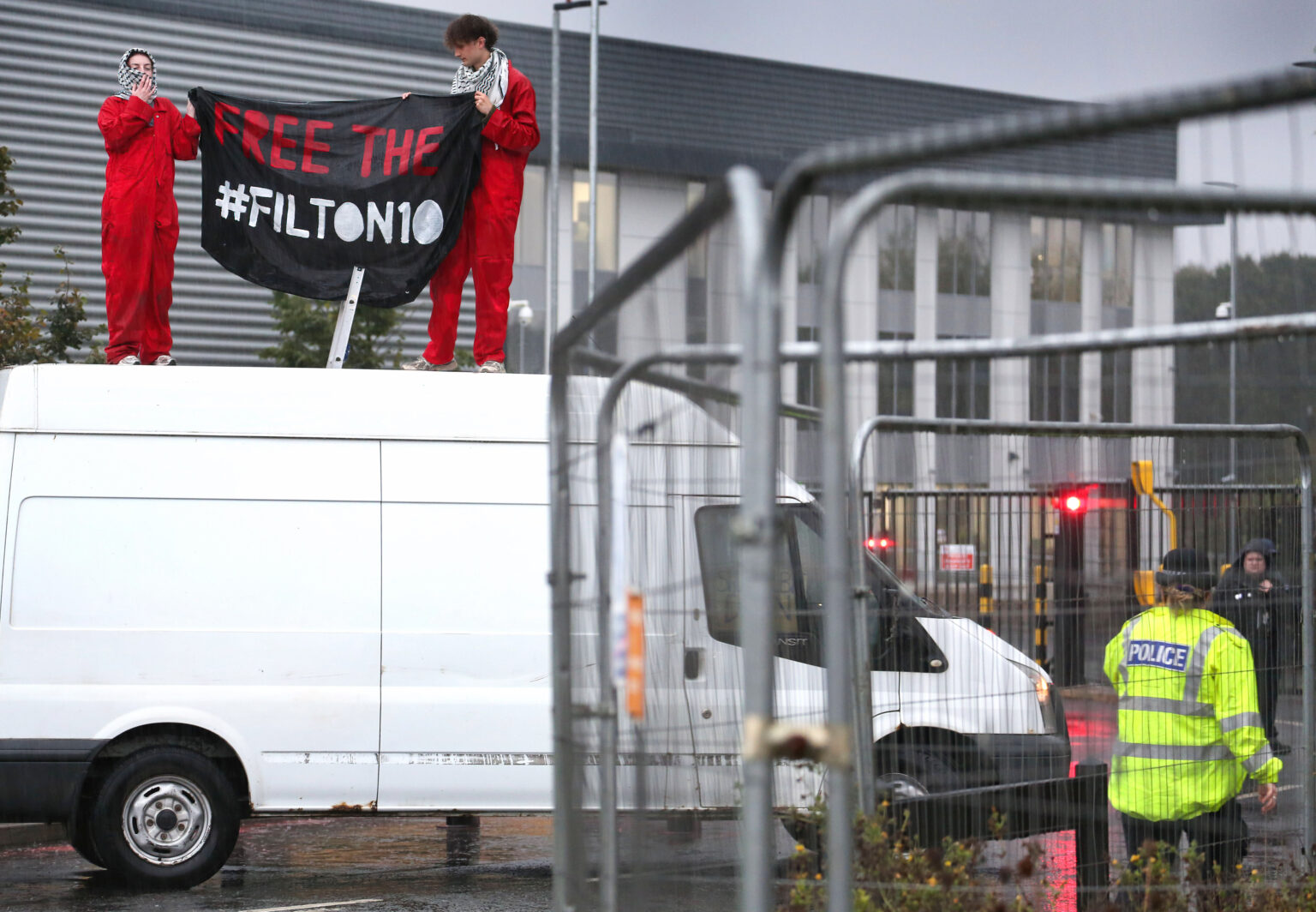
Palestine Actionists blockade the entrance roadway at the research centre of Israel weapons producer Elbit Systems at Filton, Bristol. Martin Pope/Reuters
Emma, a small business-owner living in Wales, said riot police raided her home without a warrant, despite having already arrested her daughter. “I was half naked [when they came in],” she said “They seized my work laptop, and my 16-year-old’s school laptop, handcuffed me and then led me away.”
Emma was kept by the police in solitary confinement for five days. “I disappeared from my family almost a week before they released me without charge and without apology, my life and my business upside down. I was left traumatised, in prison scrubs, 150 miles from my home, feeling like an animal. [My crime] was raising a young woman with a great moral compass.”
A spokesperson for South Wales Police said: “A complaint against police has been made which remains under investigation.”
Punished without trial.
Emma’s daughter is one of over 40 political prisoners identified by campaign group Defend Our Juries who have been jailed in the UK since July. The case of the Filton 18 has become emblematic of the UK’s increasingly repressive relationship with political activism. Advocates for the activists say the group is effectively being punished through the UK government’s abuse of counter-terrorism measures in a desperate bid to deter Palestine Action from targeting Elbit.
The controversy has reached parliament. In a Westminster Hall debate in December, John McDonnell MP made a rare, impassioned intervention on the Filton 18’s behalf, saying: “A number of them most probably will be proved innocent, but they’ll have served nearly two years in prison – for what? For trying to do what we’re failing to do – preventing this government supplying arms to a regime that’s killing children.”
In November, United Nations observers wrote to the head of the UK Mission to the UN in Geneva, Simon Manley, about the case. The activists appear to have been arrested under counter-terrorism legislation “for conduct that appears to be in the nature of ordinary criminal offences and does not appear to be genuinely ‘terrorist’ according to international standards”, the observers said. In late January, the government responded saying it would not be appropriate to comment while criminal proceedings are ongoing.
The measures taken against the Filton 18 are an escalation from the British state, especially with regards to Palestine Action. For four years, actions by those associated with the group were prosecuted using non-terrorism related charges, meaning they were released on bail before their trial. “[But now that] they’re being tagged and held in remand in connection to terrorism, suddenly the courts are very cautious of giving bail,” said Simon Pook, a lawyer at Robert Lizar, the firm defending the Filton 18. Pook spoke with Novara Media in general terms, not specifically about the Filton 18.
“When people are arrested under terrorist legislation, they are held in a remand space that is separate from the standard criminal cell. It’s very sterile and intentionally isolating, detaining you in confinement for up to seven days in what I view to be an immensely tortured position,” said Pook.
…
For Pook, there’s a concerning continuity between the overzealous anti-protest laws brought in by the previous Tory administration and the current Labour one. “Our civil liberties are in grave danger under the current process that is labelling activist groups as terrorist suspects, as first rolled out by the Conservatives and now Labour,” he said.
While the Filton 18 languish in prison being treated like terrorists, they will not be charged for terrorism, per se. The CPS intends instead to argue a “link with terrorism”. This loose “link with terrorism” charge is a new development in the UK’s legal landscape, but one that echoes the mistreatment of the Irish community in the 70s, 80s and 90s. “It’s a very chilling moment,” said Pook.
“I remember when the UK government called the Irish a ‘suspect community’. They were labelled as terrorists through similar processes we’re seeing today, detained at airports and ferry ports under the Prevention of Terrorism Act. The UK government is moving us to the point where activists are suspects, criminalising the rights of protest. This causes me grave concern.”
Pook also points to the lobbying power of the arms and fossil fuel industries – and the geopolitical interests attached to those mammoth sectors. “If the government wants those industries to develop, they’ve got to curtail opposition to it.”
Freedom of Information disclosures show that in recent years, Elbit held multiple meetings and conversations with UK ministers and the attorney general’s office (AGO), which oversees the CPS. (The AGO told Novara Media: “We do not provide a running commentary on who the AGO holds meetings with or how many.”)