Members of the Abed family warm up by a fire at a tent camp for displaced Palestinians in the Mawasi region, Rafah, southern Gaza Strip, February 24, 2025
FEARS grew today that Palestine’s population may once again be on the verge of starvation following a week-long Israeli blockade.
Israel imposed the siege to try to force Hamas to accept a different ceasefire deal to the one agreed in January.
It blocked the entry of aid shipments to Gaza on Sunday, hours after the ceasefire deal’s first phase had expired, sparking fears of hunger and more hardships during the holy month of Ramadan, which began over the weekend.
Hamas spokesman Abdel-Latif al-Qanou said Israel is pursuing “a policy of starvation and collective punishment” in Gaza by keeping land crossings closed and preventing the entry of crucial aid.
The siege is a “flagrant violation of international and humanitarian laws and a war crime that the world must stop and hold its perpetrators accountable,” he said.
“We renew our call to the international community, all human rights and humanitarian institutions and all free people of the world to force the zionist occupation to open the crossings, bring in relief and medical aid – and end the suffering of our people.”
The deal stipulated that negotiations on the second phase should have begun on day 16 of the first phase. However, Israel has deliberately obstructed second phase negotiations for about four weeks.
As the first phase of the deal was approaching its end, Netanyahu suspended the release of the seventh batch of Palestinian prisoners on February 23 for multiple days.
The head of the Israeli government used what he called “Hamas’s humiliating ceremonies” while releasing Israeli captives in the Gaza strip as a pretext for the suspension.
However, analysts suggested that Netanyahu only resorted to that claim in order to extend the first phase of the deal and therefore secure the release of more Israel captives before moving to the next phases.
After the intervention of mediators and guarantors of the deal, namely Qatar and Egypt, Hamas did consider the cancellation of the ceremonies, in order to undermine Netanyahu’s plans to sabotage the deal. As a result, the seventh and final batch of Palestinian prisoners was released late Thursday, February 27.
Backed by the US, Netanyahu bans humanitarian aid as a tool of war
Left in the lurch by Hamas’ flexibility, Netanyahu ordered the closure of all crossings into Gaza, blocking the entry of humanitarian aid and supplies into the war-torn besieged enclave on Sunday, March 2. His order came one day after the first phase of the deal had elapsed.
On Monday, March 3, Netanyahu warned that Israel might return to war with Gaza if Hamas did not return Israeli captives held in the Gaza strip.
Addressing Hamas, while speaking to the Israeli Parliament, Netanyahu said: “there will be consequences that you cannot imagine” if Israeli captives were not released.
The threats from the head of the Israeli government came days after a proposal was put forward by Trump’s “Middle East” envoy Steve Witkoff, for a temporary ceasefire during the Muslim’s holy month of Ramadan and the Jewish Passover.
Witkoff represented the proposal as an in-between phase, which stipulated that half of the remaining Israeli captives in Gaza, both living and deceased, would be freed on the first day of the proposed phase.
Netanyahu agreed to the proposal as it appeared to align with his plans, but Hamas categorically rejected it, saying it bypasses previously signed agreements.
The Israeli Prime Minister threatened to resume the war and banned humanitarian aid into Gaza just before the Emergency Arab Summit on Gaza was held in Egypt on Tuesday, March 4. The summit aims to put forward a unanimous proposal for ruling and reconstructing post-war Gaza, without displacing Palestinians.
Analysts suggest that Netanyahu has recently increased pressure on Hamas in an attempt to force concessions, such as accepting demilitarization and Trump’s reconstruction plan for Gaza, which primarily aims to displace Palestinians.
Trump’s administration has been fueling Netanyahu’s bravado while sabotaging the ceasefire deal, not only by providing diplomatic cover but also by sending further military aid to Israel.
The US announced on Saturday that it will expedite the delivery of approximately USD 4 billion in military assistance to Israel. US Secretary of State Marco Rubio has stated that nearly USD 12 billion in major foreign military sales to Israel were approved since Trump took over in January.
Rubio reaffirmed that the US “will continue to use all available tools to fulfill America’s long-standing commitment to Israel’s security, including means to counter security threats.”
Hamas documents 962 Israeli violations of the ceasefire agreement
In a televised speech, Senior Hamas leader Osama Hamdan described Netanyahu’s ban of humanitarian aid into Gaza and threats to return to war as “cheap blackmail” which aims to avoid starting negotiations for the second phase.
“Israel is pushing to return matters to ‘square one’ by proposing alternatives to the Gaza ceasefire agreement such as extending the first phase of the deal,” Hamdan stated.
The senior official listed 962 violations of the Gaza ceasefire and captives-for-prisoners swap deal committed by Israel during the first phase of the deal.
Military advances
According to Hamdan, the violations included almost daily advances beyond agreed-upon withdrawal lines, gunfire, killings of civilians, home demolitions, land bulldozing, and preventing displaced persons from returning for two full days. These violations resulted in killing 116 Palestinians and injuring 490 others.
Blocking humanitarian relief
Israel has resumed its wartime policy of blocking crucial humanitarian aid and relief trucks. While the agreement stipulated the entry of 50 fuel trucks daily, instead, an average of 23 trucks per day were allowed to enter throughout 42 days.
Obstructing infrastructure recovery and reconstruction
Palestinians in Gaza are in urgent need of dwelling amidst the mass destruction inflicted by Israel across the besieged strip. Yet only 15 mobile homes “out of the 60,000 agreed upon, were allowed to enter in addition to a limited number of tents.”
Israel has also prevented the entry of heavy machinery necessary “for clearing rubble and recovering bodies. While at least 500 machines are needed to accomplish the mission, only nine machines were allowed in.
The senior Palestinian official added that Israel banned the commercial sector from importing fuel of all types, “despite an explicit provision in the agreement permitting this.”
Construction materials needed for infrastructure rehabilitation and hospital restoration and essential medical equipment to rehabilitate hospitals, were blocked from entering Gaza. Moreover, civil defense equipment has been among the banned items.
Operation of the power plant and the entry of necessary supplies for its rehabilitation, were also prevented. Even the entry of cash liquidity into banks has been blocked, and the exchange of damaged currency notes has been refused.
Targeting fishermen and airspace violations
The Israeli Occupation Forces (IOF) prevented Palestinian fishermen from returning to the sea, shooting at them, and arresting some. The IOF’s aircrafts and drones operated during prohibited hours (10–12 hours daily), with 210 violations recorded.
Delaying prisoner releases
The deliberate delay in releasing Palestinian prisoners in the first phase, along with their humiliation and mistreatment, was also included in the list of violations.
Stalling negotiations
Hamdan emphasized that the deliberate delay in starting the negotiations of phase two, is a major political violation of the deal. He blamed the mediators and guarantors of the deal for the delay, saying that they “bear full responsibility for preventing Netanyahu from sabotaging all the efforts made to reach the agreement and for protecting the agreement from collapse.”
Regional and global implications
The senior Hamas leader pointed out that “international security and stability are now at risk in light of absolute US support for the Zionist entity and the international silence that remains unmoved” by Israel’s “lawlessness”.
“Israel threatens to resume the genocidal war against our people, escalates its aggression in the West Bank, continues its aggression on Lebanon, and wages a brutal attack on Syria as well. The consequences of this will not be limited to our people and our nation,” Hamdan warned.
In a message to Netanyahu that the movement will never accept his demilitarization plans, Hamdan concluded his speech using a phrase usually used by Abu Obaida, the military spokesperson of Al-Qassam Brigades, the military wing of Hamas. Hamdan declared: “It is jihad of victory or martyrdom.”
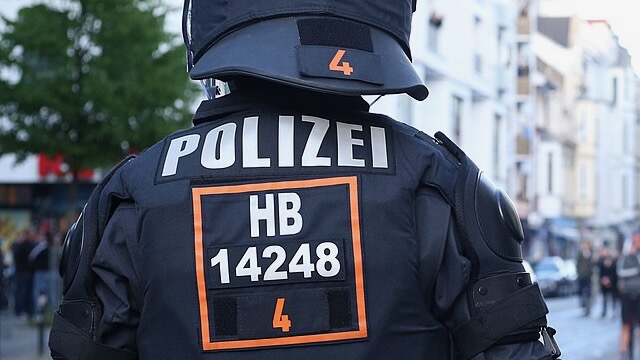
Armed state policeman in Bremen, Germany. Photo: Wikicommons
The German state has unleashed a fierce and sweeping crackdown on the Palestine solidarity movement in the country.
Germany’s policy of harsh repression of any expression of solidarity with Palestine and the struggle of the Palestinian people has continued unabated. In their attempt to silence all mentions of Palestine, German authorities have canceled events, censored activists and academics, violently repressed protests, and passed new legislation to further undermine support for Palestine solidarity.
However, despite their best efforts, people in Germany continue to defy what they see as illegitimate bans on speech and activity, and continue to express support for the Palestinian cause.
2024 ends with new attacks
In November 2024, the German parliament had passed a so-called “antisemitism resolution,” which though non-binding, sought to stifle any domestic activity to discourage participation in pro-Palestine movements.
At the beginning of December, Ramsis Kilani was expelled from the Left Party (Die Linke). The young Palestinian, who lost his father, stepmother and five siblings–ages four through twelve–in an Israeli attack in the Gaza Strip in 2014, was accused of “relativizing Hamas terror, selectively criticizing violence against women as a weapon of war, and rejecting Israel’s right to exist.”
Two weeks later, an “anti-colonial and peace Christmas market” in the west German city of Darmstadt provided the opportunity for several well-known politicians, the media, the local chapter of the “Central Council of Jews in Germany” and “concerned” evangelicals to file criminal charges and even make death threats towards the local Palestine group and church congregation that were jointly responsible for the Christmas market.
A raid to ban a no-longer-existing solidarity group
Less than a week later, on January 22, the police stormed several apartments in Frankfurt and Darmstadt. The reason given was to secure evidence to help ban the association “Palästina e.V.” However, the group had already dissolved in November 2024 and no longer existed.
Hitting children costs 800 euros
On January 24, a court dropped a case against a teacher who had punched a 16-year-old student in the face at a school in the Neukölln borough of Berlin on October 9, 2023. The teenager was attacked for bringing a Palestinian flag to school and displaying it in the playground. The fine for a teacher physically assaulting a minor in public was set by the court at just 800 euros. While the teacher has been on sick leave ever since–i.e. presumably on vacation–the student had to change schools. It is still unclear whether legal action will be taken against the student, for responding to the teacher’s assault by kicking him.
Further professional bans are being prepared
In line with the above court decision, the following week the German parliament passed a resolution that was ostensibly directed against “antisemitism and hostility towards Israel in schools and universities.” In reality, it was an addition to–and tightening of–the previous antisemitism resolution of November 2024. However, unlike the earlier resolution, this parliamentary motion received hardly any public attention and so the relatively broad criticism that had been voiced in October and November, which had extended into bourgeois circles, failed to materialize.
The new resolution is a massive attack on the freedom of research and science in Germany. It promotes the cooperation of teaching institutions with repressive and surveillance authorities, and new professional bans (Berufsverbote), which have a long and dark anti-communist tradition in the Federal Republic of Germany.
Arabic? Forbidden!
At the beginning of February, the Berlin police issued language restrictions for Palestine demonstrations: speeches, posters, slogans and music are only allowed in the German or English language. This is, therefore, a de facto ban on Arabic. This measure is not entirely new: in the last two years there have already been such bans imposed on Palestine demonstrations in various cities. In the summer of 2024, at the Palestine camp in front of Berlin’s Reichstag, Hebrew was banned alongside Arabic. What is new is that the Berlin authorities have declared that this ban applies to all gatherings in the German capital “until further notice.”
Palestinians to be deported
On the evening of February 12, two Palestinians from Gaza were arrested and detained in Berlin: the young men were to be deported to Greece the next day. After protests in Berlin, numerous angry calls to the Greek airline that was to carry out the deportation, and legal intervention, the deportation was apparently postponed. With its “asylum compromise” in 1993 (the de facto removal of the basic right to asylum from the German constitution) and the Dublin II Regulation of the European Union in 2003, the Federal Republic of Germany created the legal basis for deporting almost all asylum seekers to “safe third countries.” As an EU member state, Greece is considered a “safe third country,” however Greek camps are notorious for their inhumane living conditions, which is why a suspension of deportation seems realistic.
The two victims are said to come from Khan Younis and to be well-known for their activism against the Gaza genocide. The right-wing Springer press called them “conductors of the Palestinian protests” in Berlin and in its usual racist manner, described them as “clan” members. They are not the first Palestinians to be affected by deportations since October 7, 2023. The German state appears to be using its racist policies not only to divert attention from grievances and to divide the population, but also to get rid of political opponents who are standing up against racism, war, and genocide.
Another “scandal” at the Berlinale
This year’s Berlinale, which took place in Berlin from February 13 to 23, made headlines in the German mainstream media due to alleged “antisemitism scandals.” The Chinese director Jun Li read out a speech by Iranian actor Erfan Shekarriz, in which he said that millions of Palestinians were suffocating under Israel’s brutal settler colonialism. He accused the Federal Republic of Germany of supporting the genocide of the Palestinians. The Scottish actress Tilda Swinton, who was awarded the Honorary Golden Bear for her life’s work, declared her respect for the BDS movement at the press conference. Once again, the German media handled these statements in a scandalous manner, while the Central Council of Jews in Germany ranted about the voicing of “Hamas slogans”.
Preparations for further ban on solidarity group
At the same time, a newspaper article revealed that the German domestic intelligence service (Verfassungsschutz) in the east German state of Saxony is apparently monitoring the Leipzig-based “Handala” solidarity group. Although this group has appeared in the intelligence service’s regional report since 2023, the state of Saxony’s Ministry of Science is now also keeping an eye on it, as some of its members allegedly work at Leipzig University. The domestic intelligence service categorizes Handala’s solidarity work as a form of “secular foreigner extremism,” claiming it’s “particularly opposed to the idea of international understanding” (Völkerverständigung) and shows solidarity with Hamas.
The last two accusations are alarming because last summer, the group “Palestine Solidarity Duisburg” (PDSU) was banned by North Rhine-Westphalia state’s Ministry of the Interior on the basis of exactly the same unfounded allegations. The repressive Saxony authorities thus appear to be preparing for a ban on Handala by first creating a favorable mood in the ministries and the bourgeois media.
No stage for the UN Special Rapporteur
Most recently, two events of the UN Special Rapporteur for the Occupied Palestinian Territories, Francesca Albanese, in Munich and Berlin were canceled due to political pressure. Albanese was supposed to speak at the Ludwig-Maximilians-Universität in Munich on February 16 and at the Freie Universität (“Free University”) of Berlin on February 18. After the second venue was canceled on short notice, the event was still able to take place in the editorial offices of the left-wing daily newspaper Junge Welt. Though the event was not shut down, as was the Palestine Congress last year, the police followed the example set in Duisburg in December 2023. There, authorities had declared a discussion featuring Zaid Abdulnasser and myself a “closed-door meeting,” surrounded the venue with police cars, and insisted that the state security forces had to attend in order to be able to “intervene.” This is what happened this time in Berlin, too.
Austria: An impending party ban and a “Hamas journalist”
In Germany’s neighboring countries, things are also looking anything but good when it comes to freedom of expression in connection with Palestine.
In Austria, for example, the right-wing FPÖ and the conservative ÖVP are apparently planning to ban the “Gaza List,” which was founded last year and took part in the National Council elections in September 2024. In addition, the British journalist Richard Medhurst was arrested in Vienna at the beginning of February: according to his report, he was summoned by the Austrian immigration authorities, but was confronted on the spot by secret service agents who showed him a search warrant and then drove him to his apartment and confiscated his technological devices. The accusation against the journalist, who has lived in Austria for years, was “membership of Hamas,” or the Izz al-Din al-Qassam Brigades, the armed wing of Hamas. He was threatened with ten years in prison.
Switzerland: Journalist arrested and deported
Ali Abunimah, the journalist and managing director of the internationally renowned online independent news media outlet The Electronic Intifada, was arrested in Switzerland on January 25 and subsequently deported after two nights in custody. Abunimah had been invited to give a lecture. He had already been questioned for an hour by the authorities when he arrived at Zurich airport the day before his arrest. During his detention, he was questioned in the absence of a lawyer and was denied the right to call his family, as he reported after his release. It later became known that the Zurich cantonal police had submitted an application to the Swiss national authorities to ban the journalist from entering the country. However, they had rejected the request. Apparently, massive pressure was then exerted to get the ban passed on the second attempt–this time successfully. According to the Tages-Anzeiger, Mario Fehr was also involved. The right-wing Social Democrat and law-and-order hardliner is a well-known supporter of Israel. He publicly described Abunimah as an “Islamist Jew-hater” and accused him of inciting violence.
France: ban on solidarity group and life imprisonment
French courts dealt the Palestine solidarity movement two blows at once on February 20. First, the ban on the “Collectif Palestine Vaincra,” which was issued in March 2022 and provisionally suspended in April of the same year, has now been upheld. The organization thus meets the same fate as “Samidoun” and Palestine Solidarity Duisburg in Germany, which were banned in November 2023 and May 2024 respectively. Secondly, on February 20, it was decided to postpone the appeal hearing on the release of Georges Ibrahim Abdallah until June, because France’s “National Anti-Terrorist Prosecutor’s Office” lodged an objection. The Lebanese communist and pro-Palestinian freedom fighter has been in a French prison for 40 years and was originally due to be released on December 6, 2024.
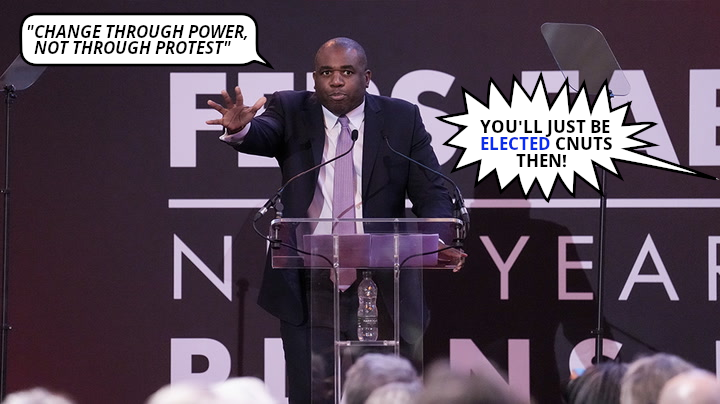
UK Labour Party Shadow Foreign Secretary repeatedly heckled at a speech to the Fabian Society over his and the Labour Party’s support for and complicity in Israel’s genocide of Gaza.
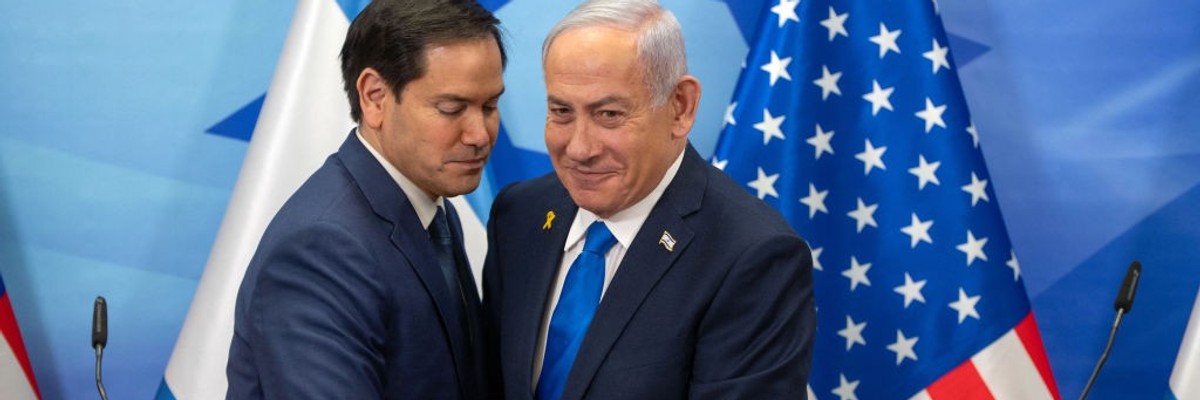
U.S. Secretary of State Marco Rubio (left) and Israeli Prime Minister Benjamin Netanyahu (right) greet each other during a joint press conference in Jerusalem on February 16, 2025. (Photo: Ohad Zwigenberg/Poll/AFP via Getty Images)
Israel is being investigated for alleged genocide at the International Court of Justice, and Israeli Prime Minister Benjamin Netanyahu is a fugitive from the International Criminal Court.
In a Tuesday phone call with Israeli Prime Minister Benjamin Netanyahu, U.S. Secretary of State Marco Rubio highlighted the Trump administration’s staunch support for Israel—which includes $4 billion in fresh fast-tracked military assistance—even as the key Mideast ally cuts off lifesaving humanitarian aid to Palestinians in the flattened Gaza Strip.
U.S. State Department spokesperson Tammy Bruce summarized Rubio’s call with the right-wing Israeli leader, who is wanted by the International Criminal Court (ICC) for alleged war crimes and crimes against humanity in Gaza:
Rubio spoke with… Netanyahu to underscore that the United States’ steadfast support for Israel is a top priority for President [Donald] Trump, as shown by the recent announcement to expedite the delivery of nearly $4 billion in military assistance to Israel. The secretary thanked the prime minister for his cooperation with Special Envoy Steve Witkoff to help free all remaining hostages and extend the cease-fire in Gaza. The secretary also conveyed that he anticipates close coordination in addressing the threats posed by Iran and pursuing opportunities for a stable region.
Rubio’s call with Netanyahu, which followed the Republican secretary of state’s visit to Israel last month, came just two days after Netanyahu’s government halted all humanitarian aid from entering Gaza. People there are reeling after 15 months of Israeli bombardment, invasion, and siege that have obliterated the coastal enclave, killing at least 48,405 Palestinians, wounding more than 111,000 others, and forcibly displacing, starving, or sickening nearly all of the strip’s approximately 2.3 million people, according to local and international agencies.
Netanyahu said the aid suspension was carried out “in full coordination with President Trump and his people.”
On Monday, Israeli Defense Minister Israel Katz threatened that “the gates of hell will be opened” on Gaza if Hamas, which rules the strip, does not free the dozens of Israeli and international hostages it kidnapped on October 7, 2023. Hamas has delayed their release due to what it claims are hundreds of Israeli violations of a January cease-fire agreement, including deadly attacks on civilians and the aid cutoff.
Katz, Netanyahu, and other Israeli leaders are among those named in an incitement to genocide complaint filed in January at the ICC by Israeli attorney Omer Shatz. Israel is also under investigation for alleged genocide at the International Court of Justice.
Bruce’s description of the Rubio-Netanyahu call does not mention the Palestinians or Gaza.
Last month, Trump proposed a U.S. invasion and takeover of Gaza, which would be ethnically cleansed of Palestinians and transformed into what the president described as “the Riviera of the Middle East.”
Neo-Fascist Climate Science Denier Donald Trump says Burn, Baby, Burn.Elon Musk urges you to be a Fascist like him, says that you can ignore facts and reality then.
Trucks line up at the Egyptian side of the Rafah border crossing between Egypt and the Gaza Strip after Israel blocked the entry of aid trucks into Gaza, March 2, 2025
THE United Nations food agency only has enough supplies in the Gaza Strip to keep public kitchens and bakeries open for less than two weeks, the body said today.
Israel has imposed another blockade on Gaza to pressure Hamas into accepting an alternative ceasefire arrangement, six weeks into their fragile truce.
Israel allowed a surge of humanitarian aid during the first six weeks of the ceasefire. But the World Food Programme said on Wednesday that its stocks are low because it prioritised delivering food to the population.
The UN agency also warned that its fuel stocks would only last for a few weeks.
Palestinians said prices spiked as people rushed to markets to stock up on supplies after Israel announced the tightening of its blockade.
After more than 16 months of war, Gaza’s population is entirely dependent on deliveries of food and other aid. Most are displaced from their homes, and many need shelter.