How the DWP fought to withhold evidence its policies kill disabled people

Image of cash and pre-payment meter key

Original article by China Mills republished from Open Democracy under a Creative Commons Attribution-NonCommercial 4.0 International licence

The welfare system has taken another hit today via a ‘benefits crackdown’ in Jeremy Hunt’s autumn statement. Since the ‘welfare reform’ of 2007, disabled people have been on the receiving end of these dehumanising and punishing policies that make people out as ‘undeserving’, prioritise work over people, and make life unlivable.

But we now have evidence the Department for Work and Pensions (DPW) knows its policies kill people. It has been repeatedly warned of this fact and has even confirmed it in its own research.

It took years of campaigning by disabled people to uncover this evidence, which largely comes in the form of DWP reviews into deaths of claimants.

Now it has been brought together as part of the Deaths by Welfare project at Healing Justice London. Since 2021, journalist John Pring and I have been creating a timeline – co-produced with disabled people – showing the links between welfare policy and disabled people’s deaths.

It also shows that not only is there often a delay between the introduction of a policy and the brutal impact it has on people’s lives, but that delay tactics are central to DWP’s weaponisation of time as a strategy to avoid accountability.

To make matters worse, most families of those who have died do not even know if a review has been carried out into their loved one’s death because the DWP has always argued this is private information – an argument found by an Information Rights Tribunal to be an error in law – and can’t be shared, not even with families.

The first family to see an IPR was Philippa Day’s. Philippa, known as Pip, took her own life in 2019 after her disability benefits were stopped.

Before she died, she told her sister that she knew the assessment system was going to kill her: “She felt that they were pressuring her to kill herself, she felt that she didn’t matter because she was disabled”.

In January 2021, the coroner at the inquest into Philippa’s death found 28 separate “problems” with the administration of the Personal Independent Payment (PIP) system contributed to her death – concluding these were not individual errors by DWP and its private sector contractor Capita but systemic flaws.

Pip’s sister Imogen told us, in an interview for the Deaths by Welfare podcast, that seeing the IPR “silenced my night-time questions, right before I was going to sleep… It made it incredibly clear that we as a family had done everything that we could have done, and that it was a governmental system that had let her down”.

“I really feel for families that still don’t have answers,” she said.

And Pip is not alone. It would later come to light, after a sustained (and continuing) Freedom of Information battle, that between 2014 and 2022, the DWP carried out approximately 220 of these reviews – formerly called peer reviews, now internal process reviews (IPRs).

After finally obtaining redacted versions of some of these, we found evidence of persistent and systemic issues across welfare policy, and evidence that welfare policy is life-threatening. The reviews also contained hundreds of recommendations, which the DWP has admitted having no system for tracking.

What makes DWP reviews into what it calls the ‘death of a customer’ important is that they are (supposedly) tools through which the DWP investigates the harms of its own policies. And yet, they are designed and carried out in a way that systemically hides any state accountability. And delays in releasing the reviews is another way the department can avoid being held accountable.

What we have discovered has been learnt slowly, largely through a mixture of FOIs, parliamentary questions, queries to the DWP press office and documents released through court cases or inquests. Many of the FOIs have been submitted by Disability News Service over the last nine years.

This battle has revealed that policy is seen to be outside the scope of such reviews and that findings are ‘not be shared outside of the department’.

An investigation by the National Audit Office (NAO) on the information the DWP holds on benefit claimants who ended their lives by suicide, found the DWP does not identify patterns between people’s deaths, meaning that “systemic issues which might be brought to light through these reviews could be missed”.

The NAO also found access to the reports is restricted to the team handling them and the recommendations are not tracked or monitored, meaning the DWP “does not know whether the suggested improvements are implemented”.

These recommendations include repeated warnings that policies to assess people for out-of-work disability benefits were putting the lives of “vulnerable” claimants (likely to be mostly people with mental health conditions or learning difficulties) at risk.

Yes, the DWP’s own investigations were identifying policies as potentially life-threatening. The IPRs also showed a recurring pattern of staff failure to follow DWP’s suicide guidance, which was introduced in 2009.

Tactics used to delay the release of information include claims by the DWP that the time required to collect data, due to lack of centralised record-keeping, was too costly and not in the public interest.

This was used under Thérèse Coffey to block requests about how many inquests relating to benefits claimants who died by suicide her department had submitted evidence to, as well as requests to find out how many inquests had ruled DWP policies were partly responsible for the deceased person’s state of mind. In both of these cases, the information wasn’t shared due to “disproportionate cost”.

These reviews should be publicly available by default, and the DWP should be held publicly accountable to making the changes required.

Yet it may be that the IPR process is by design unable to apprehend government accountability in people’s deaths. IPR findings and recommendations come from within the system that kills people, and therefore may never be enough for full accountability or justice. While some ascribe people’s deaths to flaws in a system that needs reform, others see them as endemic to a system that needs dismantling and creating anew, with disabled people, and the analysis developed through lived experience, at the core.

Original article by China Mills republished from Open Democracy under a Creative Commons Attribution-NonCommercial 4.0 International licence

Continue ReadingHow the DWP fought to withhold evidence its policies kill disabled people

Coventry Labour MP brands her own party institutionally Islamophobic and demands review

https://www.coventrytelegraph.net/news/coventry-news/coventry-labour-mp-brands-party-28146512

Zarah Sultana says an independent review needs to be held after she said her party was institutionally Islamophobia

Keir Starmer sucking up to the rich and powerful at World Economic Forum, Davos.
Keir Starmer, leader of the UK Labour party sucking up to the rich and powerful at World Economic Forum, Davos.

A Coventry Labour MP has accused her own party of being institutionally Islamophobic. Zarah Sultana made the claim in an interview after the majority of her Labour colleagues voted against a ceasefire in Gaza in the House of Commons.

The Coventry South MP gave an impassioned speech during the debate and voted for a Scottish National Party amendment, which called for an “immediate humanitarian ceasefire”. But this was not carried, despite more than 50 Labour MPs backing it – and Sir Keir Starmer ordered his party MPs not to support it amid concerns it would allow Hamas to regroup while halting Israel’s offensive.

Speaking to Novara Media, the Coventry South representative demanded a review into Islamophobia in her party. It was during a conversion about the Forde report, which found serious discrimination problems within the Labour party.

READ MORE: Two major rule changes coming into force in Coventry

This included evidence incidents of racism, sexism, antisemitism and islamophobia. She said “nothing serious has been done about these issues”.

Asked about Islamophobia in the party, she told Novara Media: “The Labour Party has a problem and I would go as far as saying it is institutionally racist because this isn’t just my individual experience or the experience of members. It crosses through to the briefings that come out, the kind of language that is used, the policies that we’re willing to say are fine and acceptable.”

https://www.coventrytelegraph.net/news/coventry-news/coventry-labour-mp-brands-party-28146512

Continue ReadingCoventry Labour MP brands her own party institutionally Islamophobic and demands review

‘This is not a plan for rebuilding Britain’

https://morningstaronline.co.uk/article/this-is-not-a-plan-for-rebuilding-britain

Image of Jeremy Hunt and David Cameron
Jeremy Hunt and David Cameron.

Tory Chancellor Jeremy Hunt uses Autumn budget to back bosses and attack the most vulnerable

TAX cuts for business while squeezing the most vulnerable are at the heart of the Tory re-election strategy, Chancellor Jeremy Hunt’s Autumn Statement revealed today.

The Chancellor focused on placating angry Conservative activists but offered little to millions struggling with the cost-of-living crisis in slow-growth Britain.

He took particularly aim at benefit claimants suffering sickness or disability with draconian measures designed to force them off welfare if they do not accept jobs that may be either unsuitable or non-existent.

Mr Hunt said that if, after seeking a job for 18 months, a claimant has still not found work they will have to take part in a compulsory work placement and if they “choose not to engage with the work search process for six months, we will close their case and stop their benefits.”

Clearly showing the class nature of his calculations, Mr Hunt boasted that he was ordering “the biggest business tax cut in modern British history” by making permanent a 25 per cent tax deduction for companies that invest in plant and equipment.

In other business-ordered moves, he extended tax relief on firms in special freeports or investment zones, which are themselves to be increased in number.

Desperate to revive the Tories’ bleak electoral prospects, the Chancellor surprised MPs by ordering a 2 per cent cut in employee National Insurance payments, to 10 per cent, which will save the average employee around £450 a year.

Nevertheless, the overall tax take in the British economy is still heading towards a post-war high of 37.7 per cent of GDP, according to the Office for Budget responsibility (OBR).

https://morningstaronline.co.uk/article/this-is-not-a-plan-for-rebuilding-britain

This blog has featured articles by Morning Star often. Morning Star is imposing a paywall system in an apparently inconsistent manner so that it is uncertain whether this blog will continue featuring it’s articles. 24/11/23 No further Morning Star articles will be featured unless they are accessible without charge. Paywalls are avoided for myself and this blog’s audience.

Continue Reading‘This is not a plan for rebuilding Britain’

Five Key Narratives to Watch For at COP28

Original article republished from DeSmog.

Here’s DeSmog’s take on what to expect at this year’s climate summit, from Big Oil’s influence, to a new Big Ag agenda, to promotion of sketchy solutions that would keep oil and gas burning for decades to come.

The United Arab Emirates’ pavilion at COP27. Credit: Adam Barnett

The annual United Nations climate negotiations are just a week away. Known as COP28 — since it’s the 28th year of the “conference of the parties” to the United Nations climate agreement — it will be hosted by the United Arab Emirates in Dubai from November 30 through December 12. 

COP28 will be especially significant, as it will feature the first-ever “global stocktake,” of how much progress — or lack thereof — countries and other stakeholders have made toward meeting the goal established in 2015’s Paris Agreement of limiting warming to “well below” 2º degrees Celsius. 

Negotiators at COP28 will also aim to make progress on key climate issues including loss and damage finance, a just energy transition, and closing the emissions gap.

As the climate crisis accelerates, so, too, do efforts by the fossil fuel industry to derail steep reductions in carbon pollution by mid-century, in part by promoting false solutions. Below, we’ve rounded up recent coverage to help you make sense of the key denial and greenwashing narratives that will be front and center during the event.

A Big Presence from Big Oil

After all, this is the first annual climate conference with a Big Oil exec at the top: COP28 President Sultan Ahmed Al Jaber

Al Jaber, the person leading these global climate negotiations, is the CEO of the Abu Dhabi National Oil Company (ADNOC). He has openly called for fossil fuel companies’ “help to drive the solutions,” and advocated overcoming “the hurdles to scale up and commercialize hydrogen and carbon capture technologies” — two so-far unproven climate solutions being heavily promoted by the fossil fuel industry. A big presence from Big Oil would be in line with trends at the past two summits: 636 fossil fuel lobbyists registered to attend last year’s conference in Sharm el-Sheikh, Egypt, while 503 registered for 2021’s gathering in Glasgow.

Dive deeper with our Climate Disinformation Database profile of Sultan Ahmed Al Jaber, our coverage of his appointment as COP28 president, and our reporting last year on fossil fuel lobbyists at COP27.

An Industry Push for CCS

The fossil fuel industry will paint carbon capture and storage (CCS) as a climate solution during this year’s conference. Critics argue it is anything but. 

Of the 32 commercial CCS facilities operating worldwide, 22 use most, or all, of their captured carbon dioxide (CO2) to pump more oil out of depleted wells. Burning that oil creates far more CO2 than what is captured. 

DeSmog recently analyzed 12 large-scale CCS projects around the world and found countless missed carbon capture targets, as well as cost overruns, with taxpayers picking up the tab via billions of dollars in subsidies. Despite these failures, Big Oil publicly champions CCS and pushes projects over communities’ objections. Privately, the industry shares critics’ concerns.

With the Biden administration channeling billions of dollars into investments and tax credits for CCS, the United States is likely to be a key CCS supporter at the conference.

Dive deeper with our explainer on how CCS is used for “enhanced oil recovery,” our investigation into CCS’s biggest fails, hear what Big Oil is saying about CCS in private.

Greenwashing by Big Agriculture

This year’s climate conference is coming on the heels of the world’s hottest year, with devastating floods around the world affecting the global food supply, and more than 330 million people worldwide facing famine. So COP28 leaders have released a four-point “food and agriculture” agenda for the summit that calls for governments and industry to collaborate on finding new solutions to climate change–driven food insecurity. 

However, some of the biggest companies in agribusiness, are using greenwashing to shift the debate away from meaningful action. DeSmog has debunked six concepts that the world’s largest food and farming companies will be co-opting in hopes of swaying debates and discussions in  Dubai — including “regenerative agriculture,” “nature-based solutions,” and “climate neutrality.” Stay tuned for DeSmog’s coverage from Dubai — our team will be keeping a close eye on Big Ag.

Dive deeper with our coverage of how food systems are linked to fossil fuel consumption, investigations into the meat and dairy groups downplaying their industries’ climate impacts, and the ties between Big Ag and right-wing politicians in the EU.

PR Spin That Promotes Denial and Delay

Ever wonder how a top oil-producing nation like the United Arab Emirates earned hosting duties for this year’s climate summit, or why the chief of UAE’s state oil company ADNOC, Sultan Ahmed Al Jaber, has ascended to one of the top roles in global climate negotiations? Reporting by DeSmog revealed that from 2007 to 2009, Edelman, the largest public relations firm in the world, ran a campaign to bolster the UAE and Al Jaber’s green images. 

Advertising and PR agencies like Edelman have long burnished the public’s perceptions of fossil fuel interests, and are still creating advertising campaigns for big polluters that distract from and delay climate action — such as sponsored-content for a pesticides giant or leading climate communications while catering to Big Oil. Still, within the ad industry, pressure is mounting to stop working with fossil fuel clients. Some companies and organizations are even dropping ad and PR firms for taking on new fossil fuel industry accounts

Follow DeSmog’s coverage as we highlight the PR spin at COP28.

Dive deeper with our Climate Disinformation Database profiles of PR and ad firms EdelmanOgilvy, and FleishmanHillard, our investigation into Edelman’s campaign to burnish Al Jaber and the UAE’s green creds, and our coverage of the backlash to Havas winning Shell’s business.

Anticipate Disinformation 

Disinformation strategies and narratives will be on display throughout the summit — much as we reported during COP27, where fossil fuel-linked groups spent around $4 million on social media ads that spread false climate claims. 

The disinformation may flow thicker and faster than ever during COP28. As DeSmog has reported, over the past five years climate greenwashing has “gone through the roof,” as major polluters turn to greenwashing to avoid accountability for the climate crisis. In part, this may be a response to the increasing number of climate lawsuits and legal complaints against misleading climate claims. Attorneys general across the U.S. have charged fossil fuel companies with defrauding consumers by lying about the impacts of burning coal, oil, and gas — while activists and campaigners in Europe seek to hold Big Oil accountable under regulations against misleading advertising.

To understand disinformation tactics and where they come from, dig into DeSmog’s reporting about past greenwashing campaigns. We recently shone a light on the way the gas industry borrowed Big Tobacco’s tactics to promote doubt over the health effects of gas stoves. Or read our investigation into how corporate polluters and their political allies have been using the same rhetoric of delay for the past six decades when faced with the prospect of regulation.

Dive deeper with our column on why greenwashing works and how to fight it, our Q&A with Climate Investigations Center researcher Rebecca John, and our investigation into Shell’s knowledge of climate change.

Original article republished from DeSmog.

Continue ReadingFive Key Narratives to Watch For at COP28

Climate Group Warns World Must Not Fall for Hydrogen ‘Hype’

Original article by JESSICA CORBETT republished from Common Dreams under Creative Commons (CC BY-NC-ND 3.0). 

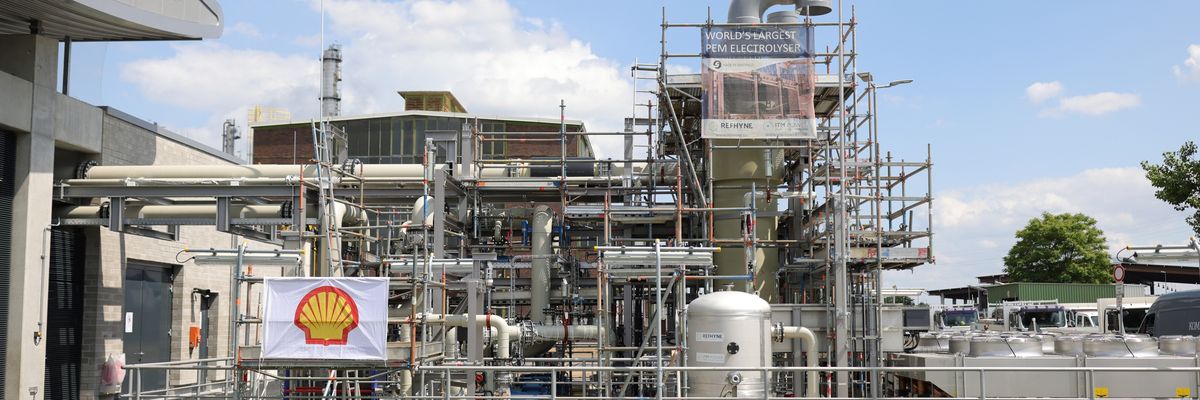
The inauguration of a hydrogen production plant at the Shell Energy and Chemicals Park Rheinland in Wesseling, Germany was held on July 2, 2021.  (Photo: Andreas Rentz/Getty Images)

“Rather than betting on unproven and inefficient hydrogen technologies, we need rich countries to put their money towards a just energy transition,” said a Friends of the Earth campaigner.

Amid preparations for COP28, the United Nations climate summit kicking off next week, a leading green group warned Tuesday that “hydrogen is big polluters’ latest trick, and we can’t afford to fall for it.”

“Hydrogen is being promoted as a ‘clean’ alternative to the fossil fuels used for domestic heating, transport, and heavy industry,” explains the new Friend of the Earth International (FOEI) paper, Don’t Fall for the Hydrogen Hype, put out ahead of the global clilmate talks. “But it’s expensive to produce, inefficient, and far from a low-carbon solution. In fact, the majority of the global hydrogen supply is made from fossil fuels.”

An “energy carrier,” hydrogen stores and transports energy produced from resources such as biomass, fossil fuels, and water—but FOEI says industry promises of hydrogen’s potential should not be trusted.

“Hydrogen, just like the fossil fuels and other false climate solutions pushed by that same industry, further reinforces neocolonial patterns of extractivism and exploitation.”

The group’s paper begins by debunking the hydrogen “rainbow.” Citing the International Energy Agency, it states:

Globally, more than 62% of hydrogen production is derived from fossil gas (known as grey hydrogen, blue hydrogen when coupled with carbon capture and storage, or turquoise hydrogen when produced from methane pyrolysis). About 21% comes from coal and lignite (black/brown hydrogen), 16% is produced as a byproduct at refineries, 0.5% derived from oil, whilst only 0.1% is produced via water electrolysis (green from renewable electricity, purple/pink from nuclear).

While some groups support green hydrogen, critics including FOEI emphasize that along with being incredibly uncommon, it “demands huge amounts of cheap renewable electricity to function, rendering the process highly inefficient,” and “requires vast amounts of water, an increasingly rare and precious resource that shouldn’t be wasted.”

“Pushed by the same fossil industry that has caused—and continues to fuel—the climate crisis, hydrogen is yet another false solution, sold by the industry as a magical fix which allows business as usual to continue,” the paper asserts. “Like other false solutions, it represents a dangerous distraction from the urgent, deep, real emission cuts that are needed to address the climate crisis.”

Climate scientists and energy experts have long said that humanity must rapidly phase out fossil fuels to avoid the most catastrophic effects of heating the planet and meet the Paris agreement goal of limiting global temperature rise this century to 1.5°C. A U.N. analysis revealed Monday that currently implemented policies put the world on track for 3°C of warming by 2100.

The FOEI paper points out that in addition to propping up polluters by “justifying more fossil gas, hydrogen conveniently allows the fossil industry to push another one of its lifelines: carbon capture and storage,” an “unproven techno-fix” that global climate groups are also warning about in the lead-up to COP28 in the United Arab Emirates.

“It is unsurprising that hydrogen, just like the fossil fuels and other false climate solutions pushed by that same industry, further reinforces neocolonial patterns of extractivism and exploitation,” the publication continues, highlighting how the oil and gas sector “has shown time and again its disregard for communities and the environment, especially in the Global South.”

Yegeshni Moodley from Friends of the Earth South Africa/groundWork said in a statement that “in the Global South, ‘green hydrogen’ receives public money yet serves only private interests. As governments collude with corporations over mega-infrastructure projects, communities struggle to keep their ancestral lands and scant water resources intact.”

The paper notes that like other “false solutions” to the climate emergency—including geoengineering, offsets, and so-called nature-based solutions—on top of “disproportionate social and environmental costs, hydrogen also comes with a high financial cost.”

FOEI advocacy officer Lise Masson argued that “rather than betting on unproven and inefficient hydrogen technologies, we need rich countries to put their money towards a just energy transition, one that puts power in the hands of people, not corporations.”

Already, some governments are pouring money into hydrogen. U.S. President Joe Biden last month announced a “historic investment” of up to $7 billion for seven hubs across the United States, the nation that has historically contributed the most to human-caused global heating.

Meanwhile, in the European Union, “the gas lobby has succeeded in securing several pieces of legislation promoting hydrogen—including legislation that allows public funds to go to fossil gas infrastructure as long as it promises to be ‘hydrogen ready’ despite the fact that Europe already has more gas infrastructure than necessary,” FOEI detailed.

In Belgium, the European Commission, Hydrogen Europe, and the Clean Hydrogen Partnership are co-hosting European Hydrogen Week 2023—which activists with We Smell Gas disrupted with a protest involving fake green vomit on Tuesday.

“From Chile, to Namibia to South Africa, the story is the same. Communities are not being consulted on [hydrogen projects] destined for European consumption [with] the costs of false solutions violently outsourced,” We Smell Gas said on social media Tuesday. “Hydrogen imports are imperial greed painted green.”

“Our current energy system relies on appropriating space, resources, and cheap labor from racialized and working-class people inside and outside European borders,” the group continued. “For the profit of E.U. multinational and the economic dominance of Western states. [Hydrogen] at scale reproduces this system.”

The FOEI position paper stresses that “addressing the climate crisis can only come through deep systemic change, dismantling the neocolonial, patriarchal, neoliberal capitalist system that created the crisis, to build a more just and equitable world for all.”

Original article by JESSICA CORBETT republished from Common Dreams under Creative Commons (CC BY-NC-ND 3.0). 

Continue ReadingClimate Group Warns World Must Not Fall for Hydrogen ‘Hype’