‘Hospitals Are Not Battlegrounds’: UN Relief Chief Sounds Alarm as Israel Raids al-Shifa

Original article by JAKE JOHNSON republished from Common Dreams under Creative Commons (CC BY-NC-ND 3.0). 

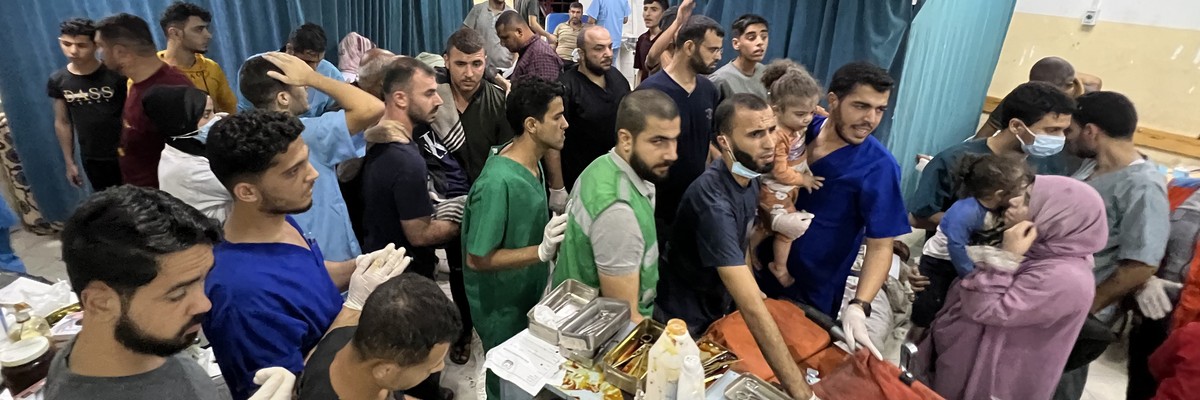
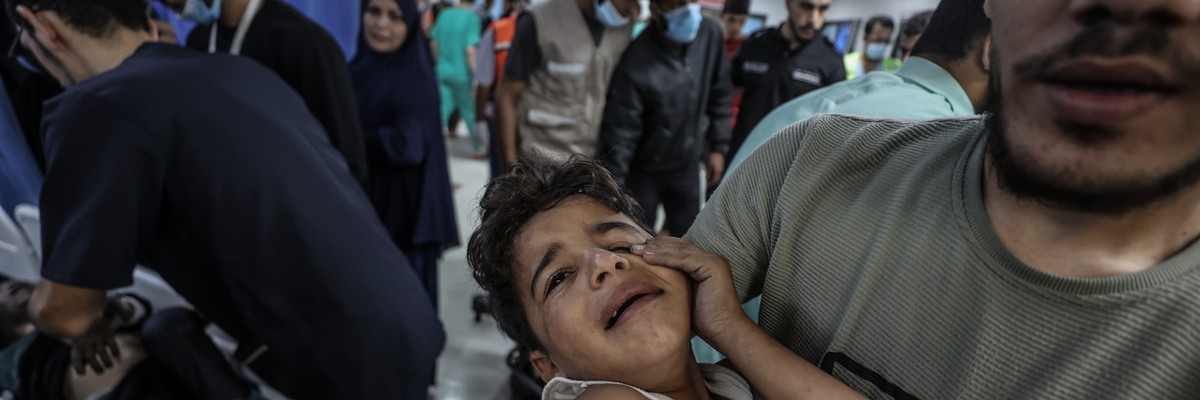
An injured child is brought to al-Shifa Hospital after Israeli attacks in Gaza City, Gaza on October 21, 2023.  (Photo: Ali Jadallah/Anadolu via Getty Images)


“The protection of newborns, patients, medical staff, and all civilians must override all other concerns,” said Martin Griffiths, the United Nations’ emergency relief coordinator.

The head of the United Nations’ emergency relief operations said Wednesday that he was “appalled” by news of the Israeli military’s raid of Gaza’s largest hospital, where hundreds of patients and healthcare workers and thousands of displaced people are sheltering.

“The protection of newborns, patients, medical staff, and all civilians must override all other concerns,” Martin Griffiths, the U.N. under-secretary-general for humanitarian affairs, wrote on social media. “Hospitals are not battlegrounds.”

Israeli forces’ raid of al-Shifa Hospital early Wednesday came days after they encircled the facility and began bombarding it, accusing Hamas of using the hospital and tunnels beneath it for military operations.

The U.S. backed Israel’s assertion on Tuesday, with National Security Council spokesman John Kirby telling reporters that “we have information that Hamas and the Palestinian Islamic Jihad used some hospitals in the Gaza Strip, including al-Shifa, and tunnels underneath them, to conceal and support their military operations and to hold hostages.”

Asked to provide specific evidence, Kirby cited “a variety of intelligence sources” but declined to publicize “a whole lot of granular detail on that.”

Hospitals are protected from military attack under international law and can only lose their protected status if they are shown to have been used for “an act harmful to the enemy.” Human Rights Watch argued in a report released ahead of Wednesday’s raid that the Israeli government has not provided sufficient evidence to justify its attacks on al-Shifa and other northern Gaza hospitals, most of which have ceased functioning due to a lack of fuel and other supplies.

An emergency room employee at al-Shifa toldAl Jazeera that during their raid, Israeli soldiers “detained and brutally assaulted some of the men who were taking refuge at the hospital.”

“Israeli forces took the detained men naked and blindfolded,” the worker added. “[They] did not bring any aid or supplies, they only brought terror and death.”

On Tuesday, according to Gaza officials, around 170 bodies were buried in a mass grave in the courtyard of al-Shifa, as there was no other way to safely bury them outside the hospital compound because of Israeli attacks and firefights with Hamas. A surgeon at the hospital toldReuters that, due to lack of refrigeration, the bodies “were generating an unbearable stench and posing a risk of infection.”

“The Health Ministry said 40 patients, including three babies, have died since Shifa’s emergency generator ran out of fuel Saturday,” The Associated Pressreported Wednesday. “Another 36 babies are at risk of dying because there is no power for incubators, according to the ministry.”

Israel’s bombing campaign, ground invasion, and siege have killed more than 11,000 people across the Gaza Strip, but the recent attacks on the enclave’s hospitals have made it impossible for Gaza health officials to reach the facilities to count the dead and wounded. Thousands more are believed to have been killed since the death toll was updated last week.

Tedros Adhanom Ghebreyesus, director-general of the World Health Organization, said early Wednesday that “we’ve lost touch again with health personnel” at al-Shifa amid Israel’s raid.

“We’re extremely worried for their and their patients’ safety,” he added.

Facing growing accusations of war crimes, the Israel Defense Forces (IDF) called its raid on al-Shifa a “precise and targeted operation against Hamas.” In the wake of the deadly Hamas-led attack on Israel last month, the IDF has claimed repeatedly that it is targeting militants even as it has decimated Gaza’s civilian infrastructure, bombing homes, medical facilities, schools, bakeries, and the strip’s largest refugee camp.

A confidential memo from the Dutch Embassy in Tel Aviv states that Israel is “deliberately causing massive destruction to the infrastructure and civilian centers” of Gaza in an effort to “showcase credible military force” to “Iran and its proxies,” according toPolitico.

Israel’s strategy, the memo states, violates “international treaties and laws of war.”

Original article by JAKE JOHNSON republished from Common Dreams under Creative Commons (CC BY-NC-ND 3.0). 


Continue Reading‘Hospitals Are Not Battlegrounds’: UN Relief Chief Sounds Alarm as Israel Raids al-Shifa

Fossil Fuel Firms ‘Building Bridge to Climate Chaos’

North Sea oil rigs in Cromarty Firth, Scotland. Credit: joiseyshowaa (CC BY-SA 2.0)

Original article by JAKE JOHNSON republished from Common Dreams under Creative Commons (CC BY-NC-ND 3.0).
An updated database shows that more than 1,000 oil and gas companies around the world are planning to expand their planet-wrecking infrastructure.

More than a thousand fossil fuel companies around the world are currently planning to build new liquefied natural gas terminals, pipelines, or gas-fired power plants even as scientists warn that fossil fuel expansion is incompatible with efforts to prevent catastrophic warming.

That’s according to an updated database released Wednesday by Urgewald and dozens of partner groups. Described as the most comprehensive public database on the fossil fuel industry, the Global Oil & Gas Exit List (GOGEL) covers 1,623 companies that are operating in the upstream, midstream, or gas-fired power sector and collectively account for 95% of global oil and gas production.

More than a thousand fossil fuel companies around the world are currently planning to build new liquefied natural gas terminals, pipelines, or gas-fired power plants even as scientists warn that fossil fuel expansion is incompatible with efforts to prevent catastrophic warming.

That’s according to an updated database released Wednesday by Urgewald and dozens of partner groups. Described as the most comprehensive public database on the fossil fuel industry, the Global Oil & Gas Exit List (GOGEL) covers 1,623 companies that are operating in the upstream, midstream, or gas-fired power sector and collectively account for 95% of global oil and gas production.

According to the 2023 GOGEL, 96% of the 700 upstream oil and gas companies in the database are exploring or actively developing new oil and gas fields, projects that Urgewald said “severely jeopardize efforts to limit global temperature increase to 1.5 °C.”

Nearly 540 companies in the database are collectively planning to produce 230 billion barrels of oil equivalent (bboe) over the short term, the database shows.

“The seven companies with the largest short-term expansion plans are Saudi Aramco (16.8 bboe), QatarEnergy (16.5 bboe), Gazprom (10.7 bboe), Petrobras (9.6 bboe), ADNOC (9.0 bboe), TotalEnergies (8.0 bboe) and ExxonMobil (7.9 bboe),” Urgewald noted. “These seven companies are responsible for one-third of global short-term oil and gas expansion.”

The database also shows that fossil fuel companies are planning to expand global LNG capacity by 162%, a significant threat to critical climate targets. A United Nations-backed report published last week warned that fossil fuel expansion plans are “throwing humanity’s future into question.”

Urgewald pointed specifically to the LNG boom in the U.S., which the group said is “cementing its position as the world’s largest export hub for LNG” with 21 new export facilities planned along the Gulf Coast. Those facilities account for more than 40% of worldwide LNG expansion documented in the GOGEL database.

“Most of the fossil gas that will be exported from these terminals stems from the Permian Basin, the heart of the U.S. fracking industry,” Urgewald observed.

The updated database shows that nearly 80 companies—including Exxon, Chevron, and BP—are currently operating in the Permian Basin, located in the U.S. Southwest.

Climate campaigners and experts have also sounded alarm over Calcasieu Pass 2 (CP2), a planned $10 billion LNG export hub that would ship up to 24 million tons of gas annually once it is completed.

“The fossil fuel industry wants to pave undeveloped wetlands all along the coast with LNG facilities like NextDecade Corporation’s Rio Grande LNG Terminal, Rebekah Hinojosa, a member of the South Texas Environmental Justice Network said Wednesday. “Besides their environmental implications, these plans violate Indigenous sacred lands, and people working in fishing, shrimping, and eco-tourism risk losing their jobs. Our communities refuse to be sacrificed for the fracking industry’s dirty gas exports.”

Original article by JAKE JOHNSON republished from Common Dreams under Creative Commons (CC BY-NC-ND 3.0).


Continue ReadingFossil Fuel Firms ‘Building Bridge to Climate Chaos’

Around a million children in the UK are living in destitution – with harmful consequences for their development

spixel/Shutterstock

Emma Louise Gorman, University of Westminster

Millions of people in the UK are unable to meet their most basic physical needs: to stay warm, dry, clean and fed. This is known as destitution.

Recent analysis from charity the Joseph Rowntree Foundation (JRF) estimates that around 3.8 million people in the UK experienced destitution at some point during 2022. This is a 61% increase since 2019 – and a 148% increase since 2017.

Living in destitution means severe material hardship. The JRF’s 2022 survey of crisis service users in the UK found that 61% reported going without food in the month before the survey. They often put other needs, such as accommodation or feeding their children, over feeding themselves.

About half of the people surveyed were not able to afford adequate clothing and basic necessities, such as toiletries. Many talked of living in insecure and low quality housing.

One particularly alarming aspect of these most recent statistics is the steep increase in the number of children living in destitution. In 2022, around 1 million children lived in households who experienced destitution. This is an increase of 88% since the charity’s corresponding 2019 study, and a 186% increase since the 2017 study.

Impact on children

Destitution causes immediate suffering. But for these children, this experience of hardship at a young age will have consequences that last throughout their lives. There is little doubt that both money and environment (housing quality, parental mental health and nutrition, for example) contribute to inequalities in child development. Both of these factors are affected by living in destitution.

When children reach the age of three, stark differences are already evident between those who live in poverty and those who do not. Children from more well-off families have better developed skills in both cognitive tasks, such as understanding basic concepts like colours, letters, numbers and shapes, as well as socio-emotional skills, such as self-control and resilience.

Other factors that are important in shaping children’s skills include housing quality and parental mental health.

Inequalities so early in life can compound and widen over time. These differences between the disadvantaged and the better off can be seen in educational achievement, health and criminal activity.

These types of inequalities were also exacerbated by the pandemic. While pupils everywhere missed out on education, these learning losses were not equally distributed: young people from lower socio-economic background fell further behind.

Despite large increases in funding for the early-year sectors, socio-economic inequalities in child development have not generally narrowed, particularly in recent years.

And now, the sharp increase in the share of children living in destitution does not paint a optimistic picture for the future.

Making a difference

However, many of these issues can be changed by government policy. For example, we know that being hungry at school makes it difficult to concentrate and learn. Measures that address hunger, then, can make a difference. Analysis of a trial of breakfast clubs in English schools, which offered free breakfast to disadvantaged children aged six and seven, found that the free breakfast lead to the equivalent of two months’ extra progress in reading, writing and maths across the course of one year.

Research has shown that many early interventions – such as high quality childcare and education programmes for at-risk children – can have long-lasting positive effects. From an economic perspective, acting early to lift children out of poverty and improve their home and learning environments can be a cost-effective way of helping in the long run, both for individuals as well as wider society.

Another option would be reform of the benefits system to make sure families have enough money to live. In the 2022 Joseph Rowntree Foundation survey of people who used crisis centres, 72% did receive social security benefits – but were still destitute.

This rise in children living in household experiencing destitution must be given serious attention. Successive governments claim to hold upward social mobility as a important goal – that is, the ability of people to move up the economic and social ladder, regardless of their own upbringing and social background. Reducing destitution would not only benefit children right now, but would help them throughout life.The Conversation

Emma Louise Gorman, Principal Research Fellow, Centre for Employment Research, University of Westminster

This article is republished from The Conversation under a Creative Commons license. Read the original article.

Continue ReadingAround a million children in the UK are living in destitution – with harmful consequences for their development

UK Conservatives heading to elections with a growing green policy gap

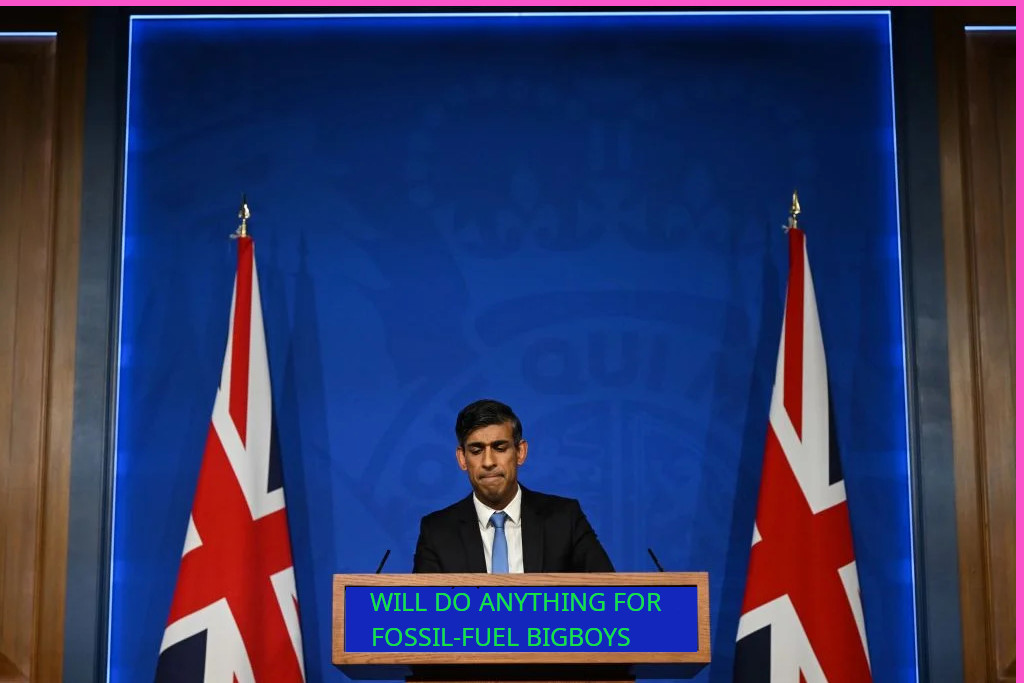
UK Prime Minister Rishi Sunak denies climate change.

https://www.energymonitor.ai/policy/net-zero-policy/weekly-data-uk-conservatives-heading-to-elections-with-a-growing-green-policy-gap/

There is now a 21% share of required emissions cuts in the UK’s 2028–32 carbon budget that is not covered by policy.

Green Alliance’s Net Zero Policy Tracker analyses the gap between confirmed policy and what would be required for net zero by 2050, according to the UK’s five-yearly carbon budgets. 

At the start of 2023, there was a 13% share of required emissions cuts in the 2028–32 carbon budget that was not covered by policy. Following the government’s so-called Energy Security Day in March – which saw 2,800 pages of new energy and climate policy – the share of emissions cuts not covered by policy grew to 15%

Since Sunak’s latest speech in March, the gap has grown to 21%: a near-doubling of the gap that existed at the start of the year. 

“The Prime Minister delayed vital policies that would have lowered energy bills, increased UK energy security, and played a critical role in creating a green and growing economy,” said Chris Venables, Green Alliance’s deputy director of politics and partnerships, in a statement following Sunak’s speech. “This represents a deeply alarming pivot that has undermined business confidence, and put at serious risk the hard-won, cross-party and evidence-based approach we have had to actually reaching our legally binding net-zero targets.”

https://www.energymonitor.ai/policy/net-zero-policy/weekly-data-uk-conservatives-heading-to-elections-with-a-growing-green-policy-gap/

Continue ReadingUK Conservatives heading to elections with a growing green policy gap

Amid War Crimes Charges, Human Rights Watch Says Israel Must ‘End Attacks on Hospitals’

Original article by JAKE JOHNSON republished from Common Dreams under Creative Commons (CC BY-NC-ND 3.0). 

Wounded people receive treatment at the Aqsa Indonesia Hospital after an Israeli attack on the Jibalia refugee camp on November 13, 2023. (Photo: Fadi Alwhidi/Anadolu via Getty Images)

“Israel’s broad-based attack on Gaza’s healthcare system is an attack on the sick and the injured, on babies in incubators, on pregnant people, on cancer patients. These actions need to be investigated as war crimes.”

Human Rights Watch on Tuesday demanded that the Israeli government immediately cease its deadly attacks on Gaza’s hospitals, arguing they’re part of a far-reaching and unlawful assault on the territory’s crumbling healthcare system.

In a new report, HRW examines the impacts of the Israeli bombing campaign, ground invasion, and siege on Gaza’s medical personnel and facilities, a majority of which have stopped functioning due to airstrike damage or lack of critical supplies, from fuel to anesthetics.

“Israel’s repeated attacks damaging hospitals and harming healthcare workers, already hard hit by an unlawful blockade, have devastated Gaza’s healthcare infrastructure,” said A. Kayum Ahmed, special adviser on the right to health at Human Rights Watch. “The strikes on hospitals have killed hundreds of people and put many patients at grave risk because they’re unable to receive proper medical care.”

Over the past week, Israeli forces have surrounded and intensified their bombardment of several hospitals in northern Gaza including al-Shifa, the enclave’s largest medical facility. Israel has also bombed ambulances and people desperately attempting to flee hospitals as they’ve come under attack.

“On November 3, the Israeli military struck a marked ambulance just outside of Gaza City’s al-Shifa hospital,” HRW said. “Video footage and photographs taken shortly after the strike and verified by Human Rights Watch show a woman on a stretcher in the ambulance and at least 21 dead or injured people in the area surrounding the ambulance, including at least 5 children.”

“An IDF spokesperson said in a televised interview that day: ‘Our forces saw terrorists using ambulances as a vehicle to move around. They perceived a threat and accordingly we struck that ambulance,'” the group added. “Human Rights Watch did not find evidence that the ambulance was being used for military purposes.”

HRW similarly questioned Israeli assertions that Hamas is using Gaza’s hospitals, including al-Shifa, for military operations.

Targeting hospitals is a war crime under international law, but medical facilities can lose their protected status if they’re used to commit an “act harmful to the enemy,” according to the International Committee of the Red Cross (ICRC).

HRW argued that Tuesday that “no evidence put forward” by the Israeli government thus far “would justify depriving hospitals and ambulances of their protected status under international humanitarian law.”

“When a journalist at a news conference showing video footage of damage to the Qatar Hospital sought additional information to verify voice recordings and images presented, the Israeli spokesperson said, ‘Our strikes are based on intelligence,'” HRW said. “Even if accurate, Israel has not demonstrated that the ensuing hospital attacks were proportionate.”

The group said Israel “should end attacks on hospitals” and urged the United Nations’ Independent International Commission of Inquiry on the Occupied Palestinian Territory and the International Criminal Court to investigate.

“Israel’s broad-based attack on Gaza’s healthcare system is an attack on the sick and the injured, on babies in incubators, on pregnant people, on cancer patients,” said Ahmed. “These actions need to be investigated as war crimes.”

The new analysis came amid horrific reports of the impact that Israel’s assault is having on healthcare workers, patients, and displaced people seeking refuge from near-constant airstrikes.

Reuters reported that people trapped inside al-Shifa Hospital “plan to start burying bodies within the hospital compound” on Tuesday “because the situation has become untenable.” The World Health Organization said over the weekend that the facility is “not functioning as a hospital anymore” due to power outages and a lack of supplies, which have caused the deaths of a number of patients—including premature babies.

Dr. Ahmed Al Mokhallalati, a surgeon at al-Shifa, told Reuters that “the bodies were generating an unbearable stench and posing a risk of infection.”

“Unfortunately there is no approval from the Israelis to even bury the bodies within the hospital area,” he said. “Today … civilians started digging within the hospital to try and bury the bodies on their own responsibility without any arrangements by the Israeli side. Burying 120 bodies needs a lot of equipment, it can’t be by hand efforts and by single-person efforts. It will take hours and hours to be able to bury all these bodies.”

Doctors Without Borders, known internationally as Médecins Sans Frontières (MSF), said that on Tuesday morning, “bullets were fired into one of three MSF premises located near al-Shifa hospital and sheltering MSF staff and their families—over 100 people, including 65 children, who ran out of food last night.”

“Thousands of civilians, medical staff, and patients are currently trapped in hospitals and other locations under fire in Gaza City; they must be protected and afforded safe passage if they wish to leave,” the group added. “Above that, there must be a total and immediate cease-fire.”

Original article by JAKE JOHNSON republished from Common Dreams under Creative Commons (CC BY-NC-ND 3.0). 
Continue ReadingAmid War Crimes Charges, Human Rights Watch Says Israel Must ‘End Attacks on Hospitals’