Insulate Britain’s ‘show trials’ expose state efforts to silence activists
Original article by Rob Stuart republished from openDemocracy under Creative Commons Attribution-NonCommercial 4.0 International licence.
OPINION: An activist is in jail for mentioning the climate crisis in court. Our judicial system is enabling the state
This week we were delivered the strongest evidence yet that the court cases of Insulate Britain members are little more than show trials – in which the defendant’s guilt has already been determined.
David Nixon, a fellow Insulate Britain supporter, was handed an eight-week sentence for merely mentioning the climate crisis during his trial for participating in a roadblock in 2021.
Judge Silas Reid had ordered Nixon to avoid talking about the climate and ecological emergency. He said, “This is not a trial about climate change, fuel poverty, etc. Matters relating to that are not relevant.”
Nixon disagreed, and used his closing speech to tell jurors: “We are on a highway to climate hell with our foot on the accelerator. That is why we sat in the road, to tell the truth about the direction we are heading in and prompt action before it’s too late.”
That this was enough to warrant his imprisonment is absurd – and raises serious questions about this country’s judicial system.
A life-changing experience
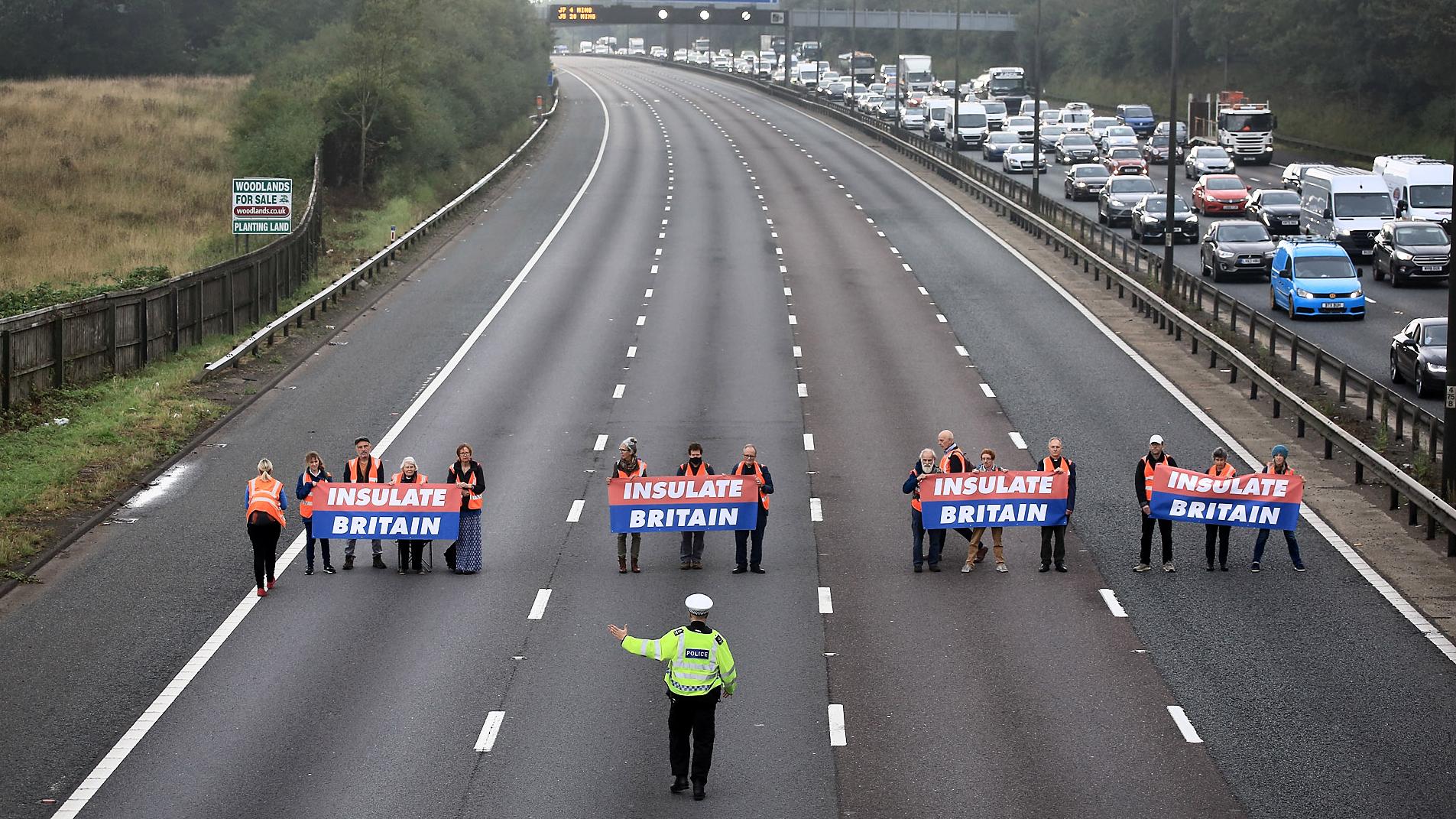
In October 2021, I also took action with Insulate Britain. We brought large sections of the M25 and other major roads to a standstill in order to raise awareness of fuel poverty and the climate and ecological emergency.
I now have three separate charges relating to these actions. I am due to stand trial in May, June and one last time in November. By then, two full years will have passed since I sat down in the road in defence of people and planet.
As a first time defendant, this has been a life-changing experience. I had never been in trouble with the law before 2019, and I acknowledge now that I have lived a relatively privileged life in that regard. As a white, middle-class man, I regret not recognising sooner the suffering of others less fortunate than me at the hands of the state.
My faith in the legal and judicial system of this country has been severely shaken. I have felt harassed and persecuted by the state as both my reputation and my livelihood have been unduly threatened. My name and address has been published online by the authorities, endangering not only myself but my family as well. Of course, my mental health has suffered.
Those who advocate for change now face even greater challenges than ever before as they risk prosecution under the draconian Police, Crime, Sentencing and Courts Act. As if that were not enough, the regime is now trying to push through its equally notorious Public Order Bill, which will give police officers even more power to crack down on protests.
If jurors can’t hear why a ‘crime’ was committed, are they there just to rubber-stamp the state’s decision?
Though neither bill had come into law at the time of my arrest, I could have reasonably expected a statutory charge of wilful obstruction under the Highways Act or an injunction under the Anti-social Behaviour Act. But neither was invoked against me.
Instead, the prosecution chose to break with legal tradition by pursuing the archaic common law offence of causing a public nuisance. This is worrying – if a charge is not defined in statute, there are no prosecution guidelines to follow.
The decision had abhorrent consequences. According to the judiciary, public nuisance is interested only in the consequences of an action, i.e. whether we supporters of Insulate Britain had caused a nuisance to the public. There is no consideration at all of the circumstances of the action, i.e. our motivations for doing what we did.
Insulate Britain supporters are not arguing that we did not cause any inconvenience or disruption to the public – that would be completely disingenuous. We are arguing that we did what we believed was necessary to sound the alarm on fuel poverty and the climate and ecological emergency. We hoped the UK government would heed our demands.
Let us be clear, it is not a lack of popular demand or technological solutions that keeps rich nations such as the UK from addressing the climate and ecological emergency. We could solve this problem if there was the political will to do so.
By denying the circumstances of our actions, I believe Judge Reid and his associates knew that we defendants would not be able to defend ourselves. We cannot minimise our actions (and neither would we want to) and yet we cannot explain ourselves either, without risking contempt of court. The scales of justice seem distinctly one-sided.
If the diverse range of legal and moral arguments in an (alleged) crime of conscience cannot be presented in front of a jury, one must ask what purpose a jury serves. Are jurors there simply to rubber stamp a guilty verdict that has already been decided since before the defendant’s arrest?
A lack of transparency
Last week another Insulate Britain supporter, Stephanie Aylett, narrowly avoided a custodial sentence after also being charged with contempt. Afterwards, she said: “It horrified me that Judge Reid deliberately stripped away all our legal defences and told us that we would be in contempt of court if we spoke about our motivations, strategy or aims.”
Aylett continued: “He prevented us from mentioning climate change or talking about any scientific evidence. It is incredibly difficult to explain the actions we took without being allowed to mention why we did such a bizarre thing.”
I am concerned about a lack of transparency over who had the authority to determine that we would be charged with public nuisance and what process, if any, was followed in reaching this decision.
The government appears to be investing more energy into silencing climate activists than implementing climate solutions
I have learned that many important decisions are made behind closed doors in secretive ‘case management hearings’ up and down the country. The existence of these hearings is not common knowledge, I am aware of them because I have been required to attend several over the past year. In my opinion they are wide open to abuse.
If there was any justice, I would not be facing charges. It would not have been necessary for me to sit down in the road to raise awareness of the climate and ecological emergency. The individuals who place profit before people and the planet would already be behind bars.
Instead, the current regime appears to be investing more energy into silencing climate activists than implementing climate solutions, such as decent home insulation that would benefit millions of ordinary people during the cost of living crisis.
This government does not represent the people, but rather the CEOs and shareholders of big business. They rule by fear, intimidation and coercion.
A few years ago, it would have been completely unheard of for a defendant to be handed a prison sentence for simply mentioning the climate crisis in a court of law. And yet here we are. As children we were warned to remain vigilant to the threat of fascism. It is time to heed those warnings.
Original article by Rob Stuart republished from openDemocracy under Creative Commons Attribution-NonCommercial 4.0 International licence.