Protesters hold demonstrations in Harrods, British Museum and Scottish Power HQ over surging energy bills

https://inews.co.uk/news/protesters-hold-demonstrations-in-harrods-british-museum-and-scottish-power-hq-over-surging-energy-bulls-2008244

Activists held protest in Harrods, the British Museum and Scottish Power headquarters today (3 December), as part of national demonstrations against surging energy bills and fuel poverty.

Don’t Pay UK, Fuel Poverty Action, Just Stop Oil and others groups held a series of what they describe as ‘warm-up’ protests.

Activists entered the British Museum’s great hall – the largest indoor public square in Europe – where they also protested against the Bloomsbury venue’s sponsorship links with oil giant BP.

Just Stop Oil supporters cosy up at Harrods on Fuel Poverty Day of Action
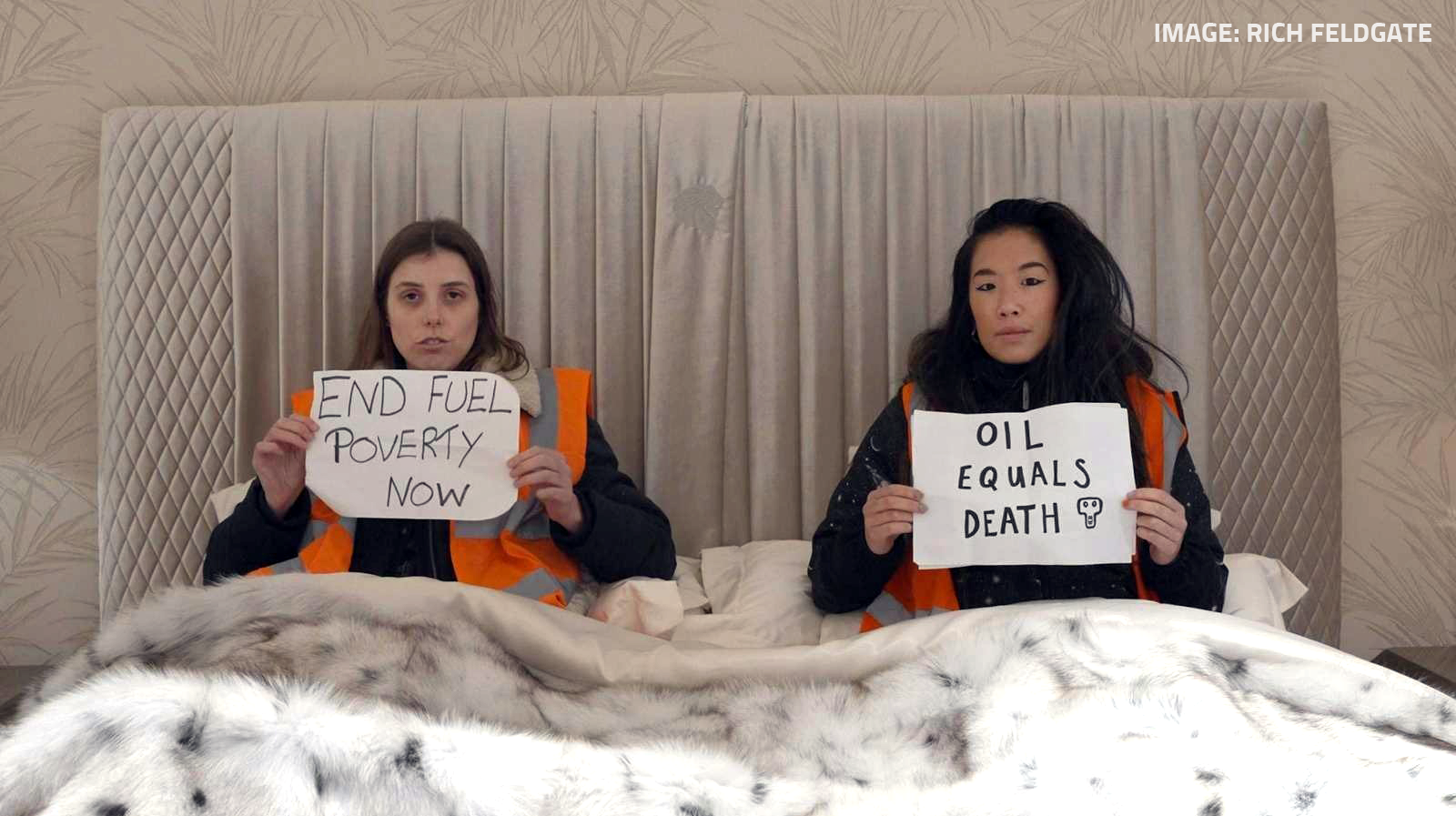
Image: Just Stop Oil, Rich Feldgate

Just Stop Oil supporters have occupied beds and sofas in Harrods to demand that the government Just Stop Fuel Poverty by insulating homes and ending our reliance on expensive, dangerous and dirty fossil fuels. 

At around 1pm, 4 Just Stop Oil supporters briefly occupied beds and sofas in Harrods department store on Brompton Road in central London and displayed signs reading “Just Stop Oil, Just Start Insulation”, “Just Stop Fuel Poverty” and “Oil Equals Death”. They were rapidly escorted out of the store by around 20 security guards.
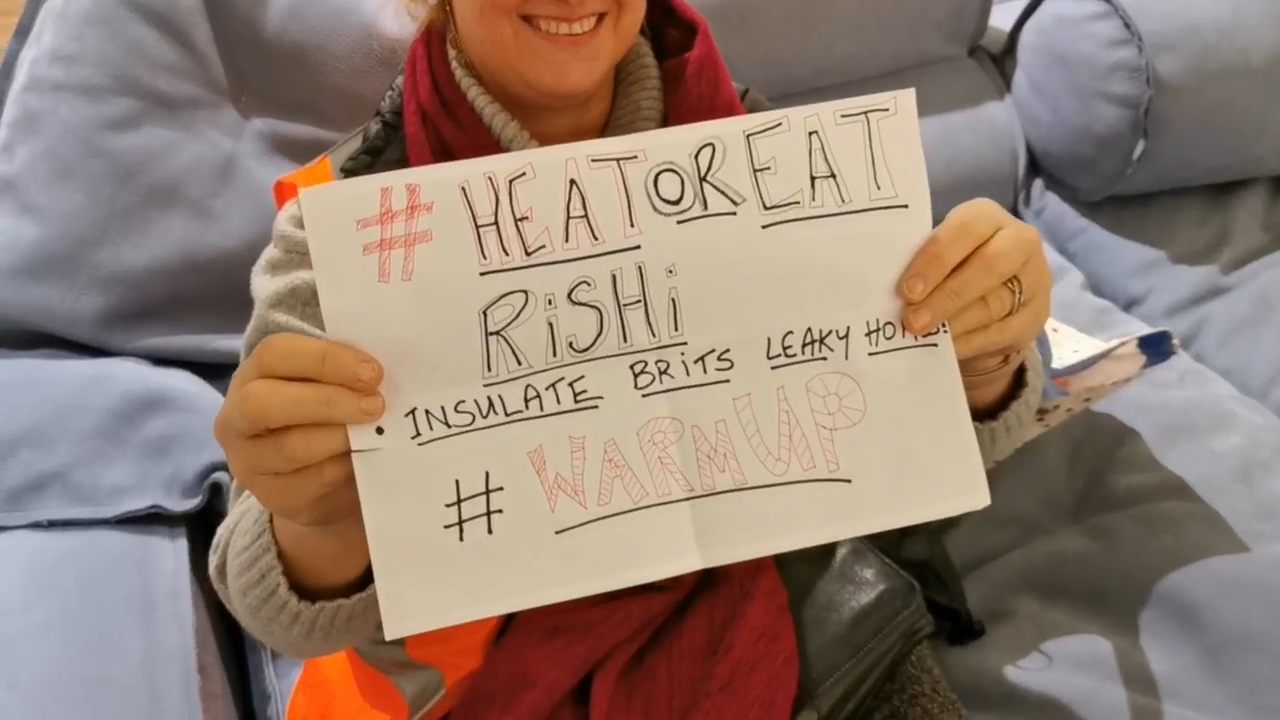
Image: just Stop Oil.

Just Stop Oil supporters are acting today in solidarity with Fuel Poverty Action’s Energy For All campaign and the Don’t Pay UK campaign. The action is one of several Warm-Ups taking place across the UK in towns and cities including Glasgow, Liverpool, Bristol and London in support of the Warm This Winter coalition’s Day of Action on fuel poverty.

A spokesperson for Just Stop Oil said 

“This government is allowing ordinary people to starve and freeze this winter as greedy energy companies squeeze every last penny out of us. The health service is in crisis, workers’ wages are being squeezed, and nurses are using food banks. Austerity is a political choice and the cost of living crisis is an unprovoked attack on ordinary people.

“Worse still, rocketing energy prices are funding the companies who are torching the climate. Rishi Sunak’s government plans to allow over 100 new UK fossil fuel projects. They are signing our death warrants. New oil and gas is criminal, an act of genocide against billions of people in the poorest countries on earth, and an act of war against the young.

“If the government really cared about ordinary people, as they keep claiming, we’d see an emergency response to the climate and cost of living crisis. Everyone would have their basic energy needs met and bills would be shrunk through insulation, renewables and free public transport, paid for by the fossil fuel companies and the rich.”

National Energy Action estimates that as a result of rising energy costs, around 2.2 million more people have fallen into fuel poverty this year in the UK raising the total figure to 6.7 million. The chancellor’s decision to further raise the energy price cap in 2023 could see the number of households in fuel poverty rise from the current 7 million this winter to 8.6 million households by next April according to the End Fuel Poverty Coalition

Continue ReadingProtesters hold demonstrations in Harrods, British Museum and Scottish Power HQ over surging energy bills

Sunak set a ‘dangerous precedent’ by reappointing Braverman days after she resigned over security breaches

The Morning Star reports :

RISHI SUNAK’S decision to reappoint Suella Braverman just days after her resignation over security breaches sets a “dangerous precedent,” a damning report by MPs has warned.

The Tory-led public administration and constitutional affairs committee released its latest report on government ethics today, singling out the PM for particular criticism over the decision.

The Home Secretary was forced to resign after sending official documents via her private email to a Tory backbencher and accidentally copying in an aid.

But soon after Mr Sunak took over the premiership, he reappointed her, sparking widespread anger and concerns that Ms Braverman’s return could pose a risk to national security.

We’ve heard very little from Sue-Ellen Braverman since she was bullied recently apparently. If you can’t take it … Her remarks about the Guardian-reading tofu-eating wokerati and the anti-groth coalition while she was Home Secretary under Liz Truss were a bit mad I thought.

Continue ReadingSunak set a ‘dangerous precedent’ by reappointing Braverman days after she resigned over security breaches

The state of UK’s water industry

The Guardian has a series of articles looking at UK’s water industry. Looks like it’s a cash cow for foreign investors with prices to consumers inflated to service debt and excessive payments to shareholders. Well worth a look (and tofu-eating is not mandatory ;) …

England’s water: the world’s piggy bank

England is one of the few countries in the world where water is fully owned by private companies. These companies answer to investors based thousands of miles away from their customers.

“What we have here is just a crazy system,” said Kate Bayliss, from the department of economics at SOAS University of London and author of several papers on England’s privatised water. “We are managing our water in the interests of offshore investors.”

These offshore investors include private and state-owned international funds, banks, multinationals and billionaires headquartered outside the UK, and they control at least 72% of English water, new Guardian research has found.

Here’s how England’s profitable water system has been sold off around the world:

Revealed: more than 70% of English water industry is in foreign ownership

Foreign investment firms, private equity, pension funds and businesses lodged in tax havens own more than 70% of the water industry in England, according to research by the Guardian.

The complex web of ownership is revealed as the public and some politicians increasingly call for the industry to be held to account for sewage dumping, leaks and water shortages. Six water companies are under investigation for potentially illegal activities as pressure grows on the industry to put more money into replacing and restoring crumbling infrastructure to protect both the environment and public health.

More than three decades after the sector was sold off with a promise to the public they would become individual small shareholders or “H2Owners”, control of the water industry has become dominated by overseas investment vehicles, the super-rich, companies in tax havens and pension fund investors. The ownership structure is such that transparency and accountability are limited, according to Dr Kate Bayliss, a research associate with the department of economics at Soas University of London.

Down the drain: how billions of pounds are sucked out of England’s water system

In the 30 years since England’s water was privatised by Margaret Thatcher, water companies have set up a system in which billions of pounds leave the network in an average year.

It’s money that could have gone towards building a more resilient water system, say academics. Among them, Dieter Helm, an Oxford professor of economic policy specialising in utilities, went as far as saying in 2021 that England’s water system was “a scandal of financial engineering”.

So where is the money going?

Continue ReadingThe state of UK’s water industry

Endless debates about soup and paintings serve those who’d prefer we ignore the climate crisis

Just Stop Oil activists with their hands glued to the wall after throwing tomato soup on Vincent van Gogh’s Sunflowers at the National Gallery. Photograph: Just Stop Oil/AFP/Getty Images. dizzy: I’m assuming that this is a JSO image really.

Zoe Williams

https://www.theguardian.com/commentisfree/2022/dec/01/debates-soup-paintings-action-climate-crisis-just-stop-oil-xr

Opponents of meaningful action are trying to sidestep the immediacy of the threat to our planet

Expert opinion is settled and public opinion united on the urgency of climate action. If our politics or our discourse were in any way functional, there would be no confusion, no debate. We would simply be proceeding from one bold practical action to the next, following the blueprints laid out by the Climate Change Committee.

Instead, we have energy policies stitched together from reheated cliches, which on the one hand doesn’t matter, since no prime minister has been stable or focused enough to iterate them since Brexit, but on the other hand does matter. There is nothing more depressing than to go back to Amber Rudd’s “energy reset” speech of 2015: what if, instead of dismissing renewables incentives as “Blairite”, she’d actually taken them seriously and built on them? What if she’d pushed energy-efficient homes instead of the “unfettered market”, what if she’d made a plan to reduce dependence on gas from Vladimir Putin rather than increase it? “Spoiler alert,” wrote the renewables entrepreneur Bruce Davis at the time: “this doesn’t end well for bill payers.” And nor has it.

Obviously, Conservatives are only interested in their own internal dumb-and-dumber popularity contests, and cannot be trusted to make sound, long-term decisions in the national interest. They degrade everything in public life. But they only get away with this because of the discursive cover provided by pointless debates about climate action.

Continue ReadingEndless debates about soup and paintings serve those who’d prefer we ignore the climate crisis