Published on Thursday, April 22, 2021 by Common Dreams
The Swedish campaigner says insufficient goals and empty rhetoric represent the “biggest elephant there’s even been in any room.” by Common Dreams staff
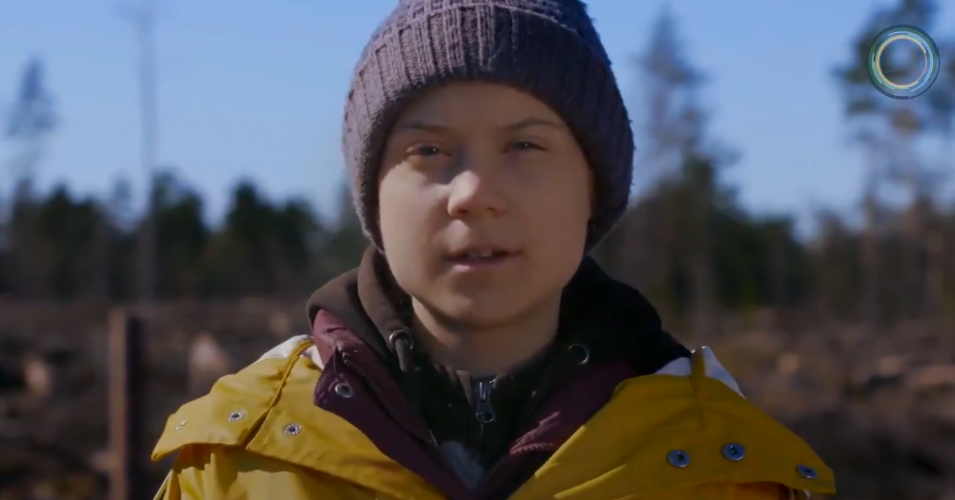
Climate campaigner Greta Thunberg in a video released shortly before the Biden administration kicked off a two-day virtual summit of international leaders to address the climate crisis. “The gap between what needs to be done and what we are actually doing is widening by the minute,” says Thunberg. “The gap between the urgency needed and the current level of awareness and attention is becoming more and more absurd.” (Photo: Screenshot/NowThis News)
Just before U.S. President Joe Biden’s two-day virtual summit on the climate crisis got underway, Swedish activist Greta Thunberg on Thursday shared a video message calling out the “bullshit” of world leaders who she says are failing to take the steps necessary to confront the planetary emergency.
“While we can fool others and even ourselves, we cannot fool nature and physics.” —Greta Thunberg
Posted online by NowThis News, the video featuring Thunberg comes as a warning from the well-known global climate campaigner that the people of the world should not be fooled by the lofty rhetoric they will hear at the summit.
“At the Leaders’ Climate Summit, countries will present their new climate commitments, like net-zero emissions by 2050,” Thunberg says in the video. “They will call these hypothetical targets ‘ambitious.’ But when you compare our insufficient targets with the overall current best available science, you clearly see that there’s a gap. There are decades missing.”
Watch the video:
‘We cannot fool nature and physics’ — In this NowThis exclusive, @GretaThunberg says commitments presented by countries at the Leaders’ Climate Summit will leave a ‘gap of awareness, action, and time’ pic.twitter.com/y8qYPJKmAE
The 18-year-old founder of “Fridays for Future” and inspiration for the global climate strike movement also penned an open letter first published in Vogue on Thursday, making much the same argument.
“You may call us naïve for believing change is possible, and that’s fine,” Thunberg wrote. “But at least we’re not so naïve that we believe that things will be solved by countries and companies making vague, distant, insufficient targets without any real pressure from the media and the general public.”
Thunberg continued:
Of course, we welcome all efforts to safeguard future and present living conditions. And these targets could be a great start if it wasn’t for the tiny fact that they are full of gaps and loopholes. Such as leaving out emissions from imported goods, international aviation and shipping, as well as the burning of biomass, manipulating baseline data, excluding most feedback loops and tipping points, ignoring the crucial global aspect of equity and historic emissions, and making these targets completely reliant on fantasy or barely existing carbon-capturing technologies. But I don’t have time to go into all that now.
The point is that we can keep using creative carbon accounting and cheat in order to pretend that these targets are in line with what is needed. But we must not forget that while we can fool others and even ourselves, we cannot fool nature and physics. The emissions are still there, whether we choose to count them or not.
“The gap between what needs to be done and what we are actually doing is widening by the minute,” she added. “The gap between the urgency needed and the current level of awareness and attention is becoming more and more absurd. And the gap between our so-called climate targets and the overall, current best-available science should no longer be possible to ignore.”
Speaking of world leaders in the Thursday video and the shortcomings of their climate proposals thus far, Thunberg said, “Let’s call out their bullshit,” because the gap between what their rhetoric and what’s actually needed is “the biggest elephant there’s even been in any room.”
Along with other witnesses, Thunberg is testifying before congressional lawmakers on Thursday during a hearing convened by the House Subcommittee on the Environment.
( Middle East Monitor ) – The Encyclopaedia Britannica defines a pogrom as “a mob attack, either approved or condoned by authorities, against the persons and property of a religious, racial, or national minority”.That is exactly what is happening today against the Palestinian people in Jerusalem.
Palestinians are not a minority in Palestine – the country that lies between the Jordan River and the Mediterranean Sea. But due to Israel’s apartheid regime that has ruled the country since 1948, the majority of Palestinians were expelled from the areas that today form so-called “Israel proper”, and which many Palestinians term “1948 Palestine”.
Due to a slow process of Israeli ethnic cleansing since then, Palestinians are no longer the majority in Jerusalem. But in recent weeks that process has sped up in that city, the historic capital of Palestine.
Some truly terrifying clips have been circulated online – including by credible journalists – showing rampaging mobs of mostly young Israeli men attacking Palestinians in Jerusalem and chanting “Death to the Arabs” (while being incited and led by mainstream Israeli political and religious leaders).
Hundreds of Jewish supremacists descend upon Palestinian East Jerusalem, chanting “Death to the Arabs!” https://t.co/zQvQttn2Rv
This is not a new phenomenon, but it has increased in recent weeks, partly due to a ruling by an Israeli court demanding new expulsions of Palestinian families from the Jerusalem neighbourhood of Sheikh Jarrah.
The families have been until the start of May to leave their homes and hand them over to Israeli settlers.
These actions by the apartheid state of Israel have only encouraged the “Death to the Arabs” hate mobs. And therein lies the key to understating the essence of a pogrom.
A pogrom is carried out by violent mobs, who are deemed in the discourse of the government and of the corporate media to be “extremists”. There is no doubt that these mobs are far-right Jewish-supremacist extremists by any objective definition.
The clip was from a 2009 film about Sheikh Jarrah. But as JVP notes, it could easily have been filmed today. Expulsions of Palestinians by mobs of highly ideological religious Zionist fanatics are still frequently carried out, in the same way seen in the clip.
But the most telling part of the video is perhaps not so much the actions of the mob itself, but how they are endorsed and backed by the racist state.
You see the thugs of Israel’s highly-armed military “Border Police” force standing by and watching the takeover, making sure that the Palestinians are not able to defend themselves or their homes.
This is the very definition of a pogrom.
In the clip posted by JVP, Israeli settler leader Jonathan Yosef is shamelessly explicit about all this, saying: “We take house after house. All this area will be a Jewish neighbourhood … We are going to the next neighbourhood and after that we’ll go [to] more. Our dream [is] that all East Jerusalem will be like West Jerusalem. [A] Jewish capital of Israel.”
He then gives a far clearer, far more honest – and frankly more accurate – definition of Zionism than the lying dissimulators of liberal and “left-wing” Zionism ever could (with their nonsense about “Jewish self-determination” in a country which has never been exclusively Jewish):
“I see this as a continuation of the Zionist project. The return to Zion. Is it at the Arabs’ expense? Yes. But our government institutions were also built at the expense of Arabs who lived here. And so was the state itself,” he says.”
Everything Yosef said in this definition of Zionism is objectively true. The difference though, is that he thinks that such violent, racist extremism is good and praiseworthy, while I (and the vast majority of people around the world) reject it as a horrifying injustice.
Yosef is no marginal figure or merely some obscure wild-eyed extremist. As my colleague David Sheen reports, he sits on Jerusalem’s city council for Shas – a religious extremist party which also happens to have won the third highest number of seats in Israel’s parliament in the election last month.
Despite the ongoing Israeli crackdown, thousands of #Palestinian worshipers performed the weekly Friday prayer today at the Al-Aqsa Mosque compound in occupied Jerusalem. pic.twitter.com/S4e24X4t25
But the Palestinians show no sign of backing down, lying down, giving up, or, – in the words of Zionism’s racist founder Theodor Herzl – allowing Israel to “spirit the penniless population across the border” of Palestine.
The views expressed in this article belong to the author and do not necessarily reflect the editorial policy of Middle East Monitor or Informed Comment.
This work by Middle East Monitor is licensed under a Creative Commons Attribution-NonCommercial-ShareAlike 4.0 International License.
But how did we get this system in the first place? Our ongoing historical research project investigates the relationship between the press and convict labor. While that story is still unfolding, we have learned what few Americans, especially white Americans, know: the dark history that produced our current criminal justice system.
If anything is to change – if we are ever to “end this racial nightmare, and achieve our country,” as James Baldwin put it – we must confront this system and the blighted history that created it.
During Reconstruction, the 12 years following the end of the Civil War and the abolition of slavery, former slaves made meaningful political, social and economic gains. Black men voted and even held public office across the South. Biracial experiments in governance flowered. Black literacy surged, surpassing those of whites in some cities. Black schools, churches and social institutions thrived.
As the prominent historian Eric Foner writes in his masterwork on Reconstruction, “Black participation in Southern public life after 1867 was the most radical development of the Reconstruction years, a massive experiment in interracial democracy without precedent in the history of this or any other country that abolished slavery in the nineteenth century.”
But this moment was short-lived.
As W.E.B. Du Bois wrote, the “slave went free; stood a brief moment in the sun; then moved back again toward slavery.”
History is made by human actors and the choices they make.
According to Douglas Blackmon, author of “Slavery by Another Name,” the choices made by Southern white supremacists after abolition, and the rest of the country’s accommodation, “explain more about the current state of American life, black and white, than the antebellum slavery that preceded.”
Designed to reverse black advances, Redemption was an organized effort by white merchants, planters, businessmen and politicians that followed Reconstruction. “Redeemers” employed vicious racial violence and state legislation as tools to prevent black citizenship and equality promised under the 14th and 15th amendments.
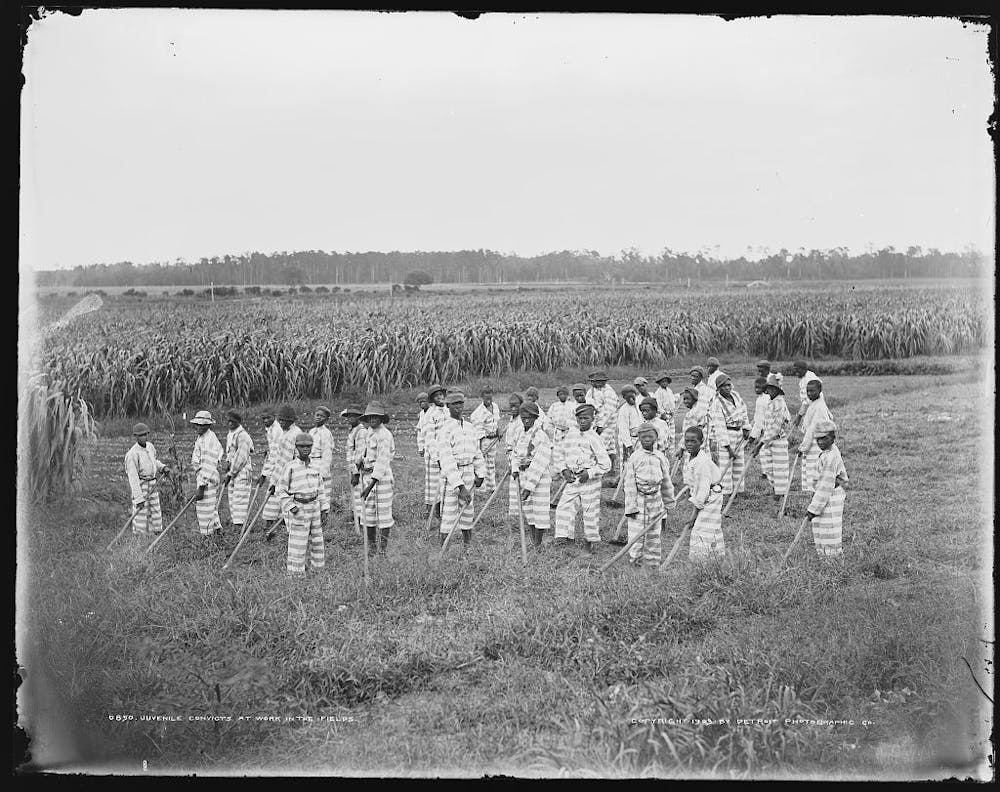
Juvenile convicts at work in the fields, 1903. Library of Congress/John L. Spivak
By the early 1900s, nearly every southern state had barred black citizens not only from voting but also from serving in public office, on juries and in the administration of the justice system.
The South’s new racial caste system was not merely political and social. It was thoroughly economic. Slavery had made the South’s agriculture-based economy the most powerful force in the global cotton market, but the Civil War devastated this economy.
How to build a new one?
Ironically, white leaders found a solution in the 13th Amendment, which ended slavery in the United States in 1865. By exploiting the provision allowing “slavery” and “involuntary servitude” to continue as “a punishment for crime,” they took advantage of a penal system predating the Civil War and used even during Reconstruction.
A new form of control
With the help of profiteering industrialists they found yet a new way to build wealth on the bound labor of black Americans: the convict lease system.
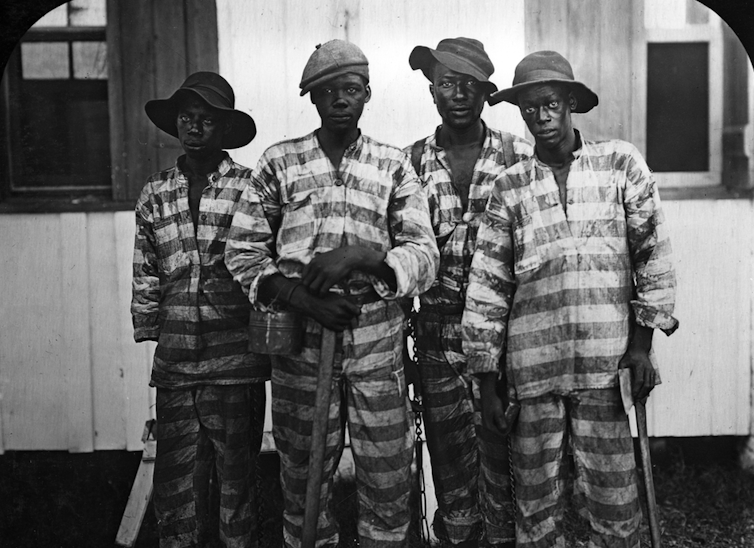
Here’s how it worked. Black men – and sometimes women and children – were arrested and convicted for crimes enumerated in the Black Codes, state laws criminalizing petty offenses and aimed at keeping freed people tied to their former owners’ plantations and farms. The most sinister crime was vagrancy – the “crime” of being unemployed – which brought a large fine that few blacks could afford to pay.
Black convicts were leased to private companies, typically industries profiteering from the region’s untapped natural resources. As many as 200,000 black Americans were forced into back-breaking labor in coal mines, turpentine factories and lumber camps. They lived in squalid conditions, chained, starved, beaten, flogged and sexually violated. They died by the thousands from injury, disease and torture.
For both the state and private corporations, the opportunities for profit were enormous. For the state, convict lease generated revenue and provided a powerful tool to subjugate African-Americans and intimidate them into behaving in accordance with the new social order. It also greatly reduced state expenses in housing and caring for convicts. For the corporations, convict lease provided droves of cheap, disposable laborers who could be worked to the extremes of human cruelty.
Every southern state leased convicts, and at least nine-tenths of all leased convicts were black. In reports of the period, the terms “convicts” and “negroes” are used interchangeably.
Of those black Americans caught in the convict lease system, a few were men like Henry Nisbet, who murdered nine other black men in Georgia. But the vast majority were like Green Cottenham, the central figure in Blackmon’s book, who was snatched into the system after being charged with vagrancy.
A principal difference between antebellum slavery and convict leasing was that, in the latter, the laborers were only the temporary property of their “masters.” On one hand, this meant that after their fines had been paid off, they would potentially be let free. On the other, it meant the companies leasing convicts often absolved themselves of concerns about workers’ longevity. Such convicts were viewed as disposable and frequently worked beyond human endurance.
The living conditions of leased convicts are documented in dozens of detailed, firsthand reports spanning decades and covering many states. In 1883, Blackmon writes, Alabama prison inspector Reginald Dawson described leased convicts in one mine being held on trivial charges, in “desperate,” “miserable” conditions, poorly fed, clothed, and “unnecessarily chained and shackled.” He described the “appalling number of deaths” and “appalling numbers of maimed and disabled men” held by various forced-labor entrepreneurs spanning the entire state.
Dawson’s reports had no perceptible impact on Alabama’s convict leasing system.
The exploitation of black convict labor by the penal system and industrialists was central to southern politics and economics of the era. It was a carefully crafted answer to black progress during Reconstruction – highly visible and widely known. The system benefited the national economy, too. The federal government passed up one opportunity after another to intervene.
Convict lease ended at different times across the early 20th century, only to be replaced in many states by another racialized and brutal method of convict labor: the chain gang.
Convict labor, debt peonage, lynching – and the white supremacist ideologies of Jim Crow that supported them all – produced a bleak social landscape across the South for African-Americans.
Black Americans developed multiple resistance strategies and gained major victories through the civil rights movement, including Brown v. Board of Education, the Civil Rights Act and the Voting Rights Act. Jim Crow fell, and America moved closer than ever to fulfilling its democratic promise of equality and opportunity for all.
But in the decades that followed, a “tough on crime” politics with racist undertones produced, among other things, harsh drug and mandatory minimum sentencing laws that were applied in racially disparate ways. The mass incarceration system exploded, with the rate of imprisonment quadrupling between the 1970s and today.
Michelle Alexander famously calls it “The New Jim Crow” in her book of the same name.
Today, the U.S. has the highest incarceration rate of any country in the world, with 2.2 million behind bars, even though crime has decreased significantly since the early 1990s. And while black Americans make up only 13 percent of the U.S. population, they make up 37 percent of the incarcerated population. Forty percent of police killings of unarmed people are black men, who make up merely 6 percent of the population, according to a 2015 Washington Post report.
It doesn’t have to be this way. We can choose otherwise.
If you’ve ever been seasick, “stable” may be the last word you associate with the ocean. But as global temperatures rise, the world’s oceans are technically becoming more stable.
When scientists talk about ocean stability, they refer to how much the different layers of the sea mix with each other. A recent study analysed over a million samples and found that, over the past five decades, the stability of the ocean increased at a rate that was six times faster than scientists were anticipating.
Ocean stability is an important regulator of the global climate and the productivity of marine ecosystems which feed a substantial portion of the world’s people. It controls how heat, carbon, nutrients and dissolved gases are exchanged between the upper and lower layers of the ocean.
So while a more stable ocean might sound idyllic, the reality is less comforting. It could mean the upper layer trapping more heat, and containing less nutrients, with a big impact on ocean life and the climate.
How the oceans circulate heat
Sea surface temperatures get colder the further you travel from the equator towards the poles. It’s a simple point, but it has enormous implications. Because temperature, along with salinity and pressure, controls the density of seawater, this means that the ocean surface also becomes denser as you move away from the tropics.
Seawater density increases with depth too, because the sunlight that warms the ocean is absorbed at the surface, whereas the deep ocean is full of cold water. The change in density with depth is referred to by oceanographers as stability. The faster density increases with depth, the more stable the ocean is said to be.
Our series on the global ocean opened with five in-depth profiles. Look out for new articles on the state of our oceans in the lead up to the UN’s next climate conference, COP26. The series is brought to you by The Conversation’s international network.
It helps to think of the ocean as divided into two layers, each with different levels of stability.
The surface mixed layer occupies the upper (roughly) 100 metres of the ocean and is where heat, freshwater, carbon and dissolved gases are exchanged with the atmosphere. Turbulence whipped up by the wind and waves at the sea surface mixes all the water together.
The lowest layer is called the abyss, which extends from a few hundred metres depth to the seafloor. It’s cold and dark, with weak currents slowly circulating water around the planet that remains isolated from the surface for decades or even centuries.
Dividing the abyss and the surface mixed layer is something called the pycnocline. We can think of it like a layer of cling film (or Saran Wrap). It’s invisible and flexible, but it stops water moving through it. When the film is ripped into shreds, which happens in the ocean when turbulence effectively pulls the pycnocline apart, water can leak through in both directions. But as global temperatures rise and the ocean’s surface layer absorbs more heat, the pycnocline is becoming more stable, making it harder for water at the ocean’s surface and in the abyss to mix.
Why is that a problem? Well, there’s an invisible conveyor belt of seawater which moves warm water from the equator to the poles, where it’s cooled and becomes more dense and so sinks, returning back to the equator at depth. During this journey, the heat absorbed at the ocean’s surface is moved to the abyss, helping redistribute the ocean’s heat burden, accumulated from an atmosphere that’s rapidly warming due to our greenhouse gas emissions.
If a stabler pycnocline traps more heat in the surface of the ocean, it could disrupt how effectively the ocean absorbs excess heat and pile pressure on sensitive shallow-water ecosystems like coral reefs.
Increasing stability causes a nutrient drought
And just as the ocean surface contains heat that must be mixed downwards, the abyss contains an enormous reservoir of nutrients that need to be mixed upwards.
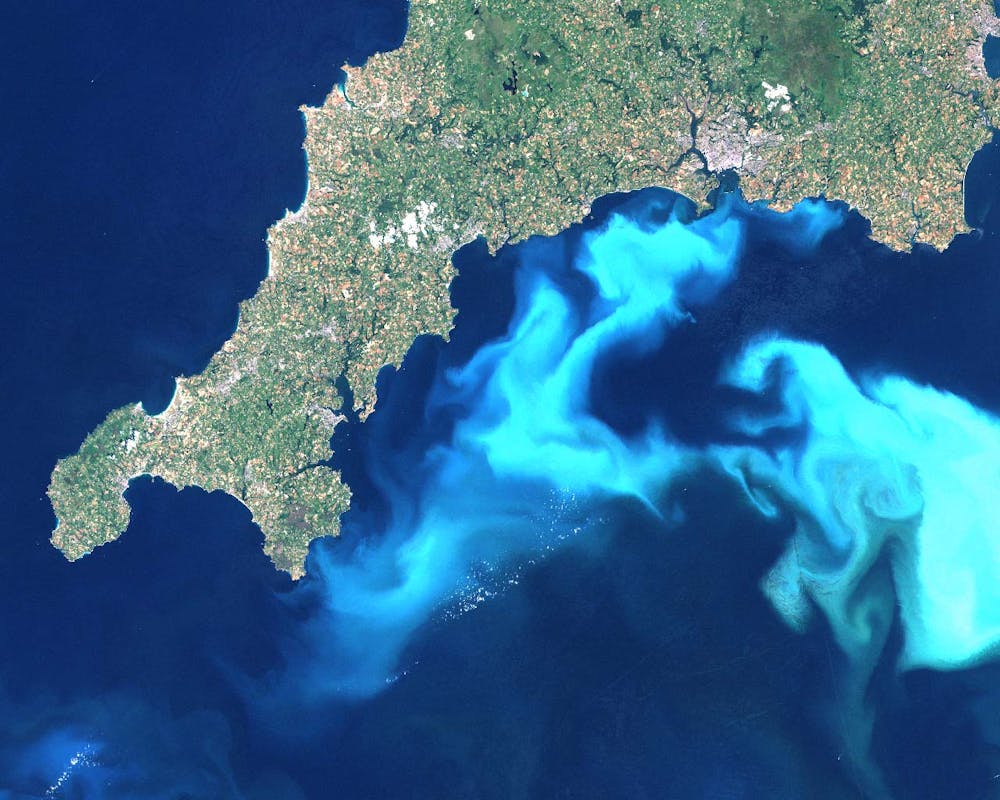
The building blocks of most marine ecosystems are phytoplankton: microscopic algae which use photosynthesis to make their own food and absorb vast quantities of CO₂ from the atmosphere, as well as produce most of the world’s oxygen.
Phytoplankton can only grow when there is enough light and nutrients. During spring, sunshine, longer days and lighter winds allow a seasonal pycnocline to form near the surface. Any available nutrients trapped above this pycnocline are quickly used up by the phytoplankton as they grow in what is called the spring bloom.
For phytoplankton at the surface to keep growing, the nutrients from the abyss must cross the pycnocline. And so another problem emerges. If phytoplankton are starved of nutrients thanks to a strengthened pycnocline then there’s less food for the vast majority of ocean life, starting with the tiny microscopic animals which eat the algae and the small fish which eat them, and moving all the way up the food chain to sharks and whales.
Just as a more stable ocean is less effective at shifting heat into the deep sea and regulating the climate, it’s also worse at sustaining the vibrant food webs at the sunlit surface which society depends on for nourishment.
Should we be worried?
Ocean circulation is constantly evolving with natural variations and human-induced changes. The increasing stability of the pycnocline is just one part of an extremely complex puzzle that oceanographers are striving to solve.
To predict future changes in our climate, we use numerical models of the ocean and atmosphere that must include all of the physical processes responsible for changing them. We simply don’t have computers powerful enough to include the effects of small-scale, turbulent processes within a model that simulates conditions over a global scale.
We do know that human activity is having a greater than expected impact on fundamental aspects of our planet’s systems though. And we may not like the consequences.
Imagine, for a moment, a different kind of Australia. One where bushfires on the catastrophic scale of Black Summer happen almost every year. One where 50℃ days in Sydney and Melbourne are common. Where storms and flooding have violently reshaped our coastlines, and unique ecosystems have been damaged beyond recognition – including the Great Barrier Reef, which no longer exists.
Frighteningly, this is not an imaginary future dystopia. It’s a scientific projection of Australia under 3℃ of global warming – a future we must both strenuously try to avoid, but also prepare for.
The sum of current commitments under the Paris climate accord puts Earth on track for 3℃ of warming this century. Research released today by the Australian Academy of Science explores this scenario in detail.
The report, which we co-authored with colleagues, lays out the potential damage to Australia. Unless the world changes course and dramatically curbs greenhouse gas emissions, this is how bad it could get.
A spotlight on the damage
Nations signed up to the Paris Agreement collectively aim to limit global warming to well below 2℃ this century and to pursue efforts to limit temperature increase to 1.5℃. But on current emissions-reduction pledges, global temperatures are expected to far exceed these goals, reaching 2.9℃ by 2100.
Australia is the driest inhabited continent, and already has a highly variable climate of “droughts and flooding rains”. This is why of all developed nations, Australia has been identified as one of the most vulnerable to climate change.
The damage is already evident. Since records began in 1910, Australia’s average surface temperature has warmed by 1.4℃, and its open ocean areas have warmed by 1℃. Extreme events – such as storms, droughts, bushfires, heatwaves and floods – are becoming more frequent and severe.
Today’s report brings together multiple lines of evidence such as computer modelling, observed changes and historical paleoclimate studies. It gives a picture of the damage that’s already occurred, and what Australia should expect next. It shines a spotlight on four sectors: ecosystems, food production, cities and towns, and health and well-being.
In all these areas, we found the impacts of climate change are profound and accelerating rapidly.
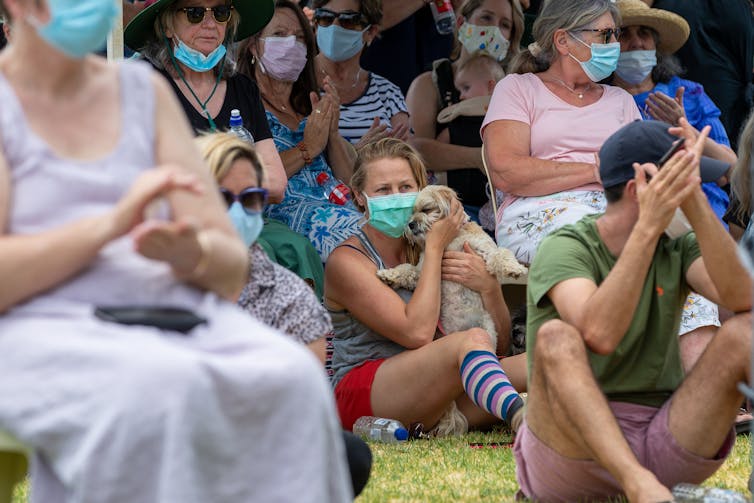
Perth residents at an evacuation centre during a bushfire in February this year. Such events will become more frequent under climate change. Richard Wainwright/AAP
1. Ecosystems
Australia’s natural resources are directly linked to our well-being, culture and economic prosperity. Warming and changes in climate have already eroded the services ecosystems provide, and affected thousands of species.
The problems extend to the ocean, which is steadily warming. Heat stress is bleaching and killing corals, and severely damaging crucial habitats such as kelp forests and seagrass meadows. As oceans absorb carbon dioxide (CO₂) from the atmosphere, seawater is reaching record acidity levels, harming marine food webs, fisheries and aquaculture.
At 3℃ of global warming by 2100, oceans are projected to absorb five times more heat than the observed amount accumulated since 1970. Being far more acidic than today, ocean oxygen levels will decline at ever-shallower depths, affecting the distribution and abundance of marine life everywhere. At 1.5-2℃ warming, the complete loss of coral reefs is very likely.
Heat stress is killing corals and marine animal habitat. Shutterstock
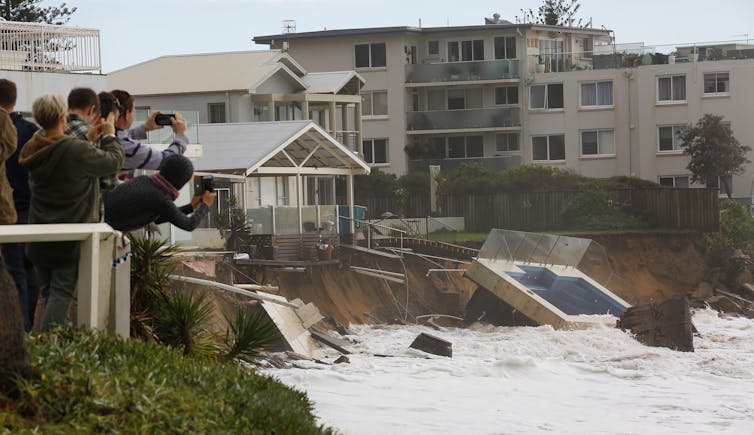
Under 3℃ warming, global sea levels are projected to rise 40-80 centimetres, and by many more metres over coming centuries. Rising sea levels are already inundating low-lying coastal areas, and saltwater is intruding into freshwater wetlands. This leads to coastal erosion that amplifies storm impacts and affects both ecosystems and people.
Land and freshwater environments have been damaged by drought, fire, extreme heatwaves, invasive species and disease. An estimated 3 billion vertebrate animals were killed or displaced in the Black Summer bushfires. Some 24 million hectares burned, including 80% of the Blue Mountains World Heritage Area and 50% of Gondwana rainforests. At 3℃ of warming, the number of extreme fire days could double.
Some species are shifting to cooler latitudes or higher elevations. But most will struggle to keep up with the unprecedented rate of warming. Critical thresholds in many natural systems are likely to be exceeded as global warming reaches 1.5℃. At 2℃ and beyond, we’re likely to see the complete loss of coral reefs, and inundation of iconic ecosystems such as the World Heritage-listed Kakadu National Park.
At 3℃ of global warming, Australia’s present-day ecological systems would be unrecognisable. The first documented climate-related global extinction of a mammal, the Bramble Cay melomys from the Torres Strait, is highly unlikely to be the last. Climate change is predicted to increase extinction rates by several orders of magnitude.
Degradation of Australia’s unique ecosystems will harm the tourism and recreation industries, as well as our food security, health and culture.
There are ways to reduce the climate risk for ecosystems – many of which also benefit humans. For example, preserving and restoring mangroves protects our coasts from storms, increases carbon storage and retains fisheries habitat.
Climate change will accelerate species extinctions. Pictured: the critically endangered orange-bellied parrot. Shutterstock
2. Food production
Australian agriculture and food security already face significant risks from droughts, heatwaves, fires, floods and invasive species. At 2℃ or more of global warming, rainfall will decline and droughts in areas such as southeastern and southwestern Australia will intensify. This will reduce water availability for irrigated agriculture and increase water prices.
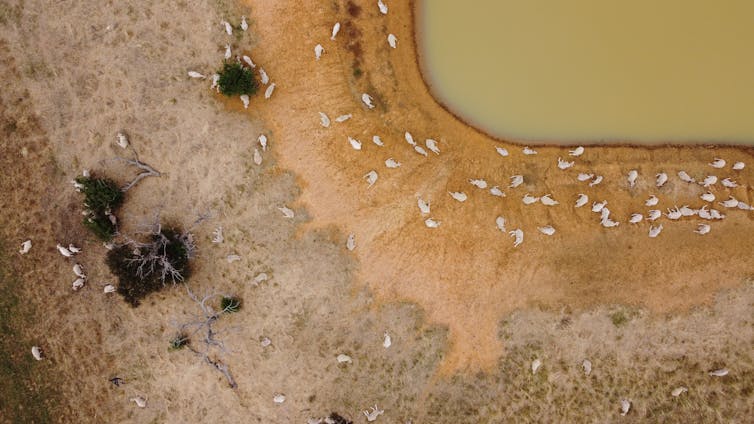
Heat stress affects livestock welfare, reproduction and production. Projected temperature and humidity changes suggest livestock will experience many more heat stress days each year. More frequent storms and heavy rainfall are likely to worsen erosion on grazing land and may lead to livestock loss from flooding.
Heat stress and reduced water availability will also make farms less profitable. A 3℃ global temperature increase would reduce yields of key crops by between 5% and 50%. Significant reductions are expected in oil seeds (35%), wheat (18%) and fruits and vegetables (14%).
Climate change also threatensforestry in hotter, drier regions such as southwestern Australia. There, the industry faces increased fire risks, changed rainfall patterns and growing pest populations. In cooler regions such as Tasmania and Gippsland, forestry production may increase as the climate warms. Existing plantations would change substantially under 3℃ warming.
As ocean waters warm, distributions and stock levels of commercial fish species are continuing to change. This will curb profitability. Many aquaculture fisheries may fundamentally change, relocate or cease to exist.
These changes may cause fisheries workers to suffer unemployment, mental health issues (potentially leading to suicides) and other problems. Strategic planning to create new business opportunities in these regions may reduce these risks.
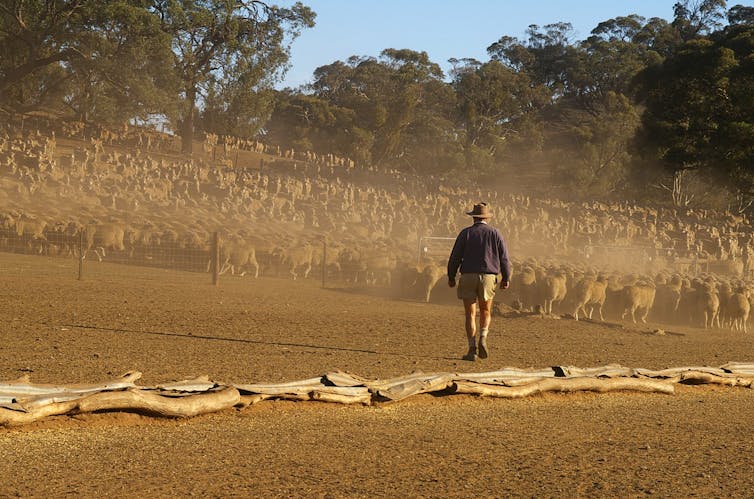
Under climate change, drought will badly hurt farm profitability. Shutterstock
3. Cities and towns
Almost 90% of Australians live in cities and towns and will experience climate change in urban environments.
Under a sea level rise of 1 metre by the end of the century – a level considered plausible by federal officials – between 160,000 and 250,000 Australian properties and infrastructure are at risk of coastal flooding.
Strategies to manage the risk include less construction in high-risk areas, and protecting coastal land with sea walls, sand dunes and mangroves. But some coastal areas may have to be abandoned.
Extreme heat, bushfires and storms put strain on power stations and infrastructure. At the same time, more energy is needed for increased air conditioning use. Much of Australia’s electricity generation relies on ageing and unreliable coal-fired power stations. Extreme weather can also disrupt and damage the oil and gas industries. Diversifying energy sources and improving infrastructure will be important to ensure reliable energy supplies.
The insurance and financial sector is becoming increasingly aware of climate risk and exposure. Insurance firms face increased claims due to climate-related disasters including floods, cyclones and mega-fires. Under some scenarios, one in every 19 property owners face unaffordable insurance premiums by 2030. A 3℃ world would render many more properties and businesses uninsurable.
Cities and towns, however, can be part of the climate solution. High-density urban living leads to a lower per capita greenhouse gas emission “footprint”. Also, innovative solutions are easier to implement in urban environments.
Passive cooling techniques, such as incorporating more plants and street trees during planning, can reduce city temperatures. But these strategies may require changes to stormwater management and can take time to work.
Extreme storms will continue to violently reshape our coastlines. David Moir/ AAP
4. Human health and well-being
A 3℃ world threatens human health, livelihoods and communities. The elderly, young, unwell, and those from disadvantaged socioeconomic backgrounds are at most risk.
Heatwaves on land and sea are becoming longer, more frequent and severe. For example, at 3℃ of global warming, heatwaves in Queensland would happen as often as seven times a year, lasting 16 days on average. These cause physiological heat stress and worsen existing medical conditions.
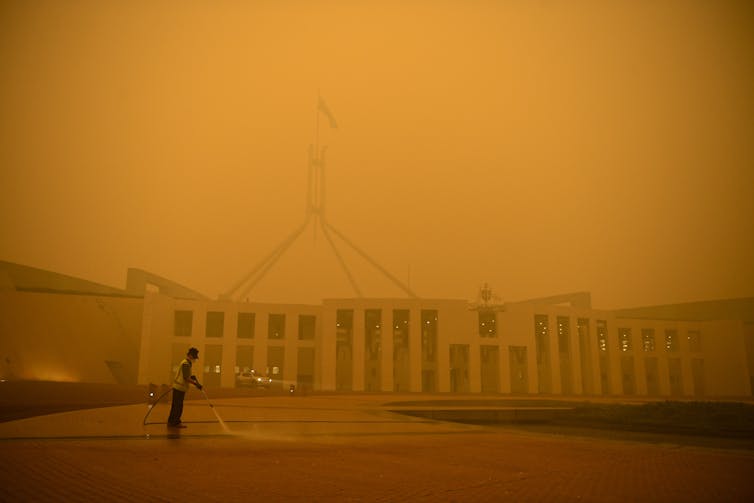
Bushfire-related health impacts are increasing, causing deaths and exacerbating pre-existing conditions such as heart and lung disease. Tragically, we saw this unfold during Black Summer. These extreme conditions will increase at 2℃ and further at 3℃, causing direct and indirect physical and mental health issues.
Under 3℃ warming, climate damage to businesses will likely to lead to increased unemployment and possibly higher suicide rates, mental health issues and health issues relating to heat stress.
At 3°C global warming, many locations in Australia would be very difficult to inhabit due to projected water shortages.
As weather patterns change, transmission of some infectious diseases, such as Ross River virus, will become more intense. “Tropical” diseases may spread to more temperate areas across Australia.
Strategies exist to help mitigate these effects. They include improving early warning systems for extreme weather events and boosting the climate resilience of health services. Nature-based solutions, such as increasing green spaces in urban areas, will also help.
Air quality in Canberra was the worst in the world after the Black Summer fires. Lukas Coch/AAP
How to avoid catastrophe
The report acknowledges that limiting global temperatures to 1.5℃ this century is now extremely difficult. Achieving net-zero global emissions by 2050 is the absolute minimum required to to avoid the worst climate impacts.
Australia is well positioned to contribute to this global challenge. We have a well-developed industrial base, skilled workforce and vast sources of renewable energy.
But Australia must also pursue far more substantial emissions reduction. Under the Paris deal, we’ve pledged to reduce emissions by 26-28% between 2005 and 2030. Given the multiple and accelerating climate threats Australia faces, we must scale up this pledge. We must also display the international leadership and collaboration required to set Earth on a safer climate trajectory.
Our report recommends Australia immediately do the following:
join global leaders in increasing actions to urgently tackle and solve climate change
develop strategies to meet the challenges of extreme events that are increasing in intensity, frequency and scale
improve our understanding of climate impacts, including tipping points and the compounding effects of multiple stressors at global warming of 2℃ or more
systematically explore how food production and supply systems should prepare for climate change
better understand the impacts and risks of climate change for the health of Australians
introduce policies to deliver deep and rapid cuts in emissions across the economy
scale up the development and implementation of low- to zero-emissions technologies
review Australia’s capacity and flexibility to take up innovations and technology breakthroughs for transitioning to a low-emissions future
develop a better understanding of climate solutions through dialogue with Aboriginal and Torres Strait Islander peoples – particularly strategies that helped people manage Australian ecosystems for tens of thousands of years
continue to build adaptation strategies and greater commitment for meeting the challenges of change already in the climate system.
We don’t have much time to avert catastrophe. This decade must be transformational, and one where we choose a safer future.
The report upon which this article is based, The Risks to Australia of a 3°C Warmer World, was authored and reviewed by 21 experts.