NHS news review

The main NHS news is that a vote by the House of Lords on political accountability has been postponed for months. There were two amendments: one by Lib-Dem Shirley Williams seeking to maintain that the Home Secretary is responsible for providing a health service and one by Tory Lord Mackay seeking to have the government responsible in exceptional circumstances. Williams and Mackay withdrew their amendments which are expected to be reconsidered at report stage in three or four months time.

This isssue of responsibility seems to be fundamental to the very notion of a National Health Service – that it is the government that is responsible for providing the health service. It appears that the Williams amendment may have passed were it not withdrawn. The Lib-Dem coalition government can’t be trusted on the NHS – we need to watch for gerrymandering, more lies and misdirection, etc…

The King’s Fund thinktank reports that Monitor – the new health service regulator – could fail unless the NHS bill passing through the upper house is amended.
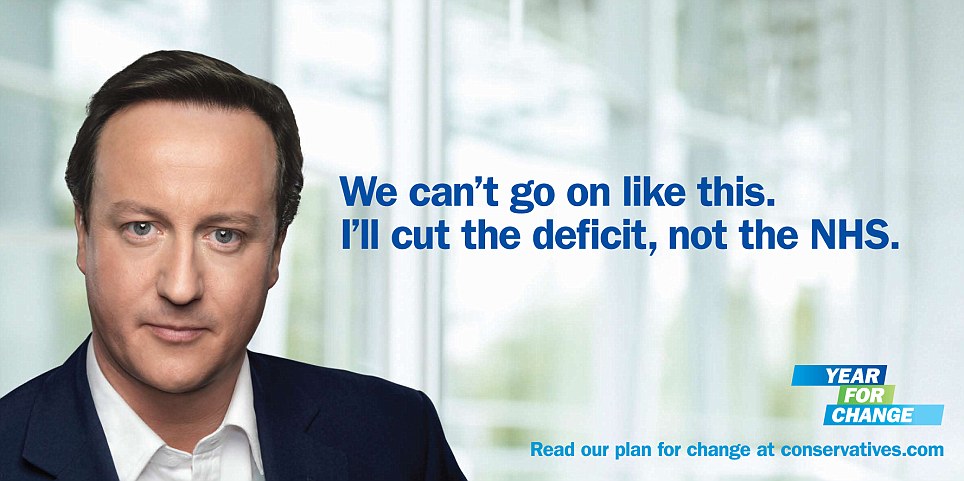
Conservative election poster 2010

A few recent news articles about the UK’s Conservative and Liberal-Democrat (Conservative) coalition government – the ConDem’s – brutal attack on the National Health Service.

NHS bill clause put on hold to stave off revolt by Liberal Democrat peers | Politics | The Guardian

Vote over key issue of political control over NHS will not be resolved until January at earliest to avoid a Lords rebellion

The government has “paused” a key part of its NHS bill to stave off an embarrassing rebellion from key Liberal Democrats in the House of Lords – a move that ensures peers will now debate the controversial legislation until Christmas.

At the heart of the debate is the government’s plan to hand over its “constitutional responsibility” to provide NHS services to a quango. But a number of Lib Dem peers, led by Lady Williams, had insisted the health secretary should be responsible for the provision of health services.

The powerful Lords constitutional committee, on which sits some of the political world’s most prominent legal minds, warned last month about the “extent to which the chain of constitutional responsibility as regard to the NHS [will be] severed”. However both Williams and former Tory lord chancellor James Mackay, who had tabled a fresh amendment seeking to accommodate Lib Dem and Tory visions, agreed to drop their proposals once the government announced it would have a further “period of reflection”.

Earl Howe, the health minister, told the peers to “use the time between now and report stage to reflect further on this matter in the spirit of co-operation”. This means the issue about political control of the NHS will not be resolved by a vote until January at the earliest. It could also see the constitution committee and other lawyers re-examine the issue again, ahead of the bill’s scrutiny at report stage next month.

Such a timetable means that the bill will last in the upper house for much longer than expected as the government is unable to “guillotine” the bill through – causing concerns that it may not be ready by April, at the end of the parliamentary session. Last night sources close to Lansley admitted it “would be a close run thing” but expected the NHS bill to be law in March.

Labour, who had managed to get more than 150 peers out on to the red leather benches, claimed it was “a mess of Andrew Lansley’s own making”. The shadow health spokesman, Andy Burnham, said: “Last week the government indicated they were ready to make concessions and accept the amendment. Today they have been forced to withdraw it for fear of losing the vote. After 10 months of debate on the health bill, it is an indictment that the government does not know what it thinks on a question as basic as the responsibilities of the secretary of state. It is yet more evidence that this Tory-led government has failed to establish a consensus on this bill. They should drop the bill and focus on the financial challenges facing our NHS.”

It is unlikely that the Lib Dem rebels will back down. Williams’s amendment had insisted the “duty to provide” NHS services rests with the health secretary. She told the house that “I in no way resile from the amendment … because we do believe it’s important to have an absolutely solid basis on which the whole of the house will understand about exactly what are the accountabilities and responsibilities of the secretary of state.”

Health policy, leadership, events, information – The King’s Fund

Monitor’s new role may be too wide and complex and could lack independence from ministerial interference, warns a King’s Fund thinktank report

The government’s new health service regulator “may fail” unless the controversial NHS bill passing through the upper house is amended, the King’s Fund has warned.

In a report examining Andrew Lansley’s proposals for Monitor, the NHS regulator, the health thinktank says the health bill expands the regulator’s role from overseeing NHS foundation trusts with a set of “wide-ranging new powers” that will allow economic supervision of the entire health sector.

Under the health secretary’s plans, Monitor will become responsible for setting prices for NHS-funded services, ensuring competition works in the health service and maintaining essential services if hospitals go bust. The new body will have 500 staff and a budget of £82m a year.

But with increased size comes increasing complexity and potential confusion, says the King’s Fund. It warns that “the large number of objectives Monitor has been set may cause confusion and risks diluting the focus of its work”.

The report also warns of a possible clash between other bodies that will seek to exercise control over doctors and hospitals: “A lack of clarity about how it will work alongside other key health bodies, including the NHS Commissioning Board and Care Quality Commission, risks creating tension and unresolved disputes.”

Continue ReadingNHS news review

NHS news review

The House of Lords is debating the Health and Social Care / Destroy the NHS Bill. Rebel Liberal-Democrat peer Shirley Williams has proposed an amendment that maintains the “duty to provide” NHS services. Shadow Health Secretary Andrew Burnham has asked for Liberal-Democrat support for the Williams amendment.

An analysis by the Unite Union reveals that many peers supporting the destruction of the NHS have private healthcare interests which will benefit.

Andrew ‘McDonald’ Lansley’s voluntary deal with alcohol producers and junk food companies is criticised by the Health Select Committee.

Scotland keeps its NHS public

North of England loses NHS funding

Conservative election poster 2010

A few recent news articles about the UK’s Conservative and Liberal-Democrat (Conservative) coalition government – the ConDem’s – brutal attack on the National Health Service.

House of Lords will be able to vote on key NHS clause | Society | The Guardian

Peers will be able to vote on the government’s controversial plan to hand over its “constitutional responsibility” to provide NHS services to an unelected quango on Wednesday.

The government is attempting to convince Liberal Democrats to back a measure proposed by a former Tory lord chancellor, Lord Mackay, which would allow the health secretary to take control of the health service only in the event of “emergency, failure or breach”. But an amendment by Lib Dem rebel Lady Williams, which revives the original “duty to provide” NHS services, is likely to find significant support in the upper house.

In a letter to Lib Dem leader Nick Clegg, Labour’s health secretary Andrew Burnham asks for support to “stand firm with us” behind the Williams amendment, which has been backed by Labour’s health spokesperson in the upper house, Baroness Thornton.

With peers beginning line-by-line scrutiny of the coalition’s NHS bill on Wednesday, the government has been attempting to rebut detractors of all political persuasions influenced by the powerful Lords constitutional committee. The committee warned last month about the “extent to which the chain of constitutional responsibility as regard to the NHS [will be] severed”.

‘Peers with private healthcare links vote for NHS privatisation’ says Unite

The second reading of the bill saw a record turnout for the modern House of Lords, with the largest numbers of peers voting since the 1993 Maastricht Treaty debate.

But an examination of the division lists shows that many of those who turned up to vote through the bill worked for companies that stand to directly benefit financially from the bill or work as lobbyists, and do not routinely attend House of Lords votes.

The so-called ‘backwoodsmen’ – Tory peers, often hereditary, who do not normally attend parliament but can be turned out occasionally to pass controversial legislation, such as the poll tax – were historically criticised as one of the most unacceptable features of the unelected upper chamber.

The passage of the bill suggests that the government is now resorting to Thatcher’s old tactics again – but with big business interests also playing a role.

Criticism will be fuelled by the revelation that the peers identified did not stay to vote on the Localism bill, which was debated immediately after the health bill and voted on before 6.00pm on the same day.

The following Lords were highlighted by the investigation:

* Baroness Bottomley of Nettlestone, the former Tory health secretary and now a director of BUPA, has an attendance rate of just 20 per cent since 2005 and has voted on less than half the Lords’ voting days this year. She has, however, turned up for every day of the health bill.
* Baroness Cumberlege of Newick is another former Tory health minister who runs her own lobbying firm, Cumberlege Connections, which works ‘extensively’ with major pharmaceuticals interests. She has recorded votes on just 22 days this year, but has voted in every division on the Health and Social Care bill.
* Notorious tax avoider and billionaire Tory bankroller Lord Ashcroft ‘of Belize’ has had investments in, at least, two private healthcare groups. His business interests have led to an attendance rate of just 16 per cent and he voted on less than a quarter of voting days this year, but did make a rare appearance to help ram through the privatisation of the NHS.
* Tim Bell, the founder of Saatchi & Saatchi and Tory advertising guru and now Lord Bell, is another businessman whose appearances in the Lords are rare. He has attended only a fifth of voting days this year. But as chairman of Chime Communications, which owns lobbying firms such as Bell Pottinger, he represents health companies including BT Health, pharma giant AstraZeneca, and the now-infamous Southern Cross, and he voted to pass the Tories’ health bill.
* Lord Chadlington is another Tory peer who appears to make his money in the lobbying industry, and his work as chief executive of the Huntworth communications group has kept him away from most votes in the Lords this year, but again he voted for the health bill.
* Lord Coe is a Tory grandee with one of the worst attendance records in parliament, at less than 10 per cent, and his name appears on the division list on only five days this year, but the government relied on him to get the bill through its second reading. He is a director of AMT-Sybex Group, which is the IT supplier to the NHS, and IT is one of many areas that the bill could lead to lucrative new opportunities for health contractors.

MPs deride Lansley’s ‘nudging’ deal with food and drink firms | Politics | The Guardian

Coalition deal with food and drink firms will not improve public health, the Commons health select committee has warned

The deal done by the coalition with food and drink firms in an attempt to improve public health will not solve what are huge problems of obesity and chronic drinking, MPs warn in a report on Wednesday.

The Commons health select committee also says the government’s other reforms risk widening health inequalities, and that frontline public health services are being cut because of the NHS squeeze, despite ministerial assurances to the contrary.

The cross-party group of MPs have serious doubts about the effectiveness of health secretary Andrew Lansley’s Public Health Responsibility Deal, whereby fast food firms, drinks makers and supermarket chains help shape the coalition’s approach to public health, and thus avoid being subjected to further legislation, in return for what critics say are inadequate changes, such as cutting salt in food.

The report echoes concerns expressed by the British Medical Association, campaigners, and celebrity chef Jamie Oliver at ministers’ reliance on voluntary agreements with big business. The government must be ready to use legislation if efforts to “nudge” people fail, the MPs say.

While not opposed to “nudging” per se, they are “unconvinced the deal will be effective in obesity and alcohol abuse, and expect the Department of Health to set out how progress will be monitored and regulation applied if necessary”. The committee, led by former Conservative health secretary Stephen Dorrell, believes “partnership with commercial organisations has a place” but adds: “Those with a financial interest must not be allowed to set the agenda.”

Related:

McDonald’s and PepsiCo to help write UK health policy | Politics | The Guardian

Leading doctors call for urgent crackdown on junk food | Politics | The Observer

Scotland keeps its NHS public | Healthcare Network | Guardian Professional

The Scottish Nationalist administration has deliberately minimised the role of the private sector in the NHS

During this year’s Scottish Parliament election campaign Alex Salmond, the SNP leader and first minister of Scotland, made a memorable appearance on the BBC’s Question Time staged in Liverpool. He boasted that his government had “eradicated the private sector” from the NHS in Scotland. Furthermore, Salmond implored the predominantly English audience not to allow the Conservatives, Liberal Democrats and Labour to “destroy” their English NHS.

The audience gave Salmond’s words a warm reception. “We knew health would come up,” explained one of the first minister’s aides, “and the point we wanted to make was not that we do things so much better in Scotland, but to make the contrast.” The aide added: “That was the key moment – he [Salmond] spoke to them as if they were Scottish voters.”

Indeed, for a party whose ultimate aim remains ‘independence’ for Scotland, repeatedly highlighting the differences between public service delivery north and south of the border is simply good politics. At the recent SNP conference in Inverness Nicola Sturgeon, the Scottish health secretary, echoed her boss’s theme, telling delegates it now seemed “inevitable that the Tories, aided and abetted by their Liberal [Democrat] partners, will break up the NHS in England.”

Complaint lodged in Gloucestershire NHS row | This is Gloucestershire

NHS Gloucestershire boss Jan Stubbings makes an official complaint about being questioned by a councillor.

TOUGH questioning on controversial NHS changes could land popular county councillor Brian Oosthuysen in hot water.

The Labour member for Rodborough’s exchanges with NHS Gloucestershire boss Jan Stubbings offended her so much that she has lodged an official complaint.

He had pressed her on several aspects of the handover of staff and services from NHS Gloucestershire to a community interest company.

That plan is on hold after a legal challenge from pensioner Michael Lloyd, backed by Stroud Against the Cuts.

“As far as I am concerned, I simply was asking questions of the chief executive and she got angry about one or two of the questions I asked,” said Coun Oosthuysen.

NHS funding shake-up could cost region £90m, warn MPs – Main Section – Yorkshire Post

HEALTH inequalities could widen following controversial reforms which it is claimed could see Yorkshire lose nearly £90m in NHS funding, MPs warn today.

A Health Select Committee report criticises a decision by Ministers to cut the weighting in NHS funding for health inequalities which will shift resources from the North to the South.

Public health experts in Manchester suggest Yorkshire could lose £87m once the full effects of the changes work through. Worst hit would be Barnsley, losing £14.7m, and Hull, losing £13.2m.

Only North Yorkshire and the East Riding would gain in the region under the change in the NHS funding formula which would leave Surrey as the biggest winner, picking up £61.4m extra.

The report also claims coalition reforms of public health, which will hand responsibilities to local authorities, pose a “significant risk” of widening health inequalities further.

It raises concerns about plans for a health premium – funding allocated to councils for good results – warning it will “undermine” areas struggling most to tackle problems.

Committee chairman Stephen Dorrell said: “The effect of this policy appears to be to target resources towards those areas which have made greatest progress with their public health challenges and away from areas which face the greatest outstanding problems.”

Continue ReadingNHS news review

NHS news review

David Cameron
David Cameron

Heir to Bleir David Cameron is confirmed as being divorced from reality and full of shit.

It’s official: Cameron and the ConDem coalition government is cutting spending on the NHS. The Independent on Sunday reports that UK Prime Minister David Cameron breaks promise to increase spending on the NHS in real terms.

‘The official analysis from the House of Commons Library – which is independent of political parties – shows that in real terms, when inflation is taken into account, NHS spending fell by £800m in 2010-11.

The Prime Minister, whose party manifesto at the last election pledged to “increase health spending every year”, has gone out of his way to say the coalition government would protect frontline health cash.

In June Mr Cameron launched five NHS “guarantees you can hold me to and that I will be personally accountable for” – including “not to cut spending on the NHS, but to increase it”.

Yet Labour has claimed that the Treasury’s own figures reveal a cut in real terms in NHS spending from £102.8bn in 2009-10 to £102bn. Mr Cameron and the Health Secretary, Andrew Lansley, reject the claims, based on the Treasury’s July 2011 Public Expenditure Statistical Analyses (PESA).

The shadow Health Secretary, Andy Burnham, asked the Commons library to analyse the data and received the following information: “NHS total expenditure [fell] from £102.8bn in 2009-10 to £102.0bn in 2010-11 (in 2010-11 prices, rounded to nearest £0.1bn) – a real terms fall of 0.7 per cent.”

Mr Burnham said that another ministerial claim – that the PESA figures had not been adjusted according to the GDP deflator – rang hollow since the Treasury document made clear they were adjusted.

Mr Burnham has called on Simon Burns, the health services minister, to correct a statement to the Commons last week in which he said: “We gave a commitment in our election manifesto to provide a real-terms increase in funding in every year of the Parliament while we are in government – the lifetime of this Parliament. We have honoured that, and we will continue to do so in subsequent years.”

Mr Burnham told The Independent on Sunday: “It is official: David Cameron cut the NHS budget in his first year as Prime Minister despite promising he wouldn’t.

“He has inflicted the first real-terms cut in NHS spending for 14 years – the last being in the final year of the Major government.

“David Cameron stands at the dispatch box week after week claiming to have increased NHS spending. His hollow rhetoric will grate with NHS staff facing the reality of redundancies and patients who are being told they must wait longer for treatment. He is hopelessly out of touch.

“Cameron ruthlessly used the NHS to detoxify the Tory brand. But, one by one, he is breaking all the promises he made. He promised no top-down reorganisation, but launched the biggest since 1948.

“He promised a moratorium on hospital changes but is closing A&E and maternity departments up and down the land. He promised not to cut the NHS, but has done just that in his first year in office.”‘


27/11/13 Having received a takedown notice from the Independent newspaper for a different posting, I have reviewed this article which links to an article at the Independent’s website in order to attempt to ensure conformance with copyright laws.

I consider this posting to comply with copyright laws since
a. Only a small portion of the original article has been quoted satisfying the fair use criteria, and / or
b. This posting satisfies the requirements of a derivative work.

Actually, this post in the public interest as a record.

Please be assured that this blog is a non-commercial blog (weblog) which does not feature advertising and has not ever produced any income.

dizzy

Continue ReadingNHS news review

NHS news review

Andrew Lansley’s choice of Commissioning Board Chairman Malcolm Grant says of NHS reforms “… this is all going to be very messy.” Camden New Journal reports on a transcript of his interview before a cross-party panel of MPs. Highlights include “… I am not a patient of the NHS.” and “Can I say that this is all going to be very messy?”.

Andy Burnham, shadow health secretary calls for the Health and Social Care / Destroy the NHS Bill to be abandoned.

Campaign group 38Degrees reports on its meeting with peers.

NHS cuts in Hull

Protest at ‘worst funded’ GP practice

Conservative election poster 2010

A few recent news articles about the UK’s Conservative and Liberal-Democrat (Conservative) coalition government – the ConDem’s – brutal attack on the National Health Service.

“I am not an NHS patient”, says new Commissioning Board Chairman Malcolm Grant | Camden New Journal

“I am not an NHS patient”, says new Commissioning Board Chairman Malcolm Grant

AS job interviews go, it was a merciless grilling.

When Professor Malcolm Grant, vying for one of the most important jobs in the health service, was asked to summon his “passion” for the NHS before a Parliamentary select committee, the Univer­sity College London provost admitted it wasn’t the easiest of tasks.

A transcript, seen by the New Journal, reveals him pleading to the committee of MPs: “Come on, what do you want me to say?” He added: “I find it difficult to demonstrate because I am not a patient of the NHS.”

The lawyer had been nominated for the role of chairman of the NHS Commissioning Board – an independent body overseeing more than £100billion of NHS funding – by Conservative health secretary Andrew Lansley.

But after a lengthy interview for the £1,300-a-day post last Tuesday, the cross-party panel of seven MPs were not so impressed.

In conclusion, they said the panel did “not endorse Professor Grant’s candidacy”, adding that he had “demonstrated a lack of experience of NHS structures and processes”; “did not demonstrate to the committee a robust understanding of the issues”; received help in preparing his application by the Department of Health; and “demonstrated an assumption that his appointment was already confirmed”.

Labour renews calls to scrap healthcare bill

Andy Burnham, shadow health secretary, today held an Opposition Day debate on the NHS, again urging Andrew Lansley to halt his controversial Health and Social Care Bill.

Introduced to the House of Commons in April 2011, the healthcare reform bill has generated significant opposition from all sides, including a unanimous vote calling for its revision by NHS nurses.

The motion in the name of Andy Burnham called on the Government to drop the Health and Social Care Bill, which is currently under consideration in the House of Lords and “accept the offer of cross-party talks on reforming NHS commissioning”.

The Bill passed to the House of Lords on 11th October, renewing calls from public sector unions to halt its passage.

“Peers must see through Lansley’s lies and vote against the Health Bill,” said Unison general secretary, Dave Prentis. “Just recently 400 health experts warned them to oppose it, joining a growing number of campaign groups, charities, patient groups, health unions and royal colleges.

Opposition to the reform proposals stems chiefly from the introduction of a competitive element from the private sector. Patient’s needs will be put before profit, argue the unions, whilst public funds will emerge as private profit.

Proponents simply argue that competition will reduce waste, and that there is no evidence that profits translate to reduced care.

38 Degrees | Blog | House of Lords meeting: how did it go?

38 Degrees came face-to-face with a couple of key players in the House of Lords debate over the NHS last Thursday. Baroness Jolly is the Lib Dem lead spokesperson on health, and Lord Marks is a senior Lib Dem lawyer. They will be negotiating with the government Minister in the Lords, a Conservative called Lord Howe. They will also be influential figures among their Lib Dem colleagues. So they are definitely people worth trying to influence.

I attended the meeting along with three lawyers – Stephen Cragg, our barrister, Alice Goodenough, our solicitor, and Peter Roderick, a public interest lawyer who runs the website dutytoprovide.net

I explained that we were there on behalf of over 480,000 38 Degrees members who had signed the Save Our NHS petition. I also explained that the legal advice we were going to be talking about was paid for by thousands of small contributions from 38 Degrees members. That clearly had an impact: it’s because hundreds of thousands of us have worked together to show how much we care about the NHS that they were meeting with us in the first place.

I explained that we were running this campaign because thousands of 38 Degrees members have voted to make it a top priority, and that the scrapping of the Secretary of State’s “duty to provide” was a top concern of ours.

Baroness Jolly set out some criticisms of our approach, which echoed comments made in the Guardian by Lord Paul Tyler, another Lib Dem Lord who voted with the government last week.Thankfully, given how badly the tone of Lord Tyler’s remarks had gone down with 38 Degrees members, Baroness Jolly was more polite and the words “crass” and “mob” did not feature! As lots of 38 Degrees members pointed out after that article appeared, it’s always woth engaging with criticisms like these and considering how we can campaign together most effectively. But it’s also true that if we’re being effective we should expect to be ruffling some feathers amongst politicians.

The legal team paid for by 38 Degrees members did a lot of the talking. They set out our position on the “duty to provide”, explaining that 38 Degrees members do not want to see the Secretary of State’s legal duties scrapped or watered down. We went into some of the issues in quite a lot of depth – the points we covered are set out in full in this legal briefing prepared for the Lords in advance of their debate next Tuesday. We explained why the options currently on the table aren’t yet adequate to address our concerns. Baroness Jolly highlighted that the Conservative minister, Lord Howe, had said in his closing speech at Second Reading that he is willing to consider any amendments on this issue. I said that that is encouraging, but that 38 Degrees members weren’t going to go away until our problems are properly addressed, in black-and-white, within the legislation.

Hull Royal Infirmary ward to shut as NHS trust looks to save £21m – Local stories – Yorkshire Post

A ward is to close and two others will merge at Hull Royal Infirmary as an NHS trust tries to save £21m this year.

Hull and East Yorkshire Hospitals NHS Trust, which has to make £95m budget savings over the next five years, says 46 beds in total will go.

A general medical ward will close and two others, neurology and stroke, will merge at the hospital.

The trust says there are no plans for redundancies, with all staff to be redeployed.

A final decision is expected at a board meeting in December.

Earlier this year it emerged that the hospital was planning to close 300 beds over five to 10 years, an announcement which caused unions serious concern, as they amount to 20 per cent of capacity.

Coffins, petitions and placards: Patients turn out to support ‘worst funded’ GP practice in the country – Pulse

Hundreds of patients turned out to demonstrate in support of a single-handed GP who claims his practice is the worst funded in the country.

Dr John Cormack has run the Greenwood practice in Chelmsford, Essex for 30 years and says that the PCT are refusing to fund the practice fairly.

Dr Cormack told Pulse: ‘We believe, on the basis of pretty good evidence, that this is the worst funded practice in the entire NHS.’

‘It goes without saying that this puts a question mark over the future of the surgery – at present, having exceeded our £25,000 overdraft we have had to ask the bank to increase it to £30,000 … and far from being able to draw a salary last month and the month before I’ve had to pay in a four figure sum in order that we stay solvent and the staff are paid.’

As a result Dr Cormack organized a demonstration of support where about 300 patients turned out.

Continue ReadingNHS news review