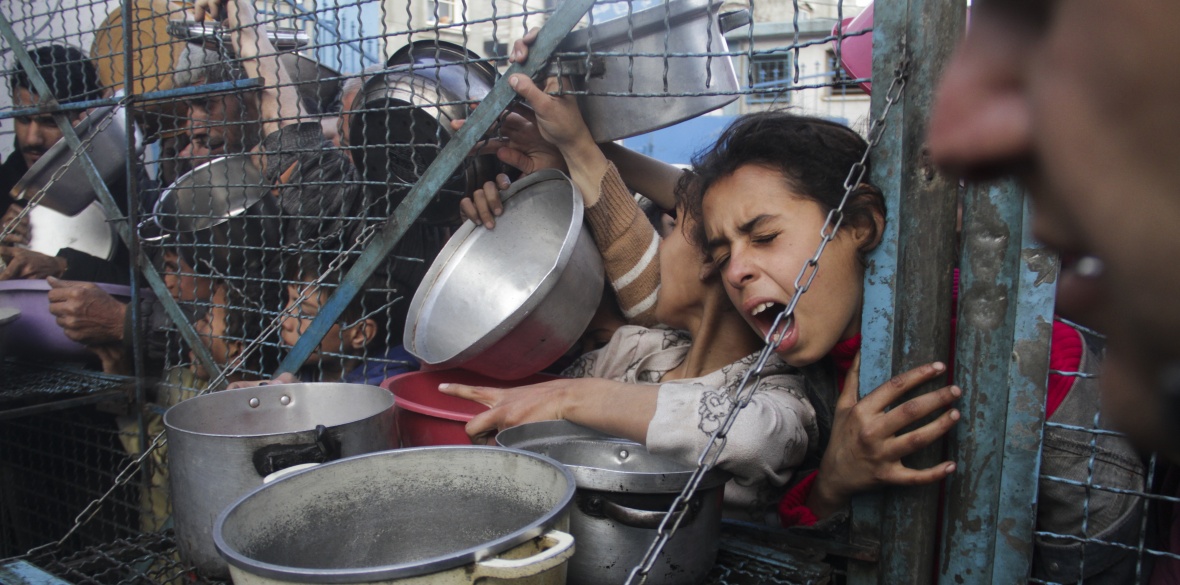
Palestinians line up to receive free meals at Jabaliya refugee camp in the Gaza Strip on March 18, 2024
ISRAEL is systematically killing healthcare workers and journalists in Gaza, doctors said today, in a direct plea for British media to scrutinise their country’s complicity in genocide.
At a London press conference on Gaza’s media blackout, hospital doctors gave first-hand accounts of how colleagues and reporters have been abducted, tortured and killed.
The British Palestinian Committee (BPC) and the UK Gaza Community (UKGC) hosted the event hours after Reporters Without Borders (RSF) revealed that Israeli armed forces were behind a third of the 54 journalists killed worldwide because of their work in 2024.
“Palestine is the most dangerous country for journalists, recording a higher death toll than any other country over the past five years,” the organisation said in its annual report, describing the number of killings as “an unprecedented bloodbath.”
RSF has filed four complaints with the International Criminal Court for “war crimes committed against journalists by the Israeli army.”
It said more than 145 journalists had been killed by the Israeli army in Gaza since October 2023.
At least 1,000 health workers have also been killed there during the Israeli onslaught.
At the conference, Dr Mohamed Ashraf showed photos of several colleagues who have been killed or abducted by Israeli forces since October 7.
“These are real people, these are real stories,” he said, describing how Dr Mosab Samman was abducted from Nasser Hospital in March, saying that the only offence he committed was volunteering to help his people inside the hospital.
UK Foreign Minister David Lammy confirms that UK government and military are active participants in Israel’s genocides and that the F-35 parts that they suspended from supplying to Israel are instead simply diverted via the United States. He says see https://youtu.be/QILgUHrdWREGenocide denier and Current UK Prime Minister Keir Starmer is quoted that he supports Zionism without qualification. He also confirms that UK air force support has been essential in Israel’s mass-murdering genocide. Includes URLs https://www.declassifieduk.org/keir-starmers-100-spy-flights-over-gaza-in-support-of-israel/ and https://youtu.be/O74hZCKKdpA
Herzi Halevi with Netanyahu and Gallant. (Photo: Kobi Gideon / GPO)
Declassified UK Exclusive: IDF chief of staff Herzi Halevi was given a “special mission” certificate for his trip to the UK last month, allowing him to visit without fear of arrest for war crimes.
The UK government has confirmed that Israel’s top soldier, Lieutenant General Herzi Halevi, was given special diplomatic immunity to visit Britain last month.
Halevi is the Chief of the General Staff of the Israel Defense Forces (IDF), and has been directing the Israeli military’s operations throughout the Gaza genocide.
He arrived in Britain in late November to discuss “the ongoing conflicts in Lebanon and Gaza” with senior UK officials from the Ministry of Defence and Foreign Office. A further meeting was held with Britain’s attorney general, Richard Hermer.
The trip came just three days after the International Criminal Court (ICC) issued arrest warrants for Israeli prime minister Benjamin Netanyahu and former defence minister Yoav Gallant for “crimes against humanity and war crimes”.
Halevi was initially reported to have been included in the ICC’s arrest applications for the crime of having “deliberately starved Palestinians in Gaza”.
While Halevi was not ultimately named in those ICC warrants, it is possible to issue private arrest applications in Britain under universal jurisdiction legislation, which allows for the most serious crimes to be prosecuted regardless of where they are committed.
However, the UK government blocked this avenue for redress by issuing Halevi with a “special mission certificate”, granting him temporary diplomatic immunity for the duration of the visit.
In response to a parliamentary question from Labour MP Brian Leishman, the Foreign Office yesterday admitted it “gave consent for special mission status for the visit to the UK on 24-25 November of Lieutenant General Herzl Halevi… and [his] delegation”.
The International Centre of Justice for Palestinians (ICJP) told Declassified: “It seems beyond belief that the UK attorney general could meet with the head of the IDF, mere days after arrest warrants were issued for Netanyahu and Gallant.
“Halevi may not yet have an arrest warrant himself, but regardless, the International Criminal Court Act 2001 obliges the UK to investigate, arrest and prosecute suspected war criminals.”
UK Foreign Minister David Lammy confirms that UK government and military are active participants in Israel’s genocides and that the F-35 parts that they suspended from supplying to Israel are instead simply diverted via the United States. He says see https://youtu.be/QILgUHrdWREGenocide denier and Current UK Prime Minister Keir Starmer is quoted that he supports Zionism without qualification. He also confirms that UK air force support has been essential in Israel’s mass-murdering genocide. Includes URLs https://www.declassifieduk.org/keir-starmers-100-spy-flights-over-gaza-in-support-of-israel/ and https://youtu.be/O74hZCKKdpA
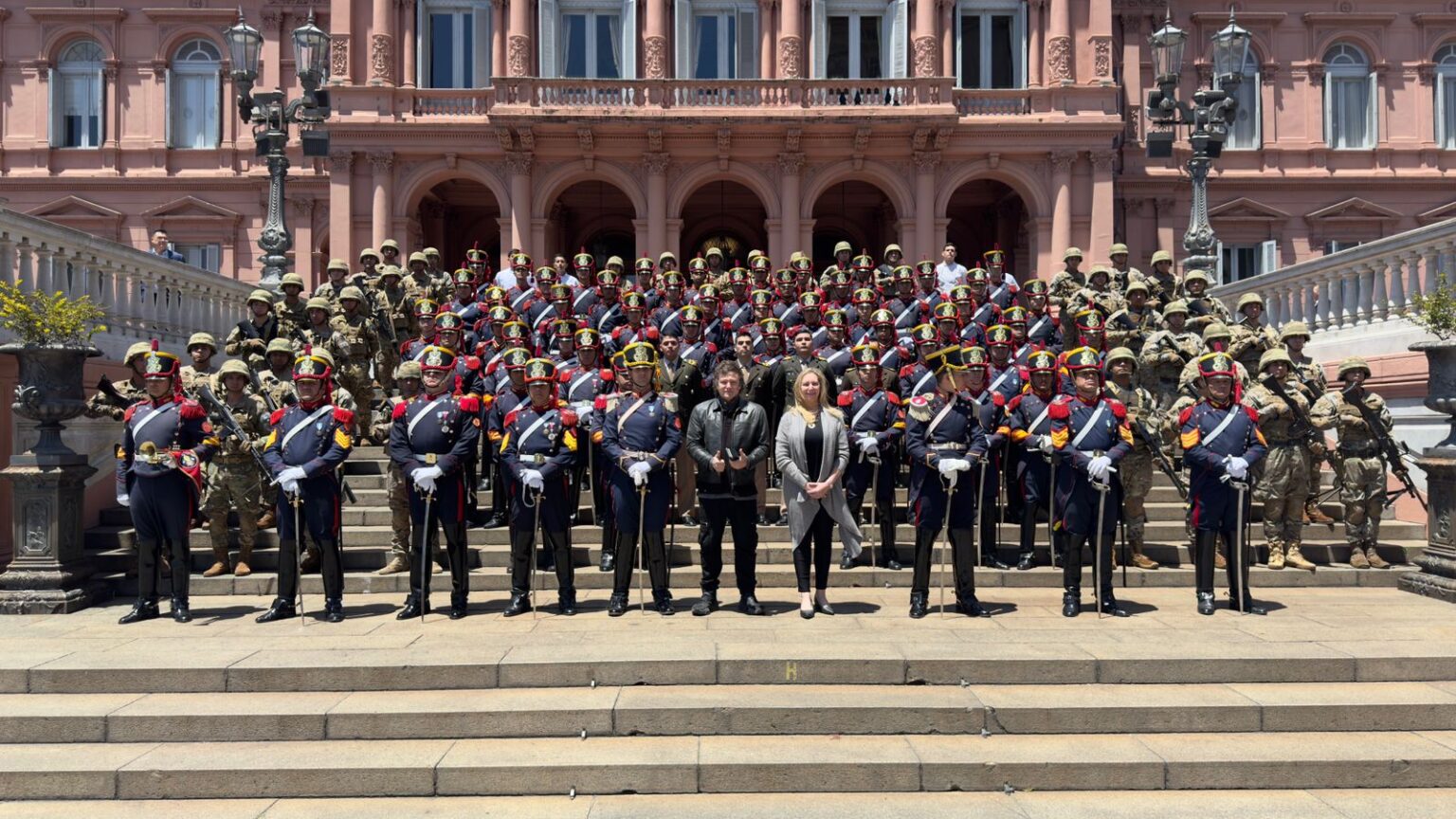
Argentine President Javier Milei. Photo: Milei / X
At one year of Milei’s presidency, we take stock of his economic policies, the impact on the working class, and perspectives for the future
A year ago, what many considered unthinkable a couple of years ago happened: Javier Milei, the eccentric libertarian economist who was almost compulsively invited by the media to increase ratings, was sworn in as president of Argentina. Gone was the neoliberal and demure option of the Argentine right wing that managed to triumph with Mauricio Macri, as well as the always latent Peronist option, which could not overcome the obstacles that the government of Alberto Fernandez left in its path.
Milei became a celebrated outsider who confronted his adversaries directly (often insulting and humiliating them), promising to lift the country out of poverty through a radical liberalization of the economy, with bold, or absurd, proposals to dollarize the economy and the eliminate the central bank. Indeed, his style as a guest on television programs was not too far removed from his actions as president of Argentina.
Erika Giménez, social communicator and a journalist with ARG Medios told Peoples Dispatch that Milei arrived with a promise that he was going to “break the State” and end all state social programs and aid to impoverished sectors because they are “a waste of money that prevents Argentina’s resurgence as a great country.” Did he succeed in his grandiose vision? What did the “lion” of Argentina manage to accomplish in his first year of governance?
Falling inflation and rising poverty
One of Milei’s main obsessions was to reduce inflation at all costs. After several setbacks that ended up increasing inflation, in October it was recorded that inflation had risen by 2.3%, the lowest percentage in several years. To achieve this, he had no qualms about firing tens of thousands of state workers (almost 36,000 according to the National Institute of Statistics and Census) and aggressively cutting the number of ministries (from 18 to 9). Social programs that had been a bulwark of the Republic for several decades were eliminated. Of the state workers who survived the layoffs, almost all have seen a reduction in their purchasing power as a consequence of the economic retrenchment policies.
Similarly, despite the fact that year-on-year inflation stood at 193%, retirees’ pensions only increased by 105%, meaning that retired elderly workers today, thanks to Milei’s government, can buy fewer things than before, because their pension was not adjusted for inflation. This incongruity provoked several mobilizations by retirees.
Likewise, Milei has refused to increase the public education budget so as not to affect the much-desired “fiscal balance”, which has led to a decline in the quality of education in the country. Also, hospital workers (doctors, nurses, and others) have reported that they have lost almost 104% of their purchasing power, which puts the country’s health care system at risk.
In addition, according to Erica Giménez, inflation is currently decreasing, among other things, because people are not able to buy goods, which causes stores to reduce prices to sell more. This can lead to a distorted view of inflation as the only measure of economic improvement because, in reality, it is actually masking a more serious problem: people have lost purchasing power. “[The decrease in inflation] is quite a deceptive figure because people cannot consume because their salary is not enough to do so…The macroeconomic meters improve (as Milei wants) by not generating fiscal deficit, but this happens at the cost of the increase of unemployment, of retirement pensions, of the most needy, and of so many who are nowadays below the poverty line,” Giménez affirms.
One of the cases which shone a light on the ridiculous nature of his radical adjustment was what happened with the social kitchens, soup kitchens run oftentimes by left and progressive community organizations. Milei’s government and his Minister of Human Capital Sandra Pettovello were involved in a serious controversy when it was shown that, while the kitchens were subjected to serious budget cuts as part of the fiscal adjustment which made it impossible to feed the increasing number of hungry people, several tons of food were rotting in State warehouses. The Argentine courts had to order the immediate distribution of the food.
The defunding of university education
Probably the most important internal challenge faced by Milei during this first year was the massive demonstrations of students, professors, and university workers against the Executive’s refusal to increase the university budget. The Legislature had passed a law allowing for the budget increase, but Milei refused to comply with it and vetoed it completely. This generated a lot of discontent among Argentine students who took to the streets against the austerity policies of Milei’s libertarian government, and even went so far as to take over dozens of universities and hold university classes in the streets as a form of protest.
Giménez says in this regard, “Those who lose the most with [the veto of the law] are the professors of public universities who today are within the poor population…According to several surveys, the majority of the population agrees with the public character of health, education, etc., and of the Argentine State as protector and benefactor of these areas, so Mieli’s discourse against universities did not work because…public university education has great popular support.”
International relations
Milei has repeatedly stated that Argentina was, at some point in its history, the first world power. Therefore, what his government should do, according to his rhetoric, is to turn it into a great world power again. This “messianic” bet is synthesized in the often-used slogan “Make Argentina Great Again”, which evidently is reminiscent of Trump’s MAGA. “But Argentina never had a geopolitical weight that Milei says it once had as a first power,” Giménez tells us.
During the vote on whether or not to lift the US economic blockade of Cuba, Argentina voted along with almost all countries to call for an end to the blockade. In retaliation, Milei fired his foreign minister for this vote. According to Giménez, Argentina has historically voted against the blockade and supported other progressive international issues because it hopes that other countries will support its intention to recover the Malvinas Islands, which are currently under British control. Milei however, has wanted to assume a Trumpist international logic, says Giménez, and has assumed a fight against LGBTIQ+ groups and measures to curb climate change, while manifesting strong support in favor of Israel and the United States.
That is why the discussions at the UN on the prevention of violence against girls and women, the ceasefire in Palestine, and the withdrawal of the Argentine delegation from COP29, show the rejection of certain political causes which the president himself calls “the Cultural Battle”. As part of this battle he has attacked journalists, politicians and intellectuals, and founded the new think tank Faro Foundation whose objective is to: “To promote the ideas of economic liberalism and the historical values of Argentine culture, in order to contribute to the economic and social development of our Nation, fighting the cultural battle.” This confrontational attitude has led him to have several impasses with regional political leaders such as Colombian President Gustavo Petro.
But this confrontational attitude, more typical of a media commentator, has its limits. For example, Giménez reminds us that after announcing before his presidency that he would never negotiate with China because they are communists, Milei eventually had to negotiate with Beijing because of the importance of that country for the Argentine economy.
Likewise, Milei has openly positioned himself behind the geopolitical line of US President-elect Donald Trump, attending several select meetings organized by the US president. Milei, according to Giménez, intends to position himself, unsuccessfully, as an international leader who will inspire a global political transformation. Perhaps that is why he has made more trips abroad than within the country, especially to the United States. Likewise, his closeness with the International Monetary Fund stands out.
His revisionist ideological struggle
Milei has also had a significant impact on the ideological dispute in Argentina with his bizarre and aggressive speeches.
For example, he said that he would be delighted to drive the last nail in the coffin of former Peronist president Cristina Fernández, who is the subject of a judicial process that seeks to disqualify her politically and put her in prison.
He has also questioned the figures of human rights organizations on the number of dead and disappeared caused by the last military dictatorship in Argentina. His vice-president, Victoria Villarruel, is a descendant of a military family and before his death, had paid a personal visit to Rafael Videla, head of the last military dictatorship. Milei wants Argentines to forget the dictatorship as if it’s something that can be left behind, says Giménez. In order for Milei to advance his political and ideological project to “make Argentina great again”, he must break certain established and socially consensual notions “and generate other discourses closer to capitalism, revisionist, discuss the importance of the university and public employment…and that includes relativizing one of the darkest periods of Argentine history such as the military dictatorship,” Giménez explains.
Milei has vigorously gone after his ambitious goals of economic liberalization and austerity, without asking “at what cost?” The significant rejection of such policies by broad sectors of the population and the deepening of social conflict will continue and intensify. Milei still has three years left in his presidency, so the future of his government is uncertain. What is certain is that he does not seem to be slowing down his pretensions, but rather accelerating the radical neoliberal program that he defends to the hilt.