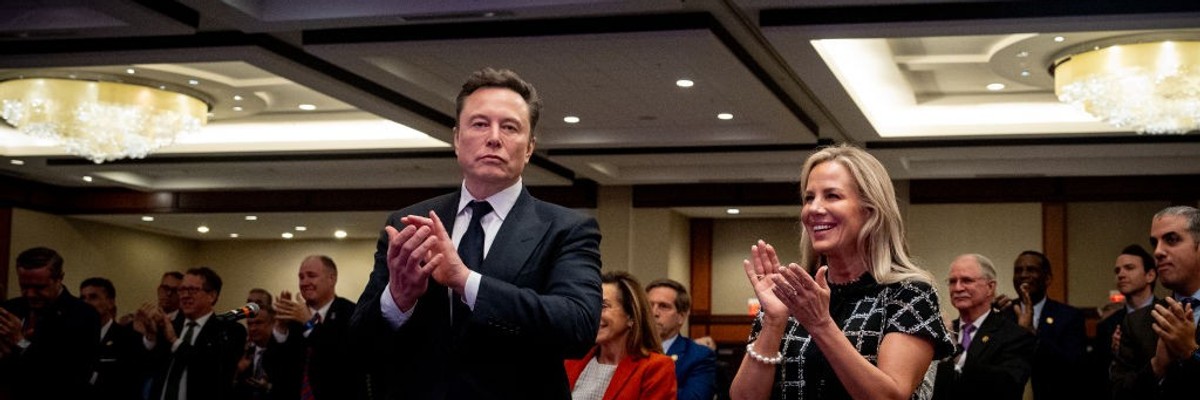
Elon Musk applauds alongside the wife of House Speaker Mike Johnson (R-La.) during a House Republican Conference meeting on November 13, 2024. (Photo: Andrew Harnik/Getty Images)
“Elon Musk’s commission is a plot to destroy our Social Security by giving it to Wall Street executives—so that you get nothing and they get everything,” warned one advocate.
A lengthy series of X posts attacking Social Security as a “nightmare” caught the attention of the platform’s mega-billionaire owner, Elon Musk, who could soon take aim at the beloved New Deal program as co-chair of an advisory commission tasked with identifying federal spending to slash.
“Interesting thread,” Musk, the world’s richest man, wrote late Monday in response to the posts by Sen. Mike Lee (R-Utah), who once said he hopes to pull Social Security “up by the roots and get rid of it,” along with Medicare and Medicaid.
In his new thread, Lee characterized Social Security—which lifts more Americans above the poverty line than any other federal program—as a “tax plan” insidiously disguised as a retirement plan and condemned the Social Security Act of 1935 as one of many “deceptive sales techniques the U.S. government has used on the American people.”
Max Richtman, president and CEO of the National Committee to Preserve Social Security and Medicare (NCPSSM), replied Tuesday that Lee’s posts amount to “a misrepresentation of Social Security’s history and how the program works.”
“There is nothing deceptive about Social Security. The social insurance program has been working just fine for nearly 90 years and has never missed a payment,” said Richtman. “The kind of propaganda Sen. Lee posted undermines public support for Social Security, making it easier to cut or privatize the program. It is perhaps no coincidence that Sen. Lee’s second-biggest campaign contributor by industry is the securities and investment sector.”
“The money is ours, Mike Lee, Elon Musk, and Donald Trump. You’re not going to get a penny of it.”
Social Security Works (SSW), a progressive advocacy group, said Tuesday that by amplifying Lee’s thread to his hundreds of millions of followers, Musk “just declared war on Social Security.”
“For 89 years, through war and peace, boom time and bust, health and pandemics, Social Security has never missed a single payment,” said Alex Lawson, SSW’s executive director. “Compared to the risky alternatives on Wall Street, Social Security is a rock of retirement security. If billionaires like Elon Musk paid into Social Security at the same rate as the rest of us on all of their income, we could expand benefits for everyone and pay them in full forever.”
“This is a declaration of war against seniors, people with disabilities, and the American public,” Lawson said. “The Republicans are coming for your Social Security, which they call a ‘nightmare.’ Elon Musk’s commission is a plot to destroy our Social Security by giving it to Wall Street executives—so that you get nothing and they get everything.”
“We’ve seen this play again and again,” he added. “When Republicans destroyed defined-benefit pension plans, they claimed that the market would be able to create amazing returns for everybody. Instead, workers got pennies, while Wall Street managers got billions. That is always the plan. We will defeat this Republican effort to steal our earned benefits. The money is ours, Mike Lee, Elon Musk, and Donald Trump. You’re not going to get a penny of it.”
Richard Fiesta, executive director of the Alliance for Retired Americans, similarly denounced Lee’s thread and Musk’s promotion of it, saying both “should enrage and concern every single American who has contributed to Social Security.”
“Sen. Mike Lee has dreamed about ‘phasing out Social Security’ and the benefits generations of Americans have earned for more than a decade. His bad ideas have been rightfully ignored but last night he got a big assist from Elon Musk, who amplified Lee’s wrongheaded views about Social Security on X.”
“Social Security is a solemn promise between the American people and the government,” Fiesta continued. “We pay for Social Security’s guaranteed benefits with every paycheck and expect them to be there when we retire, lose a spouse or parent, or become disabled. No one voted to phase out Social Security or let Wall Street gamble with their earned benefits. Older Americans will rightly punish any politician who tries to cut their benefits or gut the system that has worked for generations.”
On the campaign trail, President-elect Donald Trump pledged to defend Social Security while simultaneously pushing proposals that would wreck the program’s finances.
Many Republican lawmakers, who are soon to be in the majority in both chambers of Congress, have called for raising the Social Security retirement age—a change that would cut benefits across the board. On Tuesday, Rep. Rich McCormick (R-Ga.) toldFox Business Network that “we’re going to have to have some hard decisions” on Social Security, Medicaid, and Medicare—a euphemism for benefit cuts.
Richtman of NCPSSM said that the kind of attack advanced by Lee and other Republicans “conflicts with President Trump’s promise not to tamper with Americans’ earned benefits.”
“It signals where Trump’s MAGA allies in Congress are heading—toward privatization and benefit cuts, something the majority of Americans across party lines say they do not want,” Richtman added.
Israeli soldiers patrol the perimeter of the agricultural settlement of Avivim, next to the Lebanese border in upper Galilee, Israel, December 2, 2024
IF ISRAEL’S ceasefire with Hezbollah collapses, the country’s military will widen its strikes and target the Lebanese state itself, Defence Minister Israel Katz warned today.
He was speaking after Hezbollah and other observers alleged that Israel had been responsible for multiple violations of the 60-day truce.
The day before, Tel Aviv’s military carried out a wave of air strikes that killed nearly a dozen people after Hezbollah had fired a volley of projectiles as a warning to Israel to stop violating the ceasefire.
Speaking to troops on his country’s northern border today, Mr Katz said that any violations of the agreement would be met with “a maximum response and zero tolerance.”
He also warned that Israel would widen its strikes beyond the areas where Hezbollah activities are concentrated.
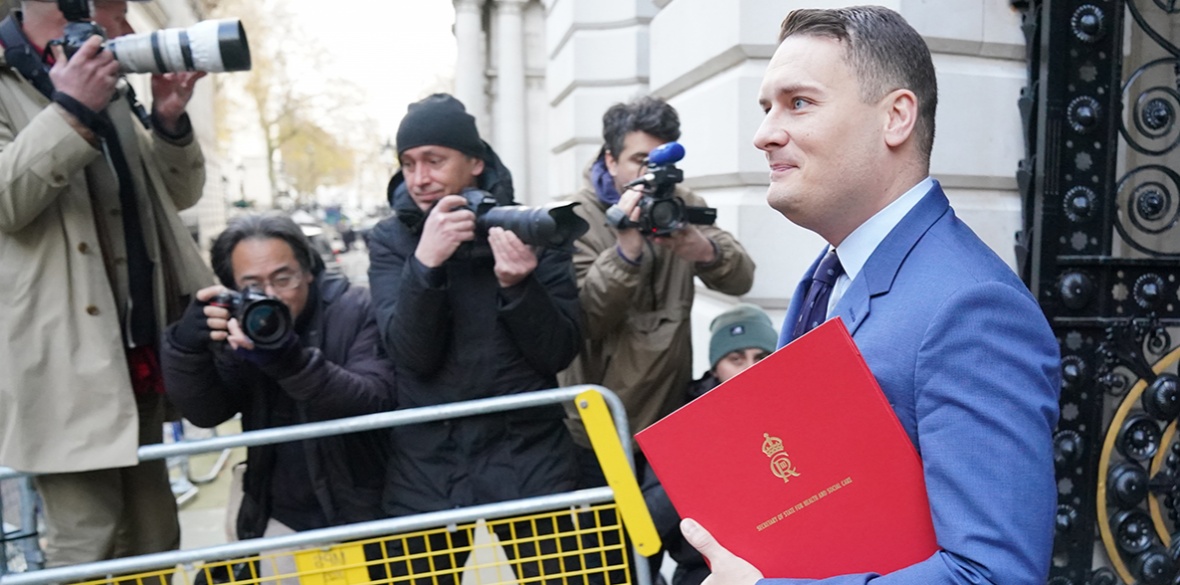
Health Secretary Wes Streeting arrives in Downing Street, London, for a Cabinet meeting, December 3, 2024
HEALTH Secretary Wes Streeting has been urged to honour the New Deal for Working People after failing to back a Unison NHS strike over a £100 million-plus privatisation plan.
More than 350 facilities workers are on a three-week walkout over East Suffolk and North Essex Foundation Trust (ESNEFT’s) plans to outsource their jobs.
Large NHS contracts such as this need Cabinet Office approval but Mr Streeting has said he will not intervene in the trust’s outsourcing bid despite Labour’s promise for the biggest wave of insourcing in a generation, a union source said.
His stance has attracted criticism from Labour MPs, Unison and NHS campaigners, with ESNEFT’s board of directors expected to rubber-stamp the outsourcing of their soft facilities management contract tomorrow.
Eastern Unison head of health Caroline Hennessy said: “Moving these essential teams out of the NHS is a false economy and goes against government pledges on insourcing.
“The trust has spent months trying to justify its ill-thought-out plans to privatise the jobs of these key staff and has failed to win any of the arguments.”
Stocks of food at the Trussell Trust Brent Foodbank, Neasden, London
A COALITION of 120 children’s charities today called for the complete eradication of child poverty in 20 years, increasing pressure for government to scrap the two-child benefit cap.
The End Child Poverty Coalition set out eight tests it said should be met by the government’s taskforce strategy if it is to succeed in tackling and ending child poverty.
Among them was that government must ultimately aim to halve child poverty in the next 10 years, and completely eradicate it in the next 20.
The coalition also said the two-child limit to benefit payments must be scrapped, estimating this could immediately lift around 300,000 children out of poverty, and that “further fundamental reform” to the social security system is needed.
…
End Child Poverty Coalition chair Joseph Howes said: “Child poverty is a blight on our society and is also completely avoidable.
“If the government is serious about tackling and ultimately eradicating child poverty in this country, it needs to be bold and ambitious in its investments, including immediately scrapping the two-child limit to benefit payments.
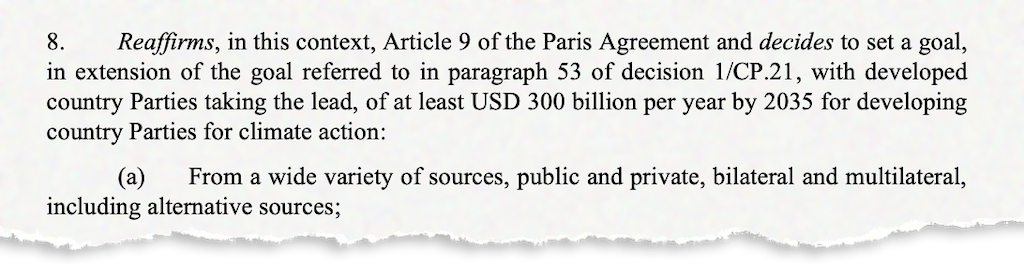
At COP29 in Baku, developed-country parties such as the EU, the US and Japan agreed to help raise “at least” $300bn a year by 2035 for climate action in developing countries.
The goal was welcomed by global-north leaders and presented as a “tripling” of the previous target for international climate finance.
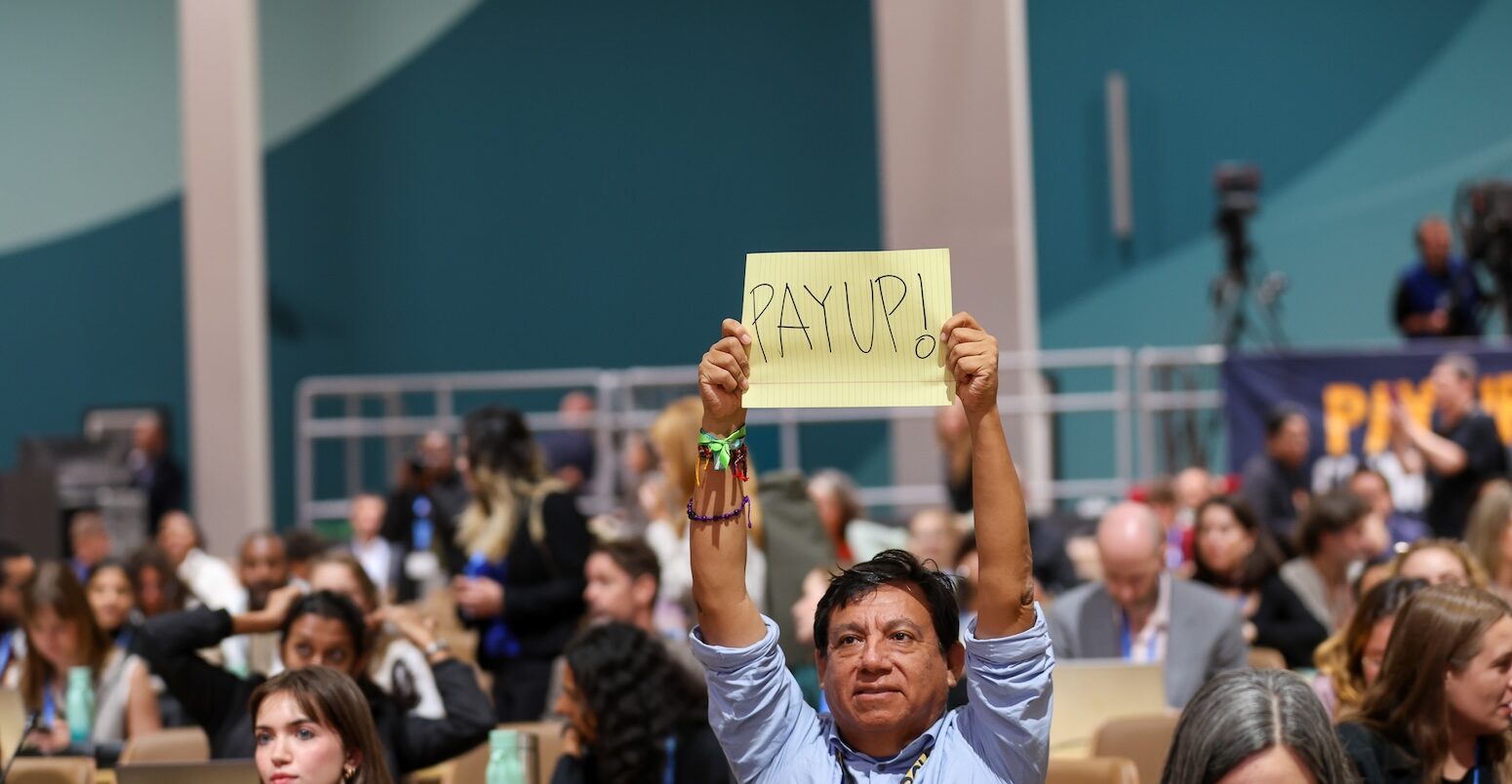
Yet it faced a strong backlash from many developing countries, with some branding it a “joke” and “betrayal”.
Closer analysis of the goal and climate-finance data helps to explain this response.
Analysts have shown that the target is achievable with virtually “no additional budgetary effort” from developed countries, beyond already-committed increases.
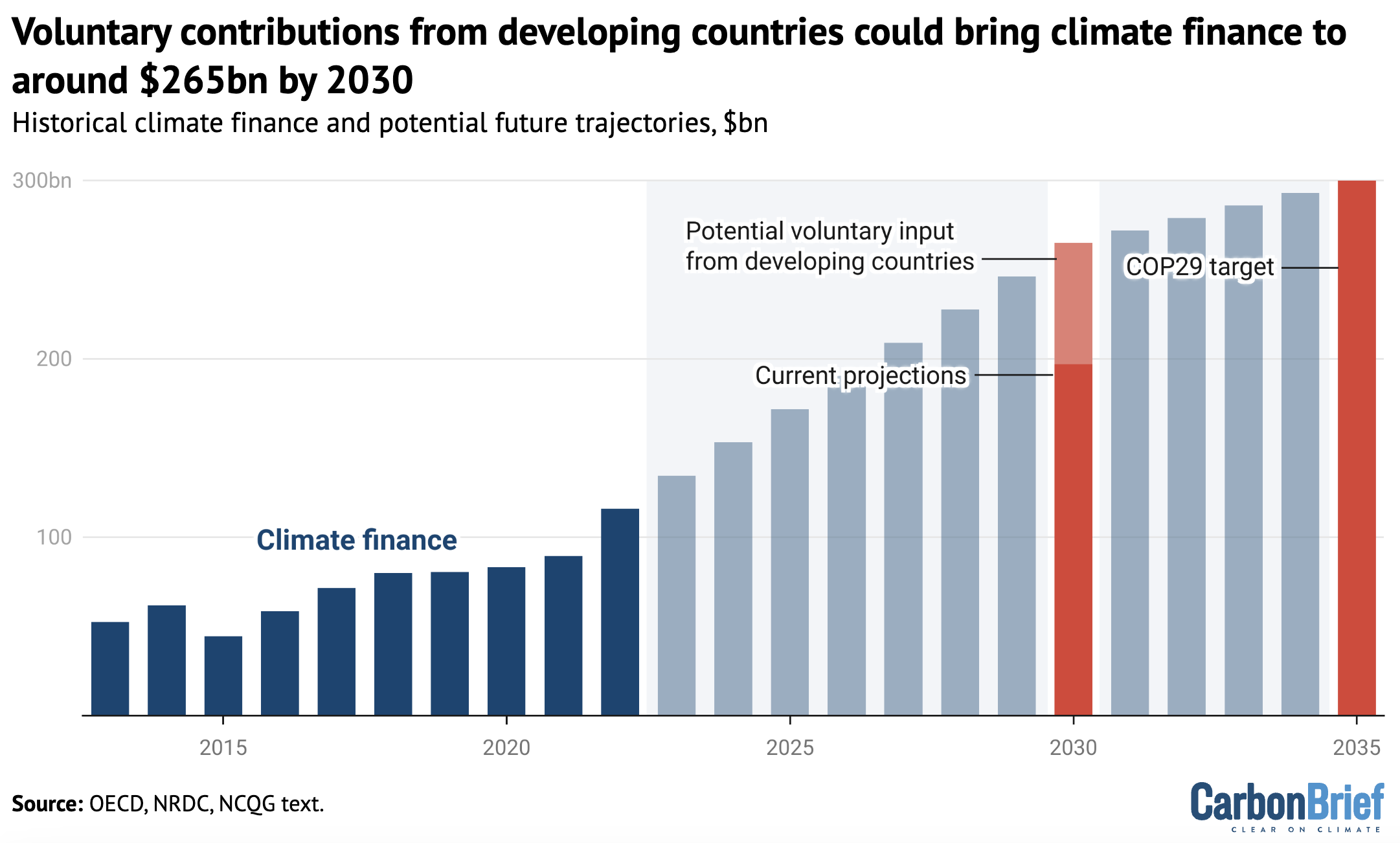
Counting money already being distributed by emerging economies such as China – as “encouraged” under the new goal – could bring the total to $265bn by 2030. This could mean the target is well on its way to being met by that date, with minimal extra effort.
Moreover, as activists and academics have noted, the $300bn target does not account for inflation. When this is factored in, its “real” value could shrink by around a quarter.
The new target has emerged against a backdrop of financial strain and political uncertainty in developed countries.
At the same time, developing countries have stressed that they need climate finance to reach the “trillions of dollars” needed to cut emissions and protect themselves from climate change.
This article looks at three ways in which the $300bn goal could be met with little extra financial effort by developed countries – and provide fewer benefits for developing countries than the figure suggests.
1. Much of the goal will be met with ‘no additional effort’
The $300bn climate-finance target agreed at COP29 in Baku will be met with finance from a “wide variety of sources”, largely coming from developed countries.
This part of the “new collective quantified goal” (NCQG) for climate finance is likely to be made up of public finance provided directly by governments, as well as money from MDBs, specialised climate funds and private finance “mobilised” by public investments.
The wording of the $300bn goal frames it as an extension of the $100bn target. This was the amount that developed countries agreed in 2009 to raise for developing countries annually by 2020 – a goal that was extended through to 2025 by the Paris Agreement.
Beyond the central goal of $300bn, the NCQG also includes a much broader “aspirational” target of $1.3tn a year in climate finance by 2035.
However, this is harder to assess, as the text of the deal is vague about who will be responsible for raising the funds, which could include various sources that are beyond the jurisdiction of the UN climate process.
Developed countries and MDBs had already committed to raising their climate-finance contributions before a deal was struck at COP29, as noted in a joint analysis by the Natural Resources Defense Council (NRDC), ODI, Germanwatch and ECCO.
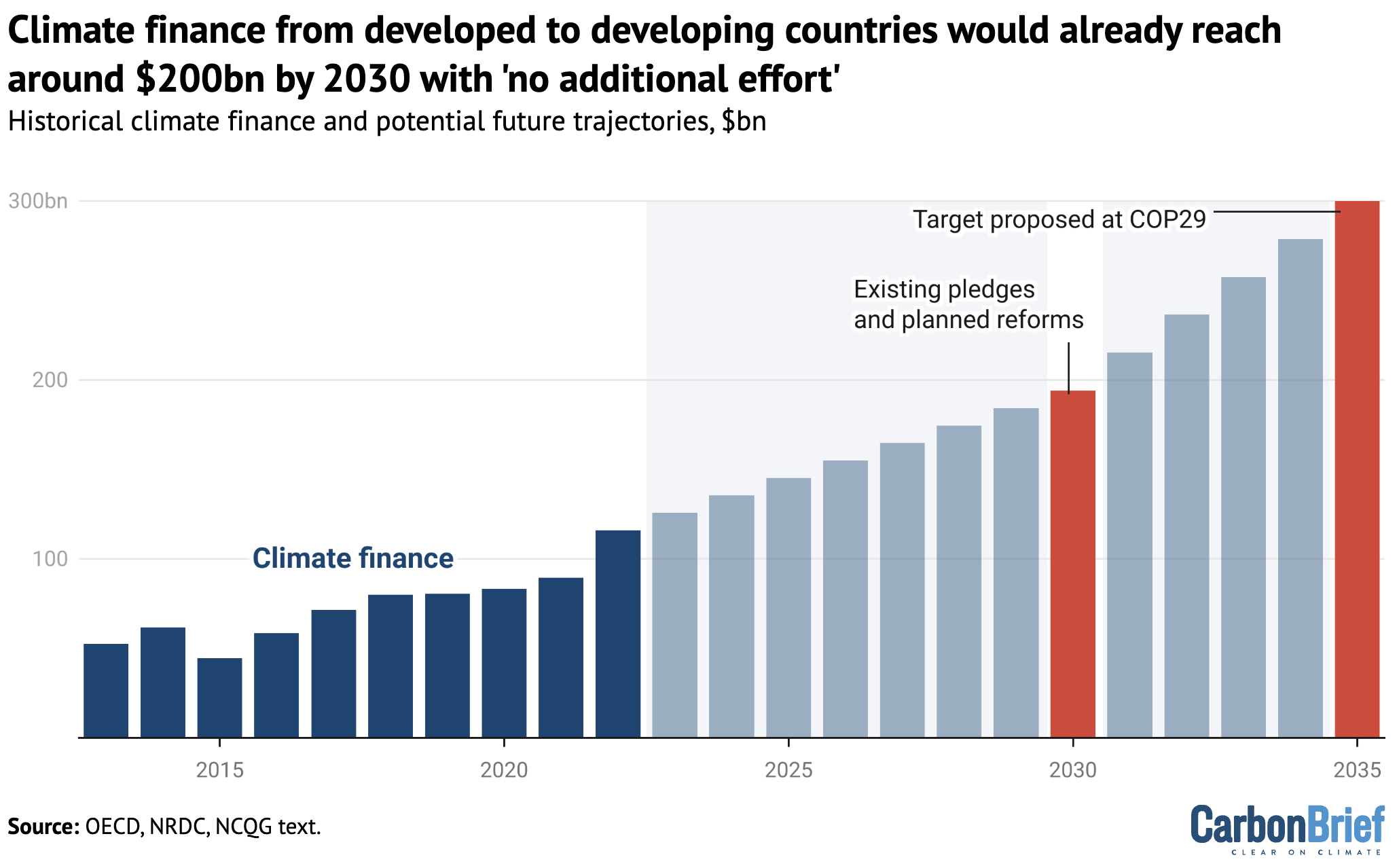
The collective impact of these pre-existing commitments can be seen below, with climate finance from developed countries set to increase from $115.9bn in 2022 – the most recent year for which data is available – to $197bn in 2030. This can be seen in the chart below, which does not account for inflation. (See: Inflation wipes out much of the increase in climate finance.)
Estimated climate finance in 2030, based on funds that have already been pledged, and target set at COP29 for 2035 (red). Dark blue bars show historical climate finance recorded by the Organisation for Economic Co-operation and Development (OECD), 2013-2022 (grey). The light blue bars indicate an estimated trajectory to reach the 2030 and 2035 levels. These figures do not account for inflation. Source: OECD, NRDC, NCQG text.
The expected increase between 2022 and 2030 comes from a few different sources.
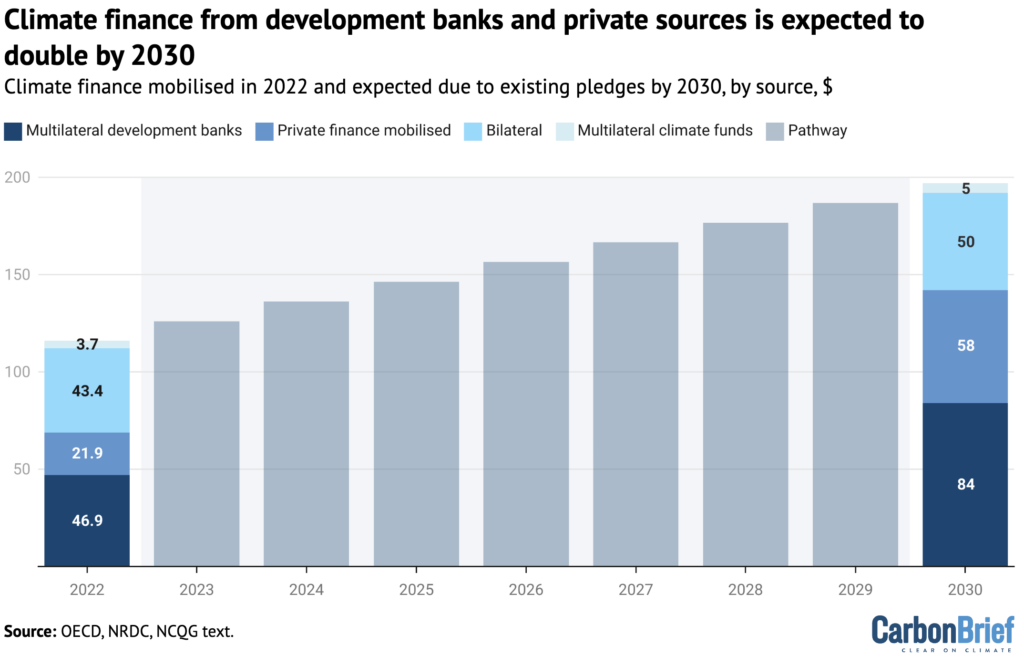
The analysts calculated that climate finance distributed “bilaterally” – as grants or loans via overseas aid and other public funding – was already expected to increase $6.6bn annually by 2025, based on existing pledges, bringing the total to $50bn. (The chart above assumes that bilateral finance remains at this level up to 2030.)
They also estimated that existing pledges and reforms at specialised climate funds, such as the Green Climate Fund and Climate Investment Funds, would add another $1.3bn per year by 2030. This would bring their contribution to $5bn.
The biggest increase that was already locked in before the COP29 deal was a pledge by MDBs – which provide 40% of existing climate finance – to increase their contributions further.
A joint statement by the World Bank, the Asian Development Bank and others in the first week of COP29 committed to raising $120bn of climate finance per year by 2030 for low- and middle-income countries. Of this, $84bn can be attributed to developed countries, based on their shareholdings in these banks.
On top of this, the climate-finance analysts estimated that $58bn of private finance would be mobilised by these bilateral and multilateral contributions in 2030 – up from $21.9bn in 2022.
The chart below shows the estimated breakdown, by source, of climate finance in 2030, compared to 2022.
Historical climate finance in 2022 and estimated climate finance in 2020, by source. Source: OECD, NRDC, NCQG text.
These expected increases over the course of this decade mean that with “no additional efforts”, beyond what had already been agreed prior to COP29, developed countries would have been on a trajectory to reach around $200bn per year by 2030, and $250bn per year by 2035. (The latter was the first numerical target proposed by developed countries at COP29, which was, ultimately, negotiated upwards to $300bn on the final day.)
NRDC climate-finance expert Joe Thwaites, one of the researchers who undertook the Natural Resources Defense Council’s (NDRC) analysis, tells Carbon Brief that bilateral funding directly from governments is the “big constraint” in climate finance. COP29 came just after the re-election in the US of climate-sceptic Donald Trump and many European countries have cut their aid budgets. Thwaites says:
“The MDBs are growing and doing all kinds of reforms and getting bigger and better, but the bilaterals are what are politically very stuck.”
Moreover, the COP29 climate-finance deal contains no pledge by developed countries to provide a set amount of public, bilateral finance, despite strong pressure from developing countries to include such a goal.
Following COP29, Thwaites released updated modelling to calculate different ways of reaching the $300bn target. He wrote:
“What is clear is that $300bn by 2035 is eminently achievable, with little to no additional budgetary effort required from developed countries, let alone other contributors, to meet the goal.”
2. Developing-country contributions could cover part of the goal
Unlike the earlier $100bn target, contributions from developing countries could count towards the new climate finance goal.
Only developed countries are obliged to provide climate finance to developing countries under the Paris Agreement. But the NCQG outcome says that developing countries can “voluntarily” declare any climate-related funds they contribute, if they choose to do so.
This allowed negotiators at COP29 to skirt the controversial issue of formally expanding the list of official donors that are required to help with financial aid.
Developed countries had previously been pushing to enlist relatively wealthy developing nations, such as China and the Gulf states, to share the financial burden.
Several countries described since the early 1990s as “developing” under the UN’s climate convention are known to already make large, climate-related financial contributions to other developing countries. Examples include China’s Belt and Road initiativesupporting clean-energy expansion and South Korea’s contributions to the GCF.
In fact, at COP29 China announced for the first time that it had “provided and mobilised” more than $24.5bn for climate projects in developing countries since 2017 – confirming that its contributions are comparable with those of many developed countries.
This roughly aligns with calculations by research groups that have placed China’s annual climate finance at around $4bn a year.
Both developed and developing countries pay money into MDBs. As well as “encouraging” developing countries to voluntarily contribute directly to climate finance, the NCQG outcome also specifies that these countries could start counting the share of climate-related money paid out of MDBs that can be traced back to their inputs.
Roughly, 30% of the banks’ “outflows” can be attributed to developing countries in this way.
Counting the developing-country share of the projected increase in climate finance from MDBs by 2030 would add an extra $36bn to the global total, plus an extra $20bn of private finance mobilised by the funds.
It is not possible to say for sure how much climate finance new contributors such as China will choose to officially declare.
However, the chart below shows an estimate based on an “illustrative scenario”, by NRDC and others, of bilateral finance and multilateral climate funds, combined with expected MDB outflows and the associated private finance that this would mobilise. This could bring total annual climate finance up to $265bn by 2030.
Potential voluntary contributions of climate finance by developing countries, including bilateral finance, contributions to multilateral funds, outflows from MDBs allocated to developing countries and private finance mobilised by developing country contributions to MDBs (lighter red), on top of estimated climate finance from developed countries in 2030 (red). The second red bar indicates the NCQG climate-finance target agreed for 2035 at COP29. The light blue bars indicate an estimated trajectory to reach the 2030 and 2035 levels. These figures do not account for inflation. Source: OECD, NRDC, NCQG text.
Some observers at COP29 said they hoped that officially counting developing-country contributions towards UN “climate finance” targets would enable parties, such as the EU, to set more ambitious goals.
However, Michai Robertson, lead finance negotiator for the Alliance of Small Island States (AOSIS), dismissed this as an “accounting trick”, because these funds are already being provided.
Li Shuo, head of the China climate hub at the Asia Society Policy Institute (ASPI), tells Carbon Brief that the NCQG outcome could bring more attention to China’s climate-related aid and lead to “stronger and better climate support from Beijing”. However, he notes that this is in the context of a low-ambition global target that is a “far cry” from what is needed:
“I take this as a classic example of geopolitical competition weakening environmental ambition, namely, the geopolitical desire of including China as a donor without corresponding desire of developed countries to contribute more limited the overall scale of climate finance.”
3. Inflation wipes out much of the increase in climate finance
One issue that has surfaced in the wake of COP29 is the impact of inflation. Campaigners have noted that the failure to factor this into the 2035 climate-finance target means that, by the time it is met, the true value of the money pledged will be far lower than it is today.
In an article highlighting this issue, the Guardian reported that the $300bn goal was, therefore, “not the tripling of pledges that has been claimed”.
Researchers had flagged this before COP29, pointing out that the previous $100bn annually by 2020goal, which was first set in 2009, had also not accounted for inflation.
They noted that merely correcting the $100bn for inflation would bring it to between $139bn and around $150bn a year. (Such calculations depend on the rate of inflation applied to the starting figure, as well as the base year for the calculation.)
Civil-society groups at COP29, such as Power Shift Africa, estimated that the impact of inflation would cut the “real” value of the $300bn to $175bn in today’s money by 2035. This is based on an annual inflation rate of 5%.
In its analysis, the Guardian opted for an inflation rate of 2.4% – based on the average rate in the US over the past 15 years. This is taken to reflect the conditions for governments contributing climate finance and the currency much of it would be provided in.
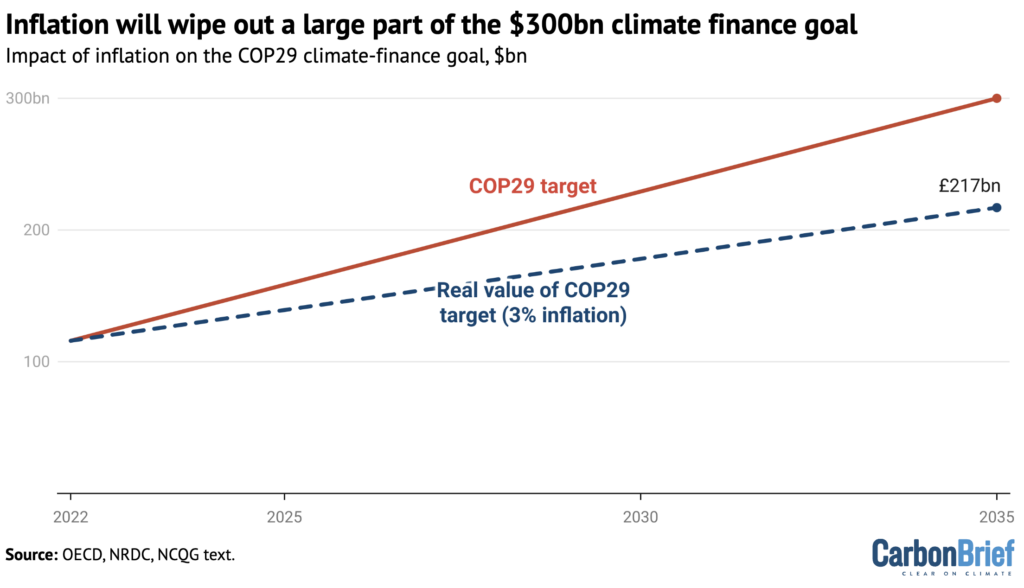
The figure below shows the impact of an inflation rate of 3%. This is based on input from economists and analysis by the Center for Global Development (CGD), which, in turn, is based on the World Bank’s global GDP deflator.
If inflation over the next decade follows this trend, the $300bn pledged in 2024 would only be worth $217bn in today’s money in 2035 – a 28% reduction in value.
In order to offer climate finance with a real value of $300bn in 2035, countries would have needed to set a goal for that year of around $415bn.
Increase in climate finance between 2022 and 2035 under the NCQG commitment in nominal terms (red line), and based on the “real” value of the $300bn climate-finance pledge in 2024 value terms (blue dotted line). Source: Carbon Brief calculation based on a 3% inflation rate, as used by CGD.
(The figures in the chart above cannot be directly compared with the existing pledges made by governments and MDBs, as those too would need to be adjusted for inflation.)
CGD modelling suggests that if developed countries’ climate-finance contributions simply increase in line with expected inflation and gross national income (GNI) growth, they would reach $220bn by 2035.
The CGD analysts write in a blog post that “by the time the new goal is met, beneficiary countries will find that the purchasing power of these resources has eroded significantly”.
Independentexperts, as well as climate-vulnerable countries themselves, emphasised both before and during COP29 that more than $1tn dollars will be needed each year to help developing countries deal with climate change. Many developing nations said that around $600bn of this should come directly from developed countries’ public coffers.
With such a relatively small amount of finance pledged for the NCQG, some developing countries have already indicated that they may scale back their future climate ambitions.